Dr Rajiv Desai
An Educational Blog
Defossilization
Defossilization:
_
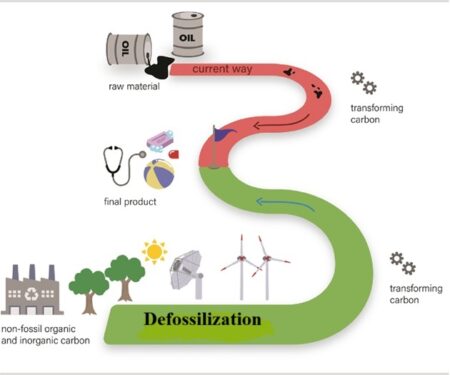
The goal of defossilization is to shift material sourcing away from fossil resources (red) to non-fossil resources, including carbon dioxide, biomass, or recyclate (green path) as seen in figure above.
_
Section-1
Prologue:
The 2026 Iran war—triggered by US-Israeli military strikes and Iran’s retaliatory actions—has sent profound ripple effects across the globe. The conflict has disrupted one of the world’s most vital maritime chokepoints and reshaped international trade. By disrupting and blocking the Strait of Hormuz, the conflict cut off roughly 20% of global oil & liquefied natural gas (LNG) supplies, and 30% of global fertilizer trade. Crude oil prices surged to nearly $100 a barrel, heavily elevating fuel costs for industries and consumers. Fossil fuels—predominantly coal, oil (petroleum), and natural gas—are primarily used to generate electricity, fuel transportation & cooking, provide industrial heating, and manufacture raw materials for plastics and fertilizers. They form the backbone of global energy and manufacturing supply chains. Beyond energy, crude oil and natural gas serve as essential raw materials for the petrochemical industry including plastics, fertilizers and everyday products. Fossil fuels aren’t just used to power cars, heat buildings and keep the lights on. They are, quite literally, woven into almost every facet of our lives. From crayons, cosmetics and carpeting to fabrics, fertilizers and pharmaceuticals, around 70,000 everyday products are made with “petrochemicals” produced from fossil fuels. These products are so ubiquitous that many oil and gas companies are betting on chemical production to stay in business even as fossil fuel use in energy, heating and transport declines. What to do when fossil fuels are unavailable due to war, natural calamity or exhaustion? We can get energy from renewables and nuclear but what about everyday products?
_
For most of human history, our ancestors relied on very basic forms of energy: human muscle, animal muscle, and the burning of biomass such as wood or crops. But the Industrial Revolution unlocked a whole new energy resource: fossil fuels. Fossil energy has been a fundamental driver of the technological, social, economic, and development progress that has followed. Fossil fuels (coal, oil, natural gas) have, and continue to, play a dominant role in global energy systems. But they also come with several negative impacts. When burned, they produce carbon dioxide (CO2) and are the largest driver of global climate change. They are also a major contributor to local air pollution, which is estimated to be linked to millions of premature deaths each year. As low-carbon sources of energy – nuclear and renewables – become readily available, the world needs to rapidly transition away from fossil fuels. Phasing out fossil fuels does not mean phasing out carbon. Under net-zero scenarios, carbon-based fuels are still needed, to provide power, for example, and for aviation. Carbon, currently often derived from fossil hydrocarbons, is also integral to everyday consumer products such as soaps and detergents, as well as medicines, fertilizers and plastics.
_
Decarbonization and defossilization are two complementary strategies addressing climate change while recognizing carbon’s irreplaceable role in life and industry. Carbon cannot be removed from human society: it forms the basis of all organic life, pharmaceuticals, plastics, steel, and advanced materials like graphene. Its unique chemical properties enable complex molecules essential for biology, medicine, and technology. Decarbonization primarily targets the reduction of CO₂ emissions to achieve net-zero, focusing on energy systems, transportation, and heavy industry. It involves shifting from fossil fuels to renewables, electrification, and carbon capture and storage (CCS), allowing residual emissions to be offset. This approach successfully cuts direct greenhouse gas releases but does not address sectors where carbon is a structural necessity rather than just an energy source. Chemistry requires carbon molecules. Currently, approximately 99% of the carbon used in polymer chemistry is derived from fossils. Decarbonizing energy isn’t enough; the materials themselves must be defossilized. Defossilization specifically tackles dependence on fossil-derived carbon feedstocks, replacing them with sustainable alternatives in industries like chemicals and materials. It sources renewable carbon from three main pathways: biomass (plants, algae, waste), captured CO₂ (via CCU), and recycling (mechanical or chemical). These methods maintain carbon’s utility—producing plastics, fuels, and chemicals—while closing the carbon loop, avoiding new fossil extraction and enabling circularity. Together, these strategies form a holistic framework: decarbonization eliminates emissions from energy use, while defossilization secures sustainable carbon supply for non-energy applications. Challenges include higher costs, land-use conflicts for biomass, and scaling CCU technologies. However, innovations in bio-based materials, microbial synthesis, and CO₂ utilization are advancing both goals.
_
Chemicals are essential components required to produce pharmaceuticals, fertilisers, plastics, paints, adhesives, coatings, electronics, cleaning products, and toiletries. Chemicals are made using an initial raw material – known as a feedstock. The vast majority of chemicals are made using fossil feedstocks – oil, natural gas and coal. These feedstocks are then transformed into intermediate chemicals and ultimately downstream consumer products. Due to the size of the industry and its use of fossil fuels and feedstocks, the chemical sector is responsible for approximately 6% of global greenhouse gas emissions. In the United States alone, chemical production directly emits 180 million tonnes of carbon dioxide equivalents (MTCO2e) per year — equivalent to the annual emissions from nearly 49 million gas-powered vehicles. The U.S. chemical sector also released 176,000 tonnes of toxic pollutants in 2021, exposing communities to water and air pollution as well as health risks like acute respiratory symptoms, skin and eye irritation and cancer. One of the most important steps the industry can take to reduce these impacts is to replace fossil fuels used as ingredients in chemical products with non-fossil alternatives. This is known as “defossilization.” The chemical industry cannot fully ‘decarbonise’ – as most chemicals inherently contain carbon atoms that are essential to the material’s structure. Decarbonisation measures such electrification, renewables, and improved energy efficiency would help to reduce the chemical industry’s emissions. Alongside decarbonisation measures, the chemical industry will also have to ‘defossilize’ – by replacing fossil feedstocks with alternative carbon sources to make chemicals. Defossilization refers to replacing fossil-derived feedstocks with alternative, non-fossil sources of carbon. The chemical industry could defossilize by using biomass, plastic waste and carbon dioxide as alternative carbon sources to make chemicals.
_
The increasing production of plastics and petrochemicals is embedding dependence on fossil fuels in our economies within and beyond the energy sector, regardless of continued contributions to climate change. Almost all plastics are made from non-renewable petrochemicals, sourced from oil, gas and coal. Currently, primary plastic production accounts for 12.5 per cent of global oil demand and 8.5 per cent of global gas demand. Increased plastics production has shifted towards regions where coal is largely used in energy systems, locking plastics into fossil fuel dependence throughout the value chain and corporate structures. Petrochemicals are projected to account for more than one thirds of global oil demand growth by 2026, and for more than half of all oil usage by 2050.
_
There exist sustainable alternatives for replacing oil, gas or coal as energy sources. However, replacing oil, gas or coal as feedstocks for basic chemicals, polymers or fine chemicals is much more difficult. In addition to the utilization of carbon dioxide, only recycling and biomass remain to meet all non-fossil demand in the future. In doing so, we encounter two problems: the low efficiency of photosynthesis from an industrial point of view (plants 1 percent, algae 6 percent) and the decrease of globally per capita available agricultural land. Moreover, living organisms and their enzymes are more suitable for the synthesis of complex and high-quality molecules but less for commodity chemicals. Organic chemistry, pharmaceuticals, and modern materials physically require carbon atoms. Completely replacing fossil feedstocks with sustainable alternatives is technologically complex. Alternative sources like green hydrogen or captured CO₂ require immense increases in water (4-6x) and electricity (7-13x) compared to traditional refining, potentially stressing local grid capacities. Cheap and abundant renewable energy is a must for defossilization. Petrochemical clusters are deeply optimized for crude oil. Retrofitting this existing, rigid infrastructure to rely exclusively on biomass or e-chemicals is technically limiting and highly capital-intensive. Defossilization—replacing fossil-derived carbon feedstocks with renewables, biomass, or captured CO2—requires an estimated $120 billion in average annual global investments across the energy and industrial sectors. Time is pressing to take the right measures for rapid defossilization and efficient resource use. The best possible action plan for such a complex challenge can only be formulated together with all partners involved such as oil-, petrochemical-, biotech- and agricultural-companies and others.
_
The overarching goal of global energy decarbonization, envisioned to combat climate change, should be coupled with material defossilization, which is just as crucial to target waste accumulation and fossil fuel depletion. However, current policies and regulatory frameworks often neglect this dimension, creating a loophole that allows stakeholders to exploit decarbonization narratives—diverting fossil fuels from energy to chemicals, alongside expanding both renewable and non-renewable power sources, resulting in a misleading green image and an unsustainable level of consumption. There is an urgent need for clearly defined, fiscally driven policies that leverage the comparative advantages, natural resources, and technical expertise of different nations to realign incentives toward long-term sustainability to lead a transition from fossil-based carbon to alternate carbon resources. Defossilization is a solution to accumulated waste and fossil fuel exhaustion as we all know that one day fossil fuels will get depleted. 2026 Iran war showed us that even temporary shortage of fossil fuels creates havoc. So, I decided to venture into defossilization as a solution to global warming, waste accumulation and eventual exhaustion of all fossil fuels.
______
______
Abbreviations and synonyms:
ACS = alternative carbon sources
BAT = Best available technology
CAPEX = Capital expenditures
CCU = Carbon capture and utilization
CCS = Carbon capture and storage
CCUS = Carbon capture, utilization, and storage
DACCS = direct air carbon capture and storage
BECCS = bioenergy with carbon capture and storage
CO2 = carbon dioxide
CCE = Circular carbon economy
e-Hydrogen = Electricity-based hydrogen
EIIs = Energy-intensive industries
NOx = Nitrogen oxides
OPEX = Operational expenditures
RE – Renewable energy
SEC – Specific energy consumption
TRL = Technology readiness level
AD = anaerobic digestion
LCA = life cycle assessment
MRV = monitoring, reporting, and verification
GHG = Greenhouse gas
IEA = International Energy Agency
NG = Natural gas
NGL = Natural gas liquids
P2G = power to gas
SNG = synthetic natural gas
CH4 = Methane
LPG = Liquid Petroleum Gas
CNG = Compressed natural gas
LNG = Liquefied natural gas
PNG = Piped Natural Gas
CO = Carbon Monoxide
LTFT = Low-temperature Fischer Tropsch
CO2e = Carbon Dioxide Equivalence
MeOH = Methanol
DAC = Direct Air Capture
MTO = Methanol to Olefins
MTA = methanol to aromatics
DME = Dimethyl Ether
Mt yr-1 = Million Tons per Year
DMTM = Direct Methane to Methanol
NH3 = Ammonia
FTS = Fisher Tropsch Synthesis
GTL = Gas to Liquids
SMR = Steam Methane Reforming
SO2 = Sulfur Dioxide
SAF = Sustainable Aviation Fuels
HTFT = High-Temperature Fischer Tropsch
CHP = Combined heat and power
GT = Gas turbine
TES = thermal energy storage
PtH = Power-to-Heat
t y-1 = Tons per Year
VOCs = Volatile Organic Compounds
HVCs = High-Value Chemicals
Gasoline = Petrol
1 barrel = 159 liters
Mt = million tonnes
______
______
Glossary:
Aromatics
Benzene, toluene and mixed xylenes, also known as ‘BTX’.
Agrochemicals
Chemicals used in agriculture. In the context of this article: synthetic fertilizers and pesticides.
Ammonia (NH₃)
A chemical compound consisting of nitrogen and hydrogen. It is a colourless gas with a distinct odour and is corrosive and acutely toxic. Ammonia is produced both naturally from bacterial processes and synthetically. It is used in many industrial applications, including in the production of synthetic nitrogen fertilizers.
Ammonium nitrate (NH₄NO₃)
A salt compound of ammonia and nitric acid. It is used in explosives and as nitrogen fertilizer.
Biomass
Material of biological origin excluding material embedded in geological formations and/ or fossilised. Sources include: biomass crops; food crops, such as vegetable oils and starches; agricultural residues; forest residues; horticultural residues; municipal food and garden waste; the biogenic fraction of municipal waste, such as paper and card; and marine biomass.
Biofuel
A fuel source derived from organic matter (biomass) such as plants, algae, or animal waste.
Blue hydrogen; blue ammonia
Hydrogen or ammonia produced from fossil gas where carbon capture and storage has been applied to at least some of the production process.
Atmospheric carbon
Carbon derived from the atmosphere, usually obtained through direct air capture of CO2.
Biogenic carbon
Carbon released from the combustion or decomposition of biomass or products derived from biomass.
Direct air capture
A form of carbon capture technology which captures CO2 directly from the atmosphere.
Captured CO2
CO2 recovered from air or emissions sources through carbon capture technologies.
Carbon capture and storage (CCS)
A process in which a relatively pure stream of CO2 from industrial and energy-related sources is separated (captured), conditioned, compressed and transported to a storage location for long-term isolation from the atmosphere.
Carbon capture and utilisation (CCU)
A process in which CO2 is captured and then used to produce a new product. If the CO2 is stored in a product for a climate-relevant time horizon, this is referred to as CO2 capture, utilisation and storage (CCUS).
CCU-products
–Fuels – materials combusted for the purpose of generating heat, e.g. methane.
–Intermediates – materials produced for conversion into more complex chemicals. Compounds such as methane, methanol and ethanol can be used as both fuels and intermediates.
–Chemicals – materials produced for use in final product which is not specifically produced for combustion, e.g. ethylene and propylene.
–e-fuels/e-chemicals – a subset of CCU fuels and chemicals synthesized from captured CO2 and green hydrogen.
Carbon dioxide equivalent (CO2e)
A metric for comparing various greenhouse gases by representing quantities of other gases as an amount of carbon dioxide that would have the same global warming potential.
Cracker
A facility that converts oil- or gas-based compounds such as naphtha or natural gas liquids into chemical components used to produce plastics.
Decarbonisation
Reducing or eliminating CO2 emissions associated with energy by replacing fossil fuel energy with carbon-free, renewable energy sources.
Defossilization
Replacing fossil-based carbon feedstocks with non-fossil, renewable carbon sources.
Drop-in
Drop-in Biomaterials are derived from biological sources (such as plant sugars or starch) that are chemically identical to traditional petroleum-based materials. Because they are chemically identical to fossil-based plastics, they are fully compatible with existing manufacturing, processing, and recycling systems without requiring any modifications to infrastructure. Example: Bio-PET (Bio-Polyethylene Terephthalate) used in plastic bottles.
Drop-out
Drop-out Biomaterials are materials derived from biological sources that are chemically different from conventional petroleum-based materials. Because of their unique chemical makeup, they cannot be mixed into existing petroleum-based recycling streams. They require entirely new processing methods and dedicated end-of-life systems—such as industrial composting facilities. Example: PLA (Polylactic Acid) used in food packaging and textiles. Novel Biomaterials are materials engineered with completely new functionalities not found in traditional materials, such as bioactive medical implants or self-healing composites.
Embedded carbon
Carbon inherent and essential to the molecular structure of chemicals and materials, (usually) not replaceable with non-carbon alternatives.
Ethene
A hydrocarbon with the formula C2H4 or H2C= CH2. It is also commonly known as ethylene.
Enhanced oil recovery (EOR)
A technique through which carbon dioxide—either from natural sources or industrial capture—is injected into underground oil reservoirs to boost oil and gas production from old wells.
Ethanol (C2H5OH)
An organic chemical compound and simple alcohol produced from the fermentation of sugars and starches or petrochemical processes. It can be used as a fuel source.
Feedstock
Unprocessed raw materials used for manufacturing plastics or other chemical products or fuels.
Fertilizer
A substance (either organic or synthetic) that is added to land or soil to increase its productivity. Synthetic fertilizers are derived from mineral or fossil fuel extraction. The three primary nutrients needed for plant growth—nitrogen (N), phosphorus (P), and potassium (K)—form the basis of industrial agricultural fertilizers.
Fossil fertilizers
Synthetic fertilizers derived from fossil fuels.
Fossil gas
A type of fossil fuel commonly known as “natural gas” that consists primarily of the hydrocarbon methane.
Fischer-Tropsch (FT) process
The Fischer-Tropsch (FT) process is a catalytic chemical reaction that converts a mixture of carbon monoxide and hydrogen (synthesis gas, or syngas) into liquid hydrocarbons. It serves as a core technology for producing synthetic liquid fuels (gasoline and diesel) and chemical feedstocks from non-petroleum sources like coal, natural gas, and biomass.
Global warming potential
A measure of the potency of a greenhouse gas, or its cumulative radiative forcing (contributing to global warming), over a specified time horizon.
Greenhouse gas emissions
The release of greenhouse gases into the atmosphere. Greenhouse gases include CO2, methane, nitrous oxide and water vapour.
Gray hydrogen; gray ammonia
Hydrogen or ammonia produced from fossil gas.
Green hydrogen; green ammonia
Hydrogen or ammonia produced with renewable energy through the electrolysis of water molecules.
Haber-Bosch process
The Haber-Bosch process is the primary industrial method used to synthesize ammonia NH3 directly from atmospheric nitrogen (N2) and hydrogen (H2). Developed in the early 20th century, it revolutionized global agriculture by providing the basis for mass-produced synthetic fertilizer.
Hydrocarbons
Chemical compounds consisting of hydrogen and carbon. They are the main components of fossil fuels and are highly combustible, producing carbon dioxide, water, and heat when fully burned (i.e., completely combusted with oxygen).
Hydrogen
A chemical element in the form of a colorless, odorless, and flammable gas. It is a constituent of fossil fuels, which are mixtures of hydrocarbons, and it is one of the two basic elements of water. Hydrogen is the lightest and most common element in the universe.
Methane (CH4)
A potent greenhouse gas and hydrocarbon compound consisting of one carbon atom and four hydrogen atoms. It is a colorless, odorless, and flammable gas. It is the main material constituent of the fossil fuel known as “natural gas.”
Methanol (CH3OH)
A toxic chemical and simple alcohol primarily derived from methane and used directly or as a feedstock for polymers, solvents, pesticides, and alternative fuel sources.
Microplastics
Tiny plastic pieces smaller than five millimeters consisting of synthetic polymers. Microplastics can fragment into smaller particles called nanoplastics (usually identified as plastic particles within the 1 to 1,000-nanometer range).
Naphtha
A liquid, volatile (often flammable) hydrocarbon mixture derived from fossil fuels, used as a chemical feedstock for making plastics and other materials.
Natural gas liquids (NGL)
Liquid hydrocarbons (made from carbon and hydrogen) that are separated from natural gas. Ethane, propane, butane, isobutane, and pentane are all NGLs.
Nitrogen oxides (NOx)
Class of toxic gases, namely nitric oxide (NO) and nitrogen dioxide (NO2), produced from the reaction of nitrogen and oxygen. The gases are common air pollutants and contribute to the formation of smog and acid rain.
Nitrous oxide (N2O)
A colorless gas, also known as “laughing gas.” It is used as an anaesthetic, among other applications. It is also a potent greenhouse gas emitted from industrial processes, fuel combustion, and, most widely, from agricultural soils treated with nitrogen fertilizers.
Nutrient cycling
The transfer or cycling of nutrients between the physical environment and living organisms.
Net zero
Anthropogenic greenhouse gas emissions balanced by anthropogenic removals over a specified period.
Olefins
Ethene, butene and propene.
Petrochemicals
Chemical products derived from petroleum refining.
Propene
An unsaturated organic compound with the chemical formula CH3CH=CH2. Also commonly known as propylene.
Primary chemicals
Primary chemicals—often called basic or primary petrochemicals—are fundamental building blocks derived directly from petroleum, coal, or natural gas. These precursors are processed to create everyday products, including plastics, synthetic rubber, fibers, fertilizers, and pharmaceuticals. It includes ethene, propene, butadiene, benzene, toluene, mixed xylenes and methanol. Whilst ammonia is usually included in this grouping, it is not a carbon-based chemical.
Plastic
Plastics are synthetic or semi-synthetic materials made from long chains of molecules called polymers. Derived primarily from fossil fuels like crude oil and natural gas, they are defined by their “plasticity”—the ability to be easily moulded, extruded, or pressed into various solid shapes
Polymer
A polymer is a large, complex molecule made of many small, repeating structural units called monomers linked together via chemical bonds. Ranging from natural biological structures to synthetic plastics, they are incredibly versatile and form the foundational material for everyday life.
Scope 1 emissions
Direct emissions associated with the processes involved in making the carbon-based chemical. This includes emissions related to the combustion of fossil fuels to produce energy as well as direct process emissions.
Scope 2 emissions
Upstream indirect emissions associated with purchased electricity for chemical conversion processes.
Scope 3 emissions
Indirect emissions associated with upstream and downstream processes. Upstream processes include the extraction and production of feedstocks. Downstream processes include product use and end-of-life disposal, such as degradation and incineration.
Emissions avoidance
Displacement or prevention of greenhouse gas emissions otherwise expected to be generated.
Emissions reduction
Reduction of emissions from existing emissions sources through change in activity, such as application of new technologies.
Process emissions
Industrial emissions arising from industrial processes that do not involve the use of fossil fuels.
Greenhouse Gas Emissions
Greenhouse gas emissions represent the release of heat-trapping gases, such as carbon dioxide, methane, and nitrous oxide, into the atmosphere, primarily resulting from human industrial, agricultural, and energy-related activities.
Energy Security
The condition of having reliable access to sufficient, affordable, and sustainable energy resources to meet national and societal needs without disruption, encompassing availability, affordability, and sustainability.
Renewable Energy Sources
Renewable energy sources are natural resources that replenish themselves over relatively short timescales, such as solar, wind, hydro, geothermal, and biomass energy, offering a sustainable alternative to finite fossil fuels.
Greenhouse Gas
A greenhouse gas (GHG) is a gaseous compound in the Earth’s atmosphere that absorbs and emits thermal infrared radiation, thereby trapping heat and contributing to the greenhouse effect, which naturally warms the planet.
Syngas
Syngas (short for synthetic gas) is a combustible gas mixture primarily composed of hydrogen (H2) and carbon monoxide (CO), often containing trace amounts of carbon dioxide and methane. It acts as a crucial building block in the chemical industry and a versatile, sustainable fuel source.
Valorization
Valorization is the circular economy strategy of converting waste, biomass, or captured CO₂ into the valuable, renewable resources needed to achieve that defossilization.
TRLs
Technology Readiness Levels (TRLs) are a standardized 1 to 9 scale used to measure the maturity of a technology, from initial concept (TRL 1) to full operational deployment (TRL 9).
_______
_______
Section-2
Carbon cycle:
Carbon is chemistry’s ultimate building block. Because of its unique ability to bond with itself and other elements, it forms the chemical backbone of all known life on Earth, creates our most vital energy sources, and dictates our global climate. Carbon is the foundational building block for all known life on Earth. Carbon compounds regulate the Earth’s temperature, make up the food that sustains us, and provide energy that fuels our global economy.
_
Carbon is the backbone of life on Earth. We are made of carbon, we eat carbon, and our civilizations—our economies, our homes, our means of transport—are built on carbon. We need carbon, but that need is also entwined with one of the most serious problems facing us today: global climate change. Carbon is both the foundation of all life on Earth, and the source of the majority of energy consumed by human civilization. Forged in the heart of aging stars, carbon is the fourth most abundant element in the Universe. Two-tenths of 1% of Earth’s total carbon – about 43,500 gigatonnes (Gt) is above surface in the oceans, on land, and in the atmosphere. The rest is subsurface, including the crust, mantle and core — an estimated 1.85 billion Gt in all. Most of Earth’s carbon is stored in rocks. The rest is in the ocean, atmosphere, plants, soil, and fossil fuels. Total organic carbon on Earth is ~2,000 Gt C in biosphere. Carbon flows between each reservoir in an exchange called the carbon cycle, which has slow and fast components. Any change in the cycle that shifts carbon out of one reservoir puts more carbon in the other reservoirs. Changes that put carbon gases into the atmosphere result in warmer temperatures on Earth. Over the long term, the carbon cycle seems to maintain a balance that prevents all of Earth’s carbon from entering the atmosphere (as is the case on Venus) or from being stored entirely in rocks. This balance helps keep Earth’s temperature relatively stable, like a thermostat.
_
Carbon is an essential building block of life on Earth. It’s released through human activity and natural processes alike. As carbon atoms are released, they make their way through the planet’s many environments, including the:
- Biosphere, or all Earth’s ecosystems
- Pedosphere, or the planet’s soil mantle
- Geosphere, or Earth’s rocks and minerals
- Hydrosphere, or the planet’s water bodies
- Atmosphere, or the gasses enveloping the globe
No matter where carbon atoms rest at any given time, these compounds work to support life, growth, and biological processes for living organisms everywhere.
_
While most of the Earth’s carbon can be found in the geosphere, carbon is found in all living things, soils, the ocean, and atmosphere. Carbon is the primary building block of life, including DNA, proteins, sugars and fats. One of the most important carbon compounds in the atmosphere is carbon dioxide (CO2), while in rocks carbon is major component of limestone, coal, oil and gas. Carbon cycles through the atmosphere, biosphere, geosphere, and hydrosphere via processes that include photosynthesis, fire, the burning of fossil fuels, weathering, and volcanism. By understanding how human activities have altered the carbon cycle, we can explain many of the climate and ecosystem changes we are experiencing today, and why this rapid rate of change is largely unprecedented in the Earth’s history.
_
Carbon is always on the move. Put simply, the carbon cycle is the transfer of carbon atoms between different zones in, on, and around the planet. In other words, carbon atoms take a cyclical pathway through Earth’s systems, into the atmosphere, and back—over and over again. The carbon cycle is the continuous, dynamic biogeochemical process by which carbon moves between Earth’s atmosphere, oceans, soil, rocks, and living organisms. It is a fundamental lifeline for the planet, as carbon acts as the structural foundation for all organic life and regulates the Earth’s climate.
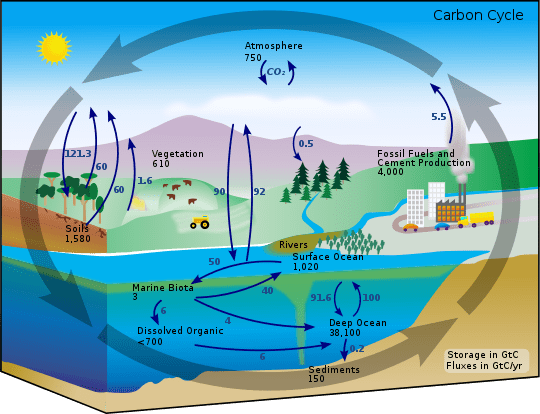
Figure above shows diagram of the carbon cycle with arrows showing the movement of carbon through a landscape with plants and animals, mountains and a volcano, a river leading to the ocean, and an industrial area. Carbon moves in and out of our atmosphere, ocean, waterways, and soil through burning fossil fuels, precipitation, fires, vegetation, volcanoes, and organic processes.
Carbon storage and exchange:
Most of Earth’s carbon is stored in rocks and sediments. The rest is located in the ocean, atmosphere, and in living organisms. These are the reservoirs through which carbon cycles.
Carbon moves from one storage reservoir to another through a variety of mechanisms. For example, in the food chain, plants move carbon from the atmosphere into the biosphere through photosynthesis. They use energy from the sun to chemically combine carbon dioxide with hydrogen and oxygen from water to create sugar molecules. Animals that eat plants digest the sugar molecules to get energy for their bodies. Respiration, excretion, and decomposition release the carbon back into the atmosphere or soil, continuing the cycle.
The ocean plays a critical role in carbon storage, as it holds about 50 times more carbon than the atmosphere. Two-way carbon exchange can occur quickly between the ocean’s surface waters and the atmosphere, but carbon may be stored for centuries at the deepest ocean depths. The ocean is the Earth’s largest active carbon sink, absorbing roughly 25% to 30% of all human-generated carbon dioxide emissions. This vital climate service helps slow global warming, but it comes at a significant cost to marine ecosystem.
Rocks like limestone and fossil fuels like coal and oil are storage reservoirs that contain carbon from plants and animals that lived millions of years ago. When these organisms died, slow geologic processes trapped their carbon and transformed it into these natural resources. Processes such as erosion release this carbon back into the atmosphere very slowly, while volcanic activity can release it very quickly. Burning fossil fuels in cars or power plants is another way this carbon can be released into the atmospheric reservoir quickly.
Changes to the carbon cycle:
Human activities have a tremendous impact on the carbon cycle. Burning fossil fuels, changing land use, and using limestone to make concrete all transfer significant quantities of carbon into the atmosphere. As a result, the amount of carbon dioxide in the atmosphere is rapidly rising; it is already greater than at any time in the last 3.6 million years. The ocean absorbs much of the carbon dioxide that is released from burning fossil fuels. This extra carbon dioxide is lowering the ocean’s pH, through a process called ocean acidification. Ocean acidification interferes with the ability of marine organisms (including corals, Dungeness crabs, and snails) to build their shells and skeletons.
As a greenhouse gas, carbon dioxide in the atmosphere helps to determine how warm the Earth is. Too little carbon dioxide and other greenhouse gases and the Earth would be frozen. Too much would turn the atmosphere into a furnace. That’s why understanding the carbon cycle—and our role in that cycle—is critical to the Earth’s future.
______
______
Within the carbon cycle, there are slow and fast cycles:
- Fast Cycle: Movement of carbon between the atmosphere and living organisms (photosynthesis, respiration, decomposition).
- Slow Cycle: Movement of carbon between rocks, soil, ocean, and atmosphere, involving weathering, erosion, and burial, which can take millions of years.
____
The Slow Carbon Cycle:
Through a series of chemical reactions and tectonic activity, carbon takes between 100-200 million years to move between rocks, soil, ocean, and atmosphere in the slow carbon cycle. On average, 10^13 to 10^14 grams (10–100 million metric tons) of carbon move through the slow carbon cycle every year. In comparison, human emissions of carbon to the atmosphere are on the order of 10^15 grams, whereas the fast carbon cycle moves 10^16 to 10^17 grams of carbon per year.
_
The movement of carbon from the atmosphere to the lithosphere (rocks) begins with rain. Atmospheric carbon combines with water to form a weak acid—carbonic acid—that falls to the surface in rain. The acid dissolves rocks—a process called chemical weathering—and releases calcium, magnesium, potassium, or sodium ions. Rivers carry the ions to the ocean. Rivers carry calcium ions—the result of chemical weathering of rocks—into the ocean, where they react with carbonate dissolved in the water. The product of that reaction, calcium carbonate, is then deposited onto the ocean floor, where it becomes limestone. Calcium carbonate is also made by shell-building (calcifying) organisms (such as corals) and plankton (like coccolithophores and foraminifera). After the organisms die, they sink to the seafloor. Over time, layers of shells and sediment are cemented together and turn to rock, storing the carbon in stone—limestone and its derivatives.
_
Limestone, or its metamorphic cousin, marble, is rock made primarily of calcium carbonate. These rock types are often formed from the bodies of marine plants and animals, and their shells and skeletons can be preserved as fossils. Carbon locked up in limestone can be stored for millions—or even hundreds of millions—of years. Only 80 percent of carbon-containing rock is currently made this way. The remaining 20 percent contain carbon from living things (organic carbon) that have been embedded in layers of mud. Heat and pressure compress the mud and carbon over millions of years, forming sedimentary rock such as shale. In special cases, when dead plant matter builds up faster than it can decay, layers of organic carbon become oil, coal, or natural gas instead of sedimentary rock like shale.
_
The slow cycle returns carbon to the atmosphere through volcanoes. Earth’s land and ocean surfaces sit on several moving crustal plates. When the plates collide, one sinks beneath the other, and the rock it carries melts under the extreme heat and pressure. The heated rock recombines into silicate minerals, releasing carbon dioxide.
When volcanoes erupt, they vent the gas to the atmosphere and cover the land with fresh silicate rock to begin the cycle again. At present, volcanoes emit between 130 and 380 million metric tons of carbon dioxide per year. For comparison, humans emit about 30 billion tons of carbon dioxide per year—100–300 times more than volcanoes—by burning fossil fuels.
Chemistry regulates this dance between ocean, land, and atmosphere. If carbon dioxide rises in the atmosphere because of an increase in volcanic activity, for example, temperatures rise, leading to more rain, which dissolves more rock, creating more ions that will eventually deposit more carbon on the ocean floor. It takes a few hundred thousand years to rebalance the slow carbon cycle through chemical weathering.
However, the slow carbon cycle also contains a slightly faster component: the ocean. At the surface, where air meets water, carbon dioxide gas dissolves in and ventilates out of the ocean in a steady exchange with the atmosphere. Once in the ocean, carbon dioxide gas reacts with water molecules to release hydrogen, making the ocean more acidic. The hydrogen reacts with carbonate from rock weathering to produce bicarbonate ions.
Before the industrial age, the ocean vented carbon dioxide to the atmosphere in balance with the carbon the ocean received during rock weathering. However, since carbon concentrations in the atmosphere have increased, the ocean now takes more carbon from the atmosphere than it releases. Over millennia, the ocean will absorb up to 85 percent of the extra carbon people have put into the atmosphere by burning fossil fuels, but the process is slow because it is tied to the movement of water from the ocean’s surface to its depths.
In the meantime, winds, currents, and temperature control the rate at which the ocean takes carbon dioxide from the atmosphere. It is likely that changes in ocean temperatures and currents helped remove carbon from and then restore carbon to the atmosphere over the few thousand years in which the ice ages began and ended.
_____
The Fast Carbon Cycle:
The time it takes carbon to move through the fast carbon cycle is measured in a lifespan. The fast carbon cycle is largely the movement of carbon through life forms on Earth, or the biosphere. Between 10^15 and 10^17 grams (1,000 to 100,000 million metric tons) of carbon move through the fast carbon cycle every year.
_
Carbon plays an essential role in biology because of its ability to form many bonds—up to four per atom—in a seemingly endless variety of complex organic molecules. Many organic molecules contain carbon atoms that have formed strong bonds to other carbon atoms, combining into long chains and rings. Such carbon chains and rings are the basis of living cells. For instance, DNA is made of two intertwined molecules built around a carbon chain. The bonds in the long carbon chains contain a lot of energy. When the chains break apart, the stored energy is released. This energy makes carbon molecules an excellent source of fuel for all living things.
During photosynthesis, plants absorb carbon dioxide and sunlight to create fuel—glucose and other sugars—for building plant structures. This process forms the foundation of the fast (biological) carbon cycle. Plants and phytoplankton are the main components of the fast carbon cycle. Phytoplankton (microscopic organisms in the ocean) and plants take carbon dioxide from the atmosphere by absorbing it into their cells. Using energy from the Sun, both plants and plankton combine carbon dioxide (CO2) and water to form sugar (CH2O) and oxygen. The chemical reaction looks like this:
CO2 + H2O + energy = CH2O + O2
Four things can happen to move carbon from a plant and return it to the atmosphere, but all involve the same chemical reaction. Plants break down the sugar to get the energy they need to grow. Animals (including people) eat the plants or plankton, and break down the plant sugar to get energy. Plants and plankton die and decay (are eaten by bacteria) at the end of the growing season. Or fire consumes plants. In each case, oxygen combines with sugar to release water, carbon dioxide, and energy. The basic chemical reaction looks like this:
CH2O + O2 = CO2 + H2O + energy
In all four processes, the carbon dioxide released in the reaction usually ends up in the atmosphere. The fast carbon cycle is so tightly tied to plant life that the growing season can be seen by the way carbon dioxide fluctuates in the atmosphere. In the Northern Hemisphere winter, when few land plants are growing and many are decaying, atmospheric carbon dioxide concentrations climb. During the spring, when plants begin growing again, concentrations drop. It is as if the Earth is breathing.
_
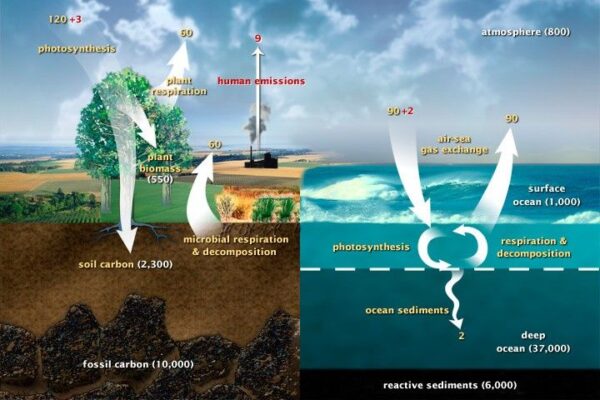
The figure above of the fast carbon cycle shows the movement of carbon between land, atmosphere, and oceans. Yellow numbers are natural fluxes, and red are human contributions in gigatons of carbon per year. White numbers indicate stored carbon.
______
______
Global Carbon Budget:
We often talk about carbon in “Gigatons” of carbon, or GtC.
1 GtC = 1 gigaton of carbon = 10^9 metric ton carbon or 1 billion tons of carbon.
1 PgC = 1 petagram of carbon = 10^15 g of carbon
One gigaton (Gt) is exactly equal to 1 petagram (Pg). Both units represent one trillion kilograms or one billion metric tons.
To convert Gigatonnes of Carbon (GtC) to Gigatonnes of Carbon Dioxide (GtCO2), multiply the GtC value by 3.67
GtCO2 = GtC X 3.67
A carbon budget is the maximum amount of carbon that can be released into the atmosphere while maintaining a specified chance of staying below a given global average surface temperature rise. Global carbon dioxide emissions from fossil fuels hit a record high, projected to reach 38.1 billion tonnes per year, according to the latest Global Carbon Budget report. The remaining carbon budget to limit global warming to 1.5°C is now virtually exhausted, requiring immediate and sustained emission cuts. There was CO2 in the atmosphere before humans were around, which is part of why Earth is habitable. But a large percentage of CO2 in the atmosphere has been produced by human beings through the burning of fossil fuels. Anthropogenic CO2 comes from fossil fuel combustion, changes in land use (e.g., forest clearing), and cement manufacture. Atmospheric CO2 concentrations rose from 288 ppm in 1850 to 422 ppm in 2025, for an increase of 134 ppm.
______
______
Section-3
Hydrocarbon:
Organic chemistry studies carbon-containing compounds, typically those with carbon-hydrogen (C-H) bonds. Inorganic chemistry, conversely, covers all other elements and compounds, dealing heavily with minerals, metals, and organometallics that generally lack C-H bonds. The primary difference that lies between these organic compounds and inorganic compounds is that organic compounds always have a carbon atom, while most of the inorganic compounds do not contain a carbon atom in them. Carbon dioxide (CO2) is an inorganic compound. While it contains carbon, it is classified as inorganic because it lacks carbon-hydrogen (C-H) bonds.
_
In organic chemistry, a hydrocarbon is an organic compound consisting entirely of hydrogen and carbon. Hydrocarbons are examples of group 14 hydrides. Hydrocarbons are generally colourless and hydrophobic; their odor is usually faint, and may be similar to that of gasoline or lighter fluid. They occur in a diverse range of molecular structures and phases: they can be gases (such as methane and propane), liquids (such as hexane and benzene), low melting solids (such as paraffin wax and naphthalene) or polymers (such as polyethylene and polystyrene).
In the fossil fuel industries, hydrocarbon refers to naturally occurring petroleum, natural gas and coal, or their hydrocarbon derivatives and purified forms. Combustion of hydrocarbons is the main source of the world’s energy. Petroleum is the dominant raw-material source for organic commodity chemicals such as solvents and polymers. Most anthropogenic (human-generated) emissions of greenhouse gases are either carbon dioxide released by the burning of fossil fuels, or methane released from the handling of natural gas or from agriculture.
_
Hydrocarbons are organic chemical compounds composed only of the elements carbon (C) and hydrogen (H). Even though they are composed of only two types of atoms, there is a wide variety of hydrocarbons because they may consist of varying lengths of chains, branched chains, and rings of carbon atoms, or combinations of these structures. In addition, hydrocarbons may differ in the types of carbon-carbon bonds present in their molecules. Many hydrocarbons are found in plants, animals, and their fossils; other hydrocarbons have been prepared in the laboratory. We use hydrocarbons every day, mainly as fuels, such as natural gas, acetylene, propane, butane, and the principal components of gasoline, diesel fuel, and heating oil. The familiar plastics polyethylene, polypropylene, and polystyrene are also hydrocarbons. We can distinguish several types of hydrocarbons by differences in the bonding between carbon atoms. This leads to differences in geometries and in the hybridization of the carbon orbitals.
Hydrocarbons are the principal constituents of petroleum and natural gas. They serve as fuels and lubricants as well as raw materials for the production of plastics, fibres, rubbers, solvents, explosives, and industrial chemicals.
Strictly speaking, coal is not a pure hydrocarbon. In chemistry, hydrocarbons are defined as organic compounds made entirely of hydrogen and carbon. While coal does contain hydrocarbons, it is primarily composed of carbon mixed with varying amounts of oxygen, nitrogen, sulfur, and hydrogen. Because the term is colloquially used for all energy-rich fossil fuels, coal is sometimes grouped with “hydrocarbons”. However, it is fundamentally an organic sedimentary rock.
_
Hydrocarbons play a key role in our daily life. You must be familiar with the terms ‘LPG’ and ‘CNG’ used as fuels. LPG is the abbreviated form of liquified petroleum gas whereas CNG stands for compressed natural gas. Liquefied petroleum gas, or LPG, is a commercial fuel made from a number of hydrocarbons, including propane and butane. Another term ‘LNG’ (liquified natural gas) is also in news these days. This is also a fuel and is obtained by liquefaction of natural gas. Petrol, diesel and kerosene oil are obtained by the fractional distillation of petroleum found under the earth’s crust. Coal gas is obtained by the destructive distillation of coal. Natural gas is found in upper strata during drilling of oil wells. The gas after compression is known as compressed natural gas. LPG is used as a domestic fuel with the least pollution. Kerosene oil is also used as a domestic fuel but it causes some pollution. Automobiles need fuels like petrol, diesel and CNG. Petrol and CNG operated automobiles cause less pollution. All these fuels contain mixture of hydrocarbons, which are sources of energy. Hydrocarbons are also used for the manufacture of polymers like polythene, polypropene, polystyrene etc. Higher hydrocarbons are used as solvents for paints. They are also used as the starting materials for manufacture of many dyes and drugs. Thus, you can well understand the importance of hydrocarbons in your daily life. Many hydrocarbons occur in nature. In addition to making up fossil fuels, they are present in trees and plants, as, for example, in the form of pigments called carotenes that occur in carrots and green leaves. More than 98 percent of natural crude rubber is a hydrocarbon polymer, a chainlike molecule consisting of many units linked together. The structures and chemistry of individual hydrocarbons depend in large part on the types of chemical bonds that link together the atoms of their constituent molecules.
_
Carbon is unique because it forms the basis for millions of different chemicals, both natural and synthetic. The study of all carbon chemistry and its derivatives is called organic chemistry. The subgroup of hydrocarbons is the backbone of organic chemistry. Furthermore, the ability of carbon to form four strong bonds is the reason that hydrocarbons hold this position of importance. In theory, an atom can form as many covalent bonds as it has orbitals that are not filled. Carbon reaches four half-filled orbitals through orbital hybridization. By gaining a small amount of energy, one electron from the 2s orbital is promoted to an empty 2p orbital. This creates four unpaired electrons, allowing carbon to hybridize (like sp3, sp2 or sp) and form four strong covalent bonds. Carbon has four half-filled orbitals in its outer shell if it gains some energy, and each orbital has one electron. By contributing each of these four outer electrons to bonds in which the other atoms likewise share, carbon can attain a chemically stable configuration (such as an inert gas, which has its outer orbitals filled). This natural ability to form four strong bonds makes carbon a very valuable building block. Carbon atoms can bond with other carbon atoms to form chains, branches, and even rings. The result is an endless array of possible molecules.
_
Types of Hybridization in Carbon:
Hybridization of carbon is the mixing of its atomic orbitals (one s and three p) to form new hybrid orbitals (sp, sp2, sp3). This process determines the geometry, bond angles, and chemical reactivity of carbon compounds.
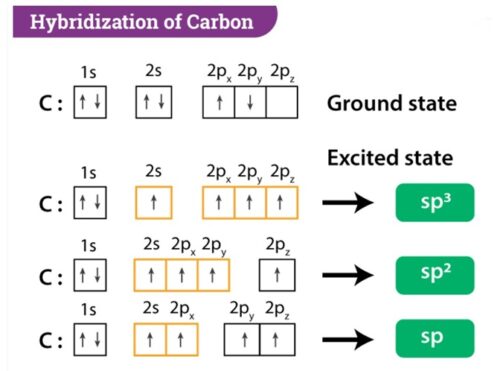
Different types of hybridization of carbon.
- sp Hybridization
Carbon can have an sp hybridization when it is bound to two other atoms with the help of two double bonds or one single and one triple bond. When the hybridization occurs the molecules have a linear arrangement of the atoms with a bond angle of 180°.
Example: Hybridization of CO2.
- sp2 Hybridization
A carbon atom is sp2 hybridized when bonding takes place between 1 s-orbital with two p orbitals. There is a formation of two single bonds and one double bond between three atoms. The hybrid orbitals are placed in a triangular arrangement with 120° angles between bonds.
Example: Hybridization of graphite
- sp3 Hybridization
When the carbon atom is bonded to four other atoms the hybridization is said to be sp3 type. Here 1 s orbital and 3 p orbitals in the same shell of an atom combine to form four new equivalent orbitals. The arrangement is tetrahedral with a bond angle of 109.5 degree.
Example: Hybridization of CH4 (Methane)
_
The simplest hydrocarbon is the gas methane. As usual, carbon’s outer electrons cause it to form four bonds. The formula for methane is CH4 (one carbon with four hydrogens), but this fails to indicate its structure. The carbon is at the center with four hydrogens separately attached to it. The hydrogens are as far apart from one another as possible and so, in three dimensions, the angle formed by any two hydrogens and the carbon is 109.5 degrees. Methane is odorless, nontoxic, and flammable, and bacteria can produce it by digesting organic molecules. Methane is called swamp gas or marsh gas because it may be formed from decaying vegetation. The gas is the main molecule found in natural gas deposits trapped by certain underground rock formations.
_
The next hydrocarbon involves two carbons. If two carbons are bonded together with a single bond (and all other bonds attach to hydrogen), then ethane is formed. The formula for ethane is C2H6. Each carbon has three hydrogens attached to it and then uses the remaining bond to join with the other carbon. If there are three single-bonded carbons with appropriate hydrogens attached, then the molecule is called propane. A chain of four single-bonded carbons, again with hydrogens attached to all the remaining bonds, is called butane. Propane (C3H8) and butane (C4H10) are normally gases but easily become liquids with an increase in pressure. Pressurized bottles and tanks of these liquefied hydrocarbons are sold for camping, outdoor cooking, and also to rural homes that are not near city gas lines. As the hydrocarbon molecules are released from their containers, they return to gases and mix with the air for burning in lamps or stoves. The larger a molecule gets, the more it is attracted to others around it. This causes the smaller propane to be more useful as a bottled gas in colder areas of the world. Butane stays liquid at 0 degrees Celsius. Propane, however, is a gas until the temperature drops to -43 degrees Celsius, which allows its use in colder situations.
_
One could continue by adding carbon (methyl) units one by one. The next hydrocarbon would be pentane; the formula is C5H12. Hexane would follow with a formula of C6H14, and so on. It is well to note, however, that as the number of carbons increases beyond three, the number of possible arrangements of the carbons also increases. There are two ways to put four carbons together. They can be bonded “normally,” one after the other in a chain: C-C-C-C, or they can be attached so that three of the carbons are attached to one central carbon. The formula for butane is still C4H10, but the properties of the two forms are different. Molecular form affects chemistry. Therefore, “normal” or n-butane and isobutane are really different compounds. This is called structural isomerism. Each different C4 arrangement is an isomer. As the number of carbons increases, the number of possible isomers accelerates. Pentane (C5H12) has three different isomers. C9H20 has thirty-five different arrangements on paper; and reassuringly, thirty-five different substances with the formula C9H20 have actually been identified in the laboratory.
_
Another variation can occur. Carbons do not always bond once with one another. They may bond twice or even three times. This reduces the number of hydrogens that can be attached. The properties of the molecules are also different. An example is C2H4, called ethylene. The “-ene” ending indicates a double bond. The carbons may also be triple bonded, which allows only two hydrogens in the molecule. Therefore, the formula for acetylene is C2H2. Molecules that have fewer hydrogens because of their multiple bonds are called “unsaturated.” Food labels use this terminology when indicating amounts of saturated and unsaturated fats.
(Note that, according to the rules where “ethyl” equals two carbons and “-yne” indicates that there is a triple bond, acetylene should be called “ethyne,” but sometimes a common name is well established before the rules take over.) Acetylene torches are well known for their hot flames, which can be used to weld or cut steel. This high energy comes from the relatively easy breaking of the three bonds between the two carbons.
_
Double and triple bonds cause the molecule to become rigid. If two hands touch each other by only one finger, then it is possible to rotate the hands while still maintaining contact. For example, while using one of the longer fingers for bonds, thumbs can be moved from positions of both up or one up and one down. If, however, two or three fingers are in contact, then no rotation is possible. If the thumbs are both up, then they must stay there; if one is up and one is down, then this condition cannot change. With hydrocarbons, this situation becomes important for the parts that surround a double bond. Allow the thumbs to represent the rest of the carbon chain instead of single hydrogens. If both carbon chains are on the same side, then the molecule is called cis. If they face in opposite directions, then the molecule is called trans. These types of differences are called geometrical isomers and also result in different properties.
_
Another variation is ring formation. Propane is able to connect its three carbons into a ring. With single bonds, this leaves two sites to attach hydrogens on each carbon. The resulting formula is C3H6 and the chemical is called cyclopropane. There are other cyclic compounds, and some have multiple bonds connecting carbons. The most important of these cyclic compounds is benzene. Benzene contains alternating double and single bonds. Its six carbons form a ring. Other atoms can attach to the ring and the number of possible compounds is endless.
_
The basic idea of polymer chemistry is that units may repeat almost endlessly. Also, the molecules can be cross-linked with one another and affect the overall flexibility. Rubber is such a hydrocarbon with the formula (C5H8)n, where n is a very large number. The repeating and cross-linked C5H8 monomers form what is called a macromolecule. Polymers can be recognized by the prefix on their names. Polyethylene, polystyrene, and polypropylene are among the hydrocarbons. Many of the other common polymers involve additional atoms such as nitrogen, oxygen, chlorine, and fluorine, but carbon and hydrogen are the backbones; examples include polyurethane, polyester, polyvinyl chloride (PVC), and acrylics.
_
With so many different molecules to study, scientists had to develop rules for naming them. The longest chain of carbons determines the basic name of the molecule. Therefore, the “octane” (or isooctane) in the mixture called gasoline is, by the new rules, actually a pentane; while it has eight carbons, they are attached so that the longest chain is only five carbons long. Consider one of the possible molecules made out of nine carbons, where the longest chain is seven. To name it according to the rules of the International Union of Pure and Applied Chemists (IUPAC), the carbons of the longest chain are numbered so that the positions of any attachments to that chain can be identified. The chain is numbered in the direction that produces the lowest sum. If the two carbons branch off at the second and fourth carbons, the molecule will be named, 2,4-dimethylheptane. The “2,4” gives the location of the methyl groups (carbons with three hydrogens). “Di” indicates that there are two methyls. “Hept” indicates that the longest chain is seven carbons long, and “-ane” indicates that all the bonds are single. It is an alkane (saturated hydrocarbon) with the formula C9H20. The molecule features a primary “parent” chain of 7 carbons (heptane) with two single-carbon “methyl” substituents attached at the 2nd and 4th positions of the chain.
______
______
Classification and Types of Hydrocarbons:
Hydrocarbons can be classified into two main categories based on the type of chemical bonds they contain: saturated hydrocarbons and unsaturated hydrocarbons. Molecules that have fewer hydrogens because of their multiple bonds are called “unsaturated.” Within these categories, there are several types of hydrocarbons.
Saturated Hydrocarbons:
- Alkanes: Saturated hydrocarbons that contain only single covalent bonds between carbon atoms. The general formula for an alkane is CnH2n+2, where n represents the number of carbon atoms in the molecule. Alkanes are commonly referred to as paraffins because they are saturated hydrocarbons with exceptionally stable carbon-carbon and carbon-hydrogen single bonds. This makes them chemically inert under normal condition. Methane (CH4), ethane (C2H6), and propane (C3H8) are examples of alkanes.
- Cycloalkanes: These are a subset of alkanes in which the carbon atoms form a closed ring structure. Cyclohexane (C6H12) is a common example.
Unsaturated Hydrocarbons:
- Alkenes: Unsaturated hydrocarbons that contain at least one carbon-carbon double bond. They have the general formula CnH2n. Ethene (C2H4) and propene (C3H6) are examples of alkenes.
- Alkynes: Unsaturated hydrocarbons that contain at least one carbon-carbon triple bond. They have the general formula CnH2n-2. Ethyne (C2H2) is an example of an alkyne.
- Aromatics: A group of unsaturated hydrocarbons with a distinctive ring structure called an aromatic ring. The most well-known aromatic hydrocarbon is benzene (C6H6), and other examples include toluene and xylene.
Functionalized Hydrocarbons:
Hydrocarbons can also have functional groups added to them, which introduces additional chemical properties. For example:
- Alcohols: Hydrocarbons with one or more hydroxyl (-OH) groups attached. Methanol (CH3OH) and ethanol (C2H5OH) are examples.
- Ethers: Hydrocarbons containing an oxygen atom connected to two alkyl or aryl groups. Dimethyl ether (CH3OCH3) is an example.
- Aldehydes: Hydrocarbons with a carbonyl group (C=O) at the end of the carbon chain. Formaldehyde (HCHO) is a simple aldehyde.
- Ketones: Hydrocarbons with a carbonyl group (C=O) within the carbon chain. Acetone (CH3COCH3) is a common ketone.
- Carboxylic Acids: Hydrocarbons with a carboxyl group (-COOH) at the end of the carbon chain. Acetic acid (CH3COOH) is an example.
___
Comparison between Unsaturated and Saturated Hydrocarbons:
|
Saturated Hydrocarbons |
Unsaturated Hydrocarbons |
|
All of the carbon atoms in saturated hydrocarbons are sp3 hybridised. |
All of the carbon atoms in unsaturated hydrocarbons are sp2 or sp hybridised. |
|
Saturated hydrocarbons contain more hydrogen atoms than unsaturated hydrocarbons. |
Unsaturated hydrocarbons contain fewer hydrogen atoms than saturated hydrocarbons. |
|
Hydrocarbons that are saturated have lower chemical reactivity as compared to unsaturated ones. |
The chemical reactivity of unsaturated hydrocarbons is relatively high. |
|
Alkanes and cycloalkanes are typical instances of saturated hydrocarbons. |
Alkynes, aromatic hydrocarbons, and alkenes are typical examples of unsaturated hydrocarbons. |
Note:
sp3 hybrid orbitals are formed by mixing one s orbital and three p orbitals from the same atom shell, creating four equivalent, degenerate orbitals. These orbitals adopt a tetrahedral geometry with bond angles of 109.5°, minimizing electron repulsion. Example methane CH4, ethane etc.
_
Hydrocarbons are classified as open chain saturated (alkanes) and unsaturated (alkenes and alkynes), cyclic (alicyclic) and aromatic, according to their structure. The important reactions of alkanes are free radical substitution, combustion, oxidation and aromatization. Alkenes and alkynes undergo addition reactions, which are mainly electrophilic additions. Aromatic hydrocarbons, despite having unsaturation, undergo mainly electrophilic substitution reactions. These undergo addition reactions only under special conditions.
Alkanes show conformational isomerism due to free rotation along the C–C sigma bonds. Out of staggered and the eclipsed conformations of ethane, staggered conformation is more stable as hydrogen atoms are farthest apart. Alkenes exhibit geometrical (cis-trans) isomerism due to restricted rotation around the carbon–carbon double bond. Benzene and benzenoid compounds show aromatic character. Aromaticity, the property of being aromatic is possessed by compounds having specific electronic structure characterised by Hückel (4n+2)π electron rule. The nature of groups or substituents attached to benzene ring is responsible for activation or deactivation of the benzene ring towards further electrophilic substitution and also for orientation of the incoming group.
______
______
Properties of Hydrocarbons:
- Physical State: Hydrocarbons can exist in various physical states at room temperature. For example, methane and ethane are gases, while compounds like octane are liquids, and those with a larger number of carbon atoms, such as paraffin wax, are solids.
- Solubility: Many hydrocarbons are nonpolar compounds, and as a result, they are generally not very soluble in polar solvents like water but are highly soluble in nonpolar solvents, such as other hydrocarbons.
- Boiling Points: The boiling points of hydrocarbons increase with an increase in molecular weight. This means that smaller hydrocarbons, like methane and ethane, boil at low temperatures, while larger ones, such as octane and hexadecane, have higher boiling points.
- Flammability: Hydrocarbons are highly flammable because they contain a significant amount of chemical energy stored in the carbon-carbon and carbon-hydrogen bonds. This property makes them valuable as fuels for combustion processes.
- Chemical Reactivity: The reactivity of hydrocarbons can vary based on their type. Saturated hydrocarbons (alkanes) are relatively unreactive, while unsaturated hydrocarbons (alkenes and alkynes) are more reactive due to their double or triple bonds.
- Isomerism: Hydrocarbons exhibit isomerism, which means that compounds with the same molecular formula can have different structures and properties. For example, butane and isobutane are isomers with the same molecular formula (C4H10) but different structures.
- Combustion: Hydrocarbons can undergo combustion reactions, reacting with oxygen to release energy in the form of heat and light. This property is central to their use as fuels.
- Density: The density of hydrocarbons depends on their molecular weight and the arrangement of atoms. Generally, liquid hydrocarbons are less dense than water, which is why they often float on water.
- Toxicity: Some hydrocarbons, particularly those with aromatic rings or functional groups, can be toxic. Polycyclic aromatic hydrocarbons (PAHs) found in some hydrocarbon compounds are known to be carcinogenic.
- Environmental Impact: Hydrocarbons, when released into the environment, can contribute to air pollution and are a source of greenhouse gases. The environmental impact depends on the type and quantity of hydrocarbons released.
__
All alkanes are composed of carbon and hydrogen atoms, and have similar bonds, structures, and formulas; noncyclic alkanes all have a formula of CnH2n+2. The number of carbon atoms present in an alkane has no limit. Greater numbers of atoms in the molecules will lead to stronger intermolecular attractions (dispersion forces) and correspondingly different physical properties of the molecules. Properties such as melting point and boiling point (Table below) usually change smoothly and predictably as the number of carbon and hydrogen atoms in the molecules change.
Properties of Some Alkanes:
|
Alkane |
Molecular Formula |
Melting Point (°C) |
Boiling Point (°C) |
Phase at STP 0 C and 1 atm |
Number of Structural Isomers |
|
methane |
CH4 |
–182.5 |
–161.5 |
gas |
1 |
|
ethane |
C2H6 |
–183.3 |
–88.6 |
gas |
1 |
|
propane |
C3H8 |
–187.7 |
–42.1 |
gas |
1 |
|
butane |
C4H10 |
–138.3 |
–0.5 |
gas |
2 |
|
pentane |
C5H12 |
–129.7 |
36.1 |
liquid |
3 |
|
hexane |
C6H14 |
–95.3 |
68.7 |
liquid |
5 |
|
heptane |
C7H16 |
–90.6 |
98.4 |
liquid |
9 |
|
octane |
C8H18 |
–56.8 |
125.7 |
liquid |
18 |
|
nonane |
C9H20 |
–53.6 |
150.8 |
liquid |
35 |
|
decane |
C10H22 |
–29.7 |
174.0 |
liquid |
75 |
|
tetradecane |
C14H30 |
5.9 |
253.5 |
solid |
1858 |
|
octadecane |
C18H38 |
28.2 |
316.1 |
solid |
60,523 |
The properties of hydrocarbons vary greatly. Physically, the various compounds can be solid, liquid, or gas at standard temperature (0 degrees Celsius) and standard pressure (760 millimeters on a mercury barometer). The smallest hydrocarbons are gases. At five carbons long (pentane) through thirteen carbons long, the hydrocarbons are liquids. After fourteen carbons, they are solids. Viscosity (resistance to flow or thickness) of liquid hydrocarbons depends on how likely the molecules are to get tangled up as they move.
_
Alkanes are relatively stable molecules, but heat or light will activate reactions that involve the breaking of C–H or C–C single bonds. Combustion is one such reaction:
CH4(g) + 2O2(g) = CO2(g) + 2H2O(g)
Alkanes burn in the presence of oxygen, a highly exothermic oxidation-reduction reaction that produces carbon dioxide and water. As a consequence, alkanes are excellent fuels. For example, methane, CH4, is the principal component of natural gas. Butane, C4H10, used in camping stoves and lighters is an alkane. Gasoline is not a single compound, but a complex mixture of hundreds of hydrocarbons. Its molecules primarily contain chains or rings of 4 to 12 carbon atoms (C4 to C12), with the most common components typically having 6 to 8 carbon atoms (such as hexane, heptane, and octane), plus various additives to improve its performance as a fuel. Kerosene, diesel oil, and fuel oil are primarily mixtures of alkanes with higher molecular masses. The main source of these liquid alkane fuels is crude oil, a complex mixture that is separated by fractional distillation. Fractional distillation takes advantage of differences in the boiling points of the components of the mixture (Figure below).
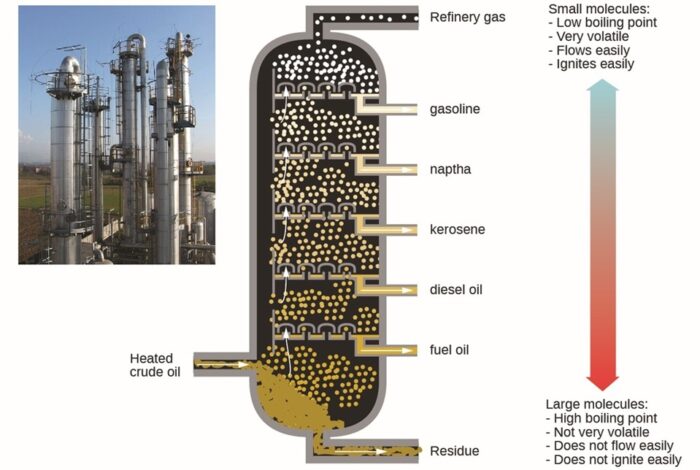
In a column for the fractional distillation of crude oil, oil heated to about 425 °C in the furnace vaporizes when it enters the base of the tower. Petroleum can be refined by heating the mixture to the gaseous state and then passing the vapors into a column still. This still, which is steam-heated, maintains progressively cooler temperatures as the crude oil vapors rise through it. The heavier molecules with the higher boiling points condense before others and are removed.
Lubricating oils, greases, asphalt, and waxes condense at the bottom of the still, which is at about 350 degrees Celsius. Heating oil is then condensed at the next level up, which is at about 300 degrees Celsius. Next, kerosene and gasoline become liquids. The lightest molecules collect at the top.
Every fraction has its uses. Modern machinery requires various lubricating oils to reduce heat. About 4 percent of the crude is asphalt and road oil and is used to surface 90 percent of the roads in the United States. Many homes are heated with oil. Kerosene is still used for cooking and lighting.
Note:
The main source for hydrocarbons is through fractional distillation of fossil fuels, especially petroleum. However, researchers are investigating alternate and renewable sources, such as converting used frying oil (usually plant-based) to biodiesel, or reclaiming waste oils from industrial processes.
_______
_______
Reactions of hydrocarbons:
Hydrocarbons usually undergo main reactions, such as:
-1. Substitution
Substitution on hydrocarbons happens on alkanes. This compound undergoes a hydrogen swap with other atoms or groups, like halogens. This reaction is important for chemical synthesis, especially in medicine and plastic making.
-2. Combustion
This reaction is the most common reaction hydrocarbons undergo, in which they react with oxygen and produce energy, water, and carbon dioxide. It usually happens in the fossil fuel combustion process, transforming it into energy for moving the vehicle.
-3. Addition
Addition is a reaction that usually occurs in alkynes and alkenes. This reaction can open the double bond structure, making it bind to other molecules or atoms. Addition can produce other compounds, such as polypropylene and polyethylene.
_____
Saturated hydrocarbons are notable for their inertness. Unsaturated hydrocarbons (alkenes, alkynes and aromatic compounds) react more readily, by means of substitution, addition, polymerization. At higher temperatures they undergo dehydrogenation, oxidation and combustion.
Saturated hydrocarbons:
Cracking:
The cracking of saturated hydrocarbons is the main industrial route to alkenes and alkyne. These reactions require heterogeneous catalysts and temperatures >500 °C.
Oxidation:
Oxidation of hydrocarbons involves their reaction with oxygen. In the presence of excess oxygen, hydrocarbons combust. With careful conditions, which have been optimized for many years, partial oxidation results. Useful compounds can be obtained in this way: maleic acid from butane, terephthalic acid from xylenes, acetone together with phenol from cumene (isopropylbenzene), and cyclohexanone from cyclohexane. The process, which is called autoxidation, begins with the formation of hydroperoxides (ROOH).
Combustion:
Combustion of hydrocarbons is currently the main source of the world’s energy for electric power generation, heating (such as home heating), and transportation. Often this energy is used directly as heat such as in home heaters, which use either petroleum or natural gas. The hydrocarbon is burnt and the heat is used to heat water, which is then circulated. A similar principle is used to create electrical energy in power plants. Both saturated and unsaturated hydrocarbons undergo this process.
Common properties of hydrocarbons are the facts that they produce steam, carbon dioxide and heat during combustion and that oxygen is required for combustion to take place. The simplest hydrocarbon, methane, burns as follows:
CH4 +2O2 ⟶ CO2 +2H2O
In inadequate supply of air, carbon black and water vapour are formed:
CH4 + O2 ⟶ C+2H2O
And finally, for any linear alkane of n carbon atoms,
Cn H(2n+2) + (3n+1)/2 O2 ⟶ nCO2 + (n+1) H2O
Partial oxidation characterizes the reactions of alkenes and oxygen. This process is the basis of rancidification and paint drying.
Benzene burns with sooty flame when heated in air:
C6H6 +15/2 O2 ⟶ 6CO2 + 3H2O
Halogenation:
Saturated hydrocarbons react with chlorine and fluorine. In the case of chlorination, one of the chlorine atoms replaces a hydrogen atom. The reactions proceed via free-radical pathways, in which the halogen first dissociates into two neutral radical atoms (homolytic fission).
CH4 + Cl2 → CH3Cl + HCl
CH3Cl + Cl2 → CH2Cl2 + HCl
all the way to CCl4 (carbon tetrachloride)
C2H6 + Cl2 → C2H5Cl + HCl
C2H4Cl2 + Cl2 → C2H3Cl3 + HCl
all the way to C2Cl6 (hexachloroethane)
____
Unsaturated hydrocarbons:
Substitution:
Aromatic compounds, almost uniquely for hydrocarbons, undergo substitution reactions. The chemical process practiced on the largest scale is the reaction of benzene and ethene to give ethylbenzene:
C6H6 + C2H4 → C6H5CH2CH3
The resulting ethylbenzene is dehydrogenated to styrene and then polymerized to manufacture polystyrene, a common thermoplastic material.
Addition:
Alkenes and alkynes undergo addition reactions because they are unsaturated, meaning they possess multiple carbon-carbon bonds (double or triple bonds). In this reaction a variety of reagents add “across” the pi-bond(s). Chlorine, hydrogen chloride, water, and hydrogen are illustrative reagents.
Polymerization is a form of addition. Alkenes and some alkynes undergo polymerization by opening of the multiple bonds to produce polyethylene, polybutylene, and polystyrene. The alkyne acetylene polymerizes to produce polyacetylene. Oligomers (chains of a few monomers) may be produced, for example in the Shell higher olefin process, where α-olefins are extended to make longer α-olefins by adding ethylene repeatedly.
Metathesis:
Some hydrocarbons undergo metathesis, in which substituents attached by C–C bonds are exchanged between molecules. For a single C–C bond it is alkane metathesis, for a double C–C bond it is alkene metathesis (olefin metathesis), and for a triple C–C bond it is alkyne metathesis.
______
______
Applications of hydrocarbons:
Society has become dependent on hydrocarbons, especially for energy. Gasoline has become the chief product of petroleum. It is a mixture of about twenty-five hydrocarbons ranging from C4H10 to C13H28, including smooth-burning isooctane. Larger molecules in petroleum can be “cracked” or broken by using a combination of heat and pressure with a catalyst to produce more gasoline-sized molecules. The smooth-burning quality of gasoline is determined by comparing it to standard solutions that vary in amount of octane. Any gasoline mixture that runs in an engine (without premature explosions called “knocking”) as well as a 90 percent octane, 10 percent heptane is given an octane rating of 90.
Methane, ethane, and other smaller hydrocarbons can also be found in wells. The gases are often under sufficient pressure to cause the liquids to gush out of the well when oil is “struck.” This natural gas is used for cooking and to heat homes.
Another source of carbon molecules is coal. Coal is a mixture of carbon molecules, which formed in the past from compressed, decomposed vegetation. Soft coal can be heated in the absence of oxygen, and the gases produced can be condensed as coal tar, which contains many hydrocarbons.
Petrochemical plants use hydrocarbons from coal tar and petroleum as the starting points for many modern products. Polymers have changed many things with new products, including synthetic fibers and cloth, food wraps, emulsion paints, plastic boats and housewares, advertising signs, toys, radios, automobile parts, electrical plugs, flexible tubing, polyvinyl chloride plumbing pipes, and varnishes. Poly-cis-isopene, natural rubber, once harvested from trees, can now be manufactured. Also, many drugs and agricultural chemicals often start as hydrocarbons.
Here are few Applications of Hydrocarbon:
- Hydrocarbons also find applications in the production of chemicals: Hydrocarbons are not limited to just fuel and polymer production. They also serve as feedstocks for the chemical industry. Through various chemical processes, hydrocarbons can be transformed into a wide range of chemicals, including solvents, lubricants, detergents, and various organic compounds used in pharmaceuticals and agriculture.
- Energy Generation: In addition to fueling vehicles, hydrocarbons are used in power generation. They are a primary source of energy for power plants that produce electricity. The combustion of hydrocarbon fuels, such as natural gas and oil, is a common method for generating electrical power.
- Heating and Cooling: Hydrocarbons are essential for providing heating and cooling in homes and commercial buildings. Natural gas, a hydrocarbon, is often used for heating through furnaces and for cooking through gas stoves. Additionally, hydrocarbons like propane can be used in refrigeration systems and air conditioning units.
- Chemical Synthesis: Hydrocarbons are building blocks for synthesizing a wide range of chemicals and materials. They are used in the manufacture of synthetic rubber, various plastics, and pharmaceuticals. For example, the production of synthetic rubber involves the polymerization of hydrocarbons like butadiene.
- Energy Storage: Hydrocarbons also play a role in energy storage. They are used in batteries and fuel cells, where they participate in chemical reactions to store and release energy, making them essential for portable electronic devices and emerging technologies in renewable energy.
- Agriculture: Hydrocarbons are used in agriculture as components of pesticides and fertilizers. These compounds are essential for modern farming practices to improve crop yields and protect against pests and diseases
_______
_______
Section-4
Fossil fuels:
Energy fosters human activities and is a necessity for modern life. Energy heats and cools buildings, powers industries, fuels transportation system, etc. All energy on Earth comes from the sun, which contributes to the formation of biomass. The biomass produces decay, which becomes buried in sediments, thereby produces coal, gas, oil, and tar sands. Fossil fuels are nonrenewable. In 1 year, mankind expends an amount of fossil fuel that took nature approximately 1 million years to produce.
_
Fossil fuels are nonrenewable sources of energy formed from the organic matter of plants and microorganisms that lived millions of years ago. The natural resources that typically fall under this category are coal, oil (petroleum), and natural gas. This energy (and CO2) was originally captured via photosynthesis by living organisms such as plants, algae, and photosynthetic bacteria. Sometimes this is known as fossil solar energy since the energy of the sun in the past has been converted into the chemical energy within a fossil fuel. Of course, as the energy is used, just like respiration from photosynthesis that occurs today, carbon can enter the atmosphere, causing climate consequences. Fossil fuels are nonrenewable because their formation took millions of years. Furthermore, higher productivity in the ancient environment allowed for more fossil fuel accumulation, meaning that the fossil fuel reserves available now could not necessarily be regenerated millions of years in the future.
_
The conversion of living organisms into fossil fuels is a complex process. As organisms die, most organic matter is oxidized back to CO2 relatively quickly (within weeks or years in most cases), but any of it that gets isolated from the oxygen of the atmosphere (for example, deep in the ocean or in a stagnant bog) may last long enough to be buried by sediments and, if so, may be preserved for tens to hundreds of millions of years and the chemical energy within the organisms’ tissues is added to surrounding geologic materials. Higher productivity in the ancient environment leads to a higher potential for fossil fuel accumulation, and there is some evidence of higher global biomass and productivity over geologic time. Lack of oxygen and moderate temperatures seem to enhance the preservation of these organic substances. Heat and pressure that is applied after burial also can cause transformation into higher quality materials (brown coal to anthracite, oil to gas) and/or migration of mobile materials.
Fossil fuel are dead old plants (or “buried sunshine”) mostly 100’s of millions of years ago.
Photosynthesis:
CO2 + 2H2O + sun energy—-> O2 +[CH2O] + H2O
Efficiency:
Average ~1% fixation of sunlight to chemical energy on land; in oceans is 1/3 that.
Average efficiency is then ~ 0.5%
Photosynthetic fixation energy Fphoto is then 0.5% X 200 W/m2 = 1 W/m2
Fphoto ~ 1 W/m2 of this, how much is buried each year and fossilized / preserved?
Buried fraction: ~ 1 in 10,000 molecules of organic carbon are buried and preserved as fossil fuels.
Flux of buried carbon~ 0.0001 W/m2 (over whole Earth)
Organic material from plants and plankton buried, subjected to high temperature and pressure. Anaerobic conditions prevent immediate oxidation.
Energy density increases during process from ~ 20 MJ/kg to up to > 40 MJ/kg
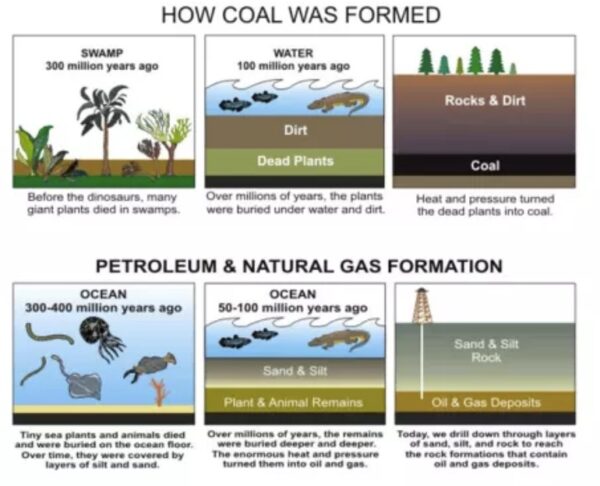
Coal comes from plants. Oil and gas believed to be mostly from phytoplankton.
Peat is still being deposited today, and has been harvested for fuel for millennia by hand or by machine.
_
Fossil fuels consist of deposits of once living organisms. The organic matter takes centuries to form. Fossil fuels principally consist of carbon and hydrogen bonds. There are three types of fossil fuels which can all be used for energy provision; coal, oil and natural gas. Coal is a solid fossil fuel formed over millions of years by decay of land vegetation. When layers are compacted and heated over time, deposits are turned into coal. Coal is quite abundant compared to the other two fossil fuels. Analysts sometimes predict that worldwide coal use will increase as oil supplies become scarcer. Current coal supplies could last for 200 years or more. Coal is usually extracted in mines. Since the middle of the 20th century, coal use has doubled. Since 1996 its application is declining again. Many developing countries depend on coal for energy provision because they cannot afford oil or natural gas. China and India are major users of coal for energy provision.
Oil is a liquid fossil fuel that is formed from the remains of marine microorganisms deposited on the sea floor. After millions of years the deposits end up in rock and sediment where oil is trapped in small spaces. It can be extracted by large drilling platforms. Oil is the most widely used fossil fuel. Crude oil consists of many different organic compounds which are transformed to products in a refining process. It is applied in cars, jets, roads and roofs and many other. Oil cannot be found everywhere on earth and consequentially, there have been wars on oil supplies. A well-known example is the Gulf War of 1991.
Natural gas is a gaseous fossil fuel that is versatile, abundant and relatively clean compared to coal and oil. Like oil, it is formed from the remains of marine microorganisms. It is a relatively new type of energy source. Until 1999, more coal was used than natural gas. Natural gas has now overtaken coal in developed countries. However, people are afraid that like oil, natural gas supplies will run out. Some scientists have even predicted this might happen by the middle or end of the 21st century. Natural gas mainly consists of methane (CH4). It is highly compressed in small volumes at large depths in the earth. Like oil, it is brought to the surface by drilling. Natural gas reserves are more evenly distributed around the globe than oil supplies.
_
Fossil fuels are composed primarily of hydrocarbons (molecules of just carbon and hydrogen), but they contain lesser amounts nitrogen, sulfur, oxygen, and other elements as well. The precise chemical structures vary depending on the type of fossil fuel (coal, oil, or natural gas). The molecules in coal tend to be larger than those in oil and natural gas. Coal is thus solid at room temperature, oil is liquid, and natural gas is in a gaseous phase. Specifically, coal is a black or dark brown solid fossil fuel found as coal seams in rock layers formed from ancient swamp vegetation. Both oil and natural gas are fossil fuels found underground that formed from marine microorganisms. Oil (petroleum) is a liquid fossil fuel and consists of a variety of hydrocarbons while natural gas is a gaseous fossil fuel that consists of mostly methane and other small hydrocarbons.
_
Figure below shows fossil fuel combustion is part of the carbon cycle.
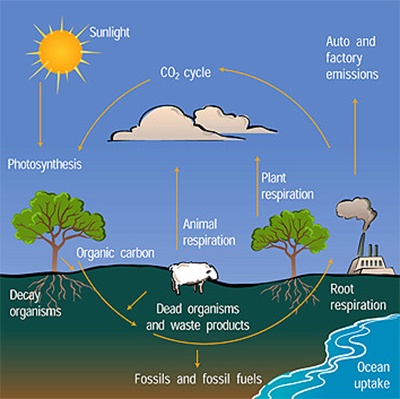
Earth is a closed system with respect to carbon, and therefore carbon on this planet has to be used and reused. A total account of carbon in the world would explain fossil fuel formation. Global carbon cycle illustrates the fate of carbon in the world. Carbon exists in the world in three major reservoirs: in the atmosphere as CO2, in the rocks as CO3–, and in the oceans, which occupy two thirds of the planet’s surface, as carbonate (CO3–) and bicarbonates (HCO3-). The CO2 in the atmosphere has a vital role in the formation of fossil fuels. The CO2 in the atmosphere reacts with water vapor in the presence of sunlight to form the organic matter and oxygen by photosynthesis reaction. The organic matter can be of microscopic plant (phytoplankton) or microscopic animal (zooplankton) or higher plants/animals. The dead organic matter through decay reaction combines with oxygen and forms CO2 and H2O. This decay reaction is exactly the reverse of the photosynthesis reaction. Fossil fuels have formed by minimization or prevention of the decay reaction by possibly inundating the organic matter by water or covering by sediments.
_
Global fossil fuel consumption:
The burning of fossil fuels for energy began around the Industrial Revolution. But fossil fuel consumption has changed significantly over the past few centuries – both in terms of what and how much we burn. In the interactive chart below, we see global fossil fuel consumption broken down by coal, oil, and gas since 1800. Fossil fuel consumption has increased significantly over the past half-century, around eight-fold since 1950 and roughly doubling since 1980. But the types of fuel we rely on have also shifted from solely coal towards a combination with oil and gas. Today, coal consumption is falling in many parts of the world. But oil and gas are still growing quickly.
Figure below shows Global fossil fuel consumption measured in terawatt-hours of primary energy consumption.
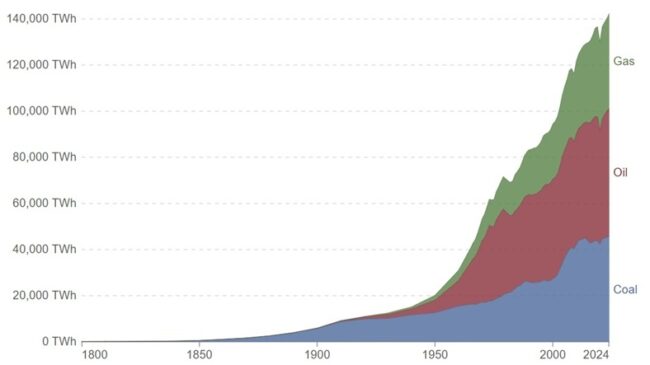
_____
_____
The Chemistry of Fossil Fuels:
Fossil fuels, including coal, oil, and natural gas, have been the primary sources of energy for centuries. However, their combustion releases a multitude of pollutants and greenhouse gases, contributing to climate change and environmental degradation. Understanding the chemical makeup of fossil fuels is crucial to mitigating their environmental impact. Fossil fuels are complex mixtures of hydrocarbons, which are molecules composed of hydrogen and carbon atoms. The chemical composition of fossil fuels varies depending on their source and type.
Types of Hydrocarbons in Fossil Fuels:
The types of hydrocarbons present in fossil fuels vary depending on the fuel type. For example:
- Natural gas is primarily composed of methane (CH4), with smaller amounts of ethane (C2H6) and propane (C3H8).
- Crude oil is a complex mixture of various hydrocarbons, including alkanes, cycloalkanes, and aromatics.
- Coal is primarily composed of aromatic hydrocarbons, with smaller amounts of alkanes and cycloalkanes.
Other Compounds present in Fossil Fuels:
In addition to hydrocarbons, fossil fuels contain other compounds that can impact their combustion and environmental effects. These include:
- Sulfur compounds: Fossil fuels contain varying amounts of sulfur, which can be released as sulfur dioxide (SO2) during combustion. SO2 is a major air pollutant that contributes to acid rain and respiratory problems.
- Nitrogen compounds: Fossil fuels contain nitrogen compounds, which can be released as nitrogen oxides (NOx) during combustion. NOx is a major contributor to ground-level ozone formation and respiratory problems.
- Oxygen compounds: Some fossil fuels, such as coal, contain oxygen compounds, which can affect their combustion characteristics and emissions.
_
The following table summarizes the typical composition of different fossil fuels:
|
Fossil Fuel |
Hydrocarbons |
Sulfur |
Nitrogen |
Oxygen |
|
Natural Gas |
Methane, ethane, propane |
Low |
Low |
Low |
|
Crude Oil |
Alkanes, cycloalkanes, aromatics |
Moderate |
Moderate |
Low |
|
Coal |
Aromatics, alkanes, cycloalkanes |
High |
High |
Moderate |
________
________
Table below show properties of fossil fuels:
|
Fraction |
Number of carbon atoms |
Boiling point range / oC |
Viscosity |
Volatility |
|
Refinery gas |
1-4 |
Below 25 |
Viscosity increases going down the fractions |
Volatility decreases going down the fractions |
|
Gasoline / petrol |
4-12 |
40-100 |
||
|
Naphtha |
7-14 |
90-150 |
||
|
Kerosene / paraffin |
12-16 |
150-240 |
||
|
Diesel / gas oil |
14-18 |
220-300 |
||
|
Fuel oil |
19-25 |
250-320 |
||
|
Lubricating oil |
20-40 |
300-350 |
||
|
Bitumen |
More than 70 |
More than 350 |
________
________
Table below shows Fossil fuel’s Elemental composition and energy density.
|
Fuel |
C:H:O |
Energy density Mj/Kg |
|
Dry biomass (or peat) |
1:2:1 |
10-‐30 |
|
Coal |
1:0.8:0.1 |
20-‐35 |
|
Crude oil |
1:1: 0.015 |
~42 |
|
Refined petroleum |
1:2:0 |
44-‐47 |
|
Natural gas |
1:4:0 |
50 |
______
______
Drivers of fossil fuel use:
- Abundant and widely available
- High energy density makes fossil fuels hard to replace for transportation and industrial heat
- Relatively low private costs (but high social and environmental costs are not factored into the price)
- Ongoing innovation in extraction drives down costs and increases available resources
- Government interventions (e.g., subsidies and low taxes) have significantly increased the growth of fossil fuel use (with huge social costs)
- Fossil fuel industries have significant political influence
- Easy to store and transport (via pipeline, ship, rail, truck)
- Sunk cost, a large fossil fuel labor force, and existing infrastructure motivate continued use
- When used for electricity generation, considered a flexible/dispatchable resource that can be ramped up and down based on needs of the electricity grid
- Few non-fossil substitutes for transportation fuels
Barriers of fossil fuel use:
- Depletable and non-renewable
- Largest source of greenhouse gas emissions and air pollutants
- Public health impacts near sites of fossil fuel production and consumption
- Fuel prices are volatile, reliant on geopolitical conditions
- Legacy issues with abandoned infrastructure (e.g., wells, mines, pipelines, refineries) and solid waste (e.g., mine tailings, metal catalysts used in refining, coal ash)
- Many other externalities, including oil spills, methane leakage, water use and contamination, inter-state conflict
- Growing competition from cheaper clean energy alternatives
_______
_______
Coal:
Coal was formed when large plants in swamps died 300 million years ago (before the dinosaurs). Over millions of years, this vegetation was buried under water and dirt (100 million years ago). Eventually, heat and pressure turned the dead plants into coal, which is found under layers of rock and dirt. There are several different types of coal ranging in quality. The more heat and pressure that coal undergoes during formation, the greater is its fuel value and the more desirable is the coal. The general sequence of a swamp turning into the various stages of coal are as follows:
Swamp → Peat → Lignite → Subbituminous coal → Bituminous coal → Anthracitic coal → Graphite
Coal rankings depend on energy content, measured as gross calorific value (how much energy is released from combustion) and carbon content that can be burned (percentage of fixed carbon). Anthracitic coal is the highest quality coal, with high energy and carbon content. Next in quality is bituminous coal, subbituminous coal, and lignite. All three have less carbon content than anthracitic coal. Bituminous coal retains high energy content, but subbituminous coal and lignite have lower energy content. Coal is extracted by two principal methods, of which there are many variants: surface mining or subsurface mining.
_
Coal is a complex solid material derived primarily from plants that died and were buried hundreds of millions of years ago and were subsequently subjected to high temperatures and pressures. Because plants contain large amounts of cellulose, derived from linked glucose units, the structure of coal is more complex than that of petroleum (Figure below). In particular, coal contains a large number of oxygen atoms that link parts of the structure together, in addition to the basic framework of carbon–carbon bonds. It is impossible to draw a single structure for coal; however, because of the prevalence of rings of carbon atoms (due to the original high cellulose content), coal is more similar to an aromatic hydrocarbon than an aliphatic one.
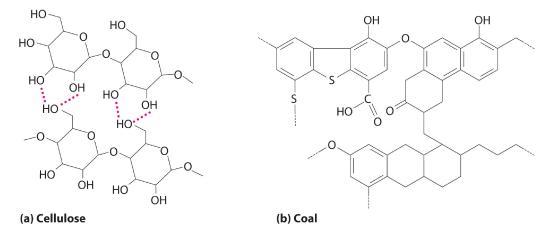
Figure above shows the structures of Cellulose and Coal (a) Cellulose consists of long chains of cyclic glucose molecules linked by hydrogen bonds. (b) When cellulose is subjected to high pressures and temperatures for long periods of time, water is eliminated, and bonds are formed between the rings, eventually producing coal. This drawing shows some of the common structural features of coal; note the presence of many different kinds of ring structures.
_
There are four distinct classes of coal; their hydrogen and oxygen contents depend on the length of time the coal has been buried and the pressures and temperatures to which it has been subjected. Lignite, with a hydrogen:carbon ratio of about 1.0 and a high oxygen content, has the lowest ΔHcomb. Lignite is extensively mined in Germany and Poland. Anthracite, in contrast, with a hydrogen:carbon ratio of about 0.5 and the lowest oxygen content, has the highest ΔHcomb and is the highest grade of coal. Anthracite is the first choice for metallurgical refining. The most abundant form in the Western United States in anthracite while that in the Eastern United States is bituminous coal, which has a high sulfur content because of the presence of small particles of pyrite (FeS2). Combustion of coal releases the sulfur in FeS2 as SO2, which is a major contributor to acid rain.
_
Peat, a precursor to coal, is the partially decayed remains of plants that grow in the swampy areas of the Carboniferous Period. It is removed from the ground in the form of soggy bricks of mud that will not burn until they have been dried. Even though peat is a smoky, poor-burning fuel that gives off relatively little heat, humans have burned it since ancient times. If a peat bog were buried under many layers of sediment for a few million years, the peat would eventually be compressed and heated enough to become lignite, the lowest grade of coal; given enough time and heat, lignite would eventually become anthracite, a much better fuel.
_
Converting Coal to Gaseous and Liquid Fuels:
As a solid, coal is much more difficult to mine and ship than petroleum (a liquid) or natural gas. Consequently, more than 75% of the coal produced each year is simply burned in power plants to produce electricity. Methods to convert coal to gaseous fuels (coal gasification) or liquid fuels (coal liquefaction) exist, but are not particularly economical unless the prices of oil and natural gas are high. With the development of fracking and the subsequent fall in oil and natural gas prices, interest in these processes has fallen however they have played an important role in the past. In the most common approach to coal gasification, coal reacts with steam to produce a mixture of CO and H2 known as synthesis gas, or syngas. Because coal is 70%–90% carbon by mass, it is approximated as C in Equation below.
C + H2O = CO + H2
Converting coal to syngas removes any sulfur present and produces a clean-burning mixture of gases. Syngas or town gas was used for cooking until the 1960s when natural gas pipelines were built. Because syngas contains carbon monoxide (CO) it is poisonous, which accounts for scenes in old movies where people were killed by sticking their heads into an oven and allowing the gas to flow.
Syngas can also be used as a reactant to produce methane and methanol.
A promising approach is to convert coal directly to methane through a series of reactions:
2C + 2H2O = CH4 + CO2
Techniques available for converting coal to liquid fuels are not economically competitive with the production of liquid fuels from petroleum. Current approaches to coal liquefaction use a catalyst to break the complex network structure of coal into more manageable fragments. The products are then treated with hydrogen (from syngas or other sources) under high pressure to produce a liquid more like petroleum. Subsequent distillation, cracking, and reforming can be used to create products similar to those obtained from petroleum.
______
______
Oil and Gas:
Petroleum is a naturally occurring, yellowish-black fossil fuel found in geological formations beneath the Earth’s surface. It is refined into critical commodities like gasoline, diesel, jet fuel, and the raw chemical feedstocks used to manufacture plastics, asphalt, and pharmaceuticals. Crude oil is the unrefined, raw fossil fuel extracted directly from the ground. Petroleum, however, is a broader umbrella term. It includes both raw crude oil and the usable, refined products derived from it, such as gasoline, diesel, and jet fuel. Natural gas is a naturally occurring fossil fuel primarily composed of methane (CH4). It is widely used globally to generate electricity, heat homes, cook food, and fuel vehicles.
_
Petroleum (oil) and natural gas were formed from marine microorganisms. These were covered by layers of silt and sand 300-400 million years ago. Over millions of years, the remains were buried deeper and deeper. When plankton died, they were buried in sediments. As with coal, oxygen-poor conditions limited decomposition. As sediments continued to accumulate, the dead organisms were further buried. As the depth of burial increases, so does the temperature—due to the geothermal gradient—and gradually the organic matter within the sediments is converted to hydrocarbons. The first stage is the biological production (involving anaerobic bacteria) of methane. Most of this escapes back to the surface, but some is trapped in methane hydrates near the sea floor. At depths beyond about 2 km, and at temperatures ranging from 60° to 120°C, the organic matter is converted by chemical processes to oil. This depth and temperature range is known as the oil window. Beyond 120°C most of the organic matter is chemically converted to methane. The enormous heat and pressure turned the remains into oil and natural gas. Now, oil and natural gas deposits are found underground and can be extracted via drilling through the layers of sand, silt, and rock. (Some natural gas is also found associated with coal deposits (coalbed methane), consisting of methane produced during coal formation.)
_
As the rock forms from the sediments that originally trapped the plankton, the oil and gas leak out of the source rock due to the increased pressure and temperature, and migrate to a different rock unit higher in the rock column. If the rock is porous and permeable rock, then that rock can act as a reservoir for the oil and gas. Petroleum is usually found one to two miles (1.6 – 3.2 km) below the Earth’s surface, whether that is on land or ocean.
_
Figure below shows location of crude oil under sea:
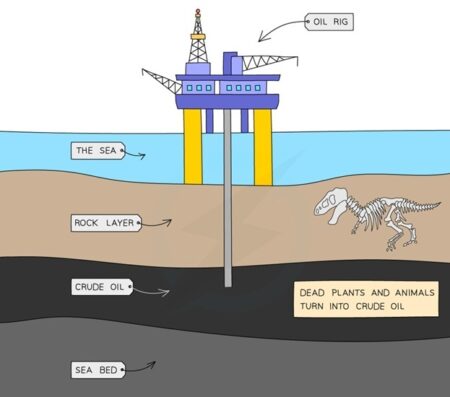
_
A trap is a combination of a subsurface geologic structure and an impervious layer that helps block the movement of oil and gas and concentrates it for later human extraction. Traps pool the fluid fossil fuels into a configuration in which extraction is more likely to be profitable, and such fossil fuels are called conventional oil and natural gas. Extraction of oil or gas outside of a trap (unconventional oil and natural gas) is less efficient and more expensive; sometimes it is not economically viable at all (does not produce a profit). Examples of unconventional fossil fuels include oil shale, tight oil and gas, tar sands (oil sands), and coalbed methane.
___
Conventional Extraction of Oil and Natural Gas:
Fossil oil reserves can be found in the earth‘s crust and there is also a considerable amount in oil sands (tar sands) close to the surface of the earth, in Canada for example. The oil is recovered by means of drilling into deposits of accumulation within the earth‘s strata where the oil forms wells. If the deposits are located in layers at relatively shallow depth within the crust, the oil navigates its own way to the surface, making drilling rather easy. This is the conventional method of oil extraction and the easiest (also referred to as easy oil). Injection wells transfer water, carbon dioxide, or other substances to an oil deposit increase pressure or change the oil’s properties, facilitating extraction. For oil located in the depths of the earth‘s crust, or in instances where it is drilled for in open seas, it is more difficult to transport to the surface and the method is thus called unconventional.
Oil is mainly obtained by drilling either on land (onshore) or in the ocean (offshore). Early offshore drilling was generally limited to areas where the water was less than 300 feet deep. Oil and natural gas drilling rigs now operate in water as deep as two miles. Floating platforms are used for drilling in deeper waters. These self-propelled vessels are attached to the ocean floor using large cables and anchors. Wells are drilled from these platforms which are also used to lower production equipment to the ocean floor. Some drilling platforms stand on stilt-like legs that are embedded in the ocean floor. These platforms hold all required drilling equipment as well as housing and storage areas for the work crews. Offshore production is much more expensive than land-based production.
___
Unconventional Extraction of Oil and Natural Gas:
Unconventional means of oil extraction include drilling for oil below the seabed, organic oil production, fracking and tar sand processing. Tight oil and natural gas trapped in shale (fine-grained sedimentary rocks with relatively high porosity and low permeability) as well as natural gas in tight sands (gas-bearing, fine-grained sandstones or carbonates with a low permeability) are extracted via hydraulic fracturing, informally referred to as “fracking”. This process uses explosives to create new fractures in these low-permeability rocks as well as increase the size, extent, and connectivity of existing fractures and then applies high-pressure fluid. First, a drill permeates the rock layers and then proceeds horizontally. Explosives then fracture rocks, freeing oil and natural gas. Finally, water, sand, and chemicals and injected, which flush out oil and natural gas.
In tar sand, the grains of sand are coated in a thin layer of petroleum. It is concentrated at the earth‘s surface and mined for further processing. A considerable amount of heated fresh water is used to separate the layer of oil and sand grains. Two tonnes tar sand and three to five tonnes fresh water are required to produce the equivalent of one tonne crude oil.
__
The petroleum that is pumped out of the ground at locations around the world is a complex mixture of several thousand organic compounds, including straight-chain alkanes, cycloalkanes, alkenes, and aromatic hydrocarbons with four to several hundred carbon atoms. The identities and relative abundances of the components vary depending on the source. So Texas crude oil is somewhat different from Saudi Arabian crude oil. In fact, the analysis of petroleum from different deposits can produce a “fingerprint” of each, which is useful in tracking down the sources of spilled crude oil. For example, Texas crude oil is “sweet,” meaning that it contains a small amount of sulfur-containing molecules, whereas Saudi Arabian crude oil is “sour,” meaning that it contains a relatively large amount of sulfur-containing molecules.
_
Natural gas is a (mostly) combustible gas found underground. While primarily composed of methane (70-90%) the gas from each well has a different composition and the value of the other components affects the value of the gas. The gas from wells that are rich in methane is called dry gas and wells that have a considerable amount of higher hydrocarbons produce wet gas. The higher hydrocarbons have value above that of methane so stripping them out is important. Some wells are sour because their gas has hydrogen sulfide which must be removed before the gas can be used for heating or generating electricity. Finally, a few wells in Texas and nearby Oklahoma have a relatively high amount of helium (0.3 – 2.7%).
Composition of Natural Gas:
|
Gas |
Molecular Formula |
Composition |
|
Methane |
CH4 |
70-95% |
|
Ethane |
C2H6 |
0-20% |
|
Carbon Dioxide |
CO2 |
0-8% |
|
Nitrogen |
N2 |
0-5% |
|
Hydrogen Sulfide |
H2S |
0-5% |
|
Propane |
C3H8 |
Traces |
|
Butane |
C4H10 |
Traces |
|
Rare Gases |
He (also Ne) |
0-3% (only in Texas) |
_
The purification of natural gas is a complex process with many steps as each of the impurities is stripped out. Gas turbine power plants to generate electricity are coming increasingly into use as fracking and other advanced drilling technologies have driven the cost of natural gas down and the supply up. While on a continental scale natural gas is transported by pipelines, natural gas can be cooled and compressed to be transported as liquified natural gas. Gas turbine power plants are small and quickly built. They can be rapidly spun up to meet peak demand.
______
______
Processing and refining fossil fuels:
Fossils, which are non-renewable energy sources, are used as fossil fuels. These include coal, oil, natural gas and peat. Fossil fuels are substances of organic origin. Their basic constituents are elements such as carbon, hydrogen and sulphur. During combustion processes, they are oxidised, resulting in the formation of the corresponding oxides. The oxidation reaction also produces energy. A good quality fuel is considered to be one that burns intensively and with the release of large amounts of heat, which can be used efficiently. Fossil fuels are often not suitable for direct use and therefore need to be properly processed.
____
Processing of coal:
- Coking – is the most important process for the chemical processing of coal. As a result, coke is obtained. Coking coal (also known as metallurgical coal or met coal) is a special grade of bituminous coal used to create coke, a vital raw material and heat source in primary steelmaking. The coal is heated at a temperature of 900 to 1100 ᵒC, without access to air. Under these conditions, the fuel decomposes and coke (in the form of a solid residue) and a mixture of gases are produced, which are called light coking products. In the coking process, it is important to properly prepare the raw material for coking so that the final product is of good quality, i.e. has the right granulation, porosity and mechanical strength.
- Gasification – the essence of this process is the transformation of extracted coal into a gas with energetic properties. Coal gasification is defined as a chemical procedure that transforms coal into syngas by heating pulverized coal in the presence of an oxidizing agent, typically steam or oxygen, resulting in the production of carbon monoxide and hydrogen among other gases. It is considered more environmentally friendly than traditional coal combustion due to its potential for carbon capture, utilization, and storage (CCUS) and reduced pollutant emissions. Synthesis gas, which is produced by coal gasification, is an important substitute for natural gas in the chemical industry.
______
______
Processing of crude oil:
- Distillation – this process aims to separate the crude oil into individual fractions (hence the name fractional distillation), which can then be used independently or sent for further processing. Crude distillation plants consist of two single-stage distillation systems. The first is distillation under atmospheric pressure and the second is distillation under reduced pressure. Under atmospheric distillation, three main fractions are obtained: first distillation naphtha (boiling range 30-200 ᵒC), kerosene (175-300 ᵒC) and paraffin oil (275-400 ᵒC). The residue from the atmospheric distillation column – the mazut – boils at temperatures above 350 ᵒC. It is separated in the next stage of oil processing, which involves distillation under reduced pressure. Vacuum and the addition of steam significantly reduce the boiling points of hydrocarbons. This allows them to be separated from each other without the risk of thermal decomposition. The products of vacuum distillation of mazut are vacuum gas oil, paraffinic distillates and an intermediate product for further processing.
- Catalytic cracking – individual crude oil fractions contain mainly long-chain aliphatic hydrocarbons. In industry, the greatest demand is for petrol, which is a mixture of hydrocarbons with chain lengths of between 5 and 12 carbon atoms. Catalytic cracking, during which the carbon-carbon bonds in long-chain molecules are broken, helps obtain such compounds. Cracking is usually initiated thermally or catalytically. The main reactions occurring during catalytic cracking are the breaking of C-C bonds in alkanes, dehydrogenation of naphthenes, ring breaking of naphthenic hydrocarbons and polymerisation of alkenes. Cracking is a vital petroleum refining process that breaks down heavy, long-chain hydrocarbon molecules from crude oil into lighter, more valuable products like gasoline, diesel, and alkenes. Using high temperatures, pressure, and catalysts, this conversion increases the yield of transportation fuels, with fluidized catalytic cracking (FCC) being the most common modern method for maximizing gasoline output.
- Reforming – reforming is another petroleum refining process, which aims to extract as much petrol as possible. Petroleum reforming is a crucial refinery process that converts low-quality, straight-chained naphtha hydrocarbons into branched and aromatic molecules. This chemical alteration significantly boosts the fuel’s octane rating—preventing engine knocking—while producing valuable hydrogen gas for other refinery processes. Unlike “cracking,” which breaks large hydrocarbon chains into smaller ones, reforming reshapes existing molecules without reducing their size. During this process, hydrocarbons with straight carbon chains in their molecules are transformed into branched and/or aromatic compounds. Reforming is applied to gasoline distillates, as well as to the products of cracking of the heavier petroleum fractions. This process is extremely important because, under its influence, petrol octane number is increased (isomerisation, dehydrocyclization, aromatisation), which increases its quality significantly. In addition, significant amounts of hydrogen gas are produced during reforming. It is used in hydroprocesses such as hydrorefining and hydrocracking.
_____
Refinery:
Crude oil contains thousands of different compounds with varying physical and chemical properties. Depending on the location of the oil well, the composition of the crude oil also varies, with some crudes containing heavier or lighter compounds. Refineries are used to separate these crude oil sources into desired, uniform products for use as transportation fuels or feedstocks for petrochemical production. Refining methods have been fine-tuned over decades to increase yields of desirable products, resulting in a complex series of innovative unit operations.
_
Petroleum is converted to useful products such as gasoline in three steps: distillation, cracking, and reforming. Distillation separates compounds on the basis of their relative volatility, which is usually inversely proportional to their boiling points. Part (a) in Figure below “The Distillation of Petroleum” shows a cutaway drawing of a column used in the petroleum industry for separating the components of crude oil. The petroleum is heated to approximately 400°C (750°F), at which temperature it has become a mixture of liquid and vapor. This mixture, called the feedstock, is introduced into the refining tower. The most volatile components (those with the lowest boiling points) condense at the top of the column where it is cooler, while the less volatile components condense nearer the bottom. Some materials are so nonvolatile that they collect at the bottom without evaporating at all. Thus the composition of the liquid condensing at each level is different. These different fractions, each of which usually consists of a mixture of compounds with similar numbers of carbon atoms, are drawn off separately. Part (b) in Figure below “The Distillation of Petroleum” shows the typical fractions collected at refineries, the number of carbon atoms they contain, their boiling points, and their ultimate uses. These products range from gases used in natural and bottled gas to liquids used in fuels and lubricants to gummy solids used as tar on roads and roofs.
Figure below shows The Distillation of Petroleum:
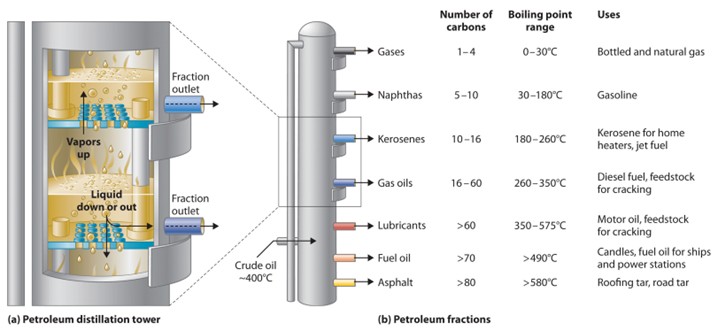
(a) This is a diagram of a distillation column used for separating petroleum fractions. (b) Petroleum fractions condense at different temperatures, depending on the number of carbon atoms in the molecules, and are drawn off from the column. The most volatile components (those with the lowest boiling points) condense at the top of the column, and the least volatile (those with the highest boiling points) condense at the bottom.
_
Fossil oils and fuels are products of crude oil straight from the depths of the earth. Fossil oil requires processing in oil refineries where it is rendered useable for various machinery and vehicles. Initially, the crude oil is treated to remove sand, water and salts in order to avoid corroding refinery process units. Within the petroleum refinery, the crude oil is prepared and refined via distillation at high temperatures. This takes place in a distillation tank 50 meters high, which is filled with crude oil and heated from below. The highest temperature occurs at the bottom and decreases progressively upwards within the column. At the top, the coolest gases and gasoline collect at 20° to 150°C, further down the column there will be kerosene and aviation fuel at 200°C, followed by diesel fuel and heavy fuel oil at 300° to 370°C and at the bottom there is lubricating oil, asphalt and tar at 400°C. A preferable distillation product ratio would yield approximately one half gasoline and one fifth diesel oil as seen in figure below.
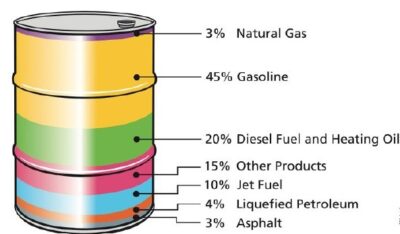
The world consumes approximately 102.5 to 105 million barrels of crude oil and petroleum liquids per day Today largest fossil fuel consumers are North and Central America, using about 20 million barrels per day. Europe uses nearly 15 million barrels a day and China is up to 9 million barrels per day. Saudi Arabia and Russia are the world‘s principal crude oil producers, reaching 10 million barrels a day, followed by the United States.
_
The economics of petroleum refining are complex. For example, the market demand for kerosene and lubricants is much lower than the demand for gasoline, yet all three fractions are obtained from the distillation column in comparable amounts. Furthermore, most gasolines and jet fuels are blends with very carefully controlled compositions that cannot vary as their original feedstocks did. To make petroleum refining more profitable, the less volatile, lower-value fractions must be converted to more volatile, higher-value mixtures that have carefully controlled formulas. The first process used to accomplish this transformation is cracking, in which the larger and heavier hydrocarbons in the kerosene and higher-boiling-point fractions are heated to temperatures as high as 900°C. High-temperature reactions cause the carbon–carbon bonds to break, which converts the compounds to lighter molecules similar to those in the gasoline fraction. Thus in cracking, a straight-chain alkane with a number of carbon atoms corresponding to the kerosene fraction is converted to a mixture of hydrocarbons with a number of carbon atoms corresponding to the lighter gasoline fraction. The second process used to increase the amount of valuable products is called reforming; it is the chemical conversion of straight-chain alkanes to either branched-chain alkanes or mixtures of aromatic hydrocarbons. Using metals such as platinum brings about the necessary chemical reactions. The mixtures of products obtained from cracking and reforming are separated by fractional distillation.
_
Octane Ratings:
The quality of a fuel is indicated by its octane rating, which is a measure of its ability to burn in a combustion engine without knocking or pinging. Knocking and pinging signal premature combustion, which can be caused either by an engine malfunction or by a fuel that burns too fast. In either case, the gasoline-air mixture detonates at the wrong point in the engine cycle, which reduces the power output and can damage valves, pistons, bearings, and other engine components. The various gasoline formulations are designed to provide the mix of hydrocarbons least likely to cause knocking or pinging in a given type of engine performing at a particular level.
The octane scale was established in 1927 using a standard test engine and two pure compounds: n-heptane and isooctane (2,2,4-trimethylpentane). n-Heptane, which causes a great deal of knocking on combustion, was assigned an octane rating of 0, whereas isooctane, a very smooth-burning fuel, was assigned an octane rating of 100. Chemists assign octane ratings to different blends of gasoline by burning a sample of each in a test engine and comparing the observed knocking with the amount of knocking caused by specific mixtures of n-heptane and isooctane. For example, the octane rating of a blend of 89% isooctane and 11% n-heptane is simply the average of the octane ratings of the components weighted by the relative amounts of each in the blend. Converting percentages to decimals, we obtain the octane rating of the mixture.
Many compounds that are now available have octane ratings greater than 100, which means they are better fuels than pure isooctane. In addition, antiknock agents, also called octane enhancers, have been developed. One of the most widely used for many years was tetraethyllead [(C2H5)4Pb], which at approximately 3 g/gal gives a 10–15-point increase in octane rating. Since 1975, however, lead compounds have been phased out as gasoline additives because they are highly toxic. Other enhancers, such as methyl t-butyl ether (MTBE), have been developed to take their place. They combine a high octane rating with minimal corrosion to engine and fuel system parts. Unfortunately, when gasoline containing MTBE leaks from underground storage tanks, the result has been contamination of the groundwater in some locations, resulting in limitations or outright bans on the use of MTBE in certain areas. As a result, the use of alternative octane enhancers such as ethanol, which can be obtained from renewable resources such as corn, sugar cane, and, eventually, corn stalks and grasses, is increasing.
_
Refinery feedstocks are crude oil and natural gas, which are extracted together at drilling sites. Natural gas is primarily made up of methane, but contains other heavier compounds called natural gas liquids, which are separated in a natural gas plant on site at the refinery.
Crude oil is a varying mixture of thousands of hydrocarbon compounds of different molecular weights, structures, and chemical properties. Because of their varying heats of vaporization, these compounds can be separated through distillation.
Table below lists compound categories resulting from the separation of natural gas and crude oil:
|
Common Name |
Compound Characteristics |
|
Methane |
C1 |
|
Ethane |
C2 |
|
Propane |
C3 |
|
n-Butane |
nC4 |
|
Isobutane |
iC4 |
|
Gasoline |
C4—C12 |
|
Naphtha |
Mid-Range |
|
Kerosene |
C6—C20 |
|
Diesel |
C10—C15 |
|
Fuel Oil |
Low Viscosity Residue |
|
Asphalt |
High Viscosity Residue |
|
Coke |
C, Free Carbon Deposits |
|
Hydrogen Sulphide |
H2S |
|
Aromatics |
Contain Ring Structures |
|
Paraffin |
Saturated Hydrocarbon |
|
Olefin |
Unsaturated Hydrocarbon |
_
Due to varying demands for products in different regions, and different characteristics of each crude oil feed, the layout and operation of refining processes is specific to each refinery. However, there are several general unit operations under the categories of separators, converters, and treatment steps used in every plant.
The first step in all refineries is to separate any light gases from the crude oil stream, which are sent to a refinery gas plant. The crude oil feed is then sent to an atmospheric distillation column, where compounds are separated into different classes based on their boiling points. Lighter fractions of the crude oil rise to the top of the column and the heavier fractions fall to the bottom.
_
Refinery gas plants process lighter hydrocarbon vapors (butanes, propane, ethane, and methane) in a series of separation steps. First, the feed stream for the gas plant is compressed and expanded to allow for some phase separation between lighter and heavier hydrocarbons. The heavier cut includes propane and butanes and is sent to a process downstream known as a debutanizer. The lighter cut, which includes ethane, methane and some butane and propane, is separated with an absorber.
_
With only a few different types of unit operations, refineries can transform crude oil into a set of intermediate product streams that have a wide range of applications. A refinery gas plant produces methane, ethane, propane, nbutane, and isobutane. Methane is typically retained within the refinery and used as fuel gas; it can also be used in select petrochemical processes. Ethane is a feedstock to ethylene plants, which produce polyethylene plastics. Propane in the primary component of liquified petroleum gas (LPG) which is the “natural gas” supply for homes and businesses around the country. N-butane is also a component in LPG and is used in gasoline blending; it also serves as a feedstock to some petrochemical processes. Isomerization plants convert n-butane to additional isobutane when the demand is present. Isobutane is a feedstock for petrochemical processes and alkylation plants, which convert lighter compounds into heavier compounds suitable for gasoline blending. Aromatics, including benzene, toluene, and xylene (BTX) are also separated from naphtha as it is reformed. These three compounds are the building blocks for thousands of petrochemical intermediates and products.
Gasoline, kerosene, and diesel are important transportation fuels, used in everything from consumer automobiles and long-distance trucking to airplanes. Fuel oil produced from the distillation residue of a refinery is one of the least valuable products of a refinery, and typically sells below the price of crude oil. It is used as fuel for marine vessel engines, power plants, and industrial facilities as well as for heating commercial buildings. It can also be blended with other compounds to produce lubricants, motor oils, and industrial greases. After being treated, petroleum coke has a variety of applications, including electrode and charcoal production and smelting. High viscosity asphalt residue is the base for asphalt roads and roofing materials.
_
Refinery product applications:
|
Common Name |
Compound |
Use |
|
Methane |
C1 |
Fuel Gas for Refinery Petrochemical Feedstock |
|
Ethane |
C2 |
Ethylene Plant Feedstock |
|
Propane |
C3 |
Liquified Petroleum Gas (LPG) |
|
n-Butane |
nC4 |
Gasoline Blending Isomerization Plant Feedstock Petrochemical Feedstock LPG |
|
Isobutane |
iC4 |
Alkylation Process Feedstock Petrochemical Feedstock |
|
Gasoline |
C4—C12 |
Gasoline Blending |
|
Kerosene |
C6—C20 |
Jet Fuel Kerosene |
|
Diesel |
C10—C15 |
Diesel Fuel |
|
Fuel Oil |
Low Viscosity Residue |
Heating Oil Engine Oil Maritime Fuel Oil |
|
Asphalt |
High Viscosity Residue |
Asphalt Roads Pitch |
|
Coke |
C |
Electrodes Smelting Industry |
|
Aromatics |
Benzene, Toluene, Xylene |
Petrochemical Feedstocks |
|
Hydrogen Sulphide |
H2S |
Petrochemical Feedstock |
_
The largest refinery in the world is the Jamnagar refinery complex, which is in India. This singular plant processes 1.2 million barrels (50.4 million gallons) of crude oil per day, but this only makes up 1.6% of global refinery capacity. At the Jamnagar refinery complex they produce gasoline, diesel and propylene, which is used to make other product like plastics, fibers and films. In September of 2020, the EIA estimated 95.3 million barrels are consumed globally per day. Oil consumption is not equal across the world however—the U.S. consumes about 20% of the world’s oil but is home to only 4.25% of the world’s population. Global energy consumption is set to increase as the global population grows and countries continue to industrialize, which will increase the demand for products and fuels derived from crude oil.
______
______
Processing of Natural gas:
Natural gas is another non-renewable fossil fuel of energy importance. It is a gaseous fuel. It is often found with oil deposits – either as a separate fraction or dissolved in it. Depending on the location of the reservoir, there are several types of natural gas: high-methane, nitrogen-rich, dry and wet.
The first of them is the most important, as it contains the most methane in its composition, up to 98%. In addition, natural gas also contains (in varying amounts) ethane, propane, carbon monoxide, carbon dioxide, nitrogen and helium. Importantly, natural gas has no odour. In order to detect its leakage quickly, it is odoured with special substances so that it can be easily sensed.
The natural gas extracted from the field is quite heavily contaminated. Thus, in order for it to be used by consumers, it must undergo purification processes. Natural gas processing is based on them.
The key stages of this process include:
- Dehydration – consists of eliminating the moisture contained in the gas. Some contaminants are also removed along with it. The water vapour in natural gas causes corrosion of pipelines and also leads to the formation of hydrates, which is why it is necessary to dry natural gas before releasing it into the network. The separated liquid is called formation water. It is taken to special storage facilities and then further purified. The methods used to dehydrate natural gas are absorption (glycols), adsorption (calcium and magnesium chloride salts) and membrane techniques.
- Carbon dioxide removal – this process is often referred to as decarbonisation. Along with sulphur, carbon dioxide is one of the more harmful pollutants in natural gas. CO2 is an acidic gas. It readily reacts with the water vapour in the gas and forms carbonic acid. Although it is a low-potency acid, it has a negative impact on, among other things, gas transport systems due to its corrosive properties. Therefore, decarbonisation of natural gas is necessary.
- Desulphurisation – the presence of sulphur in natural gas, e.g. in the form of hydrogen sulphide, is very detrimental. It not only affects the quality of the gas as a fuel, but also has poisonous and corrosive properties. Hydrogen sulphide is a highly toxic gas. Eliminating it from natural gas deposits is also an important step towards protecting the environment. Desulphurisation processes typically use physical adsorption and chemisorption methods. Activated carbon and zeolites, among others, are satisfactorily effective as adsorbents removing H2S. Absorption usually takes place by chemical reaction with natural masses (e.g. bog iron). One of the most effective methods of removing hydrogen sulphide is oxidation against a catalyst, the so-called Claus process. It involves the recovery of elemental sulphur from the H2S contained in the gas.
_______
Processing of Peat:
Peat is a fossil fuel with unique properties. It is considered the ‘youngest’ of the fossil coals. Peat formation involves the transformation of accumulated debris, mainly plant material. These processes are known as peatification. They occur at high moisture content and with limited access to oxygen. Peats are divided into homogeneous and heterogeneous, which are characterised by a mixed composition. Peat is separated from lignite by a conventional limit of elemental carbon content of 65% by weight. After extraction, peat is divided into three fractions, depending on grain size: small, medium and large. Freshly extracted peat is usually highly acidic, so additives such as dolomite powder are often used to reduce this acidity.
______
______
Petrochemical production from fossil fuels:
In 2022, United Nations (UN) Secretary General Antonio Guterres pointed to a frequently overlooked link between the pollution and climate crises, declaring that ‘plastics are fossil fuels in another form and pose a serious threat to human rights, the climate and biodiversity’ (2022). In doing so, he drew attention to the key role plastics and petrochemicals play in locking in fossil fuel production and consumption (Tilsted et al., 2023). Effectively produced exclusively from fossil fuels, used in a range of industrial processes, and serving as the fundamental component of synthetic materials, petrochemicals have been evolving as part of—and entrenched within—a petro-energy complex central to the fossil fuel energy order (Di Muzio, 2015; Hanieh, 2021). The petrochemical industrial sector uses fossil fuels for two purposes: As energy carrier and as feedstock (i.e. raw material), producing synthetic materials, industrial gases and fertilizer on an enormous scale (IEA, 2018). With an accelerating renewable energy transition and the expectation of peak fossil fuel use, the importance of petrochemicals as a source of fossil fuel demand continues to rise, and the continued use of hydrocarbons as feedstock becomes increasingly important. Recognizing the rise of electric vehicles and the decline of transport fuels as a market segment for oil and gas companies, petrochemicals constitute an important diversification strategy, with new production capacity ballooning in recent decades. Petrochemicals now constitute the main driver of oil demand growth, a trend that is set to continue in the coming decades (BP, 2023; IEA, 2024). Currently, the petrochemical industry uses ~8% of fossil gas and ~16% of global oil extraction in its production, making it the industrial sector with the highest energy demand (using approximately 50% more than steel and iron) (IEA, 2018, p. 27, 2023b, p. 27)
_
Petrochemicals are vital chemical compounds derived from crude oil and natural gas. They serve as the essential raw building blocks for manufacturing thousands of everyday products—including plastics, synthetic rubbers, fertilizers, detergents, packaging, and textiles—and are a primary focus for global energy and manufacturing sectors. Petrochemicals are derived from the refining and processing of petroleum or natural gas. As discussed above, the refining process creates a myriad of outputs that vary based on the specific input to the process – light crude, heavy crude, etc. Of interest are the three primary petrochemical outputs shown in Figure below. While there are numerous ways to categorize petrochemicals, a popular method is to conceptualize petrochemicals by their placement in the progression from feedstock to market products. For instance, the petrochemicals that are derived directly from feedstocks are often referred to as primary petrochemicals. Naturally, primary petrochemicals are further derived into various stages of intermediate petrochemicals that eventually yield end-use products. Differentiating between primary and intermediate petrochemicals is important since the latter often presents numerous, intricate, steps that vary based on the desired inputs and outputs.
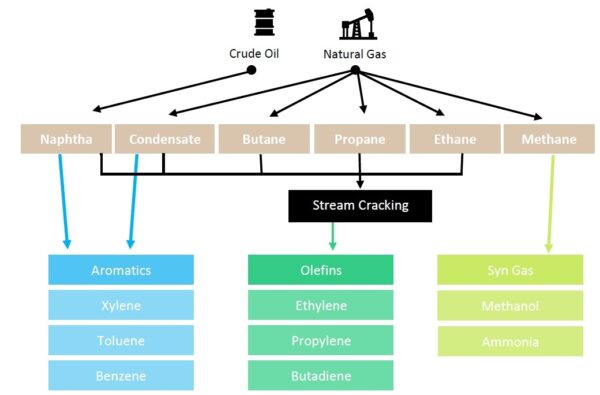
Figure above shows a sample petrochemical tree from feedstock to primary petrochemical output. Petrochemicals are divided into one of three categories left to right – aromatics (blue), olefins (green), or synthetic gas (yellow). These three categories are often referred to as the primary petrochemicals. The subsequent intermediate petrochemicals, that will eventually form end products, are derived from the primary petrochemicals.
Note that Figure above is a simplification of the primary petrochemical generation. That is, it does not include important considerations such as mass flow and yield for the different streams. Even so, the tree contextualizes the relationship between crude oil/natural gas and petrochemicals. Aromatic petrochemicals are the starting material for a wider range of consumer products and come almost exclusively from crude oil – and by extension naphtha. Olefins – compounds that contain one or more alkenes, but no other functional group – are derived from cracking feedstocks from raw materials. Lower olefins are of interest because of their use in plastic products, though higher olefins with chains up to twenty or more carbon atoms do exist. Synthesis gas (syngas) is a valuable byproduct from refineries in that they can be used to create methanol and ammonia.
_
Table below shows Petrochemical products across an assortment of industries. The selection below represents a sample of petrochemical products. Petrochemicals manifest themselves in several industries and products. Note that raw petrochemicals often undergo a rigorous transformation process to achieve final market products.
|
Thermoplastics |
• Polyethylene • Polypropylene • Polyvinyl Chloride
|
Plastics that can be remoulded when heated. As such, thermoplastics are recyclable. |
|
Thermosets |
• Polyethylene Terephthalate • Propylene Oxide
|
Plastics that cannot be remoulded after they are cooled. Thermosets are non-recyclable. |
|
Solvents |
• Acetic Acid • 2-Ethylhexyl Alcohol • Methyl-tert-butyl Ether
|
Solvents are used in a myriad of applications to dissolve other substances. |
|
Additives |
• Sulphites • Nitrites • Benzoates
|
Additives are used to preserve other substances. |
|
Fertilizers |
• Urea • Ammonium Sulphate • Nitric Acid
|
Fertilizers are used to enhance soil nutrients. |
Petrochemicals are well-contextualized by the markets and industries that they enter after intermediate processing. Petrochemicals are special, in part, because they can be used to make a seemingly endless selection of products (Table above). The economy is largely dependent on the petrochemical industry since so many products are made from petrochemicals. On a global scale, more than half of ammonia is converted to urea, which is primarily used as a fertilizer for elevated crop production. Unlocking the potential behind the petrochemical industry will be key to maximizing the energy industry and minimizing CO2 emissions.
______
______
Disadvantages of fossil fuels:
Land degradation:
Unearthing, processing, and moving underground oil, gas, and coal deposits take an enormous toll on our landscapes and ecosystems. The fossil fuel industry leases vast stretches of land for infrastructure, such as wells, pipelines, and access roads, as well as facilities for processing, waste storage, and waste disposal. In the case of strip mining, entire swaths of terrain—including forests and whole mountaintops—are scraped and blasted away to expose underground coal or oil. Even after operations cease, the nutrient-leached land will never return to what it once was. As a result, critical wildlife habitat ends up fragmented and destroyed, affecting breeding, migration, and other life cycle events and exacerbating the pressure on our planet’s biodiversity.
Water pollution:
Coal, oil, and gas development pose myriad threats to our waterways and groundwater. Coal mining operations wash toxic runoff into streams, rivers, and lakes and dump vast quantities of unwanted rock and soil into streams. Oil spills and leaks during extraction or transport can pollute drinking water sources and jeopardize entire freshwater or ocean ecosystems. Fracking and its toxic fluids have also been found to contaminate drinking water, a fact that the U.S. Environmental Protection Agency (EPA) was slow to recognize.
Meanwhile, all drilling, fracking, and mining operations generate enormous volumes of wastewater, which can be laden with heavy metals, radioactive materials, and other pollutants. Industries store this waste in open-air pits or underground wells that can leak or overflow into waterways and contaminate aquifers with pollutants linked to cancer, birth defects, neurological damage, and much more.
Air pollution:
Fossil fuels emit harmful air pollutants long before they’re burned. Active oil and gas wells (and even the millions of orphaned and abandoned ones) can leak benzene (linked to childhood leukemia and blood disorders) and formaldehyde (a cancer-causing chemical). A 2023 study estimated that air pollution from the oil and gas industry caused 7,500 excess deaths in US and $77 billion in health care impacts in just a single year. A booming fracking industry will bring that pollution to more backyards, despite mounting evidence of the practice’s serious health impacts. Mining operations are no better, especially for the miners themselves, generating toxic airborne particulate matter.
Fossil fuels emit more than just carbon dioxide when burned. Coal-fired power plants are the largest U.S. source of mercury emissions, which can lead to brain and developmental issues in children and cardiovascular, fine motor function, and memory problems for adults. These plants also emit arsenic and benzene from their smokestacks, both of which are known carcinogens, as well as soot (particulate matter) and sulfur dioxide (which contribute to acid rain). Meanwhile, fossil fuel–powered cars and trucks are the main contributors of poisonous carbon monoxide and nitrogen oxides, which produce smog on hot days and can lead to respiratory illnesses in people who experience sustained exposure.
Climate change:
Fossil fuels (coal, oil, and gas) are the primary drivers of climate change, accounting for over 75% of global greenhouse gas emissions. When burned for energy and transportation, they release massive amounts of carbon dioxide, which trap heat in the atmosphere, drive global warming, and cause extreme weather. In the US, transportation is now the largest source of heat-trapping emissions. The link between these emissions and climate change demonstrated by the increases in extreme weather like wildfires, drought, and flooding are clear. The fossil-fueled passenger cars and light-duty trucks Americans use to get around contributed in 2022 to a whopping 57 percent of the country’s total transportation emissions while the bigger vehicles, like delivery vans and semi-trailer trucks, contributed an additional 23 percent.
Ocean acidification:
When we burn oil, coal, and gas, the carbon that’s emitted changes the ocean’s basic chemistry, making it more acidic. Our seas absorb as much as 30 percent of all man-made carbon emissions. As the acidity in our waters goes up, the amount of calcium carbonate—a substance used by oysters, lobsters, and countless other marine organisms to form shells—goes down. This can slow growth rates, weaken shells, and imperil entire food chains. Ocean acidification impacts coastal communities as well. In the Pacific Northwest, it’s estimated to have cost the oyster industry millions of dollars and thousands of jobs.
______
There is no scientific doubt that fossil fuels are the principal cause of the climate crisis, as well as a major driver of toxic pollution and biodiversity loss.
Despite recognition of the need to phase out fossil fuels and significant progress in decarbonizing the energy sector, fossil fuel extraction and use are projected to increase.
The expanding production of plastics and petrochemicals particularly embeds fossil fuel dependence across sectors.
Fossil fuels cause severe harm at every stage of their life cycle:
- Exploration, site development and exploitation cause toxic pollution, evictions and displacement, water scarcity, biodiversity loss, and harm to livelihoods and cultural heritage, disproportionately impacting communities in vulnerable situations.
- Fossil fuel burning contributes to transboundary air pollution, exacerbating pre-existing health conditions and contributing to 8 million premature deaths annually.
- Decommissioning and site reclamation can leave pollutants in water and soil, hindering ecosystem restoration, agricultural productivity and water safety for generations.
- Plastics cause additional and distinct harms, including ocean, soil, water and air pollution and intergenerational health impacts.
- Petrochemicals introduce harmful substances into our food systems, harming the environment and human health.
______
______
When will fossil fuels run out?
The terms “reserves” and “resources” are often used interchangeably. However, there is an important distinction between the two. Every reserve is indeed a resource, but not every resource is a reserve. Two requirements determine whether a mineral resource becomes a reserve. The first is the degree of certainty that it exists: the planet likely has many mineral resources that we have not yet discovered. So to be defined as a reserve, we must have either a proven, probable, or possible understanding of its existence. The second criterion relates to the economic feasibility of being able to access and extract the mineral resource. To be defined as a reserve, it must be economically and technologically viable to recover. If the economics are subeconomic (i.e. would result in a net loss) or marginal, a mineral resource is not defined as a reserve.
_
Fossil fuels can be broadly categorized as either resources or reserves. Resources include all fuels, both those identified and those as yet unknown. Reserves are that portion of the identified resources which can be economically extracted and exploited using current technology. Petroleum reserves can be labelled under a wide variety of physical, chemical, and geological circumstances. For example, the boundaries between crude oil as a liquid and condensates have long been the subject of controversy. In addition, there are issues of definition as to what to include or exclude from a particular production forecast, as there are as to what can and cannot be reported as reserves because of legal and political considerations. The only near-certainty on the supply side is the actual volume of oil that has been produced. This is because the definitions of petroleum reserves often include assumptions with regard to existing technology and present economic conditions. However, there is no uniformity or stated policy as to the time period over which the existing technology and present economic conditions are anticipated to prevail. As a consequence, there is often fierce debate about how long existing petroleum reserves are likely to last and the economic consequences if future production cannot meet demand.
_
Estimating how much coal, oil and natural gas is left is complex. However, fossil fuels are indeed running out. Based on current production rates and known reserves, fossil fuels are estimated to run out within this century. Proven oil reserves stand at around 1.65 trillion barrels globally, which, at current consumption rates, could last roughly 40 to 50 years. Coal’s known reserves could stretch to about 130 years, while natural gas reserves may extend supply for around 50 to 60 years under current demand scenarios. These estimates may shift due to new discoveries, improved extraction technology, and accelerating transitions to renewable energy.
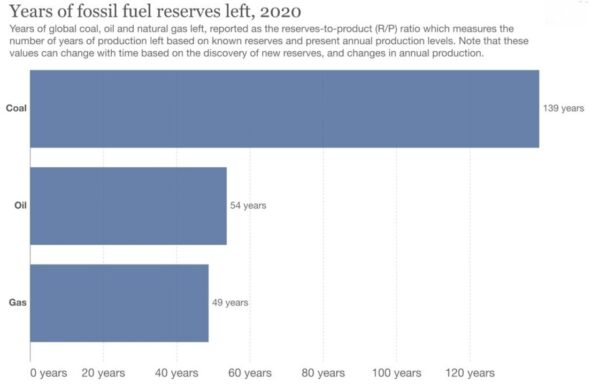
Predictive models can also factor in geopolitical uncertainties and the pace of discoveries. However, all major energy research bodies agree that fossil fuel reserves are finite and depleting. Even if new resources are found, the easy-to-reach, high-quality deposits have primarily been tapped, leaving more challenging, expensive and environmentally risky extraction ahead.
_
Factors Influencing Lifespan of Fossil Fuels:
- Consumption Rates: As easily accessible, cheap fossil fuels are depleted, extraction becomes more expensive, but rising prices can make previously unviable deposits profitable.
- Technological Advances: New techniques (e.g., hydraulic fracturing) can extend the life of reserves by allowing access to tighter or deeper resources.
- Transition to Renewables: International climate agreements and the push for renewable alternatives may decrease the demand for fossil fuels, leaving some known reserves in the ground.
- New discoveries: Exploration may uncover additional reserves, altering projections.
Although we are unlikely to fully exhaust every last drop of oil or ton of coal, the point at which they become too expensive and technologically challenging to extract is fast approaching, likely well before the end of the 21st century.
__
According to the 2015 World Energy Outlook by the International Energy Agency, current production rates indicate oil will last for approximately 53 years, natural gas for 54 years, and coal for 110 years. The Energy Institute’s 2024 Statistical Review of World Energy suggests that there are 139 years left until we officially run out of coal. However, the planet will never completely run out of oil, as some of the oil is in inaccessible places like Antarctica and may be made deep inside. Fossil fuels have formed over an extensive period of time from the remains of plants and animals that lived millions of years ago. Humans have been using them in ample amounts since the 19th century, and with our current rate of consumption, fossil fuel resources are depleting much faster than their regeneration potential.
_
Scenario of depletion of fossil fuels:
The fossil fuel industry claims that society cannot function without its products. If fossil fuels were eliminated, even maintaining current infrastructure would face significant obstacles, and international enterprises would struggle to operate effectively. The depletion of fossil fuels could lead to a shutdown of coal and gas power plants, soaring energy costs, and a possible shift towards nuclear energy, despite its high costs. Without fossil fuels, modern civilization would instantly collapse. Global transportation, agriculture, and power grids would fail.
Food Crisis:
- No Synthetic Fertilizers: Natural gas is essential for the Haber-Bosch process, which creates ammonia. Without it, global food production would plummet, leading to mass starvation.
- Farm Machinery: Tractors, harvesters, and irrigation pumps rely entirely on diesel. Farming would immediately revert to animal and manual labor.
Energy & Transportation:
- Power Grid Failure: Coal and natural gas power plants would shut down, halting electricity to homes, hospitals, and water treatment facilities.
- No Global Travel: Without petroleum, aviation, shipping, and trucking stop completely. Supply chains would freeze, causing shortages of raw materials and medical supplies.
Everyday Products & Materials:
- Plastics Disappear: Petroleum derivatives are the building blocks of most plastics. This means no medical syringes, packaging, smartphones, or computers.
- Infrastructure Loss: Asphalt for roads, synthetic rubber, lubricants for machines, and many pharmaceuticals would vanish
_
The world has consumed fossil fuels for approximately 225 years and the time frame over which fossil fuels consumed is orders of magnitude smaller than the time it takes to make fossil fuels from plant residues. Naturally, question arises as to how long can we sustain the fossil fuel production considering the fact that we cannot replace them within the time frame we are consuming.
For any naturally occurring mineral (including oil, gas or coal), we can define the resource base using resource triangle. As shown in Figure below, minerals present in natural state can be represented by this triangle. The quality of resource is the best at the apex of the triangle, but the resource is small. As we move towards the base, the quality of resource decreases significantly but the volume also increases significantly. The only way the resource at the bottom can be exploited is if we continue to develop better technology to cost-effectively produce it and there is a continued demand for this resource.
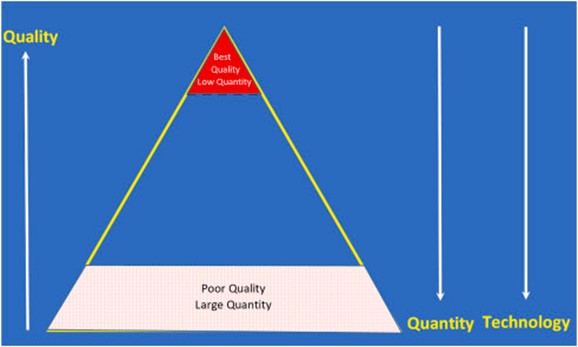
Figure above shows Resource triangle for naturally occurring minerals.
Oil, gas and coal are not exceptions to this resource triangle rule. A good example of such resource is oil and gas shales. Unlike reservoir rock where oil and gas migrates from the source rock and gets trapped, source rock is the place where oil and gas is generated. Not all the oil or gas migrates from the source rock and significant amount may stay within the pores of the source rock. Unfortunately, the source rock pores are much smaller than conventional reservoir rocks; hence it is not possible to produce oil and gas very easily from these source rocks. On the flip side, the size and volume of the source rock is enormous and contain large quantities of trapped oil and gas. A good example is Marcellus Shale which covers most of the Pennsylvania, parts of Ohio, New York, West Virgina, Virginia, Tennessee and Kentucky. According to API, Marcellus covers 95,000 square miles [246,250 square kilometers] and contains 410 trillion cubic feet [11,600 billion m3] of gas. If appropriate cost-effective technology can be developed to exploit this resource, the amount available for exploitation is orders of magnitude bigger than conventional oil and gas reservoirs. Contrast this to the largest conventional gas resource discovered in the US– Hugoton gas field – which contained about 14 trillion cubic feet [395 billion m3] of recoverable gas.
_
In early 2000’s, oil and gas industry stumbled upon such a cost-effective technology. The twin technologies of horizontal well drilling and massive hydraulic fracturing resulted in our ability to produce oil and gas from these marginal resources. The name “Shale Revolution” is a misnomer since in early phases of this revolution, the technology was used for shale reservoirs, but eventually, the technology also expanded to very tight reservoir rocks.
The twin technologies of horizontal well drilling and hydraulic fracturing allowed the oil and gas operators to access large underground resource by drilling a single vertical hole connected to long lateral in the reservoir. The long lateral provided a better connectivity in the reservoir and by creating large number of transverse fractures across the length of the well, the technology was able to create large surface area of the fractures which can connect to very tight reservoir.
Starting in 2006, the first tight gas and then tight oil reservoirs were developed using combination of horizontal wells and hydraulic fracturing technologies. Over the last 20 years, more than 200,000 horizontal wells have been drilled in the US with continued, improved, technologies. This technological evolution has allowed US operators to exploit very tight resources resulting in all time high production of oil and gas in the US.
_
Even with this efficient technology, the recovery factor (% of oil and gas recovered compared to resource available) for many of these tight formations is less than 10 %. This means that with additional improvement in technologies, it is possible to produce significant amount of additional oil and gas from these reservoirs. Although most of the technological evolution has happened in North America, other countries are also catching up with these technologies and eventually will develop the tight resources using US based expertise. For example, in February of 2024 Saudi Aramco announced a new discovery of gas and condensate reserves using similar technology in Jafura Basin. Aramco stated that it has discovered 229 trillion cubic feet of gas [6485 billion m3] and 75 billion barrels of oil [12 billion m3]in this field. Saudi Arabia is not the only country which is pursuing the exploitation of oil and gas resources from these types of tight formations. Most countries with conventional oil and gas production are interested in exploiting this resource and with significant reduction in cost and efficiency in the operations, it will become increasingly more feasible to exploit these resources.
In a nutshell, new discoveries and technological advances can extend lifespan of fossil fuels on earth far beyond all predictions.
______
______
Section-5
Decarbonization and defossilization:
In 2020, the chemical industry accounted for 14% of global oil consumption and 9% of global gas consumption. It also generated 13% of global industrial direct CO₂ emissions (Martín, 2025; Chung et al., 2023; Gabrielli et al., 2023; Meng et al., 2023). When downstream use-phase emissions are included, the industry accounts for 45% of global industrial greenhouse gas (GHG) emissions (World Economic Forum, 2023). These figures underscore a critical reality that cannot be overlooked: substantial reductions in resource use from this sector could lead to a notable decrease in global emissions, reaching up to 39% (World Economic Forum, 2023).
However, this sector is unique since the carbon molecule forms the backbone of chemical compounds, requiring solutions that go beyond mere emission reduction. While the industry cannot simply eliminate it entirely, there are strategies that can be implemented to address this issue. There are two key and complementary pathways:
- Decarbonization: The process of reducing GHG emissions associated with industrial operations, primarily by improving energy efficiency, adopting electrification, and transitioning to low-carbon energy sources.
- Defossilization: Replacing fossil-derived raw materials with renewable or alternative carbon sources, such as biomass or recycled carbon, to reduce environmental impact. This approach fulfills the fundamental requirement for carbon in chemical structures while reducing dependence on fossil resources and minimizing the overall carbon footprint.
__
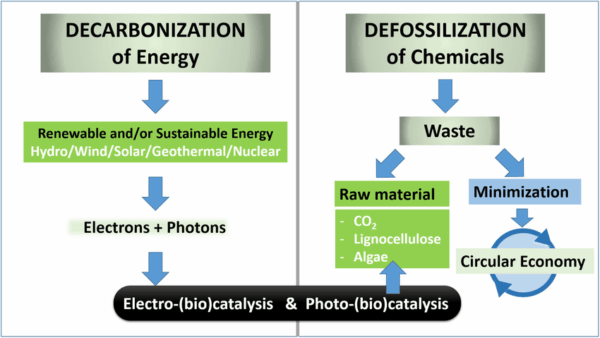
_
As climate action accelerates, two terms are shaping the future of industry and sustainability: decarbonisation and defossilization. While often used interchangeably, they target different aspects of the carbon challenge-especially in sectors like chemicals, energy, and manufacturing.
Decarbonisation: Cutting Emissions:
Decarbonisation refers to reducing or eliminating carbon dioxide (CO₂) emissions from industrial and economic activities. This is achieved through:
- Switching to renewable energy (solar, wind, hydro)
- Electrifying processes
- Improving energy efficiency
- Implementing carbon capture and storage (CCS)
The goal is to reach “net zero” emissions, particularly in sectors like power generation and transport, where carbon can be removed from the process entirely.
Defossilization: Replacing Fossil Carbon:
Defossilization goes a step further. It means eliminating fossil-derived carbon from materials and products by replacing fossil feedstocks (like oil, gas, and coal) with renewable or recycled carbon sources. This is critical for industries-such as chemicals and plastics-where carbon is an essential building block and cannot simply be removed.
Key defossilization strategies include:
- Using bio-based or recycled feedstocks
- Capturing and reusing CO₂ as a raw material
- Creating circular systems to keep carbon in continuous use
Biomaterials, particularly plant-based renewable chemicals, are fundamental to industrial defossilization because they utilize carbon already circulating within the biosphere. Through process of photosynthesis, plants absorb atmospheric CO₂ and convert it into biogenic carbon, a renewable feedstock that can be applied in industry for chemical production. When incorporated into industrial processes, these feedstocks help reduce dependence on fossil carbon and support climate mitigation by (i) enhancing carbon sequestration within agricultural systems (ii) substituting fossil-derived sources for biogenic carbon, and (iii) keeping the carbon embodied in the product throughout its life cycle. This means renewable chemicals can reduce emissions without compromising performance or functionality. According to the World Economic Forum (2023), bio-based innovations play a key role in promoting circularity and can substantially reduce both production-related and downstream emissions. As global markets evolve and regulatory pressures increase, renewable feedstocks offer not only an environmental solution but also a strategic advantage.
In a nutshell:
- Decarbonisation is crucial for reducing emissions from energy and processes.
- Defossilization is essential for industries that require carbon in their products, ensuring that carbon comes from sustainable, non-fossil sources
Both strategies are essential for a sustainable, climate-neutral future-each addressing unique challenges on the path to net zero. Decarbonisation focuses on reducing the carbon content of various sectors, primarily aiming to decrease CO2 emissions. This approach is feasible for energy and other sectors that can be almost completely decarbonised. However, for materials like plastics, which are made from carbon-based feedstocks, decarbonisation is not possible. Instead, defossilization is necessary to reduce reliance on fossil resources and use renewable carbon sources. This dual approach is essential for achieving net-zero targets and addressing climate change effectively. Both approaches are complementary in a circular carbon economy (CCE), which balances environmental, technical, and economic goals.
_
Since defossilization is distinct from decarbonization, the two do not need to overlap as seen in figure below.
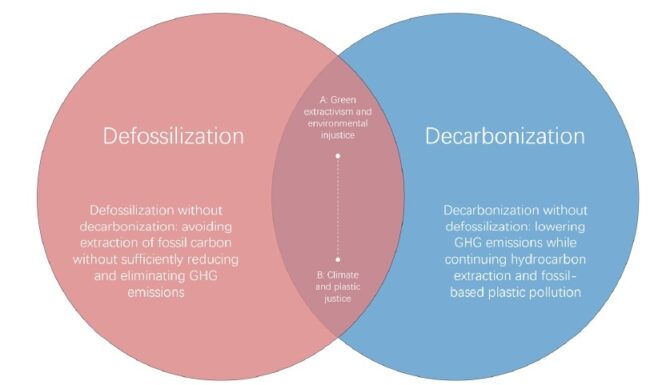
Figure above shows Stylised diagram illustrating the overlap and distinction between decarbonisation and defossilization. Decarbonization and defossilization here refer to processes of lowering carbon emissions and the use or extraction of hydrocarbons, respectively. The points A and B in the overlapping section denote two ideal-typical scenarios of decarbonization alongside defossilization, constituting a spectrum.
The lowering of emissions can, at least in theory, occur without phasing out fossil fuels. On the other hand, pursuing defossilization does not guarantee decarbonization. If sourcing biomass as feedstock, the ambition to defossilize would also be associated with increased and intensified land use alongside deforestation, working counter to decarbonization (and biodiversity conservation) (Helm et al., 2025). Defossilizing the industry at its current scale would also entail vast green hydrogen production and thus energy use (Meng et al., 2023), which can lead to additional emissions if the production is not flexible enough or the electricity mix is not sufficiently renewable (Ricks et al., 2023; Zeyen et al., 2024). Hydrogen leakage could further contribute to global warming, and capturing carbon for feedstock purposes in practice delays rather than eliminates carbon emissions because the carbon remains in circulation (de Kleijne et al., 2022; Sand et al., 2023). Moreover, the chemical recycling routes that industry actors promote, claiming to address the constraints related to mechanical recycling (such as degrading material quality and incompatibility between plastic types), are highly energy intensive (Mah, 2022, 2023). Chemical recycling thus also points to a path of defossilization without decarbonization.
Pursuing decarbonization without attending to defossilization implies that the two are independent, but this comes with a high risk of carbon lock-in. First, petrochemical infrastructure incentivizes continued extraction to supply enough feedstock to maintain profitable capacity utilization rates—ensuring that the facilities are not left unused. Operational petrochemical clusters increase the value and improve the profitability of fossil fuel assets to (vertically integrated) owners (Tilsted et al., 2023). Second, because of the co-production of feedstock and fuel in refineries, the extraction of fossil hydrocarbons for feedstock purposes implies fuel production, serving to keep fossil fuel prices low. Recent techno-economic modelling shows that such mechanisms alone serve to undermine decarbonization (Zanon-Zotin et al., 2024). Decarbonization without defossilization entails steadily and unproblematically increasing the global share of oil going to petrochemical production.
The chemical industry is foundational to modern economies and societies, underpinning broad economic sectors ranging from agriculture and construction to healthcare and consumer goods. However, the industry is also among the most carbon-intensive human activities, contributing to approximately 6% of the global CO2 emissions. As many chemicals are derived from carbon-based feedstocks, the challenge for the chemical industry is not to decarbonize but to “defossilize,” using both renewable energy and sustainable carbon sources as a feedstock.
_
How does defossilization differ from decarbonization in practice:
In practice, decarbonization and defossilization tackle different parts of the same problem: decarbonization focuses on cutting greenhouse gas emissions, while defossilization focuses on stopping use of fossil based carbon as a raw material. Together they address both energy/emissions and material/industrial feedstock sides of the fossil fuel system.
- Decarbonization means reducing or eliminating CO₂ emissions by switching from fossil fuels to renewables, electrifying processes, and using carbon capture or offsets in energy, transport, and industry. It asks: “How do we run this plant or vehicle with zero net emissions?”
- Defossilization means replacing fossil hydrocarbon feedstocks (oil, gas, coal) with sustainable carbon sources (biomass, captured CO₂, recycled plastics) in chemicals, materials, and fuels, even when emissions are already low. It asks: “Where does the carbon in this plastic, chemical, or fuel actually come from?”
Differences in concrete actions:
- Decarbonization in practice:
-Power generated from wind/solar instead of coal.
-Industrial boilers and heaters switched from gas to electricity or hydrogen.
-Capture and storage/utilization of process CO₂ to reach net zero emissions.
- Defossilization in practice:
-Making ethylene from sugarcane or captured CO₂ instead of naphtha from oil.
-Producing polymers from recycled plastic waste or biomass rather than virgin fossil feedstocks.
-Using biogenic carbon or CO₂ based routes for fertilizers, fuels, or specialty chemicals.
Why the distinction matters:
In sectors like chemicals and plastics, carbon is a structural ingredient, not just an energy carrier, so switching to “green” electricity alone does not remove dependence on fossil reserves. Defossilization closes this gap by ensuring that the carbon atoms in products are renewable or recycled, while decarbonization ensures that the energy used to make them is low or zero emission.
______
______
Greenhouse gases:
Organic chemistry is one of the important drivers for the emergence of the Second Industrial Revolution. In the meantime, products generated by the art of chemistry find applications in virtually any industry sector yielding products including but not limited to plastics, consumer goods, lubricants, adhesives, healthcare products, and agrochemicals. It’s as simple as that – no modern life without chemistry. Scarcity of resources, energy crisis, supply chain issues, environmental degradation, and most importantly the need to minimise greenhouse gas (GHG) emissions have raised the interest in strengthening supply chain diversification, local industrial resilience, nature conservation, and above all in the transformation towards a net-zero chemical industry. Of note, net-zero does not mean zero emissions, but rather that the amount of GHG emitted is balanced by active removal and sequestration of a similar amount from the atmosphere or from process or incineration gases.
_
Emissions generally accrue at three different stages as seen in figure below:
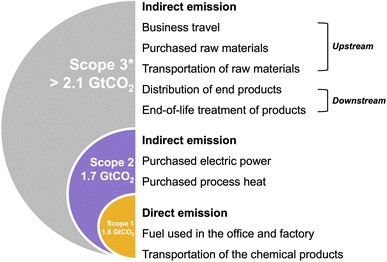
Scope 1 emissions are directly caused by sources owned or controlled by the manufacturing firm; scope 2 are indirect emissions attributed to the purchase of electric power or process heat, while scope 3 are indirect emissions that result from the activity of a firm but are not under their direct control. Scope 3 emissions are further divided into upstream emissions encompassing emissions resulting from the production of purchased raw materials and services (including raw material extraction and transportation), and downstream emissions including distribution of finished products, product use and end-of-life (EOL) treatment of the manufactured goods. In fact, scope 1 and 2 GHG emissions of the chemical industry are considerable, amounting to 6% of global emissions (3.5 Gt CO2 eq. out of 59 Gt CO2 eq.). Assessment of scope 3 emissions is notoriously difficult, as it requires emission data input from suppliers, producers, distributors, users as well as from facilities disposing, treating and processing waste. Recent published work indicated scope 3 upstream emissions may add up more than 50% of the already accounted for GHG emissions. This suggests that the total emissions from the chemical industry could indeed exceed 5.6 Gt CO2 eq. hence representing nearly 10% of the total global CO2 emissions.
_
While reducing a considerable fraction of scope 1 and 2 emissions is possible by adopting alternative organisational routines, using renewable instead of fossil-based utilities or optimising logistics, abating scope 3 is challenging. The essential reason is that most organic primary chemical products are composed to a considerable extent (>80% w/w) of carbon currently predominately derived from the geosphere in the form of oil, gas, and coal. In addition to fossil-based GHG emissions accruing upstream during feedstock mining, transportation and transformation, at the EOL (End-of-Life) of the manufactured chemical or chemicals-containing products, vast amounts of carbon previously safely stowed away underground are released in the course of incineration, biological or chemical degradation (e.g. in the sewage treatment plants). If not captured and sequestered, these gaseous carbonaceous (CO2, CO, methane) GHG waste stream are subsequently released into the atmosphere. As the resulting carbon chain is linear, carbon from the geosphere is hence continuously carried over into the atmosphere thereby significantly contributing to global greenhouse gas emissions.
_
In alignment with the Paris Agreement to limit global warming to 1.5 °C by the end of this century, CO2 emissions should reach net-zero by 2050 in any larger geopolitical area. For example, China, as the largest emitter of GHG in the world, has planned to reach peak CO2 emissions by 2030 and is committed to achieving carbon neutrality by 2060 through implemented policies, including a national emissions trading system and investments in renewable energy. The European Union is acting under its European Green Deal, aiming GHG emissions be 55% lower in 2030 compared to 1990, meanwhile the European Commission acknowledges electrification and hydrogen as key technologies. Furthermore, the global drive to use non-fossil based fuels in the transport sector (renewable fuels of non-biological origin or RFNBO, recycled carbon fuels or RCF, and sustainable aviation fuel or SAF) are pillars recognised to contribute to the deployment of net-zero technologies for supply of redox-reduced carbon though predominately for energetic applications and not as feedstock. On the international level, the chemical industry is sharing the 1.5 °C goal and has to work on reducing its CO2 emissions to achieve net-zero by 2050.
______
Common industrial decarbonization strategy elements:
|
Energy efficiency |
Energy consumption reduction, system efficiencies, process yield enhancements, thermal energy recovery |
|
Industrial electrification |
Electrification of industrial processes, low-carbon electricity sources, renewable power |
|
Low-carbon fuels and energy sources |
Clean energy technologies, hydrogen, biofuels, renewable energy |
|
Carbon capture, utilization, and storage (CCUS) |
Capturing CO2 emissions, CO2 utilization, CO2 storage, emissions reduction |
|
Circular economy and resource efficiency |
Material recycling, waste reduction, resource optimization |
|
Sectoral interventions |
Targeted industries, such as steel, cement, chemicals and refining |
|
Innovation and technology development |
Research and development, technological innovation, scaling up new technologies |
|
Policy and regulatory frameworks |
Supportive policies, financial incentives, carbon pricing, regulatory measures |
|
Stakeholder engagement |
Public–private partnerships, community involvement, industry collaboration |
|
International cooperation |
Cross-border partnerships, knowledge sharing, global initiatives |
_____
_____
Emissions-reduction pathways:
Chemical industry decarbonization strategies typically conclude that five process and technological pathways—which include energy efficiency, material efficiency, renewable energy and electrification, alternative feedstocks (i.e., defossilization), and carbon capture, utilization, and storage—will reduce chemical sector emissions. These are not all necessarily distinct; some may overlap, such as alternative feedstocks and carbon capture, utilization, and storage. The optimal combination of strategies varies by region, plant type, resource availability, and other local and global conditions. A meta-analysis of decarbonization roadmaps modeling net-zero and negative chemical sector emissions by 2050 at the national, European, and global levels found that no single reduction pathway dominates (Kloo et al. 2023). Notwithstanding differences in scope, accounting, and circumstance, the study found a range of modelled emissions reductions in the chemical sector for each pathway (range across the literature indicated in parentheses below).
-Energy efficiency (2–32 percent):
Increasing the amount of product for a given amount of energy and resources through integrating processes, using waste heat, switching catalysts, and other changes.
-Circular economy (2–11 percent):
Recycling products for reuse in plants to reduce virgin material use or processing energy. Increasing recycling rates, cutting single-use products, and turning waste into resources (e.g., CO2, heat) can improve circularity.
-Renewable energy and electrification (18–61 percent):
Switching from fossil energy to clean electricity and heat powered by wind, solar, and other zero-carbon sources like geothermal, hydropower, and nuclear. Batteries, thermal storage, and other energy storage technologies further enable electrification.
-Alternative feedstocks (defossilization):
Switching away from fossil feedstocks to low- or zero-emitting feedstocks to create defossilized chemicals. These include biomass (6–59 percent), captured CO2 (i.e., direct air capture or point source capture), electrolytic hydrogen (CO2 + H2 feedstocks, 1–145 percent), municipal waste, and biogas. (Emissions reductions of more than 100 percent indicate negative emissions.) Biomass includes forest and agriculture wastes, sugars and starches, energy crops, and lipid oils. Because converting natural land to feedstock biomass can cause high land-use emissions, using waste biomass is preferable.
-Carbon capture, utilization, and storage (17–68 percent):
Technology that separates and captures CO2 molecules from emission streams. This holds great potential for hydrogen and ammonia, which produce highly concentrated CO2 streams, but it could also be used for refinery fluid catalytic crackers and cement kilns (Byrum et al. 2021).
An illustrative net-zero scenario by Saygin and Gielen (2021) found CCUS to yield the largest reduction percentage, although it is not a dominating strategy; other approaches, among them alternative feedstocks like electrolytic hydrogen from renewable power and biomass, also contribute prominently and fairly evenly.
In the United States, the DOE (2023a) projects that electrification, electricity grid decarbonization, and carbon capture and storage will be the most effective levers to achieve net zero, specifically targeting production emissions.
______
Why are industrial emissions challenging to reduce?
There are two main reasons why industrial emissions are challenging to reduce:
-1. Many industrial processes require high-temperature heat, and the electrification of such heat is not yet mature. Therefore, in many cases, molecules are still used as the primary energy source.
-2. In some instances, these molecules serve not only as an energy source but also as feedstock (e.g. in the chemical industry) or as a reducing agent (e.g. in the steel industry to reduce iron oxide to iron).
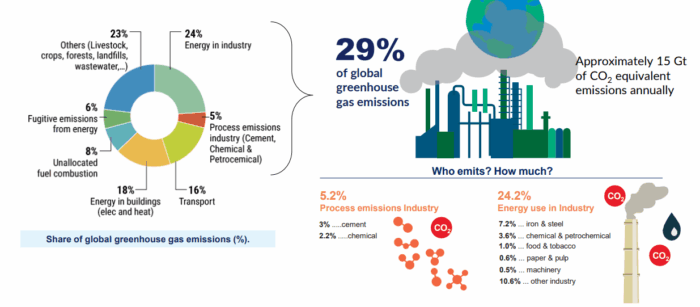
29 % of global GHG emissions are industrial emissions as seen in figure above.
New technologies for electrifying high-temperature heat could make industrial energy use fully electricity-based in the future. This requires significant investments in renewable electricity generation and grid infrastructure. Even if electrification is achieved, molecules will still be crucial as feedstock and reducing agents. Molecule-based and electron-based technologies will be needed to aid our progress toward net zero, while AI and digital technologies can help deploy these innovations more effectively to further accelerate the energy transition.
-1. Molecule Based Technologies
The chemical and petrochemical sectors currently rely on oil and gas as feedstocks for producing fuels, chemicals, and materials. Therefore, the need to defossilize rather than decarbonize. Both carbon and hydrogen are essential building blocks of organic chemistry (and hence also life science or pharmaceutical) applications, making it impossible to eliminate their use in chemical and material production entirely. Technologies exist to convert these feedstocks, either biologically or via electricity to generate plasma, into fundamental building blocks for chemicals, materials and pharmaceuticals. Using renewable electricity and biogenic/atmospheric CO2 enables the creation of carbon-neutral fuels, chemicals, materials and pharmaceuticals.
-2. Electron based Technologies
We can use electricity to produce heat or generate microwaves for converting feedstocks like carbon molecules or iron ore into chemicals, materials, and steel. While novel heat pumps cannot deliver heat above 200°C (and we do not see this changing over the next decade(s)), they are suitable for industries like food processing, textiles, and paper. A key issue with current heat pumps is the high global warming potential of the refrigerants used. Elastocaloric heat pumps offer higher efficiencies and avoid harmful refrigerants. Additionally, new technologies use renewable electricity to reach very high temperatures up to 1,000°C, traditionally met by molecular energy sources for use in ‘heavy’ industries such as chemical, cement, glass, and steel.
-3. Digital Technologies
Digital technologies can contribute to the defossilization of industries. A digital twin model coupled with AI combines numerical simulations with real-world observations to provide a comprehensive understanding of the performance of industrial processes. This approach allows for the identification of potential efficiency improvements and offers capabilities such as condition monitoring and predictive maintenance. By combining human expert knowledge with AI-based digital systems (both data-based and rule-based), more informed and accurate decisions can be made compared to either method alone. The goal is to enhance operational efficiency and to reduce downtime in industrial processes.
_______
While energy-intensive sectors such as power generation and transport have begun to “decarbonize’’ through electrification and renewable electricity integration via grid adjustments and storage expansion, the chemical industry faces a more complex challenge: its carbon footprint is not only energy related but also embedded in the molecular structure of its products. Based on its energy and process purposes, the sector emits an equivalent of 1.3 Gt of CO2. This is only one-third of its CO2 footprint, though. The sector uses fossil hydrocarbons, i.e., oil, gas, and coal, as feedstock source of carbon and hydrogen to produce chemicals and plastics. As depicted in Figure below, the carbon incorporated in the sector’s end products is double its direct emissions, leading to an additional amount of carbon equivalent to 2.6 Gt of CO2 annually. This implies that “decarbonization” is not possible since carbon is an essential feedstock of chemicals, plastics, and materials. Defossilization of the chemical industry is not only a more appropriate term for the chemical sector but also particularly challenging, as it requires not only cleaner energy inputs but also a fundamental shift in feedstock sourcing and process design. Figure below also shows that 70% of the overall chemical sector emissions are associated with the production of only three chemicals: methanol (a building block for chemicals), ammonia (primarily used in fertilizers), and ethylene (primarily for plastic production). Encouragingly, these three chemicals can be entirely defossilized, as shown for e-ammonia, e-methanol, and e-ethylene.
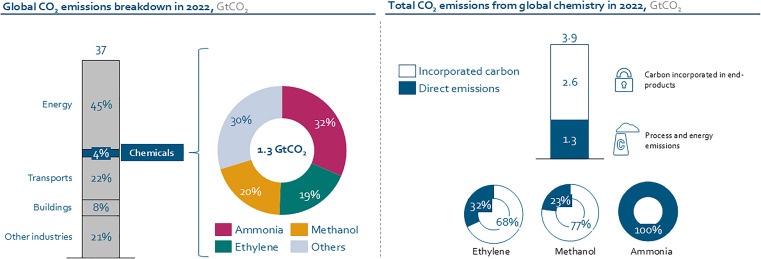
Figure above shows chemical sector’s direct emissions account for around 4% of global CO2 emissions or 1.3 GtCO2 (IEA, 2023), of which ammonia, methanol, and ethylene production take a 70% share.
______
______
Bridging the gap between defossilization and decarbonization through Circular carbon economy (CCE):
The CCE approach incorporates energy efficiency, renewable energy, electrification, low-carbon fuels, and carbon capture, utilization and storage, particularly offers a practical pathway for oil and gas (O&G) producing countries to transition towards net-zero industrial emissions. CCE allows these and similar countries to balance environmental goals with technical, economic, social and political challenges associated with defossilization.
The circular carbon economy (CCE) approach, as shown in figure below focuses on the reduction, recycle, reuse and removal of carbon dioxide (CO2) to achieve net-zero emissions, is endorsed by major oil and gas (O&G) producing and exporting countries and is gaining traction as a decarbonization approach (Dong et al 2022). The CCE framework aims to integrate carbon management strategies that support the continued use of fossil fuels (Alsarhan et al 2021, Shehri et al 2023). Technologically, CCE emphasizes CCUS and hydrogen, aiming to align fossil fuel use with climate goals. Also as shown in figure below, CCE can be extended to explicitly consider the potential impacts of upstream emissions from fossil fuel, and even hydrogen, extraction and transport (Sun et al 2024).
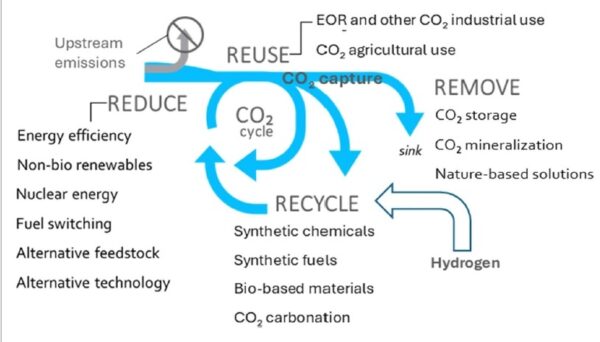
Figure above shows Circular carbon economy (CCE) framework.
____
US industrial decarbonization → CCE → defossilization.
The US approach to industrial decarbonization, which is shown in figure below, exemplifies how industrial decarbonization pillars integrate into national industrial decarbonization strategies.
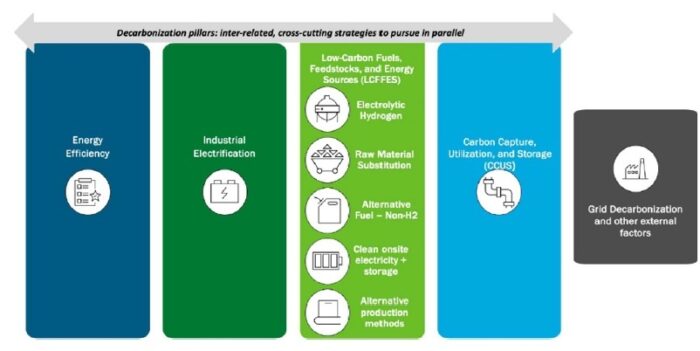
Figure above shows US industrial decarbonization pillars (Source: U.S. Department of Energy 2023).
_
As shown in figure below, the US industrial decarbonization roadmap indicates that CCE can serve as a bridge to industrial decarbonization that, in the coming decades, is increasingly oriented towards reduced fossil fuel extraction and use, depending on the extent to which efficiency, electrification and renewable energy can penetrate heavy industries, carbon capture from point sources is replaced with carbon removal using technologies like direct air capture (DAC) and low-carbon fuels are derived mainly from renewable sources.
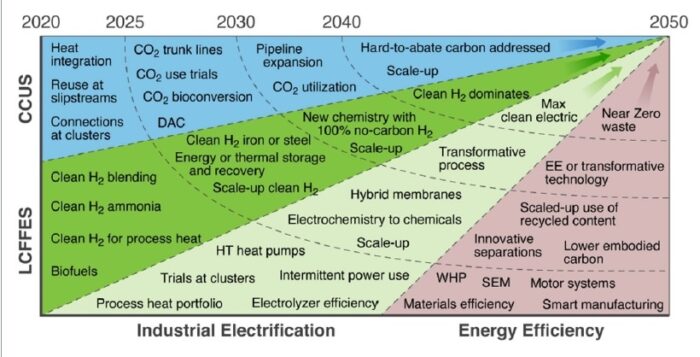
Figure above shows US industrial decarbonization roadmap (2020–2050) (Source: U.S. Department of Energy 2022). So, the CCE framework can clearly be a bridge to defossilization technically,
__
The CCE framework, which includes a diversity of decarbonization approaches, offers resource-rich countries a practical and more economically viable pathway for decarbonization that, importantly, would allow for those countries with the responsibility and capability to develop CCE technologies and approaches to benefit the global community by doing so (Yiakoumi et al 2023). Perhaps most importantly, however, the CCE framework can serve as a bridge to defossilization, which aims to completely, or as completely as possible, eliminate hydrocarbon extraction and use over the long term, reflecting the ‘phase-out’ or ‘phase-down’ approach to decarbonization (Trencher et al 2022). Key to this perspective is a vision for achieving a closed-loop CO2 emissions cycle that could, for instance, support the production of CO2-derived fuels, such as methanol and sustainable aviation fuels, that many suggest will inevitably be needed to decarbonize shipping and aviation (Ampah et al 2021, Bergero et al 2023) As shown in figure below, in the closed-loop CO2 cycle, infrastructure developed now for CCUS could be well-leveraged using CO2 captured from the air, for instance via DAC, to produce not just aviation and shipping fuels, but also diesel fuel, gasoline and methane as well as other products beyond these fuels. The key here is that the argument for CCE needs not be about a perpetuation of the O&G industry as it is today, but rather sustainable transformation and reconfiguration of the industry.
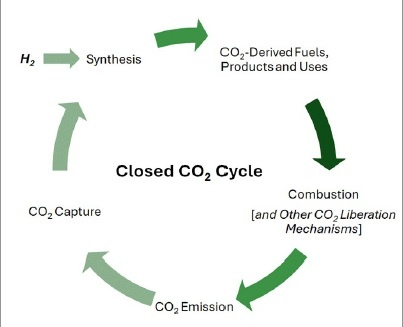
Figure above shows closed-loop CO2 cycle.
_
The preference for CCE over defossilization is clearly influenced by economic and political factors that are extremely difficult to displace in a short period of time (e.g. the next 5–10 years). CCE is therefore a preferred pathway for countries heavily reliant on fossil fuel revenues, allowing them to balance economic stability with environmental goals. Defossilization, on the other hand, has associated technological and infrastructural challenges related to retrofitting or replacing existing, long-lived fossil fuel-based processes, making it a less attractive option. This does not mean that countries that have Energy-intensive Processing Industries (EPI) based economies and/or export significant amounts of hydrocarbons should simply dismiss the defossilization perspective. Rather they should articulate how CCE approaches to net-zero industry can align with the phase-out of fossil fuel extraction and use. The US industrial decarbonization roadmap (figure above) exemplifies a reasonable starting point, but ideally would indicate specific points at which CCUS and low-carbon fuel technologies are envisioned to primarily support ‘inevitable’ CO2 needs, such as for sustainable transportation and perhaps specific industrial applications (e.g. cement and concrete, sustainable chemicals).
______
______
Section-6
Introduction to defossilization:
Carbon is a fundamental element that is an essential building block of life on Earth, and it plays a crucial role in various natural processes. While carbon atoms themselves are not in short supply, the problem lies in the imbalance between the release of carbon into the atmosphere and the Earth’s ability to naturally sequester or absorb that carbon through processes like photosynthesis in plants, carbon storage in forests and oceans, and mineralization in rocks over long periods. Nowadays, global warming is becoming more and more serious. The dramatic imagery of global warming frightens people. Carbon is situated at the core of this alarm. It has been scientifically confirmed that global warming is closely related to the increased concentration of CO2 in the atmosphere, controlling and reducing carbon emissions has thus become a global consensus. Carbon neutrality by the mid-21st century is essential in order to limit global warming to ≤1.5°C. This means that the atmospheric CO2 concentration must be controlled below 450 ppm, which is also specified in the Paris Agreement and signed by 196 countries including the USA, the European Union and China. Besides, it is worth noting that China made a solemn commitment to achieve carbon peaking by 2030 and carbon neutrality by 2060 at the United Nations General Assembly in September 2020, which reflects the responsibility and determination of China to achieve this goal. Up to now, carbon neutrality has become the mainstream direction of global development transformation. Net zero means that a country takes as much CO2 out of the atmosphere as it puts in. Various governments are focusing on decarbonisation, which is the process of reducing the carbon content of something, and in the context of climate change, it primarily focuses on reducing CO2 emissions. Some things can be almost completely decarbonised, such as energy, via, for example, renewable wind and solar power. Other things cannot be decarbonised since they are made of carbon. This is where defossilization comes into play, reducing our dependence on fossil resources and instead using sources of renewable carbon.
_
Plastic is amazing. It has allowed us to land on the moon, place stents in people’s hearts, and dive deep in the ocean discovering new creatures. However, over the last decades, as humans, we have misused plastic technology. As of 2021, globally, more than 10 billion tonnes of plastic waste were generated – with only 9 per cent recycled, -12 per cent incinerated, and 79 per cent accumulated in landfills or the open environment. The largest market for plastics today is packaging which accounts for nearly half of all plastic waste globally and more than 40 per cent of plastic is used just once, then discarded. Plastics are made from chemicals, which contain carbon. This carbon usually comes from fossil resources, and this means that these materials account for 3.4 per cent of CO2 emitted globally annually and a whopping 1.8 gigatonnes of GHG emissions. With these emissions being almost entirely Scope 3, being generated in the extraction and conversion of fossil resources, the only currently feasible way to reduce these is to change the source material. Since feedstock needs to be carbon-based, this means plastic cannot be decarbonised, but instead needs to be defossilized. The key challenge with defossilization of the chemical and plastics industry is, therefore, the requirement for carbon-based feedstocks, but from renewable sources.
_
Defossilization is a term that often comes up in connection with the development of sustainable chemistry of the future. Defossilization means the substitution of fossil carbon sources, such as crude oil, natural gas and coal, by stocks which are renewable, including biogenic raw materials, recyclates, and atmospheric carbon dioxide for the manufacturing of organic chemicals including plastics. They do not increase the net amount of CO2 in the atmosphere and therefore do not exacerbate the greenhouse effect or climate change.
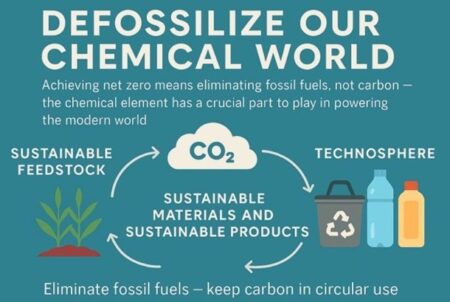
_
Defossilization is the process of replacing fossil-based feedstocks (oil, coal, natural gas) with renewable alternatives like biomass, waste plastic, or captured co2 to produce chemicals and materials. Unlike decarbonization (removing carbon), defossilization keeps carbon in the loop but moves from a linear to a circular, non-fossil source. Three processes (A) electrolysis (electrochemically produce hydrogen from water), (B) carbon capture – capturing CO2 emitted from industrial plants, and (C) CO2 hydrogenation – chemical/electrochemical reduction methods into useful chemicals (and fuels) are considered as primary in the pathway toward defossilization.
Key Aspects of Defossilization:
- Target Sectors: Primarily the chemical and materials industry, which uses about 18% of global fossil fuels as raw materials for products like plastics, fertilizers, and pharmaceuticals.
- Methods: Key technologies include using biomass (plants, waste), recycling carbon from plastic waste, and using captured carbon dioxide (CCU).
- Key Enablers: Electrification, green hydrogen production, and renewable energy to power processing.
- Goal: To achieve net-zero emissions while maintaining the carbon needed for chemical products, ensuring sustainability in industries that cannot exist without carbon molecules.
_
Defossilization refers to the transition from the use of fossil carbon-containing raw materials such as coal, oil and natural gas to the use of renewable and sustainable carbon compounds. Defossilization describes the process of reducing and ultimately eliminating dependence on fossil fuels as a feedstock for the production of organic substances and materials, especially plastics. This process is crucial to limiting global warming and mitigating the effects of climate change, as the CO2 in defossilized materials is in a cycle and the concentration in the atmosphere does not increase any further. A successful transition requires not only a reduction in the use of fossil raw materials, but also a fundamental transformation of economic and energy infrastructures. This is because the measures for defossilization are often more cost-intensive than the unsustainable solutions used to date and in some cases also involve a high energy input. For example, if a car is powered by e-fuels (defossilization), which are produced from renewable electricity, 75% of the energy stored in the fuel is converted into heat during combustion in the engine. However, if the car is operated electrically (decarbonization) and refuelled directly with renewable electricity, only 20% of the energy is converted into heat and 80% can be used for locomotion. For this reason, the three basic strategies of the green economy (efficiency, consistency, sufficiency) should nevertheless be observed and implemented.
_
Achieving net zero isn’t about eliminating carbon – it’s about eliminating fossil carbon. Carbon will remain essential for energy-dense applications (like sustainable aviation fuels) and for the everyday chemicals behind detergents, medicines, fertilizers and plastics. The challenge ahead is to defossilize, not decarbonize – replace fossil hydrocarbons with renewable, circular sources of carbon. Global demand for embedded carbon in chemicals is projected to grow significantly toward 2050. Leading analyses show this demand can be met by a mix of biogenic carbon (sustainable biomass), carbon captured from CO₂, and recycled carbon – shifting the feedstock base away from coal, oil and gas while keeping carbon in use and out of the atmosphere.
What this looks like in practice:
Biosphere resources: Converting sustainable feedstocks into biomaterials and bioproducts – prioritizing residues and advanced lignocellulosic streams to avoid land-use impacts and protect biodiversity.
Atmospheric carbon: Direct conversion of CO₂ into chemicals and materials, powered by renewable energy, to close the carbon loop.
Technosphere carbon: Reuse and recycling of materials to extend carbon lifetimes and reduce demand for virgin fossil inputs.
_
Alternative carbon sources (ACS):
There are several alternative sources that could provide the carbon we need to support the organic chemical industry. Plants are already proving to be a useful source of carbon that is being turned into polymers to make plastic packaging and bags, for example. Biomass from both crop waste and virgin crops offer a rich supply of carbon that many in both academia and industry are finding ways to utilise. The molecular building block of the common plastic used to make drinks bottles and polyester clothing, Polyethylene terephthalate or PET, has a ring structure that can be replicated using biologically available molecules.
There are also huge amounts of carbon tied up in the polymers we already use and throw away. We live in an age of plastic – 70% of the output from the chemical industry is polymers. But much of that is still thrown away. By repurposing plastics through advanced recycling methods that allow the materials to be broken into their molecular building blocks, we can reform them into new polymers, potentially endlessly.
A third source could be the air itself. Carbon dioxide makes up around 0.04% of the gas in the atmosphere, but its levels have been rising due to human activities. Pulling some of that additional CO2 out of the atmosphere through Direct Air Capture technologies could provide industry with a source of carbon that actually has a positive effect on climate change.
All three are not without their challenges, though. Direct Air Capture of CO2 is still extremely expensive and is not considered feasible anytime soon. In the shorter term, it may be possible to capture carbon from point sources of carbon emissions, such as power stations, cement factories and chemical manufacturing sites – if we overcome challenges such as CO2 purity from some of these sources.
The techniques needed to make sufficient quantities of basic chemicals such as methanol and ethene from sustainable sources of carbon also need to be developed. Around 170 million tonnes of ethene and 100 million tonnes of methanol are produced each year to serve as the primary chemicals in products and processes around the world.
There are also issues around the amount of land that might be needed to produce sufficient biomass and the competing demands between sectors for available biomass. To generate the 12.3 million tonnes of jet fuel currently used by the UK’s aviation industry would require 68% of arable land to be turned over to growing biomass crops. A key challenge is how to meet the needs of the chemical industry without eating into food production further.
Huge amounts of hydrogen will also be needed. It is another key component in organic molecules, and fossil fuels are a plentiful source of it – but this means a lot of emissions. Shifting to other sources of carbon such as biomass, CO2 capture and reusing waste polymers, we will need to generate large amounts of green hydrogen sourced from renewable energy to make the molecules we want.
This is not something that will happen overnight. The transition to sustainable sources of carbon and hydrogen will take time – putting new chemical processes in place and making them productive can take upwards of 15 years. There will also need to be a lot of innovation too. The chemical industry will have to rethink the molecules it uses and make new ones that can do the jobs we currently use fossil-fuel-sourced chemicals for. Some of the science we need already exists, but it needs to be scaled up and made commercially viable. We are also going to need new technologies and to come up with new catalysts, and even create entirely new molecules with the properties we want.
_
Examples:
There are many technologies for defossilization. Carbon capture and utilization (CCU), which provides the required raw material CO2, serves as the basis in many processes. This CO2 can then be used, for example, in methanation or methanolization, which in turn can serve as starting materials for e-fuels, chemicals and active pharmaceutical ingredients. Many defossilized substances also consist of biobased materials, such as packaging materials made from fungi or algae, or they use biological raw materials as starting materials, for example for bio-based plastics. In some cases, biological waste streams are used (so-called second generation feedstock), which turns this waste back into raw materials and thus assigns them a value, leading to a more complete circular economy. Chemical recycling is also included in defossilization, as this measure can be used to substitute new fossil oil in the production of plastics.
_
Difference with decarbonization:
Defossilization and decarbonization are important terms in the climate debate, but they are often mistakenly used interchangeably, even though they represent different concepts. However, they complement each other and are both crucial in the fight against climate change.
Defossilization: Defossilization means that carbon-containing products are still used, but the carbon comes from sustainable and renewable sources and no longer from fossil sources. When this material is disposed of (e.g. by incineration), CO2 may still be produced, but no more than what was used in the production of the material. This results in a closed CO2 or carbon cycle, which ultimately keeps the CO2 concentration in the atmosphere the same.
Decarbonization: Decarbonization is the process of reducing greenhouse gas emissions—primarily carbon dioxide (CO2)—released into the atmosphere. It is achieved by transitioning away from fossil fuels and adopting clean energy, energy efficiency, and carbon capture technologies.
_______
_______
Reasons to replace fossil carbon in chemical products:
The chemical industry accounts for roughly 5% to 7% of global greenhouse gas (GHG) emissions and consumes more energy than any other industrial subsector. Its complex environmental footprint stems from fossil fuels used for both heating and raw material inputs (feedstocks). There is currently approximately 550 Mt per year of embedded carbon in feedstocks for chemicals and derived material. An estimated 88% of this is fossil-based, 8% bio-based, 4% recycled, and less than 0.1% is from CO2. Demand for embedded carbon could be approximately double, at over 1.1 Gt, by 2050. Defossilising the chemical industry involves replacing fossil fuels (oil, gas, and coal) used as raw chemical building blocks (feedstocks) with renewable carbon sources, such as biomass, recycled plastic waste, and captured atmospheric CO2. This transition goes beyond traditional decarbonisation (cutting emissions from energy use) because most chemicals structurally require carbon.
-1. Climate and Environmental Urgency
- Emissions Reduction: The chemical sector is responsible for roughly 6% of global greenhouse gas emissions. Shifting to circular or biological carbon loops prevents the extraction and release of new, underground carbon into the atmosphere.
- Emissions from End-of-Life: More than half of chemical-sector emissions are Scope 3, meaning they occur during the breakdown or incineration of products like plastics. Defossilisation captures and recycles this carbon instead of creating it from scratch.
-2. Physical Necessity of the Products
- Decarbonisation is Not Enough: While renewable energy (like solar or wind) can power factory operations, it cannot eliminate the physical fossil carbon embedded in products like plastics, solvents, and pharmaceuticals.
- Closing the Carbon Loop: Organic chemistry requires carbon atoms to structure materials. Defossilisation provides alternative ways to source that carbon without relying on raw extraction.
-3. Supply Chain Security and Economics
- Import Independence: Fossil feedstocks create geopolitical vulnerabilities by tethering manufacturing hubs to volatile global oil and gas markets.
- Price Volatility: Extracting virgin fossil fuels is becoming more resource-intensive and expensive, making circular economic models (like converting local plastic waste or CO2 into chemical feedstocks) more attractive long-term investments.
- Fossil fuel exhaustion: It is predicted that we will run out of fossil fuels in this century. Oil can last up to 50 years, natural gas up to 53 years, and coal up to 114 years. Defossilization will help by substituting them with sustainable, non-fossil carbon alternatives.
-4. Waste generation: The world of today generates 2 billion tonnes of waste each year, with 80% of it being non-biodegradable, requiring hundreds and some even thousands of years to break down naturally and completely vanish. With the global recycling rate lingering below 20%, far behind the rate at which waste is produced, humanity risks being increasingly surrounded by the very waste it creates. Defossilization can valorise the waste.
______
______
Fossil fuel ► petrochemicals◄ alternate feedstocks:
Petrochemicals made from fossil fuels are used in over 70,000 everyday products. Fossil fuels aren’t just used to power cars, heat buildings and keep the lights on. They are, quite literally, woven into almost every facet of our lives. From crayons, cosmetics and carpeting to fabrics, fertilizers and pharmaceuticals, around 70,000 everyday products are made with “petrochemicals” produced from fossil fuels. These products are so ubiquitous that many oil and gas companies are betting on chemical production to stay in business even as fossil fuel use in energy, heating and transport declines. This comes with serious consequences for people and the planet. In the United States alone, chemical production directly emits 180 million tonnes of carbon dioxide equivalents (MTCO2e) per year — equivalent to the annual emissions from nearly 49 million gas-powered vehicles. The U.S. chemical sector also released 176,000 tonnes of toxic pollutants in 2021, exposing communities to water and air pollution as well as health risks like acute respiratory symptoms, skin and eye irritation and cancer. One of the most important steps the industry can take to reduce these impacts is to replace fossil fuels used as ingredients in chemical products with non-fossil alternatives. This is known as “defossilization.” While promising, defossilization technologies are rarely used at scale and face complicated hurdles. Some alternative materials are currently only available in small quantities. Others can risk increasing emissions if not used carefully.
_
“Petrochemicals” — chemicals derived from fossil fuels like petroleum, natural gas and coal — are present in just about every material that is not 100% organic, mineral or metallic. This includes plastics, electronics, textiles, cleaning products, rubber, paints and thousands of other synthetic products that most people use every day. The process to make these products starts with processing fossil fuels into chemical “feedstocks” (or raw materials). Chemical feedstocks are turned into primary chemicals before being converted into intermediary chemicals and polymers. These are then manufactured into materials such as plastics and fibers and finally put to use in end products as seen in the figure below.
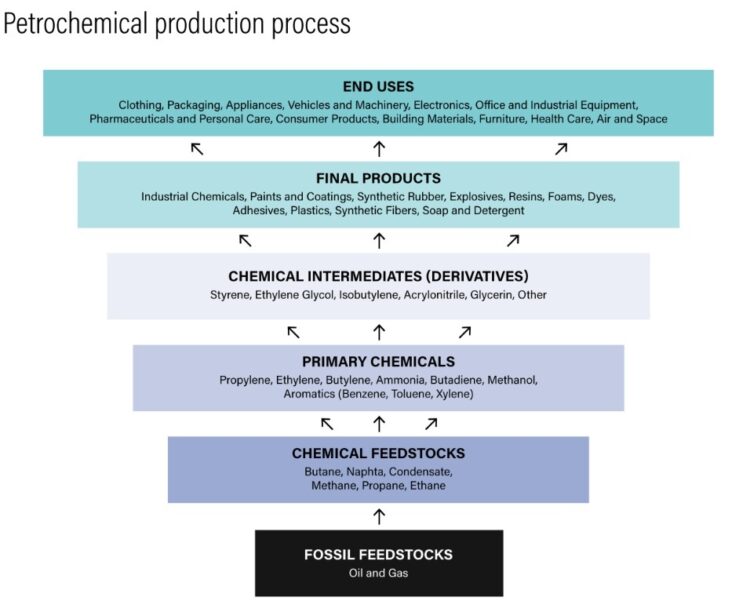
One of the most common chemical processing chains in the U.S. distils ethane from natural gas (a chemical feedstock), which is then “cracked” into ethylene (a primary chemical) and eventually turned into plastics and other materials.
Production of primary chemicals — including ethylene, propylene, benzene, toluene, xylene, ammonia and methanol — emits the most greenhouse gases along the chemical supply chain. These “process emissions” come from burning additional fossil fuels to generate the high temperatures (up to 1,000 degrees C) needed to turn fossil fuels into primary chemicals.
Ammonia, for example, is one of the most common chemicals globally due to its use in synthetic fertilizer. Producing it requires hydrogen, which is typically made by reforming natural gas into a mixture of hydrogen, carbon monoxide and carbon dioxide. The resulting CO2 is usually emitted into the atmosphere. Extracting and transporting natural gas to an ammonia plant also emits greenhouse gases and risks methane leakages. (Methane is a highly potent greenhouse gas with 80 times the warming power of CO2 over a 20-year period.)
Because this small handful of chemicals are the precursors to thousands of end products and drive most emissions in the product lifecycle, they offer a strategic emission reduction opportunity. The production of these handful of chemicals from non-fossil-fuel sources is defossilization.
_
The chemical industry is responsible for 14 percent of global oil and 8 percent of natural gas consumption worldwide, as 90 percent of chemicals are made from oil and gas. The rest comes from coal and biomass. The range of chemical products produced ranges from primary chemicals with huge volumes such as ethylene, propylene, ammonium and methanol to plastics and the most complex organic molecules with dozens of chiral centers, some of which are produced in very small quantities. Plastics are a major driver of petrochemical demand, and by 2050, oil demand related to plastic consumption could exceed that of road passenger transport. Petrochemical products require the hydrocarbons contained in fossil fuel feedstocks such as petroleum, natural gas, and coal. Petrochemical plants, and petroleum refineries to some extent, process fossil feedstocks through several steps to create primary chemicals, then intermediate chemicals, and finally end products.
_
Among energy intensive industries, the chemical industry is one of the most challenging to defossilize due to the abundance of cheap fossil fuel-feedstocks and it is currently responsible for roughly 6% of global anthropogenic CO2 emissions. Unlike other energy-intensive industries, the chemical industry cannot be made fully sustainable directly with renewable electricity and green electricity-based hydrogen (e-hydrogen). Therefore, new green carbon feedstocks must be developed to defossilize the production of large volume organic chemicals. The most promising green carbon feedstocks are electricity-based methanol (e-methanol) and biomass-based methanol (bio-methanol), which can be used directly or as a feedstock for olefin and aromatic production. Increased recycling of plastics will reduce the amount of primary feedstock that will be required for chemical production.
_
Chemicals produced from non-fossil feedstocks would be considered “defossilized” chemical products. Defossilization via alternative feedstocks reduces life-cycle emissions by changing the source of a chemical’s hydrocarbons. For example, plastics conventionally obtain their carbon molecules from natural gas or methane (CH4), which can be replaced by carbon from biomass. Ammonia (NH3), does not contain carbon, but the hydrogen required to make it is conventionally produced from natural gas; it could instead be produced by splitting water with electricity. In these cases, biomass and clean hydrogen are non-fossil feedstocks, and if the biomass is sourced sustainably and electricity produced emission-free, the non-fossil feedstocks reduce lifecycle emissions.
_
There exist sustainable alternatives for replacing oil, gas or coal as energy sources. However, replacing oil, gas or coal as feedstocks for basic chemicals, polymers or fine chemicals is much more difficult. In addition to the utilization of carbon dioxide, only recycling and biomass remain to meet all non-fossil demand in the future. Biomass plays a critical role in defossilization by replacing virgin fossil fuels and petroleum-based chemical feedstocks with sustainable, renewable carbon sources. It is utilized across high-emissions sectors to produce biochemicals, biofuels, and bio-based hydrogen, significantly reducing lifecycle carbon footprints. In doing so, we encounter two problems: the low efficiency of photosynthesis from an industrial point of view (plants 1 percent, algae 6 percent) and the decrease of globally per capita available agricultural land. Moreover, living organisms and their enzymes are more suitable for the synthesis of complex and high-quality molecules but less for commodity chemicals. Unfortunately, the replacement of oil, gas and coal with biogenic energy and raw material sources is an almost unsolvable challenge with a growing population and dwindling agricultural land. As of today, about 0.18 hectares of agricultural land per capita are available to humans worldwide. 50 years ago, it was over 0.28 hectares. As a result, the oil and petrochemical industry remain systemically relevant.
_
Innovation is key.
The innovation and development of new technologies is essential for defossilization. Today, the organic chemical toolbox allows the synthesis of the most complex structures. However, with a huge disadvantage: the more complex the structures, the greater the Process Mass Intensity (PMI) and E-factor (E = waste produced/product produced). In extreme cases, the latter can be a thousand or even higher: This means that around one ton of waste and by-products are produced per kilogram of product.
_
Production of methanol from carbon dioxide.
With almost 100 kilograms of hydrogen per cubic meter, methanol is the best hydrogen storage medium. It is also an important C1 building block for basic chemicals (e.g. formaldehyde, ethylene, propylene) and, with an annual production of 100 million tons after crude oil, also the world’s most traded liquid. Methanol is also one of the most suitable candidates for sustainable defossilization without side effects, as the carbon dioxide can be taken from the atmosphere and converted into methanol and other products.
China’s researchers use different terms for their defossilization programmes. ‘Green carbon science’, for example, denotes sustainable carbon-based technologies (Z. Xie et al. Natl Sci. Rev. 10, nwad225; 2023). Another term, ‘liquid sunshine’, means making carbon-based chemicals, such as methanol, using solar energy. Methanol is a common feedstock for olefins, a class of petrochemicals (such as ethylene and propylene) that are used as fuels for applications that are difficult to decarbonize, and can also be used in the manufacture of plastics, rubber and adhesives. China Coal Ordos Energy Chemical Company’s Liquid Sunshine project, located in Inner Mongolia started producing methanol. It is one of the world’s largest such projects, and aims to produce around 100,000 tonnes of methanol per year. The estimated saving in CO2 emissions would be about 500,000 tonnes per year — admittedly only a fraction of the 12.6 billion tonnes that China emitted in 2024. The technologies currently being rolled out are based on advances in known chemistry. The underlying science behind the Liquid Sunshine project originated at the Dalian Institute for Chemical Physics in China. It focuses on two established chemical processes — the electrolysis of water and the hydrogenation of CO2 (J. Wang et al. Sci. Adv. 3, e1701290; 2017). Clever use of catalysts reduces the amount of energy needed at each stage of the process and brings production costs closer to those of methanol made from oil, natural gas or coal.
Note:
CO2 hydrogenation is a catalytic process that converts captured carbon dioxide (CO2) and renewable hydrogen (H2) into value-added chemicals and synthetic fuels, such as methanol, methane, and olefins. It serves as a key pathway for carbon recycling and the transition to sustainable energy.
______
______
Defossilization technologies to replace fossil fuel feedstocks with alternative carbon sources:
The modern chemical industry is built on fossil fuels because they are dense in energy as well as contain carbon and hydrogen (the two key molecules in most chemical products). This makes them an economical feedstock option. But technically, anything containing many carbon and hydrogen atoms can be used to replace fossil fuels in chemical production.
The following alternative feedstocks are either abundant today or are projected to be in the coming years:
- Electrolytic hydrogen: Pure hydrogen can be obtained by using electricity to split water (H2O) into hydrogen and oxygen through a process called electrolysis. This should be done using clean power to avoid adding greenhouse gas emissions from fossil-fueled electricity.
- Captured CO2: Carbon that is captured from industrial sources (such as cement manufacturers), or from the atmosphere (via direct air capture and other methods) could be used in chemical production.
- Waste biomass: This includes unused plant parts and other organic material collected in agriculture, forestry and municipal waste. Waste biomass can be a substitute for fossil fuels because, technically, fossil fuels are just biomass and animal matter subjected to heat and pressure underground for millions of years; both contain the same carbon and hydrogen molecules. It is important that biomass truly comes from waste and is not purpose-grown for the chemical industry, as it will need land that competes with land use for food and biofuels.
- Ethanol: Ethanol, which is currently widely produced in the U.S. by fermenting corn, can be used in place of fossil fuels to produce the chemical ethylene. While there is an opportunity cost of using prime farmland for corn ethanol, using ethanol as a chemical feedstock is more productive than blending it with gasoline as a “renewable” fuel. Capturing the CO2 emitted during ethanol production would reduce emissions from existing facilities.
- Ammonia: Rather than deriving hydrogen from natural gas, an ammonia plant can defossilize by using electrolysis to split water into its component hydrogen and oxygen molecules. Electrolysis does not emit greenhouse gases if the electricity comes from zero-carbon sources like wind or solar. Because most of the emissions caused by ammonia production derive from reforming natural gas, replacing it with clean hydrogen makes the process nearly zero-carbon.
_
Many researchers, companies, and institutions are pursuing ways to produce chemicals without fossil feedstocks and thereby reduce carbon intensity (Biederman et al. 2021). Experiments with different feedstocks, processing methods (thermochemical, electrochemical, or biological), catalysts, and energy and heat aim to minimize inputs and maximize outputs of desired products, energy and material efficiency, and GHG reductions. For example, CO2 electrolysis is a process that electrochemically reduces CO2 to ethylene with few emissions, but it has not yet advanced beyond the lab (Roh et al. 2020).
Figure below shows Fossil feedstocks, their non-fossil substitutes, and processing technologies:
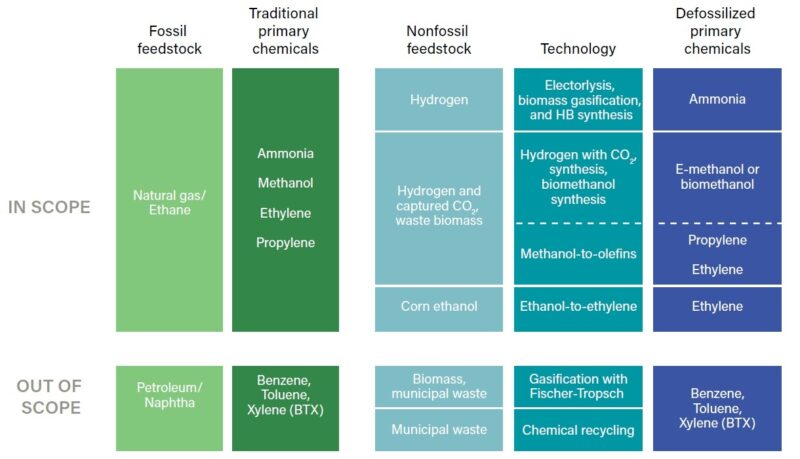
The highlighted technologies are the following:
-“Green hydrogen” (hydrogen produced by electrolysis) (TRL 9): Conventional technology of producing hydrogen by reforming natural gas is replaced by electrolysis, in which electricity generated by non-fossil resources is channeled into an electrolyzer submerged in water to split water (H2O) into oxygen and hydrogen. The resulting clean hydrogen is a feedstock for ammonia and methanol.
-E-methanol synthesis (TRLs 7–9): Traditional methanol is produced by creating syngas, a mixture of hydrogen and carbon monoxide, from natural gas and reacting that with a catalyst to produce methanol. E-methanol derives from reacting clean hydrogen with CO2 captured from a flue stack or via DAC. The process is also known as direct CO2 synthesis to methanol.
-Methanol-to-olefins (MTO) (TRL 9): The MTO process converts methanol into ethylene or propylene.
If that methanol is created from clean feedstocks, the resulting olefins can also be considered defossilized. MTO is commercially used in China, with coal as the feedstock (Gogate 2019).
-Biomass gasification (TRLs 3–5): Lignocellulosic biomass or municipal waste is fed into a gasification reactor to produce syngas, which can be directly turned into methanol or processed into hydrogen and carbon dioxide. The hydrogen can be separated to produce ammonia and other chemicals (Cao et al. 2020).
-Ethanol-to-ethylene (TRL 9): Ethanol made by fermenting crop sugars, mainly corn in the United States, is widely produced as a fuel additive. Catalytically dehydrating ethanol to yield ethylene is a well-understood process with several commercial plants operating globally (Mohsenzadeh et al. 2017). Ethanol plants emit highly concentrated CO2, allowing for low-cost CO2 capture to reduce lifecycle emissions.
-The Fischer-Tropsch (FT) process is a catalytic chemical reaction that converts a gaseous mixture of carbon monoxide and hydrogen (known as synthesis gas or syngas) into valuable liquid hydrocarbons, such as synthetic petroleum, diesel, or kerosene. It is a critical component of gas-to-liquids (GTL) and coal-to-liquids (CTL) technologies.
_
Table below shows total volume of non-fossil feedstocks needed to meet total primary chemical demand
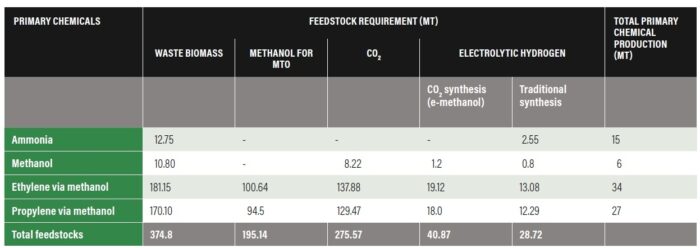
Notes: The amount of feedstock needed to satisfy total demand for a single chemical is represented by the individual center cells. For example, 12.75 Mt of waste biomass or 2.55 Mt of hydrogen are needed to satisfy all ammonia demand. The bottom row indicates the amount of feedstock needed to meet all chemical demand. Thus, 374.8 Mt of waste biomass or 275.57 MtCO2 is needed to meet all chemical demand. The rightmost column indicates the total demand for that chemical. Thus, total ammonia production is 15 Mt. The biomass, CO2, and hydrogen cells rightward of ethylene and propylene via methanol indicate the amount of feedstock needed to make the methanol that would be converted to those olefins.
The methanol row and column function somewhat differently. The row, starting from the leftmost column, represents methanol as a product, with the individual cells representing the feedstock needed to meet current demand of 6 Mt. The column represents methanol as an intermediary feedstock for methanol-to-olefins, with the individual center cells representing the amount of methanol needed for conversion into ethylene or propylene. Total methanol as a feedstock to satisfy all ethylene and propylene demand is 195.14 Mt.
_
In the US, the estimated demand for alternative feedstocks is currently greater than available feedstock supplies. In some cases, the difference is relatively small: The U.S. currently produces around 315 million tonnes of waste biomass per year, and the estimated demand for chemical production is around 375 million tonnes. In other cases, demand massively outstrips supply. For example, as much as 29-41 million tonnes of electrolytic (clean) hydrogen would be needed as a chemical feedstock. The U.S. currently produces almost none, although this is expected to change thanks to recent production incentives. While the U.S. produces 10-11 million tonnes of conventional (dirty) hydrogen, this would not be a low-carbon feedstock.
_______
_______
For the chemical industry, defossilization, i.e. the replacement of fossil-based feedstocks with alternative, non-fossil sources of carbon for product manufacturing, provides a promising avenue for reaching net-zero emission as seen in figure below. Notably, defossilization is also a crucial concept in the context of the Science Based Targets initiative (SBTi), which aims to support companies in setting targets to reduce their GHG emissions and limit global warming. SBTi recognises the importance of defossilization and encourages companies to develop strategies that align with a low-carbon, sustainable future.
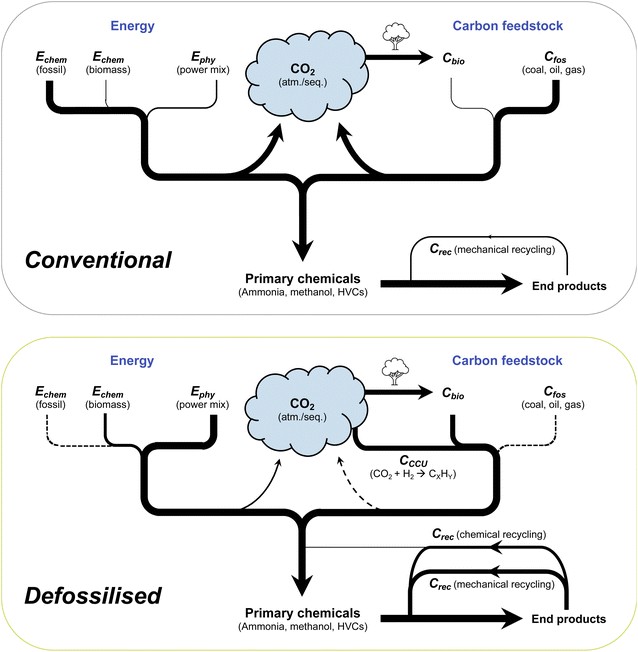
Figure above shows Material and energy flow of the chemical industry today and once defossilized. Today, carbon feedstock is sourced from fossil fuels (coal, oil, gas) with a small fraction (less than 1%) of biomass and recycled plastics (9%) added. Similarly, energy is predominantly derived from fossil fuels. In a defossilized scenario, larger fractions of feedstock are generated by carbon capture and utilisation (CO2 from unavoidable exhaust gases or from the atmosphere), or obtained from biomass, or massive recycling of plastics. The share of fossil fuels is hence decreased, and residual CO2 emissions are captured and stored (CCS). While this process does not fully achieve defossilization, it is included here as part of the low-carbon emission scenarios. Energy is then predominantly obtained from biomass or carbon-free electricity generated from renewables. In all of the analysed scenarios, a product mix of primary chemicals (ammonia, methanol, and high value chemicals, including ethylene, propylene, benzene, toluene, and mixed xylenes), which are then transformed into the various industrial, professional, or consumer end products but also used energetically in the transport and agricultural sector are manufactured. The thickness of the arrows shall indicate the relative size of the energy or carbon streams. Dotted arrows indicate the continued use of fossil fuels coupled with CCS, a practical option to reach a net-zero chemical industry, although it is not considered a defossilization technology.
_
Figure below shows transition from fossil fuel based chemicals in 2020 to alternate feedstock based chemicals in 2050:
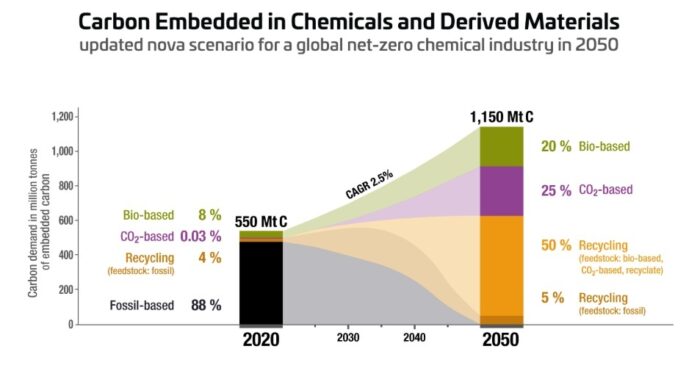
_
Several emerging technologies for sustainable chemical production are already being recognised and implemented to enhance efficiency, reduce energy consumption, and lower environmental impacts. For example, (a) biotransformation, which utilises biological systems such as enzymes or microorganisms to catalyse reactions under mild conditions using renewable feedstocks like biomass; (b) flow chemistry, which improves reaction control and efficiency through continuous flow systems, leading to reduced energy use and byproducts; (c) photochemistry, which leverages light to drive reactions under mild conditions, with the potential to use renewable energy sources like sunlight and (d) water-based chemistry, which substitutes harmful solvents with water, reducing environmental impact and enhancing safety. These technologies reduce reliance on fossil fuels while promoting circularity and resource efficiency. Another notable trend is product innovation at the chemical and polymer level. For instance, biogenic carbon (e.g. furandicarboxylic acid FDCA) is increasingly being used for the production of polymers with significantly higher oxygen but lower energy and carbon content if compared to conventional polymers like polyethylene, polypropylene or polystyrene. This shift is expected to result in substantial reductions in carbon emissions.
_
In 2020, 160 PWh of primary energy was produced and consumed globally, with 79% from fossil carbon, 5% from nuclear, and 16% from renewables. Of this, 13 PWh of fossil fuels was directed to the chemical industry meeting over 99% of its energy and carbon feedstock needs. For defossilization of the chemical industry both energy and carbon feedstock supply have to be rewired. While energy (electricity and heat) can be obtained from renewables (e.g. solar, wind, hydrodynamics, or biomass), carbonaceous feedstock input will have to be defossilized, i.e. of non-fossil origin.
_______
_______
Evolution of biorefinery:
A biorefinery is a facility that processes renewable biomass (like crops, algae, and waste) into a diverse range of marketable products. Operating on circular economy principles, it functions like a traditional petroleum refinery, but uses biological inputs to yield biofuels, biochemicals, bioplastics, food, and animal feed. Biorefineries use various processes such as fermentation, hydrolysis, gasification, and pyrolysis to convert biomass into different products.
_
The chemical sector is expected to reduce the use of fossil feedstock to 10–42 % (Meng et al., 2023). To achieve this challenging target there are a number of steps starting with the use of alternative raw materials. Over the last few years there has been a trend to evaluate the possibility of substituting the production of basic chemicals from biomass and waste using renewable energy, mostly solar and wind, specifically the major building blocks. The waste from chemicals production, CO2, and the bioproducts, i.e. O2 from water electrolysis, are recycled and reused creating a circular economy.
_
The first major attempt to substitute crude oil as raw material was the first-generation of biofuels. However, these technologies, corn or cereal based ethanol and biodiesel from edible oil sources, posed the ethical question on the use of food as a source for fuels. Second generation, the use of lignocellulosic biomass and waste or nonedible oils, represented the next step. Beyond ethanol and biodiesel, the valorization of byproducts of the facilities such as glycerol, biodiesel major byproduct, due to its use in cosmetics (Almena et al., 2018), was interesting for some time. However, as the biofuels production capacity grew, glycerol price went down and alternative uses were evaluated such as a source of other chemicals including epichlorohydrin (Almena and Martín, 2016) hydrogen, alcohols or monomers, (i.e. ethylene, butadiene), where catalytic and biochemical processes are used (Almena et al., 2018). The high demand for fossil fuels, the complex transformation and the limited biomass resources to produce biofuels (Martín and Grossmann, 2018; Potrč et al., 2021) has resulted in a paradigm shift, the production of other chemicals with larger profit margins but lower demand.
The follow-up effort was the production of platform chemicals from biomass (i.e. Dimethyl furfural, xylitol) (Montagamwala et al., 2019; Galán et al., 2021). Platform chemicals represented the major product from the facility, maintaining the trend to product bulk chemicals, but with a higher market price.
_
So far two main barriers have been identified in the use of alternative raw materials such as biomass or waste: i) their economics, the higher production cost (Meng et al., 2023) and the tight margins (Martín, 2017), together with the fact that ii) the petrochemical industry and the related business are well established. The additional processing steps required in waste pretreatment and processing add cost to the final product, even if the raw material is cheap or even free (Hernández and Martin, 2017; Sánchez and Martín, 2018a,b) so that the use of residues is first and foremost a waste management strategy instead of a true starting point to substitute raw materials. In addition, the use of waste results in heterogenous raw materials that affect the design of the pretreatment step requiring flexibility. Note that a market of waste has yet to be established which can add operating costs. On the bright side, the similarities between the crude oil refineries and thermochemical biorefineries have provided the opportunity to retrofit conventional facilities into biobased ones reducing the entrance barrier (Floudas et al., 2016; Zhang et al., 2023b).
_
Thus, the biorefineries evolved into the production of specialty chemicals, (i.e. limonene, polyphenols) (Criado and Martín, 2020; Guerras et al., 2021). The target shift to the production of high added value products in small amounts allowed improving the economics of the facility while the residual raw material could still be used to produce the utilities required within the facility and/or biofuels. The use of biomass waste under this scheme becomes promising. To achieve that, the biorefineries have to be reengineered so that high added value products produced at low rates are the principal product, while the residues of the biomass or waste can then be used to obtained bulk chemicals, biofuels and/or utilities reducing or avoiding the need for external sources of utilities (Criado and Martín, 2020; Guerras et al., 2021).
______
______
Bio-based versus petrochemicals struggle for market share:
The production of bio-based chemicals is far from new. As early as the 1910s, they were used to manufacture rubber tires, pharmaceuticals, explosive cordite, and biofuels, primarily driven by wartime necessity. However, by the 1950s, the advent of low-cost, high-volume petrochemicals sidelined bio-based routes, relegating them mostly to specialty niches, such as pharmaceuticals and biotech compounds (e.g., DNA recombinants). Despite more than a century of development, bio-based chemicals still account for less than 5% of global output. Many of the industrialized bioproducts today are “drop-in” alternatives, like methanol, ethylene, and propylene, which can be incorporated into existing gasification processes. More ambitious fossil-free routes now allow biomass to serve as a feedstock for a broad range of commodity chemicals and polymers (see figure below), achieving up to 90% reductions in emissions due to lower processing temperatures and pressures.
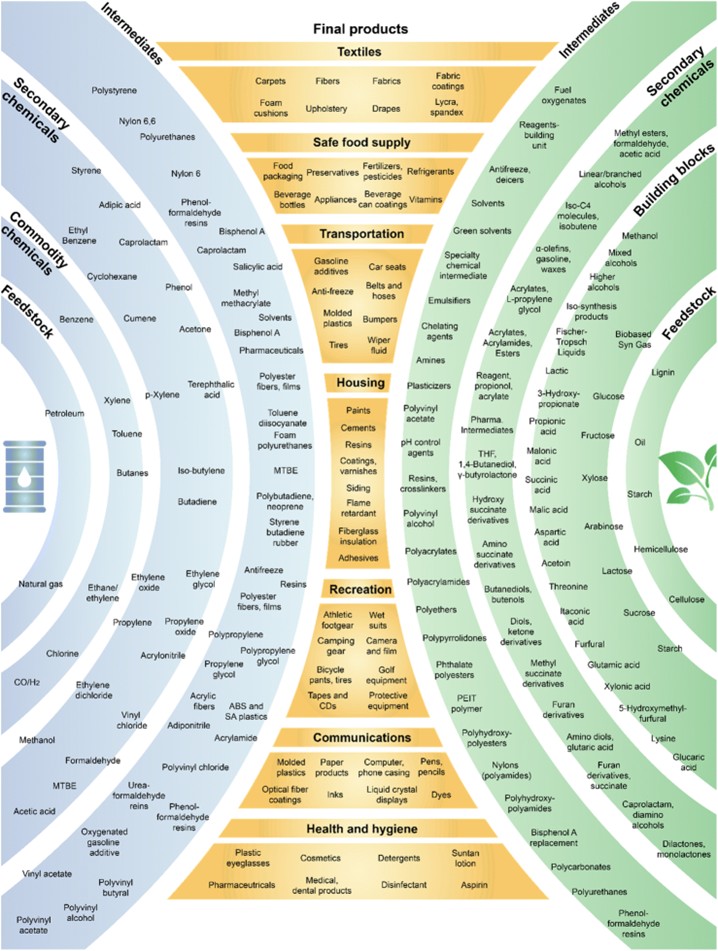
Figure above shows Flow chart of products derived from fossil-fuel-based and biomass feedstocks.
_
So why, after a hundred years and with technological feasibility no longer in question, do bio-based chemicals remain on the periphery of global production?
The answer lies in the entrenched dominance of fossil-based systems. Although decarbonization efforts have begun to erode their structural, economic, and policy advantages, the lack of coherent policies, modernized infrastructure, and regionally aligned cost competitiveness continues to hinder the widespread adoption of bio-based alternatives.
The EU is the world’s largest and longest-standing chemical producer, led by major bioeconomies, such as Germany, France, Italy, Poland, and the Netherlands, which are pioneers in both fossil-based and bio-based sectors. Nevertheless, over the past decade, the EU’s share of the global chemical market has declined by 11%, driven in part by its aggressive push towards climate neutrality and circular economy goals, causing rising energy costs that outpace the revenues and demands of bio-based chemicals. Moreover, EU countries have limited domestic biomass availability, and they import 51% of its biomass just to sustain even the current production of a mere 3% of their chemicals. This reliance raises concerns about feedstock security and cost volatility due to seasonality and logistics, as well as the question of food competition when sourcing biomass. Building bio-based value chains further compounds the challenge. The seven major chemicals (methanol, ethylene, propylene, butadiene, benzene, toluene, and xylene) drive over 90% of downstream production and are deeply rooted in mature fossil-based technologies. While drop-in bio-alternatives exist, they require modifications to existing processes, whereas more transformative bio-based routes demand substantial capital investment in new equipment, technical expertise, and innovation. Adding to the difficulty is market resistance, in which many bio-based products face higher production costs than their fossil-based counterparts, and in cases involving functional replacements or novel bioproducts, customers often hesitate due to unfamiliarity or uncertainty about performance. This market hesitance further complicates the adoption and scaling of bio-based alternatives.
China, after absorbing the EU’s lost market share, has now emerged as the world’s largest chemical producer. Nevertheless, this ascent is underpinned by heavy reliance on coal-based feedstocks, which runs counter to the global defossilization effort. To make matters worse, China’s coal power construction approvals have surged to a 10-year high, in which the country is attempting to offset emissions by simultaneously scaling up renewable energy generation. However, this parallel growth of renewables and fossil fuels reveals a fundamental disconnect: when defossilization is not holistically integrated into decarbonization strategies, climate commitments risk becoming a counterproductive patchwork. The ramping up of renewables has also prompted many domestic chemical producers to double down on fossil-derived production, viewing it as a lifeline for the continuity of their business. Although the Chinese government has shown support for bio-based products, such as bioethanol and biopolymers, the scale of this effort pales in comparison to its continued expansion of fossil-based chemical production.
To better understand these dynamics, consider how oil displaced from the energy sector by the rise of biofuels is now being funnelled into the chemical industry. Major oil and gas companies, such as Exxon (US$20 billion), CPChem (US$14.5 billion), and Dow (US$10 billion), are heavily investing in downstream petrochemical expansion. This simply shifts upstream emissions from one sector to another, rather than reducing them, exposing a major blind spot in current sustainability efforts. To close this gap, strong policy frameworks and strategic investments that redirect capital away from fossil-based production toward sustainable materials and technologies are required.
Industries in the EU and Japan have also started actively pursuing the production of “e-chemicals”, generated from green hydrogen through electrolysis and captured CO2 as fossil-free alternatives. Nevertheless, significant barriers associated with high energy consumption remain in scaling up “e-chemicals”, which should be viewed only as a complement to bio-based chemicals within an integrated biorefinery framework, where the availability of sustainably-produced e-chemicals is permitted.
______
______
Table below shows a summary of technologies, sources and their roles and impacts for a sustainable chemical and process industry:
|
Source |
Technology |
Role |
Impact |
|
Sun |
PV panels |
Electricity production |
Electrification of the system |
|
CSP |
Electricity production |
Renewable heat and power |
|
|
Wind |
Turbines |
Electricity production |
Electrification of the system |
|
Geothermal |
Organic (Flash) Rankine cycle |
Electricity production |
Electrification of the system |
|
Biomass |
Synthesis |
Chemicals production |
Biofuels |
|
Boilers |
Electricity and steam production |
Renewable heat and power |
|
|
Digestion |
Electricity and steam production |
Renewable heat and power |
|
|
Tidal |
Turbines |
Electricity production |
Electrification of the system |
|
Hydro |
Turbines and dams |
Electricity production |
Electrification of the system |
|
CCUS |
Several (Adsorption, Absorption, membranes) |
CO2 emission removal |
Production of chemicals |
|
Renewable electricity |
NH3/CH4/MeOH |
Energy storage |
Decabonization/defossilization of the system |
|
Renewable electricity |
H2 |
Decarbonization of the system |
Synthesis |
_____
_____
Solar to X:
The concept of “Solar-to-X” refers to the conversion of solar energy into various valuable products beyond traditional electricity generation. This includes the transformation of solar energy into fuels, chemicals, thermal energy, hydrogen, and other forms of energy carriers. With the increasing demand for clean and sustainable energy, solar-to-X technologies are emerging as a cornerstone in the global effort to decarbonize energy systems.
Solar-to-X refers to technologies that convert sunlight and basic molecules (like water or CO2) directly into usable fuels, chemicals, or materials. By bypassing the need to first generate electricity, these systems simplify production chains and support decentralized, local energy production—transforming communities into prosumers of green fuels rather than just power.
These technologies are highly modular and focus on cutting emissions in energy-intensive industries. Depending on what the energy is converted into, the “X” stands for different end-products:
- Sunlight-to-Fuels / Artificial Photosynthesis: Directly converting sunlight and water/carbon oxides into liquid or gas energy storage (e.g., green hydrogen, synthetic natural gas, or stable carbon-free liquid fuels like HydroSil).
- Sunlight-to-Chemicals / Materials: Using bio-hybrid photo-electrochemical systems to transform simple feedstocks into complex chemical compounds, bypassing the need for fossil fuel feedstocks.
- Sunlight-to-Heat: Utilizing concentrated solar thermal systems to instantaneously provide high-temperature heat directly for industrial processes.
_
Why Solar-to-X is Gaining Traction:
- Energy Density: It solves the intermittency of standard solar power by storing the sun’s energy in stable chemical bonds.
- Decentralization: Localized solar-to-X devices can operate in remote areas without relying on large, complex electrical grids or traditional power supplies like electrolyzers.
- Industrial Decarbonization: It provides renewable-derived molecules to “hard-to-abate” sectors, such as shipping, aviation, and heavy manufacturing
_
Solar-to-X enables industrial defossilization turning power to molecules or materials:
The industry sector is most challenging to defossilize, due to high energy and feedstock demand, large and continuously running production plants, hard-to-abate process emissions, and infrastructural challenges. In public discourse, hydrogen is discussed prominently for industry, but its role may be overestimated. Solar PV as the least cost source of electricity may bring the electrification of industry to the next level.
Solar-to-X as an industrial strategy:
In most regions in the world, solar PV is already the least cost source of electricity, with excellent resource availability opening new industry opportunities for countries in the sun belt region. While large investments in new plants will be necessary, the already low and still decreasing costs of solar PV and batteries will open the door for large-scale industrial production, with directly electrified processes, or by using green e-hydrogen as a transition option. These countries, often located in the global South, can become exporters of either green bulk e-chemicals (ammonia, methanol, ethylene) or other intermediate or final products such as e-steel or e-aluminium. Countries in the global South also benefit from reduced seasonality, ensuring continuous production enabled by a synergetic interplay of large- and small-scale batteries and solar PV. While the global industry transition is still in its early stages, the promising technical opportunities for green industrial production and low-cost electricity are ideal preconditions for a Solar-to-X-based industrial leap – one that allows emerging economies to position themselves as key players in a defossilized global supply chain.
______
______
Technology hurdles:
While some defossilization methods are already commercially viable, sustainable supplies of feedstocks like waste biomass and clean hydrogen are limited. Carbon capture technology needs more private investment and deployment. Renewable energy generation, required for clean hydrogen, is already pacing behind what’s needed in a net-zero economy. And competition for resources like clean electricity would put the chemical sector at odds with other sectors seeking to reduce emissions. While renewable energy technologies are becoming increasingly competitive, they still face challenges in terms of intermittency, grid integration, and storage. Other technologies, like direct air capture, have not yet been demonstrated at a sufficient scale but are poised to be within the decade. Retrofitting existing chemical plants and building new plants and infrastructure would also require extraordinary effort. Financing new technologies, re-engineering existing facilities to accommodate new equipment, and permitting and building clean energy and energy infrastructure — such as transmission lines, CO2 and hydrogen pipelines — would likely be the largest obstacles.
_
The defossilization of the chemical industry represents an additional hard constraint to greenhouse gas reduction. A replacement of fossil-based feedstocks by renewable feedstocks leads to a significant increase in hydrogen demand by +40% compared to the reference scenario. This is also reflected in the cumulative costs of the transformation, which are almost one-third higher. Without the import of hydrogen-based energy carriers, the entire hydrogen demand, including the demand for renewable raw materials, must be produced domestically. This leads to cumulative additional costs of the transformation that are 72% higher than those of the reference scenario. The analyses make it clear that a self-sufficient, almost greenhouse gas neutral energy supply, which includes defossilization, is an economic and technological challenge.
______
______
Sustainability by defossilization:
We already have escalating waste generation and unsustainable fossil-based chemical production. By shifting from fossil fuels to renewable biomass feedstocks and promoting integrated biorefinery models, developing nations can reduce carbon emissions, enhance resource efficiency, and bolster economic resilience. This sustainable advancement not only mitigates environmental impacts but also addresses critical supply-chain challenges in the chemical industry. The world of today generates 2 billion tonnes of waste each year, with 80% of it being non-biodegradable, requiring hundreds and some even thousands of years to break down naturally and completely vanish. With the global recycling rate lingering below 20%, far behind the rate at which waste is produced, humanity risks being increasingly surrounded by the very waste it creates. Much of this non-biodegradable waste comes from essential daily products, ranging from automotive components to household items like cleaning products, plastic bags, and furniture, whose biodegradability is hindered by the use of fossil-based chemicals that microorganisms can barely break down. Making matters worse, chemical production ranks among the world’s largest CO2-emitting industrial activities. The annual release stands at about 935 million metric tonnes of CO2 eq. (5–6% of global greenhouse gas (GHG) emissions), already more than the entire EU’s emissions in 2024 (894 million tonnes of CO2 eq.).
Fossil fuels account for 95% of the feedstocks used in chemical production, giving them an extensive presence in consumer products and closely linking their use to the escalating demand driven by increasing population and urbanization. In a paradoxical twist in this increasingly environmentally conscious era, while platform chemicals are being employed to build negative carbon technologies, such as polymer fibres for carbon capture systems and lightweight plastics for battery packaging, this effort highlights the palpable irony of patching up the damage while inflicting further harm, as the raw materials themselves are unsustainable. As the industry navigates mounting pollution and energy challenges, the risk of exacerbating climate issues and waste generation looms large if it fails to decouple from fossil fuels. Even though 194 countries have signed the Paris Agreement to limit global temperature rise, and at least 4100 of the world’s largest companies have launched industry decarbonization initiatives, these can only alleviate operational emissions, but they are unable to address upstream emissions from fossil input and end-of-life emissions from incineration. A fundamental shift in feedstock to non-fossil sources of carbon remains largely voluntary and is inconsistently regulated across regions, leading to uncertainties and divergent effects. Overcoming these challenges will require coordinated policy intervention, targeted investment, and robust government incentives, alongside transparent, measurable, and traceable data systems to ensure accountability and enforcement.
______
______
Royal society report 2024:
Society is dependent on carbon-based chemicals for everyday uses and specialist applications. The vast majority of chemicals are currently made from fossil feedstocks – oil, natural gas and coal. The chemical sector has co-developed alongside the fossil fuel industry over the last century and is currently closely integrated with, and dependent on, fossil fuels.
The chemical sector accounts for approximately 6% of global CO2-equivalent emissions. At least one-third of chemical sector emissions are due to direct energy consumption and chemical transformation processes, typically powered by fossil fuels. These emissions can be reduced through, for example, the electrification of power and heating and energy efficiency improvements.
The chemical sector cannot fully decarbonise, though, as most chemicals inherently contain carbon atoms that are essential to the material’s structure. As this briefing explores, it could be possible to significantly ‘defossilize’ the organic chemical industry by replacing fossil feedstocks with alternative carbon sources, as part of the transition to a net zero chemical industry.
The alternative feedstocks explored in this briefing are biomass, plastic waste and carbon dioxide (CO2). These can act as sources of carbon required for primary chemical building blocks, further intermediate chemicals and ultimately downstream consumer products. These alternative starting materials have the potential to reduce the chemical industry’s greenhouse gas emissions. Defossilizing chemicals will be a complex, long-term challenge requiring scientific, economic and policy coordination.
______
______
Key Benefits of Defossilization of the Material Value Chain:
-1. Reduced Environmental Impact
The frightening consequences of climate change are global and the successful transition toward a more sustainable future is possible if we can collectively reduce the annual global CO₂e emissions across all emitting industries. We’re far too reliant on petrochemistry and fossil fuels for so many products in life and in fighting Climate Change, we need a materials transformation moving towards bio-products instead of oil products. By transitioning to bio-based materials, companies can significantly reduce their greenhouse gas emissions, a crucial step in combating climate change. Unlike traditional petroleum-derived materials, bio-based alternatives offer a more sustainable alternative, contributing to a cleaner and healthier environment.
-2. Enhanced Performance
Biomaterials maintain excellent performance attributes, ensuring that brands don’t have to compromise on quality or functionality. Contrary to misconceptions, bio-based materials are not just eco-friendly; they also offer high performance. These materials can match or even surpass the quality and functionality of their fossil fuel-derived counterparts, ensuring that companies don’t have to compromise on performance while pursuing sustainability.
-3. Biodegradability and non-toxicity:
By replacing oil-based materials with plant-based alternatives, which are sourced sustainably and have a lower environmental footprint, we can continue to create significant change towards healthier and safer consumer goods. The impact of renewable plant-based materials on the environment is far less compared to toxic oil-derived counterparts. Bio-based materials often boast biodegradable properties, mitigating concerns about environmental pollution and waste accumulation. Moreover, by eliminating toxic elements present in conventional materials, such as tin-based catalysts, companies can enhance product safety and reduce environmental harm.
-4. Cost Efficiency and Scalability
Plants are one of the most abundant renewable resources on earth. Nature produces more plant matter in one day than the sum of all the petrochemistry-based materials produced globally per year. Plant-based chemistry is comparable to petrochemicals without the negative impact, plants have emerged as a sustainable alternative such as coconut husk, ground stone fruit pits, corn, sugarcane, or lignin.
Embracing bio-based materials can be a financially prudent decision for businesses. Not only are these materials becoming increasingly cost-competitive, but they are also designed for scalability, allowing companies to implement sustainable practices without sacrificing profitability.
-5. Innovation and Diversification
The adoption of bio-based materials opens doors to innovation and diversification across industries. From textiles and foams to plastics and adhesives, bio-based alternatives offer versatile solutions that cater to a wide range of applications, fostering creativity and driving progress towards a greener future.
______
______
Section-7
Challenges to defossilization:
Despite its importance, defossilization faces several significant hurdles and challenges that have slowed its widespread implementation. These include technological limitations in developing and scaling up the use of non-fossil alternatives, high economic costs compared to cheaper fossil fuels and complex supply-chain issues for non-fossil materials. Additionally, inconsistent regulations and lack of supportive policies, along with the need to increase market acceptance and consumer demand for non-fossil-based products, further complicate the transition.
While defossilization presents challenges, it also offers opportunities for innovation and the development of new products and processes, opening up new markets and fostering growth. Biobased feedstocks have evolved as a key component in defossilization, attracting growing interest and significant efforts towards technological advancements.
__
To reduce emissions and help progress towards net zero, the chemical industry will have to address its Scope 3 emissions by transitioning away from fossil feedstocks to alternative carbon sources. The sector will also have to address Scope 1 and 2 emissions through measures such as energy efficiency and process electrification using renewable energy. Potential alternative carbon sources include biomass, plastic waste and CO2. There are both opportunities and challenges associated with each of these feedstocks.
-1. There are already some commercially available routes from biomass to chemicals and polymers. Approximately 8% of chemicals are currently produced using biomass feedstocks. There is a growing research base in this area, opening up potential routes to downstream chemicals that bypass existing primary chemicals. However, the viability of biomass to replace all fossil feedstocks is constrained by competing demands, such as for food and aviation fuels, and challenging due to wider sustainability implications on land use and biodiversity. There are also significant technical challenges, particularly regarding processing lignocellulose.
-2. Plastic waste is another viable route to chemicals and polymers. Mechanical recycling and some chemical recycling routes are already commercially available. Further development of chemical recycling technologies would help scale ‘back-to-monomer’ recycling, avoiding the issues of impurities, additives and performance decline of mechanically recycled products. Vast scale up of plastic waste recovery and both mechanical and chemical recycling is required to reduce emissions, address pollution and waste mismanagement issues, and reduce demand for virgin fossil carbon. This is particularly important given the forecast rise in plastic production between now and 2050.
-3. Point-source and DAC carbon capture and utilisation is a further alternative source of carbon for chemicals. There is significant potential availability from both point sources and atmospheric carbon. However, the number of point sources of CO2 will decline over time as industries decarbonise. DAC is currently prohibitively expensive and has vast energy requirements. Both CCU routes to chemicals will require a significant expansion of renewable energy and green hydrogen, to avoid adding further emissions. It is important to recognise that there will also be competition for CO2, renewable energy and hydrogen across sectors.
To manage the availability, benefits and limitations of all three alternative carbon sources, the future chemical industry will likely have to use a mixture of biomass, plastic waste and CO2 feedstocks for chemicals manufacture – and a declining proportion of fossil feedstocks over time during the transition. It is critical to assess the emissions and wider sustainability of each alternative feedstock and the various routes from these to chemicals. Whilst each source offers potential to reduce emissions, this will not be realised without sustainable sourcing practices, vastly scaling renewable energy, and addressing products’ end-of-life emissions and environmental impacts. Long-term, cross-government, international policy coordination could help to support and enable the transition to a net zero chemical industry – capitalising on innovation, investment and growth opportunities, whilst building in resilience of supply to mitigate risks and competing demands.
____
The main challenges in defossilizing chemicals lie in technology, economics, infrastructure, and systems level constraints, not just in changing feedstocks. Here are the core issues grouped by theme.
-1. Technology and process limitations
- Many non-fossil feedstocks (biomass, CO₂, plastics waste) require complex conversion routes such as gasification, pyrolysis, or catalytic hydrogenation, which are less mature or less efficient than fossil-based routes.
- Bio based and CO₂ based intermediates often underperform in properties like reactivity, durability, or thermal stability, making them hard to drop in for existing polymer and specialty chemical applications.
-2. Feedstock and resource constraints
- Sustainable supplies of biomass, waste plastics, and low carbon hydrogen are limited and compete with other sectors (e.g., power, agriculture, transport).
- Feedstock variability (e.g., different types of lignocellulose, oils, or waste plastics) complicates process design and consistent product quality, increasing R&D and operational costs.
-3. High costs and investment risk
- Defossilized routes are often more energy and capital intensive than incumbent fossil-based processes, especially when they require clean hydrogen, CO₂ capture, or novel biorefineries.
- Short term fossil feedstock prices remain relatively low, so the business case for defossilization can look weak unless strong policy or carbon pricing support exists.
-4. Infrastructure and integration barriers
- Existing chemical plants and supply chains are optimized for oil and gas derived feedstocks; retrofitting or rebuilding them for bio, CO₂, or e chemicals is expensive and slow.
- New “green” infrastructure (CO₂ and hydrogen pipelines, large scale renewable power links, waste plastic collection systems) is underdeveloped and geographically mismatched with many chemical clusters.
-5. Regulations, markets, and social acceptance
- Inconsistent regulations, fragmented incentives, and unclear long term policy signals make large scale investment in defossilized chemicals risky.
- End users often resist change because of long qualification cycles (especially in automotive, aerospace, and pharma), performance concerns, and supply risk fears from new single source bio or CO₂ based monomers.
-6. System level and timing issues
- Chemicals are deeply embedded in heavier industries (construction, transport, agriculture), so defossilization must align with energy system decarbonization and circular economy transitions.
- Developing and scaling defossilized processes typically takes multiyear to decade long timelines, raising the risk of stranded assets if technologies or policies shift.
_______
_______
Major Challenges to Defossilization in detail:
-1. Comprehensive retrofitting:
At the plant level, changing front-end feedstock processes will require retiring or retrofitting existing equipment. For example, ammonia plants switching to green ammonia would replace SMRs with electrolyzers. Additionally, switching out one piece of equipment for another could lead to indirect effects on the manufacturing process as production systems are efficiently configured to optimize energy savings. An industrial heat-exchanger network transfers heat from a high-temperature process for use in a lower-temperature process (Bonhivers et al. 2018). Switching processes may require compensating or adjusting for efficiency losses.
-2. Intermittent renewable energy and electricity competition:
One of the largest barriers to electrolytic hydrogen is the availability of a consistent zero-carbon electricity supply. Electrolyzers connected to an electrical grid powered mainly by fossil energy can produce more emissions than conventional SMR hydrogen. Electrolyzers connected to a grid largely powered by renewable sources can still lead to indirect emissions if periodic additional demand on the system is filled by fossil power instead of additional clean electricity (Ricks et al. 2023). A decarbonized economy is one that is largely electrified. Clean energy has the dual challenge of satisfying both today’s and tomorrow’s electricity demand. In pursuit of a net-zero economy, today’s demand plus electrified technologies like electric vehicles, heat pumps, direct air capture, and many others will likely increase electricity generation by two to four times today’s levels (Larson et al. 2020). Chemical production is one of many electricity uses that will require and compete for clean power to reduce emissions.
-3. Infrastructure buildouts:
Alongside retrofits, new infrastructure will be needed to transport feedstocks and products, store hydrogen and CO2, and produce methanol for MTO plants. Hydrogen and CO2 require appropriate pipelines and permitted storage, clean electricity needs more high-voltage transmission lines, and waste biomass must be collected and transported as a bulk solid.
Waste biomass is particularly challenging, as it can be geographically dispersed, arduous to collect, and is only movable by truck, rail, or barge, and not by pipeline (Stolaroff et al. 2020). These challenges vary by waste type—for example, agriculture residues are centrally located and collected in the field while forest residues must be collected, chipped, and sometimes dried. As biomass is gassified which reduces the long-distance bulk transport difficulty, the conversion plant should also be near CO2 transport and storage infrastructure unless the CO2 is also being used as a local feedstock. Biomass gasification is a thermochemical process that converts solid organic materials (like wood chips or agricultural residues) into a combustible gas mixture called syngas. By heating the biomass in an oxygen-starved environment, it breaks down the material instead of burning it, producing a clean, versatile fuel that generates electricity, heat, or biofuels.
Constructing enough new methanol capacity for an MTO system could be one of the greatest challenges. To expand current production 30-fold, new chemical plants must be built, many of which would likely be in already heavily industrialized areas. The impact on communities could be a serious problem, particularly in already overburdened ones. Additional impacts could be mitigated if MTO plants replace conventional olefin plants—particularly if they replace older plants with higher safety or leakage risks—but estimating the displacement rate is out of this study’s scope.
-4. Economical CO2 capture:
Carbon capture is undeniably expensive because it requires massive amounts of energy and highly complex chemical processes to separate and compress CO₂ from other gases. Costs vary drastically depending on the source, but it remains one of the priciest methods for reducing emissions. Carbon capture costs depend heavily on the source of the CO₂. Capturing highly concentrated emissions from industrial processes costs $15 to $35 per metric ton, whereas capturing dilute emissions from power plants ranges from $50 to $120 per metric ton. Direct Air Capture (DAC) is the most expensive, spanning $200 to $1,000 per metric ton. The supply of captured CO2 will be determined by the deployment of industrial CCUS systems. Although many sources emit enough to be eligible for the 45Q subsidy, which provides tax credit funding per tonne of CCUS, that does not necessarily make CCUS economical at today’s costs. Specifically, smaller emission sources do not benefit from economies of scale, making capture more costly per tonne of CO2 than larger systems.
-5. Water scarcity:
Some areas with the highest solar capacity for electrolysis might be constrained by water availability. Specifically, the Southwest and Southern California have the most insolation, but they also experience high water scarcity (Lee et al. 2019). Large electrolysis deployment may compete with other important water uses and is likely to generate sensitive conversations about the highest and best uses for water.
-6. Community opposition:
Although defossilizing chemical manufacturing offers an opportunity to amend historical patterns of pollution, those affected by that history might not support new infrastructure; for many of those harmed by pollution, the only way to eliminate negative local impacts entirely may be to deconstruct polluting facilities. Constructing new, low- to zero-emitting facilities would require industries to earnestly pursue gaining social license through thoughtful and responsible project development. Many grassroots groups and local and national campaigns have emerged to fight new projects they believe would perpetuate and extend the lifetime of historically polluting industries (Buck 2021; Climate Justice Alliance 2023; Chemnick 2023). For these groups, pollution’s accumulated harm has eroded trust to an extent that they doubt any new project would reduce or mitigate health risks. This opposition has already been enshrined in local legislation, with New Orleans having passed a bill that would ban CCS facilities and pipelines (Alliance for Affordable Energy 2022).
_______
_______
Section-8
Feedstocks for defossilization (alternate carbon sources):
Defossilization requires replacing fossil-based raw materials (coal, oil, natural gas) with alternative carbon sources (ACS) and green hydrogen to produce chemicals, materials, and fuels. The transition relies on three primary pillars of alternative feedstocks:
-1. Biomass-Based Feedstocks
Biomass uses living or recently dead organic matter as a direct carbon source.
- Agricultural & Forestry Residues: Materials like straw, bagasse, and wood waste.
- Energy Crops: Non-food crops (e.g., miscanthus, algae) and organic industrial waste.
- Processing: Converted via pyrolysis or gasification into biogas, bio-crude, syngas, and biogenic pellets to substitute conventional petroleum and coal.
-2. Recycled & Waste Carbon
This approach recovers carbon embedded in existing products.
- Plastic Waste: Mixed post-consumer plastics are depolymerized or pyrolyzed to yield monomers, basic chemicals, or molecular hydrogen.
- End-of-Life Tires (ELT): Tire pyrolysis oil (TPO) serves as a valuable drop-in feedstock for petrochemical refineries.
- Municipal Solid Waste: Organic waste converted into synthetic fuels or chemical precursors via gasification.
-3. CO₂-Based Feedstocks (Carbon Capture & Utilization)
This involves capturing carbon dioxide directly from industrial point sources or the atmosphere and using it as a direct carbon source.
- Direct Air Capture (DAC): Sucking CO₂ from the atmosphere to use in synthetic chemistry.
- Industrial Exhaust: Utilizing emissions from cement, steel, or chemical plants.
- Power-to-X (PtX): Combining CO₂ with green hydrogen (produced via water electrolysis) to synthesize methanol, methane, and other basic chemical building blocks.
Note:
Municipal Solid Waste contains a mix of organic biogenic materials and synthetic, non-biogenic components, meaning only a specific portion of your everyday garbage qualifies as biomass.
_
Each sustainable carbon feedstock (biomass, recycled plastics, or CO2) presents distinct technological and economic advantages and limitations, and their relative deployment will significantly influence the feasibility, cost, and pace of defossilization. Growing demand from diverse sectors for each potential carbon feedstock source will put the chemical industry in competition with multiple other sectors that will vie for them. Estimates of their future contribution to the chemical sector vary across studies. For instance, Nova Institute (2024) projects a distribution of 25% CO2-based, 20% biomass-based, and 55% recycling-based chemicals and plastics. In contrast, Vogt and Weckhuysen anticipate a higher reliance on CO2, estimating a split of 50% CO2-based, 25% biomass-based, and 25% recycling-based inputs. These differences underscore the uncertainty and evolving nature of the composition of the sustainable carbon landscape, as well as the need for flexible, regionally adapted strategies.
_
The production of high-value petrochemicals (HVC) is the most important process chain in terms of non-energetic feedstock consumption. At the beginning of this chain is the production of naphtha. Together with diesel and kerosene, naphtha is produced from mineral oil in refineries and then refined into fuels (see figure below). However, naphtha is also used in the petrochemical industry as the main non-energetic feedstock for the production of HVCs. With biomass gasification and Fischer-Tropsch synthesis, two processes are modelled in addition to the classical refinery processes that will be available for the production of green naphtha in the future.
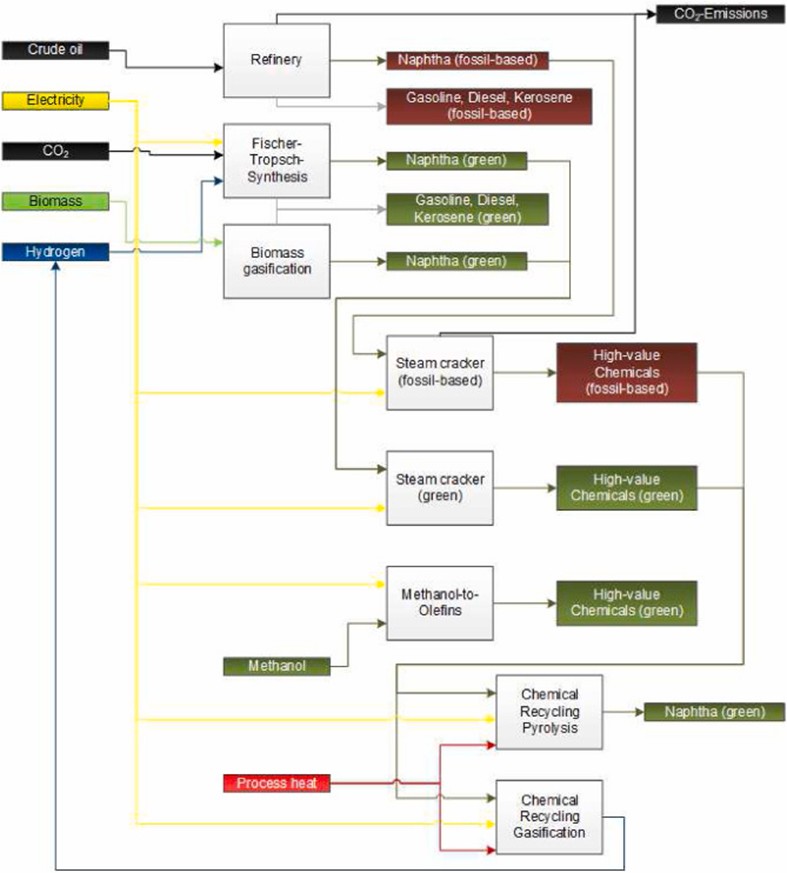
Figure above shows schematic display of how the production of high-value chemicals is embedded in the energy system model.
By using biomass, or hydrogen, CO2 emissions can be avoided in the production of naphtha. In the further course, naphtha is split into highly refined chemicals in steam crackers. Conventionally, the required process heat is provided by combustion of parts of the naphtha, which results in CO2 emissions. In the future, however, it will also be possible to provide the required process heat by means of electric heaters. The second process implemented for the production of HVCs is the methanol-to-olefins process. In this process, methanol is used instead of naphtha as a feedstock for the production of HVC. Connected to the production of HVC are recycling processes for the treatment of waste streams composed of HVC.
_______
_______
Biomass feedstocks:
Biomass can be considered as “material of biological origin excluding material embedded in geological formations and/or fossilised” The types of biomass covered by this definition include: biomass crops; food crops, such as vegetable oils and starches; agricultural residues; forest residues; horticultural residues; marine biomass; municipal food and garden waste and the biogenic fraction of municipal waste, such as paper and card. Biomass has a highly heterogeneous nature, as the biomass composition depends on the plant species, location and year-to- year variability. Dry plant matter is known as lignocellulosic biomass. This is made of polysaccharide carbohydrates – cellulose and hemicelluloses – and an aromatic polymer, lignin. Lignin makes plant cell walls, accounting for approximately one-third of lignocellulosic biomass.
In defossilization pathways, biomass plays a key role as a renewable carbon source that can replace oil, gas, and coal as raw material for fuels, chemicals, and materials. It helps “keep carbon in the economy” while cutting dependence on fossil reserves, rather than just reducing emissions.
Biomass feedstocks, enabled by catalyst innovation, are helping to defossilize chemical production and build a more sustainable industrial future.
Because biomass is typically composed of a range of organic molecules that contain both hydrogen and carbon atoms, alongside other atoms (predominantly oxygen and nitrogen), any type of biomass can theoretically be used as a feedstock in the production of chemicals.
Biomass feedstocks are often discussed in terms of “generations”: first-generation feedstocks refer to food crops (corn, beetroots, sugar cane), while second-generation encompasses all the forms of biomass that are not dedicated to food uses (including woody biomass or waste from food crops, for instance). Third-generation refers to the biomass of microorganisms such as algae or bacteria.
Biomass feedstocks can also be categorised based on their chemical classes, which might overlap with the aforementioned classification. To date, (a) sugars/starch and (b) triglycerides/oils are the main resources used to produce biofuels and bio-derived chemicals, mostly from food crops such as corn (raising questions over possible usage conflicts with other sectors). A shift to (c) lignocellulosic forms of biomass may also be possible in the near- to medium- term. Importantly, while lignocellulosic biomass is harder to valorise compared to first-generation biomass, it can be sourced from non-food crops (“energy crops”), such as the often-cited Miscanthus, and a range of biomass residues (non-edible parts of food crops, forestry residues, industrial and municipal solid waste). In particular, lignin, a key component of lignocellulosic biomass and the world’s second most abundant biopolymer, is composed of around 60% of carbon and is seen as a crucial potential resource for unlocking large-scale industrial production of bio- derived chemicals, especially aromatics.
_
Conversion pathways:
Biomass feedstocks are very different from fossil hydrocarbons in terms of their composition, often consisting of complex, highly oxygenated molecules. Several conversion pathways are envisioned to turn raw biomass materials into useful chemicals.
Biomass to chemicals processes:
Processes that can be used for the conversion of biomass products to chemicals are either thermochemical, such as direct gasification, or thermo-catalytic and bio-catalytic, such as hydrolysis. Thermochemical processing is used to convert biomass into products such as biochar, bio-oil and syngas. Biochar and bio-oil contain corrosive and unstable oxygenates and are therefore difficult to use. Enabling these to be valuable products for the chemical industry is an active area of research. A promising conversion method is the direct gasification of biomass at high temperatures (>700°C) and low oxygen levels to produce a syngas mixture containing hydrogen, carbon monoxide, CO2 and methane. Thermochemical routes that lead to the production of a syngas, mainly composed of H2 and CO in varying proportions, depending on the feedstock. Later on, the syngas can be used through various processes (such as Fischer-Tropsch) to produce MeOH or naphtha, similarly to more traditional fossil syngas.
Another thermochemical route is pyrolysis. Biomass pyrolysis uses thermal degradation to convert feedstocks into solid, liquid and gaseous products. The products formed are heavily dependent on the composition of the feedstock in question and process conditions. The type of reactor, heat transfer, residence time, heating rate and temperature all impact product formation. Oxygen contained within the structural components of biomass – lignin, cellulose and hemicellulose – leads to pyrolysis oils. These oils contain oxygenated compounds that can be detrimental to oil stability and lead to undesirable properties. Catalytic pyrolysis has advantages over non-catalytic pyrolysis, as it reduces the activation energy of feedstock degradation and provides control over product formation, helping to increase the purity, directing towards higher value products, and promoting the removal of oxygen from pyrolysis oils. Developments to catalytic pyrolysis seek to improve selectivity, promote deoxygenation reactions and reduce catalyst degradation through coke formation. This is a major challenge for commercial catalytic pyrolysis. Commercial operations usually seek valorisation through production of biochar or crude pyrolysis oils that can be used directly as fuels, as feedstocks in fuel production, or as feedstocks for production of other materials and chemicals. It is also possible to valorise the gaseous products, but these are often combusted to provide process heat.
Biochemical processing, such as hydrolysis and fermentation, leads to chemical compounds such as adipic acid, glycerol, fumaric acid and propylene glycol. These can be widely used for pharmaceutical, polymers, cosmetics, solvents and broader chemical products. This offers the opportunity to bypass the existing primary chemicals stage, which is beneficial in terms of energy use and manufacturing complexity.
Before converting biomass to chemicals, some pre-treatment steps (milling, pressing, grinding, drying…) are often required to remove impurities due to inherent heterogeneity of feedstock. Those steps may be time-, energy- and cost-intensive.
_
Biorefineries:
A biorefinery is a dedicated facility for producing chemicals or fuels from biomass, using technologies, but the term is often used specifically to refer to a system that makes a range of products and/or energy carriers (e.g. power, fuels) rather than a single product. Though in some ways this kind of integrated biorefinery approach is analogous with an oil refinery, it is in fact more complex: rather than just separating the feedstock components as an oil refinery does, a biorefinery converts a single feedstock into multiple products. An integrated biorefinery allows multiple valuable products to be obtained from a biomass feedstock which can improve the environmental and economic performance. There are already hundreds of biorefineries operating around the world (e.g., the Bazancourt–Pomacle Biorefinery described below). A “biorefinery” should not be interpreted as a mere transposition of an oil refinery fitted with biomass feedstocks. Instead, the term designates a large variety of facilities that enable “the sustainable processing of biomass into a spectrum of marketable products (food, feed, materials, chemicals) and energy (fuels, power, heat)”.
Several classifications exist, which can be based on:
- The inputs and outputs: phase I biorefineries produce one feedstock from one primary product with fixed capacity, phase II biorefineries yield several products from one input product, and phase III produce several outputs from a variety of feedstocks.
- The type of biomass feedstocks (sugar, triglyceride, lignocellulosic).
- The processes involved (IEA Bioenergy’s classification): mechanical/physical, biochemical, chemical, thermochemical.
_
BAZANCOURT–POMACLE BIOREFINERY:
The Bazancourt–Pomacle Biorefinery in France begun as a sugar refinery. It is now a truly integrated biorefinery, converting 4 Mt biomass a year into chemicals, fuels, and food and feed ingredients. It utilises biomass from the surrounding region, benefiting the local agricultural economy, and was developed with the support of local farming cooperatives. Multiple companies now operate at the site reaping the benefits of co-location such as sharing of intermediates, reduced waste, and lower energy consumption, as is commonly seen in the petrochemical industry. There is also a multidisciplinary research centre on the site to support innovation and translation of new biomass utilisation approaches. The biorefinery has attracted large amounts of investment into the region, and directly employs 1,200 people and supports a further 800 jobs indirectly.
_
Biomass is currently the best-established sustainable carbon feedstock, already integrated into various bio-based chemical processes. However, its future role in defossilizing the chemical sector is constrained by several factors: land use competition, including agriculture, sustainability criteria, and growing demand from other sectors such as aviation, maritime, power generation, heat supply, and construction. This competition puts pressure on the finite supply of sustainably sourced biomass.
_
Estimates of global sustainable biomass availability vary significantly depending on the geographic context and the stringency of sustainability criteria applied. Given conservative assumptions that prioritize biodiversity, food security, land-use integrity, and global availability, worldwide biomass availability is estimated to range between 50 and 100 EJ/y. Latest insights indicate that the upper limit of 100 EJ/y may be available from only using residues, by-products, and wastes, i.e., fully avoiding land-use conflicts of energy crops. Geographic disparities also complicate the picture. Countries like Brazil benefit from abundant biomass resources due to favorable climate and land availability conditions, whereas others, such as Belgium and the Netherlands, Singapore, or Qatar, face more constraints. These regional imbalances necessitate a differentiated approach to biomass deployment. However, those residues may also become valuable in other sectors, e.g., forestry, bringing new challenges of both the energy and chemical sectors to the forefront.
_
Given this limited and uneven availability, biomass should be strategically prioritized for applications where alternative decarbonization pathways are either technologically immature or economically unviable. These include sectors such as pulp and paper, chemicals and plastics, woody construction materials, and sustainable aviation fuels. In regions with more abundant biomass, additional applications may be viable, including district heating, high-temperature industrial heat, seasonal power balancing, steel production, and maritime transport. This prioritization is essential to ensure that biomass contributes effectively to climate goals without exacerbating land-use conflicts or undermining ecological integrity and biodiversity priorities.
____
Bio-based chemicals: drop-in and novel:
Biomass feedstocks can be converted into drop-in bio-based chemicals, which are structurally identical to existing fossil-based chemicals. The fact that biomass feedstocks contain molecules that are markedly different from those found in fossil feedstocks makes a bio-based chemicals industry well suited to the production of novel organic chemicals. While the history of the petrochemical industry has been one of converting relatively simple molecules into more complex compounds, a shift towards large-scale bio-based chemistry could represent a switch in the opposite direction. Several approaches can be conceptualised as follows:
-1. In “drop-in” pathways, biomass feedstocks are used to produce base chemicals that have identical properties to their fossil-based counterparts, such as ethene or methanol. This approach asks for minimal adaptation of existing infrastructures and processes, at the expense of lower biomass utilisation efficiency.
-2. Another pathway consists of focusing on producing novel or dedicated chemicals that more efficiently exploit the intrinsic properties of biomolecules, such as their complex composition and functionality. In addition to displacing the use of fossil carbon, these may be a more sustainable alternative to some damaging (i.e., toxic) chemicals currently used today, and in some cases even show better performances. This more disruptive approach would however rely on innovative processes and require more significant changes to current infrastructures and value chains, as well as shifts in buyer or consumer practices, leading to potentially significant barriers to adoption.
-3. Hybrid approaches, sometimes referred to as “smart drop-in” strategies, combine drop‑in chemicals with bio-based compounds used for improving one or several steps of traditional processes.
Drop-in and novel approaches may be complementary. From a drop‑in perspective, biomass gasification to syngas (an already mature technology) and later conversion to chemicals could provide a relevant near-term
opportunity to replace large volumes of fossil carbon with biogenic carbon. As would be expected, novel chemicals, are best deployed in small-scale applications at first.
Example of Novel chemical is Cyrene™ that is derived from waste cellulose and replace N-methyl-2-pyrrolidone (NMP), a toxic solvent currently used in the production of textiles, resins and plastics.
Example of “Smart drop-in” is Epichlorohydrin, used to produce resins and plastics, is currently produced in a 3-step fossil pathway from propene. However, it could be produced in 2 steps only using biomass-derived glycerol as an input.
Figure below shows simple visualisation of drop-in vs dedicated routes for bio-based chemicals.
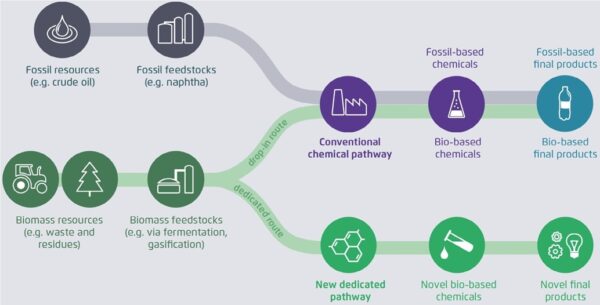
Biomass-sourced carbon is more oxidised than all components of fossil carbon. This means that commodity chemicals with oxygen atoms in their structure require fewer processing steps to be produced from biomass than fossil feedstocks. This could be a potential advantage over fossil feedstocks. However, much further research and development is required into known and potentially viable routes to converting oxygenates into valuable chemicals. More research is also needed into addressing disadvantages such as high water content, lower energy content and removing impurities.
In contrast, the production of conventional building blocks with no oxygen atoms, such as ethene, from biomass is energy intensive as it requires its deoxygenation. This could encourage the production of novel chemical building blocks from biomass that are closer to the final products – bypassing the existing dominant primary chemicals. This may theoretically mean the future chemical industry manufactures many more final products, rather than deriving the majority of products from just a few primary chemical building blocks.
______
Role of biomass in defossilization pathways:
Main roles in practice:
- Renewable feedstock for chemicals and polymers: Biomass (e.g., lignocellulosic residues, vegetable oils, sugars) is converted via biochemical (fermentation, hydrolysis) or thermochemical (gasification, pyrolysis) routes into platform chemicals such as ethanol, lactic acid, or furans that can be used to make bio-based monomers and plastics.
- Source of “green” hydrogen and fuels: Biomass derived hydrogen or biofuels (including cellulosic biofuels) can displace fossil-based hydrogen and transport/light industrial fuels, directly defossilizing energy carriers and reducing upstream fossil feedstock demand.
Environmental and systems benefits:
- When sourced sustainably, biomass is treated as broadly carbon neutral over its lifecycle because the CO₂ absorbed during growth offsets emissions released during processing or combustion.
- Biomass can also enable carbon removal and storage strategies (e.g., biochar, biogenic carbon storage in materials), giving some defossilization pathways negative emission potential or at least reduced net carbon impact.
Key constraints and cautions:
- Land use competition, biodiversity impacts, and indirect emissions mean biomass must be carefully managed; defossilization strategies typically prioritize wastes, residues, and non-food feedstocks over prime food crops.
- Supply chain scale, logistics, and technology maturity (especially for lignin rich and mixed residues) still limit how fast biomass can be ramped up as a widespread defossilization lever.
_______
Biomass availability:
There are many complex interacting factors that will influence the future availability of biomass. These include improvements in crop yields (itself connected to the production of energy intensive fertilisers), the impact of climate change on agricultural productivity, the extent to which productive agricultural land is used for food or biomass crop cultivation, future global population and dietary change, demand for biofuels, and the protection of land for nature. Biomass availability will differ between countries and regions, due to a range of factors including geography and domestic policy.
Approximately 60 EJ (exajoules) of solid bioenergy (energy generated from biomass) is used per year globally. This is equivalent to around 4.3 Gt of fresh biomass. Under future net zero scenarios which account for food supply and environmental considerations, estimates of the future bioenergy supply required range from 85 – 250 EJ per year. Using the assumption from the International Energy Agency of 100 EJ per year, this equates to just over 7 Gt of biomass, including moisture content.
However, there are many potential uses for biomass, with competing sectoral demands, such as for food, animal feed and bioenergy. For example, global food production may have to increase by more than 50% by 2050 to meet demands for a growing population, whilst demand for bioenergy has risen by 3% per year since 2010 and is forecast to continue increasing. There is also increasing demand for biomass for Sustainable Aviation Fuels (SAF).
Sustainable Aviation Fuels (SAF) biomass demand in the UK:
The UK government has placed a strong emphasis on the use of biomass for sustainable aviation fuels. The UK has an upcoming SAF mandate, “requiring at least 10% (c.1.2 Mt) of jet fuel to be made from sustainable sources by 2030”. At present, only a very small fraction of biofuel is used in the UK aviation sector.
However, a previous Royal Society report has outlined the challenges of meeting the UK’s SAF demand through biomass. The report outlines three energy crop scenarios – for oil seed rape, miscanthus and poplar – in which more than 50% of all UK agricultural land would be needed to produce the necessary amount of biomass to replace all the UK’s aviation fuel. Alternatively, waste cooking oil, agricultural residues, forest residues and municipal waste could account for approximately 20% of jet fuel demand.
Alongside land use challenges associated with SAF from biomass, the emissions from the production methods and burning SAF at altitude should be considered. Whilst biomass for both chemical feedstocks and SAF used in the UK could be sourced from international markets, the above example is to illustrate the potential implications of replacing fossil sources with biomass at significant scales.
Considering the above competing demands and wider sustainability considerations, it is unlikely that existing sources of biomass will provide a significant percentage of embedded carbon required by the chemical industry under expected growth trajectories. Biomass may, though, act as a promising route for more limited markets, such as for speciality chemicals.
_
Waste biomass:
Waste biomass refers to organic byproducts and residues from agriculture, forestry, industry, and municipalities (e.g., crop stalks, manure, sawdust, food scraps). Instead of rotting in landfills or being burned—which causes air pollution and methane emissions—it is valorized. It is converted into renewable energy, biofuels, bioplastics, and biochar through biological and thermal processes. To reduce land-use change emissions and impacts associated with water use, fertilizer production, food competition, and habitat land, waste biomass is preferable to total virgin biomass. This includes crop residue, urban wood waste, forest residue, primary mill residue, and secondary mill residue. Removing constraints from virgin biomass to include other sources like dedicated energy crops would increase the available resources but could result in impacts mentioned earlier as well as further compete with other uses like aviation, biofuel, and energy production.
_______
Biomass for Cleaner Energy (decarbonization):
Heavy industries are major carbon emitters, but there’s a growing shift towards renewable energy sources, with biomass at the forefront. Here’s how biomass can drastically cut CO2 emissions:
– Biomass Cogeneration: Generating heat and electricity simultaneously using biomass reduces reliance on fossil fuels and enhances efficiency.
– Process Heat: Biomass can replace fossil fuels for high-temperature industrial processes, significantly lowering carbon emissions.
– Combined Heat and Power: Integrating biomass into CHP systems allows industries to cut CO2 emissions while maintaining energy reliability.
– Biomass conversion to liquid: Biomass conversion to liquid fuels, such as biofuels and biocrude, offers a versatile and sustainable energy solution.
– Biomass conversion to gas: through a range of process enables us to produce and replace natural gas with bio-natural gas and biohydrogen. Biohydrogen (H₂) is a clean, renewable energy source produced through biological processes. It harnesses microorganisms to break down organic waste or water into hydrogen gas, offering a highly sustainable, zero-emission fuel alternative.
_______
Bio-based platform chemicals:
Platform chemicals are versatile, foundational building-block molecules that can be converted into a wide array of higher-value, specialized end-products. They act as the molecular springboards for everyday items like plastics, solvents, resins, and fuels.
Historically derived from fossil fuels (petrochemicals), the industry is shifting toward “bio-based” platform chemicals to reduce carbon footprints and utilize renewable resources.
Key Bio-based Platform Chemicals:
- Succinic Acid: A core building block used for bioplastics (like PBS), solvents, and food additives.
- Levulinic Acid (LA): Upgraded into fuel additives, resins, and specialized solvents (like GVL).
- Hydroxymethylfurfural (HMF): Synthesized from sugars to replace petroleum-based plastic precursors like terephthalic acid.
- Furfural: Derived from agricultural byproducts; critical for making resins, furfuryl alcohol, and various polymers.
- Lactic Acid: The primary precursor for Polylactic Acid (PLA), one of the most widely used biodegradable plastics.
_______
Biogenic carbon:
Biogenic carbon is carbon derived from living matter—such as plants, trees, and organic waste. During growth, biological organisms absorb carbon dioxide (CO2) from the atmosphere through photosynthesis, storing it as carbon. When these materials decompose or are burned, they release this stored carbon back into the atmosphere. Unlike fossil carbon (which releases carbon that has been locked deep underground for millions of years), biogenic carbon operates within a short-term, circular loop.
-1. Absorption: Plants and trees extract (CO2) from the air while growing.
-2. Storage: The carbon remains locked in the biomass (like wood or crops).
-3. Release: At the end of its life, through natural decomposition or combustion, the carbon is returned to the atmosphere.
Because the emitted carbon was recently captured from the air, it is largely considered “carbon neutral,” meaning it does not increase the total amount of CO2 in the atmosphere compared to relying on fossil fuels.
_
Replacing Fossil Carbon with Biogenic Carbon by Design: HMF synthesis:
Here’s how the pathway works:
-1. CO₂ intake through photosynthesis: Crops absorb atmospheric CO₂ and convert it into sugars, such as fructose.
-2. Production Processes: The fructose, along with utilities and other raw materials, is produced and prepared for conversion.
-3. HMF Production: Fructose and other inputs are transformed into 5-HMF (5-hydroxymethylfurfural), with humins as a byproduct.
Primary Uses of HMF:
- Bioplastics & Polymers: HMF is oxidized into 2,5-furandicarboxylic acid (FDCA), a key monomer used to produce polyethylene furanoate (PEF). PEF is a sustainable, bio-based alternative to traditional packaging plastics like PET.
- Biofuels: HMF can be upgraded into advanced, renewable liquid transportation fuels to supplement or replace fossil fuels.
- Fine Chemicals: It serves as an essential precursor for synthesizing resins, solvents, agrochemicals, and pharmaceutical intermediates.
- Industrial Derivatives: HMF is further processed into other valuable platform molecules, such as 2,5-bis(hydroxymethyl)furan (BHMF) and 2,5-dimethylfuran (DMF).
_____
Biomass Flows (biogenic carbon use):
Global biomass utilisation:
In 2023, the total global demand for biomass was around 13.6 billion tonnes, with bio-based polymers accounting for only 0.023% of this. This corresponds to an area share of 0.013%, as bio-based polymer feedstocks are mainly derived from high-yielding crops such as maize and sugarcane, as well as by-products like glycerol and used cooking oil. Around 3.2 million tonnes of biomass feedstock were used to produce 4.2 million tonnes of (some only partly) bio-based polymers worldwide in 2024, mainly from glycerol (31%), sugars (25%), starch (20%), and non-edible plant oils (12%) as seen in figure below.
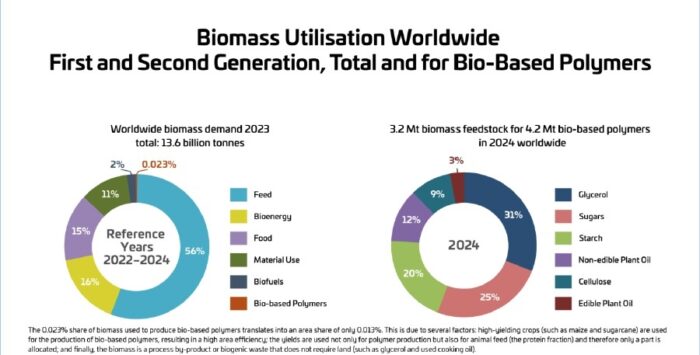
Figure above shows Biomass Utilisation Worldwide.
_
Biogenic Carbon Use in the EU-27 Chemical Sector:
According to the RCI Carbon Flows Report (Kähler et al., 2023 – an update is prepared for 2026), the total embedded carbon demand for materials and chemicals in the EU-27 amounts to approximately 200 Mt C per year. Within this total, the chemical industry (PRODCOM NACE C20 “Manufacture of chemicals and chemical products”) accounts for roughly 110 Mt C per year, corresponding to more than half of the embedded carbon in the materials and chemicals sector. Of this, about 5-6 Mt C per year originate from biogenic sources, representing around 4 % of the total embedded carbon in the chemical industry and around 5 % when excluding heavy oil fractions such as bitumen, paraffin waxes and lubricants. The remaining approximately 95 % are fossil-based. According to the BIC/RCI Biomass Report (Carus et al., 2025), the total biomass input to the EU chemical and derived materials sectors amounts to approximately 11.5 Mt dry mass, equivalent to 6.2 Mt biogenic carbon per year. The main feedstock categories comprise starch, sugars, vegetable oils and fats, pulp, and natural rubber.
_
Bio-based polymer:
Figure below shows Bio-based Polymer Capacities and Production Worldwide 2025.
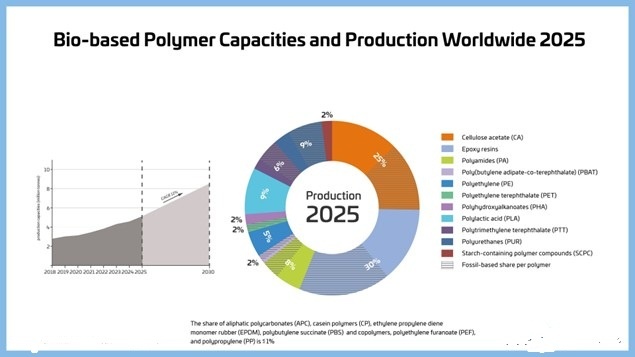
Of the total 4.5 million tonnes of bio-based polymers produced in 2025, cellulose acetate (CA), with a bio-based content of 50 % and epoxy resins with a bio-based content of 45 % accounted for more than half of the bio-based production, 25 % and 30 %, respectively. This is followed by 30 % bio-based polyurethanes (PUR) and 100 % bio-based polylactic acid (PLA) with 9 %. Polyamides (PA) (60 % bio-based content) with 8 %, polytrimethylene terephthalate (PTT) (31 % bio-based content) with 6 % and polyethylene (PE) with 5 %. The share of aliphatic polycarbonates (APC; circular and linear), poly(butylene adipate-coterephthalate) (PBAT), polyethylene terephthalate (PET), polyhydroxyalkanoates (PHA), polypropylene (PP) and starch-containing polymer compounds (SCPC) was less than 5 %. Casein polymers (CP), ethylene propylene diene monomer rubber (EPDM), polybutylene succinate (PBS) and polyethylene furanoate (PEF) accounted for less than 1 % of the total bio-based polymer production volume and are not shown.
All (semi-) commercial pathways from biomass via different intermediates and building blocks to bio-based polymers are shown in figure below. Bio-based building blocks and polymers analysed in detail are highlighted in bold.
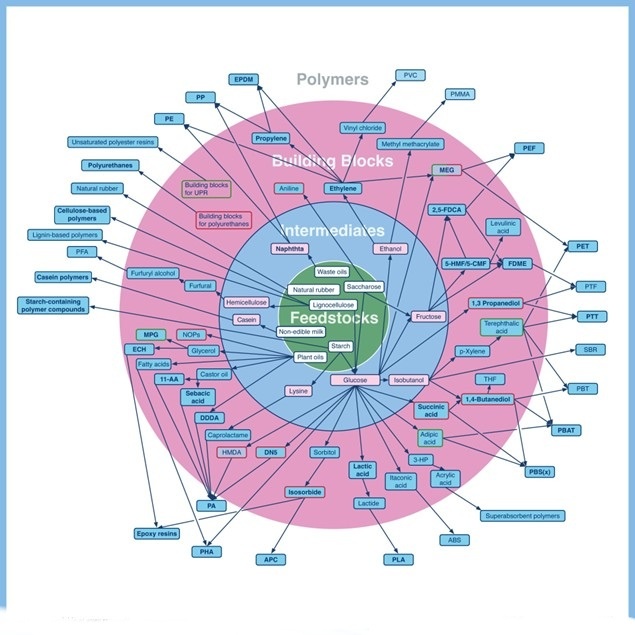
Figure above shows Pathways to Bio-based Polymers.
_______
Emerging routes from biomass to chemicals:
Biomass and bio-derived products present a valuable opportunity to be electrocatalytically converted into bespoke chemicals, such as for cosmetics and pharmaceuticals – though, again, these are not at a significant scale of production to substantially reduce chemical sector emissions in line with net zero targets. An example of an alternative plastic production route and an example of potential green hydrogen co-production are outlined below.
Glycerol to lactic acid:
In 2022, around 2.3 billion litres of biodiesel were produced in the UK. Glycerol is the main by-product of biodiesel production. Glycerol of high purity (>98%) can be electrocatalytically converted to high value products, such as organic acids, depending on the catalyst and the potentials applied.
An alternative route to glycerol conversion comprises a mix of electrocatalytic and chemical routes, yielding lactic acid – a precursor to a bioderived polymer – with high selectivity above 85%. Whilst the lactic acid market is growing, this is not large in comparison to primary chemical markets.
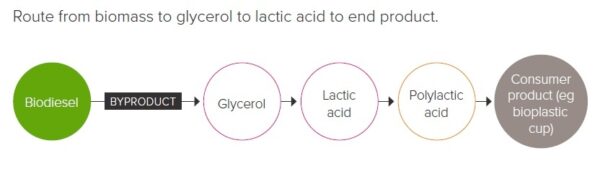
Figure above shows Route from biomass to glycerol to lactic acid to end product. Lactic acid can be obtained directly via the fermentation of sugars present in biomass. However, recent studies suggest that an electrochemical and chemical route might have both environmental and technoeconomic advantages.
_
Co-producing green hydrogen and chemicals from biomass:
An advantage of the electrocatalytic processes described above is that these take place in electrolysers, identical to water electrolysis – a well-established technology used in, for example, hydrogen production. Instead of oxidising water to create oxygen at the anode, a bio-derivative is oxidised to produce high value chemicals, such as 5-(hydroxymethyl) furfural (5-HMF) and 2,5-Furandicarboxylic acid (FDCA). At the cathode, green hydrogen is simultaneously produced from the protons contained in biomass as seen in figure below.
Since biomass oxidation takes place at much lower potentials compared to oxidation of water, the total electricity input required is significantly lower, reducing costs for hydrogen production.
The key to realising this technology is developing cost-effective catalysts that can achieve biomass partial oxidation with high activity and high selectivity. The scale of possible hydrogen production is restricted as the hydrogen extraction rate is around 10% of the weight of the total biomass, though it could be used to feed back into the chemical industry at the point of production for further use.
Figure below shows Concept of a biomass electrolyser with high value chemicals and green H2 coproduction.
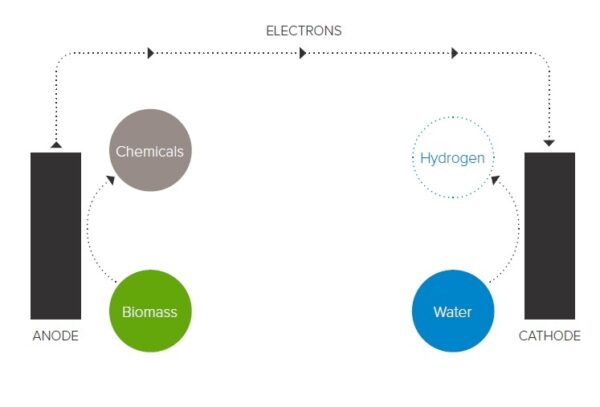
_____
Biomass to levulinic acid:
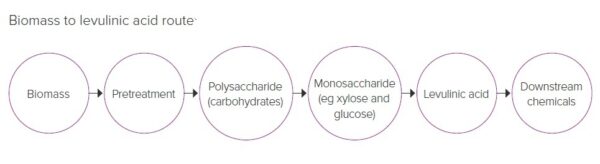
Levulinic acid is seen as an attractive ‘stepping stone’ chemical building block that can be made from waste biomass. Possessing two different reactive functional groups – ketone and carboxylic acid – levulinic acid is highly versatile for the synthesis of a large number of downstream intermediate chemicals, which are used in many industries including polymers, electronics, cosmetics, solvents and fuels.
Levulinic acid synthesis has been studied extensively in academia, using a wide range of biomass sources, such as food crops, food waste and even algal biomass. In particular, levulinic acid can be derived from five- and six-carbon sugars, such as xylose and glucose found in lignocellulosic biomass feedstocks, including waste wood.
Levulinic acid is now being commercially produced from biomass, principally as a solvent rather than as an intermediate. Reducing the cost and energy intensity of this potentially important intermediate is the next challenge, to move beyond very small-scale production and to lower associated emissions. The downstream conversion of levulinic acid to other chemicals has attracted attention from electrochemical investigation to improve efficiencies.
To make any substantial impact on the emissions of the global chemical industry, routes from alternative carbon sources will have to be made as low emission as possible and replace high emission pathways at significant scale.
______
______
Biofuel and Biogas:
Biomass energy includes biogas, liquid biofuels (biodiesel, ethanol, methanol, butanol), and solid biofuels (typically wood, but could be any solid burned to create energy from heat). Solid biofuels can be burned directly to create energy, but both biogas and liquid biofuels must go through a conversion process to become usable fuel. There are several processes that convert biomass to fuels (figure below) that power homes, create fuel for vehicles, and fulfill other energy needs. How biomass is processed depends on the type of biomass (e.g., manure or oilseed crops) and how it will be used (e.g., to fuel cars or power generators).
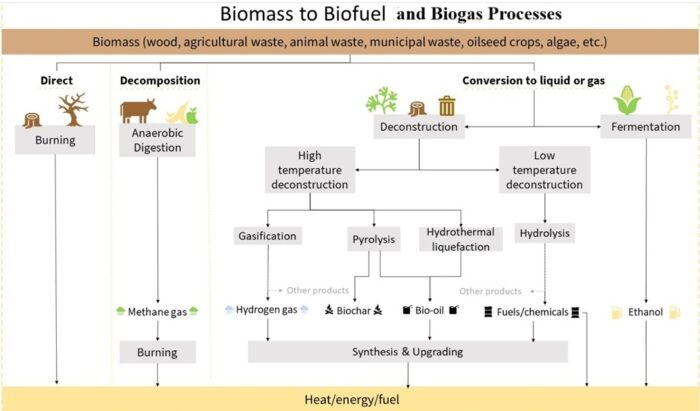
_
Ethanol
In 2021, the United States produced about 44 Mt of ethanol, almost entirely from corn crops grown in the Midwest. Ethanol is mostly used as a fuel additive in motor gasoline, with some other chemical uses as well (EIA 2022a). Braskem plant has disclosed yield of 200,000 tonnes of ethylene from 462 million liters of ethanol. Considering the opportunity cost of using farmland for ethanol destined for chemicals or fuel instead of food or storing carbon through nature restoration, it is advisable that more land not be used for ethanol crops (Searchinger et al. 2018).
The shift to ethanol blends must include a shift from crop-based to agri residue-based options. Even the biofuels mission needs to shift its focus, from using food crops to produce ethanol – sugarcane, corn, maize – to using crop residue. Waste-based biofuels kill two birds with one, biorefinery – they produce fuel (ethanol) and can replace imported chemical fertilisers (urea) with organic ones at the farm level. If India were to meaningfully move away from food crops to using crop residue – think cane stubble and bagasse, rice and wheat straw, corn cobs – it will harvest a multiplier effect. Processing farm residue, nothing goes to waste. India generates more than 500mn tonnes of agricultural residue each year, that could, per some estimates, yield over 40bn litres of ethanol-equivalent.
_
Methanol:
Defossilization of methanol is achieved through two main pathways:
- E-Methanol (Power-to-Methanol): Synthesized by combining captured CO₂ (from point sources like cement plants or direct air capture) with green hydrogen produced via water electrolysis powered by renewable electricity.
- Bio-Methanol: Produced from the gasification of biomass, agricultural waste, or municipal solid waste
Defossilized methanol is an intermediary between feedstocks and olefin production. Methanol production processes are conventional methanol synthesis with defossilized hydrogen, e-methanol using hydrogen and CO2, or bio-methanol. E-methanol CO2 synthesis would require more hydrogen than conventional synthesis per kilogram but provides a better circular economy opportunity for emitted CO2 and avoids using carbon monoxide, which is typically a by-product of combustion. Co-electrolysis of carbon monoxide and hydrogen and direct conversion of CO2 and water into methanol are not included because they are currently lab-scale, but they could improve e-methanol conversions in the future (IRENA 2021).
Note that methanol is both a primary chemical and a feedstock, as it can be converted into ethylene and propylene through the MTO process. Thus, inputs for ethylene and propylene via MTO equal the total amount of feedstock (e.g., biomass, H2, CO2) needed to make one tonne of methanol multiplied by the amount of methanol feedstock to make one tonne of olefins. Additionally, the total amount of methanol would equal final methanol product plus methanol used as an intermediary for MTO. Finally, electrolytic hydrogen is divided between the volume needed for the CO2-to-methanol process (CO2 hydrogenation) and traditional Haber-Bosch synthesis with hydrogen, as each process requires different volumes of hydrogen.
Ammonia can be produced from waste biomass or clean hydrogen; it does not require carbon molecules. Methanol can be produced from waste biomass, hydrogen using traditional synthesis, or hydrogen and CO2 via e-methanol synthesis. Ethylene can be produced through the MTO process using either the aforementioned methanol synthesis process, as well as through ethanol-to-ethylene.
_
Selected defossilization technologies and technology readiness levels
TECHNOLOGY TRL
Hydrogen electrolysis 9
Green ammonia (modified Haber-Bosch) 9
E-methanol 7–9
Methanol-to-olefins 9
Ethanol-to-ethylene 9
Point source CO2 capture 5–9
Biomass gasification with CCUS 3–5
Notes: CCUS = carbon capture, utilization, and storage; CO2 = carbon dioxide; TRL = technology readiness level. TRL of CO2 capture depends on the industry and capture system design. Industries with highly concentrated CO2 emissions (i.e., ethanol, ammonia) and solvent-based systems have the highest TRLs. Lower concentrations and new systems are maturing.
Defossilization pathways that have not been deployed commercially but are comprised of technologies that are either commercial or near commercial are included. For example, defossilized methanol-to-olefins (MTO) is not commercial scale, but conventional MTO is and could become a defossilized process if the methanol were made with non-fossil inputs, which is also well understood.
_______
Many techniques for fuel production from biomass:
Growing population and consequential rise in energy demand are contributors to overdependence of carbon-based fossil fuels combustion for various applications which continues to increase the atmospheric CO2 to unrecyclable levels leading to anthropogenic global warming from insufficient CO2 capture and sequestration, and thus incomplete carbon cycle. Depleting fossil fuel reserves and concerns of CO2 emissions from fossil fuel combustion, along with the concerns of improper waste disposal poses great global challenges that need to be addressed for energy and environment sustainability. Many techniques for energy and fuel production from biomass and solid wastes have been examined in the recent past of which thermochemical reformation of wastes are dominant, compared to biochemical processes such as anaerobic digestion, as they provide high reaction rates from their high operational temperatures. These thermochemical processes include pyrolysis, gasification, and hydrothermal conversion techniques. Gasification techniques offer efficient and effective transformation of solid biomass and wastes into gas/liquid fuels and value-added materials. This technique offers clean energy production at high efficiency compared to other transformation techniques via syngas which can be used for combined heat and power generation, production of fuels for transportation using Fischer Tropsch synthesis, and production of value-added chemicals. Low grade or high moisture content feedstocks may need drying before gasification which can significantly lower the economic value and efficiency of gasification that depends on net energy density of the feedstock. Hydrothermal processing is beneficial for the conversion of high moisture content feedstock such as wet grass, algal biomass, municipal waste, and sludge to bio-oils, which can further be refined to produce liquid biofuels that helps to reduce fossil fuel requirement of gasoline, diesel, and other fuels used for transportation, energy, power purposes. Other thermochemical methods such as fast pyrolysis have also been examined during the past couple of decades for the production of bio-oils for biofuel synthesis. Catalytic conversion techniques are required for refining of the bio-crude and bio-oils produced from liquefaction and fast pyrolysis.
_____
_____
Biogas from biomass:
Biogas is generated through the breakdown of organic material in the absence of oxygen via anaerobic bacteria; this occurs naturally in the digestive tract of mammals, wetlands, swamps, and bogs. It can also be fabricated in anaerobic digestion (AD) reactors, where the organic content of biowaste is broken down. Biogas is a mixture of primarily methane and CO2, with traces of H2S, H2, N2, O2, NH3, and chlorine compounds. Anaerobic digesters can produce a stream of 50-70% methane with the remainder being CO2; biogas from landfills is typically between 30-65% methane and 25-50% CO2. Biogas is typically used for heat and power generation, but the large percentage of CO2 reduces its heating value compared to LPG. It can also be injected into natural gas pipelines after purification or compressed or liquified for use as a transportation fuel. The method chosen for removing impurities is application dependent and can include pressurized water scrubbing, pressure swing absorption, membrane permeation, and amine absorption.
Compositions of anaerobic digester and landfill biogas are depicted in table below.
|
Compounds |
Unit |
AD Biogas |
Landfill Biogas |
|
CH4 |
vol% |
53—70 |
30—65 |
|
CO2 |
vol% |
30—50 |
25—47 |
|
N2 |
vol% |
2—6 |
<1—17 |
|
O2 |
vol% |
0—5 |
<1—3 |
|
H2 |
vol% |
NA |
0—3 |
|
Higher HCs |
vol% |
NA |
NA |
|
H2S |
ppm |
0—2000 |
30—500 |
|
NH3 |
ppm |
<100 |
0—5 |
|
Chlorines |
mg/N m3 |
<0.25 |
0.3—225 |
|
Siloxane |
μg/g-dry |
<0.08—0.5 |
<0.3—36 |
_
Biogas and biomethane:
Biogas and biomethane are not the same, but rather stages of the same renewable energy source. Biogas is the raw, unrefined product of organic waste decomposition, whereas biomethane is highly purified biogas that has been upgraded to match the quality of standard fossil natural gas. Biomethane is primarily obtained from the biogas (∼60 % CH4 and 40 % CO2) produced during the anaerobic digestion of organic-rich streams. In the EU, around 20 billion Nm3 of biogas/biomethane are produced annually, which corresponds to an energy content of 220 TWh based on the higher heating value (HHV). Biomethane has a large potential: (i) to reduce the dependency on fossil natural gas (ii) to defossilize hard-to-abate industrial sectors in which direct electrification is not possible and (iii) to reduce the net greenhouse gas (GHG) emissions in the transportation sector when biomethane is used as a fuel in a combustion engine.
Converting raw biogas to pure methane using electrolyzers is a powerful “Power-to-Gas” (PtG) strategy. It upgrades biogas (typically 50-70% methane and 30-50% CO₂) to grid-quality biomethane. This is achieved by feeding electrolyzer-produced hydrogen and the biogas’s carbon dioxide into a methanation reactor. Water electrolyzers (like PEM or Alkaline) use renewable electricity to split water (H₂O) into hydrogen (H₂) and oxygen (O₂). The separated hydrogen is combined with the CO₂ naturally present in raw biogas. Over a catalyst (like nickel), these gases react to produce synthetic methane and water:
CO2 + 4H2 = CH4 + 2H2O
_
Figure below shows Anaerobic digestion (AD) process:
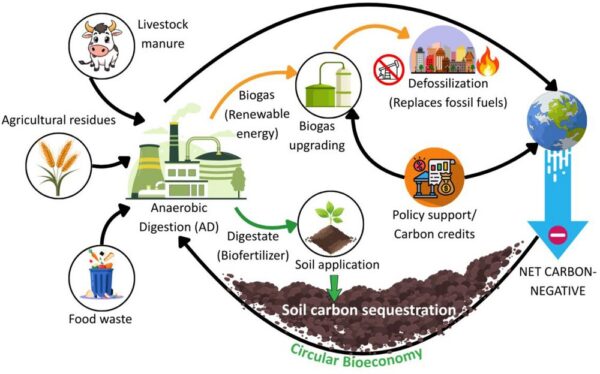
Anaerobic digestion is a biochemical process where microorganisms break down organic materials—such as food waste, manure, and sewage—in the absence of oxygen. It reduces waste volume and generates two highly valuable outputs: biogas (a renewable energy source) and digestate (a nutrient-rich fertilizer).
Anaerobic digestion is a process through which bacteria break down organic matter—such as animal manure, wastewater biosolids, and food wastes—in the absence of oxygen. Anaerobic digestion for biogas production takes place in a sealed vessel called a reactor, which is designed and constructed in various shapes and sizes specific to the site and feedstock conditions. These reactors contain complex microbial communities that break down (or digest) the waste and produce resultant biogas and digestate (the solid and liquid material end-products of the AD process) which is discharged from the digester.
Multiple organic materials can be combined in one digester, a practice called co-digestion. Co-digested materials include manure; food waste (i.e., processing, distribution and consumer generated materials); energy crops; crop residues; and fats, oils, and greases (FOG) from restaurant grease traps, and many other sources. Co-digestion can increase biogas production from low-yielding or difficult-to-digest organic waste.
_
Anaerobic digestion (AD) coupled with carbon capture, utilization, and/or storage (CCUS) is a deployable bioenergy platform that supplies renewable energy and bioresources while valorizing biogenic CO2 for integrated carbon management on the pathway to net-zero. Framing AD solely as a waste-treatment technology undervalues its broader contribution to defossilization, particularly its capacity to directly substitute fossil-based natural gas, fertilizers, and chemicals. Typical biogas contains 50%–75% CH4 and 25%–50% CO2 (USEPA, 2024). A 2025 synthesis by the European Biogas Association reported that 125 biomethane plants are already capturing 1.17 Mt CO2 per year, with rapid growth anticipated (EBA, 2025). This highlights a practical implication: AD upgrading can provide distributed, high-purity biogenic CO2 that supports both durable carbon removals (via storage) and defossilization (via fuel and industrial substitution), but only if performance is measured and governed credibly. Techno-economic studies estimate capture and liquefaction costs in the range of €40–105 per tonne of CO2, with the capture and compression step alone as low as €14–35 per tonne at scale (IEA, 2025), substantially below the costs of direct air capture or post-combustion CCUS applied to fossil sources.
_______
Syngas from biomass:
The syngas composition is not greatly influenced by the biomass type used, making this process suitable for a wide range of feedstocks. Biomass may be sourced from forestry, agricultural, industrial, and waste sectors in the form of woodchips, straw, manure, sawdust, organic municipal waste, sewage sludge, etc. Syngas (synthesis gas), a mixture of hydrogen and carbon monoxide, is primarily utilized as an intermediate in the production of valuable industrial chemicals and synthetic fuels. It is also burned directly for electricity and high-temperature heat generation.
-1. Biomass gasification is a thermochemical process that converts organic materials (wood, agricultural residues) into a combustible gas mixture called syngas. By heating the biomass at high temperatures (>700°C) in a controlled environment with limited oxygen, it yields hydrogen, carbon monoxide, and methane without direct combustion.
-2. Biomass pyrolysis is the thermochemical decomposition of organic materials (such as wood, agricultural waste, and energy crops) at elevated temperatures in the absence of oxygen. It yields three valuable products: bio-oil (for fuels/chemicals), biochar (for soil amendment/carbon sequestration), and syngas (for energy). In pyrolysis, the biomass is subjected to high temperatures to break the chemical bonds and form smaller hydrocarbon species, much like the hydrocracking stage of a refinery. Pyrolysis can produce gas, liquid, and solid phase hydrocarbon species. Different heating rates and temperatures yield vastly different proportions of the three products. The solid phase is known as char, the liquid phase is denoted as tar, and the gaseous phase, which makes up most of the product from this stage, is called pyrolysis gas. Pyrolysis gas is primarily CO, H2, CO2, and light hydrocarbons such as CH4. In the final reduction step, the gas mixtures from the pyrolysis and oxidation stages react with the char to produce the syngas mixture. The temperature at which the reduction step is carried out determines the final composition of the syngas. When pure oxygen is used, process temperatures range from 500-600°C; when air is used as an O2 supply a temperature range of 800-1100°C is more common. CO formation is favored at higher reaction temperatures.
Note:
Pyrolysis and gasification are both thermal decomposition processes that convert carbon-based materials (like biomass or plastics) into simpler, valuable byproducts. The primary difference is the presence of oxygen: pyrolysis occurs in a zero-oxygen environment to produce bio-oil and char, whereas gasification uses limited oxygen to convert materials primarily into syngas.
_______
Syngas from biogas:
The route for producing syngas from biogas is slightly different than for natural gas. Because methane and CO2 are present in biogas in around a 1:0.5 ratio, dry reforming is more suitable than steam methane reforming. Dry reforming subjects the biogas to high temperatures (700-900°C) to catalytically convert the mixture to syngas. However, side reactions also occur, including methane cracking, the Boudouard reaction, and the reverse water gas shift reaction. Methane cracking and the Boudouard reaction produce coke which can deposit on the catalyst and reduce its activity. Methane cracking is more likely to occur at high temperatures because it is an endothermic reaction, whereas the Boudouard reaction is exothermic. Water produced from the RWGS must be separated from the syngas before it is used for methanol production. Nickel catalysts are generally preferred because of their low cost, but noble metal catalysts such as Pt, Pd, Rh, Ru, and Ir based catalysts reduce the occurrence of the unwanted side reactions.
Dry Reforming:
𝐶𝐻4 + 𝐶𝑂2 → 2𝐶𝑂 + 2𝐻2 Δ𝐻 = 247 kj/mol
Methane Cracking:
𝐶𝐻4 → 𝐶 + 2𝐻2 Δ𝐻 = 75 kj/𝑚𝑜𝑙
Boudouard Reaction:
2𝐶𝑂 → 𝐶 + 𝐶𝑂2 Δ𝐻 = −173 kj/mol
Reverse Water-Gas Shift:
𝐶𝑂2 + 𝐻2 → 𝐶𝑂 + 𝐻2𝑂 Δ𝐻 = 42 kj/ 𝑚𝑜𝑙
______
In 2019, methane emissions from manure management, municipal solid waste landfills, and wastewater treatment represented 9.4%, 16.4%, and 2.2% of the total U.S. methane emissions; the remainder is mostly attributed to coal and crude oil sources. Collecting and utilizing biogas from these sources presents both an opportunity to reduce methane emissions, which is a far more potent GHG than CO2, and produce fuels and goods from non-fossil feedstocks. Across the globe, biogas projects have already been installed, showing a promising outlook for biogas utilization. Of the 1250+ landfills in the US, 619 have been outfitted with biogas collection projects and approximately 480 are being considered for new projects. There are also 248 anaerobic digestion projects for livestock manure and 1,200+ wastewater treatment biogas collection projects (half of which only flare their biogas). The biogas collected from these sites is generally used for energy production or is combined with existed natural gas pipelines. In a few instances, the biogas is compressed and used for transportation fuel at Bio-CNG stations, 11 of which exist in the US. A station in Fair Oaks, Indiana for example produced the Bio-CNG equivalent of 5.6 million liters of diesel in 2012, which was used for long-distance trucking.
_______
Waste to energy:
Waste-to-energy (WtE) or energy-from-waste (EfW) are processes designed to convert waste materials into usable forms of energy, typically electricity or heat, in waste-to-energy plants. The most common method of WtE is direct combustion of waste to produce heat, which can then be used to generate electricity via steam turbines. This method is widely employed in many countries and offers a dual benefit: it disposes of waste while generating energy, making it an efficient process for both waste reduction and energy production. Waste-to-energy (WtE) operations produce direct CO₂ and other greenhouse gas emissions during incineration. However, they yield net-positive climate benefits by preventing massive methane emissions from landfills and displacing electricity that would otherwise be generated by burning fossil fuels. The Deonar Waste-to-Energy (WtE) project is a major Brihanmumbai Municipal Corporation (BMC) initiative aiming to process 600 tonnes of municipal solid waste daily and generate 7–8 megawatts of electricity.
In addition to combustion, other WtE technologies focus on converting waste into fuel sources. For example, gasification and pyrolysis are processes that thermochemically decompose organic materials in the absence of oxygen to produce syngas, a synthetic gas primarily composed of hydrogen, carbon monoxide, and small amounts of carbon dioxide. This syngas can be converted into methane, methanol, ethanol, or even synthetic fuels, which can be used in various industrial processes or as alternative fuels in transportation.
_______
Exploring the potential of biological methanation for future defossilization scenarios: Techno-economic and environmental evaluation, a 2024 study:
Highlights:
- The economic and environmental potential of biological methanation was evaluated.
- The electricity price features a high impact on the biomethane production costs.
- Flexible operation of the system is economically feasible at load factors above 35%.
- Global warming impact of biomethane is lower than natural gas at 62% renewable electricity.
- Biomethane is expected to be an important energy vector to promote defossilization.
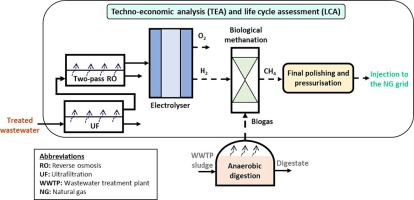
The REPowerEU plan establishes the production objective of 35 billion m3 of biomethane in the European Union (EU) by 2030. Biomethane is an excellent energy vector to promote the defossilization of different sectors within a Power-to-Gas approach. The present study evaluates the economic and environmental implications of producing biomethane from the biogas generated in a municipal wastewater treatment plant (WWTP) with a treatment capacity of 100,000 m3/d and 500,000 population equivalents. The techno-economic analysis (TEA) and life cycle assessment (LCA) were conducted for a biomethane production plant based on biological methanation process using the hydrogen produced in a water electrolyser. The TEA illustrated that the electricity price (0–0.20 €/kWh) features an important impact on the biomethane cost (0.05–0.23 €/kWhHHV) due to the high electrolyser energy consumption. Flexible operation of the electrolyser is economically feasible at load factors above 35 %, which can be attributed to the lower impact of the electrolyser capital cost as the load factor increases. The LCA illustrated that biomethane has a lower global warming impact (<0.28 kg CO2-eq/kWhHHV) than fossil natural gas when the renewable electricity production in the mix is above 62 %. The results highlighted that high carbon prices under the EU Emission Trading System is an important driver to promote biomethane production in European countries since energy production from biomethane could be exempted to acquire emission allowances. This would provide a competitive advantage of biomethane over natural gas when considering the whole supply chain of the energy carrier. Overall, this study demonstrates that biological methanation has the potential to become an important biomethane production technology for future defossilization scenarios. Overall, this study highlights that biological methanation can be an important biogas upgrading technology in the context of green energy transition in Spain and Germany.
______
______
Recycling as alternative carbon source:
Plastic waste as a feedstock for chemicals:
Recycled plastics are expected to become a major pillar of sustainable carbon sourcing in the chemical and polymer industries. However, today only about 10% of plastics are recycled globally, reflecting limitations in collection systems, material sorting, and end-market demand. However, projections indicate that this share could increase to approximately 45% by 2050, provided that enabling conditions, i.e., technological, regulatory, and infrastructural, are met. Plastics are a type of polymer which are composed of thousands to millions of chemically bonded ‘monomer’ units. These monomers are often either basic chemicals or produced from them. Among the various types of polymers, polyethylene (PE), polypropylene (PP) and polyethylene terephthalate (PET) dominate global plastic waste streams. PE is produced from ethene, PP is produced from propene, and PET is produced from ethene and p-Xylene.
Plastic waste to chemicals processes:
Plastic waste needs to be separated from the wider waste stream for recycling. Mechanical recycling applies forces or heat to reprocess the polymer ‘back-to-polymer’ into a new product. Chemical recycling applies biochemical processes to chemically breakdown the plastic, potentially back into monomers, in which case it can also be known as ‘back-to-monomer’ recycling. Chemical recycling differs from mechanical recycling in that it creates a feedstock for chemical production.
_
Mechanical recycling:
Mechanical recycling breaks waste plastics down into flakes or pellets through physical processes including shredding, pressing and melting. Mechanical recycling can be energy efficient, avoiding the need to break down to primary chemicals. However, not all products can be mechanically recycled. There are also limits to mechanical recycling, such as compromised product performance, as well as the introduction of virgin product and additives, which can raise sustainability concerns. Mechanical recycling is already established for certain polymers such as polyethylene terephthalate (PET) and high-density polyethylene, but its applicability is constrained by contamination, polymer degradation, and limited compatibility with mixed waste streams.
Purification can allow for the whole polymer to be recovered without additives and impurities, using a solution to separate the polymer chains. This could be thought of as a variant of ‘back-to-polymer’ recycling method. The main products undergoing purification are PE, PP, PVC and polystyrene. However, solvent based purification recycling is not operating at any meaningful scale. The recycling rates of PP and polystyrene are very low and PVC is hardly recycled at all.
_
Chemical recycling:
Chemical recycling is still in the early stages of industrial deployment, and while it is much more flexible in terms of feedstock, it does remain energy intensive. Chemical recycling converts waste plastic into monomers, other hydrocarbons or chemicals. There are numerous types of chemical recycling technologies and processes, which are suited to different polymer types and are at different stages of maturity. Converting plastic to syngas (synthesis gas) is a thermochemical process that breaks down polymer chains into a valuable mixture of hydrogen (H₂) and carbon monoxide (CO). It primarily uses gasification or pyrolysis, transforming waste into a versatile resource for power generation, liquid fuels, and chemical manufacturing. It is possible to use heat or catalytic reactions to convert waste plastics into simple monomers, oils and gases. This can be done via hydrothermal treatment or gasification into syngas, pyrolysis, and enzymatic polymer recycling. This can be a challenging process for some polymer types, such as polyethylene or polypropylene, since it requires very high temperatures and is unselective, meaning it does not cleanly yield back the monomer, such as ethene or propene.
The chemistry of other chemical recycling routes depends on the polymer under consideration. For polyesters, such as PET and polylactic acid (PLA), it involves processes such as solvolysis, hydrolysis, alcoholysis or glycolysis. These reactions occur under accessible temperatures and are selective for monomer production. However, these reactions will not work with PE, PP, polystyrene or other commodity hydrocarbon plastics.
_
Petrochemicals are critical components in many, perhaps most, industrial and consumer products. Currently, petrochemicals are made from non-renewable fossil fuels, primarily crude oil. According to the World Economic Forum, reducing the chemical industry’s need for fossil-based petrochemicals by using plastic waste-based alternatives can potentially save 300 million tons of fossil-embedded greenhouse gas emissions annually.
Currently, most plastic waste recycling is “downcycling” – the value of recycled products is lower than that of products made from virgin plastics because traditional recycling degrades the physical properties of the material being processed. Mechanical recycling does not depolymerize its feedstock and, therefore, can only create plastic of the same type as its feedstock. In contrast, chemical recycling via thermal cracking depolymerizes plastic and, therefore, is not restricted to plastic-to-plastic recycling. Moreover, chemical recycling can handle some plastic types that are difficult or impossible to recycle mechanically, like ultra-high-molecular-weight polyethylene (UHMWPE) and wider mixes of plastics with lower quality and higher levels of contamination.
When a process creates outputs with a higher value than the original, it is known as “upcycling”. Chemical upcycling can produce petrochemicals – oils, solvents, and waxes that can serve as alternatives to fossil-based oils, solvents, and waxes.
_
Plastic waste availability:
Approximately 300 – 400 Mt of plastic is produced annually. This range is an indication of varying standards and types of reporting, such as whether textiles are included, and difficulties with verification. Plastic production has rapidly increased in recent decades and will continue to do so for the next several decades under a business-as-usual scenario, potentially reaching 1 Gt by 2050. As there are a wide range of uses for polymers, there are also many sources of waste for potential to use as a feedstock, including clothing, plastic products, pipes and plastic packaging.
Globally, approximately 9% of all plastic waste is currently recycled. It is important to note that actual recycling rates vary widely between and within countries and there is uncertainty around exact recycling figures and reporting.
Without policy intervention, low collection rates may significantly impact the viability of plastic waste as a carbon source for chemical production, particularly in countries with low recovery and recycling rates.
_
Plastic waste is a well-recognised source of environmental pollution, with approximately 80 Mt of global plastic waste being ‘mismanaged’ – not stored in secure landfills, recycled or incinerated. Of that, 19 Mt is leaked into the environment, of which 13 Mt enters terrestrial environments, 6 Mt enters rivers and coastlines and 1.7 Mt is then transported to the ocean. Assigning an economic value to this material has the potential create a market and thus reduce plastic waste in the environment. Early-stage research has demonstrated potential for recycling plastic from the marine environment.
_
Improving recycling rates could greatly increase the availability of plastic waste as a feedstock, as well as reduce demand for primary chemical production and virgin fossil feedstock input. This would reduce competition pressure for alternative chemical feedstocks to produce polymers. However, polymer reuse (apart from mechanical recycling) is currently mostly very energy intensive – leading to high associated emissions, if powered by fossil energy. This is a further challenge to consider when comparing the sustainability or emissions intensity of virgin fossil feedstock-derived products to chemically recycled feedstocks.
To significantly reduce emissions and environmental issues associated with plastic production, whilst providing an alternative source of carbon for chemicals compared to virgin fossil carbon, recycling rates will have to significantly expand – with some estimating a potential required recycling rate of between 70 – 90%. This is a vast increase on present recycling rates and would require significant policy intervention and system redesign.
______
______
Plastic waste to hydrogen: How plastic waste contributes to defossilization:
- In thermochemical routes (pyrolysis + steam reforming or gasification), plastic is heated without oxygen to produce a gas rich in hydrocarbons; this gas is then reformed with steam to yield hydrogen instead of using natural gas.
- Because the carbon input comes from waste plastic rather than fresh fossil gas wells, the overall hydrogen production pathway is “defossilized,” even if some process energy is still fossil based.
Key technologies and products:
- Plastic to H₂ routes: Pyrolysis to syngas, steam reforming, gasification, and flash heating or microwave driven methods can convert mixed plastics into hydrogen plus solid carbon or nanocarbons (e.g., carbon black, graphene like materials).
- Carbon management benefit: Much of the plastic origin carbon is captured in solid form (char, carbon black, graphene), which can be stored or valorized, helping to decarbonize the process as well.
Why this matters for defossilization:
- Plastic waste based hydrogen avoids drawing new fossil hydrocarbons from the ground, so it decouples hydrogen supply from fossil fuel extraction and supports a circular carbon economy.
- When paired with renewable electricity for heating or reforming, the same plastic to hydrogen systems can become both defossilized and low carbon, addressing both feedstock and emissions sides.
______
Defossilization and decarbonization of hydrogen production using plastic waste: Temperature and feedstock effects during thermolysis stage, a 2023 study:
The replacement of natural gas with plastic-derived pyrolysis gas can defossilize H2 production, while subsequent capture, utilization and storage of carbon in a solid form can decarbonize the process.
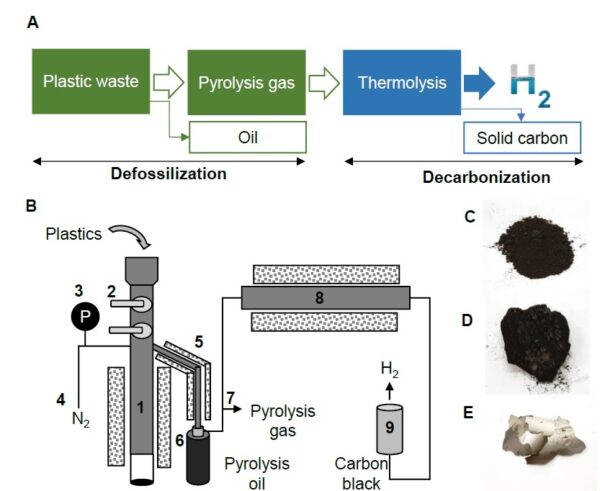
Figure above shows (A) Process flow diagram of plastic waste-to-hydrogen comprising pyrolysis and thermolysis stages. (B) Experimental setup: 1 – plastic pyrolysis reactor, 2 – airlock valve, 3 – manometer, 4 – N2 supply, 5 – cracking reactor, 6 – oil condenser, 7 – sampling port for pyrolysis gas, 8 – thermolysis reactor, 9 – filter. (C) Carbon collected from the particle filter, (D) carbon recovered from the thermolysis reactor and (E) carbon layer deposited on the inner wall of thermolysis reactor (MP, 1300 °C).
The objective of this study was to investigate H2 production from three types of plastics using a process comprising pyrolysis (600 °C) and thermolysis stages (1200-1500 °C). Depending on the plastic feedstock and thermolysis temperature, the laboratory-scale setup generated 1000-1350 mL/min product gas with H2 purity of 74.3-94.2 vol.%. The recovery of 5-9 wt.% molecular H2 per mass of plastics was achieved. Other products included solid residue (0.1-12 wt.%) and oil (8-52 wt.%) from the pyrolysis reactor, solid carbon (36-53 wt.%) and gas impurities (2-16 wt.%) from the thermolysis reactor. The purity of H2 gas was detrimentally influenced by polyethylene terephthalate in the feedstock due to the dilution of gas by CO. The decomposition of methane containing in the pyrolysis gas was the limiting reaction step during H2 production and improved at higher thermolysis temperature. Three solid carbon structures were formed during the thermolysis stage regardless of the plastic type: carbon black aggregates, carbon black aggregates coated with a layer of pyrolytic carbon and a carbon film on the inner reactor wall. Among the three types of carbon, the highest valorization potential was identified for carbon black aggregates. Plastic feedstock composition had little if any effect on carbon black properties, while high thermolysis temperature (1500 °C) reduced the particle sizes and increased the surface area of aggregates.
______
______
Routes to recycling of textile wastes:
Mechanical or chemical recycling is the most common methods for textile recycling. Using mechanical recycling, waste is transformed into useful materials for various applications, including construction, agriculture, and gardening (Briassoulis et al., 2013). In a review, Baloyi et al. (2023) discussed recent techniques for textile waste fabrics. They reported that the mechanical recycling method is limited in use because it degrades the quality of fabrics compared to chemical and biological methods. The depolymerisation or dissolution of polymers is an essential stage in the chemical recycling process (of cotton and viscose). It has been reported that fibres from chemical recycling can be of as high a quality as those from virgin materials (Valerio et al., 2020). It is possible to chemically treat sorted textile waste to extract resources such as cellulosic fibres for bioethanol production and proteins to generate wood panel adhesives (Rosenboom et al., 2022). In a recent study, Damyanti et al. (2021) discussed different possible mechanisms to recycle textile waste materials as seen in figure below.
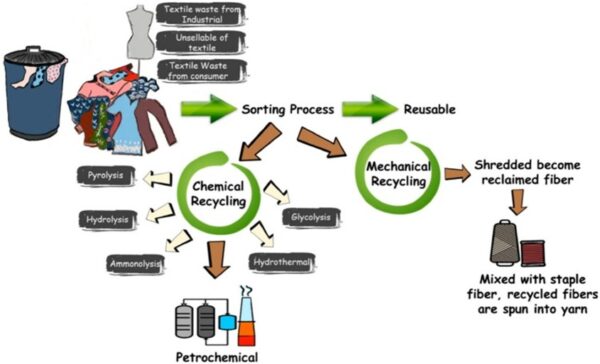
Figure above shows mechanisms of possible textile waste recycling routes.
Pyrolysis:
Pyrolysis can generate products in solid, liquid, and gaseous states from the decomposition of carbon polymers in waste textiles. Different textile materials that haven’t been sorted prior to pyrolysis could be used in textile products (Limburg and Quicker, 2016). Without oxygen, pyrolysis transforms organic molecule waste into three-phase pyrolysates by reassigning C/H/O elements. Hydrocarbons and alcohols could be made from the syngas produced by thermochemical processes. Pyrolysis processes do not require pre-treatments, which makes them a viable option for treating polluted waste (Torri et al., 2021). Compared to chemical methods (including bio-chemicals), pyrolysis uses fewer chemicals, produces less waste, and can be scaled up more quickly. Chemical methods, on the other hand, require a greater number of chemicals, generate waste, and can require significant time for large scaleup of operations. Aromatic hydrocarbons are the most common liquid products made from textile waste (Yousef et al., 2019). In pyrolysis, the operating parameters influence the amount of oil and tar formed. At 500 °C, hydrocarbon compounds and aromatic oxygen were discovered. Furthermore, alkylphenols were produced at > 600 °C, and the O2 yield began to decline at temperatures above 800 °C (Zhou et al., 2016). Aromatic compounds with no substituent groups, naphthalene or benzene, were found in the condensable compounds at 800 °C. In contrast, the aromatic hydrocarbon compounds with three and four rings were produced when the reaction temperature was around 850 °C (Ravenni et al., 2019).
A pyrolysis reactor converts cotton textile waste into carbon nanoball (CB) with a 10–20 nm diameter (Yousef et al., 2021). In concrete composite applications, textile waste pyrolysis char can be used as a primary filler. But Jagdale et al. (2017) investigated how cotton waste pyrolysis carbon could be used in active electrode battery materials. Cotton waste pyrolytic char can also be used as an adsorbent. When measuring the adsorption performance of the chars on Cr (VI), the highest adsorptive capacity of char-FeCl3 was 70.39 mg/g (Damayanti et al., 2021, Damayanti and Wu, 2021). In a study, Wang et al. (2020) investigated the catalytic pyrolysis of ultrastable zeolite. In another study, Yousef et al. (2021) new method for functionalisation of char obtained through pyrolysis of textile waste and its use.
Hydrothermal method:
To decompose organic matter, the hydrothermal method uses chemical crystallisation at high temperatures and pressures. Hydrothermal method is a promising alternative for degrading carbon-polymer waste (Feng et al., 2021). This method uses water and can be divided into five categories such as hot water extraction, pressurised hot water extraction, treatment, hydrothermal carbonisation, and hydrothermal liquefaction based on the temperature range used (Elliott et al., 2015). The hydrothermal process requires a temperature near 280 °C. The hydrothermal method has a number of drawbacks, including long reaction times and high pressures (Li et al., 2017). In a study, researchers (Hongthong, 2021) studied about hydrothermal liquefaction for the conversion of nylon 6 net waste using macroalgae, Fucus serratus. A 50/50 mix of nylon 6 and F. serratus could produce up to 17 % bio-crude yield. Nylon 6 was completely degraded during the production of caprolactam, a molecule derived from nylon 6. Xu et al., (2021a) found that surfactants were used to catalyse hydrothermal carbonisation.
One step in the hydrothermal process involves splitting the polyester–cotton fibre waste mixture into smaller pieces, and another in dispersing that mixture with an organic acid catalyst in an aqueous phase to produce products (Hou et al., 2021). High pressure caused the reaction temperature to rise to 140 °C. This achieved a 99 % polyester fibre aggregate’s recycling yield and an impressive 81 % of the cotton fibre fragments’ recycling yield were also achieved. In a study, Qi et al. (2021) used FeCl3 as a catalyst, lowering the hydrothermal carbonisation temperature to achieve highly efficient hydrophobicity.
Gasification:
Gasification processes recycle textiles at higher temperature. Low or no oxygen is required for the reactions to take place. Gasification is more difficult than pyrolysis because it involves chemical reactions with the substance itself (Arafat and Jijakli, 2013). Gasification, like pyrolysis, produces gases with high concentrations of carbon and hydrogen. Although pyrolysis yields a higher percentage of gaseous waste, gasification yields a much higher gaseous fraction (Wu and Williams, 2010). When gasification is used, the increased pressure can lead to increased H2 concentrations, calorific value, yield, and CO. In contrast, as operating temperatures rise, syngas production rises while char yield falls (Ahmad et al., 2016). It is possible to distinguish between various types of gasifiers by looking at the reactor bed and the flow pattern. The most common gasification methods use a fixed bed or fluidised bed gasifier. On the other hand, it is hard for coarser solid particles to separate because of the way the hydraulics are set up (Sridhar, 2012).
When using gasification, the goal is to produce synthesis gas, which includes compounds such as hydrogen, CO2, and methane (CH4). A mixture of ethylene and ash by-products can be formed. The steam gasification of mixed textile waste was studied by Vela et al. (2019) using a bench-scale fluidised bed reactor at 850 °C. Polyethylene glycol production yields polyester, cotton, and 50/50 polyester/cotton (Atakan et al., 2019). In another investigation, Vikrant et al. (2020) reported that textile wastes such as cotton, wool, and polyester had definite activation energies making them ideal candidates for this process.
_
Sustainable approaches to textile recycling:
Biological method:
Fibers that degrade in nature or through synthetic means are known as biodegradable because enzymes are able to break down their chemical bonds. Mechanical properties and degradability will determine whether or not a material is suitable for a given application (Azevedo and Reis, 2004). The degradation process may take two weeks to six months for the most biodegradable textile materials, including composites. Textile biodegradability depends primarily on crystallinity and orientation, hydrophilicity/hydrophobicity, soil conditions, and the types of microorganisms that live in them (Zambrano et al., 2020).
Fungi and bacteria cause degradation of cotton fabrics. Cotton fibres, primarily composed of cellulose, are well-known for their susceptibility to microbial degradation. Bacillus, Fusarium, Clostridium, Myrothecium, Sporocytophaga and Memnoniella are known microorganisms responsible for cellulose hydrolysis and oxidative degradation (Sanders et al., 2021). Fungi are efficient in the degradation of cellulosic fabrics (Zayed et al., 2022).
Laccase-mediator and protease systems have been used for polyamide 6.6 (nylon) degradation (Kabir and Koh, 2021). Bacteria, viz., Flavobacterium and Pseudomonas sp., can degrade nylon oligomers (Sanuth, 2012). Oxidase from lignolytic fungi have also been used to depolymerise polyamides. Keratinolytic enzymes play an important role in the decomposition of keratin-rich wastes from the wool textile industry (Wojnowska-Baryła et al., 2022). Keratinases are the proteases capable of degrading complex proteins (Jagadeesan et al., 2020), and keratin is used as a carbon, sulphur, nitrogen, and energy source by many bacterial, actinomycete, and fungal species (Bohacz, 2017). A wide range of environments from hot springs to Antarctic soils have been found to contain these microorganisms (Sahay et al., 2017). In a study, researchers studied about cotton based textile wastes and cellulose development through enzymatic saccharification (Hong et al., 2012).
Glycolysis:
Degradation processes like glycolysis can be used to break down the large molecules of textiles into smaller ones. The short reaction time and reduced energy consumption are advantages of the glycolysis process. Polyethylene terephthalate (PET) fibres is one of the common textile materials (Park and Kim, 2014). A method to recycle PET fibre waste in an environmentally friendly way is required as they cause significant environmental harm (Awoyera et al., 2021). Glycolising PET waste for degradation is a difficult task because it requires the use of a catalyst (Hoang et al., 2019). The macromolecules of textile fibres are converted into monomeric forms. Guo et al. (2021) investigated the recycling of polyester textiles using Mg-Al as a catalyst, and found that using a double oxide catalyst with wet mixing, the BHET yield was over 82 %. Furthermore, the spinnability and mechanical properties of the re-polymerised recycled PET (r-PET) fibres were comparable to those of PET fibres. In a study, researchers (Damayanti and Wu, 2021) reported the possible ways of recycling PET.
Hommez and Goethals (1998) studied the depolymerisation of nylon 6 via the glycolysis process. The glycolysis of nylon 6,6 with ethylene glycol produced major products of the bis(hydroxyethyl) adipate and hydroxyethylester groups (Thiyagarajan et al., 2022). In a study, BHET achieved 100 % PET fibre conversion and 80 % monomer yield, respectively (Heiran et al., 2021). Dimers formed from the oligomers were unstable and had a low molecular weight due to the oligomer breakdown into dimers. The glycolysis of PET fibres to produce BHET with lithium hydroxide, acetic acid, sodium sulphate, and potassium sulphate, on the other hand, resulted in yields at different levels (Ghosal and Nayak, 2022).
Ammonolysis:
Nylon 6,6 carpet waste is primarily depolymerised via the ammonolysis method. Lee et al. (2019) used ammonia or ammonium phosphate as a catalyst to study the reactions of nylon 66 and nylon 6 mixtures. In this process, the temperature and pressure were between 137 bar and 200 °C, respectively, and the main byproducts of nylon 6,6 depolymerisation were 5-cyanovaleramide, hexamethylenediamine, and adiponitrile. In another study, Chanda (2021) described also the depolymerisation mechanism for a nylon 66 and nylon 6 mixture.
Enzymatic hydrolysis:
Enzymes produce excellent degradation results in textile recycling. Using enzymatic hydrolysis, Li et al., (2019a) were able to recover polyester and sugar compounds from textile wastes. The pretreatment was done at a temperature of 20 °C for 6 with a NaOH/urea concentration of 7 percent/12 percent. With a cellulase dosage of 20 FPU/g, 98.3 % of the glucose was recovered. In hydrolysis reactions, cellulases act as catalysts. It is theoretically possible to reuse these enzymes indefinitely, as they are not affected by the equilibrium conditions of the reaction. The fact that these enzymes are organic compounds necessitates consideration of some decomposition processes that take place over time (Piribauer and Bartl, 2019). The degradation of these enzymes can alter the physicochemical properties of materials, which can also break down material structures. Certain enzymes are capable of initiating a wide range of enzymatic reactions. Certain parts of these materials may therefore be selectively broken down by enzymes. Commercial cellulase mixtures are typically composed of three types of enzymes, endoglucanases, exoglucanases, and beta-glucose depolymerases, all of which depolymerise the disaccharide cellobiose into monosaccharide units, e.g., glucose (Hu et al., 2018). Textile waste such as cotton, nylon, polyester, and silk can be recovered through the use of an enzymatic degradation process called fermentation.
Microbial engineering:
Conventional methods can’t decompose synthetic fibre blends due to low enzyme accessibility and a lack of efficient enzymes that can decompose synthetic materials quickly (Wojnowska-Baryła et al., 2022, Orlando et al., 2023). So, microbial engineering contributes to the breakdown of synthetic fibre (Buragohain et al., 2020). Focusing on materials with hydrolysable bonds helped in the enzyme-catalysed depolymerisation of textile polymers. Polyester made from terephthalic acid and ethylene glycol is known as polyethylene terephthalate (Jönsson et al., 2021). It was reported by researchers that a hydrolase from engineered T. fusca could degrade PET to some extent, and subsequent reports have demonstrated PET hydrolysis using, as well as PET degradation using other hydrolases (Yoshida et al., 2016). I. sakaiensis 201-F6 has recently been shown to degrade and grow on PET as a part of its carbon and energy source. PETASE (polyethylene terephthalate-degrading enzyme) and MHETASE [mono(2-hydroxyéthyl) terephthalic acid hydrolase] are two enzymes discovered by microbial engineering that catalyse polymer hydrolysis. Several researchers discussed the role of genetically engineered PETase and MHETase in the degradation of PET that offers a sustainable strategy (Maity et al., 2021, Hachisuka et al., 2021). Site-directed mutagenesis experiments also allowed for a better understanding of the PET degradation mechanism and increased the enzyme’s biocatalytic potential (Hajighasemi et al., 2016). It is well established for PA those proteases degrade keratinous proteins in wool (Harmsen and Bos, 2020).
Nylon-and nylon-oligomer hydrolases from Agromyces sp. have been reported to be useful in the processing of synthetic nylon. The Flavobacterium sp. KI72 have been shown to hydrolyse cyclic or linear nylon oligomers. When tested on Nylon-6 in low yields, manganese peroxidase from B. adusta showed activity through an oxidative mechanism (Jönsson et al., 2021). White rot fungi IZU-154, T. versicolor, and P. chrysosporium were used to degrade Nylon 6,6. Laccases produced by P. chrysosporium can degrade polypropylene to some extent via oxidative mechanisms (Kale et al., 2015). Hydroquinone peroxidase from A. beijerinckii has shown some biodegradation activity for polystyrene. It has been found that gut microbes of mealworms help to depolymerise polystyrene foam. In a study, Gricajeva et al. (2022) reported the polyester plastic biodegradation by carboxyl ester hydrolase enzyme.
_
The many different technologies used to break down textiles and turn them into usable products each have their own set of benefits and challenges, outlined in Table below.
|
S.No. |
Technologies to recycle textile wastes |
Advantages |
Challenges |
|
1 |
Pyrolysis |
It’s a Simple process. Applied on broad range of materials. Does not necessitate prior textile waste treatment. |
High-temperature chemical reaction process. Excessive use of electrical power. |
|
2 |
Hydrothermal |
Low ash and oxygen. Less temperature compared to pyrolysis. |
Long reaction time Decreased purification, as well as heterogeneity. |
|
3 |
Gasification |
It can be used with potentially combined textile waste |
High consumption of energy High degree of heat is required. |
|
4 |
|||
|
4.1 |
Biological |
This method has a high probability of removing dyes from clothing. An eco-friendly solution. |
Toxic intermediates are produced at a high cost and have a long retention time compared to other methods. |
|
4.2 |
Glycolysis |
Low energy consumption |
Low selectivity. Sluggish processing in the absence of a catalyst |
|
4.3 |
Ammonolysis |
Textile waste can be used to make byproducts like carpet and upholstery. |
A blend of primary and secondary amines is produced. Toxic solvents were used (ammonia)Costs rise due to the necessity for high pressure and temperature. |
|
4.4 |
Enzymatic hydrolysis |
A new microorganism boosts biopolymer production and conversion. It can be spun into new waste fibres. Low energy demand. Makes use of eco-friendly chemicals and solvents |
Enzymatic hydrolysis can only be used to recycle certain materials, such as rayon, hemp, cotton. Requires a lot of water. |
|
4.5 |
Microbial bioengineering |
More efficient to use genetically modified microorganisms. Reduce the demand for energy. |
Absence of effective enzymes for the rapid decomposition of synthetic man-made materials |
_______
Figure below shows Textile waste utilisation for value-added products.
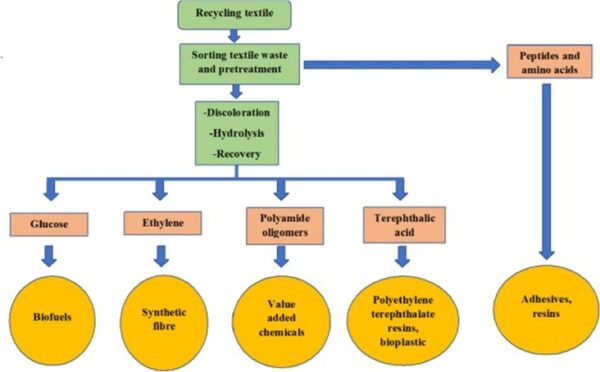
There are different pretreatment approaches used for valorisation of wastes into useful bioproducts (Fallahi et al., 2021, Usmani et al., 2020, Usmani et al., 2022). Biotechnological approaches have been reported as important in valorising textile waste (Stanescu et al., 2009). In a recent review, Mishra et al. (2022) discussed valorisation strategies for textile wastes and their uses in different sectors along with challenges in different processes.
_______
_______
Carbon dioxide as feedstock for defossilization:
The difference between CCS, CCU, CCUS and CDR:
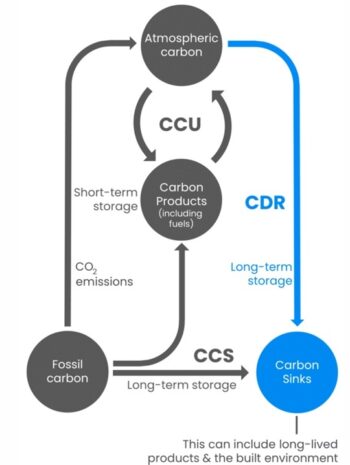
While carbon dioxide removal, carbon capture and storage, and carbon capture and utilisation are methods of the broader family of ‘carbon management’, they have different impacts on climate change due to their crucial divergence in source and destination of handled CO2. Clear distinctions of these terms are essential to enable effective climate action, avoid greenwashing and strengthen public confidence.
Carbon capture and storage (CCS) is the separation of CO2 from industrial exhausts coupled with the permanent geological storage of that carbon (applied, e.g., on cement, steel, power plants, chemical production facilities etc.). When the origin of the CO2 is exclusively fossil or geological carbon (e.g., fossil fuels, limestone), then this action is emission reduction, not carbon removal. Carbon dioxide removal and CCS are distinct, but some carbon dioxide removal methods (e.g., direct air capture) may share the same capture processes or long-term storage infrastructure used for conventional CCS.
Carbon capture and utilisation (CCU) is part of a broader set of ‘carbon recycling’ applications, describing the reuse of captured carbon either directly (e.g., to fertilise greenhouses, in beverages) or as an ingredient in new products (e.g., concrete, fuels, chemicals). CCU can displace additional fossil fuel use, thereby reducing emissions. If the carbon is removed from the atmosphere and stays in a closed loop over many decades or centuries (e.g. when incorporated into cementitious building materials), the method may be considered removal. All other cases of CCU, in which carbon is rapidly (re-)released to the atmosphere, only delay (re-)emissions. As most captured carbon is not durably stored, CCU is generally not considered removal.
CCUS stands for Carbon Capture, Utilization, and Storage. It is a suite of climate technologies designed to mitigate greenhouse gas emissions by intercepting carbon dioxide (CO₂) at its source or directly from the air and either permanently storing it underground or recycling it for industrial use.
Carbon Dioxide Removal (CDR) refers to “anthropogenic activities removing CO2 from the atmosphere and durably storing it in geological, terrestrial, or ocean reservoirs, or in products” (IPCC). Removals can 1) accelerate the reduction of net emissions (immediately), 2) counterbalance ‘hard-to-abate’ emissions (near-term), and 3) deliver net negative emissions (long-term). Carbon removals lead to the generation of “negative emissions”, which are crucial in achieving our climate goals. In the words of the IPCC, “The deployment of CDR to counterbalance hard-to-abate residual emissions is unavoidable if net zero CO2 or greenhouse gas (GHG) emissions are to be achieved”.
Carbon Capture and Storage (CCS) prevent new CO₂ from entering the atmosphere by capturing it at industrial sources, whereas Carbon Dioxide Removal (CDR) actively extracts legacy CO₂ that is already in the air. CCS reduces emissions; CDR actively decreases atmospheric carbon levels.
_
Carbon dioxide (CO2) is emerging as an important feedstock in the defossilization of the chemical industry, particularly in the context of long-term net-zero strategies. Unlike biomass or recycled plastics, CO2 offers the potential for near-unlimited availability, especially when captured directly from the atmosphere. However, its use as a feedstock is still in its infancy and its scaling presents both technical and even more so economic challenges. CO2 will be essential to close the carbon supply gap in a fully defossilized chemical sector. While biogenic CO2 is limited in volume, direct air capture (DAC) is expected to play a pivotal role in providing scalable, location-independent carbon inputs, underscoring the need for early investment in DAC research and technology development and elevating technology readiness levels (TRL) and economics and CO2 logistics infrastructure. For the foreseeable future (10–15 years) DAC will be limited in volume. Since it depends on clean energy supply, ideally available as a constant supply to keep down costs given the high CapEx of DAC, there is for now an economic and feasibility limitation to DAC, besides the scaling of DAC itself, that will have to be overcome by continuous R&D efforts. Such efforts are on their way, as our extant review of the literature shows.
_
Widespread deployment of carbon capture &storage is not a solution to the climate crisis. The capture process removes only a fraction of emissions from the underlying source—often a smaller fraction than projected by proponents—and is often only deployed for a limited part of a given facility’s emissions. Carbon capture also incurs a significant energy penalty, counteracting any capture benefit and increasing upstream emissions from oil, gas, and coal production. Finally, by keeping such facilities operating and extending their economic lives, CCS presents a major obstacle to the necessary transition away from fossil fuels.
The industrial agriculture system is bound up in the ongoing effort to develop CCS systems. The cost of carbon capture (in financial, energetic, and material terms) is closely correlated with the concentration of carbon dioxide in the waste stream from which it is being removed. When carbon dioxide represents all or most of the waste gases in a smokestack, capturing it is comparatively easier than capturing the same amount of carbon dioxide from a waste stream containing other gases and pollutants. The more concentrated the carbon dioxide in the stream, the cheaper the process. Because they produce relatively concentrated waste streams of carbon dioxide, hydrogen, ammonia, and ethanol production are among the more amenable processes to which carbon capture can be applied and are a major component of the current wave of announced and planned carbon capture projects. These projects, particularly in the US, hope to take advantage of generous tax subsidies and provide another source of revenue beyond the marketing of their primary products.
______
Sources of CO2:
Point sources of CO2 and direct air capture (DAC) of atmospheric CO2 are the two main potential sources of CO2 that could be used as a feedstock for chemicals. These are both a form of carbon capture and utilisation (CCU).
-1. Point sources of CO2:
Point sources of CO2 are typically found at large industrial facilities that emit waste CO2. Examples include power stations, cement and steel factories, chemical manufacturing like ammonia production, paper and waste incinerators, and brewing or bioethanol production plants. The precise ratio of CO2 in these emissions varies. For example, cement emissions comprise 75 – 90% CO2, whilst natural gas power stations emissions are just 4 – 5%.
The purity of the CO2 is important for any subsequent chemical production. Coupling these processes with capture provides an opportunity both to concentrate and purify the waste gas emissions. Specifications for CO2 purity are helpful for understanding the potential to integrate with chemical manufacturing. The typical ‘pipeline’ specifications are set to >95% CO2 with parts per million level limitations on the quantity of water, oxygen, carbon monoxide, sulphur and nitrogen oxide contaminants. There is a slightly higher (a few percent) level tolerance of nitrogen (N2), argon and methane as impurities. These specifications are likely to be quite well aligned with some chemical processes but may present challenges in others, most obviously catalyst poisoning in electrochemical processes.
-2. Direct air capture (DAC) of CO2:
DAC differs from point source CCU in that the technology removes CO2 directly from the atmosphere, rather than from a specific source. There is clearly a very significant difference in CO2 concentration between the two, with DAC needing to capture and concentrate starting from 0.04% CO2. The highly dilute CO2 in the air means that any uses in chemical manufacturing will require a very significant energy input both to capture and concentrate it.
There are two main types of DAC technology being explored: solid DAC, using adsorbents, where capture occurs at relatively low pressures and medium temperatures, and liquid DAC, which uses a solution and high temperatures to extract CO2. DAC is currently a nascent technology, which appears to be viable in countries with specific geologies and readily available renewable energy. Because it is so energy intensive to concentrate atmospheric levels of CO2, DAC would require a vast supply of energy. To limit emissions associated with this energy and DAC as a process, this energy supply would have to be sourced from renewable energy. There will also be cross-sectoral competition for that energy, which could act as a limiting factor on the viability of DAC.
_
In contrast to the anthropogenic GHG emissions, only a few processes can effectively reduce GHG emissions, most notably among these direct air carbon capture and storage (DACCS), bioenergy with carbon capture and storage (BECCS) and nature-based solutions for carbon dioxide removal (Nb-CDR). Each approach presents challenges including high water consumption, significant land-use, or substantial energy demand. This results in considerable societal costs (land-use for Nb-CDR or BECCS) and economic burdens (BECCS, DACCS), alongside high energy consumption, particularly for DACCS. The combined potential of BECCS and DACCS to generate negative CO2 emissions is limited, estimated between 0.3 to 1.9 Gt CO2 annually by 2050. Projections suggest that carbon capture and storage (CCS) technologies could cost between $100 to $825 per metric ton of CO2 by 2050.
_
Several reports deem that point-source CO2 capture (PSCC) and carbon dioxide removal (CDR) technologies will play a significant role in pursuing a net-zero emission world. PSCC technologies have been well studied and adopted commercially in several regions of the world (e.g., in Saudi Arabia, the United States, Australia, and China). On the other hand, CDR technologies, including bioenergy with carbon capture and storage (BECCS) and direct air CO2 capture (DACC), have not been adopted commercially yet. Their technology readiness levels (TRLs), based on the definition given by the international energy agency (IEA), range from 1 to 6, with ocean alkalinization and enhanced weathering being at a TRL of 1–3 and BECCS and DACC being at a TRL of 6. BECCS offers an attractive CO2 capture cost of $13–120 per t-CO2, however its impacts on food security, biodiversity, crop prices, and deforestation raise concerns about its deployment at large scales. DACC can overcome such challenges by offering modular design, low to no competition with food lands, and flexible locational possibilities. However, its wide literature projected cost range of roughly $100–1000 per ton of CO2 suggests a high uncertainty of the DACC capture cost estimates. In addition, it is generally more expensive than BECCS, largely due to expensive sorbents, high contactor costs, and/or high energy demands for regenerating the captured CO2 and the solvent/sorbent. Therefore, discovering less-expensive capture materials and improving the DACC process energy efficiency should be targeted to advance DACC towards commercialization.
_____
CO2 to chemicals processes:
CO2 is already used to make chemicals including urea (for fertilisers), methanol, carbonates and polymers. The thermodynamic stability of CO2 means that many transformations require significant energy input. This energy must be low carbon to reduce associated Scope 1 and 2 emissions. Life Cycle Assessments of the thermodynamics and economics will be needed to understand the net contribution of specific uses of CO2.
The potential chemistries to convert CO2 into chemicals are almost all catalytic processes and often require both vast energy input and other chemicals to work. There are different ways the energy can be input to these processes, including by heating (thermochemical), electrically or, in the longer-term, by sunlight.
The most technologically advanced catalytic routes for the conversion of CO2 include methanation to produce methane, direct methanol synthesis and other alcohols, and syngas production using the water-gas shift reaction followed by methanol synthesis or Fisher-Tropsch to produce hydrocarbons. All these processes require a large amount of hydrogen and heat. However, these technologies require further development to be commercially viable.
Several pathways are envisioned to turn CO2 into useful molecules, as described by the IEA:
- Direct conversion through CO2 hydrogenation.
- Indirect conversion through syngas production and reverse water-gas shift reaction.
Through these conversion routes, nearly all C-containing chemicals can theoretically be generated from captured CO2. Turning CO2, a low energy state molecule, into useful products generally requires adding a lot of energy in the processes. For that reason, molecules that already contain C-O bonds, such as MeOH, appear to be interesting target molecules, for they do not require CO2 to be further reduced.
_
Electrocatalysis converts CO2 into a variety of products in an electrochemical cell through the application of an electrical voltage. The main challenges of the current technologies are: maintaining selectivity to the desired carbon based product; the very low solubility of CO2 in water; the need for extra voltage to drive the reactions, which leads to energy inefficiencies; and intolerance to feed impurities. One of the main advantages is that electrocatalytic CO2 conversion can be integrated with renewable energy sources: without doing so, the technology would cause a net increase in emissions and be counterproductive to any efforts to transition the chemical sector to help meet net zero targets.
Carbon monoxide can be made by the reaction of CO2 with hydrogen that can be produced from water. This is the high temperature shift reaction, which is a well known process. A potential alternative to this shift reaction is thermochemical cycling, which provides an opportunity to split water and reduce CO2 into syngas using reductionoxidation (redox) cycles. This technology has high theoretical efficiencies. However, it currently suffers from low efficiencies due to the large temperature swing between redox steps. Isothermal or near-isothermal operation with implementation has been demonstrated by pressure-swing, enhancing heat efficiency and fuel yield. Further research should be directed towards high temperature energy storage, solid-solid heat recuperation, and oxygen separation for achieving high solar-to-fuel conversion efficiencies.
At the very early research stage, photoelectrochemical routes can potentially convert CO2 into syngas by combining light and electrochemical driven steps, whilst other studies have explored novel photoelectrochemical routes that combine CO2 conversion with plastic-to-chemical conversion. However, all these routes are at very early stages of development and are a long way off being realisable. This field of research remains at an academic discovery stage and there are still fundamental challenges to be overcome.
Another option to use CO2 is to produce carbonates and polymers by combining it with other chemicals. This utilisation does not rely on any hydrogen or reductant and can be economically attractive since the CO2 replaces petrochemicals. For example, CO2 copolymerisation with epoxides produces polycarbonate polyols used to make insulation foams, coatings, sealants, adhesives and elastomers. This technology is therefore advanced as a CO2 utilisation. CO2 can also be reacted with epoxides to produce cyclic carbonates, essential electrolytes for batteries and electric vehicles. These uses of CO2 are covered in a previous Royal Society report on the potential and limitations of using carbon dioxide.
_______
Availability of CO2:
There is currently a high potential availability of CO2 from point sources, due to the number of large industrial and power plants using fossil fuels or bioethanol. Industrial point sources could meet demand for chemical sector CO2 use in 2030 but would likely not suffice by 2050, as point sources of CO2 decline in the context of net zero ambitions and demand across other sectors increases. It is further necessary to consider how the choice of CO2 source affects the climate impact, eliminating some sources for select product categories.
To meet the growing demand for CO2, DAC supply would have to expand significantly. At present, DAC plants capture approximately 0.01 Mt CO2 per year. Plants under construction or in advanced development will likely only be able to capture around 4.7 Mt CO2 per year by the end of this decade. Under the International Energy Agency’s Net Zero by 2050 scenario, DAC expands to just under 1 Gt CO2 by 2050.
At present, approximately 0.2 Gt of CO2 is used globally each year, of which around half is used to produce urea fertiliser and around a third is used for the extraction of crude oil through enhanced oil recovery. To achieve a significant scale up of CCU, there would have to be developments in both capture and utilisation technologies, access to sufficient low-cost renewable energy and other resources such as water, and changes in the policy and funding landscape DAC currently costs around USD $200 – 1000 per tonne of CO2 removed. This would have to fall to make large scale chemical production from DAC CO2 competitive.
There will also be competing demands for CO2 in other sectors, such as for concrete and building materials. There is also growing interest in the use of DAC CO2 for synthetic fuels for transportation, for heating and, to a less extent, in the power sector.
There are various future estimates of how much CO2 the chemicals sector could utilise, given this competing demand. Lower end estimates suggest 0.2 – 0.6 Gt CO2 could be used to produce polymers and other chemical products. Higher end estimates propose that the chemical industry may require as much as between 2.8 Gt147 up to 4.7 Gt in 2050.
It is difficult to estimate exact supply and demand, given the infancy of some technological routes, overcoming the energy requirements to turn CO2 into reduced carbon molecules and the changing policy landscape.
It is also important to note that the estimates of the overall scale of CO2 utilisation for chemicals is less than 1% of annual anthropogenic input of CO2 into the atmosphere (~59 Gt CO2 equivalent).
___
Predicted CO2 demand exceeds supply estimates in 2050; the mismatch highlights the need for DAC to supplement biogenic sources:
Figure below shows estimated global supply and demand of sustainable CO2 in 2050 across multiple scenarios:
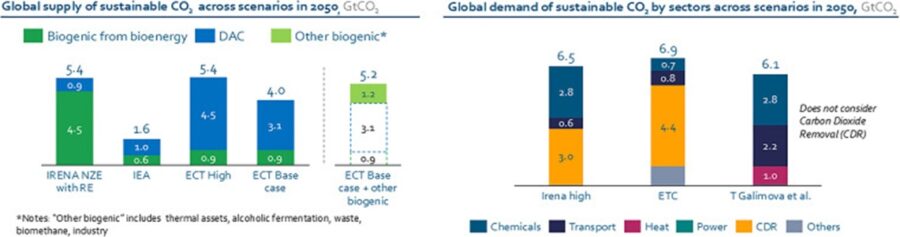
As illustrated in Figure above, in a net-zero scenario, the demand for sustainable CO2 is projected to significantly exceed supply, creating a gap that must be addressed to enable full defossilization. Global demand could reach up to 6.9 GtCO2 per year, primarily driven by the needs of carbon dioxide removal (CDR), the needs of the chemical sector, and transport applications. Notably, Galimova et al. estimate a demand exceeding 6 GtCO2 by 2050, even without accounting for CDR, underscoring the scale of the challenge. In contrast, the estimated supply of sustainable CO2 from biogenic sources ranges from as low as 0.6 GtCO2 to a maximum of 4.5 GtCO2 by 2050, depending on the scenario assumptions held. This results in a projected gap of several Gt, particularly in high-ambition pathways. DAC, therefore, emerges as a critical technology to close this gap, especially in sectors with a higher willingness to pay for CO2, such as CDR, polymer production, and construction materials. The strategic relevance of DAC is further supported by Mertens et al., who propose a quality-based evaluation of CDR technologies, highlighting the need for DAC-CCS to evolve into a high-performing option in terms of environmental, social, and governance criteria and sequestration permanence. This strategic relevance positions CO2 not only as a necessary component of the sustainable carbon mix but also as a strategic lever for deep decarbonization. The successful deployment of DAC, and potentially direct ocean capture, will depend on further R&D evolutions and accelerated technological development, access to sufficient volumes of renewable electricity, low-carbon hydrogen, and the establishment of robust and economical infrastructures for CO2 capture, purification, and distribution. For energy providers, this represents a pivotal opportunity to support the emergence of a circular carbon economy centered on CO2 valorization.
______
Resource and impacts at scale:
In a “what-if” scenario, the IEA explored what it would take to produce the current amounts of chemicals entirely from CCU technologies. Theoretically, while the supply of CO2 would not be a limiting factor with 1.4 GtCO2 required, the energy demand would be more challenging at 11,700 TWh (representing around half of the world’s electricity production in 2018). Electricity is a cornerstone of CO2-based production pathways. A first challenge is to ensure the electricity used is low carbon. Depending on the end products, a threshold ranging from 260 to 74 gCO2e/kWh (for MeOH and xylenes respectively) has been shown to be necessary for ensuring CCU-based chemicals make sense from a climate perspective. Such carbon intensities of energy generation are about two to six times lower than the global average in 2022. Therefore, in many regions, using the grid to power CCU-based processes will not provide a climate solution in the near-to medium-term, at least before the grid is decarbonised. Alternatively, shifting production to more suitable locations (with cleaner energy sources) and importing the resulting products, or relying on dedicated off-grid low-carbon production, may be the appropriate route to net-negative CO2-based chemical production.
Another challenge lies in the quantities of low-carbon electricity that CCU-based pathways may require, and which may have several unintended impacts. Refineries powered entirely by wind and solar could require more than 150 times as much land as current refineries. Furthermore, such electricity demand might come at the expense of other sectors that also require low-carbon power: using 1 kWh for decarbonising mobility is often more efficient in terms of emissions reductions than using it for producing CCU-based chemicals.
_
Towards a methanol economy?
Already fundamental in the chemical industry, there may yet be an even bigger role for methanol (MeOH) as a platform chemical, in particular through methanol-to-X (MTX) routes to produce olefins (MTO) and aromatics (MTA). This would be part of what some have called a large-scale methanol economy. Electricity-based MeOH (e-MeOH) can be produced either via CO2 hydrogenation or catalytic conversion. Provided that the electricity, CO2 and H2 used are all low-carbon, the whole process could be a gamechanger for low-carbon MeOH production. Such technologies are gaining momentum and have now reached a high technological readiness level (TRL) of approximately seven (prototype stage).
While the direct synthesis of olefins from CO2 is at a low technological maturity level (TRL 3–4), some MTO processes are already running at large commercial scales in China, generating about a fifth of the country’s domestic HVC production, although unfortunately they currently run on coal-derived MeOH. Adapting those processes to e-MeOH is doable and may represent an interesting low-carbon pathway for producing olefins in the medium-term. MTA is currently a less developed pathway (TRL 7), partially because it involves more process steps to produce more complex molecules. While olefins and aromatics are generally co-produced in refineries, MTA is one of the only ways aromatics can be produced independently from olefins in a net zero future.
Controlling the individual shares of the olefins and aromatics that are physically produced via MTX processes is complex. Meeting ethene demand through large-scale MTO might lead to an oversupply of propene, while MTA may result in benzene or xylene oversupply. The shift to large-scale chemical production via MTO and MTA may thus require some flexibility in production.
________
________
CCU:
Industrial production is the foundation of the global economy, yet it is also a significant source of greenhouse gas emissions. As countries and industrial sectors pursue pathways to net zero, the question is not whether carbon management is needed, but how to do it effectively. Among the options available, carbon capture and utilization (CCU) offer a promising pathway to convert captured CO2 into products such as fuels, chemicals and building materials – potentially creating new industrial value streams while reducing reliance on primary fossil feedstocks and contributing to emissions abatement. While CCU is still at an early stage, with high costs and uneven policy support, its potential benefits warrant attention.
_
Carbon capture and utilization (CCU) could present an opportunity for reducing emissions from industrial supply chains by converting captured CO2 and other carbon-based emissions into valuable carbon-based products. CCU technologies therefore offer the potential to “defossilize” industries that rely on carbon feedstocks. A few re-use opportunities are already mature, such as urea production for use in fertilizers. Beyond this, there are technology pathways for reusing carbon in fuels, chemicals, construction materials and other pure-carbon products being developed with potential for climate benefits.
_
Utilization pathways
There is a range of emerging CCU pathways at different levels of technology readiness and addressable market potential (see Figure below). Applications span agriculture, construction, fuel and chemicals manufacturing, as well as emerging next-generation materials such as graphene and carbon nanotubes. The relative scale of these applications in the coming decades will be driven by a combination of demand in end-use sectors, the rate of learning improvements and cost reductions in both CCU technologies and feedstocks such as low-carbon hydrogen.
_
Figure below shows summary of emerging CCU pathways, maturity and cost comparison.
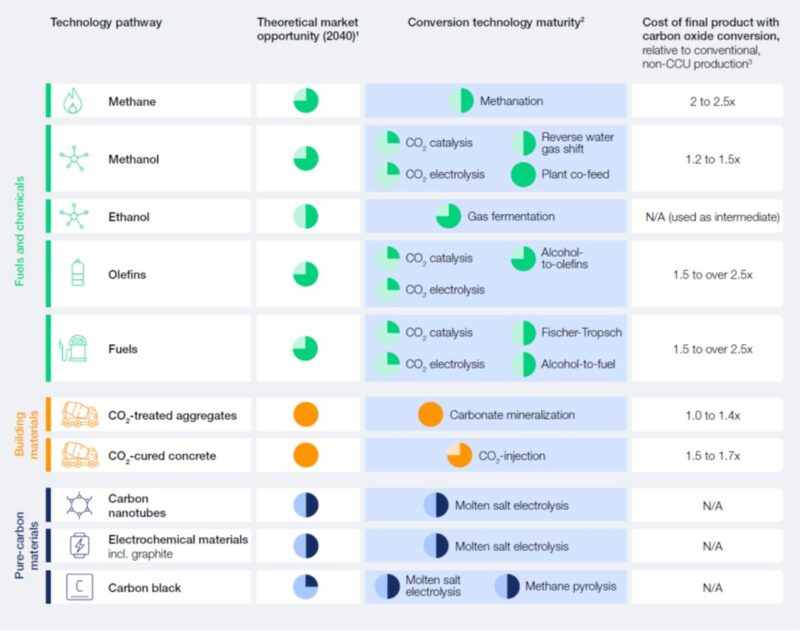
_
CCU will go mainstream as soon as renewable energy becomes cheap and abundant. The potential for carbon capture and utilisation (CCU) is tremendous. Utilising CO2 from fossil and biogenic sources, and eventually from the air (direct air capture), could easily meet the entire demand for embedded carbon of the global chemical and plastics industry. There are many different chemical and biotech pathways; most rely on CO2 plus hydrogen (H2) to produce intermediates such as CO, syngas, methane, methanol, formic acid, and naphtha as seen in figure below.
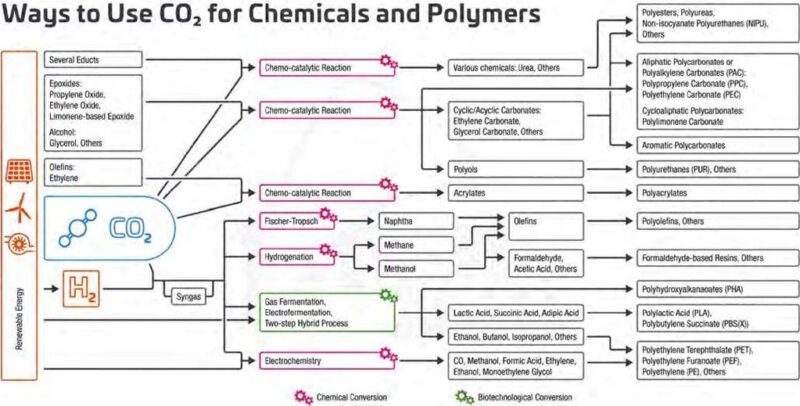
Almost all chemicals and plastics can be produced in this manner. According to experts at nova-Institute, an area the size of Greece (135,000 km2, equivalent to 1.5 % of the Sahara Desert or 0.8 % of all subtropical deserts combined) would be enough to produce sufficient green hydrogen via photovoltaics to meet the global chemical and plastics industry’s demand for embedded carbon with CCU by 2050. This calculation assumes that the demand for embedded carbon in chemicals and plastics will double from 550 million tonnes to 1,150 million tonnes (of carbon) by 2050. This simple calculation demonstrates the tremendous potential of CCU.
_
Using or storing CO2?
Using or storing CO₂ is a process called Carbon Capture, Utilization, and Storage (CCUS). It traps carbon dioxide from industrial sources or the air, converts it into a high-pressure liquid state, and routes it for permanent geological storage or commercial use. The implementation of CCU pathways shares common challenges with large-scale deployment of CCUS. We have to maintain balance between CCU and CCUS in the portfolio of climate solutions. While by 2050, CCUS largely dominates in terms of volumes in net zero scenarios, interesting synergies could be observed between both approaches. By establishing an easily identifiable use case for captured CO2, CCU-based chemicals could spur investment in capture facilities and act as a catalyst, potentially solving the CCUS “chicken-and-egg” conundrum. The chemical industry could thus act as a system service provider to other industries willing to rely on CCUS. CCU applications, generally small-scale, might in return benefit from mutualising transport infrastructure built for larger-scale CCUS facilities, for instance in CCUS hubs.
______
______
Defossilized hydrogen production:
Hydrogen is considered a key resource for decarbonized economy. However, current hydrogen production relies heavily on fossil feedstock. Approx. 95-96% of hydrogen supply originates from coal gasification and natural gas (methane) steam reforming. Methane is a “cleaner” fossil feedstock compared to coal. The estimated CO2 emissions from steam methane reforming are 9-11.5 tonnes per 1 tonne of hydrogen, which is nearly two times lower than from coal gasification. Of the approximately 10–11 Mt of dedicated hydrogen produced by the United States, about 60 percent is used to refine fossil fuels, with the remainder used to produce ammonia, methanol, and in several miniscule applications. Nearly all hydrogen is produced through steam methane reforming (SMR), a carbon-intensive process using natural gas feedstock.
_
Several technologies are being developed to reduce carbon footprint of hydrogen from methane, including steam methane reforming coupled with CO2 capture and storage (so called low-CO2 or blue hydrogen) and methane pyrolysis (CO2 free or turquoise hydrogen). The carbon footprint of these technologies is sensitive to the efficiency of carbon capture, CO2 leakage, source of heat to run the process, fugitive methane emissions and natural gas supply chain due to the vicinity of deposits. The conceptual difference of hydrogen production using steam methane reforming with carbon capture and storage from methane pyrolysis is a form of carbon by-product. The former technology generates CO2 that requires permanent CO2 storage, typically under supercritical conditions in geological formations. Leakage from storage sites is the major risk associated with CO2 and it can be induced by geochemical reactions, pressure and temperature as well as poor cement cladding near a wellbore region. The latter technology transforms methane into a solid carbon product, that is easier to handle, and store compared to CO2, for instance, in concrete.
_
While the above-mentioned technologies can reduce carbon emissions, their benefits come at a cost of higher fossil resource consumption. The efficiency drop of steam methane reforming upon integration with carbon capture and storage is 5-14%, meaning more methane is required to compensate growing process needs. The consumption of methane is even larger when steam methane reforming is replaced by methane pyrolysis. During steam methane reforming, one molecule of methane can yield up to four molecules of hydrogen. The first step of the process is a reforming reaction, typically yielding a gas mixture containing hydrogen and CO. Water gas shift reaction is then applied as a second step to catalytically convert CO in the presence of steam into CO2 and generate more hydrogen. During methane pyrolysis, only two molecules of hydrogen are produced from one molecule of methane. That is, two times larger methane usage is required to reach the equivalent hydrogen outputs.
Reforming step: CH4 + H2O = CO + 3H2
Water-gas shift step: CO + H2O = CO2 + H2
Combined steam methane reforming: CH4 + 2H2O = CO2 + 4H2
Methane pyrolysis: CH4 = C + 2H2
_
How to defossilize hydrogen production?
Defossilized hydrogen production is the process of generating hydrogen without using fossil fuels as a feedstock or energy source, completely eliminating associated greenhouse gas emissions. It acts as a cornerstone for deep decarbonization in hard-to-abate sectors like steel manufacturing, chemical production, and heavy transport.
-1. One way to achieve this goal is by partially replacing natural gas with alternative hydrocarbon sources. Biomass is one potential feedstock for hydrogen production. However, the concentration of hydrogen in producer and pyrolysis gases (i.e. from gasification and pyrolysis, respectively) is relatively low due to the high O/C molar ratios. This leads to exergy losses and co-generation of large quantities of carbon oxides, reflecting on hydrogen separation cost and potential need for CO2 capture and storage.
-2. An alternative source of hydrogen is plastic waste. Global plastic consumption is growing. So does the amount of discarded plastic waste and associated pollution due to leakage of plastics into the environment. Plastic waste is recognized as a promising feedstock for hydrogen production via gasification and pyrolysis-based technologies.
Waste-to-hydrogen (WtH) is the process of converting organic waste, biomass, and non-recyclable plastics into clean hydrogen fuel. It solves two problems at once: eliminating landfill waste and generating sustainable, zero-emission energy. India’s first commercial solid waste-to-hydrogen project is being set up in Pune, Maharashtra. Developed at an investment of over ₹430 crore, this plant converts municipal solid waste into hydrogen.
-3. Green hydrogen is hydrogen produced via water electrolysis using electricity from renewable sources like solar and wind. It is a zero-emission, clean energy vector crucial for decarbonizing hard-to-abate sectors such as heavy industry, shipping, and long-term energy storage.
___
Hydrogen and ammonia are proposed as options to decarbonize various facets of industry, energy and power production, and transportation. Because neither hydrogen nor ammonia molecules contain carbon, they do not release carbon dioxide when burned or otherwise combined with oxygen, as in a fuel cell.
Hydrogen has several possible uses as a source of energy and heat; however, very few of these uses outweigh the benefits of other alternatives. Hydrogen can be combusted like methane and create high temperatures, making it suitable for industrial processes that require high heat and significant power. Hydrogen can also be used in a fuel cell, wherein it electrochemically reacts with oxygen to produce electricity rather than directly combusting. Finally, hydrogen can be used as a chemical reactant to make steel, eliminating the need for coke (a coal-based fuel) or other carbon-based agents in the process. While it is true that these processes do not release carbon dioxide at the point of use, to determine hydrogen’s full climate impact, calculations must consider its entire life cycle and its impacts on the broader transition from fossil fuels.
Figure below shows Hydrogen Rainbow Spectrum:
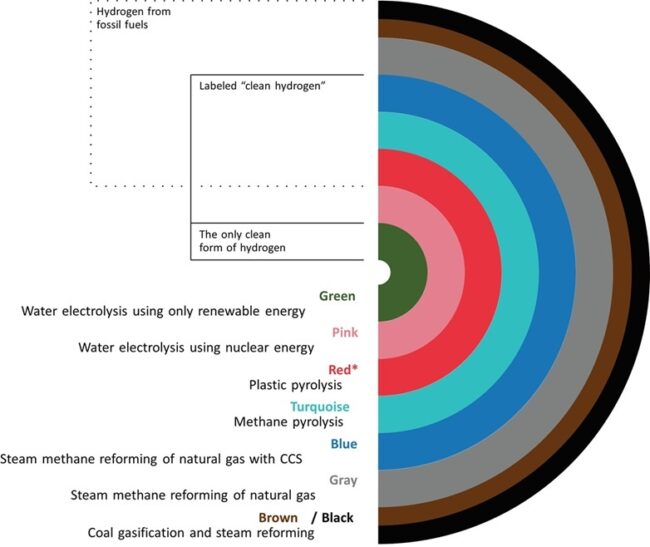
There are multiple routes for H2 production with various CO2 emissions intensities. Brown hydrogen refers to H2 produced from coal, whereas gray hydrogen is H2 derived from natural gas or petroleum. When carbon capture is combined with either of these methods to offset emissions, the H2 is referred to as blue hydrogen. Finally, the most sustainable is green hydrogen, or H2 sourced completely from renewables.
When made from truly renewable energy, green hydrogen may have a role to play in climate solutions, though that contribution is likely to be modest. So-called “green hydrogen” is produced by running electricity through water to separate it into its constituent parts, hydrogen and oxygen. If powered by renewable energy sources, this hydrogen would, in fact, be untethered to fossil fuels and would produce no GHG emissions during its production. But green hydrogen is expensive to produce, and there are only a limited number of circumstances where it will be a good substitute for fossil fuels relative to other options, especially compared to measures that reduce fossil fuel demand or switch to electrification. Electrolyzing water requires large amounts of energy and water, presenting constraints on how much green hydrogen can and should be produced. It is estimated, for example, that 9 tonnes of water are required to produce 1 tonne of green hydrogen, and if the water needs to be purified, the amount of water required will double.
Moreover, hydrogen, regardless of its provenance, is explosive —it can explode when it mixes with ambient air, for example —and is difficult to transport. Finally, though it does not contain contaminants or particulates, hydrogen produces nitrogen oxides when burned, creating toxic risks if it is used in industrial applications or domestic gas lines. Green hydrogen is, therefore, not a panacea for the energy transition but, rather, one potential solution for a limited number of use cases. Any such uses will involve significant risks and trade-offs; therefore, hydrogen should only be used where there are no better options for electrification or decarbonization.
__
The Role of Hydrogen for the Defossilization of the German Chemical Industry, 2023 study:
Methanol synthesis requires hydrogen, which is currently provided by steam reforming from natural gas or partial oxidation of mineral oil. The future use of CO2-free hydrogen (green hydrogen) has two major advantages. First, the process-related CO2 emissions of steam reforming are avoided. On the other hand, process-related CO2, which was previously captured in other processes, can be used as a raw material to combine with H2 to produce methanol. For ammonia synthesis, the Haber-Bosch process is presented in which natural gas is currently converted to hydrogen in steam reforming and then reacts to form ammonia. Since urea synthesis is usually downstream of the Haber-Bosch synthesis, no additional process heat is required in the conventional case, since the waste heat from steam reforming can be used. In the case of a process conversion for the use of externally supplied CO2-free hydrogen, similar to the methanol synthesis, not only CO2 is required as a raw material, but also process heat for the downstream urea synthesis.
A 95% reduction in CO2 emissions in 2050 with additional defossilization of the chemical industry leads to increased hydrogen demand. A replacement of fossil-based feedstocks by renewable feedstocks leads to a significant increase in hydrogen demand by 40% compared to a reference scenario. The resulting demand of hydrogen-based energy carriers, including the demand for renewable raw materials, must be produced domestically or imported. This leads to cumulative additional costs of the transformation that are 32% higher than those of a reference scenario without defossilization of the industry. Fischer-Tropsch synthesis and the methanol-to-olefins route can be identified as key technologies for the defossilization of the chemical industry. A defossilized methanol production in 2050 requires 165 TWh hydrogen, which corresponds to an additional 89 TWh hydrogen compared to a reference scenario, in which only GHG emissions are reduced. 19 Mt methanol are used to produce highly refined chemicals.
______
______
Defossilization of syngas production:
Syngas is a mixture of primarily hydrogen and carbon monoxide that often also contains some amount of carbon dioxide and methane and that is highly combustible. Syngas is used primarily in the production of hydrocarbon fuels, such as diesel fuel and methanol, and in the production of industrial chemicals, particularly ammonia. Syngas produced from waste materials and other biomass is considered a form of renewable energy.
_
The utility of syngas as a fuel was realized in Germany during World War II, when gasoline shortages affected transportation for both the military and civilians. At the time, it was known that coal could be converted to liquid hydrocarbons through either the Bergius process, developed by German chemist Friedrich Bergius, or the Fischer-Tropsch (FT) reaction, developed by German chemists Franz Fischer and Hans Tropsch. In the Bergius process, liquid hydrocarbons are produced through hydrogenation of coal dust at high temperature and pressure. In the FT reaction, a mixture of carbon monoxide and hydrogen is converted into liquid hydrocarbon at elevated temperature and normal or elevated pressure in the presence of a catalyst of magnetic iron oxide. Fuels produced by FT synthesis served a critical role in fulfilling fuel needs in South Africa in the 1950s.
Syngas generation today remains a critical industrial process primarily driven by the steam reforming of natural gas and the gasification of coal, which collectively account for about 85% of global production. While fossil fuels dominate, modern production is aggressively shifting toward sustainability through biomass gasification, plasma gasification of municipal solid waste, and co-electrolysis of water and CO₂.
Applications of Syngas:
Syngas is an important source of valuable chemicals that include:
- Hydrogen, produced in refineries
- Diesel or gasoline, using FTS
- Fertilizer, through ammonia
- Methanol, for the chemical industry
It should be noted that a major fraction of the ammonia used for fertilizer production comes from syngas and nitrogen.
_
Syngas conversion technologies range from heat or power applications to a variety of synthetic fuels as shown in figure below.
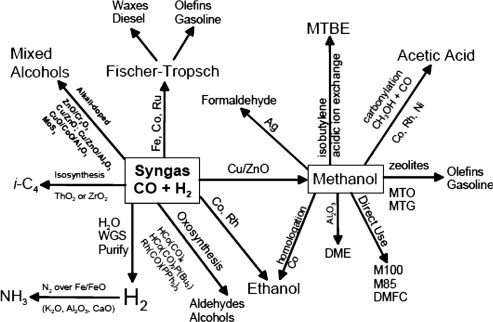
With such applications, each contaminant creates specific downstream hazards. These include minor process inefficiencies such as corrosion and pipe blockages as well as catastrophic failures such as rapid and permanent deactivation of catalysts. A multitude of technologies exist to purify the raw synthesis gas stream that is produced by gasification. Some methods are capable of removing several contaminants in a single process, such as wet scrubbing, while others focus on the removal of only one contaminant. Techniques are available that minimize the syngas contamination by reducing the contaminants emitted from within the gasifier; an approach typically termed ‘primary’ or ‘in-situ’ cleanup. Also available are a variety of secondary techniques that clean the syngas downstream of the reaction vessel in order to meet the stringent requirements of today’s applications.
_
Production of Syngas:
Gasification is the preferred route for the production of syngas from coal or biomass. Steam reformation reaction that is widely used for bulk production of hydrogen is a popular method for production of syngas from natural gas.
-1. Steam Reforming of Methane
In the steam reforming method, natural gas (CH4) reacts with steam at high temperatures (700–1100°C) in the presence of a metal-based catalyst (nickel).
CH4+H2O ⟶Catalyst →CO+3H2+206 kJ/mol
If hydrogen production is the main goal, the carbon monoxide produced is further subjected to the shift reaction to produce additional hydrogen and carbon dioxide.
CO+H2O⟶Catalyst→CO2+H2 -41.1 kJ/mol
The molar ratio of hydrogen and carbon monoxide (H2/CO) in the gasification product gas is a critical parameter in the synthesis of the reactant gases into desired products such as gasoline, methanol, and methane. The product desired dictates this ratio. For example, gasoline may need the ratio, H2/CO to be in the range of 0.5–1.0, while the stoichiometric ratio for methanol production is 2.0. In a commercial gasifier, the H2/CO ratio of the product gas is typically less than 1.0, so the shift reaction is necessary to increase this ratio by increasing the hydrogen content at the expense of CO. The shift reaction often takes place in a separate reactor, as the temperature and other conditions in the main gasifier may not be conducive to it.
-2. Partial Oxidation of Natural Gas:
Steam reforming of natural gas is a highly endothermic reaction. An alternative approach for production of syngas from CH4 is partial oxidation, which is slightly exothermic instead of being highly endothermic like the steam reforming reaction.
CH4+1/2O2 = CO+2H2 -22.1″ kJ/mol
A comparison between partial oxidation and steam reforming shows that the former produces less hydrogen. A lower H2/CO ratio (2:1) in the partial oxidation reaction is favorable for use of the syngas in FTS. The selectivity toward CO or H2, however, is influenced by simultaneous occurrence of total combustion of methane and secondary oxidation reactions of CO and H2. Potential catalysts for this reaction are Ni and Rh. Though Ni shows high conversion and selectivity, it suffers from catalyst deactivation.
-3. Coal Gasification:
During coal gasification, solid carbon (coal or petroleum coke) is partially oxidized to produce syngas, a gaseous mixture of CO and H2. Typically, a fine particle form of the solid carbon source is fed into a reactor operating at high temperature and pressure. The particles are suspended in steam, and a limited supply of oxygen is introduced. The oxygen supplied is just enough to induce partial oxidation but not full combustion, which would only produce CO2 and H2O.The mixture may contain sulfur byproducts, CO2, and residual H2O and carbon; these components are later separated leaving a syngas mixture with a final H2/CO ratio between 1.6 and 1.8.
Gasification Reaction:
3𝐶 + 𝑂2 + 𝐻2𝑂 → 𝐻2 + 3𝐶𝑂
Gasification processes in general are endothermal. The energy necessary to complete the reaction can be produced within the reactor through partial combustion of the carbon source (auto-thermal process), or by supplying energy from an outside source (allo-thermal process). Different reactor configurations and gasification processes can be utilized based on the properties of the carbon source.
______
Biomass to syngas via gasification:
Syngas is usually a product of gasification and can be produced from many sources, including natural gas, coal and biomass, by reaction with steam or oxygen. Gasification is the complete thermal breakdown of biomass into a combustible gas, volatiles, char and ash in an enclosed reactor or gasifier.
Syngas (synthesis gas) production from biomass involves thermochemical conversion—primarily gasification. Biomass is heated to high temperatures (700°C–900°C) with a restricted supply of oxygen or steam. This partial oxidation breaks down organic matter into a combustible gas mixture of Hydrogen (H₂), Carbon Monoxide (CO), and Methane (CH₄).
The Gasification Process:
The production of syngas goes through four distinct stages inside the gasifier:
-1. Drying: Heat evaporates moisture from the biomass at around 100°C–150°C.
-2. Pyrolysis: In the absence of oxygen, volatile components break down into gases, condensable vapors (tars), and char at 200°C–500°C.
-3. Combustion: Residual char and volatiles react with a controlled amount of oxygen to supply the intense heat needed for the rest of the process.
-4. Reduction: High-temperature chemical reactions (like the water-gas shift reaction) convert carbon and water vapor into permanent gases, increasing the H₂ and CO yield.

Figure above shows Gasification process using biomass as feedstock.
Biomass is represented by the empirical formula (CHaObNc). The general gasification equation balancing biomass with gasification agents (like oxygen and steam) is
CHaObNc + wH2O + m(O2 + 3.72N2) = n1H2 + n2CO + n3CO2 + other
Primary Reaction Formulas:
Inside the gasifier, several distinct reactions occur at high temperatures (700° C – 1000° C):
Partial Oxidation (Combustion)
Releases the heat required for the endothermic gasification reactions:
- 2C + O2 → 2CO
- C + O2 → CO2
Boudouard Reaction
Carbon reacts with carbon dioxide to produce carbon monoxide:
- C + CO2 → 2CO
Water-Gas Reaction
Carbon reacts with steam to yield hydrogen and carbon monoxide:
- C + H2O → CO + H2
Water-Gas Shift Reaction
Adjusts the ratio of hydrogen to carbon monoxide:
- CO + H2O → CO2 + H2
Methanation
Carbon and hydrogen combine to produce trace methane (CH₄):
- C + 2H2 → CH4
- CO + 3H2 → CH4 + H2O
Steam Reforming
Hydrocarbons react with steam to form synthesis gas components:
- CH4 + H2O → CO + 3H2
Composition of syngas is affected by the feedstock and also the amount of water/oxygen used during gasification process. Syngas produced from biomass, such as wood, usually contains lower percentage of CO but higher percentage of hydrocarbons. Depending on the sulfur content in the coal, syngas produced from coal may contain considerable amount of H2S. Similar to biogas, utilization of syngas also requires removal of impurities, especially NH3 and H2S to avoid corrosion.
_____
CO2 to syngas:
Converting CO₂ into syngas (a mixture of carbon monoxide and hydrogen) is a key pathway for carbon recycling. It provides a carbon-neutral alternative to fossil-fuel-derived synthesis gas, which is used to manufacture liquid fuels, methanol, and green chemicals.
The conversion typically happens via two main processes:
-1. Reverse Water-Gas Shift (RWGS) Reaction
Syngas is a key intermediate in the chemical industry, which can be produced from electrolytic H2 and air-sourced CO2. This thermochemical process reacts captured CO₂ directly with hydrogen (H₂) to produce Carbon Monoxide (CO) and water vapor.
- The Equation: CO2 + H2 → CO + H2O 42kJ/mol
- How it works: Because this is an endothermic reaction (requiring heat), it requires high temperatures (typically 300°C to 800°C) and specific catalysts, such as copper- or nickel-based alloys. The resulting CO and the leftover H₂ can be tuned to the precise ratio required for downstream chemical synthesis.
-2. Co-Electrolysis (Electrochemical Reduction)
This method uses electricity—ideally from renewable sources—to directly split CO₂ and water in an electrolyzer.
- How it works: Using Solid-Oxide Electrolyzer Cells (SOECs) or advanced gas-diffusion systems, electricity breaks down both molecules, combining the components into syngas in a single step.
- Advantage: It skips the high thermal requirements of the RWGS reaction and can even be integrated with direct air capture (DAC) technologies to pull CO₂ and moisture directly from the atmosphere
______
Air to syngas:
Climate change has already caused increases in heat waves, wildfires, and sea levels worldwide. With increasing global CO2 emissions reaching an all-time-high of more than 36.8 Gt-CO2 in 2022, the world is furthering away from net-zero emission targets. Along with energy decarbonization efforts, CO2 capture from point sources and air plays a significant role in driving the trajectory down to the net-zero emission point by mid-century. Air-to-product processes offer defossilized pathways to pursue carbon neutrality while benefiting from economic incentives. To date, there has been a lack of rigorous modeling and techno-economic studies on emerging air-to-syngas pathways. The study below aims to fill that gap by providing a thorough assessment of integrating direct air CO2 capture (DACC) with CO2 and H2O electrolysis systems to produce syngas, a key intermediate in the chemical industry. A comparison of such an emerging route with traditional ones is given to guide further DACC-electrolysis research towards relevant targets. In addition, authors provide carbon pricing targets, integration with variable renewable energy considerations, and social implications of deploying such pathways, composing a comprehensive overview of upcoming challenges to stakeholders.
_
Evaluating the techno-economic potential of defossilized air-to-syngas pathways, a 2023 study:
Defossilizing the chemical industry using air-to-chemical processes offers a promising solution to driving down the emission trajectory to net-zero by 2050. Syngas is a key intermediate in the chemical industry, which can be produced from electrolytic H2 and air-sourced CO2. To techno-economically assess possible emerging air-to-syngas routes, authors develop detailed process simulations of direct air CO2 capture, proton exchange membrane water electrolysis, and CO2 electrolysis. Their results show that renewable electricity prices of r$15 per MWh enable the replacement of current syngas production methods with CO2 electrolysis at CO2 avoidance costs of about $200 per t-CO2. In addition, authors identify necessary future advances that enable economic competition of CO2 electrolysis with traditional syngas production methods, including a reverse water gas shift. Indeed, they find an improved CO2 electrolysis process (total current density = 1.5 A cm2, CO2 single-pass conversion = 54%, and CO faradaic efficiency = 90%) that can economically compete with the reverse water gas shift at an optimal cell voltage of about 2.00 V, an electricity price of $28–42 per MWh, a CO2 capture cost of $100 per t-CO2, and CO2 taxes of $100–300 per t-CO2. Finally, authors discuss the integration of the presented emerging air-to-syngas routes with variable renewable power systems and their social impacts in future deployments.
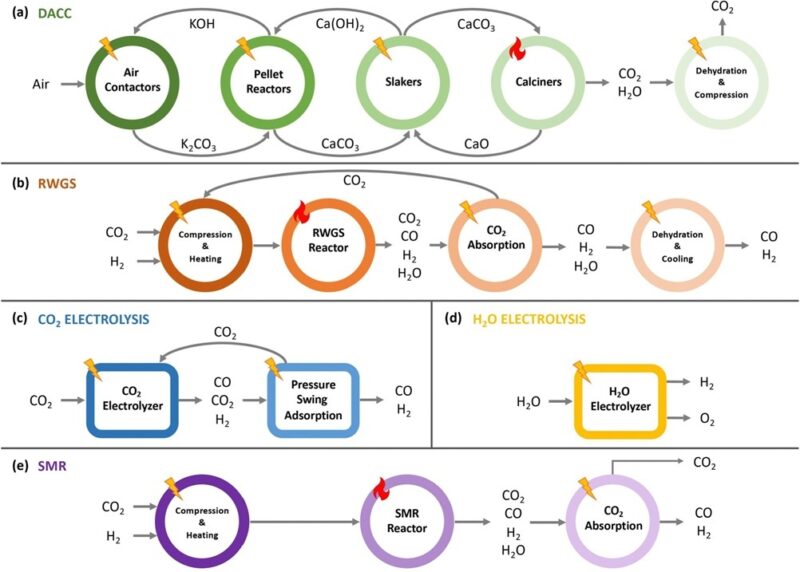
Figure above is simple block flow diagrams of (a) liquid hydroxide-based DACC, (b) reverse water gas shift, (c) CO2 electrolysis, (d) H2O electrolysis, and (e) steam methane reforming. The fire symbol represents fossil-based thermal energy and the lightning bolt symbol represents electricity, which can be sourced from renewables.
In this effort, authors developed and verified a DACC model in Aspen Plus based on Carbon Engineering’s design. They also developed an electrolysis model to be applied to CO2 and water electrolysis. In addition, they referenced a RWGS model and an SMR model from the literature to fill the gap in integrated assessment. Authors used these models to assess DACC-SMR-RWGS, DACC-PEMWE-RWGS, and DACC-PEMWE-CO2ER pathways in terms of carbon efficiency, energy consumption, energy cost, and marginal energy-associated CO2 emissions. Finally, authors performed a full techno-economic assessment of DACCPEMWE-RWGS and DACC-PEMWE-CO2ER to understand the effects of technical and economic parameters as well as process design improvements on the total syngas production cost.
Authors technoeconomic assessment demonstrates that reducing the cost of DACC and the price of electricity are the key drivers to enable a commercial air-to-syngas process. At the current technological stage, defossilized air-to-syngas pathways would benefit the most from reduced electricity prices, which would in turn help reduce the H2 production cost via electrolysis, and from more energy and cost efficient DACC process designs. Achieving the U.S. DOE carbon negative shot target of $100 per t-CO2, reducing renewable electricity prices to $20–40 per MWh, and increasing the CO2 tax and tax credits to Z$100 per t-CO2 are the three most influential goals to realizing a commercial defossilized air-to-syngas process.
______
______
Section-9
Defossilization of chemicals:
The annual global CO2 emissions were 36.8 Gt in 2022, corresponding to a 1% increase from the previous year. Out of this value, the chemical industry is responsible for ~5.5 Gt CO2-eq (~15%) with a breakdown of ~1.8 Gt CO2-eq for Scope 1, ~1.7 Gt CO2-eq for Scope 2 and ~2 Gt CO2-eq for Scope 3. Scope 1 emissions are directly emitted by the process for either chemical conversion or energy production, Scope 2 emissions are associated with electricity utilized in the process and Scope 3 emissions are all indirect upstream and downstream emissions, such as those associated with extracting fossil fuels and end-of-life disposal. The distribution of Scopes 1 and 2 contributions depend on whether aspects such as the production of heat and steam are considered within the process boundaries. In general terms, Scopes 1 and 2 emissions are strongly dependent on the fossil feedstock used. For a given energy value, the associated CO2 emissions increase as natural gas < oil < coal. A number of technology developments and heat integration strategies over the last decades have facilitated the maximization of the energy efficiency with an associated decrease in emissions. As an example, in the EU27, the chemical industry Scope 1 emissions were ~0.12 Gt CO2-eq in 2023, down by 55% since 1990, mainly due to decreased process emissions rather than decreased energy consumption. Equally important, N2O emissions were ~1/3 of the total emissions in 1990 but are now minimal due to new legislation and technologies.
In addition to the chemical industry, there are other important industries, namely, the cement/concrete, glass and steel industries, which are key for society, but high CO2 emitters and difficult to abate. As a whole, the four industries (chemical, cement, glass and steel) are responsible for ~25% of total CO2 emissions, with ~9.6 Gt CO2 directly (Scopes 1 and 2) emitted annually. To put this into perspective, the aviation industry and the shipping industries are each responsible for ~2% of the total CO2 emissions.
Within the chemical industry, the production of ammonia is a particularly energy-intensive process, responsible for ~10% of the CO2 emissions of the chemical industry and ~40% of the primary chemical industry, followed by methanol (28%) and high-value chemicals (27%). Ammonia is mainly used for fertilizers production, particularly as urea, ammonium nitrate and ammonium sulphate. Currently, this process is responsible for ~420 Mt CO2 emissions (in 2022) with 1.6 – 1.8 tCO₂-eq/tNH3 when using natural gas as feedstock and fuel and 3.2 tCO₂-eq/tNH3 when using coal. It is important to note that China is currently the main ammonia producer with almost all their plants using coal as feedstock and fuel.
_
Refinery products:
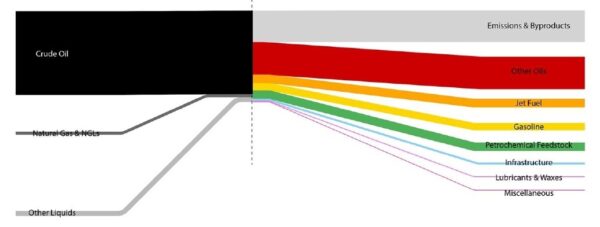
Figure above shows U.S. refinery feedstocks and products from 2019. The refinery feedstocks are comprised of fossil fuels such as crude oil and natural gas. The products contain mostly oils as well as fuels and petrochemical feedstocks.
Crude oil, coal and natural gas are initially processed through two types of facilities: refineries and coal gasification plants. The U.S. has largely moved away from coal; in 2019 only four coal gasification plants were in operation which consumed 10.22 Mt of coal and lignite. There were also 132 refineries operating in the U.S. in 2019 which combined processed 836.2 Mt of crude oil, the equivalent of 6.045 billion barrels or 385,000 Olympic swimming pools. They also processed 16.95 Mt/y of natural gas and 49.1 Mt/y of other liquids. Not all the crude oil and natural gas processed by a refinery is transformed into product—refineries alone emitted 205.7 Mt/y of CO2e in 2018, around 25% of their total input.
Coal gasification plants primarily produce syngas, a mixture of H2 and CO, as a feedstock for ammonia fertilizer and methanol synthesis. Refineries produce an array of products, some of which are used as is, and others are further transformed into useable products at petrochemical plants. Liquid fuels, natural gas liquids (NGLs), and oils comprise 71% of the total mass of products produced by refineries and are the primary source of global CO2 emissions because they are burned for energy almost immediately after they are refined. Refineries also produce lubricants, waxes, petroleum coke, and asphalt/road oil, which may require some further processing but are basically in their final form as they exit the refinery.
Petrochemical feedstocks are made up of NGLs (ethane, propane, n-butane, isobutane), olefins (ethylene, propylene, n-butylene, isobutylene), naphtha, still gas, and BTX (benzene, toluene, xylene) aromatics. In some instances, depending on the proximity of the refinery to the petrochemical plant, these compounds may be further broken down into a desired feedstock before leaving the refinery.
Note:
Still gas is any form or mixture of gases produced in refineries by distillation, cracking, reforming, and other processes. The principal constituents are methane and ethane. May contain hydrogen and small/trace amounts of other gases. Still gas is typically consumed as refinery fuel or used as petrochemical feedstock.
__
Chemicals are ubiquitous in and essential for everyday life. This is reflected in the quantity and variety of chemicals produced worldwide: estimates of the number of commercially available chemicals range from 40,000 to over 100,000. Chemicals are essential components required to produce pharmaceuticals, fertilisers, plastics, paints, adhesives, coatings, electronics, cleaning products and toiletries. Alongside these everyday commodities, chemicals are needed for essential net zero technologies, for example solar panels, wind turbines, batteries and many types of insulation. The vast majority of chemicals upon which society relies are carbon-based. To produce carbon-based chemicals and ultimately downstream consumer products, an initial feedstock containing carbon is required. Currently, almost 90% of feedstocks used to make chemicals are from fossil sources – oil, natural gas and coal. Feedstocks are transformed, often at high temperature and pressure, into the key ‘primary chemicals’ used to service the chemical industry.
Primary chemicals are ethene (C2H4), propene (C3H6), butadiene (C4H6), benzene (C6H6), toluene (C6H5CH3), mixed xylenes ((CH3)2C6H4), and methanol (CH3OH). These primary chemicals are transformed by a wide range of processes and chemical reactions into intermediates, speciality and fine chemicals used to make consumer products.
Figure below shows simplified example of the route from fossil feedstocks to consumer products.
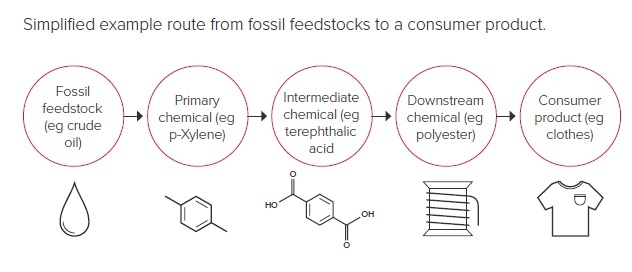
_
_
Figure below shows examples of uses of chemicals found in common consumer products.
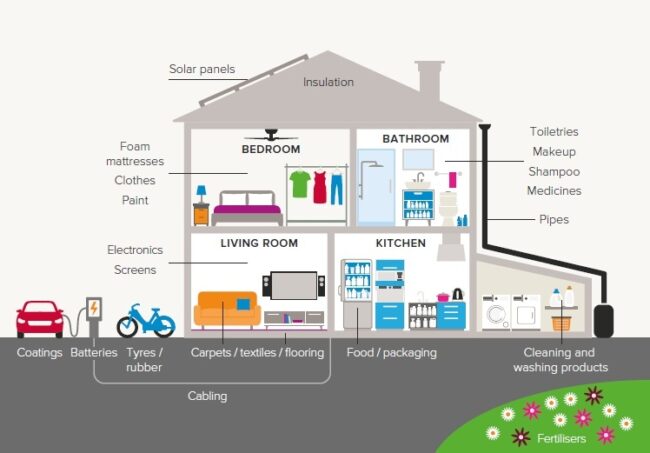
___
The term “petrochemicals” originally refers to chemicals produced from petroleum, and is now often used interchangeably with the simpler, shorthand term “chemicals”. Petrochemicals can be produced from feedstocks derived from oil, natural gas liquids or coal. Oil refining allows the separation of crude oil, which is a complex mixture of many hydrocarbons, into several “fractions” for further processing; natural gas is purified and further processed; coal is usually gassified into syngas. Following these initial purification steps, more chemical reactions (such as cracking or reforming) are used to convert such hydrocarbons into more reactive “primary chemicals “. Primary chemicals serve as precursors to larger and/or more molecularly complex chemicals, such as “specialty chemicals” and polymers.
_
Currently, around 90% of the feedstocks for the chemical industry originate from fossil sources, specifically, oil, natural gas and coal. Oil can be processed for ethene, propene, benzene, toluene and mixed xylenes. Natural gas and coal are used to produce ammonia and methanol. In recent years, natural gas derived feedstocks have become much more significant for ethene and propene production, due to the rise in shale gas production in, for example, the US. Whilst ammonia is also considered a primary chemical, is not a carbon-based chemical. It is important to note that ammonia is one of the largest drivers of chemical sector emissions, accounting for almost 2% of global carbon dioxide emissions. Other feedstocks that are important for the chemical industry include water, oxygen, nitrogen, hydrogen, and the halogens (chlorine, bromine and iodine).
_
A broad overview of how fossil fuel feedstocks are currently processed, firstly into primary chemicals and then into the everyday products on which society relies is shown in Figure below.
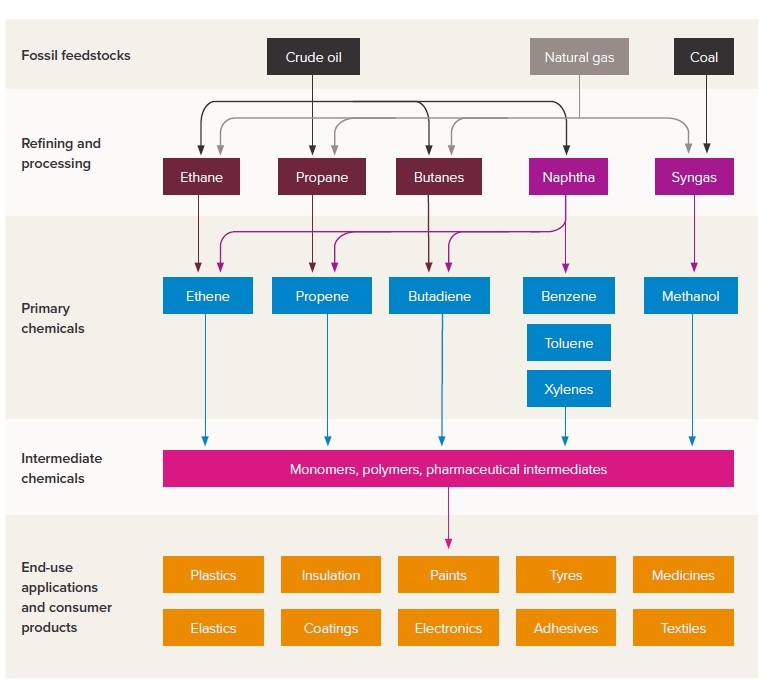
Figure above shows simplified flow diagram showing the production of end-use applications and consumer products from fossil feedstocks.
The petrochemical production cycle can be broken down into four steps, simplified in Figure above:
-1. Processing fossil fuels into chemical feedstocks, such as natural gas into ethane
-2. Converting chemical feedstocks into primary chemicals
-3. Producing intermediary chemicals and polymers
-4. Manufacturing final products
The vast range of final products currently rely on these primary chemicals. Collectively, primary chemicals account for two thirds of the global energy demand of the chemical sector and underpin many thousands of chemical products. However, the future chemical industry does not necessarily have to follow this linear structure dominated by primary chemicals. Biomass and plastic waste carbon feedstocks could generate new or different primary chemicals than those used today, though may also offer opportunities to bypass primary chemicals and develop new pathways more directly to fine or speciality chemicals.
_
Currently, organic chemicals are almost entirely derived from fossil feedstocks (e.g., coal, oil, and natural gas), and so they are often referred to as petrochemicals. The value chain for organic chemicals and materials is depicted in Figure below.
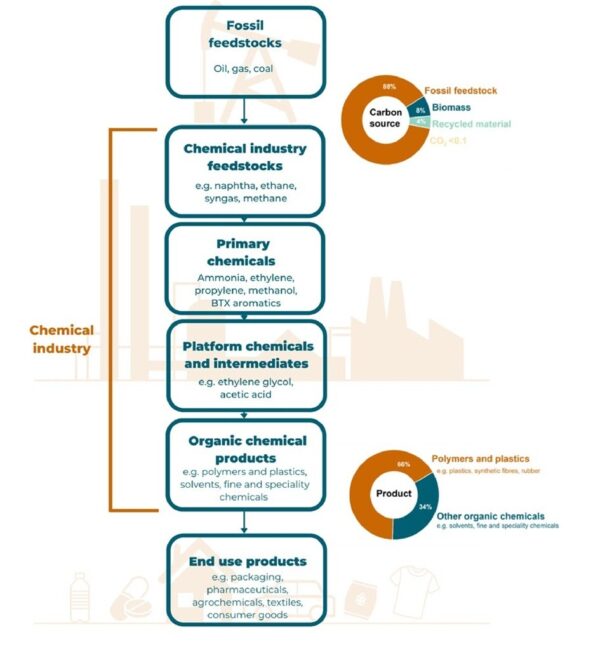
Figure above shows production of organic chemicals and materials from fossil feedstocks. Pie charts are based on data previously published by the Renewable Carbon Initiative, and show distribution of embedded carbon in organic chemicals and materials according to feedstock type and product type.
After they are extracted from underground reserves, fossil feedstocks are processed in refineries. Most of the products of these refineries are used for energy applications. However, they also yield feedstocks for the chemical industry, such as naphtha (a liquid mixture of hydrocarbons produced from crude oil) and ethane (a simple hydrocarbon produced via natural gas or petroleum refining). The chemical industry converts these feedstocks into primary chemicals via processes such as steam cracking and catalytic reforming. These primary chemicals are then transformed into a vast array of organic chemicals and materials via numerous processes and intermediates. More than 90% of organic chemicals are derived from ammonia, methanol, ethylene, propylene, and BTX aromatics (i.e., a mixture of benzene, toluene, and xylene). Organic chemicals and materials produced by the industry range from polymers and plastics, which account for almost a third of the chemical industry’s outputs, to fine and speciality chemicals such as dyes, surfactants, and therapeutics.
_
Figure below shows simple flow diagrams of the petrochemical, hydrogen, and hydrogen derivatives production process.
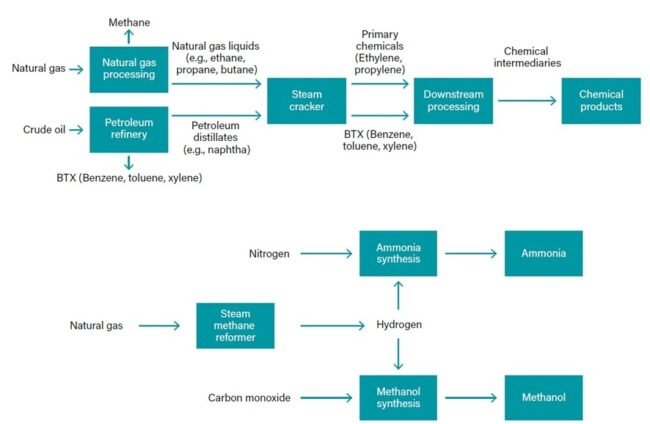
Figure above provides a simple illustration of the most common primary chemical production processes in the United States. The top half shows how ethane and naphtha—natural gas and petroleum derivatives, respectively—are steam cracked into olefins. Steam cracking can also produce aromatics, but those are more commonly made as a refining by-product. The bottom half illustrates hydrogen production from natural gas, which is synthesized into ammonia or methanol. Other countries less abundant in natural gas might use higher percentages of coal or petroleum, with slightly different production processes, than the United States.
_______
Estimated 2021 production of primary chemicals (million tonnes) in the US:
Primary chemical 2021 0utput (Mt) Major uses
Ethylene 34 Plastics, synthetic materials, fibers, packaging, PVC, pharmaceuticals
Propylene 27 Plastics, cosmetics, electronic appliances, engine parts
Ammonia 15 Fertilizer, cleaning products, explosives, chemical processing
Methanol 6 Solvents, formaldehyde, acrylics, synthetic fibers, adhesives,
paints, pharmaceuticals
Ethylene is the most produced primary chemical in the United States, given the demand for its end products, specifically plastics, and abundant ethane production via the large U.S. natural gas reservoirs. Propylene, another precursor to plastics and other products, follows behind. Note that both propylene made in chemical plants and as a refining byproduct are included. Substituting aromatic chemicals produced in refineries are out of scope, but propylene’s total production is shown to illustrate total demand. Ammonia, the vital component of synthetic fertilizer, is the third-most produced, with methanol as the fourth-most. Although methanol is last here, its importance would grow enormously in an MTO-based market.
Carbon-based chemicals cannot be decarbonised, but they can be defossilized through a transition to renewable carbon sources such as biomass, recycled material (e.g., plastic), or carbon dioxide (CO2). The petrochemicals sector is large, complex, and well established, and the widespread change required to move away from fossil-based chemicals will likely only be possible with government intervention.
______
______
Steps to defossilization of chemicals:
Aside from being employed as fuels, fossil resources are now still the primary components to manufacture various important chemicals utilized by plastic, electronic, textile, food, cosmetic, pharmaceutical, and other manufacturing industries. These so-called petrochemicals are extracted or processed from non-renewable carbon sources, such as natural gas, petroleum, and coal. The vast majority of daily products used by humans contain components manufactured from these fossil-based raw materials. Besides, the International Energy Agency (IEA) report shows that the oil consumption as a feedstock for plastic production in the United States, Europe, China, and India would outnumber the quantity of oils utilized for transportation (International Energy Agency, 2018).
Figure below shows production of several Fossil-Based Commodities in the Chemical Industry:
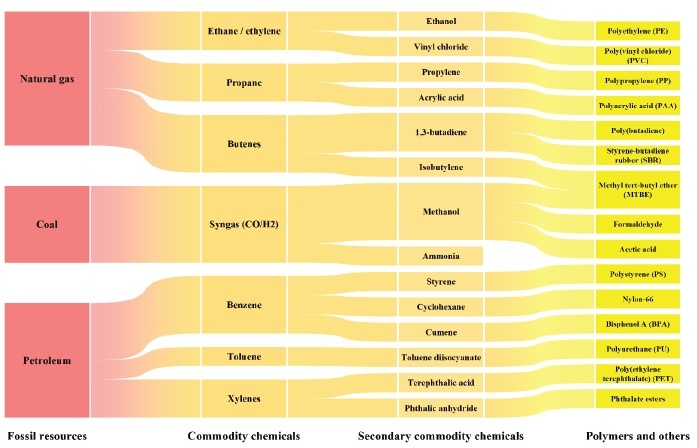
As shown in Figure above, numerous commodity chemicals are derived from fossil-based feedstocks. Natural gas liquids (NGLs) drilled from the Earth’s surface, including ethane, propane, and butane, are intermediates to generate olefins, such as ethylene, propylene, which are raw materials to produce various platform chemicals, e.g., ethanol and 1,3-butadiene (for synthetic rubbers), and polymer, e.g., polyethylene (PE; for plastic packaging), polyvinyl chloride (PVC; for pipes and electric cables) and polyacrylic acid (PAA; for superabsorbent and disposable diapers). Meanwhile, benzene, toluene, and xylene (BTX) are formed from catalytic reforming of naphtha, one of the fractions from petroleum refining. These chemicals are starting materials to produce commercial polymers, such as polystyrene (PS; for Styrofoam products), nylon-6 (for synthetic fibers), bisphenol-A (BPA; for food ware products), polyurethane (PU; for kitchen foams, automobile interiors, and decorations), polyethylene terephthalate (PET; for plastic bottles) and phthalic anhydride (for plasticizers and dyestuffs). Coal gasification generates syngas consisting of hydrogen and carbon monoxide, precursors for producing methanol and ammonia. Both chemicals, plus ethylene and propylene, are commodities with the most significant global production volumes and the highest GHG emissions compared to other chemicals.
Note:
A platform chemical is defined as a chemical that can serve as a substrate for the production of various other higher value-added products.
_
Achieving Net-Zero Emissions in the Chemical Industry:
The foundations of the modern organic chemical industry are built on seven key building blocks or primary chemicals: ammonia (NH3), methanol (CH3OH or MeOH), ethylene (C2H4), propylene (C3H6), benzene (C6H6), toluene (C7H8), and mixed xylenes (C8H10). Ethylene and propylene are often discussed as light olefins, and benzene, toluene, and mixed xylenes are referred to as BTX aromatics, and together are referred to as high value chemicals (HVCs). Due to the abundance of low-cost fossil feedstocks, discussions of emission reductions in the chemical industry have largely focused on process emissions.
To date, there are three approaches to achieving net-zero emissions (or, in this case, net-CO2 emission) in the chemical industry. Briefly, the CO2 emission produced from converting fossil resources into target chemicals in the current industrial process leads to the positive accumulation of GHGs in the atmosphere. For that reason, many scientists explore methods to avoid the release of CO2 by capturing the gas and storing it underground, i.e., geological storage, in the form of supercritical fluid, known as carbon capture and storage (CCS). However, this strategy still uses fossil resources as feedstocks. Therefore, rather than transferring the gas below the surface, the second approach, termed carbon capture and utilization (CCU), attempts to employ the generated CO2 as a raw material to synthesize various chemicals. Unfortunately, there are still numerous technological limitations to efficiently obtaining the CO2 with high purity from the air and performing the chemical conversion using CO2 as the substrate due to its low reactivity. Meanwhile, the third approach uses organisms, such as plants and microorganisms, as a natural CO2 capturer and converter before its utilization. Measures to decarbonise the chemical industry, such as improved efficiency, electrification or carbon capture and storage, can help to partially reduce the climate impacts of the sector. However, since carbon will remain an important feedstock for most chemical compounds, those levers will need to be complemented by a switch to novel sources of carbon (biogenic or atmospheric). Some voices therefore call for a “defossilization” of the chemical industry. A shift to renewable sources of carbon would require a substantial re-engineering of the value chains of the chemical industry. Processes would need to be tailored to the composition of biogenic molecules, to different storage and transport requirements, and be able to adapt to possible seasonal and daily variations.
_
Defossilization of chemicals is the transition of the chemical industry away from fossil feedstocks (oil, gas, coal) to renewable raw materials, aiming for net-zero emissions. It involves replacing fossil carbon with renewable carbon sources, specifically biomass, plastic waste recycling, and CO2 utilization (CCU), along with utilizing renewable energy for processing.
Key Aspects of Defossilization:
- Renewable Feedstocks: Shifting to bio-based materials, agricultural waste, and circular raw materials to provide the carbon backbone for plastics, pharmaceuticals, and chemicals.
- Carbon Capture and Utilization (CCU): Capturing industrial or atmospheric and converting it into synthetic feedstocks.
- Power-to-Chemicals (PtC): Utilizing renewable electricity to generate hydrogen via water electrolysis, which acts as a key feedstock for green chemical synthesis.
- Waste Valorization: Pyrolysis of plastic waste to generate raw materials for new products, reducing reliance on virgin fossil resources.
_
Table below shows various important chemical products such as platform chemicals, plastics and other polymers, solvents, and fine and speciality chemicals that need defossilization.
|
Chemical products |
Examples of Fossil based |
Key applications |
Approximate global demand |
|
Platform chemicals |
Primary chemicals (ethylene, propylene, methanol, and BTX aromatics) |
Converted into vast array downstream chemicals and products. |
Primary chemicals alone total almost 500 Mt |
|
Plastics |
Polyethylene, polypropylene, and polyvinyl chloride (PVC) |
Packaging, textiles, automotives, household appliances, toys, sports equipment, and construction. |
391 Mt |
|
Polymers in liquid formulations (PLFs) |
Polyacrylics, polyesters, polyurethanes, vinyl polymers, and a variety of water soluble polymers |
Paints, coatings, inks, adhesives, home and personal care products, agrochemicals, water treatments, and lubricants |
36 Mt |
|
Synthetic fibres |
Polyester (polyethylene terephthalate), polyamides (e.g., nylon 6,6 and nylon 6) |
Mainly textiles in clothing and home furnishings |
75 Mt |
|
Synthetic rubbers |
Styrene butadiene rubber and polybutadiene rubber |
Automotives (e.g. tyres), industrial and consumer goods (e.g. gloves, footwear), and construction |
15 Mt |
|
Polymer composites |
Polyesters, polyamides, and polyurethanes (polymer matrix) and polymer fibres, carbon nanotubes or carbon fibre (embedded fillers) |
Automotives and other vehicles, wind energy (structural components of wind turbines) and other energy applications, aerospace, defence, and construction |
12 Mt |
|
Solvents |
Oxygenated solvents (e.g., ethanol, acetone), hydrocarbon solvents (e.g., cyclohexane), and halogenated solvents (e.g., dichloromethane). |
Industry, home and personal care products, and paints |
28 Mt |
|
Plasticizer |
Phthalates. |
Plastic products, such as packaging, textiles, and construction. |
11 Mt |
|
Surfactant |
Linear alkylbenzene sulfonates (LAS), sodium lauryl ether sulphate (SLES), cationic surfactants, and non-ionic surfactants |
Home and personal care products, industrial applications, agrichemicals, pharmaceuticals (as drug delivery agents), and paints |
19 Mt |
|
Bitumen |
Often combined with aggregates such as sand to form asphalt. |
Road and pavement surfacing, construction (e.g., roofing and waterproofing) |
Over 100 Mt |
_
Both bio-based and CO2-based pathways to chemicals are resource-intensive, and a one-to-one replacement of current fossil production capacities through such pathways is likely to lead to very high demand for biomass raw materials and electricity/H2/CO2, respectively. On a global scale, these demands would be challenging to meet sustainably.
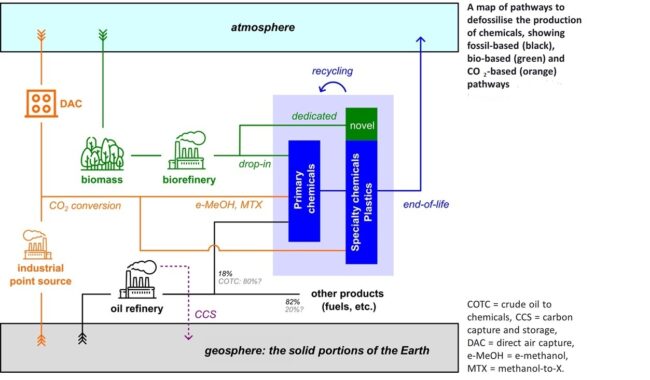
Although there are no agreed-upon pathways to enable the chemicals industry to meet net zero, and the contribution of different technologies is still uncertain, a combination or co-evolution of bio-based and CO2-based pathways – coupled with demand reduction strategies – is likely to increase the overall feasibility and sustainability of the sector’s defossilization.
Developments in niche markets and a focus on the chemicals that have the highest feasibility and marketability may act as “market shapers”, paving the way to larger-scale transformation of the chemicals industry. Identifying and accelerating those candidates (such as polyurethane) may be a powerful step to scale up novel carbon feedstocks in the chemical industry.
_
The chemical sector accounts for approximately 6% of global CO2-equivalent emissions. At least one-third of chemical sector emissions are due to direct energy consumption and chemical transformation processes, typically powered by fossil fuels. These emissions can be reduced through, for example, the electrification of power and heating and energy efficiency improvements. The chemical sector cannot fully decarbonise, though, as most chemicals inherently contain carbon atoms that are essential to the material’s structure. It could be possible to significantly ‘defossilize’ the organic chemical industry by replacing fossil feedstocks with alternative carbon sources, as part of the transition to a net zero chemical industry. The alternative feedstocks explored are biomass, plastic waste and carbon dioxide (CO2). These can act as sources of carbon required for primary chemical building blocks, further intermediate chemicals and ultimately downstream consumer products. These alternative starting materials have the potential to reduce the chemical industry’s greenhouse gas emissions.
_
The production and combustion of fossil fuels is the largest contributor to CO2 emissions, and while ceasing fossil fuel usage entirely seems like an obvious solution, it overlooks the world’s vast dependence on them. Crude oil, natural gas, and coal are not only used for heating and transportation, but for petrochemical production as well. Almost everything in our everyday lives, from the fertilizers used to grow our food to the plastic fibers in our clothes, is in some way derived from petrochemicals. While there are known renewable energy replacements for fuels, essential petrochemical products such as plastics and fertilizers will require different alternative production methods. Over 95% of all petrochemical products are derived from methanol, ethylene, propylene, ammonia, and BTX aromatics intermediates. So we need alternative production methods depending entirely on waste products (biomass, biogas, CO2) and renewables (energy, H2) for feedstocks. Large scale production of fossil-free petrochemicals is already occurring in some instances and should continue to focus on upstream chemicals.
______
Alternative processes:
Almost all petrochemical end-products are synthesized from five intermediates: methanol, propylene, ethylene, ammonia, and BTX aromatics. Replacing the processes responsible for producing each of these intermediates with renewables-based technologies is the simplest way to reduce the fossil-fuel dependence and emissions intensity of the petrochemical industry. This also avoids the replacement of equipment for many existing secondary processes (for example propylene to polypropylene reactors), reducing the capital needed to accomplish this feat. The following is a summary of a new production processes for these intermediates.
_
-1. Syngas:
Syngas is an extremely reactive mixture of CO and H2 used in many reactions. It is typically produced from coal, through coal gasification, or through steam reforming of natural gas or light naphtha. When additional hydrogen is desired, the water gas shift reaction may be used to convert CO to H2.
Coal Gasification:
3𝐶 + 𝑂2 + 𝐻2𝑂 → 𝐻2 + 3𝐶𝑂
Steam Reforming:
𝐶𝑛𝐻𝑚 + 𝑛𝐻2𝑂 → 𝑛𝐶𝑂 + (m/2 + 𝑛)𝐻2
Water Gas Shift Reaction:
𝐶𝑂 + 𝐻2𝑂 → 𝐶𝑂2 + 𝐻2
Syngas may also be produced through biomass gasification, where biomass is dried and pyrolyzed (heated to high temperatures) to produce pyrolysis gas, a mixture of CO, H2, CO2, and light hydrocarbons. Pyrolysis gas is then reacted with residual carbon, called char, to form the final syngas mixture. Biogas is a mixture of methane and CO2 and can sourced from anaerobic digesters which treat municipal and industrial wastewater, or landfills. Through biogas dry reforming, it can be converted to syngas for petrochemical production. Both processes present an opportunity to use waste materials to make value added chemicals.
Dry Reforming of Biogas:
𝐶𝐻4 + 𝐶𝑂2 → 2𝐶𝑂 + 2𝐻2
It is also possible to produce sustainable hydrogen separately through electrolysis of water. Renewable electricity is used to split water into H2 and O2 molecules via an anode and cathode in an electrolyzer reactor.
Electrolysis of Water:
2𝐻2𝑂 → 2𝐻2 + 𝑂2
A similar process for the electrochemical reduction of CO2 to CO has also been envisioned but has not been demonstrated on a reasonable scale due to side reactions and limitations in catalyst and reactor design.
Fischer Tropsch Synthesis (FTS):
Fischer Tropsch Synthesis (FTS) was one of the first synthetic fuels and chemicals processes to reach industrial scale. Syngas is catalytically reacted to form CH2 monomers which combine to form a mixture of various hydrocarbon molecules, called syncrude. Depending on the choice of catalyst and reaction conditions, the syncrude composition can favor gasoline, diesel, middle distillates, or waxes. FTS also has the potential to generate petrochemical feedstocks such as olefins and aromatics. There are at least six industrial FTS plants operating world-wide.
Monomer Formation:
𝐶𝑂 + 2𝐻2 → (𝐶𝐻2) + 𝐻2𝑂
Direct CO2 FTS has been proposed to use captured CO2 and renewable H2 as feedstocks. This reaction proceeds through a pseudo-syngas route where CO2 and H2 are first converted to CO and H2O and the second step is the monomer formation. Difficulties in improving kinetics and selectivity are the result of the stability of CO2, and thus current research is mostly focused on catalyst improvement.
_
-2. Methanol:
Most methanol is synthesized through the low-pressure Synetix process, which uses syngas produced from coal or natural gas feedstocks and copper catalysts. This two-step process (syngas production followed by conversion to methanol) is extremely energy intensive, so naturally other processes have been pursued.
Methanol Synthesis:
𝐶𝑂 + 2𝐻2 → 𝐶𝐻3𝑂𝐻
Researchers have proposed a Direct Methane to Methanol (DMTM) route which avoids the initial syngas production stage, using methane as a feedstock. But this process is thermodynamically difficult in practice because of the instability of methanol. Instead, more stable species such as formaldehyde, CO, CO2, and H2O are favored. Efforts towards identifying suitable catalysts and reaction conditions are still being made, but DMTM is currently not available on a large scale. The same is true for methanotrophy, a process that utilizes methanotrophic bacteria to convert methane to methanol. A methyl formate route also exists, where methanol is reacted with CO to form methyl formate as an intermediate, then further reacted to produce twice the original amount of methanol. This process has a lower energy requirement than traditional methanol synthesis but is not widely used byproduct formation.
CO2 hydrogenation to methanol is a process that has been demonstrated using renewable H2, captured CO2 and traditional methanol synthesis catalysts. Several largescale pilot plants are currently in operation, including the George Olah Plant in Iceland and the pan-European MefCO2 project in Germany. Both ventures are great examples of the potential of defossilized petrochemical production.
CO2 Hydrogenation:
𝐶𝑂2 + 3𝐻2 → 𝐶𝐻3𝑂𝐻 + 𝐻2𝑂
Methanol is a feedstock for the production of formaldehyde, methyl tert-butyl ether (MTBE), acetic acid, methylamines, methyl methacrylate, fuel additives, and other chemicals. Through the Methanol to Olefins (MTO) and Methanol to Gasoline (MTG) processes, it can also be converted to ethylene, propylene, and fuels.
_
-3. Ethylene & Propylene:
Ethylene (C2H4) and propylene (C3H6) are homologues of one another and are both largely produced through steam cracking of other petroleum feeds such as ethane or naphtha. Refinery off gases from fluid-catalytic cracking units also contain ethylene and propylene which is recovered. Propylene production may be supplemented by propane dehydrogenation or olefin metathesis, whereas ethylene and butene are converted to propylene.
Propane Dehydrogenation:
𝐶3𝐻8 → 𝐶3𝐻6 + 𝐻2 Olefin Metathesis:
𝐶𝐻2=𝐶𝐻𝐶𝐻2𝐶𝐻3 + 𝐶𝐻2=𝐶𝐻2 → 2𝐶𝐻2=𝐶𝐻𝐶𝐻3
Oxidative Coupling of Methane (OCM) to ethylene is another well studied reaction but is limited by stable reaction conditions and catalyst activity. Ethylene may also be produced by cell factories of cyanobacteria, which enzymatically convert CO2, solar energy, and water to hydrocarbon products. Currently, cyanobacteria technologies are only at the proof-of concept stage and the costs associated with them are prohibitive. However, biological catalysis processes are promising given their ability to utilize CO2 without the need for complex process design. Additionally, advances in the MTO process have to be made wherein CO2 is hydrogenated to methanol, then converted to olefins within the same reactor.
_
-4. Ammonia:
Ammonia is produced through the extremely energy intensive Haber-Bosch process, where fossil-fuel derived H2 is combined with atmospheric N2 at high pressure and temperature. Ammonia production accounts for around 2% of global energy usage and 1.44% of CO2 emissions, thus finding renewables-based alternatives is very advantageous to climate goals.
Ammonia Synthesis:
𝑁2 + 3𝐻2 → 2𝑁𝐻3
One alternative is to replace fossil based H2 with green H2 from water electrolysis. Several large projects are underway in Australia, New Zealand, Spain, and the U.S. to integrate green H2 production into new and existing ammonia plants.
Ideally, the process energy needed for NH3 synthesis could also be sourced from renewable electricity. Electrochemical NH3 synthesis reduces the process energy required by operating at atmospheric pressure and lower temperatures than the Haber-Bosch process. This technology is very similar to water electrolysis, where an electric current is applied via an anode and cathode to ionize and recombine H2 and N2. Reaction selectivity and kinetics are limited due to nitrogen’s extreme stability; there is much progress to be made in improving catalyst design and lowering energy requirements before this process can reach industrial scalability.
_
-5. BTX Aromatics:
BTX aromatics (which includes benzene, toluene, and xylenes) are produced directly from crude oil in hydrotreating and catalytically reforming naphtha. Alternative routes seek to use captured CO2, renewable H2 and electricity, or biomass to synthesize these compounds.
Direct CO2 to BTX synthesis is essentially a modified Fischer-Tropsch process where different catalysts which are more selective towards aromatic compounds are used to increase yields. This typically includes a bifunctional catalyst to convert CO2 to olefins and a zeolite catalyst to convert olefins to aromatics. This process has not yet been demonstrated on a large scale, but because FTS is a mature technology this process looks promising.
Another route is thermochemical production from biomass, where fast pyrolysis is used to convert biomass to bio-oil; catalytic cracking then converts the bio-oil into a mixture of aromatic compounds. Biomass feedstocks can come from a variety of sources including agricultural, industrial, and household waste or dedicated crops. Land usage for chemical production crops is a controversial topic which will likely limit the scale of this alternative, but it presents an excellent opportunity to repurpose waste biomass. A final option is biological production from biomass, where biomass is first converted to isobutyraldehyde through microbes, then into aromatics with zeolite catalysts. This process remains at the proof-of-concept stage, whereas thermochemical routes have already reached pilot scale production.
______
______
Making Chemicals from biomass:
Biomass can be used to make a vast array of organic chemicals and materials including plastics and polymers, fine and speciality chemicals, and other products such as bitumen and functional materials (see Figure below). These bio-based chemicals and materials can replace fossil-based chemicals in a range of applications, such as home and personal care products, packaging, and construction. The molecules comprising biomass feedstocks are carbon-based, but they have different structures and chemical compositions than those in fossil feedstocks. As a result, new processes are often required to convert biomass feedstocks into valuable organic chemicals and materials. When successfully translated to industrial scale, these conversion technologies are used in dedicated biorefineries. In some cases, processes used in the petrochemical industry can be used to transform bio-based feedstocks into platform chemicals or intermediates. Biomass can be used to make drop-in bio-based chemicals, which are chemically identical to existing fossil-based chemicals, but the unique chemical structures found in biomass also enable novel bio-based chemicals with new structures and properties.
Figure below shows biomass feedstocks to bio-based chemicals:
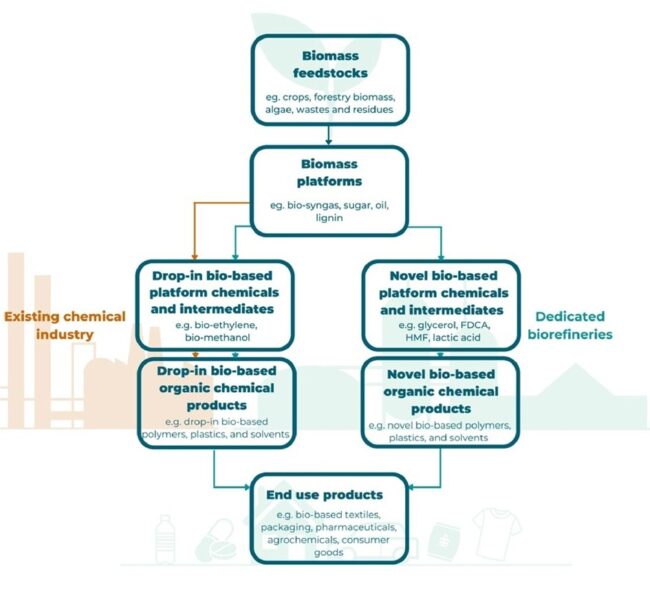
_
Biomass feedstocks to bio-based chemicals:
Biomass feedstocks include crops (e.g. annual crops such as wheat or sugar beet, perennials such as miscanthus and willow, and novel crops such as hemp), algae (e.g., macroalgae (i.e. seaweed) and microalgae), agricultural residues (e.g., straw and manure), forestry biomass, and other biogenic wastes and residues (e.g., food waste). Feedstocks can be classified according to their major chemical components such as sugar, starch, or oil. Perennial crops, wood, and some wastes and residues are types of lignocellulosic biomass.
Biomass feedstocks contain a vast array of organic molecules, many of which have complex structures and contain elements (e.g., oxygen) that are not found in fossil feedstocks. Biomass sometimes contains valuable molecules that can be directly extracted and used. More often, conversion technologies are used to transform the molecules found in biomass into valuable bio-based chemicals. Biomass feedstocks tend first to be fractionated (i.e. separating the different components of the biomass) or processed (i.e. breaking down the components in the biomass) into biomass platforms (e.g., sugar, oil, lignin, carbon dioxide, syngas, biomethane, and pyrolysis oil) from which a range of bio-based chemicals, materials, and fuels can be produced (see below).
_
Currently, sugar from annual crops such as maize and wheat is the most common bio-based chemical production platform. Alternative feedstocks such as wastes, residues, and lignocellulosic biomass can improve sustainability performance and avoid competition with food applications, but they are often heterogeneous and more challenging to process. Lignocellulosic biomass is recalcitrant, and pre-treatment steps are usually required to access the polymers and sugars it contains before they can be processed using other technologies. Pre-treatment can be achieved by chemical, physical, or biological means, but current technologies tend to add significantly to the cost and energy demand.
_
Common biomass platforms from which bio-based chemicals can be produced:
Sugar
Sugar extracted from sugar crops or yielded by the breakdown of polysaccharides (e.g., biological polymers composed of sugar monomers) from starch crops, algae, or lignocellulosic biomass. Sugars are converted to products via chemical catalysis or fermentation. Sugar from annual crops such as maize and wheat is a common platform for commercial scale bio-based chemicals production.
Oil
Oils extracted from oily crops like palm, coconut, or rape seed, or from algae, animal material, or some waste streams (e.g., crude-tail oil from paper processing industries). The components of bio-oils are converted into fatty acids and alkyl esters (including for bio-diesel applications), with glycerol as a by-product. Oleochemicals (i.e. chemicals derived from bio-oils) are already major industry, with derivatives used in products such as plastics and surfactants. Bio-oils can also be used to produce bio-naphtha, a substance like the fossil-based naphtha often used as a feedstock in the petrochemical industry. Naphtha is currently a by-product of the HVO (hydrogenated vegetable oil) processes that convert bio-oils into biofuels.
Lignin
Lignin is a naturally occurring polymer that can be directly extracted from lignocellulosic biomass. It is an extremely abundant material. Large amounts are already produced as a by-product of the paper and pulp industry but this is often burned for energy generation. However, lignin shows potential for use in the production of other valuable products in the future, for example aromatic chemicals and adhesives.
Biogenic carbon dioxide
Biogenic carbon dioxide is that which is released via biomass combustion or as a by-product of other conversion processes such as fermentation and anaerobic digestion. Carbon dioxide can be converted into valuable products via catalytic processes or gas fermentation, though this usually requires the addition of hydrogen.
Syngas
Syngas is a gaseous mixture of carbon monoxide, carbon dioxide, hydrogen and water produced by biomass gasification or reforming of bio-methane. Catalytic conversion or gas fermentation can be used to make a variety of useful chemical products from syngas.
Pyrolysis oil
Pyrolysis oil which is produced via pyrolysis (see below) of biomass. Pyrolysis oil is a mixture of many different organic molecules and its composition varies according to the feedstocks used and how pyrolysis is caried out. Some substances commonly found in pyrolysis oil can be purified and converted into valuable chemical products.
Biomethane
Biomethane is a component of the biogas produced during anaerobic digestion. Biomethane is already produced commercially, and although this is mostly for energy applications, it has potential as a chemical feedstock to replace the fossil-derived methane currently used as a feedstock in the chemical industry. Researchers are also developing novel technologies for direct bio-conversion of methane to chemicals.
_
Conversion technologies based on chemical, thermochemical, or biological processes are used to transform biomass into bio-based chemicals (see below). There are also exciting new conversion technologies at the very early stages of development, such as photocatalysis (conversion using light) and electrocatalysis (conversion using electricity). Each of the technologies described below has its own strengths and limitations. For example, industrial biotechnology tends to use lower temperatures and pressures and fewer hazardous chemicals than other conversion technologies. Not only can this lead to lower energy consumption and safer manufacturing, but it often means that the chemical structures found in biomass are maintained in the products. In contrast, many other conversion technologies, particularly thermochemical processes such as gasification, completely deconstruct the molecules found in biomass into simple building blocks. The nature of biological systems also enables industrial biotechnology to provide simple routes to complex chemical products that would not be possible via other processes. However, industrial biotechnology also has limitations. It tends to use large volumes of water and require significant downstream processing to recover products, which increases costs and energy consumption. Biological processes also tend to result in low yields, are often slower than chemical or catalytic processed and there are inherent limitations on the scale of bioreactor that can be operated, all of which can be problematic for industrial systems. A bio-based chemical system will likely require a variety of different conversion technologies, with the best approach varying according to the feedstock, product, and wider context.
_
Conversion Technologies for making bio-based chemicals:
-1. Chemical synthesis
Chemical or catalytic conversion of biomass-derived components. Examples include transesterification of lipids from oil crops, catalytic conversion of sugars, and catalytic routes for syngas conversion.
-2. Thermochemical conversion
Conversion of biomass feedstocks through the application of heat, sometimes in the presence of a catalyst. Examples include pyrolysis, hydrothermal liquefaction, and gasification.
-3. Biological conversion
Biological processes are often discussed under the banner of ‘industrial biotechnology’, which is defined as the use of biological systems, including enzymes, micro-organisms, cells, or whole organisms, to make valuable products such as chemicals or materials. The scope and potential of industrial biotechnology is greatly increased by the growing field of engineering biology, which is the application of engineering principles to the design of biological systems. Engineering biology encompasses the academic discipline synthetic biology, which is the design and construction of new biological systems, for example bacterial strains that produce interesting new compounds, or modified enzymes.
Examples of biological conversion include:
- Fermentation: Conversion of bio-based molecules such as sugars by microbes (e.g. yeast or bacteria). Fermentation is commonly used to make alcohols, often driven by their use as fuels, but there are also examples of commercial-scale production of other chemicals such as high-value or speciality products.
- Anaerobic digestion: Microbial conversion of biomass into biogas, a mixture of biomethane and biogenic carbon dioxide. Anaerobic digestion is a versatile technology which is already widely deployed at commercial scale to produce biomethane from crops or low-value, mixed waste streams including food and agricultural waste.
- Gas fermentation: Microbial conversion of single carbon (C1) gases such as biomethane, biogenic carbon dioxide (a by-product of anaerobic digestion and some fermentation processes), and bio-derived syngas. Gas fermentation is a less mature technology than sugar fermentation, but some examples are starting to reach commercial scale.
- Biocatalysis: Biocatalysis involves the use of enzymes (biological catalysts) outside of the cellular environment.
-4. Extraction
Some useful organic chemicals can be extracted directly from biomass feedstocks. For example, there are natural products in some plants that have pharmaceutical activity and pigments in algae that can be used to make inks and dyes. Engineering biology approaches mean it is increasingly possible to increase the amount of these valuable chemicals produced in plants or make new products.
_
When biomass is converted into bio-based chemicals, not all the material ends up in the final product as some may become by-products, be lost as process carbon dioxide emissions, or end up as waste. The biomass utilisation (or conversion) efficiency is affected by the feedstock, the technology, and the nature of the product. High biomass utilisation efficiency usually stems from processes with fewer reaction steps, higher yields, and fewer waste or byproducts, and this often correlates to bio-based products that retain a chemical structure that is similar to that seen in the biomass. The more efficient the biomass utilisation, the greater the amount of product that can be made from a specific volume of feedstock, and this can have benefits in terms of land use, environmental impact, and economics.
_
Lignocellulose biomass (LB) to chemicals:
Of all the renewable feedstocks, lignocellulose biomass (LB) is the most studied material. The general processing steps aim to transform LB into so-called ‘bio’-based chemicals using various methods, such as thermochemical, chemical, biochemical, or/and mechanical techniques. LB contains three significant convertible fractions based on its chemical structure: cellulose, hemicellulose, and lignin. Cellulose and hemicellulose are polysaccharides; thus, they have sugar(s) as their main monomers. Cellulose is thicker due to its linear glucan structure, whereas hemicellulose is less stiff and also composed of xylans, mannans, galactans, and arabinans (Brunner, 2014). In contrast, lignin consists of aromatic carbons possessing guaiacyl, syringyl, and p-hydroxyphenyl groups (Mathews et al., 2015). Commonly, these polymers are separated and broken down into their monomers using pre-treatment and enzymatic hydrolysis steps. Afterward, simpler monomers are transformed into the platform chemicals via the fermentation step.
_
Figure below shows Production Flow of several Bio-Based Chemicals using Lignocellulose based Carbon Feedstocks:
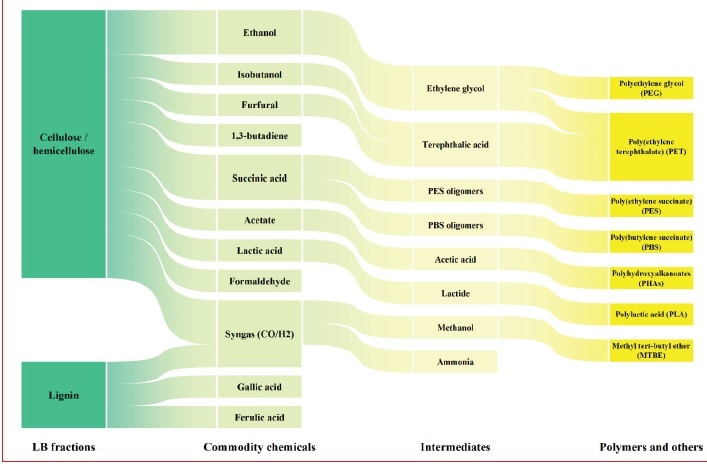
As depicted in Figure above, numerous petroleum-based chemicals can also be synthesized from LB as feedstock substitutes. For instance, essential commodity chemicals, such as acetic acid, can be produced from cellulose and hemicellulose in lieu of synthesized from syngas-origin methanol. Also, instead of extracting NGLs to manufacture 1,3-butadiene, this chemical can be produced from bioethanol via catalytic conversion or fermentation (Jones, 2014; Mori et al., 2021). Bio-PET, a bio-based version of PET, can be synthesized by mixing bio-ethylene glycol (bio-EG) with bio-terephthalic acid (bio-TPA) obtained from transforming bio-furfural or bio-isobutanol (Nakajima et al., 2017). In addition to bio-based traditional plastics, LB can also be utilized to make “bio-based biodegradable” (originated from renewable sources and can naturally be degraded) plastics, e.g., polylactic acid (PLA) and polyhydroxyalkanoates (PHAs), from biobased monomers, e.g., bio-lactic acid and bio-acetic acid, respectively. Besides being greener, those commercial biodegradable polymers also possess thermal, mechanical, rheological, and physical properties that are competitive with fossil-based plastics. Thus, they are futuristic plastics that can substitute low-density polyethylene (LDPE), polystyrene, and other mainstream plastics (Naser et al., 2021).
______
______
Novel processes and pathways to produce sustainable chemicals:
There are some novel processes that are under development to produce sustainable chemicals. Perhaps the most prominent and technologically mature pathway for producing e-chemicals from renewable sources involves the synthesis of platform molecules using green hydrogen (produced with renewable energy) and carbon dioxide captured directly from the atmosphere. This class of technologies, which couples water electrolysis with DAC and subsequent catalytic conversion, has already been addressed in earlier paragraphs.
_
Low-carbon hydrogen integration into biomass to chemical pathways:
The integration of hydrogen into biomass conversion processes represents a promising strategy to enhance carbon efficiency in the production of high-value chemicals. Biomass is inherently hydrogen lean and oxygen rich, whereas most chemical products are hydrogen rich. This elemental mismatch leads to significant carbon losses during conventional thermochemical conversion. By introducing hydrogen from low-carbon sources into the conversion pathway, the carbon yield of biomass-to-chemical processes can be substantially increased. This approach not only improves the overall atom economy but also reduces CO2 emissions by minimizing the formation of CO2 as a by-product. As illustrated in recent process simulations, hydrogen-assisted biomass valorization can significantly shift the carbon balance toward target molecules, thereby supporting the dual objectives of defossilization and resource efficiency. This strategy highlights the synergistic role of low-carbon hydrogen in enabling circular carbon flows within the chemical industry.
_
Novel pathways to convert syngas/biogas/biomethane to chemicals and plastics:
Biogas and biomethane represent promising renewable feedstocks for the production of chemicals and plastics, offering a viable pathway to defossilize the chemical sector. These molecules can be converted into syngas (CO + H2), a versatile intermediate used in the synthesis of fuels, methanol, ammonia, and high-value chemicals. Steam methane reforming, the most mature technology (TRL 9), is widely used today but emits significant CO2 and requires water. Emerging alternatives such as dry methane reforming and super dry methane reforming use CO2 instead of H2O, improving carbon efficiency and eliminating the need for water input. For example, super dry methane reforming follows the reaction CH4 + 3CO2 → 4CO + 2H2O, producing a CO-rich syngas ideal for Fischer-Tropsch synthesis. These routes are particularly attractive when using biogenic CO2 from anaerobic digestion, enabling a more circular carbon economy and reducing net emissions.
_
Apart from going via the syngas pathway, direct conversion technologies are being developed to transform biomethane into olefins, the key precursors for plastics. Oxidative coupling of methane (OCM) and non-oxidative coupling of methane (NOCM) are two such pathways. As indicated in figure below, OCM, operating at 700°C–900°C with oxide catalysts (e.g., La2O3) enables the partial oxidation of methane to ethylene and ethane, with higher selectivity due to controlled oxidation. NOCM, in contrast, operates at >1,000°C without an oxidant and produces solid carbon as a by-product, avoiding CO2 emissions but facing challenges such as coking and catalyst deactivation. These technologies are currently at TRL 4–7 levels and require further R&D to improve selectivity and process stability.
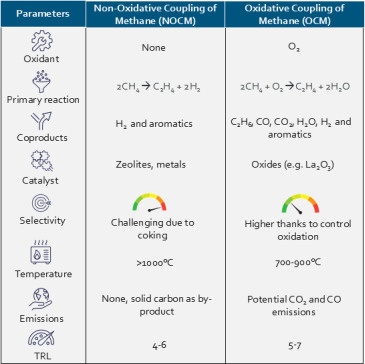
Figure above shows comparative analysis of NOCM and OCM as emerging pathways for direct methane-to-olefin conversion.
_
The strategic value of biomethane lies not only in its renewable origin but also in its compatibility with existing infrastructures. It can be injected into the gas grid and used as a drop-in replacement for fossil methane in existing methanol and ammonia plants, reducing the need for new capital investments. Given that methanol and ammonia together account for over 300 Mt of annual production globally, even partial substitution with biomethane could yield significant emission reductions. Moreover, the use of biomethane-derived syngas in Fischer-Tropsch synthesis or methanol-to-olefins processes could enable the production of sustainable plastics and fuels at scale. However, economic viability will depend on biomethane availability, cost competitiveness, and the development of supply chains to support these conversion routes.
_
In addition to its chemical versatility, biomethane offers a unique infrastructural advantage: it can be seamlessly integrated into existing gas networks and utilized in conventional fossil methane-based chemical plants. In Europe, for instance, approximately 17% of biomethane production sites are connected to the high-pressure transport grid and 58% to the distribution grid, enabling a “plug-and-play” approach to defossilization. This allows biomethane to be directly substituted for fossil methane in methanol and ammonia production without requiring major capital investments. Such integration enhances supply security and reduces logistical risks associated with raw material transport. Figure below compares two strategic scenarios: (1) centralized biomethane production with injection (of biomethane and in the future also CO2) into the gas grid and (2) decentralized biomass-to-chemicals conversion at the production site. The first scenario leverages existing infrastructure and is more compatible with current industrial setups, but it may be constrained by the availability and cost of biomethane and the need for CO2 capture and transport infrastructure to valorize the biogenic CO2. The second scenario requires significant investment in on-site conversion technologies and logistics for biomass handling and storage. Moreover, many of the biomass-to-chemical routes are still at low technology readiness levels. The choice between these scenarios will depend on the economics of regional factors such as feedstock availability, infrastructure maturity, and policy incentives. For energy providers, both pathways offer strategic entry points into the sustainable carbon value chain, either by supplying biomethane and CO2 via existing or new networks or through the supply of low carbon hydrogen, which increases the carbon efficiency of many biomass-to-chemicals pathways.
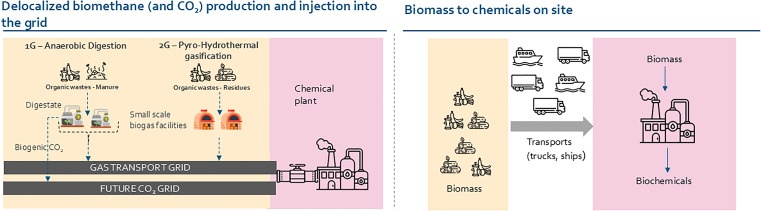
Figure above shows comparison of two pathways for integrating biomass-derived carbon into the chemical industry: the left pathway illustrates centralized biomethane production via anaerobic digestion (1G) and/or pyro-hydrothermal gasification (2G), with subsequent injection into the gas grid and transport of biogenic CO2 via a future CO2 grid to chemical plants. The right pathway shows decentralized biomass-to-chemicals conversion, where biomass is transported to chemical plants for on-site processing.
_
Many sustainable chemical processes require large volumes of renewable electricity, either for direct electrification or for producing green hydrogen as a feedstock, raising the question of how to structure these supply chains at a global level. Verpoort et al. present a techno-economic comparison of scenarios ranging from full domestic production to the import of semi-finished products. Their analysis shows that relocating production to regions with abundant, low-cost renewable electricity can yield significant cost savings, with the greatest advantage seen when importing intermediates, e.g., urea as precursor for ammonia and methanol as precursor for ethylene and plastics. This allows regions scarce in renewable energy to retain higher-value downstream processing and keep focal jobs in the chemical industry. However, such strategies involve trade-offs, including increased reliance on international supply chains, potential carbon leakage, and the need for robust certification systems to ensure environmental integrity. For energy and chemical companies, this evolving landscape underscores the importance of aligning industrial footprints with Renewable Energy (RE) availability and developing flexible supply chain models that balance cost, resilience, and sustainability.
______
______
Defossilization of n Propanol:
Biogas Could Enable Cost-Effective Defossilization of n Propanol and Its Derivatives, a 2026 study:
The n-propanol (referred to as propanol) is an important platform chemical, widely used as an additive in the cosmetics and pharmaceutical industries, and also as a precursor for the production of amines, esters, and ethers. With an annual demand of 4 Mt and a growth rate of 5%, propanol is primarily produced following a multistep process involving hydroformylation of syngas (derived from natural gas reforming) and ethylene (derived from naphtha cracking). The resulting propanal undergoes hydrogenation using hydrogen obtained from natural gas reforming to yield propanol. This reliance on fossil fuel-based precursors results in a high carbon footprint of around 3.1 kg CO2e /kg propanol. One alternative approach is to resort to one-step synthesis routes based on thermocatalysis, , electrocatalysis, and fermentation, which can convert CO2 (or syngas) into propanol in a single reaction step. However, the low technology readiness level (TRL) of these technologies makes the decarbonization of the conventional fossil multistep process as the currently preferred choice, thus making the defossilization of the two main precursors, i.e., ethylene and syngas, essential to reduce the footprint of such two-step route.
_
In this work, authors compare the economic and environmental performance of propanol production via the fossil-based and alternative low-carbon production processes. Using techno-economic analysis and life cycle assessment, authors show that biogas-based routes for n-propanol synthesis could be economically, in addition to environmentally, appealing. Specifically, they find that the biogas-based propanol route (using biogas, electrolytic hydrogen, and fossil ethylene) could become a win–win alternative, with 30% better economic performance and 70–73% lower climate change impacts than the fossil analog while not entailing any significant burden-shifting. Overall, their results highlight the promising use of biogas as an alternative feedstock in the conventional hydroformylation–hydrogenation process for cost-effective, low-carbon n-propanol production.
_
The biogas route consists of using biogas (along with DAC CO2, essential to eventually produce syngas with a 1:1 ratio of CO:H2) as feedstock, undergoing dry reforming (at 850 °C, 1 bar) to produce syngas. Subsequently, water removal, and Monoethanolamine (MEA) absorption for CO2 removal result in syngas with the required CO:H2 ratio of 1:1. Next, the produced syngas is combined with ethylene (either fossil or green) to produce propanal (C3H6O) via the hydroformylation reaction (at 100 °C, 28 bar) shown below:
CO+H2+C2H4→C3H6O (propanal)
The produced propanal then undergoes hydrogenation (at 175 °C, 2.5 bar) using hydrogen obtained from natural gas reforming or electrolysis to produce propanol, as shown below:
C3H6O+H2→C3H8O (propanol)
The other route utilizing DAC CO2 and electrolytic hydrogen is analogous to the biogas route in all process steps starting from syngas treatment (using water removal and MEA absorption). It differs only in the feedstock and its processing step, i.e., DAC CO2 and electrolytic hydrogen undergo the RWGS reaction (at 727 °C, 9 bar) to produce syngas. Data for green ethylene were extracted from Ioannou et al. based on the MTO process, with methanol itself derived from DAC CO2 and electrolytic hydrogen.
______
______
Status and gaps toward fossil-free sustainable chemical production, a 2022 study:
Drivers to develop a new model of chemical production:
Authors could identify two main driving factors in the current model of petrochemical production: the use of FFs and the scale economy. These are two interlinked components of the model of development because over 90% of the raw materials for chemical production are based on FFs, but less than 40% on average is used as carbon sources or to increase the energy value of the product (the ratio of the output energy potential useful – exergy – to the potential exergy input for chemical production is around 30%).
Most of the FFs used in petrochemistry are needed to produce the heat and the energy used in the chemical processes. In addition, most of the chemicals are not produced directly, but involve an often-complex sequence of processes, thus with a progressive loss of energy efficiency (in the global process). Chemical production is strongly linked to the combustion of FFs used to produce the heat and energy necessary to run the chemical transformation and separation. Heat recovery is thus a critical element to achieve acceptable overall energy efficiency, and from here the motivation to have a scale economy, e.g., large plants integrated into complex chemical/refinery sites. Heat recovery is efficient only in large-scale plants.
Chemical production needs to transform radically toward fossil-free sustainable chemical production to meet the targets for net-zero emissions by the year 2050. The feasibility of this transformation, the motivations, status and gaps, and perspectives are discussed in this study after introducing how this change also implies a change in the model of production. Realizing the defossilization of chemical production involves electrifying the chemical processes, especially crucial elements such as chemical reactors, and the direct use of renewable energy to drive the chemical reaction. With a focus on electrocatalysis, the most relevant cases of (i) light olefin production, (ii) direct synthesis of main intermediates such as formaldehyde and acetic acid, and (iii) the production of aromatics are analyzed. The feasibility of these routes in the short–medium term is shown, while other cases such as the direct synthesis of ammonia from N2 require turning the approach to other directions. In conclusion, the analyses presented in this perspective show that proceeding towards defossilization of the chemical production may result in an over 70% cut of the current greenhouse gas impact, with a saving of over 800 Mt per year CO2 eq. emissions.
Note:
Exergy is the maximum theoretical useful work obtainable from a system as it comes into thermodynamic equilibrium with its environment. While energy is conserved in all processes, exergy is destroyed due to irreversibilities (like friction or heat loss), representing the “quality” or practical usefulness of that energy.
______
______
From fossil to green chemicals: sustainable pathways and new carbon feedstocks for the global chemical industry, a 2023 study:
Following current trends, the global chemical industry is set to become the largest consumer of fossil fuels. Among energy intensive industries, the chemical industry is one of the most challenging to defossilise due to the abundance of cheap fossil fuel-feedstocks and it is currently responsible for roughly 6% of global anthropogenic CO2 emissions. Unlike other energy-intensive industries, the chemical industry cannot be made fully sustainable directly with renewable electricity and green electricity-based hydrogen (e-hydrogen). Therefore, new green carbon feedstocks must be developed to defossilise the production of large volume organic chemicals. The most promising green carbon feedstocks are electricity-based methanol (e-methanol) and biomass-based methanol (bio-methanol), which can be used directly or as a feedstock for olefin and aromatic production. Increased recycling of plastics will reduce the amount of primary feedstock that will be required for chemical production. To investigate the energy and feedstock requirements for a global defossilisation of chemical production, scenarios are developed that reach net-zero emissions by 2040, 2050, and 2060 compared to business-as-usual conditions to 2100. High and low biomass feedstock variations are included to investigate the potential of biomass feedstocks in the future chemical industry, which are limited due to strict sustainability criteria. The results suggest that the chemical industry could become the largest e-hydrogen consumer, with a demand ranging from 16100 to 23100 TWhH2,LHV in 2050. High shares of electricity-based chemicals (e-chemicals) were found to provide the lowest annualised costs, suggesting that an e-chemical transition pathway may be the most economically competitive pathway to defossilise the global chemical industry.
Note:
TWhH2,LHV represents Terawatt-hours of hydrogen energy based on its Lower Heating Value (LHV). It measures the thermal energy released when hydrogen combusts, excluding the energy required to vaporize the resulting water.
_______
_______
Waste-based value-added feedstocks from tire pyrolysis oil distillation: defossilization of the petrochemical industry, a 2024 study:
The recovery of waste-based feedstocks is an important step in the defossilization of the petrochemical industry and thus in the circular economy for petroleum-based products that have reached the end of their useful life such as end-of-life tires (ELT). This work is part of the European BLACKCYCLE project, and focuses on the distillation performance of tire pyrolysis oil (TPO) obtained from an industrial scale plant, ranked at the ninth technology readiness level (TRL-9). The influence of different reboiler temperatures and reflux ratios on the yields and characteristics of the resulting streams was investigated using a pilot scale packed distillation column under industrially relevant conditions, classified within the fifth technology readiness level (TRL-5). The distillation process was shown to be capable of continuously producing a light fraction (LF) with a very high concentration of benzene, toluene, ethylbenzene and xylenes (BTEX) suitable for high value chemicals. Similarly, a heavy fraction (HF) with a high C/H ratio, high flash point and high presence of polycyclic aromatic hydrocarbons (PAH) is obtained, making it an attractive alternative to carbon black oil. These results are quite outstanding to accomplish the recovery of waste-based value-added feedstocks in such a way that the carbon embedded in the ELT is retained in the petrochemical industry. This work is committed to the development of green, affordable and practical recycling processes to fill the gap in the production of sustainable chemical commodities, while paving the way to address one of the industry’s greatest challenges: the defossilization of the petrochemical industry.
______
______
Section-10
Defossilization of fertilizers:
Fertilizer is any natural or synthetic material applied to soil or plant tissues to supply essential nutrients for growth. It acts as plant food, ensuring crops and gardens thrive by increasing yields and supporting food systems worldwide. Many sources of fertilizer exist, both natural and industrially produced. For most modern agricultural practices, fertilization focuses on three main macronutrients: nitrogen (N), phosphorus (P), and potassium (K) with occasional addition of supplements like rock flour for micronutrients. Farmers apply these fertilizers in a variety of ways: through dry or pelletized or liquid application processes, using large agricultural equipment, or hand-tool methods.
_
Historically, fertilizers came from natural or organic sources: compost, animal manure, human manure, harvested minerals, crop rotations, and byproducts of human-nature industries (e.g. fish processing waste, or bloodmeal from animal slaughter). However, starting in the 19th century, after innovations in plant nutrition following Justus von Liebig’s discoveries, an agricultural industry developed around synthetically created agrochemical fertilizers. This transition was important in transforming the global food system towards larger-scale industrial agriculture with large crop yields in monocultures. The invention of Haber process for producing ammonia for nitrogen in the 20th century combined with amplified chemical production capacity created during World War II led to a boom in using nitrogen fertilizers. In the latter half of the 20th century, increased use of nitrogen fertilizers (800% increase between 1961 and 2019) has been a crucial component of the increased productivity of conventional food systems as part of the so-called “Green Revolution”.
_
The “Big Three” Nutrients (NPK):
Most commercial fertilizers focus on three primary macronutrients, often expressed as a ratio (e.g., 10-10-10):
- Nitrogen (N): Promotes leafy, green growth and overall foliage development.
- Phosphorus (P): Stimulates root development, blooming, and fruit production.
- Potassium (K): Enhances overall plant health, disease resistance, and water regulation.
Types of Fertilizers:
- Organic: Derived from natural sources like compost, manure, bonemeal, and seaweed. They improve soil structure and slowly release nutrients.
- Synthetic/Inorganic: Manufactured industrially to deliver highly concentrated, fast-acting nutrients (e.g., Urea, NPK blends).
- Bio-fertilizers: Eco-friendly supplements containing living microorganisms that help fix atmospheric nutrients in the soil
_
Each year, farmers worldwide apply close to 200 million tonnes of the three primary nutrients, nitrogen, phosphorus and potassium, the three essential building blocks for plant growth, to their crops. Nitrogen makes up the largest share of inorganic fertilizer use worldwide and accounted for 58% of production in 2023. Urea is a straight inorganic nitrogen fertilizer, meaning that it only supplies nitrogen, not potassium or phosphorus. Nitrogen is essential for plant growth and required in large quantities because plants cannot obtain it directly from air and water like oxygen or carbon, so it must be added through fertilisers.
In 2023 total fertilizers production:
Nitrogen-based 112 Mt
Potassium-based 38 Mt
Phosphorus-based 41 Mt
__
Fossil fuels provide both the energy and the primary feedstock for the production of synthetic nitrogen fertilizers and most pesticides, making agrochemicals a significant driver of global fossil fuel use and its attendant climate and environmental impacts.
Nitrogen fertilizer is derived from ammonia, which is synthesized by combining nitrogen from the air with hydrogen from fossil fuels—typically fossil gas. Globally, about 72 percent of the hydrogen used for ammonia production comes from fossil gas (in a process called steam methane reforming), and 26 percent comes from coal. The energy-intensive Haber-Bosch process that produces ammonia accounts for about 5 percent of industrial coal demand (75 million tonnes of coal equivalent) and about 20 percent of industrial gas demand (170 Billion Cubic Meters of fossil gas). Fertilizer producers then convert ammonia into ammonium nitrate or urea as the base for fertilizer. Urea uses carbon dioxide in its synthesis. The vast majority of ammonia produced globally (around 80 percent) goes to producing urea, the most common type of nitrogen fertilizer.
Therefore, nitrogen-based fertilizer is predominantly produced from fossil gas—which is made up of methane (CH4), another potent GHG. Approximately 3–5 percent of the world’s fossil gas production is used for synthesizing ammonia. In the US, approximately 6.5 percent of industrial fossil gas consumption went to ammonia production in 2020. The US produced approximately 14 million tonnes of ammonia in 2020, making it the third-largest ammonia producer behind China and Russia. Nearly a quarter (24 percent) of the chemical sector’s fossil fuel feedstock input of over 500 million tonnes goes to ammonia production.
_
Figure below shows pathways of Fossil Fuels to Fertilizers:
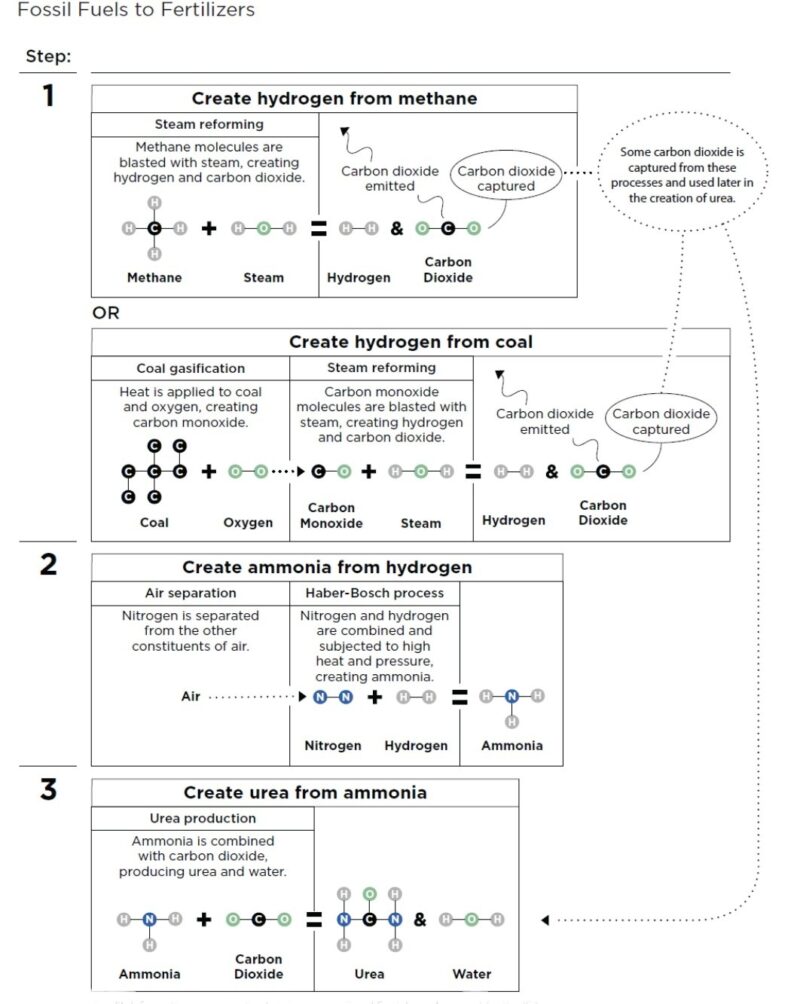
____
How China turns coal into urea:
While most countries rely on natural gas, China’s coal‑based urea industry has cushioned it from the Iran war and the price shocks rippling through global fertilizer markets. China is largely self‑sufficient in urea production, with about 78% of its output coming from coal rather than natural gas, a key distinction from other major exporters such as Qatar, Russia and Saudi Arabia, which rely predominantly on gas. While the technical processes for converting coal or gas into urea are largely the same, there are some key differences at the beginning.
Figure below shows urea production routes:
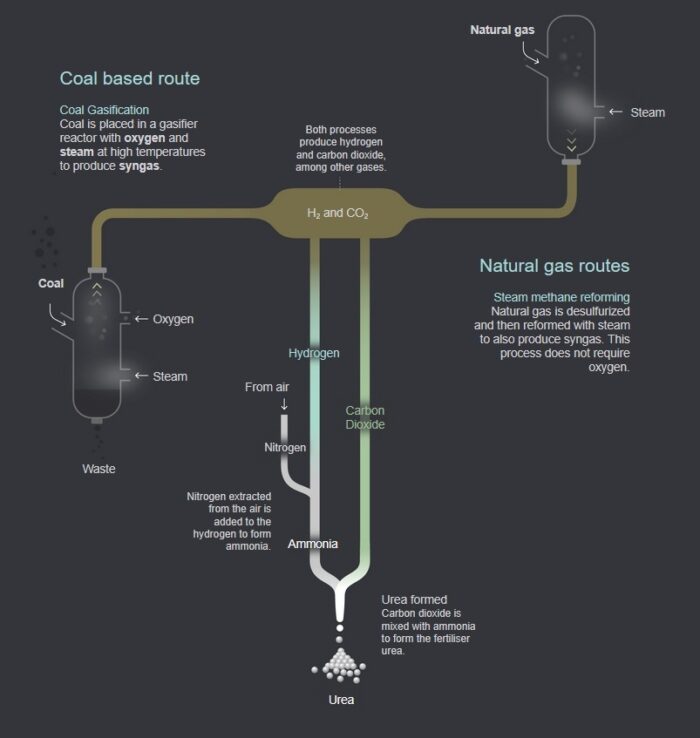
Above diagram explains fertiliser production routes to urea. On the left, a “Coal based route” shows coal gasification with oxygen and steam producing syngas; waste exits the reactor. On the right, “Natural gas routes” show steam methane reforming without oxygen. Both feed a central stream labelled “H₂ and CO₂”. Hydrogen (with nitrogen extracted from air) forms ammonia; carbon dioxide combines with ammonia to form urea, shown as white pellets at the bottom.
This coal‑based production model gives China access to abundant, domestically sourced energy, reducing exposure to volatile international gas prices and supply disruptions. During the Iran war in early 2026, which disrupted shipping through the Strait of Hormuz—a route handling roughly 30% of global fertiliser trade—urea prices outside China surged by about 70%. In contrast, China maintained ample stocks, keeping domestic prices roughly a third of international benchmarks.
China’s coal‑based urea production reflects its abundant domestic resources of the mineral, historic investment in coal‑to‑chemicals infrastructure, and a policy focus on fertiliser self‑sufficiency and food security—advantages enjoyed by few other urea‑producing countries. China’s fertiliser industry developed alongside its coal‑based heavy industrial system, rather than around gas. Last year, China accounted for roughly a fifth of fertiliser imports by Brazil, Indonesia and Thailand as well as a third of those by Malaysia and New Zealand, data from the International Trade Centre shows. For India, the share was about 16%, its trade data shows. Between half and 80% of those exports are now restricted due to Iran war.
______
______
Technology of defossilization of fertilisers:
Defossilization of fertilizers is the process of transitioning fertilizer production away from fossil fuel-based feedstocks (primarily natural gas and coal) toward renewable, non-fossil alternatives to reduce greenhouse gas emissions. While synthetic fertilizers are essential for global food security—supporting roughly half of the current global population—their production and use account for roughly 1.8–2.4 percent of global greenhouse gas emissions.
Here are the key approaches and technologies involved in the defossilization of fertilizers:
-1. Green Ammonia Production:
The most critical step in defossilizing nitrogen fertilizers is changing how ammonia (NH3) is produced.
- Current Method (Grey Ammonia): Natural gas is used to produce hydrogen via steam methane reforming, which emits large amounts of large amount of CO2
- Green Hydrogen Route: Electrolysis of water, powered by renewable energy (wind, solar), produces green hydrogen. This hydrogen is then combined with nitrogen to create “green ammonia,” which is nearly zero-carbon.
- Blue Ammonia: A transitional approach using natural gas for hydrogen production but capturing the emissions (Carbon Capture and Storage – CCS).
-2. Alternative Raw Materials (Feedstocks):
Defossilization requires moving away from fossil carbon sources.
- Biomass: Utilizing agricultural waste, woody biomass, or biogenic waste to produce feedstocks instead of using coal or natural gas.
- Waste Gasification: Converting plastic waste or other waste materials into synthetic gas for fertilizer production.
-3. Sustainable Nutrient Management (Field Level):
Defossilization also includes reducing emissions at the farm level, particularly nitrogen fertilizer application, which releases nitrous oxide (N2O), a potent GHG.
- 4R Nutrient Stewardship: Applying the right nutrient source, at the right rate, right time, and right place to maximize efficiency.
- Enhanced Efficiency Fertilizers (EEFs): Utilizing nitrification inhibitors and controlled-release coatings to reduce emissions and fertilizer runoff.
- Organic Alternatives: Shifting toward biofertilizers, compost, and manure, which improves soil health and reduces reliance on synthetic, petrochemical-based inputs.
_____
_____
Green ammonia:
Green ammonia is defined as a sustainable alternative to conventional ammonia production, created using renewable energy sources like solar or wind power, and characterized by its negligible greenhouse gas emissions during production. An expansion of “green” ammonia—produced through electrolysis powered with renewable energy rather than natural gas or coal—would represent a major breakthrough, both for its smaller carbon footprint and its potential to enable nitrogen production in more countries. But to date, green ammonia contributes only a small fraction of overall production.
_
Currently ammonia is produced by combining nitrogen and hydrogen in the Haber-Bosch process with the hydrogen produced from natural gas in a Steam Methane Reformer (SMR).
Alternative production technologies to reduce and eliminate GHG emissions include replacing natural gas as our primary feedstock with bio-methane or biogas, capturing and storing CO2 generated in the production processes and large-scale electrolysis as seen in figure below.
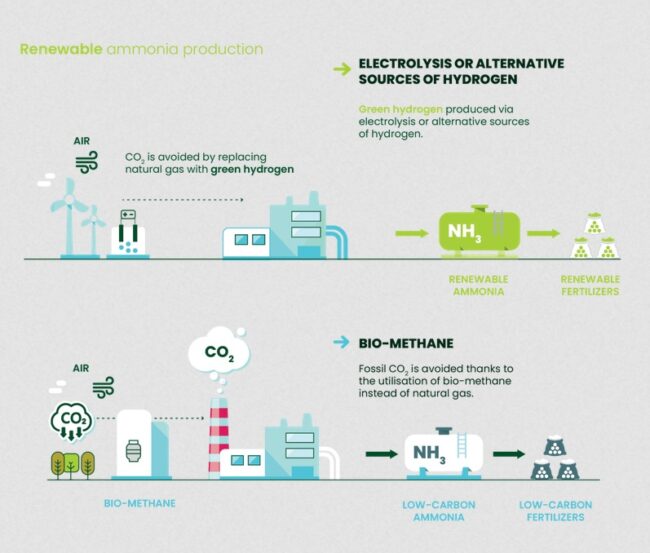
Fertilizer plants are strategically located across Europe based on the availability of natural gas, raw materials, logistics infrastructure and proximity to agricultural markets. For a successful transition, the availability of sufficient competitively priced low-carbon and renewable electricity, biomethane or hydrogen, and CO2 infrastructure is key. In addition, proximity to ports (for ammonia imports if required), availability of nutrients (for recycling) and water are also important factors.
Cost of technological change in EU:
€17 billion electrolysers only
€3 billion hydrogen pipeline network
€64 billion offshore wind parks
_
What are the main uses of green ammonia?
This type of chemical compound is widely used in the production of agricultural fertilisers as ammonia is an essential source of nitrogen for plant growth. It is also used as a raw material in the production of a variety of chemical products, such as nitric acid, synthetic fibres, explosives, dyes and pharmaceuticals. In addition to traditional uses, the emergence of green ammonia will give rise to new demand uses with high growth potential. On the one hand, ammonia is considered an energy vector as it enables efficient hydrogen transport and storage. It involves an additional process called “cracking” which consists of re-splitting the NH molecule to recover the hydrogen contained in it. Another possible new use for green ammonia is as a fuel for ships and it could play a relevant role in the decarbonisation of the maritime sector. Finally, green ammonia has the potential to be used as a fuel in boilers, turbines or engines to generate heat and electricity, reducing greenhouse gas emissions.
_
Why Ammonia and not just Hydrogen:
Green hydrogen gets a lot of attention as a clean fuel, but hydrogen is notoriously difficult to store and transport. Liquefying pure hydrogen requires cooling it below minus 253°C, and the energy cost of that cooling alone eats up roughly 45% of the energy contained in the gas. Ammonia solves this problem. It liquefies at just minus 33°C at normal atmospheric pressure, or at room temperature under modest pressure. That makes it far easier to ship in bulk using infrastructure that already exists.
Liquefied ammonia also packs more energy into the same volume: 3.83 MWh per cubic meter compared to 2.64 MWh per cubic meter for liquid hydrogen. In practical terms, a tanker full of ammonia carries about 45% more energy than the same tanker filled with liquid hydrogen, under far less demanding storage conditions. This is why ammonia is increasingly discussed not just as a fertilizer ingredient but as a carrier molecule for moving clean energy around the world.
The Efficiency Trade-off:
Using ammonia as an energy carrier comes with a significant efficiency penalty. When you factor in the full cycle of producing green ammonia, storing it, shipping it, and then converting it back to electricity, the round-trip efficiency is roughly 28%, meaning about 72% of the original renewable energy is lost along the way. That’s comparable to the round-trip efficiency of green hydrogen pathways at 40%, so ammonia doesn’t lose ground relative to its main competitor. But both numbers highlight that ammonia and hydrogen are best suited for applications where direct electrification isn’t possible, not as replacements for batteries or grid-connected renewables.
_______
Green ammonia production: Process technologies and challenges, a 2024 study:
Ammonia, a vital player in the global economy, propels economic growth through its key role in fertilizer production, boosting agricultural output significantly. While traditional methods dominate its production, recent efforts focus on sustainable pathways like green ammonia, produced using renewable energy. This colourless gas, beyond agriculture, becomes a versatile input in chemical manufacturing, finding applications in solvents and fertilizers. Industries are increasingly adopting green pathways to reduce carbon footprints, exploring methods using green hydrogen and CO2 by-products. Green ammonia, a beacon for decarbonization, surpasses hydrogen in volumetric energy density, making it a preferred energy carrier. Power-to-Ammonia technology supports energy storage and transfer capabilities, aiding renewable energy integration. Despite challenges like low reactivity, NOx emissions, and toxicity, ammonia’s global demand is projected to rise to 350 million tonnes/year by 2050. This review article emphasizing the need for sustainable ammonia production to achieve economic competitiveness, environmental sustainability, and a carbon–neutral future.
Highlights:
- Ammonia crucial for global economy, driving agriculture and chemical sectors.
- As a carbon–neutral energy carrier, green ammonia presents versatile applications.
- Shift to green ammonia requires innovation for efficient, cost-effective production.
_______
The potential of green ammonia in the de-fossilization of the steel, glass and cement industries, a 2024 study:
The development of new technologies for the synthesis of green ammonia using exclusively hydrogen from water and nitrogen from air in processes driven exclusively by renewable energy is poised to decarbonize the production of this important molecule for the production of green fertilizers as well as offering a carbon-free vector for the long-term storage of renewable energy. In this article, authors explore and quantify the CO2 emission reduction potential of green ammonia, evaluating how it can facilitate the decarbonization of other hard-to-abate industrial processes such as steel, glass and cement industries. Green ammonia can be used as a direct replacement of fossil fuels used as energy sources in the different processes. In addition, green ammonia can facilitate the electrification of the processes (so-called Power-to-X) by storing renewable energy in the long term to balance a decarbonized grid against intermittent renewable energy supplies.
One of the main attractions of the ammonia molecule as a carbon-free vector of renewable energy is its flexibility in the way it can be used. With a high energy density, comparable with that of coal and other fossil fuels (see below), it can be directly combusted to produce heat or converted into electricity using fuel cells (e.g. PEM or SOFC) or by combustion in gas turbines in power stations.
Comparison of energy density of ammonia and other fossil fuels conventionally used in industry.
fuel energy density (MJ/kg)
ammonia 23
coal 26
heavy oil 41
natural gas 46
In this work, authors have tentatively quantified the reduction of hard-to-abate industries by using green ammonia as a fuel to replace fossil fuels or as a long-term storage medium to balance the electricity grid to account for the intermittencies in production of (solar and wind) renewable energy. Considering both, the steel industry can reduce its CO2 emissions by between 10 and 12% when using blast furnaces and 70 and 85% when using a direct reduction and electric arc furnace when using green ammonia as fuel and electricity sources. In the case of the glass industry, the CO2 emissions reduction potential of green ammonia is between 59 and 75%, while in the cement industry it is between 23 and 55%. The ranges depend on the fossil fuel to be replaced as well as the source of renewable energy used for the synthesis of green ammonia, with solar-derived green ammonia having a lower CO2 emission reduction potential than a wind-derived one. These preliminary values of CO2 emission reduction potential of green ammonia in industrial processes would require further analysis, optimization and technical feasibility studies, but clearly demonstrate the appeal of this approach to continue utilizing existing high-value CAPEX assets in conventional processes. However, special care should be taken when considering the modifications of these highly integrated and optimized processes to ensure overall CO2 emission reductions. It is possible that in a number of cases, the replacement of fossil fuels by green ammonia can only be carried out partially in hybridized processes.
______
______
Biological nitrogen fixation (BNF):
By 2050, the global population is projected to surpass nine billion, and one of the biggest challenges humanities will face is food security. Current agriculture practices depend heavily on synthetic nitrogen fertilizers, a costly and energy-intensive process that harms the environment. Reducing dependence on these fertilizers is essential for sustainable food production.
Biological nitrogen fixation (BNF) offers a natural alternative to synthetic fertilizers by enhancing soil fertility without environmental damage. Advances in BNF technology and nitrogen-fixing biofertilizers are shaping a more sustainable future by achieving higher crop yields, reducing dependence on environmentally harmful synthetic fertilizers, and feeding the growing global population.
_
Biological nitrogen fixation is a process where specialized microorganisms convert atmospheric nitrogen into ammonia, essential for plant growth. This transformation is necessary because most living organisms, including plants, cannot use nitrogen in its gaseous state. Specific bacteria and archaea, called diazotrophs, facilitate this process by producing the enzyme nitrogenase. These microorganisms exist freely in the soil or form partnerships with plants to support nitrogen intake. Free-living bacteria like Azotobacter contribute independently, while others, such as Rhizobium, form root nodules in legumes. This process improves soil fertility, reducing dependence on synthetic fertilizers for agricultural productivity.
Although 78% of air composition is represented by nitrogen gas (N2), plants cannot utilize it. Instead, they require nitrogen in the form of ammonia or nitrate, which is naturally obtained through BNF or anthropogenically through the Haber-Bosh process.
______
______
Fertilizer from local resources instead of fossil fuels:
The prices of mineral fertilizers are rising. The Fraunhofer Institute for Interfacial Engineering and Biotechnology IGB is working on alternative production methods: Researchers have developed various processes and demonstrated them on a pilot scale to recover nutrients from locally available waste streams. Fertilizers ready for immediate use can be obtained from digestion residues, manure, and wastewater. This circular approach strengthens supply security and protects water bodies and the climate. Researchers are investigating how nitrogen and phosphorus can be recovered from nutrient-rich waste streams. Various methods have been developed in a wide range of projects to recycle essential mineral salts from liquid manure, digestate, or wastewater into fertilizers that can be used directly.
-1. Locally available waste and residual materials as reliable sources of nutrients:
Particularly high concentrations of nutrients are found in agricultural waste – liquid manure from livestock farming and digestate from biogas plants, but also in municipal wastewater. In livestock farming alone, nitrogen and phosphorus are excreted across the EU each year in quantities sufficient to meet Europe’s demand for mineral fertilizers.
-2. Processing of manure and digestate into fertilizer, peat substitute, and irrigation water:
One approach that benefits agricultural producers and wastewater treatment plants as well as the environment and the climate is the recovery of nutrients in a form that can be used directly as fertilizer. To this end, Fraunhofer IGB, together with its partners in the EU-funded BioEcoSIM project, has implemented a multi-stage process in a pilot plant that can be used to process manure and digestate into ammonium fertilizer, phosphorus fertilizer, and organic soil conditioners.
The processing procedure itself begins with acidification of the manure or digestate to completely dissolve phosphorus in the aqueous phase. Through a multi-stage filtration process, the substrate is then separated into a liquid and a solid fraction. From the liquid phase, which contains the dissolved inorganic nutrients, phosphorus is first precipitated in the form of phosphate salts. In a second step, the dissolved nitrogen is recovered and separated as an ammonium sulphate solution via membrane absorption.
The dewatered solid fraction can either be composted or dried. When processed into compact organic soil conditioners, the product can compensate for the loss of organic soil matter and be used as a substitute for peat. The resulting water can also be reused, for example for irrigation or as rinse water.
To additionally generate energy and thereby improve economic efficiency, a biogas plant can be integrated upstream of the process. This allows even odor-intensive substances in the raw manure to be metabolized and thus removed.
-3. Recycling nitrogen and phosphorus from wastewater:
The membrane absorption process used in the treatment of manure and digestate to produce ammonium sulphate has also been demonstrated for nutrient recycling at wastewater treatment plants, most recently as part of the “RoKKa” project funded by the Baden-Württemberg Ministry of the Environment, Climate Protection and the Energy Sector and the European Union. The concentration of ammonium in the filtrate from sludge dewatering was reduced by 90 percent. Measurements also showed that ammonium recovery resulted in lower nitrous oxide emissions. In this process, phosphorus is precipitated purely electrochemically – without the addition of chemicals – as magnesium ammonium phosphate, a long-term phosphorus fertilizer also known as struvite. The magnesium required for this is added in an electrolysis cell via a sacrificial magnesium anode, which is consumed in the ongoing process.
______
______
Effects of organic fertilizers via quick artificial decomposition on crop growth, a 2021 study:
Crops could directly uptake and use organic nutrients from soils. Organic matters should have small molecules to be efficiently used by crops such as amino acids, peptides, sugar and organic–metallic complexes. The new technology of quick artificial decomposition could efficiently convert biological wastes into organic fertilizer containing various small molecular organic matters to supply crops. Applying organic matters into the soil would help to improve soil quality and sustain crop production. In addition, the small molecular organic matters could be active in influencing soil nutrient cycling and crop development. Thus, this study has firstly induced a new technology of quick artificial decomposition to produce fertilizers containing small molecular organic compounds from crop residues and other biological wastes. The fertilizers were produced via the quick artificial decomposition from biological wastes. The small organic species in the fertilizers were identified by the LC–MS. Field experiments of kiwifruit were conducted to test the effects of fertilizers. In total, 341 species of small organic matters have been determined in the produced fertilizers. The results showed that the organic fertilizers could significantly increase the yields of kiwifruit by 15.2% in contrast with mineral fertilizer treatments. The organic fertilizers could also enhance the contents of nutritive components in kiwifruits. These results proved that the organic fertilizers containing more small organic matter could be more efficient in promoting crop production. These studies have shown that the produced fertilizers could both increase crop yields and quality compared with mineral fertilizers and conventional organic fertilizers.
______
______
Defossilization of agriculture:
The Green Deal, unveiled by the European Commission in December 2019, aims to make Europe the world’s first climate-neutral continent by 2050. At its core, the Green Deal seeks to decouple economic growth from environmental degradation by transforming Europe into a sustainable, low-carbon society. With agriculture being responsible for approximately 10% of the EU’s greenhouse gas emissions, the Green Deal recognizes the need for a comprehensive strategy to defossilise this sector.
Promoting sustainable farming practices:
- Enhancing soil health: Healthy soils act as carbon sinks, sequestering atmospheric carbon dioxide. Promoting sustainable soil management practices, such as conservation agriculture, cover cropping, and reduced tillage, helps improve soil structure, increase organic matter content, and enhance carbon sequestration.
- Precision agriculture: Leveraging technological advancements like remote sensing, GPS, and machine learning, precision agriculture minimizes the use of fertilizers, pesticides, and water by optimizing resource allocation. This reduces the carbon footprint of agriculture while maximizing yields and minimizing environmental impacts.
- Organic farming: Encouraging the transition to organic farming practices reduces dependence on fossil fuel-intensive inputs like synthetic fertilizers and pesticides. Organic farming promotes biodiversity, improves soil fertility, and reduces greenhouse gas emissions associated with chemical inputs.
- Agroforestry and perennial crops: Integrating trees and perennial crops into agricultural landscapes not only provides sustainable sources of food and fuel but also sequesters substantial amounts of carbon. Agroforestry systems, such as alley cropping and silvopasture, combine trees with annual crops or livestock, resulting in enhanced carbon storage and diversified income streams for farmers.
- Renewable energy adoption: Agriculture can contribute to defossilization by transitioning to renewable energy sources. Solar panels, wind turbines, and biogas digesters can provide clean energy for on-farm operations, reducing reliance on fossil fuels and decreasing emissions.
- Sustainable livestock management: Livestock farming is a significant contributor to agricultural emissions. Encouraging the adoption of sustainable livestock management practices, such as improved feed efficiency, methane capture, and alternative protein sources, can substantially reduce the carbon footprint of animal agriculture.
- Circular economy principles: Adopting circular economy principles in agriculture promotes resource efficiency and waste reduction. Implementing practices like nutrient recycling, anaerobic digestion of organic waste, and the use of bio-based materials fosters a closed-loop system that minimizes the need for fossil fuel-based inputs.
______
______
Section-11
Defossilization of plastics:
Please read section:8 ‘Feedstocks for defossilization (alternate carbon sources)’ wherein plastic recycling and plastic waste as feedstock for chemicals and hydrogen are discussed.
Now I will discuss defossilization of plastics production which includes plastic recycling.
_
Plastics are derived from natural, organic materials such as cellulose, coal, natural gas, salt and, of course, crude oil. Crude oil is a complex mixture of thousands of compounds and needs to be processed before it can be used. The production of plastics begins with the distillation of crude oil in an oil refinery. This separates the heavy crude oil into groups of lighter components, called fractions. Each fraction is a mixture of hydrocarbon chains (chemical compounds made up of carbon and hydrogen), which differ in terms of the size and structure of their molecules. One of these fractions, naphtha, is the crucial compound for the production of plastics.
_
Almost all plastics are made from non-renewable petrochemicals sourced from fossil fuels, viz., oil, gas, and coal. The alarmingly increased conversion of fossil fuels into plastics and petrochemicals is “locking in” our economies into fossil fuels. Plastics and petrochemicals not only cause pollution but also severely worsen climate change and impact agri-food systems and the food value chain, thereby compounding negative impacts on health. Defossilization of our world economy will also mean preventing fossil fuel lock-in through plastics and petrochemicals production. Turning off the tap in plastics production is urgently needed to reduce greenhouse gas emissions and limit global temperature rise to 1.5°C by the end of the century.
There is no scientific doubt that fossil fuels are the main cause of climate change, and the main driver of other planetary crises – biodiversity loss and toxic pollution. As the fossil fuel industry is facing increasing pressure from governments, citizens and civil society organisations to move to renewable energy, “Plastics are the Fossil Fuel industry’s Plan B”. The polymer industry is characterized by a few oligarchs who control not only the polymer industry but also the downstream production of plastics and how they are disposed of. This control encompasses the narrative in the media and also policies. It is imperative therefore that this segment of the polymer industry be held accountable for the implications of their businesses on the climate, public health and environment.
_
Plastics are a wide range of synthetic or semisynthetic materials composed primarily of polymers. Their defining characteristic—plasticity—allows them to be molded, extruded, or pressed into various solid forms, making them incredibly versatile, lightweight, and durable. Polymers (from Greek words poly meaning “many” and mer meaning “parts”) are large molecules made up of repeating units, referred to as monomers. Polymers can be natural (starch is a polymer of sugar residues and proteins are polymers of amino acids) or synthetic [like polyethylene, polyvinyl chloride (PVC), and polystyrene]. The variety of structures of polymers translates into a broad range of properties and uses that make them integral parts of our everyday lives. Adding functional groups to the structure of a polymer can result in significantly different properties.
An example of a polymerization reaction is shown in figure below. The monomer ethylene (C2H4) is a gas at room temperature, but when polymerized, using a transition metal catalyst, it is transformed into a solid material made up of long chains of –CH2– units called polyethylene. Polyethylene is a commodity plastic used primarily for packaging (bags and films).
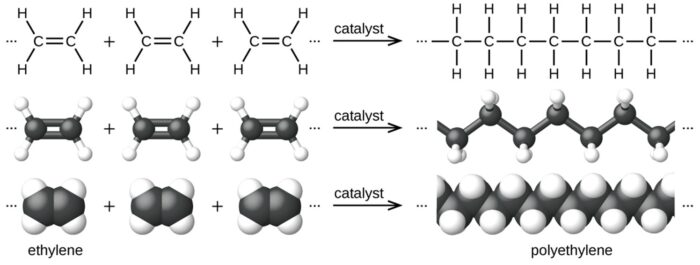
Figure above shows the reaction for the polymerization of ethylene to polyethylene. This diagram has three rows, showing ethylene reacting to form polyethylene.
In the first row, Lewis structural formulas show three molecules of ethylene being added together, which are each composed of two doubly bonded C atoms, each with two bonded H atoms. Ellipses, or three dots, are present before and after the molecule structures, which in turn are followed by an arrow pointing right. On the right side of the arrow, the ellipses or dots again appear to the left of a dash that connects to a chain of 7 C atoms, each with H atoms connected above and below. A dash appears at the end of the chain, which in turn is followed by ellipses or dots.
The reaction diagram is repeated in the second row using ball-and-stick models for the structures. In these representations, single bonds are represented with sticks, double bonds are represented with two parallel sticks, and elements are represented with balls. Carbon atoms are black and hydrogen atoms are white in this image.
In the third row, space-filling models are shown. In these models, atoms are enlarged spheres which are pushed together, without sticks to represent bonds.
Polyethylene is a member of one subset of synthetic polymers classified as plastics. Plastics are synthetic organic solids that can be molded; they are typically organic polymers with high molecular masses. Most of the monomers that go into common plastics (ethylene, propylene, vinyl chloride, styrene, and ethylene terephthalate) are derived from petrochemicals and are not very biodegradable, making them candidate materials for recycling. Recycling plastics helps minimize the need for using more of the petrochemical supplies and also minimizes the environmental damage caused by throwing away these nonbiodegradable materials.
_
Plastic recycling is the process of recovering waste, scrap, or used plastics, and reprocessing the material into useful products. For example, polyethylene terephthalate (soft drink bottles) can be melted down and used for plastic furniture, in carpets, or for other applications. Other plastics, like polyethylene (bags) and polypropylene (cups, plastic food containers), can be recycled or reprocessed to be used again. Many areas have recycling programs that focus on one or more of the commodity plastics that have been assigned a recycling code as seen in figure below. These operations have been in effect since the 1970s and have made the production of some plastics among the most efficient industrial operations today.
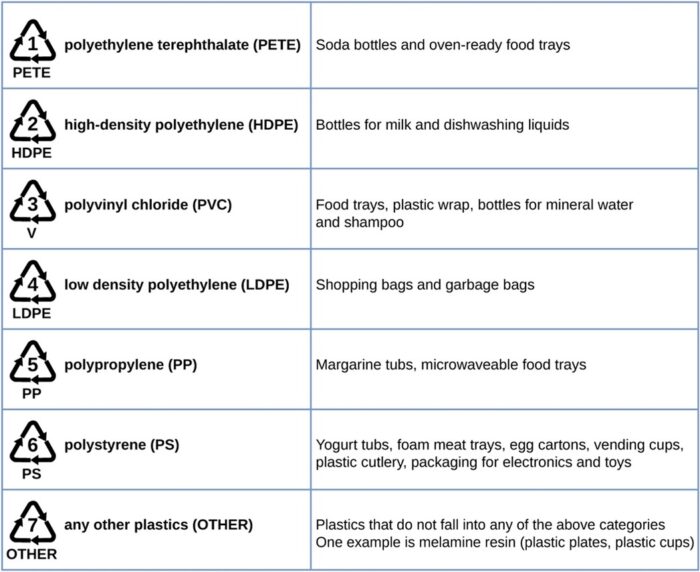
Figure above shows each type of recyclable plastic imprinted with a code for easy identification. This table shows recycling symbols, names, and uses of various types of plastics. Symbols are shown with three arrows in a triangular shape surrounding a number. Number 1 is labeled P E T E. The related plastic, polyethylene terephthalate (P E T E), is used in soda bottles and oven-ready food trays. Number 2 is labeled H D P E. The related plastic is high-density polyethylene (H D P E), which is used in bottles for milk and dishwashing liquids. Number 3 is labeled V. The related plastic is polyvinyl chloride or (P V C). This plastic is used in food trays, plastic wrap, and bottles for mineral water and shampoo. Number 4 is labeled L D P E. This plastic is low density polyethylene (L D P E). It is used in shopping bags and garbage bags. Number 5 is labeled P P. The related plastic is polypropylene (P P). It is used in margarine tubs and microwaveable food trays. Number 6 is labeled P S. The related plastic is polystyrene (P S). It is used in yogurt tubs, foam meat trays, egg cartons, vending cups, plastic cutlery, and packaging for electronics and toys. Number 7 is labeled other for any other plastics. Items in this category include those plastic materials that do not fit any other category. Melamine used in plastic plates and cups is an example.
______
Biodegradable plastics are materials designed to break down into natural substances (CO2, water, biomass) by microorganisms under specific conditions, unlike traditional plastics that persist for centuries. Made from renewable sources like corn starch or petrochemicals, they offer applications in packaging, films, and consumer goods but require specific environments, like industrial composting, for effective breakdown, often necessitating proper disposal for them to truly benefit the environment.
_______
_______
Global plastic waste:
The scale of the plastic waste problem is substantial and growing. In 2025, global plastic production exceeded 450 million metric tons. Recent projections indicate that global plastic demand is expected to rise significantly, reaching approximately 800 million metric tons per year by 2050. If current waste management trends persist, this surge in production will result in over 9 billion tons of plastic waste accumulating in landfills or the natural environment by mid-century, with some estimates as high as 17 billion tons. Between 1950 and 2015, plastic production increased from 2 to 380 million metric tons annually, escalating plastic pollution in natural environments. Additionally, the production of plastics is expected to increase its share of global oil consumption from 6 % today to 20 % by 2050. By 2050, plastics are also projected to contribute 15 % of the yearly greenhouse gas emissions allowance to keep global warming below 1.5 °C.
_
Defossilization of plastics involves replacing fossil-based raw materials (oil, gas, coal) with renewable carbon sources, such as biomass, recycled plastic waste, and captured CO2, to eliminate reliance on fossil fuels in plastic production. This shift is critical for a circular economy, reducing greenhouse gas emissions by replacing petrochemistry with sustainable alternatives like bio-based polymers and chemical recycling.
Key Pathways to Defossilize Plastics:
- Biomass-based Plastics: Utilizing renewable raw materials like plants, agricultural residues, or algae to create polymers.
- Chemical Recycling: Using technology to break down plastic waste back into basic chemicals to replace raw fossil feedstocks.
- Carbon Capture and Utilization (CCU): Capturing emissions from industrial sources and converting them into new plastic materials.
- Green methanol: Deploying proven methanol-to-olefins technology powered by green methanol and renewable energy.
- Circular Economy Initiatives: Improving mechanical recycling to keep materials in use longer and reduce the need for virgin production.
Defossilization differs from decarbonization by maintaining the carbon backbone of materials while removing the fossil source, ensuring industries like plastics can continue to function without extracting new carbon.
______
Various ideas for the defossilisation of the plastics industry:
Start-ups provide crucial impulses for the future and show how the plastics sector can operate with fewer fossil resources and what kinds of solutions are needed to transform production processes.
- AES develops modular, scalable chemical recycling units that convert plastic waste into reusable oil right where it’s generated, eliminating the need for long-distance transportation.
- coiss produces smart plug-and-play sensors to digitally retrofit existing machinery, helping to reduce downtime and cut energy consumption.
- Moldsonics offers ultrasonic sensors that make plastic machines more precise while reducing waste, energy, and material consumption.
- Osphim develops AI-powered software for plastics converters, helping manufacturers integrate more recyclates and lower energy consumption, even in complex applications.
- Radicaldot enables energy-efficient chemical recycling to produce basic chemicals from plastic waste that partially replace fossil raw materials in plastics production.
- s1seven offers solutions for digital material passports that provide transparency on the origin, composition, and carbon footprint of plastics, enabling high-quality recycling.
- Carbon Minds provides data-driven insights into emissions from plastic production, helping companies reduce their environmental footprint.
- ECO2GROW enables small and medium-sized enterprises to purchase affordable green electricity at fixed rates, directly from producers, just like major customers.
- MacroCycle operates energy-efficient chemical recycling facilities that enable infinite PET recycling without any degradation in quality.
- Paques Biomaterials produces biodegradable plastics from various organic waste streams to replace fossil raw materials.
- Polymerize uses an AI-powered platform to speed up research and development in materials science and improves outcomes in plastic product design and performance.
- sykell develops ERP software to supports circular business models by enabling the efficient return and reuse of packaging and materials.
_____
Defossilizing Plastics at Scale:
Vioneo’s Strategy to Bring Fossil-Free Polymers to the Global Market in 2026:
Founded in 2024 and backed by A.P. Moller Holding, Vioneo is pioneering the production of fossil-free polyethylene and polypropylene at commercial scale by leveraging green methanol as a feedstock. The company aims to decarbonize the materials sector through the use of renewable energy and green methanol as a feedstock, and plans to situate its first production facility close to a green methanol source to optimize efficiency and supply security. Ms. Judy Hicks, Vice President – Corporate Affairs at Vioneo spoke about the company’s mission to defossilize the global plastics industry and accelerate the adoption of fossil-free polymers. Ms. Hicks outlined Vioneo’s strategy of deploying proven methanol-to-olefins technology powered by green methanol to address the structural demand for virgin plastics in a net-zero, circular economy. She also discussed Vioneo’s decision to establish its first commercial production facility in China, emphasizing the importance of green methanol availability, competitive economics, and scalable supply chains. Vioneo’s long-term vision is based on enabling a fully circular and net-zero plastics industry. Independent analysis, including a Systemiq report commissioned last year, clearly shows that even with maximum implementation of reuse, reduction, and both mechanical and chemical recycling, approximately 50% of future plastics demand will still require virgin polymers. To meet climate targets, those virgin polymers must be fossil-free. Vioneo addresses this challenge by deploying proven methanol-to-olefins (MTO) technology using green methanol as feedstock. Incremental decarbonization solutions are insufficient; true defossilization of polymer production is required. Their objective is to commercialize fossil-free plastics at scale and replicate this model globally.
_____
Plastics to Bio initiative:
A “plastic to bio” initiative refers to circular economy projects that convert traditional, fossil-fuel-based plastic waste into biodegradable bioplastics or clean biofuels using biological or chemical processes. These initiatives aim to decouple plastic production from fossil fuels and reduce severe environmental pollution. Plastics To Bio is an affordable, economically viable concept and initiative to decouple plastics from fossils. The plastics problem can be solved. Three things are needed: collection of all plastics after use, no matter how long the use period has been; recycling of all plastic types and qualities; and enough bio-based feedstock to replace fossil feedstock. Companies need to join forces to implement in large scale the collection and recycling of plastics. Under the PlasticsToBio initiative companies with non-competitive interest to recycle plastics and start the use of bio-based materials as raw material can collaborate to optimize solutions for each type of recyclable material available. The good news is that societies and consumers have in recent times become more and more aware of the huge magnitude of the plastics waste problem. Companies around the world are keen to begin this task of solving the world’s plastics problems and preventing us from drowning in plastics.
In a matter of a decade, we should recycle already more than 100 million tons of plastics and by 2050 the amount must exceed 500 million tons. Currently, less than 10% of all plastics end up recycled. This PlasticsToBio concept will lead to the largest transformation in the history of petrochemicals and the restructuring of businesses and redistribution of value. PlasticsToBio will enable 1 Gt CO2 savings per year when implemented. Society can save over US$100 billion in transition to circular bioeconomy.
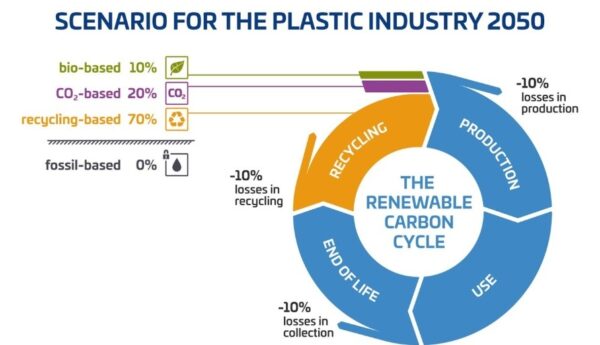
______
______
Plastic Waste Valorization through Pyrolysis:
Pyrolysis – one method of chemical recycling of plastics:
Pyrolysis is a process where plastics are collected at the end of their product life cycle and heated to high temperatures (300-900°C) in an inert atmosphere without oxygen. Thermal degradation causes plastic materials to break down into smaller molecules. From this, what once was plastic waste is transformed into pyrolysis (pyrolytic) oil or gas, which can be repurposed and utilised as reusable crude oils.
Boasting multiple applications, pyrolytic oil can reduce dependence on fossil fuels, presenting a lower carbon solution for hard-to-abate sectors, and diversifying energy materials. In petroleum refineries, the oil can replace fossil-based naphtha as a more sustainable feedstock to produce fuels and chemicals. Industries that still rely heavily on crude oil and natural gas (such as shipping, construction, and manufacturing) can use it as a fuel (once refined and blended with conventional fuels) to power vehicles and machinery.
However, technical challenges still limit the wider adoption of pyrolytic oil as a raw feedstock – specifically, purity and compositional diversity. Mixed waste plastics are often a complex combination of polymers, and the final composition of these products can differ due to regional and country-specific factors. Plastics such as polyethylene terephthalate (PET) and polyvinyl chloride (PVC) can yield oxygenated and chlorinated compounds. These factors can contribute to and result in the contamination of pyrolytic oil.
_
Plastic waste can be minimized through conversion to fuel or repurposing into new plastics. This minimizes reliance on fossil resources, which are often imported, thereby saving valuable resources and enhancing energy security and sustainability. Countries can reduce their fossil fuel imports by converting waste plastics into fuels or new plastic products, contributing to economic savings and greater energy independence.
Table below illustrates the identified benefits of pyrolysis technology in addressing sustainability and environmental challenges. Pyrolysis technology is touted for its promise to convert biomass and waste plastics into valuable products, promoting a circular economy by enhancing recycling and reuse. It offers environmental benefits by reducing harmful emissions and preventing marine pollution by reducing plastic waste. Pyrolysis also supports the transition to a net-zero economy by producing renewable energy and enabling carbon sequestration with biochar.
This table below outlines the potential benefits of pyrolysis technology in addressing sustainability and environmental challenges. It focuses on the technology’s theoretical advantages and future promise, recognizing that current outcomes may not fully align with these aspirations.
|
Challenges |
Pyrolysis as a Solution |
|
Sustainability and Circularity |
– Converts biomass and waste plastics into valuable products |
|
Environmental Impact |
– Prevents open burning of biomass and waste plastics |
|
Marine Pollution |
– Reduces waste plastics, mitigating the release of microplastics into the ocean |
|
Net-Zero Transition and Carbon-Negative Economy |
– Produces renewable energy sources from biomass |
|
Energy Security and Equity |
– Offers decentralized and flexible energy solutions |
|
Alignment with Global Goals |
– Supports SDGs 7 (Affordable and Clean Energy), 12 (Responsible Consumption and Production), and 13 (Climate Action) |
|
Chemical Production |
– Produces bio-oil and syngas from biomass and waste plastics |
Additionally, it provides decentralized energy solutions, enhancing energy security and equity. This technology aligns with global sustainability goals, offering the potential for significant impact across multiple sectors. It is acknowledged that the current state of pyrolysis technology—particularly concerning emissions—reflects findings from studies like those by the International Solid Waste Association (ISWA). The focus of this table is to highlight the potential of pyrolysis technology, emphasizing its theoretical benefits as a sustainable solution. These advantages are framed with an optimistic outlook, detailing how pyrolysis could evolve to meet future sustainability goals rather than asserting its present performance.
______
Biomass vs plastic pyrolysis:
Despite the fundamental similarity in process, the attributes, outcomes, and environmental impacts of biomass pyrolysis and waste plastics pyrolysis differ significantly due to the nature of the feedstocks and the resulting products. Understanding these differences is crucial for optimizing the application of pyrolysis technology in industrial waste management and sustainability strategies. Biomass feedstocks, such as agricultural residues, forestry by-products, and dedicated energy crops, comprise cellulose, hemicellulose, lignin, and moisture. These components decompose at different temperatures, contributing to the complexity of the pyrolysis process. In contrast, waste plastics are synthetic polymers like polyethylene (PE), polypropylene (PP), polystyrene (PS), and polyethylene terephthalate (PET), which consist mainly of long-chain hydrocarbons and contain additives such as plasticizers, stabilizers, and pigments. Unlike biomass which is renewable, plastics are derived from fossil fuels, making them non-renewable and contributing to environmental waste.
_
The products of biomass pyrolysis include bio-oil, biogas, and biochar, with bio-oil requiring upgrading for use as fuel, biogas used for power generation or chemical synthesis, and biochar serving as a carbon-rich solid. In contrast, waste plastics pyrolysis primarily produces liquid hydrocarbons similar to crude oil, which can be refined into fuels such as gasoline, diesel, and kerosene, along with syngas for energy recovery. However, solid residues from plastic pyrolysis have limited applications compared to biochar. Energy balance and efficiency differ between the two processes. Biomass pyrolysis can be energy self-sufficient, with syngas and bio-oil producing the required energy. In contrast, plastics pyrolysis requires significant external energy input to reach the high temperatures needed for the thermal cracking of polymers. The liquid hydrocarbons produced are similar to fossil fuels. They can be refined and used in existing fuel infrastructure, while pygas can also be used for energy recovery, improving overall efficiency.
_
Technologically, biomass pyrolysis involves handling heterogeneous feedstocks with varying moisture content and composition, requiring advanced reactor designs and control systems. Its economic viability depends on the value of biochar, bio-oil upgrading, and biogas utilization, supported by policies and incentives for renewable energy and carbon sequestration. Plastic pyrolysis faces challenges related to diverse polymer types and contaminants, requiring efficient sorting and preprocessing. Its profitability depends on the market value of liquid hydrocarbons and pygas and waste plastic collection and preprocessing costs. Regulatory policies for plastic waste management and recycling significantly influence the economic viability of plastics pyrolysis.
______
______
Plastics recycling technologies:
Table below provides a brief overview of advanced recycling technologies, detailing the types of plastics each technology processes, the products generated, and the leading companies involved. It categorizes these technologies into feedstock recycling (pyrolysis, gasification, and specialty), depolymerization (thermochemical, enzymolysis, and specialty), and solvent-based purification, highlighting their respective outputs and notable technology providers. This classification underscores the diverse approaches and key players in the advanced recycling sector, aiming to enhance plastic waste management and support the circular economy.
Summary of recycling technologies, plastic types, end products, and leading providers:
|
Recycling Technology Type |
Plastics Processed |
End Products |
Leading Providers |
|
Pyrolysis (Feedstock Recycling) |
Mixed plastics (mainly PE, PP) |
Base chemicals like oils, diesel, naphtha, syngas, char, and waxes |
Neste, Ineos, Chevron Phillips, Versalis, Honeywell, Plastic Energy, Agilyx, Quantafuel, Brightmark, etc. |
|
Gasification (Feedstock Recycling) |
Mixed plastics |
Synthesis gas (syngas) |
Enerkem, Olefy |
|
Specialty (Feedstock Recycling) |
Various |
Base chemicals |
Aduro Clean Technologies (water-based chemical cracking), Mura Technology, Synova (advanced thermal cracking) |
|
Thermochemical Depolymerization |
PET, PMMA, PS, PUR, PA |
Monomers, dimers, oligomers |
Eastman, Aquafil, IFP Energies Nouvelles (IFPEN), Gr3n, Loop Industries, revalyu, Ioniqa |
|
Enzymolysis Depolymerization |
PET |
Monomers, dimers, oligomers |
Carbios, Samsara |
|
Specialty Depolymerization |
Various |
– |
Pyrowave, Microwave Chemical Co. |
|
Solvent-Based Purification |
PE/PP, PET, PS, ABS, HIPS, PVC |
Purified polymers |
Polystyvert, Recycling Avenue |
_
Various companies have already introduced products made from chemically recycled plastics, demonstrating market feasibility and consumer acceptance. Table below highlights various food-grade consumer products incorporating recycled materials, showcasing efforts by leading brands to integrate sustainable practices into their packaging and product development. These initiatives are part of broader strategies to reduce environmental impact and promote a circular economy using recycled polymers from reputable producers.
Food-grade Market-Ready Products Made from Chemically Recycled Plastics are depicted in table below:
|
Product |
Brand |
Recycled Material Producer |
Polymer Type |
|
Ice-Cream Tubs |
Unilever (Magnum) |
SABIC (TrueCircle) |
Recycled Polypropylene (rPP) |
|
Meat Packaging |
Zur Mühlen Group |
BASF & SABIC |
Recycled Polyamide (rPA), Recycled Polyethylene (rPE) |
|
Cheese Packaging |
Bradburys Cheese |
SABIC |
Recycled Polypropylene (rPP) |
|
Pet-Food Packaging |
Mars |
SABIC |
Recycled Polypropylene (rPP) |
|
Yogurt Tubs |
Yoplait |
Total |
Recycled Polystyrene (rPS) |
|
Chocolate Wrapper |
Nestle (KitKat) |
LyondellBasell |
Recycled Polypropylene (rPP) |
|
Food-Storage Containers |
Tupperware |
Eastman (Tritan Renew) |
Recycled Co-polyester |
|
Milk Bottles |
Lactel |
Ineos |
Recycled High-Density Polyethylene (rHDPE) |
|
Reusable Water Bottles |
Eco Ello Bottle |
Eastman (Tritan Renew) |
Recycled Co-polyester |
_______
_______
Bio-based feedstock in plastic packaging analysis:
In 2023, global biomass demand reached 13.6 billion tonnes, with bio-based polymers accounting for just 0.023% of the total. Around 3.2 million tonnes of biomass feedstock were used to produce 4.2 million tonnes of bio-based polymers in 2024, primarily from glycerol, sugars, starch, and non-edible plant oils. The EU-27 chemical industry uses around 110 Mt of embedded carbon each year, of which only 4-5% comes from biogenic sources. The plastics subsector remains over 99% fossil-based. Bio-based polymer production is growing, with global capacities expected to increase significantly by 2030. Nevertheless, bio-based plastics currently account for less than 1% of total plastic production.
Although seventeen bio-based polymers are commercially available, they represent only ~1% of the global plastics market and account for just 4–5% of biogenic carbon in the EU chemical sector. Production capacity is concentrated in Asia (55%), followed by North America (17%) and the EU27+3 (14%). Despite their limited market share, there are no fundamental technical barriers to using them in packaging. Bio-based plastics offer a 30–70% reduction in greenhouse gas emissions compared to fossil-based alternatives, which supports the EU’s decarbonisation and circular economy goals.
Dedicated bio-based plastics, such as PLA and PEF, offer unique properties (e.g. enhanced barrier properties for PEF) that can outperform their fossil-based counterparts in certain applications. Bio-based plastics can be mechanically or chemically recycled, composted or incinerated. Drop-in bio-based plastics (e.g. bio-PE and bio-PET) are fully compatible with existing recycling infrastructure. However, novel bio-based polymers require expansion and adaptation of recycling infrastructure.
Scenarios for 2050 suggest that bio-based plastics could account for 10-30% of plastic packaging, alongside recycled content. Setting gradual, binding targets could stimulate market growth and investment, but learnings from other binding targets (e.g. SAFs) should be considered. There are a few key drivers and barriers when it comes to bio-based content targets in plastics. Key drivers include climate action, consumer demand and circular economy goals. Barriers include higher production costs, limited recycling infrastructure and policy gaps compared to biofuels.
_______
_______
Section-12
Defossilization of process heat:
Industrial process heat is a significant energy consumer, accounting for 60–70 % of total energy use in the industrial sector across most European countries. This demand largely falls into two temperature categories: high-temperature processes (above 500 °C), which account for about half of the total heat demand and rely on industrial furnaces, and low to medium-temperature processes (below 500 °C), which mainly use steam as the transfer medium and represent 40–50 % of Europe’s industrial heat demand. Steam generation for industrial processes is, at present, heavily dependent on fossil fuels, leading to annual CO2 emissions of approximately 150–160 Mt per annum, equivalent to about 23 % of Europe’s industrial sector. Transitioning from fossil fuels for steam generation is essential, requiring the adoption of low-carbon, cost-effective technologies such as heat pumps, electrode boilers, or solar thermal technology. Solar thermal technology is particularly noteworthy due to its ability to meet required temperature ranges, potential for cost efficiency and the broad availability of solar resources.
_
Energy carriers and CO2 emission of main components used in the steam generation technologies:
Energy carrier Emission factor (gCO2/kWh)
Natural gas 221
Renewable electricity 26
Green Hydrogen 38
Biomethane (a) 70
Concentrated solar power 27
Thermal energy storage 5
Geothermal setup (b) 100
(a) Average Emission factors for two main feedstocks (most production today comes from crops and animal manure) making up ∼ 60 % of global and 80 % of European biogas production;
(b) Average geothermal LCA CO2-Emission. Solely upstream emissions and assuming the electricity used it renewable.
_
The industrial manufacturing sector in the EU accounted for 21% of the final energy use in 2023. This corresponded to annual emissions of 706.5 million tonnes of CO2 equivalents (Eurostat, 2024). Processes such as steel making in the metal industry, glass melting in the mineral industry, or drying in the paper industry have a high energy or, more specifically, process heat demand. In alignment with the EU Climate goals to achieve climate neutrality by 2050, many attempts are made to transform this industrial energy demand. Whilst defossilising electric (e.g. mechanical) processes simply requires the switch to renewable energy sources, process heat imposes many more technological difficulties to enable a transformation. The challenge of developing strategies for defossilising process heat lies in the diversity of industrial processes and their specific temperature demands.
_____
The most energy intensive manufacturing sectors according to Eurostat are the petro-/chemical, non-metallic minerals, paper, food/beverages/tobacco and iron/steel industries (Eurostat, 2022). To show the relevance of temperatures on the energy demand, Figure below exemplifies the process heat demand in North Rhine-Westphalia (NRW), Germany, which can be seen as representative for other European temperature distributions, since it is one of the most industrial federal states of Germany (Wirtschaft.NRW, 2024).
Process heat demand [TWh] by industrial sector:
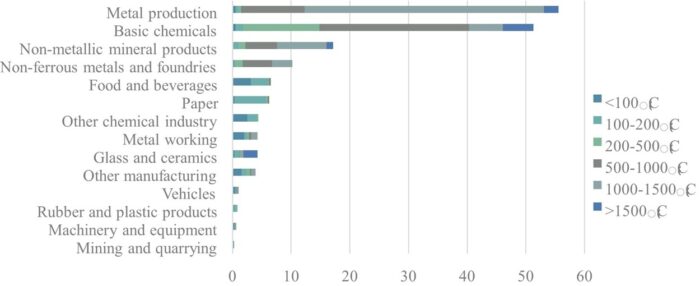
Figure above shows Temperature distribution of process heat demand in North Rhine-Westphalia (NRW), Germany, by industrial sector for 2020 (Budt et al., 2024).
In these sectors, each product has various manufacturing steps involved, which were identified and analysed, like boiling, drying, etc. The processes involving heat are tabularised along with their respective temperatures. Regardless of the product, industrial sectors often share processes with similar temperature levels that could potentially be served in a technologically similar way (von Thadden del Valle et al., 2023).
_
Process heat technologies:
Heat can be supplied in a multitude of ways to the industrial processes. To generate process heat, combustion of different fuels, such as fossil/biogas or oil, can be used, as well as electric heat generation (e.g. boilers) or renewable sources such as solar or geothermal energy. This heat can be directly supplied, for example in furnaces (direct or indirect contact with the product), or indirectly using heat transfer mediums, such as steam or hot water.
_____
Technologies for the defossilization of process heat:
Figure below includes typical energy sources, technologies, and heat transfer mediums that are currently used to supply process heat. Both fossil and renewable technologies and sources are examined.
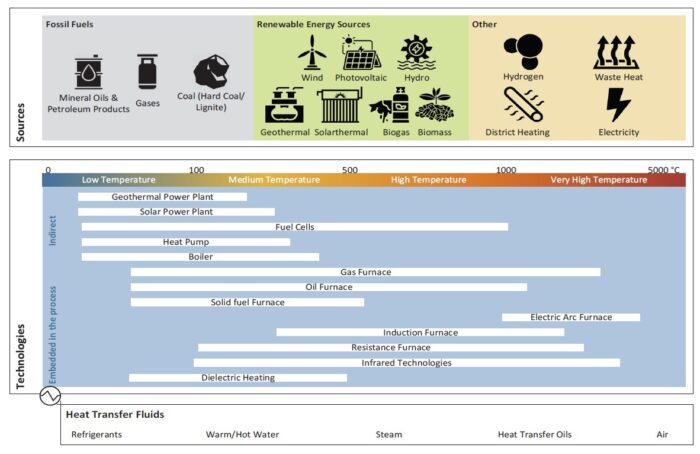
Figure above shows Overview for the different options of process heat supply with its sources and technologies.
-1. Geothermal energy encompasses the heat stored in the Earth’s crust and its practical application in engineering (Umweltbundesamt, 2023). Geothermal energy is divided into shallow geothermal energy and deep geothermal energy, with the latter considered from a depth of 400 metres (Begemann et al., 2021). Geothermal energy for process heat is set to reach around 200°C (Bracke and Huenges, 2021), depending highly on its location.
-2. Solar thermal collectors produce process heat by converting incident solar radiation to thermal energy. They are split into three types of solar thermal systems: flat plate collectors, vacuum tube collectors, and parabolic trough collectors. Maximum achievable temperatures vary due to location and solar incidence, but are assumed to be at 250 °C (Schabbach and Leibbrandt, 2021).
-3. In a cogeneration setup, fuel cells can provide (waste) heat from the electrochemical reaction. There are various types of fuel cells, such as Polymer Electrolyte Membrane (PEM) Fuel Cells or Solid Oxide Fuel Cells (SOFCs); however, they are summarised as a singular potential technology enabling process heat temperatures of up to 1000°C (Brett et al., 2008).
-4. Heat pumps (HP) are classified as PtH technology. The main advantage of heat pumps is the ability to have coefficients of performance (COP) greater than 1. HP can be classified into four categories based on the temperatures they can achieve. Low-temperature heat pumps can reach temperatures up to 60°C, medium-temperature heat pumps up to 80°C and high-temperature heat pumps reach up to 120°C. Heat pumps that can achieve temperatures higher than 120°C are classified as ultra-high temperature heat pumps (Wolf, 2017). There are four types of heat pumps further differentiated: compression heat pumps (vapour compression – max. 200 °C, gas compression – max. 250 °C), adsorption heat pumps (not suitable for industrial processes), absorption heat pumps (AHP) (Type I – max. 90°C, Type 2 – max. 230°C), and mechanical vapour recompression (MVR) heat pumps (max. 280°C) (Arpargaus, 2023; Klute et al., 2024).
-5. Boilers are typically used to provide process steam, which is then conducted to the different processes. Boilers can use combustion of fuels to provide heat or can be electrically heated, either as resistance boilers or electrode boilers. Electrode boilers reach temperatures up to 500 °C (Münnich et al., 2022) and resistance boilers around 350°C (Begemann et al., 2021).
-6. Gas/oil/solid fuel furnaces are fuelled by fossil-free alternatives, such as biomass, biogas, bio-oil, and biodiesel. In the case of all furnaces, the product can be either in direct contact with the firing process or indirectly. Furnaces can hence transmit the process heat to the product through radiation, conduction, and convection. Hydrogen burners reach temperatures of around 3000 °C (Begemann et al., 2021), and bio- or synthetic methane burners can provide around 2460 °C (Leicher et al., 2023). Combustion of biomass typically supplies temperatures up to 500 °C (Naegler et al., 2016).
-7. Electric arc/induction/resistance furnaces are PtH technologies and use electric arcs, electromagnetic induction, and electric resistance to generate heat. They are known to achieve good temperature control with high efficiency (Begemann et al., 2021) and are typically used in high-temperature processes reaching temperatures of 4000°C (Salzgitter Mannesmann Stahlhandel, 2024), 2000°C (Dhakal et al., 2012), and 2400°C (Rosenhain and Coad-Pryor, 1919) respectively.
-8. Infrared (IR) process heating uses electromagnetic radiation to transfer heat directly to materials. Emitter face temperatures range from 343°C to 2,400°C depending on the wavelength, which allows the target material to reach specific process temperatures typically between 90°C and 600°C. They belong to the group of PtH technologies.
-9. Dieletric heating is a PtH technology that utilises the principle of dielectric loss to generate heat in materials. Dielectric heating technologies can reach temperatures of about 500°C (Brauner, 2016).
Note:
Here PtH technologies are only considered defossilised if the electricity comes from a renewable source. For high-temperature processes, specialized technologies are required like furnaces, whereas many technologies exist that provide lower temperatures (<500°C) which are often used as general-purpose technologies to provide e.g. process steam.
_
All researched technologies are aggregated in a figure below including their peak power and temperatures. It has to be noted that these two are not necessarily linked as they might stem from different sources. The graph in Figure below can therefore only be seen as the maximum existing technology options to understand their suitability for different processes. Configurations and combinations of these technologies, such as connecting several in series or parallel, might be possible for some options, such as geothermal energy with heat pumps (Klute, 2023).
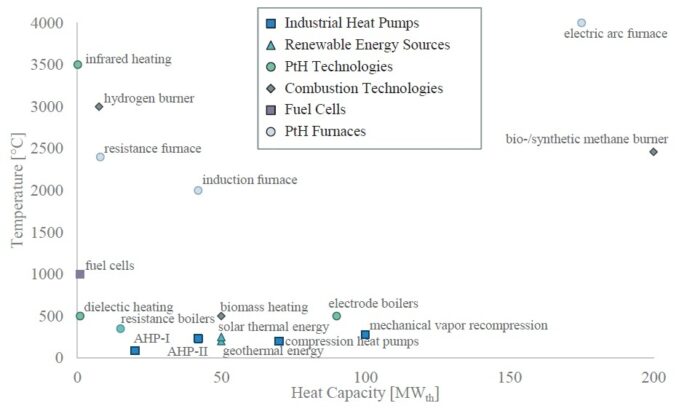
Figure above shows Technology comparison with heat capacity (MWth) and temperatures.
The technologies were further grouped into Industrial Heat Pumps (compression heat pumps, AHP-Type I, AHP-Type II, mechanical vapour recompression heat pumps), Renewable Energy Sources (solar thermal and geothermal), PtH Technologies (infrared heating, dielectric heating, resistance boilers, electrode boilers), Combustion Technologies (biomass heating, hydrogen burners, bio/synthetic methane burners), Fuel Cells and P2H Furnaces (resistance, induction, and electric arc furnace).
______
High-temperature heat through electrification:
The defossilization of the electricity and heat supply in the chemical industry poses a significant challenge. In particular, the intended feed-in of volatile renewable electricity into the chemical processes may conflict with the need for a constant, secure and affordable electricity and heat supply for chemical plants. According to current knowledge, ‘‘CO2-free’’ gas (e.g., green hydrogen) and the use of renewable electricity are the most suitable options for defossilization of heat and electricity supply in the chemical industry. The decarbonization of high-temperature industrial processes is increasingly supported by the emergence of electric heating technologies, which start offering a viable alternative to fossil fuel-based thermal energy when renewable or low-carbon electricity is used. High-temperature heat pumps are under development, but their temperature level is not likely to exceed 180°C–200°C, which is insufficient for many processes in the chemical industry. However, their deployment in other industries requiring lower heat levels such as the food, textile, and tobacco industries is kicking off today. For higher-temperature heat (up to 1,000°C–2,000°C or more) technologies such as electric boilers, resistance and induction heating, plasma torches, and electric arc furnaces are reaching high(er) TRLs (TRL 7–9), with some already deployed at commercial scale. While resistance and induction heating offer high thermal efficiencies (up to 98%), emerging technologies, such as shockwave heating, promise further gain in product yield and selectivity. The challenge for the electrification of the chemical industry is, therefore, no longer related to a lack of high-temperature heat technologies. However, their large-scale deployment will depend on the availability of affordable, low-carbon electricity and the expansion of grid infrastructure to accommodate gigawatt-scale industrial loads, including economically viable OpEx and CapEx boundary conditions. For instance, a single electric steam cracker requires approximately 0.8 GW of power (size of a standard nuclear reactor), and with around 40 such units in the EU, the cumulative impact on the electricity grid could be substantial. Again, these developments underscore the need for coordinated investment in both technology and energy systems to enable the electrification of heat-intensive chemical processes.
_____
_____
Electrification for energy intensive industries (EII):
An energy system based on a 100% renewable energy (RE) supply is increasingly proposed as the most energy-efficient, cost-effective, and sustainable option to radically reduce greenhouse gas emissions in the next decades. The essential technologies to ensure a transition toward this goal already exist and have been commercially applied. Some key technologies such as electrolysers and large-scale batteries are in the final stage of development towards demonstrating stability in large-scale applications. Others suffer from low technological maturity and are in urgent need of further development towards pilot and demonstration projects before full commercialisation. In particular, abatement technologies in energy-intensive industries (EIIs) are often subject to low technological maturity and higher costs than current methods of production.
EIIs, which include steel, cement, basic chemicals, non-ferrous metals, glass and pulp and paper industries, are responsible for roughly one-fifth of global greenhouse gas emissions and energy consumption, representing a key sector that needs to reduce emissions. These industries are generally characterised by large, continuously operating production plants, investment cycles of several decades and high capital intensity, indicating that EIIs must immediately transition towards emission-free production, which requires significant investment in the near future.
_
The overall electrification of the entire energy system is a central component of the energy transition. It refers to the substitution of fossil fuels with electricity in all major energy-consuming sectors, i.e., power, heat, transport, and industry. Where possible, this electricity should be supplied directly from RE sources to maximise efficiency and minimise conversion losses. In the heat and transport sectors, technologies such as heat pumps and electric vehicles enable efficient direct electrification. The direct electrification of the industrial sector can be more challenging due to high temperature requirements and process-specific constraints, but solution are increasingly being explored.
_
A variety of strategies have been suggested to reduce emissions from EIIs. These strategies can be broadly categorised as follows: 1) incremental improvements such as increased efficiency and best available technologies (BAT), 2) secondary production, recycling (including carbon capture and utilisation (CCU) and material efficiency, 3) carbon capture and sequestration (CCS), and 4) radical transformations to low-carbon fuels and low-carbon processes using electrification and biomass. In terms of their CO2 reduction potential, all strategies except for electrification suffer from several drawbacks: increased efficiency and BAT can only reduce a small share of emissions; secondary production is dependent on a continuous supply of scrap; and CCS is often inherently connected to the continued use of fossil fuels with various sustainability constraints and potential fossil lock-ins. Additionally, the availability of biomass is limited, especially if sustainability constraints are properly respected.
_
In contrast, the electrification of the industrial sector stands out as a transformative strategy with the potential for deep emission reductions. Studies agree that the full electrification of EIIs is technically possible, and even high-temperature heat can be fully electrified if research and development progresses. Electrification is unique in enabling substantial emission reductions in line with ambitious climate neutrality goals. Additionally, it aligns seamlessly with 100% renewable energy (RE) systems, provided that the electricity supply is entirely renewable. There are two paths towards electrification: direct and indirect electrification, where the former focuses on using green electrons and the latter on green molecules. Direct electrification aims to use renewable electricity without further conversion. In contrast, indirect electrification uses power-to-X technologies to convert renewable electricity into other energy carriers, such as heat, gases, or fuels. This includes the production of green electricity-based hydrogen (e-hydrogen) as well as its further transformation into hydrogen-rich gases, synthetic fuels or chemicals, depending on the specific application, as well as seawater desalination, materials and food. While green e-hydrogen is generally regarded as an essential component of future industry, previous studies have attempted to estimate the maximum hydrogen demand in industry without comparing hydrogen technologies to direct electrification. Due to decreasing costs of renewable electricity, green e-hydrogen production can become cost-competitive in the coming years.
_
Electrons versus molecules in industry:
A public debate similar to the transport (battery electric vehicles versus fuel cell electric vehicles) and heat sector (heat pumps versus hydrogen boilers) may emerge soon for energy-intensive industries. While direct electrification is clearly superior for heat and transport, the picture for industry is more complicated. A new study from LUT University & RLS-Graduate School challenges existing narratives on large hydrogen quantities and highlights the possibilities of direct electrification. Using multi-criteria decision analysis as a methodological framework, with five different weighting strategies, the study compares direct electrification and hydrogen technologies for four industry segments, including e-ammonia and e-methanol. The overall results show that hydrogen is technically easier to implement, but suffers from high energy costs, limited process flexibility, potentially lower efficiency, and higher land impact than its electron-based alternative. Still under lab-scale development but highly promising are the electrocatalysis routes for ammonia and methanol production that avoid high temperatures, high pressures and energy losses during the production of green hydrogen as an intermediate step and synthesize the final products directly from water and nitrogen or carbon dioxide, for ammonia and methanol, respectively.
_
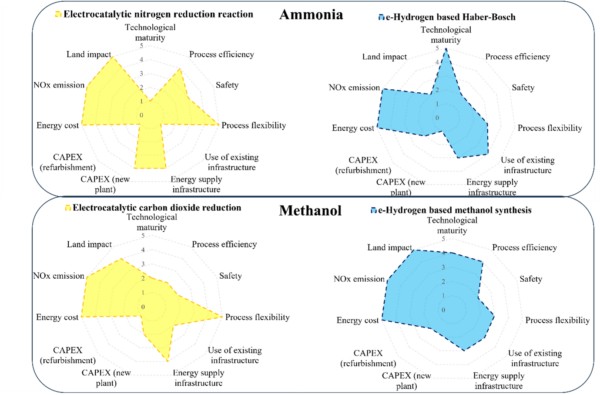
Figure above shows technology comparison for basic chemical production with direct electrification (yellow) and hydrogen-feedstock (blue). Indeed, chemical industry transition research has estimated that upwards of 33 PWh of electricity may be required to defossilize chemical feedstock production. Given the high electricity requirements to produce hydrogen before chemical synthesis, low-cost solar PV may be the key to producing economically viable electricity-based feedstocks.
_
Currently, the world is waiting for the first hydrogen direct reduction plants in Sweden (Stegra) and Germany (Thyssenkrupp) to start large-scale green steel production. However, direct electrification is a considerable option for each industry segment: most prominently for low-and medium-temperature heat supply via heat pumps and electric boilers across all industries or by simply replacing fossil with renewable electricity for already electrified processes (such as aluminium smelting). Additionally, direct electrification can be implemented in technically advanced approaches such as plasma-fired heating in rotary cement kilns, full electric glass melting with submerged electrodes, or new electrolysis or electrocatalysis approaches for steel and chemical production, respectively. Most importantly, a study demonstrated that most industries could benefit from increased use of already available technologies for secondary production and recycling to electrify processes, increase efficiency and reduce pressure on material availability.
_
A big debate surrounds the choice between defossilisation through electrification or the use of green hydrogen. One of the main arguments for electrification is that the conversion losses for synthesis are higher compared to those for Power-to-Heat (PtH) applications. While PtH has an efficiency of 97%, obtaining heat from hydrogen after electrolysis (Power-to-Gas-to-Heat, PtGtH) gives an efficiency of around 63% and similarly heat from synthetic methane (PtGtH) which has an efficiency of around 50% (Begemann et al., 2021). Availability and infrastructure, as well as high demand for hydrogen, should limit it to applications that require high flame temperatures or where complete electrification is technically not feasible, such as the steel industry (Begemann et al., 2021; Lopez et al., 2022).
_____
_____
Defossilization of steel industry:
The global steel industry is increasing its efforts to defossilize and reduce its specific CO2 footprint. Using electrical energy to melt iron units of scrap, pig iron, DRI and HBI of various mixtures and origins is beneficial to reduce the CO2 footprint but leads to new challenges. Direct Reduced Iron (DRI) and Hot Briquetted Iron (HBI) are premium, high-iron feedstock (90–94% Fe) produced by reducing iron ore without melting, used primarily in Electric Arc Furnaces (EAF) to produce high-quality steel, reduce harmful residuals found in scrap, and lower carbon emissions. HBI is a denser, safer form of DRI designed for long-distance transport and storage.
_
Electric Arc Furnace (EAF) steelmaking is a, efficient, flexible process that melts recycled steel scrap or Direct Reduced Iron (DRI) using high-power electrical arcs (up to 3,000 C+) to produce steel. It uses electricity instead of coal to create intense heat, allowing for roughly 400-440 kWh per tonne consumption, favoring lower emission “green steel” production compared to traditional blast furnaces. Best Available Techniques (BAT) in steelmaking are high-efficiency, environmentally sustainable technologies and management practices, such as top-gas recovery, waste heat utilization, and EAF dust recycling, aimed at minimizing emissions and energy use. These techniques are mandated or guided for both integrated (BF-BOF) and electric arc furnace (EAF) steel production to maximize energy efficiency and reduce GHG emissions.
_
To tackle climate change, many regions of the world have chosen to first restrict and then even zeroize the enormous quantity of CO2 that is being emitted into the atmosphere. Since the iron- and steel industry takes a non-negligible part, strategies are developed to gradually reduce CO2 emissions in order to comply with the local governmental framework and the interests of society. The three main strategies that each steelmaker can utilize are visualized in figure below.
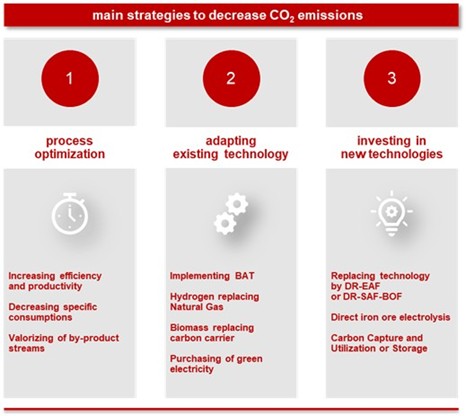
Figure above shows three main strategies to mitigate CO2 emissions in the iron- and steel industry.
First and foremost are process optimizations (1), which are procedures that call for direct action and some smaller fundings, but no significant investments are needed. Increased output and / or an optimized material utilization will directly result in reduced CO2 emissions per tonne of steel. Thereby, external expertise can help identify the quickest path to an optimal production strategy. The impact of this strategy is very effective but also limited. In reality, a scrap-based EAF operation might reduce their emissions to below <100 kg CO2 per tonne steel by reducing power-on-time (PON), specific electrical consumption (kWh/t) or optimizing the usage of different carbon carriers (bucket coal, injection coal, etc.). Pushing beyond the limits of process optimization, first investments are necessary to adapt existing technology (2). By replacing outdated systems with more efficient machines and switching to lower-carbon (such as natural gas), carbon-free (such as hydrogen or ammonia) or non-fossil and therefore off-balance carbon sources (such as biomass), CO2 emissions are reduced even further. This approach usually requires more investments and sometimes even research activities. Finally, Carbon Direct Avoidance (CDA) at its final stage means investing in new technologies (3) and leads to significant investments of billions of US-Dollars or Euros. While step 1 and 2 are most suitable for EAF-based steelmakers, integrated plants cannot avoid step 3.
_
Numerous challenges will arise when an integrated plant chooses to proceed to step 3, which requires switching from oxygen steelmaking to electrical steelmaking while maintaining the same secondary metallurgy. In addition to requiring extensive project management, an EAF’s operational and maintenance realities differ greatly from those of a BOF. Basic Oxygen Furnace (BOF) steelmaking, or the Linz-Donawitz (LD) process, is a primary method of converting molten iron (hot metal) from a blast furnace into steel by blowing high-purity oxygen through a lance. The process reduces carbon, silicon, and impurities via oxidation, producing steel in under 40 minutes. The impact spreads a wide range of issues, from metallurgical questions (e.g. iron unites, impurities, and trace elements) that have a significant impact on secondary metallurgy, to new slag designs and recycling, off-gas treatment considerations, new and varied safety risks, and maintenance issues that significantly affect the productivity of EAF-based steelmaking. A 300 t EAF does not produce and perform like a 300 t BOF and the majority of figures in discussion are theoretical in nature because actual industrial data are hard to come by.
_
Electrification pathways for primary steelmaking:
Researchers expect steel recycling using electric arc furnaces to play an increasingly prominent role. However, primary steelmaking using reduced iron ore, i.e., pig/sponge iron, will still be needed for high-quality steel production. Aside from the hydrogen direct reduction route, direct electrolysis of iron ore via electrowinning may be an opportunity for direct electrification of sponge iron production. Previous LUT University research indicated that, assuming technical maturity in 2040, steelmaking via electrowinning may be the least cost steelmaking technology at an electricity price of €16 ($18.7)/MWh, well achievable by solar PV and CO2 emissions costs of €30/tCO2.
Anticipating hydrogen direct reduction in the short term, companies have made investments to produce sponge iron in regions with abundant renewable energy resources, particularly solar PV, along with iron ore deposits to supply electric arc furnaces in regions with limited land availability or less abundant renewables. Such projects are currently underway in Namibia, Algeria, and Mauritania to produce green iron that can be used in Europe’s electric arc furnaces. New supply chains may then emerge with sponge iron being a heavily traded commodity due to the significant share of hydrogen production costs in total steelmaking costs. Technical development of electrowinning may allow for higher shares of self-sufficiency across the steelmaking supply chain, as total steel production costs would be less sensitive to electricity prices.
______
______
Potential of concentrated solar power systems for defossilization of industrial process heat for steam generation, a 2025 study:
Highlights:
- Concentrated solar thermal energy is cost-competitive at 1200 kWh/m2/year.
- Energy storage lifts concentrated solar thermal carbon dioxide reduction by 45%
- Hybrid systems with heat pumps needed for over 70% carbon dioxide reduction.
- High initial capital, water, and land needs remain key barriers to widespread adoption.
Concentrated solar power, particularly parabolic trough collectors (PTCs), is especially effective among solar thermal technologies. Parabolic trough collectors can achieve temperatures beyond 400 °C, making them well-suited for various industrial applications, including process steam generation. In the context of steam generation, this allows them to be integrated at multiple points within industrial process chains, either as a supplementary solution (e.g., pre-heating water) or as a potential substitute for natural gas-fired boilers. The present study investigates the potential of concentrated solar power as a defossilization option for industrial process heat, using process steam generation as a case study. The study considers various topologies, including standalone low-CO2 steam generation technology and hybrid systems integrating concentrated solar power with complementary solutions. These are evaluated across diverse European locations with varying solar irradiance and operating conditions. The results demonstrate that integrating concentrated solar power can significantly reduce the levelized cost of heat and CO2 emissions in regions where direct normal irradiance exceeds 1200 kWh/m2/year. This effect is independent of the targeted CO2 reduction level. In contrast, in regions with irradiance below this threshold, the economic and technical competitiveness of low-CO2 solutions depends strongly on the stringency of the CO2 reduction target. For CO2 reduction targets up to 70 %, multiple topologies remain cost-competitive. These include standalone low-CO2 technologies – such as geothermal systems, concentrated solar power, or heat pumps – supplemented by minimal operation of the existing natural gas-fired boiler and hybrid configurations combining these low-CO2 technologies. However, for solar irradiance above 1200 kWh/m2/year and CO2 reduction targets beyond 70 % deploying heat pumps becomes essential. These may be as standalone or combined with concentrated solar power systems or biomethane-fired boilers to minimize costs. In general, the findings emphasize the importance of location-specific analysis and demonstrate the effectiveness of concentrated solar power in achieving substantial CO2 reduction targets across a wide range of solar irradiance levels, operating temperatures, and various steam generation topologies.
_____
_____
Section-13
Defossilization of hard-to-electrify segment:
Roadmap to close the carbon cycle:
Hard-to-electrify (HTE) sectors—such as long-haul aviation, maritime shipping, heavy-duty transport, and primary steel and cement manufacturing—account for roughly 20% of global CO₂ emissions. They resist direct electrification due to three main factors: requirements for extreme process heat, the need for highly energy-dense liquid fuels, and unpreventable chemical process emissions.
_
Unlike decarbonization, which focuses on capturing or sequestering carbon emissions, defossilization involves slowing or stopping the demand for new fossil-fuel extraction. This could be achieved by recovering carbon from existing processes and products and, instead of setting it aside, reusing it where possible. This “circular economy” would reclaim much of the carbon that already exists in fossil-fueled power generation and difficult-to-use materials such as biomass, municipal waste, biomethane, carbon dioxide and plastics.
Defossilization could specifically help reduce new emissions from the transportation and industrial sectors that, together, account for more than 50% of the US carbon footprint. They also are the most difficult segments to transition from fossil fuels to electricity in a process called electrification. While industrial and scientific research continues to discover suitable clean technologies or materials substitutes, these and other vital parts of the economy will continue to require carbon to operate.
_
Creating a “circular economy” that reclaims much of the existing carbon in fossil-fueled power generation and difficult-to-recycle materials could lead to “defossilization.” For this to happen, the technology must be energy efficient, cost effective and scalable with equitable and ecological solutions to ensure that all communities will benefit. The researchers from the DOE laboratories — ORNL, Pacific Northwest National Laboratory, Brookhaven National Laboratory, Argonne National Laboratory, Lawrence Berkeley National Laboratory, Ames National Laboratory and SLAC National Accelerator Laboratory — pooled their diverse expertise to devise a roadmap to “defossilize” portions of the U.S. economy by reducing carbon emissions from segments of the market that are challenging to electrify. Their plan calls for using novel approaches to increase the repurposing of carbon that already exists, thereby closing the carbon cycle. The roadmap was published in the journal Nature Reviews Chemistry in 2024.
______
A US perspective on closing the carbon cycle to defossilize difficult-to-electrify segments, a 2024 study:
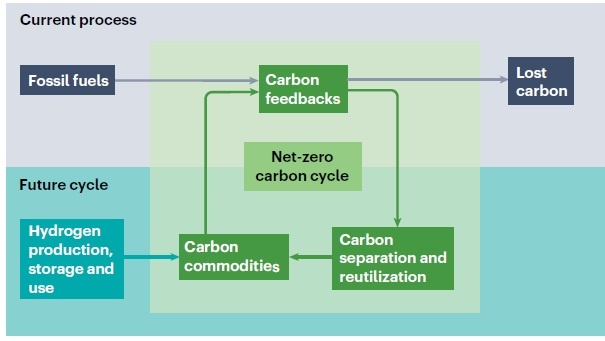
Electrification to reduce or eliminate greenhouse gas emissions is essential to mitigate climate change. However, a substantial portion of our manufacturing and transportation infrastructure will be difficult to electrify and/or will continue to use carbon as a key component, including areas in aviation, heavy-duty and marine transportation, and the chemical industry. In this Roadmap, authors explore how multidisciplinary approaches will enable them to close the carbon cycle and create a circular economy by defossilizing these difficult-to-electrify areas and those that will continue to need carbon. Authors discuss two approaches for this: developing carbon alternatives and improving their ability to reuse carbon, enabled by separations. Furthermore, authors posit that co-design and use-driven fundamental science are essential to reach aggressive greenhouse gas reduction targets.
_
The present and looming climate consequences of continued CO2 emissions, limited clean water resources, dispersal of plastics in the environment and pervasiveness of mismanaged municipal wastes have led to an increasing emphasis on decarbonizing our economy and infrastructure, and the design and aspiration of a circular economy. Electrifying with carbon-free energy sources will be a critical component of decarbonization. However, several segments of our economy, including the manufacturing of chemicals and polymeric materials, will continue to need carbon. In addition, segments of our transportation economy will also be difficult to electrify due to the size and weight of the batteries that would be needed, including aviation, long-haul, heavy-duty, and marine transportation. Together, these ‘hard-to-electrify’ segments contribute to ~20% of the overall US greenhouse gas (GHG) emissions (see Figure below a, in which the areas not covered by parallel lines represent the areas difficult to electrify). Although efforts are being made to decarbonize parts of these segments, they are unlikely to completely transition from carbon. We can reduce carbon use by increasing efficiency and reducing waste, but that approach alone will not be sufficient to achieve net-zero CO2 emissions. It is therefore posited that defossilization, or removing fossil fuels while still using carbon in our economy, is a critical part of achieving net-zero CO2 emissions for difficult-to-electrify sectors.
_
Defossilization of difficult-to-electrify sectors can help create a circular carbon economy (Figure below b) in one of two ways. The carbon can either be replaced with non-carbon containing alternative such as clean hydrogen, or fossil carbon can be replaced with non-fossil sources of carbon such as CO2, agricultural and forestry residues and other forms of biomass (biomass), food waste, polymer waste, and biogenic methane (CH4), in conditions in which, effectively, waste becomes a feedstock. Ideally, each carbon atom would be reused multiple times, reducing the need to extract fossil fuels and creating a circular economy that would allow us to move towards net-zero CO2 emissions in these segments of our economy. If circularity could be implemented with 100% efficiency, fossil fuels would no longer be needed. This scenario is unlikely to materialize, certainly in the near term. However, focusing on areas in which reusing carbon is achievable will begin moving the needle to net-zero CO2 emissions and may provide a foundation upon which defossilization can be achieved in the areas with the greatest impact. These efforts will move us towards ‘closing the carbon cycle’, achieving net-zero CO2 emissions in segments of our economy that cannot be easily electrified. Although fully utilizing non-fossil sources of carbon is the ultimate goal, in the intervening time, using fossil-derived waste, such as polymers or fossil-derived CH4, is an important step in developing the science to close the carbon cycle.
_
Alternatives to carbon-based fuels:
Both H2 and ammonia (NH3) have the potential to be low-carbon-intensity or carbon-free fuels that can reduce our carbon footprint, provided renewables are used to generate them. For example, researchers are making advances in using H2 for small aircraft, and NH3 is under consideration as a fuel for the maritime industry. H2 and/or H2 carriers may also be considered as viable long-term, grid-scale energy storage media. This could mitigate the temporal oscillations of renewable energy, providing further opportunities to reduce carbon emissions.
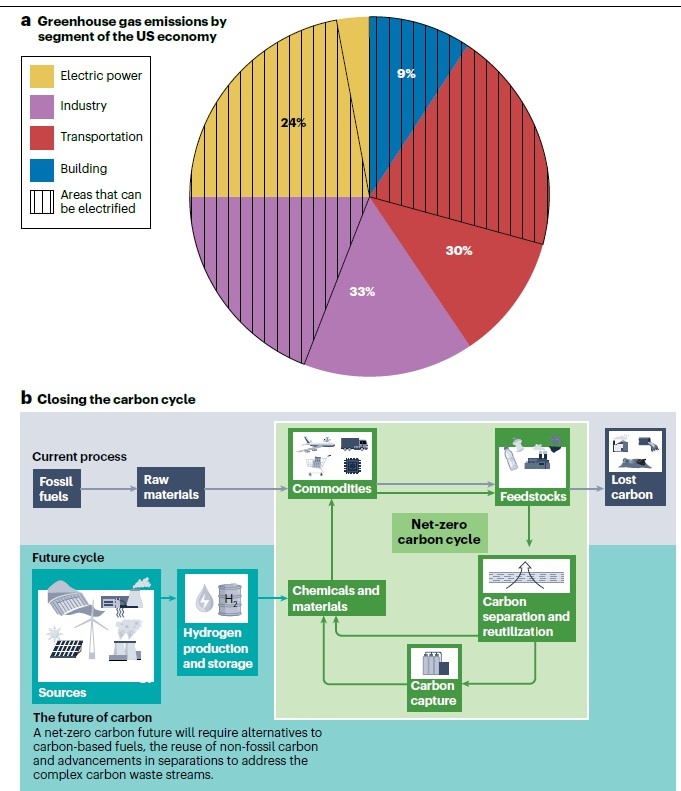
Figure above shows Closing the carbon cycle to remove CO2 greenhouse gas (GHG) emissions.
-a, Chart showing the percentage of GHGs coming from different segments of the US economy. The four major sectors are electric power (yellow), buildings (blue), industry (purple) and transportation (red). The portions of these segments that are marked by parallel black lines indicate areas that can be electrified. The segments that will be difficult to electrify are shown as solid colours. Industry, electric power, and transportation sectors have opportunities to decarbonize and contribute to about 20% of the current GHGs, driving the need to achieve net-zero carbon for these areas as well.
-b, The future of net-zero CO2 emissions for hard-to-electrify industries involves moving away from fossil fuels and our current linear use of raw materials (top). It focuses on providing alternatives to carbon-based fuels (that is, H2) and reusing available ‘above-ground’ carbon, such as traditional waste sources: CO2, biomass, food waste, polymers, and biogenic or stranded CH4. Energy-efficient separations must be achieved to allow the use of more complex carbon feedstocks without increasing CO2 emissions from inefficient separations. Moving to the proposed carbon cycle of the future would build upon renewable energy sources, such as wind and solar, as well as clean H2, which can be used both for keeping carbon in play to serve as energy carriers and for long-duration energy storage.
_
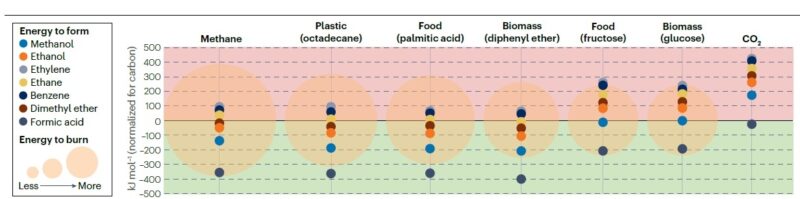
Figure above shows the energetics of various feedstocks and of their conversion. A diagram capturing the overall energetics of the carbon streams discussed in this Roadmap to aid in evaluating the most energetically useful carbon streams. The smaller dots represent the difference in enthalpy of formation (kJ/mol; normalized for the number of carbons) of a series of common platform chemicals made from the indicated source feedstock, in which a value below 0 indicates a thermodynamically favourable process, and a value above 0 indicates a thermodynamically unfavourable process that requires energy input for the conversion. Zero kJ/mol is indicated by a bold line. The larger orange circles in the background represent the energy available (based on energy to burn in kJ/mol, normalized for the number of carbons) in each feedstock. In assessing the conversion of these feedstocks to other chemicals, data indicate that the transformation of CH4 to formic acid, ethanol, methanol and dimethyl ether is energetically downhill whereas, in the case of CO2, only its conversion to formic acid is energetically favourable. CH4 and polymers require the lowest energy to be converted to other chemicals and have the most energy to burn. Food waste and biomass have a medium level of energy to burn and require a relatively high energy to convert to many chemicals. CO2 needs the most energy to be converted, and it has no energy to burn. Comparing the enthalpies of formation and energies of combustion allowed us to be reaction-agnostic, a simplification enabling this qualitative comparison on the potential of each feedstock. To fully assess the suitability of any of these feedstocks in a given process, a full energetic analysis would be needed, in addition to a life cycle analysis assessing all energy inputs, including the transportation of feedstocks.
_
Ammonia:
For difficult-to-electrify sectors, NH3 is being considered as an alternative to carbon-based fuels. The maritime industry is particularly focused on using NH3 fuels through both direct combustion in specially designed 2-cycle engines and in fuel cells. There are advantages of using NH3 as a fuel compared with H2, including an energy density about 30% higher than liquid H2 and storage requirements that are less stringent than those for H2 (NH3 is already used as a refrigerant). In addition to direct combustion, for transportation, NH3 can be oxidized directly in fuel cells to release electrons (and protons), providing advantages in energy efficiency with respect to combustion. A recent technoeconomic analysis demonstrated that direct ammonia fuel cells can be cost-competitive with carbon-based fuels.
In addition, NH3 can be used as a hydrogen storage medium, subsequently being catalytically decomposed to H2 and N2. This technology is currently being developed and commercialized to provide H2 for fuel cell applications.
Although the long-established Haber–Bosch process catalytically reduces N2 to NH3 on a massive worldwide scale, a substantial effort has been devoted to achieving NH3 synthesis electrochemically, ideally with much lower energy input and greatly reduced environmental impact. Molecular catalysts have been studied in detail. Although important advances have been reported in the design of heterogeneous catalysts, further improvements are needed to lower the overpotential, increase the Faradaic efficiency, improve selectivity and minimize competitive H2 production.
Despite the promise of NH3 fuels, there are still limitations to consider. With respect to GHG emissions, the byproducts of the combustion of NH3 at high temperatures, NxO and NOx, are substantially more potent greenhouse gases than CO2. Notably, N2O has almost 300 times the global warming impact of a similar weight of CO2. There are also concerns that the use of NH3 could disrupt the nitrogen cycle, promoting eutrophication and air pollution.
_
Hydrogen:
Another carbon-free alternative fuel is H2. The versatility of H2 ensures that it will play a key role in reducing carbon emissions in both industrial and energy sectors. The current cost for transport is US$10 /kg H2, an order of magnitude greater than the targeted production cost. There are several current options, but none of them viable on a large scale. For instance, H2 can be transported in pipelines, but there are currently only 1,600 miles of H2 pipelines in operation within the USA, and the infrastructure cost is high. H2 can be transported as a 10% mixture in current natural gas pipelines without degrading the pipeline, but H2 may require a separation step for use. Tube trailers can be used for transporting limited amounts of compressed gaseous H2 (250 kg at 200 bar). Multi-layered vacuum-insulated double-walled vessels can transport 4000 kg of liquid H2; however, liquefaction is an energy-intensive process with about 35% efficiency. Although these forms of H2 transport are helpful in the short term, new infrastructure is needed in the mid-to-long term if H2 is to play a greater role in reducing carbon emissions.
As renewable power resources are developed in the short term, the electricity generated should be used directly to replace power provided by fossil sources to reduce GHG emissions. However, as excess renewable energy becomes available, novel approaches to store energy for longer durations need to be developed to achieve the US 2050 goals. By 2050, the Energy Information Administration predicts that there will be an excess of wind and solar resources in the USA and a need to store between 35,000 and 200,000 GWh of energy daily. At these large scales, because power and energy are decoupled, storing energy in the form of H2 is expected to be more economical than batteries, because adding additional storage (energy) only needs relatively inexpensive tanks.
_
Hydrogen carriers for energy storage and transportation:
Liquid organic hydrogen carriers (LOHCs) are molecules that store energy (H2) in chemical bonds and are derived from carbon feedstocks, such as methylcyclohexane from toluene, methanol and formic acid, which have promising pathways from CO2, or perhydrobenzyltoluene from benzyltoluene. A key differentiator between LOHCs and storage of hydrogen in metals, as hydrides, or carbon sorbents, such as metal–organic frameworks (MOFs), is the need for catalysts to activate C–H, N–H and O–H bonds. Although catalysts and catalytic reactors add complexity compared with metal hydrides and carbon sorbents, LOHCs have the enormous advantage of decoupling power and energy to enable large-scale energy storage (GWh) and long-duration energy storage (>100 h). However, both life cycle analysis (LCA; to show where there is a reduced carbon footprint) and techno-economic analysis (TEA; to show which carbon feedstocks are economically viable) should be used to focus the research on H2 carrier development.
An additional advantage of LOHCs is that the current infrastructure, including pipelines, shipping and rail, for transporting liquids nationally or internationally would only need moderate modifications to transport LOHCs. H2 carriers can also be used to provide energy in difficult-to-electrify sectors, such as heavy-duty, long-haul transportation.
_
Keeping carbon in play:
Keeping carbon in play is defined as a carbon cycle in which every carbon atom within products and waste streams is reused, ideally multiple times. Here multiple feedstocks could be used, including CO2, biomass, food wastes, plastics/polymers and biogenic CH4. In the illustration of feedstock energies in Figure above, CH4 and plastics have the highest enthalpy of combustion, as can be determined from the size of the orange circles. The conversion of these two feedstocks into many major platform chemicals is also thermodynamically favourable, given that most of the products, shown as small dark circles, have a negative enthalpy of formation, as illustrated by the fact that they lie below 0 kJ /mol and within the green band. Food waste and biomass are about equivalent, having somewhat less energy to burn (smaller orange circles) than CH4 or plastic, and their conversion to major platform chemicals is generally less energetically downhill, or even uphill, as illustrated by the majority of the small dark product circles lying above 0 kJ /mol. The most difficult to convert and with the least energy to burn is CO2. This property is unfortunate when considering CO2’s abundance. Therefore, converting non-CO2 sources of carbon to new materials makes more energetic sense, followed by filling any remaining carbon needs with CO2.
Transportation of these wastes over long distances is not practical from an economic or carbon footprint point of view. A possible solution is the development of small modular reactors at or close to the source of the feedstock, which would likely involve new chemical processes. This will require access to renewable energy at the point of generation to avoid increased GHG emissions and complete life cycle analyses of the overall process would be needed.
The described feedstocks will be quite complex, with many types of carbons as well as a variety of other constituents. Due to the complexity of these feedstocks, energy-efficient separations are an additional need. Currently, separations processes consume 10–15% of US energy. Therefore, the development of energy-efficient separations will be needed to keep CO2 generation low.
_
Feedstocks:
Here we focus on the availability and the pros and cons of using major non-fossil carbon sources, including CO2, biomass, food waste, plastics waste and CH4, as carbon feedstocks. The attributes of renewable carbon feedstocks including availability, quality, impurities, energy content, and energy input needed for conversion to desired products are summarized in table below:
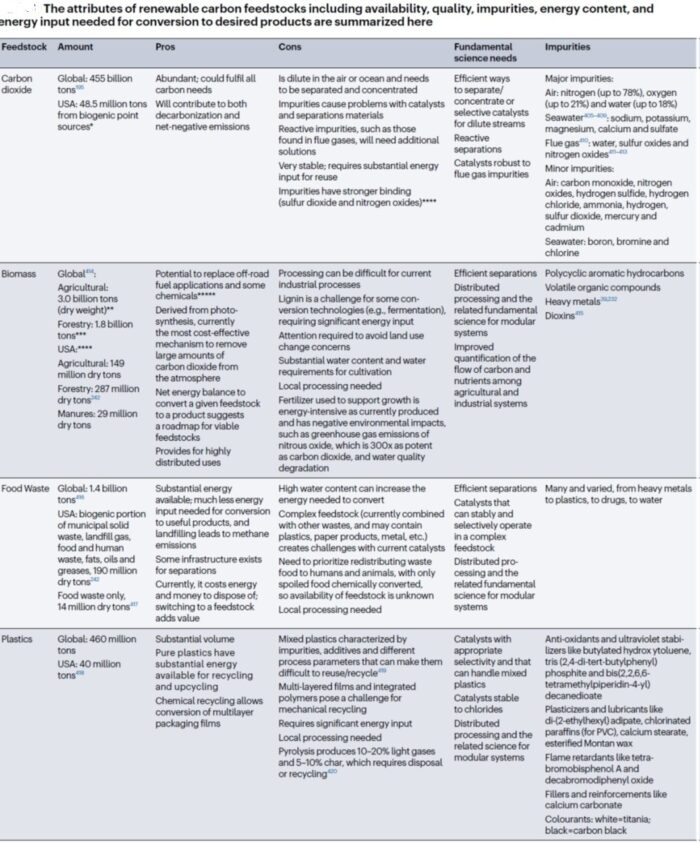
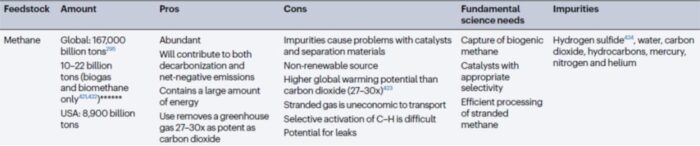
Multiple substantial carbon feedstocks exist without the need to extract new fossil fuels. Each feedstock has different availability, quality, impurities, energy content and energy input needed for conversion to desired products. Based on these features, each stream may be suited to specific ideal products. Those attributes are summarized here.
*Calculated based on emissions from the corn ethanol, wine and beer industries.
**Considers the major global crops (wheat, maize, rice, soybean, barley, rapeseed, sugarcane and sugar beet) in the selected countries/regions with large biomass potential (Europe, USA, Canada, Brazil, Argentina, China and India) and assumes an average crop residue moisture content of 8%, based on values in PHYLLIS database. An alternate source suggests that the amount of biomass could be highly variable, ranging from 5 to 95 billion tons dry weight, with variability due to assumptions on crop yield trends, land use, population, diet changes, and so on.
***1.3 Gt per year goes to fuel purposes and 0.9 Gt per year is primary residues for a total of 2.2 Gt per year, or 1.8 Gt per year dry weight, assuming reported weight was fresh and using a 16.67% average moisture content.
****Excludes energy crops (239 million dry tons).
*****We want to avoid the 30% of the gasoline market that represents the light-duty and medium-duty vehicles, which will be electrified.
******Biogas is projected to be available in quantities sufficient to meet a noticeable fraction of future fueling needs, but only at costs that are five to ten times the current price of fossil fuels.
_
As we consider the various feedstocks’ ability to be converted into platform chemicals, the comparison in earlier figure shows that CH4 and plastics have the highest enthalpy of combustion, and the formation of many major platform chemicals from them is thermodynamically favourable. The routes to platform chemicals using CH4 include C1 and C2 chemistry of synthesis gas (CO plus H2) made by steam reforming. The routes starting from plastics will depend on the type and purity of the feedstock. If it is a mixed feedstock then either steam gasification or pyrolysis could be effective, the former yielding syngas, the latter yielding mixed hydrocarbons that would need to be fractionated, much like petroleum into streams (olefins, aromatics and oxygenates) that could be converted further. Similar routes extend from biomass and food waste. Processing of waste plastic would be needed to avoid downstream contamination by halogens (polyvinylchloride and additives). Speciating the plastics into easily depolymerized fractions, such as polystyrene and polyethylene terephthalate, can allow the production of repolymerizable monomers styrene, terephthalic acid and ethylene glycol. Alternately, carbonization of either CH4 or waste plastic can produce valuable carbon products and H2. Each process would benefit from research on the catalysts and reactors. In summary, all the major platform chemicals made from petroleum are accessible starting with waste or non-fossil carbon sources.
______
______
Section-14
Defossilization of other sectors:
___
Defossilization of Textile production:
Please read section:8 ‘Feedstocks for defossilization (alternate carbon sources)’ wherein various methods of textile recycling are discussed. Now I will discuss defossilization of textile production which includes textile recycling.
_
Textiles are an integral part of our society because clothes provide comfort, protection, and temperature regulation to people, while domestic textiles provide utility around the house, and technical textiles play crucial roles in their respective industries. These industrial applications may even have positive effects on sustainability, such as textiles used for wastewater treatment and material recovery. While the global significance of textiles is unquestionable, the sustainability of the textile sector is still far from optimal. A sustainable industry can be defined as one that provides for the needs of the current generation without compromising future generations’ ability to do the same, smartly integrating material usage and the environmental impact of production. More generally, three aspects of the industry can be looked at: the economic, social, and environmental aspects. This is the so-called “triple bottom line” framework coined by John Elkington in 1994.
_
When it comes to the economic aspect, the textile industry is a global giant. The worldwide production of textile fibers reached 113 million tons in 2021—up from approximately 24 million tons in 1976—and continues to grow at a consistent rate of 3.4%. This represents a vital fraction of the world’s economy, with textiles representing 4.19% (USD 882 billion) of the world’s total trade in 2021 as the seventh most-traded product. This is expected to grow to USD 1320 billion by 2030. Within Europe, this industry’s largest subsectors are clothing and accessories (37%, including workwear), industrial and technical textiles (17%), fabrics (15%), and home textiles (14%).
_
From today’s vantage point, the idea that the global textile industry could meaningfully wean itself off fossil carbon in the foreseeable future is not just optimistic, it should be considered structurally implausible. Sustainability narratives that emphasise material substitution and circularity, massively underestimate the extent to which textiles are embedded in a broader fossil-based industrial system – chemically, energetically, and economically.
_
As illustrated in Figure below, textiles start their life cycle as non-polymers, naturally occurring polymers, or building blocks that are synthesized into synthetic polymers. These polymers can then be extruded into fibers, although naturally occurring fibers that do not need to be extruded also exist, such as cotton or wool. Whatever their composition, many fibers can, at a further stage, be combined by spinning them into yarns to then make fabrics via different processes (weaving, knitting, braiding, etc.), or they can be bound (e.g., by adhesives) and turned into nonwoven fabrics. Final processing into a finished textile product involves coloration and finishing treatments.
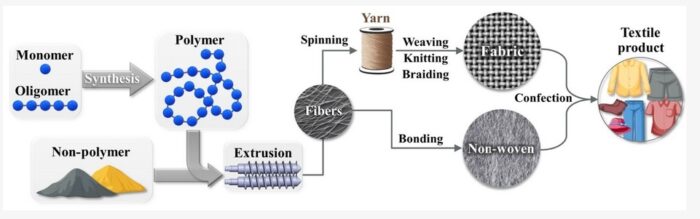
Figure above shows the textile manufacturing chain, from building block to end product.
______
Where are fossil fuels embedded in the textile industry:
Synthetics:
At the most visible level, the industry’s dependence is obvious. Almost 70% of global fibre production is directly fossil-derived, dominated by polyester, nylon, and other synthetics. Polyester alone accounts for more than half of all fibres produced worldwide, and its production is inseparable from petrochemical feedstocks derived from oil and gas. The intermediates and monomers that form the building blocks of synthetic fibres are not incidental by-products of refining; they are primary outputs of a system optimised to transform fossil carbon into durable, high-performance polymers.
Biobased Fibres:
Yet focusing only on synthetics understates the problem. The remaining 30–35% of fibres: cotton, wool, linen, and man-made cellulosic fibres (MMCFs) such as viscose, are often portrayed as “natural” or bio-based alternatives, but in industrial reality they are deeply dependent on fossil-derived inputs at multiple stages. In cotton and linen processing, fibres must be scoured with strong alkalis to remove waxes and impurities, bleached using oxidising agents such as hydrogen peroxide, and dyed with reactive colourants derived from petrochemical aromatics; finishing steps add synthetic resins, silicone softeners, and water-repellent coatings, all fossil-based. Wool requires detergent scouring to remove lanolin, acid-based treatments to eliminate vegetable matter, and polymer-based shrink-resist finishes, again relying on petrochemical chemistry. Even in MMCF production, where the raw material is wood pulp, the fibre is dissolved and regenerated through chemically intensive processes using solvents, alkalis, and sulphur-based reagents, and is subsequently dyed and finished using the same petrochemical-based auxiliaries as other fibres. Across all these fibres, dyes, surfactants, dispersants, and finishing agents are overwhelmingly derived from fossil feedstocks, while many of the upstream inputs such as fertilisers, pesticides, and processing energy are also fossil-based. In this sense, natural and bio-based fibres do not eliminate fossil carbon from textiles, they rely on it at nearly every step of their industrial transformation. They do not eliminate fossil carbon from textiles; they relocate it from the polymer backbone to the processing chemistry and agricultural inputs. The system remains fundamentally fossil-linked either way.
Process Energy:
Energy use reinforces this dependency. Textile manufacturing, particularly wet processing, is highly energy-intensive. Dyeing and finishing require large volumes of high-temperature steam, most of which is generated from coal or natural gas, especially in key production hubs across Asia. Even processes that are already electrified, such as spinning and weaving, draw power from grids that remain 75-90% fossil-based in countries like India, Bangladesh, and Indonesia. Electrification, in this context, does not equate immediate decarbonisation.
Global Transport:
Transport adds another layer of lock-in. Textile supply chains are global by design, with fibres, yarns, fabrics, and finished goods moving across continents multiple times. Around 90% of global textile trade by volume is transported by sea, supplemented by air freight for time-sensitive products. Both modes remain, likely for many decades, overwhelmingly dependent on fossil fuels, with no scalable CO2-neutral fuel alternatives in the near term.
Market Growth:
End market demand dynamics make the challenge even more intractable. While consumption may stabilise or decline slightly in mature economies, this effect is completely overwhelmed by growth elsewhere. In emerging economies, home to the majority of the world’s population, rising incomes are driving rapid increases in textile consumption. Global fibre production has grown from ~25 million tonnes in 1970 to over 120 million tonnes today, and is projected to reach 150–160 million tonnes by 2030. Crucially, the vast majority of this growth will come from emerging markets, where billions of consumers are entering the middle class. Any reductions in consumption in Europe or North America are arithmetically insignificant compared to this expansion.
Technical textiles:
Moreover, a growing share of textile demand is not discretionary. Synthetic fibres, in particular, play an essential role in technical applications: medical supplies, automotive components, construction materials, agricultural systems, and protective equipment. In many of these uses, their performance characteristics – strength, durability, chemical resistance – are difficult to replicate with bio-based alternatives. Technical textiles already represent about 40% of global textile fibre demand and as infrastructure expands and safety standards rise globally, demand for these materials will continue to grow structurally.
Petrochemical Systems Complexity:
A further, often overlooked constraint lies in the economic architecture of the petrochemical industry itself. Synthetic fibres depend on petrochemical intermediates, which in turn are deeply intertwined with the fuel system. Today, the vast majority of crude oil – around 85–90% – is refined into transport fuels, which provide the economic backbone of the industry. Petrochemicals, including the precursors of polyester and nylon, represent a much smaller share of output and typically rely on the same infrastructure and feedstock streams.
This creates a critical interdependence. If fuel demand declines rapidly, through electrification of transport, for example, the result is not a simple reallocation toward materials. Instead, it risks undermining the economics of refining itself, leading to plant closures, reduced throughput, and tighter availability of petrochemical feedstocks such as naphtha and aromatics. Petrochemicals cannot simply “scale up” to replace fuels; their markets are too small, and their margins too volatile. In this sense, the textile industry’s reliance on fossil carbon is reinforced not only by chemistry, but by the economic structure of the fuel system that sustains it.
_
Defossilization of textiles is the systematic shift away from fossil-based raw materials (polyester, nylon, elastane) and processes in the fashion/apparel industry. It involves adopting bio-based, recycled, and circular materials, alongside sustainable chemistry—such as chemical recycling and enzymatic hydrolysis—to replace petroleum-derived inputs. This transition targets reducing the industry’s massive carbon footprint and waste.
Key Aspects of Textile Defossilization:
- Material Shift: Moving from virgin polyester (petrochemicals) to recycled polyester, bio-based synthetic fibers, and natural fibers.
- Recycling Technologies:
-Chemical Recycling: Technologies like Glycolysis and Aminolysis break down polyester waste into monomers to create new, high-purity fibers.
-Enzymatic Hydrolysis: Using fungi-derived enzymes to break down cotton waste into glucose.
-Decolorization: Innovative methods like Supercritical CO2-assisted decolorization allow for the removal of dyes from garments, enabling high-quality fiber-to-fiber recycling.
- Process Improvement: Replacing petrochemical-based dyes and coatings with bio-based alternatives and switching to renewable energy in manufacturing.
_
Even if fossil-free textiles are technically achievable, cost remains a binding constraint. Low-carbon fibres, alternative chemistries, and electrified processes all come at a premium. In a global market where affordability is critical – particularly in emerging economies – these costs cannot easily be passed on to consumers. The result is a structural tension between sustainability ambitions and economic reality.
Taken together, these dynamics suggest that a rapid phase-out of fossil carbon in textiles is unlikely. More realistically, absolute fossil resource use in the sector will likely remain on a high plateau or even continue to grow into the early-to-mid 2030s, as demand expansion outpaces efficiency and decarbonisation efforts. From the mid-to-late 2030s we may start to see real decoupling, based on deep structural changes across global energy systems, while global transport, chemical production, and consumption patterns may take longer to adapt.
_
Accelerating that transition will require coordinated action on multiple fronts:
- First and foremost, applying easily available energy-efficiency measures and state-of-the-art technology across the whole supply chain;
- decarbonising electricity grids in key manufacturing regions and intentionally shifting production to areas of available low-carbon electricity;
- installation of viable alternatives for high-temperature process heat such as heat pumps and electric boilers;
- scaling fibre-to-fibre recycling especially for synthetics while using low-carbon process energy;
- advancing biobased material innovation and biochemistry;
- and aligning policy frameworks to reflect the true cost of carbon.
Crucially, it will also require confronting the systemic nature of the challenge. The textile industry is not merely a user of fossil carbon; it is an extension of the fossil-based industrial economy. Replacing it is not a matter of switching materials, but of transforming an entire system. Until that reality is acknowledged, the vision of fossil-free textiles or net-zero industry operations will remain more aspirational than achievable.
_______
Textile recycling (vide supra, section:8):
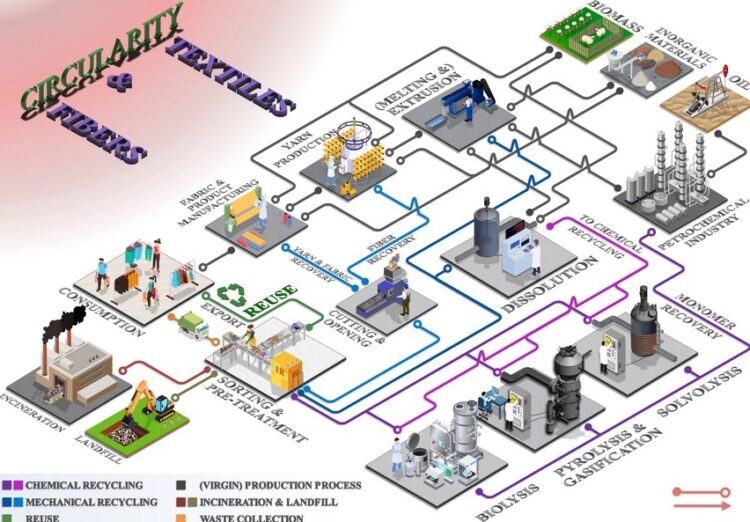
As textile production continues to grow worldwide, managing the mounting waste generated by this industry is becoming an urgent environmental concern. Globally, over 92 million tons of textile waste are produced annually, much of which is incinerated or disposed of in landfills, contributing to greenhouse gas emissions, soil and water contamination, and ecosystem harm. Various chemical and biotechnological methods, such as acid hydrolysis (achieving up to 70% glucose recovery) and enzymatic recycling (reducing energy consumption by approximately 20% compared to conventional methods), can transform textile waste into valuable resources, fostering a shift toward a circular economy that minimizes reliance on virgin materials. However, the diverse nature of textile waste—particularly in mixed fibers and materials treated with various finishes and additives—adds complexity to recycling processes, often necessitating specific pretreatment steps to ensure both efficiency and economic viability. Scalable solutions such as advanced solvent recovery systems, optimized pretreatment techniques, and fluidized-bed pyrolysis (which can increase bio-oil yields by up to 25% compared to fixed-bed reactors) play crucial roles in making textile recycling more sustainable and adaptable at an industrial scale.
_
Various methods that have been developed to recycle textiles include physical recycling, chemical recycling (differentiating between solvolysis, pyrolysis, and gasification, all aiming at different small chemical products depending on the type of process and textile waste), biological recycling (e.g., enzymolysis and fermentation), composting, and mechanical recycling (in which the polymer structure of the textile is preserved). Mechanical recycling techniques may involve fiber, yarn, and/or fabric recycling, or the conversion of textiles into primary raw materials through dissolution and/or re-extrusion to enable fiber production or for other purposes.
_
Mechanical recycling, while cost-effective and environmentally favorable, is limited by its inability to maintain fiber quality over repeated cycles, especially for blended fabrics. Polymer recycling, which involves melting or dissolving waste polymers, offers higher-quality outputs but is more resource-intensive. Chemical recycling methods like solvolysis and pyrolysis hold the potential for producing virgin-quality monomers, particularly for synthetic fibers, while biological recycling shows promise for natural fibers. However, these methods face significant scalability challenges due to high energy consumption and operational costs.
_____
_____
Defossilization of Pharmaceuticals:
The transition from the carbonization of wood to the coking of coal marked the beginning of industrial organic chemistry. This step was an advance in the sense of sustainability, which we who strive to produce less and less carbon dioxide may not immediately recognize as such. In fact, there is even a lesson in it for us today, as explained herein. At the end of the 19th century, thus coal tar, a byproduct of degassing and coking of coal, became the main source of raw materials for the emerging organic chemical industry because of its high content of aromatic compounds, which were used to manufacture artificial dyes — and soon also pharmaceuticals. However, because yields were low and the demand for organo-chemical raw materials was steadily growing, coal as the main fossil source was displaced by oil in the early 20th century. And this is still where we stand today. The current generation of chemists must turn over a new page in history and face the task of decoupling organic chemistry from petroleum, a finite fossil stock, and — on top — of helping to improve humanity’s climate gas balance on the road to climate neutrality. This is what we call defossilization. The term decarbonization does not make sense if one talks about the future of industrial organic chemistry, as organic chemistry (and biotechnology) cannot be decarbonized as all molecules by their nature contain carbon atoms.
_
In the manufacturing of small molecule pharmaceuticals, the top ten chemical substances used are organic chemicals, which presumably are all of fossil origin. To advance the defossilization of pharmaceutical manufacturing, one should then focus on the largest mass streams of organic chemicals. When defossilization of these high-volume organic chemicals advances, also active pharmaceutical ingredients and their intermediates could be defossilized. This goal would gradually be achieved as a consequence of defossilizing the large chemical commodities, which are the basis of making fine chemicals, which are the building blocks of active pharmaceutical ingredients.
_
The United States Food and Drug Administration define biologics as ‘biological products’ (which) include a wide range of products such as vaccines, blood and blood components, allergenics, somatic cells, gene therapy, tissues, and recombinant therapeutic proteins. Biologics can be composed of sugars, proteins, or nucleic acids or complex combinations of these substances, or may be living entities such as cells and tissues. Biologics, in contrast to small-molecule pharmaceuticals, are not chemically synthesized but mostly manufactured by fermentation. Up to 60% of bioprocess raw materials, including chemicals used for sanitization and storage may be of fossil origin. However, for drugs derived from fermentation, most of the fossil-derived impact comes from energy usage. The fermentation process itself requires extremely sterile conditions, therefore, the process is operated under cleanroom conditions in contrast to small-molecule manufacturing, which instead relies on organic solvent to limit microbial contamination.
_
If the pharmaceutical industry is successful in defossilizing its products, this could spark innovation and make non-fossil resources more attractive for other sectors, for example, for fine and specialty chemicals, in vitro diagnostic reagents, plastics, fertilizers, textiles, and so on. Defossilization of the chemicals used for pharmaceuticals will reduce net emissions by reducing the use of fossil carbon sources. To reach a net-zero world, it is of particular importance that the energy input to the production processes comes from renewable energy.
_
Options to defossilize the sector include biobased chemicals from waste such as renewable solvents. The agricultural, forestry and fishing industries produce waste of biogenic carbon origins, such as oils (fish, vegetable or plant), rice straw, and wood remnants. Presently, plenty of carbon dioxide is still generated by industrial sources, such as plants for cement and coal power, from which the carbon dioxide can be captured and applying direct air carbon capture coupled with green energy use has the greatest potential for climate change mitigation and nature conservation. Essentially, we see two technologies relevant in the context of defossilization of pharmaceutical manufacturing: bio-based chemicals, and direct carbon capture and processing into organic building blocks.
(a) Bio-based chemicals:
Here bio-based chemicals are those manufactured from crops, although this comes with the risk of ecological (extensive land use, monoculture, biodiversity loss) and social disadvantages (competition with food crops). Therefore, this class of chemicals can be seen as a bridging solution in the current phase of defossilization efforts, but in the long term, it can probably only play a niche role in the supply of raw materials for chemical and pharmaceutical production. There are of course further sources of biologically generated organic matter, such as waste from the fishery, livestock breeding, food scraps, or forestry, that can be recycled. These are also limited resources, which are already now in high demand and largely processed. Another option includes using biomass by-products from other industries such as pulp and paper production, for example, producing bio-based sodium polyacrylate (a polymer often used in hygiene products) from pulp mill side streams.
There are also opportunities in using non-agricultural biologic manufacturing methods, such as aquaculture or algae farming or artificial photosynthesis. These methods are also using atmospheric CO2 as a carbon source and are actually a transitional form to the methods discussed in the following paragraph.
(b) Direct carbon capture and processing:
This is the key technology to achieve defossilization of the organic-chemical raw material base of chemical and pharmaceutical manufacturing. The basic idea is to sustainably generate electricity and use this energy to bind carbon dioxide by the means of electrolytically generated hydrogen, after further process steps, produce the desired substances or materials. This technology is called Power-to-X (P2X or PtX). Applying P2X means that humanity would begin to assimilate — like a plant — autotrophically. That is what it means to turn power into X, where X stands for much more than organic chemicals, for instance, also for fuel, food, or plastics. It should be noted that the air is a very dilute source of carbon and it requires large amounts of energy for separation to create purified CO2 streams. To be economically viable, this requires a certain price of sustainably generated electricity.
___
Examples of defossilization in pharmaceutical manufacturing:
Defossilization in pharmaceutical manufacturing mainly means replacing fossil-based carbon on the molecule building and process operations side with renewable or recycled carbon sources, while keeping product quality and safety intact. Here are concrete types of examples seen in industry and research.
-1. Renewable carbon building blocks
- Using bio based starting materials (e.g., sugars, fatty acids, or terpenes from non-food biomass) to synthesize Active pharmaceutical ingredients (APIs) or intermediates instead of petrochemicals.
- Switching to bio derived solvents (such as ethanol or ethyl lactate from fermentation) in crystallization, extraction, or cleaning steps to reduce fossil derived solvent use.
-2. Solvent and reagent reduction / recycling
- Redesigning API routes to shorten synthesis (fewer steps, fewer reagents) and cut fossil derived solvent volumes, as done by companies like Lupin on multiple APIs.
- Installing on site solvent recovery (distillation, membrane separation) so the same fossil based solvents are reused many times, effectively “diluting” new fossil carbon intake.
-3. Green hydrogen and energy linked defossilization
- Powering reduction or hydrogenation steps with “green” hydrogen (from electrolysis with renewable electricity) instead of hydrogen from steam methane reforming, which removes one fossil carbon input from the process train.
- Shifting plant scale energy (heat, steam, cooling) to renewable electricity or biomass based heat, which indirectly supports the defossilization of carbon containing intermediates by decoupling the plant from fossil fuel infrastructure.
-4. Defossilized specialty chemicals supply chains
- Sourcing key intermediates (e.g., certain amines, alcohols, acids) from “defossilised” organic chemical suppliers that use CO₂ based, biomass based, or recycled carbon routes, as proposed by companies such as Roche for their supply chains.
- Building multi company “green API” value chains where carbon source transparency (bio based, CO₂ derived, or recycled) is tracked from raw material to finished tablet or vial.
______
______
Defossilization of Glass:
Defossilization of Industrial Glass Production via Carbon Capture and Utilization of Flue Gas, a 2026 study:
The glass industry faces significant challenges in achieving carbon neutrality due to its reliance on fossil fuels and process-related CO2 emissions from raw material decomposition. While most defossilization efforts focus on CO2-neutral heating, batch-related emissions remain largely unaddressed. This study investigates a closed carbon cycle approach for glass manufacturing by integrating carbon capture and utilization (CCU) with power-to-gas technologies. The proposed process captures both combustion- and batch-related CO2 emissions and converts them into synthetic natural gas using renewable hydrogen. The techno-economic model, based on a typical oxy-fuel container glass furnace (300 t per day) and current (2022) German market conditions, covers all key process steps: flue gas cleaning, CO2 separation, hydrogen production via electrolysis, and methanation. Results show that more than 99 % of scope 1 emissions and about 62% of scope 1+2 emissions can be abated. However, the process is associated with high energy demand and costs, with energy supply alone amounting to €559 (2022) per metric ton glass at an electricity price of €60 per MWh. The cost of CO2 abatement is estimated at €1132 (2022) per metric ton. While all process steps are based on established industrial technologies, the overall economic viability remains highly sensitive to electricity prices and further technological improvements. The approach is especially relevant for high-quality glass production with low cullet content and in regions with abundant renewable electricity.
_
Model description:
Authors model integrates five modules to establish a closed carbon cycle for glass manufacturing: (1) the glass furnace serves as the core process unit; (2) flue gas purification captures raw CO2 emissions; (3) the electrolyzer unit produces renewable hydrogen; (4) syngas purification prepares synthesis-grade H2/CO2 mixtures; and (5) the methanation unit converts syngas into furnace fuel. Authors selected each technology to ensure seamless integration with both upstream and downstream units. For instance, they tailored the methanation unit (5) to match the glass furnace’s fuel demand (1), while designing gas purification steps (2, 4) to meet stringent CO2 specifications for methanation (5). Figure below illustrates the process chain schematically.
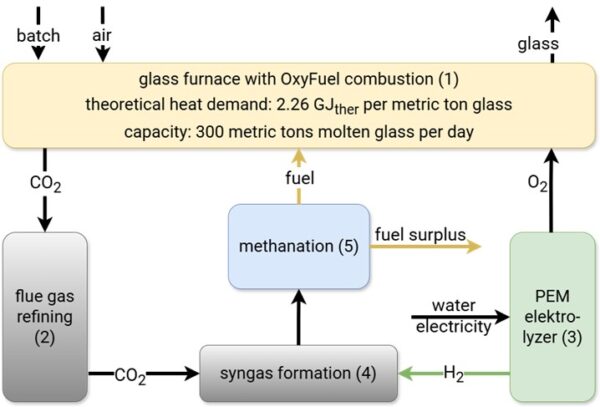
_
The suggested process cycle enables the abatement of more than 99 % of the scope 1 emissions at a glass production plant. When including scope 2 emissions associated with the electrolysis unit, the overall abatement is about 60 %, based on the prognosed energy mix of 2035. Although the interaction of all implemented technologies has not yet been fully investigated, each process step is well established in different industrial applications. Therefore, their integration should not pose major challenges for the process chain. However, the proposed process comes with several drawbacks, particularly regarding energy efficiency, use of rare elements, and, most importantly, economic viability. The combination of multiple technologies, such as wet lime scrubbing, nitrogen removal unit, hydrogenation, guard beds, methanation, and PEM electrolysis, result in a relatively high level of complexity. This complexity can be reduced by outsourcing certain steps to external partners. As the suggested process chain has not been thoroughly tested, authors assessed a technological readiness level of 3, even though all selected technologies are industrially proven.
At the same time, the cost of energy supply for glass production at an average electricity price of €60 per MWh (2022) amounts to €559 per metric ton molten glass (2022). This is significantly more than the current cost of fossil energy, which was around €174 per metric ton molten glass in 2022. From a CO2 abatement perspective, the proposed process chain leads to an increase in cost of €1,130 (2022) per metric ton CO2 avoided.
_____
_____
Defossilizing the transportation sector:
The defossilization of transportation is the global shift away from petroleum-based fuels toward zero-carbon energy sources. It involves replacing internal combustion engines with electric drives and utilizing renewable, carbon-neutral drop-in fuels to drastically cut greenhouse gas emissions.
Achieving a fully defossilized transportation sector relies on a multipronged approach:
- Avoid & Shift: Reducing overall travel demand through better urban planning and shifting to highly sustainable public transit, walking, and cycling.
- Electrification: Transitioning passenger cars, light commercial vehicles, and some short-haul transport to battery-electric vehicles (BEVs) or hydrogen fuel cells.
- Renewable & Synthetic Fuels: Utilizing zero-carbon fuels (hydrogen, ammonia, e-fuels, and biofuels) for hard-to-electrify sectors like aviation and long-haul maritime shipping. While passenger cars are easily electrified; heavy-duty transport, aviation, and shipping require energy-dense liquid fuels that provide massive power without drastically increasing vehicle weight. To solve this, innovators are developing drop-in synthetic fuels. For example, companies are producing liquid renewable fuels by capturing carbon dioxide directly from the air and using solar energy to transform it into sustainable kerosene.
______
______
Defossilization of Copper production:
Power-to-H2 in Copper Production:
Today, copper production is a CO2-intensive process that consumes high amounts of fossil fuels both as reducing agent and for supply of thermal energy. To cut CO2 emissions, electrifying energy-intensive processes is regarded as promising. A study explores the techno-economic potential of power-to-H2 technology as an enabler for defossilization of copper production. On-site integration of water electrolysis and copper production eliminates the need for long-distance H2 transport and allows to utilize the electrolysis byproduct, O2, to partially substitute the demand for cryogenic air separation. Aiming for deep defossilization, researchers consider the use of H2 as both chemical feedstock, i.e., reducing agent, and as fuel to produce high temperature process heat. To determine the minimal cost of retrofitting an existing copper production plant with power-to-H2 technology, researchers develop a mixed-integer linear programming model. The results show that, under today’s electrolysis investment cost and electricity prices, the resulting CO2 abatement costs vastly exceed current European CO2 certificate prices. However, for the year 2050, the CO2 abatement costs would be in line with CO2 prices expected in the later stages of the energy transition, suggesting that power-to-H2 could provide a pathway to defossilize copper production.
_____
_____
Section-15
Cost of Defossilization:
Defossilization—replacing fossil raw materials with renewable carbon (biomass, recycling, CO2)—carries a high economic premium, often 3–9 times more expensive for products like renewable ethylene. Costs are driven by high electricity demand for green hydrogen ($4–$7/kg), but in some cases, lower feedstock prices like biogas can offer competitive alternatives. The cost of defossilization in energy-intensive industries, such as chemicals, steel, cement, or aluminum in EU, is projected to be around 67 billion euros annually in the future. Defossilization is increasingly viewed not just as a cost, but as a necessary transition to mitigate the high health and environmental costs of fossil fuels.
Cost Drivers & Projections:
- Energy & Feedstock: Electricity constitutes >70% of green hydrogen production costs.
- Industry Examples: Defossilizing industrial glass production can incur CO₂ abatement costs around €1132 per metric ton, with high energy demand driving costs.
- Chemical Sector: Renewable ethylene is 3–9 times more expensive than fossil counterparts. By 2050, costs for synthetic naphtha-based ethylene could reach 480€/t, while CO2 based options could be 1660€/t.
- Alternative Paths: Biogas-based routes for chemical production (like n-propanol) can be competitive, potentially 30% cheaper than traditional methods.
- Feedstock Distribution: Future sustainable feedstocks for chemicals are projected as 55% recycling, 20–25% biomass, and 25–50% CO2-based.
_______
_______
Financing the energy transition:
The last world climate conference in Baku (COP29) once again emphasized the urgency of global defossilization. In view of the advancing climate crisis, the international community has reaffirmed its commitment to limiting global warming to a maximum of 1.5°C. This challenge requires not only technological innovation and political determination, but above all massive financial investment – a key theme of COP29 – and a fundamental redirection of global financial flows.
Although investments in renewable energies and sustainable technologies are increasing worldwide, enormous amounts of money continue to flow into the development and production of fossil energies. In recent years, investments in fossil energy sources have even increased again. In addition, global capital flows into green technologies are still insufficient and unevenly distributed. In this context, key questions arise: How much must be invested in the future in order to achieve the 1.5-degree target? How are current capital flows distributed worldwide and across different areas, and what changes in the framework conditions are associated with the energy transition and climate change?
_
The forecasts for the annual financing volumes required in the International Energy Agency’s (IEA) Net Zero Emission by 2050 Scenario (NZE) vary considerably and range from around EUR 3 to 10 trillion per year. These deviations are due to different approaches and assumptions in the analyses. The studies vary in terms of which expenditure is included. Some focus exclusively on the additional investment requirements for the energy transition, while others also take other cost factors into account, such as expenditure for the acquisition of low-emission consumption technologies or compensation payments for the premature decommissioning of fossil fuel infrastructure, so-called “stranded assets”. In addition, the different levels of analysis – by sector, technology or end application – make it difficult to compare the results. However, there is agreement that the need for capital is considerably higher than the investments currently being made, which underpins the need for significant efforts in climate financing.
_
Significant regional differences can be seen worldwide with regard to investments made in the energy transition. Industrialized countries – 38 states that make up around 14% of the world’s population – have continuously increased their investments in the energy transition and climate protection in recent years. A similar but much slower trend can be observed in developing countries. China’s growing share of global financing volumes for climate protection measures is particularly noteworthy. As an individual country, China is now making a significant contribution, the scale of which has continued to increase in recent years. Germany’s share of global investments amounted to 5.8% in 2023, which corresponds to the third-largest share of investments in climate action measures. The aforementioned differences in investment volumes show that the distribution of climate financing continues to be strongly influenced by the economic performance and political priorities of individual countries.
_
The financial resources required to achieve the global climate targets are available in principle, but require strategic reallocation and realignment. As described above, the estimated annual need for measures to mitigate the effects of climate change and adapt to its consequences is between EUR 2.86 and 10.23 trillion. According to current analyses, however, global capital flows of around EUR 1.62 trillion have only been reached by 2023. The financing gap is considerable, but a comparison with global spending on other areas shows that it is possible to close it as seen in figure below. For example, global military spending in 2023 amounted to around EUR 2.32 trillion, while EUR 2.09 trillion was invested in the digital transformation. Overall, the global capital markets manage considerable assets, reaching around 109 trillion euros by the end of 2022. These figures underline the fact that the challenge lies less in the availability of financial resources and more in their effective mobilization and targeted use for climate protection.
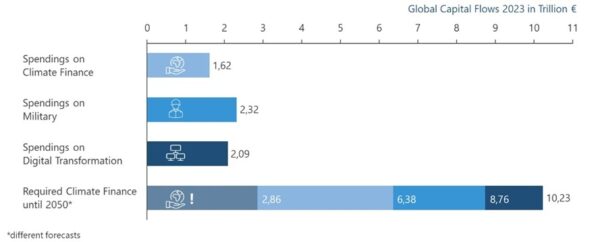
Figure above shows Annual capital flows in selected areas in comparison.
_
Investment requirements in the various areas of the energy transition:
Significant absolute increases in investment are required, particularly in electrified transport and renewable energies, including battery storage systems. In order to achieve the climate targets, investment in electrified transport must be increased by 230% and in renewable energies by 110%. These areas are crucial for the defossilization of transport and energy supply and for a sustainable future.
According to forecasts, electrified transport will account for the largest share of investments for a climate-neutral future. This includes both private and commercial means of transportation. Annual investment must increase from around 602 billion euros/year to around 2,000 billion euros/year.
A large increase in investment is also required in the area of renewable energies and storage systems. Annual investments totaling 1,425 billion euros are required for the energy sector. Of this, around 1,225 billion euros will be spent on expanding emission-free power generation capacities and 200 billion euros on improving grid flexibility through battery storage and seasonal storage systems.
The infrastructure sector includes key measures such as the expansion of electricity grids, the development of interconnected grids and increasing grid flexibility through digitalization and demand-side management in order to ensure a reliable and efficient energy supply. This also includes the massive expansion of the charging infrastructure for electric vehicles and targeted support for their market launch. By 2050, this sector will require an annual investment of around 675 billion euros, which represents a significant increase compared to the current annual investment of 362 billion euros.
In the building sector, annual investment will have to increase from around 261 billion euros today to around 475 billion euros in 2050. This includes around 215 billion euros for retrofitting buildings to increase efficiency (e.g. better insulation) and around 260 billion euros, including 140 billion euros for heat pumps, for a renewable heat supply.
_
The smallest sector in terms of share is hydrogen and the defossilization of industry. However, this is where investment must increase the most in relative terms, with an increase of 300%. This area primarily comprises the production, transportation and storage of hydrogen. In the area of defossilization of energy-intensive industries such as chemicals, steel, cement or aluminium, around 67 billion euros are to be invested annually in the future, with the focus on technologies such as CCS, pyrolysis and hydrogen-based DRI plants.
_
Business-as-usual more expensive than consistent climate protection:
The need for massive investments in defossilization becomes particularly clear when considering the long-term socio-economic consequences. The global economic losses occurring in a “business as usual” scenario make it clear how important measures to curb global warming are. Nevertheless, it should be noted that even in a 1.5-degree scenario, high annual losses are to be expected and the intensity of environmental disasters such as floods, droughts and forest fires will increase. However, the gap between the annual losses of the 1.5-degree scenario and the “business as usual” scenario is almost 17 trillion euros, which is greater than the necessary annual investment in climate protection measures. This shows that measures to mitigate climate change also make economic sense.
______
______
Energy prices key to hydrogen cost-effectiveness, more than carbon price:
Based on coherent cost estimates, green hydrogen is expected to be more expensive than blue hydrogen for at least the next decade, beyond certain optimal operating conditions for electrolysers, or exceptionally high gas prices as seen in figure below.
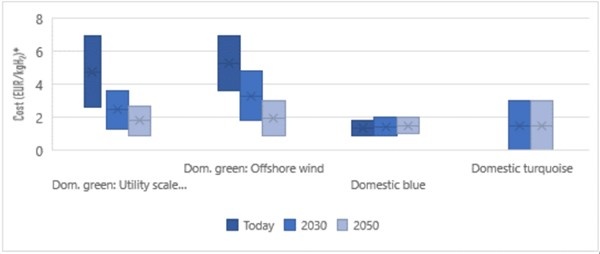
Figure above shows Minimum and average levelized cost for low & zero carbon hydrogen of different origins: present, 2030, 2050. Low value represents estimated minimum cost, high value represents estimated average cost
**Euros per kilogram of hydrogen produced
This is largely due to the anticipated relative cost and availability of natural gas versus renewable electricity. However, by 2030, green hydrogen may theoretically be competitive with blue and grey hydrogen, if renewable electricity prices can fall sufficiently, relative to the cost of natural gas. For example, under the very high natural gas prices experienced in Europe during the second half of 2021, green hydrogen has consistently been more competitive than blue and even grey hydrogen. If these market conditions were to persist, or restabilise at lower but similar levels, green hydrogen would be competitive with blue hydrogen much more quickly. Nevertheless, it should be noted that the IEA expects the gas price to return to normal levels relatively quickly.
_
Indeed, there are large discrepancies in the projected costs and capacities of different RES-E technologies, wind vs solar, offshore vs onshore, pyrolysis vs electrolysis, etc., as well as trajectories for biomethane costs. The cost (but not necessarily the market price) of RES-E from all sources is projected to decrease considerably in the coming years, but with competitive prices from offshore wind coming the latest (see Figure below). This in itself is an important point. The price that renewable hydrogen manufacturers will have to pay for RES-E in the EU will not be dependent on the cheapest cost of producing new capacity in the most favourable part of the EU. Rather, so long as RES-E is ‘scarce’, it will be set by the forward electricity price.
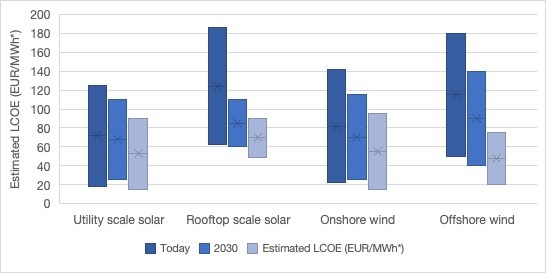
Figure above shows Estimated levelised cost of energy (LCOE) for different renewable electricity sources, present, 2030, 2050
* Euros per megawatt hour of electricity produced
In this view, solar PV is seemingly the most financially competitive electrolysis option in the medium term (2030) with wind becoming more relevant by 2050. This is notwithstanding other potential challenges at scale, such as water stress, competition for land use, and even the potential impacts of climate change on wind speeds and solar exposure. Moreover, due to the different daily production patters of wind versus solar relative to demand patterns, wind may end up being the more attractive supply source in some circumstances. This is because wind power continues to be generated at night when overall electricity demand is lower, often leading to lower electricity prices and lower risk of high opportunity costs in the allocation of renewable electricity.
_
Turquoise hydrogen potentially shows the most promise in terms of cost decrease, with considerably less sensitivity to fluctuations in energy price than blue or green hydrogen, as it requires less electricity than electrolysis and less gas than SMR with CCS. When bio-methane is part (or all) of the feedstock, the hydrogen produced can be carbon-negative. Arguably the key variable for pyrolysis is the value of the co-product, carbon black, with 3 kg of solid carbon produced for every kg of hydrogen. Low quality carbon black has a value of ~4.30 EUR/kg, but higher quality graphene is ~150 EUR/kg and carbon nanotubes are ~2,000 EUR/kg.
______
______
Cost of Defossilization is High:
Producing the materials needed for the infrastructure and objects we use every day accounts for more than 20% of global emissions. These are some of the most difficult industries to decarbonize, as we have few ready options to replace the coal, gas and oil they typically use as fuel and feedstocks. Over the next six years hydrogen, carbon capture and electrification will need to be tested and scaled, as industrial emissions must drop dramatically from 2030. Applying new technologies will increase costs, but not astronomically. Many net-zero routes for steel, aluminum and petrochemicals incur cost premiums of around 50% or less, and some could deliver cost savings in the future. This is lower than reported premiums in other hard-to-abate sectors like sustainable aviation fuels and would have a minimal effect on most end-use products. Green premiums, carbon prices or subsidies will still be needed to level the playing field and ensure that new, clean capacity comes online as quickly as possible.
_
BloombergNEF’s newly published ‘2024 Levelized Cost of Net-Zero Materials’ report shows the cost of green steel, petrochemicals and aluminum in 2024, 2030 and 2050, for 12 regions globally. It is based on their proprietary levelized cost models for materials, where clients can change the inputs to the models to create their own scenarios.
Steel has some of the most competitive green options:
Levelized cost of net-zero steel production, 2030 is depicted in figure below.
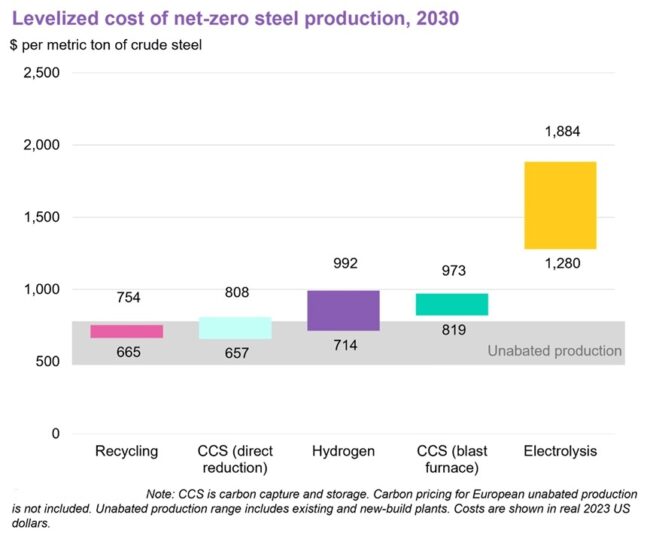
By 2030, falling clean fuel costs, carbon prices in Europe and subsidies in the US mean that some net-zero steel production can compete with the highest-cost unabated production. On average, green steel costs 66% more to produce than existing production routes in 2030, falling to 39% by 2050. Low-carbon production never outcompetes the cheapest existing plants but can become a competitive option compared to building a new coal-fired plant. Gas-fired direct reduction plants are already cheaper than coal plants and can be designed to use carbon capture at a lower cost than blast furnaces.
Local resources have a large influence on which production route is the most expensive. In China and South America, where hydrogen costs could be among the lowest in the world, building new hydrogen-based steel plants is cheaper than retrofitting carbon capture onto existing coal-fired blast furnaces by 2030. Conversely, where we expect hydrogen costs to be very high, such as in Japan, using carbon capture on existing blast furnaces is the lower cost option. For steel recycling, scrap prices, rather than electricity prices, determine the cost. Regions with well-developed scrap supply chains can produce cheap green recycled steel today. Electrolysis is an early-stage technology that will take time to scale and will still be expensive in 2030. Only regions with low-cost firm clean power will be able to use it competitively.
_
Subsidies can make green petrochemicals competitive in the US:
Levelized cost of naphtha-based high-value chemicals, 2030 is depicted in figure below.
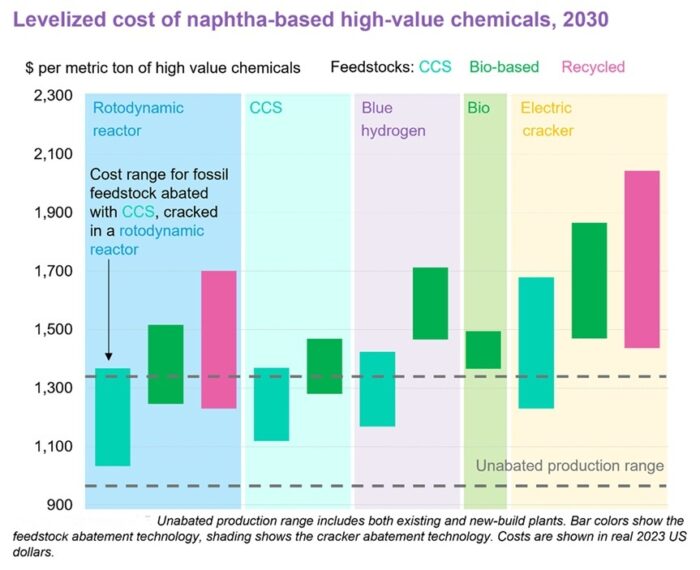
Decarbonizing petrochemicals is complex, with many combinations of low-carbon feedstocks and cracking technologies available. For feedstocks, fossil-based naphtha from oil can continue to be used, if carbon capture is used to abate the refining emissions. Bio-based naphtha made from used cooking oil or oil seed crops is a drop-in substitute for fossil feedstocks, but is more expensive and limited in supply. Plastic waste that has been chemically recycled back into naphtha is the highest cost feedstock option. These feedstocks then need to be cracked to produce the ethylene, propylene and aromatics used to make plastic. This can be done in new, electrically powered crackers or rotodynamic reactors running on clean power, or in crackers running on blue hydrogen or using carbon capture to abate its emissions. Bio-naphtha is a carbon sink and can be used in an unabated cracker to offset its emissions.
Green petrochemicals would be, on average, 45% more costly to produce in 2030. However, subsidies from the US Inflation Reduction Act can make petrochemicals abated with carbon capture cheaper than unabated production. US costs represent the low end of the ranges above. Costs vary significantly between feedstocks. Using fossil naphtha, with its production abated by carbon capture is always the lowest-cost option and the most scalable, so long as CO2 transport and storage is available. Both bio-based and recycled naphtha are reliant on waste products with highly distributed supply chains. This makes them expensive and difficult to produce at scale. We expect both to be blended into naphtha crackers, but rarely used to provide 100% of the feedstock.
_
Recycled aluminum offers a green product at a small premium:
Levelized cost of recycled aluminum – all technologies, 2030 is depicted in figure below.
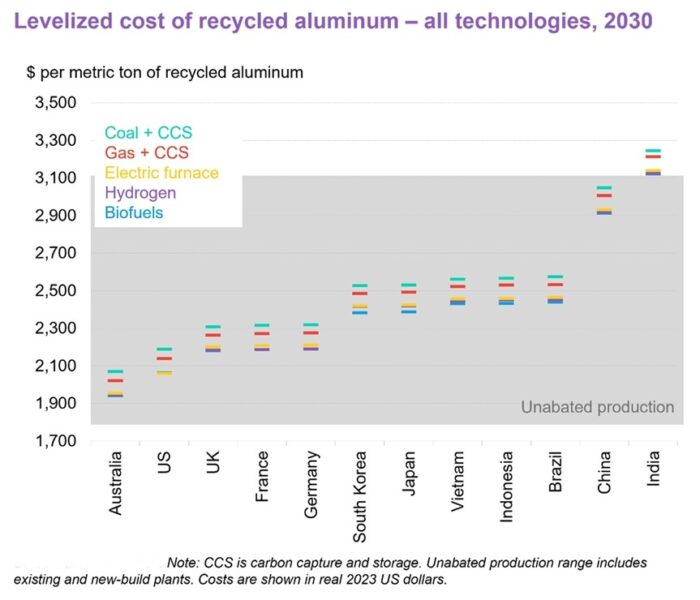
The cost of net-zero recycled aluminum changes very little between 2024 and 2050. Most of the cost declines over this time happen in clean fuels, but it is scrap prices that dictate the cost of recycled aluminum. The aluminum scrap market is mature and we expect little change in scrap costs in real terms. However, there is a huge range in scrap prices between regions, from Australia at the low end, where a lack of any domestic aluminum recycling means there is no demand for scrap, to India, where large amounts of aluminum scrap are imported from other countries. This difference in scrap price creates a large unabated production cost range.
Recycled aluminum already has a much lower carbon footprint than making new aluminum. It can be fully decarbonized by switching gas or coal for biofuels or hydrogen, using an electric furnace, or applying carbon capture to fossil-based plants. Biofuels, hydrogen and electrification compete for the lowest costs, but on average, decarbonizing aluminum recycling only incurs a very small cost premium, below 10%. Many countries are beginning to see their scrap reserves as strategic and are considering export bans in order to take advantage of this relatively low-cost, near-term option for decarbonization.
______
______
Portfolio optimization for industrial cluster defossilization in the Port of Rotterdam, a 2026 study:
Defossilizing feedstocks of industrial clusters has increasingly attracted attention due to potential impacts on climate change mitigation targets. However, the transition from fossil-based feedstocks to alternative carbon sources (ACS) presents both environmental and economic challenges in terms of performance and feasibility. One issue is the large uncertainties regarding the techno-economic feasibility in terms of investment decisions, which has been barely studied in the literature at cluster level. This study considers market price fluctuations of raw materials, products and energy over time to evaluate the profit and risk associated with individual plants for decision-making purposes. By adopting Modern Portfolio Theory (MPT), a portfolio optimization problem is defined to provide a risk-return-based guidance framework for transitioning to alternative carbon feedstocks. The proposed optimization model obtains investment portfolios and corresponding production capacity distributions based on the optimal constituents among fossil-based and ACS-based plants. The Port of Rotterdam, the Netherlands, is considered as a case study to assess the defossilization of feedstocks at the cluster level. The results show that integrating ACS-based plants into the cluster requires substantial capital investment, and reduces the Return on Investment (RoI) relative to the associated risk, making full defossilization economically challenging to achieve. However, applying a price-allocation method for re-costing ACS-based (by-)products considering governmental financial supports, the transition to alternative carbon sources can become attractive to investors at specific production capacities, as identified through optimal risk–return portfolios.
_________
_________
Section-16
Future and research:
The defossilization of the chemical industry presents a unique opportunity to reconfigure the relationship between the energy and chemical sectors. While electrification of high-temperature processes has kick-started, the transition to the three sustainable carbon feedstocks (biomass, recycled plastics, and CO2) remains at an early stage of implementation. Given the limited availability of sustainable biomass and biogenic CO2, direct air capture (DAC) is expected to become a strategic enabler of circular carbon flows, particularly in high-value applications and regions with constrained biogenic resources, even considering existing development challenges. DAC will have to overcome factors such as land availability and social acceptance alongside scaling and economical ones. However, transportation of biomass to regions with little biogenic resources also faces both technological and economic challenges. Based on analysis and expert iterative, Delphi-based judgment, an expected timeline from technology to market maturity is provided in figure below. Figure below is not exhaustive with respect to all technologies that exist for the production of green chemicals but focuses on those technologies that work at the interface between the energy and chemical industry. The visualization underscores the need for coordinated investment and policy support to accelerate their deployment.
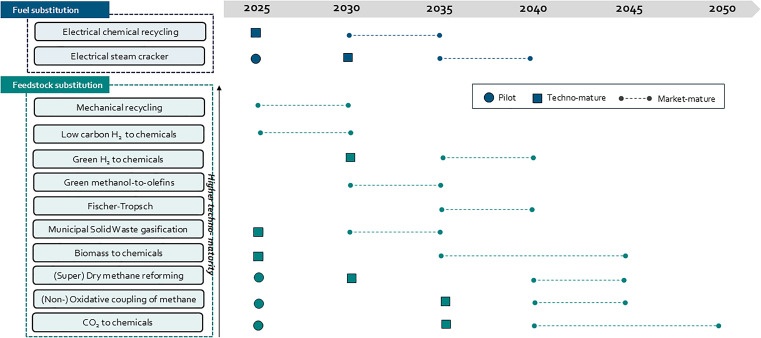
Figure above shows Projected development timeline and maturity levels of key technologies for fuel and feedstock substitution in the chemical industry. Each technology is mapped across a timeline from 2025 to 2050, indicating stages of development from pilot (●), to technology mature (■), to market mature (dotted line).
_
These evolutions will require a coordinated build-out of infrastructure for CO2 capture, purification, and distribution, as well as access to low-carbon hydrogen. The energy sector must, therefore, prepare to support not only the electrification of heat but also the development of a CO2-based carbon economy. For the chemical sector, this implies a dual transformation: decoupling from fossil carbon and aligning production with the geography of renewable energy and sustainable carbon availability. In this context, biomethane and biogas are likely to be valuable as feedstocks and not only as fuels, especially when leveraged through existing gas infrastructures. Hydrogen (low carbon and going forward also green) will also play a central role, not only as a clean energy carrier but also as a feedstock for carbon-rich molecules. In the near term, low-carbon hydrogen may be sufficient to initiate this transition, but long-term competitiveness will depend on the convergence of renewable energy, carbon logistics, and chemical production footprints.
_
Ultimately, the successful defossilization of the chemical industry will hinge on cross-sectoral collaboration, long-term policy frameworks, and strategic investment in infrastructure that links energy and chemistry. This transformation requires the combination of both technological feasibility and economic and environmental value. Driving such transformational change calls for a combination of policy interventions targeting the supply of, demand for, and innovation in these products and processes, including support for R&D and commercialization of new technologies, removal of fossil fuel subsidies that impede defossilization, and expanded Green House Gas (GHG) pricing to redirect financial incentives toward low-carbon alternatives. While the technological pathways for a fossil-free chemicals sector are increasingly clear, their realization is constrained by political and economic realities. As Tilsted and Newell point out, petrochemicals are often ignored in global energy debates, even though they will strongly shape future energy use. Mah adds that the so-called energy revolution is complicated, because fossil fuels are not only used for energy but also as raw materials for plastics and chemicals. Shifting away from fossil-based growth will need the support of the petrochemical industry, given the political and economic influence it wields. Research on socio-technical transitions also shows that current systems are very hard to change. They are locked in by existing factories and infrastructure, government subsidies and rules, powerful industry groups, and everyday habits that people take for granted. Overcoming these barriers will, therefore, require more than just new technology. It will also need strong political and policy action, pressure from civil society to challenge entrenched interests and create space for alternatives, and institutions to support a just transition.
_
Key recommendations for policymakers and industry:
- Electrify high-temperature processes for major chemicals (methanol, ammonia, and ethylene) where renewable electricity is abundantly available and grid capacity allows. Invest in grid upgrades and pilot projects to accelerate deployment. Where renewables are limited, look into the import of intermediates from energy-rich regions.
- Deploy low-carbon hydrogen, prioritizing ammonia and methanol synthesis, and integrate with CO2 utilization for platform chemicals. Build hydrogen infrastructure and foster cross-sector partnerships, starting with low-carbon hydrogen and transitioning to green hydrogen as renewables expand.
- Invest in DAC for long-term carbon supply and integrate with renewable energy and hydrogen. Leverage existing infrastructure for biomethane and CO2 transport and adapt supply chains to regional realities. Align energy and chemical sector policies and support commercialization of new technologies. Encourage adaptive, regionally tailored strategies to manage uncertainty and foster collaboration.
______
______
Coupled vs. separate optimization in industry and energy system defossilization analysis: A German case study of 2025:
Highlights:
- Compared coupled and soft-linked optimization of energy and industry sectors
- Coupling reduces direct air capture reliance by enabling negative emissions in industry
- Coupling shifts biomass use from industry to the energy system
- Coupling leads to more direct electrification in industrial transformation
_
The energy system and industry are major emitters and must defossilize to meet climate goals. They are closely linked: defossilized industry relies on electricity, hydrogen (H2), and synthetic fuels to be provided by the energy system, while both compete for limited resources and for remaining emission budgets. Despite this interdependency, optimization studies typically focus on one sector and treat the other sector’s transformation as exogenous by using results from a model of the other sector (sequential approach via soft-link). This method does not fully capture the feedbacks between the sectors. While initial approaches for co-optimization in coupled models (in the context of this study, coupled meaning fully integrated in a joint model, as defined in the study by Helgesen et al.) exist, the impact of coupled versus soft-linked optimization remains unexplored, leaving the influence of integrated transformation unclear.
_
The following interactions exist between the two sectors. First, the sectors have to jointly meet emission targets and cross-sectoral offsetting of emissions is possible. Second, industry defossilization options include direct electrification (e.g., electric furnaces) and indirect electrification via H2 and synthetic hydrocarbons. These choices affect capacity and flexibility requirements in the energy system, while energy carrier prices and availability affect cost-minimal industry transformation. Additionally, limited resources such as biomass and CO2 storage are useful in both sectors, and cost-efficient allocation can only be determined when considering trade-offs in both sectors jointly.
The application options for shared resources and energy carriers are summarized in Table below.
|
Resource |
Industry |
Energy System |
|
Solid biomass (optional BECCS) |
Process heat, feedstock after conversion to gas or biofuels |
Dispatchable electricity and heat generation, conversion to gas or liquid fuels |
|
Biogas |
Process heat, feedstock |
Dispatchable electricity and heat generation |
|
CO2 storage |
Process emissions, emissions from fossil-based process heat |
Emissions from fossil gas (space heat, CHP, electricity), temporary storage for synthetic fuels production |
|
H2 |
Process heat, feedstock |
Dispatchable electricity and heat generation |
|
Synthetic liquid fuels (methanol, naphtha) |
Feedstock for chemicals production |
Fuel for transportation and agriculture |
Sustainable biomass can serve as fuel for process heat and feedstock in industry or for dispatchable power and heat generation in the energy system, and can provide negative emissions when combined with carbon capture (CC) and storage (bioenergy with CC and storage, BECCS). CO2 storage is essential in both sectors, for storing CO2 temporarily for synthetic fuel production, or permanently to offset remaining emissions. H2 and synthetic fuels are not inherently limited, but their production is energy-intensive, thus their use needs efficient allocation.
_
These interactions are relevant for policies on carbon management, on the use of limited resources, on sectoral emission budgets and on infrastructure planning. For instance, in Germany, the development of a long-term negative emissions strategy and a carbon management strategy is planned. Cornerstones for these strategies have been formulated, which set a focus on CC for technologies in the energy system (gas- and biomass-based generators, waste incineration) and industry (hard-to-abate process emissions, e.g., cement and lime), set the goal to plan a CO2 infrastructure, and identify the need to consider potential conflicts in respect to land use and biomass availability. Negative emission targets for the years 2030, 2040, and 2045 are planned to be defined based on scenario work. To define these strategies effectively, it is essential to analyze both conflicts and synergies arising from the parallel transformation of the energy system and industry. Key issues include how to allocate limited resources such as biomass and CO2 storage, which shifts in energy carrier demand and supply occur in both sectors, and how remaining emission budgets and CC technologies should be distributed between them.
_
Figure below illustrates varying levels of industry integration into energy system models, from treating industry demand as exogenous, taken from literature (A) or a soft-linked industry model (B), to partly (C) or fully coupling (D). Soft-linking approaches are common in large scenario studies for Germany, and studies at European level. In these studies, industrial energy and resource demand and emissions are determined first, and given as constraints to the subsequent energy system optimization. Allocation of resources and emissions is done beforehand, based on e.g., today’s sectoral shares, or giving industry priority or technical considerations. The sequential approach does not necessarily reach system-wide cost optima, but avoids methodological and computational challenges of fully integrating models.
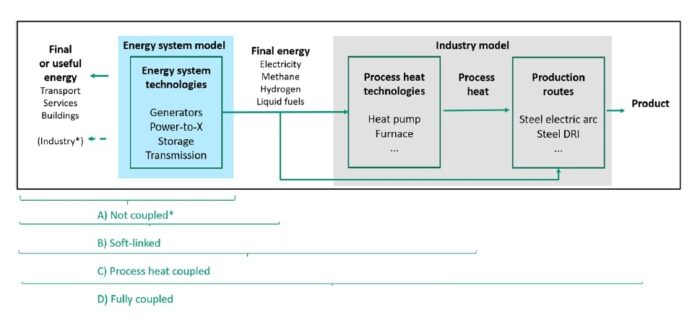
Figure above shows different degrees of industry sector integration into energy system models (brackets represent parts of the model that are endogenous).
_
In a nutshell
Achieving carbon neutrality requires defossilizing both the energy system and industry, which are closely linked through shared resources and energy carrier exchange. However, many studies treat them separately, overlooking important feedbacks. This study uses a techno-economic model for German industry to compare coupled and sequential (soft-linked) optimization with the energy system model PyPSA-Eur. Coupled optimization yields similar overall costs (0.3% lower) but different resource use: industry relies more on direct electrification, uses less biomass and hydrogen, and achieves negative emissions (− 24 Mt CO2), offsetting energy system emissions. In contrast, the soft-linked approach treats sectoral neutrality independently, requiring more costly direct air capture. This study underscores the role of cross-sectoral feedback in resource and emission allocation and hydrogen use and reveals limitations of sequential approaches in representing these feedbacks.
______
______
Future alternatives:
For many energy sectors, such as power, heat, and transport, the discussion on reaching carbon neutrality is often centred around the concept of ‘decarbonisation’; however, for the chemical industry, ‘decarbonisation’ is impossible due to the requirement of carbon feedstocks to produce all large volume organic chemicals. Therefore, the development of a net-zero emissions or even negative emissions chemical industry must centre around the concept of ‘defossilisation’, which requires the introduction of new sustainable carbon feedstocks through sustainable biomass and carbon capture and utilisation (CCU). The most discussed sustainable feedstock for the global chemical industry has been e-methanol and biomass-based methanol (bio-methanol), which can either be used directly or as a feedstock for olefins and aromatics through the methanol-to-olefins (MTO) and methanol-to-aromatics (MTA) processes. Indeed, methanol has been discussed as a substitute for oil-based feedstocks and fuels as early as the 1980s, though fossil methane was suggested as the major feedstock. Both methanol and ammonia can be synthesised through green e-hydrogen and biomass, and e-methanol and bio-methanol as the central feedstocks would lead to a methanol economy basis for the current petrochemical industry.
_
Power-to-ammonia.
Research regarding sustainable ammonia has largely fallen into three categories focusing on blue hydrogen, green e-hydrogen, and electrochemical ammonia production. The use of blue hydrogen for ammonia production would use carbon capture and storage (CCS) to reduce the emissions of conventional ammonia production, though this process would not capture all related CO2 emissions and life-cycle emission factors may be further limited to 60–85%. Green e-ammonia, conversely, proposes the use of green e-hydrogen for the Haber–Bosch synthesis unit, and a temperature of 480 C at a pressure of 150 bar is applied in this research. The use of water electrolysis adds a new water demand of 1.6 tH2O/ tNH3 for the water electrolyser that is not present in conventional ammonia production, which may cause an additional water stress in regions experiencing water scarcity. The green e-ammonia process, consists of two primary subsystems, which are the gas subsystem supplying nitrogen and hydrogen, and the ammonia synthesis system consisting of the Haber–Bosch reactor. Of the green e-ammonia options, the power-to-ammonia is the most commercially available, at a TRL of 8–9. While there is research investigating direct electrochemical synthesis of ammonia from water and nitrogen under low temperature and low pressure conditions, such ammonia synthesis systems are not yet commercially available.
_
Power-to-methanol.
Compared to conventional methanol production, which synthesises methanol from carbon monoxide and hydrogen, a power-to-methanol route could convert carbon dioxide and hydrogen to methanol over a Cu/ZnO/Al2O3 catalyst. The chosen e-methanol synthesis reactor has an inlet temperature of 210 C and 76 bar. The entire process has a water requirement of around 27 tH2O/tMeOH, for water electrolysis; however, this requirement is lower than conventional methanol production, which requires 90 tH2O/tMeOH. While the overall synthesis route is similar, e-methanol synthesis from carbon dioxide and e-hydrogen is at a lower TRL compared to the conventional route, currently around TRL 7. Power-to-methanol has been widely researched as an alternative to conventional production, due to the wide range of applications for methanol to replace fossil fuels in marine and aviation transportation as well as chemical production and methanol derivative syntheses. Furthermore, pilot power-to-methanol plants from Carbon Recycling International in Iceland have operated since 2012, and additional pilot plants are being developed by Power to Methanol Antwerp pathways to directly synthesise ammonia and methanol from plant using atmospheric CO2, with a capacity of 110 ktMeOH, started production in October 2022 in Anyang, Henan Province, China. It uses the emissions-to-liquids technology developed by Carbon Recycling International.
The carbon dioxide demand of 1.46 tCO2/ tMeOH is considered to be supplied by a direct air capture (DAC) unit; however, carbon dioxide can also be supplied from process emissions from the cement mills, pulp and paper mills, or waste incinerators burning biomass or municipal solid waste. Techno-economic assessments of the power-to-methanol route have been investigated for a range of carbon inputs including CO2 from a biogas treatment plant and a fossil ammonia plant, DAC, carbon recycling, and other point sources. Research has also investigated sourcing carbon dioxide from lignite power plants; however, this would not be a fully sustainable solution given the use of coal as an input for electricity generation and leakage emissions, as point source carbon capture from coal power plants is typically designed around a 90% CO2 efficiency. Additionally, the fossil carbon embedded in the methanol could return to air or water as CO2 or other GHG emissions at the end of its life cycle.
_
Power-to-methanol-to-olefins.
Although there are pathways to directly synthesise ammonia and methanol from green e-hydrogen, such routes are not readily available for olefins or aromatics, as the single stage conversion of hydrogen and CO2 to olefins is still at a TRL of 3–4. Therefore, the conversion of methanol has been proposed to substitute oil feedstocks. The MTO process, however, has largely been investigated to use coal-based methanol as an input, largely in China due to the high availability of coal. Due to its commercialisation in China, MTO already has a high TRL of 8–9. MTO operates at around 500 C and 2.5 bar over a SAPO-34 type catalyst, with a carbon selectivity ranging from 78 to 82%. The methanol input for MTO is 16.34 MWhMeOH,LHV/tOlefin. Multiple MTO processes have been developed, and different ratios of ethylene and propylene can be achieved depending on the catalyst used. In addition to the ethylene and propylene products, there is a heat by-product of 0.688 MWhth/tOlefin at 500 C and a water by-product of 1.685 tH2O/tOlefin.
_
Power-to-methanol-to-aromatics.
Compared to the MTO route, MTA is much less developed, with a TRL of 7. MTA has also largely been researched in the context of coal-based methanol. The MTA process converts methanol to aromatics over a zeolite catalyst, HZSM-5, at 370–540 C and 20–25 bar. Of the final products, BTX aromatics compose around 16% of the total yield by weight; therefore, a significant methanol input of 34.46 MWhMeOH,LHV is required. The most significant by-products of the MTA process are liquefied petroleum gas (LPG), which is produced at a rate of 1.24 tLPG/tBTX, and water, which is produced at a rate of 3.224 tH2O/tBTX. Additionally, the MTA process is highly exothermic, with a heat output of 2.838 MWhth/tBTX.
_
Fossil feedstocks with carbon capture & storage and biomass feedstocks.
Considering the composition of emissions, the IEA reports that the highest share of emissions from primary chemical production comes from ammonia, at 49%, followed by HVCs, at 27%, and methanol, at 24%. For methanol and ammonia, a high share of emissions comes from the reduction of the fossil feedstock to syngas. Therefore, CCS has been proposed to remove the high amount of process CO2 emissions, and, for ammonia production, some carbon capture is already utilised for downstream urea production. Conversely, due to the conversion of fossil hydrocarbons to HVCs, most emissions are a result of process energy, as feedstock losses, and thus feedstock emissions, tend only to be 0.5% of the feedstock input. For these HVC production routes, CCS would largely be unnecessary if the process energy inputs were decarbonised. Gabrielli et al. highlighted the potential for CCS to reduce emissions in the chemical industry; however, due to the point source capture efficiency of 90%, additional DACCS is required to capture the remaining 10% of CO2 that is not captured in the CCS stage. Furthermore, while fossil carbon may not be emitted to the atmosphere during the chemical production stage, it may be emitted at the end-of-life stage through waste incineration or degradation in landfills. Additionally, fossil chemicals with CCS may lead to a fossil lock-in for the chemical industry, and lead to stranded fossil assets as fossil reserves become increasingly nonviable as well as increased life-cycle emissions from the carbon content of fossil-based chemicals.
Biochemical routes have also been widely suggested to substitute fossil feedstocks for ammonia, methanol, olefins, and aromatics, as part of a larger bioeconomy. While biochemical routes are available, increased scrutiny must be placed on the sourcing of the biomass feedstocks. Today, bioethylene is produced in Brazil via bioethanol dehydration using sugarcane as the biomass feedstock for ethanol production. However, as biomass resources become increasingly limited, strict sustainability requirements must be placed on biomass resource use, as biomass competes both with food and feed supply and bioenergy in other energy sectors such as biofuels for transport. Globally, the sustainable bioenergy limit has been estimated to be 100 EJ (27800 TWh). Sustainable biomass use effectively eliminates first-generation biomass from being used for chemical production, and, therefore, only biomass residues and wastes, e.g., lignocellulosic biomass, should be considered for biochemical production.
______
______
Moral of the story:
_
-1. Carbon is the foundational building block for all known life on Earth. Carbon compounds regulate the Earth’s temperature, make up the food that sustains us, and provide energy that fuels our global economy. Most of Earth’s carbon is stored in rocks. The rest is in the ocean, atmosphere, plants, soil, and fossil fuels. Carbon is always on the move. Put simply, the carbon cycle is the transfer of carbon atoms between different zones in, on, and around the planet. The carbon cycle is the continuous, dynamic biogeochemical process by which carbon moves between Earth’s atmosphere, oceans, soil, rocks, and living organisms.
_
-2. The ocean plays a critical role in carbon storage, as it holds about 50 times more carbon than the atmosphere. Two-way carbon exchange can occur quickly between the ocean’s surface waters and the atmosphere, but carbon may be stored for centuries at the deepest ocean depths. The ocean is the Earth’s largest active carbon sink, absorbing roughly 25% to 30% of all human-generated carbon dioxide emissions. This extra carbon dioxide is lowering the ocean’s pH, through a process called ocean acidification. This vital climate service helps slow global warming, but it comes at a significant cost to marine ecosystem.
_
-3. Human activities have a tremendous impact on the carbon cycle. Burning fossil fuels, changing land use, and using limestone to make concrete, all transfer significant quantities of carbon into the atmosphere. As a result, the amount of carbon dioxide in the atmosphere is rapidly rising; it is already greater than at any time in the last 3.6 million years. There is no scientific doubt that fossil fuels are the principal cause of the climate crisis, as well as a major driver of toxic pollution and biodiversity loss.
_
-4. The ability of carbon to form four strong bonds is the reason that hydrocarbons hold the position of importance. In theory, an atom can form as many covalent bonds as it has orbitals that are not filled. Carbon reaches four half-filled orbitals through orbital hybridization. By gaining a small amount of energy, one electron from the 2s orbital is promoted to an empty 2p orbital. This creates four unpaired electrons, allowing carbon to hybridize (like sp3, sp2 or sp) and form four strong covalent bonds. By contributing each of these four outer electrons to bonds in which the other atoms likewise share, carbon can attain a chemically stable configuration. This natural ability to form four strong bonds makes carbon a very valuable building block. Carbon atoms can bond with other carbon atoms to form chains, branches, and even rings. The result is an endless array of possible molecules.
_
-5. Carbon is unique because it forms the basis for millions of different chemicals, both natural and synthetic. The study of all carbon chemistry and its derivatives is called organic chemistry. Organic chemistry studies carbon-containing compounds, typically those with carbon-hydrogen (C-H) bonds. Carbon dioxide (CO2) is an inorganic compound. While it does contain carbon, it is classified as inorganic because it lacks carbon-hydrogen (C-H) bonds. In organic chemistry, a hydrocarbon is an organic compound consisting entirely of hydrogen and carbon. Hydrocarbons are organic chemical compounds composed only of the elements carbon (C) and hydrogen (H). Even though they are composed of only two types of atoms, there is a wide variety of hydrocarbons because they may consist of varying lengths of chains, branched chains, and rings of carbon atoms, or combinations of these structures. In the fossil fuel industries, hydrocarbon refers to naturally occurring petroleum, natural gas and coal, or their hydrocarbon derivatives and purified forms. Strictly speaking, coal is not a pure hydrocarbon. While coal does contain hydrocarbons, it is primarily composed of carbon mixed with varying amounts of oxygen, nitrogen, sulfur, and hydrogen.
_
-6. Hydrocarbons are chemical compounds consisting of hydrogen and carbon. They are the main components of fossil fuels and are highly combustible, producing carbon dioxide, water, and heat when fully burned (i.e., completely combusted with oxygen).
Hydrocarbons are highly flammable because they contain a significant amount of chemical energy stored in the carbon-carbon and carbon-hydrogen bonds. This property makes them valuable as fuels for combustion processes. Hydrocarbons can undergo combustion reactions, reacting with oxygen to release energy in the form of heat and light. This property is central to their use as fuels. Alkanes burn in the presence of oxygen, a highly exothermic oxidation-reduction reaction that produces carbon dioxide and water. As a consequence, alkanes are excellent fuels. For example, methane, CH4, is the principal component of natural gas. Butane, C4H10, used in camping stoves and lighters is an alkane. Gasoline (petrol) is a liquid mixture of continuous- and branched-chain alkanes, each containing from 4 to 12 carbon atoms, plus various additives to improve its performance as a fuel. Kerosene, diesel oil, and fuel oil are primarily mixtures of alkanes with higher molecular masses.
In addition to fueling vehicles, hydrocarbons are used in power generation. They are a primary source of energy for power plants that produce electricity. The combustion of hydrocarbon fuels, such as natural gas, coal and oil, is a common method for generating electrical power.
Hydrocarbons also find applications in the production of chemicals. Hydrocarbons are not limited to just fuel and power (electricity) production. They also serve as feedstocks for the chemical industry. Through various chemical processes, hydrocarbons can be transformed into a wide range of chemicals, including solvents, lubricants, detergents, synthetic rubber, various plastics, and various organic compounds used in pharmaceuticals. Hydrocarbons are also used in agriculture as components of pesticides and fertilizers. These compounds are essential for modern farming practices to improve crop yields and protect against pests and diseases.
_
-7. Fossil fuels—predominantly coal, oil (petroleum), and natural gas—are primarily used to generate electricity, fuel transportation & cooking, provide industrial heating, and manufacture raw materials for plastics and fertilizers. Beyond energy, crude oil and natural gas serve as essential raw materials for the petrochemical industry including plastics, fertilizers and everyday products from crayons, cosmetics and carpeting to fabrics, fertilizers and pharmaceuticals. Around 70,000 everyday products are made with “petrochemicals” produced from fossil fuels. Fossil fuels are considered non-renewable because they take millions of years to form and we are consuming these finite reserves much faster than natural processes can create new ones. Fossil fuels are often not suitable for direct use and therefore need to be properly processed.
_
-8. All major energy research bodies agree that fossil fuel reserves are finite and depleting. However new discoveries and technological advances can extend lifespan of fossil fuels on earth far beyond all predictions. Although we are unlikely to fully exhaust every last drop of oil or ton of coal, the point at which they become too expensive and technologically challenging to extract is fast approaching, likely well before the end of the 21st century. Even if new resources are found, the easy-to-reach, high-quality deposits have primarily been tapped, leaving more challenging, expensive and environmentally risky extraction ahead.
_
-9. Petrochemicals:
The vast majority of chemicals upon which society relies are carbon-based. To produce carbon-based chemicals and ultimately downstream consumer products, an initial feedstock containing carbon is required. Currently, almost 90% of feedstocks used to make chemicals are from fossil sources – oil, natural gas and coal. The term “petrochemicals” originally refers to chemicals produced from petroleum, and is now often used interchangeably with the simpler, shorthand term “chemicals”. Feedstocks are transformed, often at high temperature and pressure with the help of catalysts, into the key ‘primary chemicals’ used to service the chemical industry. These primary chemicals are transformed by a wide range of processes and chemical reactions into intermediates, speciality and fine chemicals used to make consumer products. Oil can be processed for ethene, propene, benzene, toluene and mixed xylenes. Natural gas and coal are used to produce ammonia and methanol. In recent years, natural gas derived feedstocks have become much more significant for ethene and propene production, due to the rise in shale gas production in, for example, the US. Ammonia is not a carbon-based chemical but natural gas is the primary raw material used to produce the majority of the world’s ammonia and hence ammonia is classified along with primary chemicals. The foundations of the modern organic chemical industry are built on seven key building blocks or primary chemicals: ammonia (NH3), methanol (CH3OH or MeOH), ethylene (C2H4), propylene (C3H6), benzene (C6H6), toluene (C7H8), and mixed xylenes (C8H10). Ethylene and propylene are often discussed as light olefins, and benzene, toluene, and mixed xylenes are referred to as BTX aromatics, and together are referred to as high value chemicals (HVCs). More than 90% of organic chemicals are derived from ammonia, methanol, ethylene, propylene, and BTX aromatics. Rather than being used for energy, petrochemicals serve as the essential raw building blocks for manufacturing thousands of everyday products—including plastics, synthetic rubbers, fertilizers, detergents, packaging, and textiles. Carbon-based chemicals cannot be decarbonised, but they can be defossilized through a transition to renewable carbon sources such as biomass, recycled material (e.g., plastic), or carbon dioxide (CO2).
_
-10. Effectively produced exclusively from fossil fuels, used in a range of industrial processes, and serving as the fundamental component of synthetic materials, petrochemicals have been evolving as part of—and entrenched within—a petro-energy complex central to the fossil fuel energy order. The petrochemical industrial sector uses fossil fuels for two purposes: As energy carrier and as feedstock (i.e. raw material), producing synthetic materials, industrial gases and fertilizer on an enormous scale. Plastics and petrochemicals play a key role in locking in fossil fuel production and consumption. Currently, the petrochemical industry uses ~8% of fossil gas and ~16% of global oil extraction in its production, and 90 percent of chemicals are made from oil and gas. The rest comes from coal and biomass. Defossilization of chemicals is the transition of the chemical industry away from fossil feedstocks (oil, gas, coal) to renewable raw materials, aiming for net-zero emissions. It involves replacing fossil carbon with renewable carbon sources, specifically biomass, plastic waste recycling, and CO2 utilization (CCU), along with utilizing renewable energy for processing.
_
-11. Decarbonization:
Decarbonisation is the process of reducing or eliminating greenhouse gas emissions—primarily carbon dioxide and methane—from human activities like energy production, manufacturing, and transport. The ultimate goal is to reach global “net-zero” emissions, where any remaining carbon is balanced by natural or technological removal. This is achieved through:
- Switching to renewable energy (solar, wind, hydro)
- Electrifying processes
- Improving energy efficiency
- Implementing carbon capture and storage (CCS)
- Planting trees really matter in the race to decarbonization
- Avoid meat eating. Eating meat significantly drives climate change through greenhouse gas emissions (methane and nitrous oxide), deforestation to clear land for grazing and feed crops, and intensive resource use. The livestock sector alone accounts for roughly 14.5% to nearly 20% of global greenhouse gas emissions,
Some examples:
-Power generated from wind/solar instead of coal.
-Industrial boilers and heaters switched from gas to electricity or hydrogen.
-Transitioning to a vegetarian diet is one of the most effective personal actions to combat global warming, as food production contributes roughly a third of all human-caused greenhouse gases. Meat-heavy diets generate up to 50–70% more carbon emissions than plant-based diets.
_
-12. Defossilization:
Defossilization goes a step further. It means eliminating fossil-derived carbon from materials and products by replacing fossil feedstocks (like oil, gas, and coal) with renewable or recycled carbon sources. This is critical for industries-such as chemicals and plastics-where carbon is an essential building block and cannot simply be removed. Alternative carbon source (ACS) for defossilization include biomass, recycled plastic/textile waste, captured CO2 (i.e., direct air capture or point source capture), carbon monoxide, electrolytic hydrogen, municipal waste, ethanol and biogas. Green electricity is the foundational driver of defossilization, replacing coal, oil, and gas with renewable power. It cuts emissions not only by directly powering grids with solar and wind, but by acting as a feedstock to produce e-fuels and green hydrogen, decarbonizing heavy sectors like steel, cement, and chemicals.
Key defossilization strategies include:
- Using bio-based or recycled feedstocks
- Capturing and reusing CO₂ as a raw material
- Using electrolysis (electrochemically produce hydrogen from water)
- CO2 hydrogenation is a catalytic process that converts captured carbon dioxide and hydrogen into valuable chemicals and fuels (e-fuels) like methanol, methane, and olefins
- Creating circular systems to keep carbon in continuous use
Some examples:
-Making ethylene from sugarcane or captured CO₂ instead of naphtha from petroleum.
-Producing polymers from recycled plastic waste or biomass rather than virgin fossil feedstocks.
-Using biogenic carbon or CO₂ based routes for fertilizers, fuels, or specialty chemicals.
_
-13. Decarbonization and defossilization:
Decarbonization and defossilization are two complementary strategies addressing climate change while recognizing carbon’s irreplaceable role in life and industry. Decarbonization eliminates emissions from energy use, while defossilization secures sustainable carbon supply for non-energy applications. Decarbonization involves shifting from fossil fuels to renewables, electrification, and carbon capture and storage (CCS), allowing residual emissions to be offset. Defossilization refers to replacing fossil-derived feedstocks with alternative, non-fossil sources of carbon. The chemical industry could defossilize by using biomass, plastic waste and carbon dioxide as alternative carbon sources to make chemicals. In sectors like chemicals and plastics, carbon is a structural ingredient, not just an energy carrier, so switching to “green” electricity alone does not remove dependence on fossil reserves. Defossilization closes this gap by ensuring that the carbon atoms in products are renewable or recycled, while decarbonization ensures that the energy used to make them is low or zero emission.
In 2020, 160 PWh of primary energy was produced and consumed globally, with 79% from fossil carbon, 5% from nuclear, and 16% from renewables. Of this, 13 PWh of fossil fuels was directed to the chemical industry meeting over 99% of its energy and carbon feedstock needs. For defossilization of the chemical industry both energy and carbon feedstock supply have to be rewired. While energy (electricity and heat) can be obtained from renewables (e.g. solar, wind, hydrodynamics, or biomass) i.e. decarbonization, carbonaceous feedstock input will have to be defossilized, i.e. of non-fossil origin.
_
-14. Chemical sector uses fossil hydrocarbons, i.e., oil, gas, and coal, as feedstock source of carbon and hydrogen to produce chemicals and plastics. This implies that “decarbonization” is not possible since carbon is an essential feedstock of chemicals, plastics, and materials. Defossilization of the chemical industry is not only a more appropriate term for the chemical sector but also particularly challenging, as it requires not only cleaner energy inputs but also a fundamental shift in feedstock sourcing and process design. About 70% of the overall chemical sector emissions are associated with the production of only three chemicals: methanol (a building block for chemicals), ammonia (primarily used in fertilizers), and ethylene (primarily for plastic production). Encouragingly, these three chemicals can be entirely defossilized by producing e-chemicals (e-ammonia, e-methanol and e-ethylene), as well as, bio-chemicals (bio-ammonia, bio-methanol and bio-ethylene).
_
-15. How defossilization reduce emissions:
Achieving net zero isn’t about eliminating carbon – it’s about eliminating fossil carbon. Phasing out fossil fuels does not mean phasing out carbon. Carbon will remain essential for energy-dense applications (like aviation fuels) and for the everyday chemicals behind detergents, medicines, fertilizers and plastics. The term decarbonization does not make sense if one talks about the future of industrial organic chemistry, as organic chemistry (and biotechnology) cannot be decarbonized as all molecules by their nature contain carbon atoms. The challenge ahead is to defossilize, not decarbonize – replace fossil hydrocarbons with renewable, circular sources of carbon.
The chemical sector is responsible for roughly 6% of global greenhouse gas emissions. Shifting to circular or biological carbon loops prevents the extraction and release of new, underground carbon into the atmosphere. More than half of chemical-sector emissions are Scope 3, meaning they occur from upstream raw material extraction to downstream product disposal of products like plastics. Defossilisation captures and recycles this carbon instead of creating it from scratch. Even though 194 countries have signed the Paris Agreement to limit global temperature rise, and at least 4100 of the world’s largest companies have launched industry decarbonization initiatives, these can only alleviate operational emissions, but they are unable to address upstream emissions from fossil input and end-of-life emissions from incineration. A fundamental shift in feedstock to non-fossil sources of carbon will solve scope-3 emission issue.
Also, more ambitious fossil-free routes now allow biomass to serve as a feedstock for a broad range of commodity chemicals and polymers, achieving up to 90% reductions in emissions due to lower processing temperatures and pressures.
Plastics are made from chemicals, which contain carbon. This carbon usually comes from fossil resources, and this means that these materials account for 3.4 per cent of CO2 emitted globally annually and a whopping 1.8 gigatonnes of GHG emissions. With these emissions being almost entirely Scope 3, being generated in the extraction and conversion of fossil resources, the only currently feasible way to reduce these is to change the source material. It could be possible to significantly ‘defossilize’ the organic chemical industry by replacing fossil feedstocks with alternative carbon sources, as part of the transition to a net zero chemical industry. This demand can be met by a mix of biogenic carbon (sustainable biomass), carbon captured from CO₂, and recycled carbon – shifting the feedstock base away from coal, oil and gas while keeping carbon in use and out of the atmosphere. Defossilization describes the process of reducing and ultimately eliminating dependence on fossil fuels as a feedstock for the production of organic substances and materials, especially plastics. This process is crucial to limiting global warming and mitigating the effects of climate change, as the CO2 in defossilized materials is in a cycle and the concentration in the atmosphere does not increase any further. Defossilization via alternative feedstocks reduces life-cycle emissions by changing the source of a chemical’s hydrocarbons. For example, plastics conventionally obtain their carbon molecules from natural gas or methane (CH4), which can be replaced by carbon from biomass. Ammonia (NH3), does not contain carbon, but the hydrogen required to make it is conventionally produced from natural gas; it could instead be produced by splitting water with electricity. In these cases, biomass and clean hydrogen are non-fossil feedstocks, and if the biomass is sourced sustainably and electricity produced emission-free, the non-fossil feedstocks reduce lifecycle emissions.
_
-16. Circular carbon economy:
Defossilization is the process of replacing fossil-based feedstocks (oil, coal, natural gas) with renewable alternatives like biomass, waste plastic, or captured CO2 to produce chemicals and materials. Unlike decarbonization (removing carbon), defossilization keeps carbon in the loop but moves from a linear to a circular, non-fossil source. Unlike decarbonization, which focuses on capturing or sequestering carbon emissions, defossilization involves slowing or stopping the demand for new fossil-fuel extraction. This could be achieved by recovering carbon from existing processes and products and, instead of setting it aside, reusing it where possible. This “circular economy” would reclaim much of the carbon that already exists in fossil-fueled power generation and difficult-to-use materials such as biomass, municipal waste, biomethane, carbon dioxide and plastics.
Defossilization can help create a circular carbon economy in one of two ways. The carbon can either be replaced with non-carbon containing alternative such as clean hydrogen/ammonia, or fossil carbon can be replaced with non-fossil sources of carbon such as CO2, agricultural and forestry residues and other forms of biomass, food waste, polymer waste, and biogenic methane (CH4), in conditions in which, effectively, waste becomes a feedstock. Ideally, each carbon atom would be reused multiple times, reducing the need to extract fossil fuels and creating a circular economy that would allow us to move towards net-zero CO2 emissions in these segments of our economy.
_
-17. Present defossilization technologies are as follows:
(1. “Green hydrogen” (hydrogen produced by electrolysis) (TRL 9): Conventional technology of producing hydrogen by reforming natural gas is replaced by electrolysis, in which electricity generated by non-fossil resources is channeled into an electrolyzer submerged in water to split water (H2O) into oxygen and hydrogen. The resulting clean hydrogen is a feedstock for ammonia and methanol. You need cheap and abundant renewable electricity for it.
(2. E-methanol synthesis (TRLs 7–9): Traditional methanol is produced by creating syngas, a mixture of hydrogen and carbon monoxide, from natural gas and reacting that with a catalyst to produce methanol. E-methanol derives from reacting clean hydrogen with CO2 captured from a flue stack or via DAC. The process is also known as direct CO2 synthesis to methanol.
(3. Methanol-to-olefins (MTO) (TRL 9): The MTO process converts methanol into ethylene or propylene.
If that methanol is created from clean feedstocks, the resulting olefins can also be considered defossilized. MTO is commercially used in China, with coal as the feedstock, hence not defossilized.
(4. Biomass gasification (TRLs 3–5): Lignocellulosic biomass or municipal waste is fed into a gasification reactor to produce syngas, which can be directly turned into methanol or processed into hydrogen and carbon dioxide. The hydrogen can be separated to produce ammonia and other chemicals.
(5. Ethanol-to-ethylene (TRL 9): Ethanol made by fermenting crop sugars, mainly corn in the United States, is widely produced as a fuel additive. Catalytically dehydrating ethanol to yield ethylene is a well-understood process with several commercial plants operating globally. Ethanol plants emit highly concentrated CO2, allowing for low-cost CO2 capture to reduce lifecycle emissions.
_
-18. There is currently approximately 550 Mt per year of embedded carbon in feedstocks for chemicals and derived material. An estimated 88% of this is fossil-based, 8% bio-based, 4% recycled, and less than 0.1% is from CO2. Demand for embedded carbon could be approximately double, at over 1.1 Gt, by 2050.
_
-19. Renewable electricity:
Defossilization eliminates reliance on fossil fuels by substituting them with sustainable, non-fossil carbon sources for both energy and material feedstocks. By providing clean electricity and green hydrogen, renewables replace fossil fuels in power grids and heavy industry, while powering the synthesis of sustainable, circular materials.
Core Roles in Defossilization:
(1. Direct Electrification
- Application: Powering transport (EVs), buildings (heat pumps), and industrial processes.
- Impact: Displaces coal, oil, and natural gas combustion directly at the point of end-use, neutralizing direct emissions.
(2. Green Hydrogen Production
- Application: Utilizing renewable electricity to split water (H₂O) into hydrogen and oxygen via electrolysis.
- Impact: Replaces fossil-derived hydrogen in carbon-intensive sectors like ammonia production, fertilizers, and steel manufacturing (Direct Reduced Iron).
(3. Synthetic Feedstocks (Power-to-X)
- Application: Combining green hydrogen with captured CO₂ or renewable biomass.
- Impact: Synthesizes sustainable fuels (e-fuels), plastics, and chemicals without the need for virgin fossil extraction.
(4. Carbon Capture and Utilization (CCU)
- Application: Powering Direct Air Capture (DAC) systems and industrial carbon-recycling facilities with zero-carbon electricity.
- Impact: Turns captured carbon into usable materials, closing the circular carbon loop
Many sustainable chemical processes require large volumes of renewable electricity, either for direct electrification for chemical reactors, CCUS & high-temperature industrial processes; or for producing green hydrogen as a feedstock; raising the question of how to structure these supply chains at a global level. Relocating production to regions with abundant, low-cost renewable electricity can yield significant cost savings, with the greatest advantage seen when importing intermediates, e.g., urea as precursor for ammonia and methanol as precursor for ethylene and plastics. This allows regions scarce in renewable energy to retain higher-value downstream processing and keep focal jobs in the chemical industry. Unlike other energy-intensive industries, the chemical industry cannot be made fully sustainable directly with renewable electricity and green electricity-based hydrogen (e-hydrogen). Therefore, new green carbon feedstocks must be developed to defossilise the production of large volume organic chemicals.
_
-20. Syngas:
Syngas is a mixture of primarily hydrogen and carbon monoxide that often also contains some amount of carbon dioxide and methane and that is highly combustible. Syngas is usually a product of gasification and can be produced from many sources, including natural gas, coal and biomass, by reaction with steam or sub-stoichiometric amount of oxygen. Syngas generation today remains a critical industrial process primarily driven by the steam reforming of natural gas and the gasification of coal, which collectively account for about 85% of global production. While fossil fuels dominate, modern production is aggressively shifting toward sustainability through biomass gasification, plasma gasification of municipal solid waste, Reverse Water-Gas Shift (RWGS) Reaction using green hydrogen and co-electrolysis of water and CO₂. Syngas is used primarily in the production of hydrocarbon fuels, such as diesel fuel and methanol, and in the production of industrial chemicals, particularly ammonia. Syngas produced from waste materials and other biomass is considered a form of renewable energy.
_
-21. Hydrogen:
Huge amounts of hydrogen will be needed in defossilization. It is another key component in organic molecules (hydrocarbons), and fossil fuels are a plentiful source of it – but this means a lot of emissions. While shifting to other sources of carbon such as biomass, CO2 capture and reusing waste polymers, we will need to generate large amounts of green hydrogen produced by splitting water (H₂O) into hydrogen and oxygen using electricity generated from renewable sources like solar or wind to make the hydrocarbon molecules we want. Hydrogen is used as a feedstock for carbon-rich molecules, as a clean energy carrier, as a reducing agent in manufacturing and refining processes, and as fuel to produce high temperature process heat.
We can also generate clean hydrogen from biomass and plastic waste. Waste-to-hydrogen (WtH) is the process of converting organic waste, biomass, and non-recyclable plastics into clean hydrogen fuel. It solves two problems at once: eliminating landfill waste and generating sustainable, zero-emission energy.
Hydrogen is considered a key resource for decarbonized & defossilized economy. However, current hydrogen production relies heavily on fossil feedstock. Approx. 95-96% of hydrogen supply originates from coal gasification and natural gas (methane) steam reforming. Of the approximately 10–11 Mt of dedicated hydrogen produced by the United States, about 60 percent is used to refine fossil fuels, with the remainder used to produce ammonia, methanol, and in several miniscule applications.
A 95% reduction in CO2 emissions in 2050 with additional defossilization of the chemical industry leads to increased hydrogen demand. A replacement of fossil-based feedstocks by renewable feedstocks leads to a significant increase in hydrogen demand by 40% compared to a reference scenario. Fischer-Tropsch synthesis and the methanol-to-olefins route can be identified as key technologies for the defossilization of the chemical industry. A defossilized methanol production in 2050 requires 165 TWh hydrogen, which corresponds to an additional 89 TWh hydrogen compared to a reference scenario.
_
-22. Why Ammonia as energy carrier and not just Hydrogen:
Green hydrogen gets a lot of attention as a clean fuel, but hydrogen is highly flammable, notoriously difficult to store and transport. Liquefying pure hydrogen requires cooling it below minus 253°C, and the energy cost of that cooling alone eats up roughly 45% of the energy contained in the gas. Ammonia solves this problem. It liquefies at just minus 33°C at normal atmospheric pressure, or at room temperature under modest pressure. That makes it far easier to ship in bulk using infrastructure that already exists.
Liquefied ammonia also packs more energy into the same volume: 3.83 MWh per cubic meter compared to 2.64 MWh per cubic meter for liquid hydrogen. In practical terms, a tanker full of ammonia carries about 45% more energy than the same tanker filled with liquid hydrogen, under far less demanding storage conditions. This is why ammonia is increasingly discussed not just as a fertilizer ingredient but as a carrier molecule for moving clean energy around the world. One of the main attractions of the ammonia molecule as a carbon-free vector of renewable energy is its flexibility in the way it can be used. With a high energy density, comparable with that of coal and other fossil fuels, it can be directly combusted to produce heat or converted into electricity using fuel cells (e.g. PEM or SOFC) or by combustion in gas turbines in power stations.
However, using ammonia as an energy carrier comes with a significant efficiency penalty. When you factor in the full cycle of producing green ammonia, storing it, shipping it, and then converting it back to electricity, the round-trip efficiency is roughly 28%, meaning about 72% of the original renewable energy is lost along the way. That’s comparable to the round-trip efficiency of green hydrogen pathways (40%), so ammonia doesn’t lose ground relative to its main competitor. But both numbers highlight that ammonia and hydrogen are best suited for applications where direct electrification isn’t possible, not as replacements for batteries or grid-connected renewables. Both H2 and ammonia (NH3) have the potential to be low-carbon-intensity or carbon-free fuels that can reduce our carbon footprint, provided renewables are used to generate them.
_
-23. Green Electron vs Green Molecule:
The electrification of the industrial sector stands out as a transformative strategy with the potential for deep emission reductions. Studies agree that the full electrification of EIIs is technically possible, and even high-temperature heat can be fully electrified if research and development progresses. Electrification is unique in enabling substantial emission reductions in line with ambitious climate neutrality goals. Additionally, it aligns seamlessly with 100% renewable energy (RE) systems, provided that the electricity supply is entirely renewable. There are two paths towards electrification: direct and indirect electrification, where the former focuses on using green electrons and the latter on green molecules. Direct electrification aims to use renewable electricity without further conversion. In contrast, indirect electrification uses power-to-X technologies to convert renewable electricity into other energy carriers, such as heat, gases, or fuels. This includes the production of green electricity-based hydrogen (e-hydrogen) as well as its further transformation into hydrogen-rich gases, synthetic fuels or chemicals, depending on the specific application, as well as seawater desalination, materials and food.
The overall results show that hydrogen is technically easier to implement, but suffers from high energy costs, limited process flexibility, potentially lower efficiency, and higher land impact than its electron-based alternative. Still under lab-scale development but highly promising are the electrocatalysis routes for ammonia and methanol production that avoid high temperatures, high pressures and energy losses while using green hydrogen and synthesize the final products directly from water and nitrogen or carbon dioxide, for ammonia and methanol, respectively.
A big debate surrounds the choice between defossilisation through electrification or the use of green hydrogen. One of the main arguments for electrification is that the conversion losses for synthesis are higher compared to those for Power-to-Heat (PtH) applications. While PtH has an efficiency of 97%; obtaining heat from hydrogen after electrolysis (Power-to-Gas-to-Heat, PtGtH) gives an efficiency of around 63% and similarly heat from synthetic methane (PtGtH) which has an efficiency of around 50%. Availability and infrastructure, as well as high demand for hydrogen, should limit it to applications that require high flame temperatures or where complete electrification is technically not feasible, such as the steel industry.
_
-24. Biomass:
Biomass sometimes contains valuable molecules that can be directly extracted and used. More often, conversion technologies are used to transform the molecules found in biomass into valuable bio-based chemicals. Biomass feedstocks tend first to be fractionated (i.e. separating the different components of the biomass) or processed (i.e. breaking down the components in the biomass) into biomass platforms (e.g., sugar, oil, lignin, carbon dioxide, syngas, biomethane, and pyrolysis oil) from which a range of bio-based chemicals, materials, and fuels can be made.
The integration of hydrogen into biomass conversion processes represents a promising strategy to enhance carbon efficiency in the production of high-value chemicals. Biomass is inherently hydrogen lean and oxygen rich, whereas most chemical products are hydrogen rich. This elemental mismatch leads to significant carbon losses during conventional thermochemical conversion. By introducing hydrogen from low-carbon sources into the conversion pathway, the carbon yield of biomass-to-chemical processes can be substantially increased. This approach not only improves the overall atom economy but also reduces CO2 emissions by minimizing the formation of CO2 as a by-product.
Biomass gasification utilizes biomass waste that would otherwise be discarded as a feedstock for syngas and energy production. The syngas composition is not greatly influenced by the biomass type used, making this process suitable for a wide range of feedstocks. The resulting syngas is used to produce heat, power, biofuels, hydrogen, and value-added chemicals.
Biomass is currently the best-established sustainable carbon feedstock, already integrated into various bio-based chemical processes. However, its future role in defossilizing the chemical sector is constrained by several factors: land use competition, including agriculture, sustainability criteria, and growing demand from other sectors such as aviation, maritime, power generation, heat supply, and construction. This competition puts pressure on the finite supply of sustainably sourced biomass.
Around 3.2 million tonnes of biomass feedstock were used to produce 4.2 million tonnes of (some only partly) bio-based polymers worldwide in 2024, mainly from glycerol (31%), sugars (25%), starch (20%), and non-edible plant oils (12%).
_
-25. Waste management as defossilization strategy:
(1. Worldwide biomass availability is estimated to range between 50 and 100 EJ/y. To reduce land-use change emissions and impacts associated with water use, fertilizer production, food competition, and habitat land, waste biomass is preferable to virgin biomass. Waste biomass refers to organic byproducts and residues from agriculture, forestry, industry, and municipalities (e.g., crop stalks, manure, sawdust, food scraps). Instead of rotting in landfills or being burned—which causes air pollution and methane emissions—it is valorized. It is converted into renewable energy, biogas, biofuels, bioplastics, and biochar through biological and thermal processes.
(2. Collecting and utilizing biogas from waste management presents both an opportunity to reduce methane emissions, which is a far more potent GHG than CO2, and produce fuels and goods from non-fossil feedstocks. Across the globe, biogas projects have already been installed, showing a promising outlook for biogas utilization. Of the 1250+ landfills in the US, 619 have been outfitted with biogas collection projects and approximately 480 are being considered for new projects.
(3. Waste-to-energy (WtE) are processes designed to convert waste materials into usable forms of energy, typically electricity or heat, in waste-to-energy plants. The most common method of WtE is direct combustion of waste to produce heat, which can then be used to generate electricity via steam turbines. This method is widely employed in many countries and offers a dual benefit: it disposes of waste while generating energy, making it an efficient process for both waste reduction and energy production.
(4. In addition to combustion, other WtE technologies focus on converting waste into fuel sources. For example, gasification and pyrolysis are processes that thermochemically decompose organic materials in the absence of oxygen to produce syngas, a synthetic gas primarily composed of hydrogen, carbon monoxide, and small amounts of carbon dioxide. This syngas can be converted into methane, methanol, ethanol, or even synthetic fuels, which can be used in various industrial processes or as alternative fuels in transportation.
(5. Waste-to-hydrogen (WtH) is the process of converting organic waste, biomass, and non-recyclable plastics into clean hydrogen fuel by using thermo-/bio-/electro-chemical methods. It solves two problems at once: eliminating landfill waste and generating sustainable, zero-emission energy.
(6. In 2021, the United States produced about 44 Mt of ethanol, almost entirely from corn crops grown in the Midwest. If India were to meaningfully move away from food crops to using crop residue – think cane stubble and bagasse, rice and wheat straw, corn cobs – it will harvest a multiplier effect. Processing farm residue, nothing goes to waste. India’s 500mn tonnes of agricultural waste presents a massive opportunity for second-generation (2G) biofuels. Converting this residue could theoretically yield over 40bn litres of ethanol-equivalent, helping solve the stubble-burning crisis while curbing petroleum imports.
(7. Converting organic waste into fertilizer is a highly sustainable way to enrich soil while cutting down on landfill waste as organic waste provides essential nutrients like nitrogen, phosphorus, and potassium.
_
-26. Biomethane:
Biomethane, also known as Renewable Natural Gas (RNG), is a near-pure, combustible gas (95%+ methane) produced by purifying biogas or through biomass gasification. Because it is chemically almost identical to fossil natural gas, it serves as a powerful, low-carbon alternative for heating, electricity generation, and transportation. The strategic value of biomethane lies not only in its renewable origin but also in its compatibility with existing infrastructures. Biomethane is likely to be valuable as feedstocks and not only as fuels, especially when leveraged through existing gas infrastructures. It can be injected into the gas grid and used as a drop-in replacement for fossil methane in existing methanol and ammonia plants, reducing the need for new capital investments. Given that methanol and ammonia together account for over 300 Mt of annual production globally, even partial substitution with biomethane could yield significant emission reductions. Moreover, the use of biomethane-derived syngas in Fischer-Tropsch synthesis or methanol-to-olefins processes could enable the production of sustainable plastics and fuels at scale. However, economic viability will depend on biomethane availability, cost competitiveness, and the development of supply chains to support these conversion routes.
_
-27. Bio-based chemicals and e-chemicals:
Biomass is processed in biorefineries using biological fermentation or thermo-chemical conversion (like pyrolysis or gasification). This yields high-value “platform chemicals” such as furfural, levulinic acid, succinic acid, and lactic acid. These platform molecules act as building blocks for a wide range of industrial applications, replacing petroleum-based counterparts to manufacture green plastics, renewable solvents, and drop-in replacements for everyday chemicals. Bio-based chemicals are derived from renewable biomass (plants, algae, and waste) using various processes. In contrast, e-chemicals (electricity-based) are synthesized via Power-to-X processes. They use renewable electricity and captured CO2 or water as raw materials, bypassing biomass entirely.
Industries in the EU and Japan have started actively pursuing the production of “e-chemicals”, generated from green hydrogen through electrolysis and captured CO2 as fossil-free alternatives. Companies can make carbon-based molecules without exploiting fossil hydrocarbons by reacting carbon dioxide with hydrogen. The CO2 can be captured from existing fossil-based energy production or directly from the air, and hydrogen atoms can be extracted from water molecules, separating them from the oxygen atoms using a source of renewable energy. However, these chemical reactions are difficult to achieve, because both water and CO2 are highly stable molecules. The thermodynamic stability of CO2 means that many transformations require significant energy input. This energy must be low carbon to reduce associated Scope 1 and 2 emissions. CO2 hydrogenation is a catalytic process that converts captured carbon dioxide and hydrogen into valuable chemicals and fuels like e-methanol, e-methane, and e-ethylene. It requires specialized catalysts (often copper, zinc, or iron) to break the strong carbon-oxygen bonds, providing a pathway to reduce greenhouse gas emissions and replace fossil feedstocks.
_
-28. Defossilization feedstocks comparison:
CH4 (biomethane and e-methane) and plastics have the highest enthalpy of combustion. The enthalpy of combustion (ΔHc) is the total heat energy released when exactly one mole of a substance undergoes complete combustion with oxygen under standard conditions. Because this reaction releases heat, it is an exothermic process, and (ΔHc) is always expressed as a negative value (measured in kilojoules per mole, or kJ ⋅ mol⁻¹). The conversion of these two feedstocks into many major platform chemicals is also thermodynamically favourable. Food waste and biomass are about equivalent, having somewhat less energy to burn than CH4 or plastic, and their conversion to major platform chemicals is generally less energetically downhill, or even uphill. The most difficult to convert and with the least energy to burn is CO2. This property is unfortunate when considering CO2’s abundance. Therefore, converting non-CO2 sources of carbon to new materials makes more energetic sense, followed by filling any remaining carbon needs with CO2.
The routes to platform chemicals using CH4 include C1 and C2 chemistry of synthesis gas (CO plus H2) made by steam reforming. The routes starting from plastics will depend on the type and purity of the feedstock. If it is a mixed feedstock then either steam gasification or pyrolysis could be effective, the former yielding syngas, the latter yielding mixed hydrocarbons that would need to be fractionated, much like petroleum into streams (olefins, aromatics and oxygenates) that could be converted further. Similar routes extend from biomass and food waste. Speciating the plastics into easily depolymerized fractions, such as polystyrene and polyethylene terephthalate, can allow the production of repolymerizable monomers styrene, terephthalic acid and ethylene glycol. Alternately, carbonization of either CH4 or waste plastic can produce valuable carbon products and H2. Each process would benefit from research on the catalysts and reactors. In summary, all the major platform chemicals made from petroleum are accessible starting with waste or non-fossil carbon sources.
_
-29. CCU:
Carbon dioxide (CO2) is emerging as an important feedstock in the defossilization of the chemical industry, particularly in the context of long-term net-zero strategies. Unlike biomass or recycled plastics, CO2 offers the potential for near-unlimited availability, especially when captured directly from the atmosphere. However, its use as a feedstock is still in its infancy and its scaling presents both technical and even more so economic challenges. The potential for carbon capture and utilisation (CCU) is tremendous. Utilising CO2 from fossil and biogenic sources, and eventually from the air (direct air capture), could easily meet the entire demand for embedded carbon of the global chemical and plastics industry. There are many different chemical and biotech pathways; most rely on CO2 plus hydrogen (H2) to produce intermediates such as CO, syngas, methane, methanol, formic acid, and naphtha Almost all chemicals and plastics can be produced in this manner. An area the size of Greece (135,000 km2, equivalent to 1.5 % of the Sahara Desert or 0.8 % of all subtropical deserts combined) would be enough to produce sufficient green hydrogen via photovoltaics to meet the global chemical and plastics industry’s demand for embedded carbon with CCU by 2050.
_
-30. DAC:
DAC differs from point source CCU in that the technology removes CO2 directly from the atmosphere, rather than from a specific source. There is clearly a very significant difference in CO2 concentration between the two, with DAC needing to capture and concentrate starting from 0.04% CO2. The highly dilute CO2 in the air means that any uses in chemical manufacturing will require a very significant energy input both to capture and concentrate it. Because it is so energy intensive to concentrate atmospheric levels of CO2, DAC would require a vast supply of energy. To limit emissions associated with this energy and DAC as a process, this energy supply would have to be sourced from renewable energy. At present, DAC plants capture approximately 0.01 Mt CO2 per year. Plants under construction or in advanced development will likely only be able to capture around 4.7 Mt CO2 per year by the end of this decade. Under the International Energy Agency’s Net Zero by 2050 scenario, DAC expands to just under 1 Gt CO2 by 2050. DAC currently costs around USD $200 – 1000 per tonne of CO2 removed. This would have to fall to make large scale chemical production from DAC CO2 competitive. It is also important to note that the estimates of the overall scale of CO2 utilisation for chemicals is less than 1% of annual anthropogenic input of CO2 into the atmosphere (~59 Gt CO2 equivalent).
_
-31. CCS:
Widespread deployment of carbon capture & storage is not a solution to the climate crisis. The capture process removes only a fraction of emissions from the underlying source—often a smaller fraction than projected by proponents—and is often only deployed for a limited part of a given facility’s emissions. Carbon capture also incurs a significant energy penalty, counteracting any capture benefit and increasing upstream emissions from oil, gas, and coal production. Finally, by keeping such facilities operating and extending their economic lives, CCS presents a major obstacle to the necessary transition away from fossil fuels.
_
-32. Role of methanol:
With almost 100 kilograms of hydrogen per cubic meter, methanol is the best hydrogen storage medium. It is also an important C1 building block for basic chemicals (e.g. formaldehyde, ethylene, propylene) and, with an annual production of 100 million tons after crude oil, also the world’s most traded liquid.
Bio-methanol and e-methanol are both classified as renewable, low-carbon variants of traditional methanol, but they differ fundamentally in their production pathways and raw material inputs. Both are chemically identical and compatible with existing infrastructure, offering up to 90-95% greenhouse gas emission reductions compared to fossil fuels. Bio-methanol is produced via gasification or anaerobic digestion of sustainable biomass. Feedstocks include agricultural waste, forestry residues, biogas from landfills, and municipal solid waste. E-methanol is produced through Power-to-X (PtX) technology. It combines renewable electricity (from solar or wind) with captured carbon dioxide (from biogenic sources or direct air capture) to synthesize the fuel.
Already fundamental in the chemical industry, there may yet be an even bigger role for methanol (MeOH) as a platform chemical, in particular through methanol-to-X (MTX) routes to produce olefins (MTO) and aromatics (MTA). This would be part of what some have called a large-scale methanol economy.
_
-33. Air to syngas means integrating direct air CO2 capture (DACC) with CO2 & H2O electrolysis systems to produce syngas. Reducing the cost of DACC and the price of electricity are the key drivers to enable a commercial air-to-syngas process. At the current technological stage, defossilized air-to-syngas pathways would benefit the most from reduced electricity prices, which would in turn help reduce the H2 production cost via electrolysis, and from more energy and cost efficient DACC process designs.
_
-34. Fertilizer defossilization:
Nitrogen fertilizer is derived from ammonia, which is synthesized by combining nitrogen from the air with hydrogen from fossil fuels—typically fossil gas. Globally, about 72 percent of the hydrogen used for ammonia production comes from fossil gas (in a process called steam methane reforming), and 26 percent comes from coal. Nearly a quarter (24 percent) of the chemical sector’s fossil fuel feedstock input of over 500 million tonnes goes to ammonia production.
Here are the key approaches and technologies involved in the defossilization of fertilizers:
(1. Currently ammonia is produced by combining nitrogen and hydrogen in the Haber-Bosch process with the hydrogen produced from natural gas in a Steam Methane Reformer (SMR). Alternative production technologies to reduce and eliminate GHG emissions include replacing natural gas as our primary feedstock with bio-methane or biogas, and capturing and storing CO2 generated in the production processes.
(2. Green Ammonia Production: Electrolysis of water, powered by renewable energy (wind, solar), produces green hydrogen. This hydrogen is then combined with nitrogen to create “green ammonia,” which is nearly zero-carbon.
(3. Biological nitrogen fixation is a process where specialized microorganisms convert atmospheric nitrogen into ammonia, essential for plant growth. This transformation is necessary because most living organisms, including plants, cannot use nitrogen in its gaseous state.
(4. Researchers are investigating how nitrogen and phosphorus can be recovered from nutrient-rich waste streams. Various methods have been developed in a wide range of projects to recycle essential mineral salts from liquid manure, digestate, or wastewater into fertilizers that can be used directly. Particularly high concentrations of nutrients are found in agricultural waste – liquid manure from livestock farming and digestate from biogas plants, as well as in municipal wastewater.
(5. Crops could directly uptake and use organic nutrients from soils. Organic matters should have small molecules to be efficiently used by crops such as amino acids, peptides, sugar and organic–metallic complexes. The new technology of quick artificial decomposition could efficiently convert biological wastes into organic fertilizer containing various small molecular organic matters to supply crops. The produced fertilizers could both increase crop yields and quality compared with mineral fertilizers and conventional organic fertilizers.
_
-35. Plastic waste:
Plastics are a type of polymer which are composed of thousands to millions of chemically bonded ‘monomer’ units. These monomers are often either basic chemicals or produced from them. Among the various types of polymers, polyethylene (PE), polypropylene (PP) and polyethylene terephthalate (PET) dominate global plastic waste streams. PE is produced from ethene, PP is produced from propene, and PET is produced from ethene and p-Xylene. The scale of the plastic waste problem is substantial and growing. In 2025, global plastic production exceeded 450 million metric tons. Currently, less than 10% of all plastics end up recycled. To significantly reduce emissions and environmental issues associated with plastic production, whilst providing an alternative source of carbon for chemicals compared to virgin fossil carbon, recycling rates will have to significantly expand – with some estimating a potential required recycling rate of between 70 – 90%. Recent projections indicate that global plastic demand is expected to rise significantly, reaching approximately 800 million metric tons per year by 2050. If current waste management trends persist, this surge in production will result in over 9 billion tons of plastic waste accumulating in landfills or the natural environment by mid-century, with some estimates as high as 17 billion tons. In a matter of a decade, we should recycle more than 100 million tons of plastics and by 2050 the amount must exceed 500 million tons.
Plastic waste can be minimized through conversion to fuel or repurposing into new plastics. This minimizes reliance on fossil resources, which are often imported, thereby saving valuable resources and enhancing energy security and sustainability. Countries can reduce their fossil fuel imports by converting waste plastics into fuels or new plastic products, contributing to economic savings and greater energy independence.
Independent analysis clearly shows that even with maximum implementation of reuse, reduction, and both mechanical and chemical recycling, approximately 50% of future plastics demand will still require virgin polymers. To meet climate targets, those virgin polymers must be fossil-free.
_
-36. Pathways to Defossilize Plastics:
(1. Biomass-based Plastics: Renewable raw materials like plants, agricultural residues, or algae can be used to create polymers. Although seventeen bio-based polymers are commercially available, they represent only ~1% of the global plastics market and account for just 4–5% of biogenic carbon in the EU chemical sector. There are a few key drivers and barriers when it comes to bio-based content targets in plastics. Key drivers include climate action, consumer demand and circular economy goals. Barriers include higher production costs, limited recycling infrastructure and policy gaps compared to biofuels.
(2. Chemical Recycling: Using technology to break down plastic waste back into basic chemicals to replace raw fossil feedstocks.
(3. Carbon Capture and Utilization (CCU): Capturing emissions from industrial sources and converting them into new plastic materials.
(4. Green methanol: Deploying proven methanol-to-olefins technology powered by green methanol and renewable energy.
(5. Circular Economy Initiatives: Improving mechanical recycling to keep materials in use longer and reduce the need for virgin production.
_
-37. Textile waste:
Textile waste is a massive environmental crisis, with the fashion and textile industry generating around 92 million tonnes of waste globally every year. Textile waste management is the process of reducing, reusing, recycling, and properly disposing of unwanted or discarded fabrics and clothing. Various methods that have been developed to recycle textiles include physical recycling, chemical recycling (differentiating between solvolysis, pyrolysis, and gasification, all aiming at different small chemical products depending on the type of process and textile waste), biological recycling (e.g., enzymolysis and fermentation), composting, and mechanical recycling (in which the polymer structure of the textile is preserved). Chemical recycling methods like solvolysis and pyrolysis hold the potential for producing virgin-quality monomers, particularly for synthetic fibers, while biological recycling shows promise for natural fibers. However, these methods face significant scalability challenges due to high energy consumption and operational costs.
_
-38. Textile defossilization:
Defossilization of textiles is the systematic shift away from fossil-based raw materials (polyester, nylon, elastane) and processes in the fashion/apparel industry. It involves adopting bio-based, recycled, and circular materials, alongside sustainable chemistry—such as chemical recycling and enzymatic hydrolysis—to replace petroleum-derived inputs. This transition targets reducing the industry’s massive carbon footprint and waste.
Even if fossil-free textiles are technically achievable, cost remains a binding constraint. Low-carbon fibres, alternative chemistries, and electrified processes all come at a premium. In a global market where affordability is critical – particularly in emerging economies – these costs cannot easily be passed on to consumers. The result is a structural tension between sustainability ambitions and economic reality. Taken together, these dynamics suggest that a rapid phase-out of fossil carbon in textiles is unlikely.
_
-39. Defossilization of process heat:
Industrial process heat is a significant energy consumer, accounting for 60–70 % of total energy use in the industrial sector across most European countries. This demand largely falls into two temperature categories: high-temperature processes (above 500 °C), which account for about half of the total heat demand and rely on industrial furnaces, and low to medium-temperature processes (below 500 °C), which mainly use steam as the transfer medium and represent 40–50 % of Europe’s industrial heat demand.
Transitioning from fossil fuels for steam generation is essential, requiring the adoption of low-carbon, cost-effective technologies such as heat pumps, electrode boilers, biomass boilers or solar thermal technology. Solar thermal technology is particularly noteworthy due to its ability to meet required temperature ranges, potential for cost efficiency and the broad availability of solar resources.
Green hydrogen and the use of renewable electricity are the most suitable options for defossilization of heat for high-temperature processes. Technologies such as electric arc furnaces (EAFs), induction heating, and plasma heating are replacing traditional gas-fired boilers in hard-to-abate sectors. Green hydrogen can be used directly for combustion in industries like green steel production or glass manufacturing.
_
-40. Defossilization of transport sector:
While passenger cars are easily electrified; heavy-duty transport, aviation, and shipping require energy-dense liquid fuels that provide massive power without drastically increasing vehicle weight. To solve this, innovators are developing drop-in synthetic fuels. For example, companies are producing liquid renewable fuels by capturing carbon dioxide directly from the air and using solar energy to transform it into sustainable kerosene.
Sustainable Aviation Fuel (SAF) is a renewable, non-petroleum alternative to conventional jet fuel. Made from sustainably sourced materials like used cooking oil, agricultural waste, and household trash, SAF produces up to 80% fewer lifecycle carbon emissions. It acts as a direct “drop-in” fuel that powers aircraft without requiring modifications to engines or airport infrastructure.
Sustainable shipping fuels are green ammonia and green methanol produced using renewable energy to avoid greenhouse gas emissions
_
-41. Cost of defossilization:
Defossilization—replacing fossil raw materials with renewable carbon (biomass, recycling, CO2)—carries a high economic premium, often 3–9 times more expensive for products like renewable ethylene. Costs are driven by high electricity demand for green hydrogen ($4–$7/kg), but in some cases, lower feedstock prices like biogas can offer competitive alternatives.
Based on coherent cost estimates, green hydrogen is expected to be more expensive than blue hydrogen for at least the next decade. This is largely due to the anticipated relative cost and availability of natural gas versus renewable electricity.
On average, green steel costs 66% more to produce than existing production routes in 2030, falling to 39% by 2050. Low-carbon production never outcompetes the cheapest existing plants but can become a competitive option compared to building a new coal-fired plant.
Using fossil naphtha, with its production abated by carbon capture is always the lowest-cost option and the most scalable, so long as CO2 transport and storage is available. Both bio-based and recycled naphtha are reliant on waste products with highly distributed supply chains. This makes them expensive and difficult to produce at scale. Green petrochemicals would be, on average, 45% more costly to produce in 2030.
In the area of defossilization of energy-intensive industries such as chemicals, steel, cement or aluminium in EU, around 67 billion euros are to be invested annually in the future, with the focus on technologies such as CCS, pyrolysis and hydrogen-based DRI plants.
Portfolio optimization for industrial cluster defossilization in the Port of Rotterdam, a 2026 study found that that integrating ACS-based plants into the cluster requires substantial capital investment, and reduces the Return on Investment (RoI) relative to the associated risk, making full defossilization economically challenging to achieve.
_
-42. Do measures to mitigate climate change make economic sense?
Yes.
The global economic losses occurring in a “business as usual” scenario make it clear how important measures to curb global warming are. Nevertheless, it should be noted that even in a 1.5-degree scenario, high annual losses are to be expected and the intensity of environmental disasters such as floods, droughts and forest fires will increase. However, the gap between the annual losses of the 1.5-degree scenario and the “business as usual” scenario is almost 17 trillion euros, which is greater than the necessary annual investment in climate protection measures.
_
-43. Limitations and challenges to defossilization:
There exist sustainable alternatives for replacing oil, gas or coal as energy sources. However, replacing oil, gas or coal as feedstocks for basic chemicals, polymers or fine chemicals is much more difficult. A successful transition requires not only a reduction in the use of fossil raw materials, but also a fundamental transformation of economic and energy infrastructures. While some defossilization methods are already commercially viable, sustainable supplies of feedstocks like waste biomass and clean hydrogen are limited. Carbon capture technology needs more private investment and deployment. Renewable energy generation, required for clean hydrogen, is already pacing behind what’s needed in a net-zero economy.
(1. Despite its importance, defossilization faces several significant hurdles including technological limitations in developing and scaling up the use of non-fossil alternatives, high economic costs compared to cheaper fossil fuels and complex supply-chain issues for non-fossil materials. Defossilized routes are often more energy and capital intensive than incumbent fossil-based processes, especially when they require clean hydrogen, CO₂ capture, or novel biorefineries. Many non-fossil feedstocks (biomass, CO₂, plastics waste) require complex conversion routes such as gasification, pyrolysis, or catalytic hydrogenation, which are less mature or less efficient than fossil-based routes. New “green” infrastructure (CO₂ and hydrogen pipelines, large scale renewable power links, waste plastic collection systems) is underdeveloped and geographically mismatched with many chemical clusters.
(2. In addition to the utilization of carbon dioxide, only recycling and biomass remain to meet all non-fossil demand in the future. In doing so, we encounter two problems: the low efficiency of photosynthesis from an industrial point of view (plants 1 percent, algae 6 percent) and the decrease of globally per capita available agricultural land. Moreover, living organisms and their enzymes are more suitable for the synthesis of complex and high-quality molecules but less for commodity chemicals. Unfortunately, the replacement of oil, gas and coal with biogenic energy and raw material sources is an almost unsolvable challenge with a growing population and dwindling agricultural land.
The viability of biomass to replace all fossil feedstocks is constrained by competing demands, such as for food and aviation fuels, and challenging due to wider sustainability implications on land use and biodiversity. There are also significant technical challenges, particularly regarding processing lignocellulose. There are also issues around the amount of land that might be needed to produce sufficient biomass and the competing demands between sectors for available biomass. Replacing fossil jet fuel with crop-based biofuels at a massive scale creates severe resource bottlenecks and places extreme demands on arable land. To generate the 12.3 million tons of jet fuel currently used by the UK’s aviation industry would require 68% of the UK’s total agricultural land to be turned over to growing biomass crops. A key challenge is how to meet the needs of the chemical industry without eating into food production further. So, waste biomass is preferable to virgin biomass. Waste biomass is particularly challenging, as it can be geographically dispersed, arduous to collect, and is only movable by truck, rail, or barge, and not by pipeline.
(3. Cheap and abundant renewable electricity is a must for defossilization. Upwards of 33 PWh of electricity may be required to defossilize chemical feedstock production. While renewable energy technologies are becoming increasingly competitive, they still face challenges in terms of intermittency, grid integration, and storage. One of the largest barriers to electrolytic hydrogen is the availability of a consistent zero-carbon electricity supply. Hydrogen could be generated from renewable electricity, but that would be expensive and, renewable electricity has better uses for the next few decades. Refineries powered entirely by wind and solar could require more than 150 times as much land as current refineries. Furthermore, such electricity demand might come at the expense of other sectors that also require low-carbon power: using 1 kWh for decarbonising mobility is often more efficient in terms of emissions reductions than using it for producing CCU-based chemicals.
(4. Retrofitting existing chemical plants and building new plants and infrastructure would require extraordinary effort. Financing new technologies, re-engineering existing facilities to accommodate new equipment, and permitting and building clean energy and energy infrastructure — such as transmission lines, CO2 and hydrogen pipelines — would likely be the largest obstacles.
(5. Out of all alternate carbon sources, most difficult to convert into major platform chemicals and with the least energy to burn is CO2. This property is unfortunate when considering CO2’s abundance. Therefore, converting non-CO2 sources of carbon to new materials makes more energetic sense, followed by filling any remaining carbon needs with CO2.
(6. DAC is currently prohibitively expensive and has vast energy requirements. Carbon capture is undeniably expensive because it requires massive amounts of energy and highly complex chemical processes to separate and compress CO₂ from other gases. Costs vary drastically depending on the source, but it remains one of the priciest methods for reducing emissions. Carbon capture costs depend heavily on the source of the CO₂. Capturing highly concentrated emissions from industrial processes costs $15 to $35 per metric ton, whereas capturing dilute emissions from power plants ranges from $50 to $120 per metric ton. Direct Air Capture (DAC) is the most expensive, spanning $200 to $1,000 per metric ton.
(7. A replacement of fossil-based feedstocks by renewable feedstocks leads to a significant increase in hydrogen demand by +40% compared to the reference scenario. Green hydrogen is hydrogen that is generated entirely by renewable energy. Green hydrogen is produced through electrolysis, in which machines split water into hydrogen and oxygen, with no other by-products. Historically, electrolysis required so much electricity that it made little sense to produce hydrogen that way unless significant amounts of excess renewable electricity have become available at grid scale. Electrolysis is an energy intensive process. About 50 kWh energy is used to produce 1 kg hydrogen and the same 1 kg hydrogen contain 33 kWh usable energy for work. That means 17 kWh energy is lost in producing 1 kg hydrogen by electrolysis no matter the source of electricity. Remember, it takes more energy to produce hydrogen (by separating it from other elements in molecules) than hydrogen provides when it is converted to useful energy, and it is costly to do it. Of course, in defossilization, hydrogen is used as a feedstock as well.
(8. Both bio-based and CO2-based pathways to chemicals are resource-intensive, and a one-to-one replacement of current fossil production capacities through such pathways is likely to lead to very high demand for biomass raw materials and renewable electricity/H2/CO2, respectively. On a global scale, these demands would be challenging to meet sustainably.
_
-44. Counterview on defossilization:
The momentum of the energy transition must be maintained without compromising energy security, and that includes affordability, as well as universal access to reliable energy. But we can only do this through decarbonisation, not defossilization. For example, if a car is powered by e-fuels (defossilization), which are produced from renewable electricity, 75% of the energy stored in the fuel is converted into heat during combustion in the engine. However, if the car is operated electrically (decarbonization) and refuelled directly with renewable electricity, only 20% of the energy is converted into heat and 80% can be used for locomotion. For this reason, the three basic strategies of the green economy (efficiency, consistency, sufficiency) should nevertheless be observed and implemented in defossilization.
Also, we simply don’t have alternatives today to replace oil and gas in myriad uses that go far beyond electricity generation and transport. Those uses include the fertilisers that have allowed us to produce more food using less water and less land, the cement and steel that have built our modern cities, and the polymers that are the building blocks for the clothing, plastics, and chemicals we use every day. If we want an economy that makes things, we are going to need oil and gas because renewables cannot replace them as feedstocks for fertilisers and polymers.
_
-45. My view:
We (biological life) are caught in the game of carbon, hydrogen, oxygen, and nitrogen. We are made up of these atoms. We convert sunlight, water, and carbon dioxide into oxygen and energy-rich sugars that creates global food chain and produces the oxygen necessary for most life on Earth. When we perish under anaerobic conditions, we generate fossil fuels. We use fossil fuels for energy and feedstocks for manufacturing chemicals, plastics, fertilizer, pharmaceutical, house hold items etc. Burning fossil fuels generate CO2 and global warming. Global warming makes our life difficult. To reduce global warming, we decarbonize energy, industry and transport by electrification, renewables, efficiency etc. To reduce fossil fuel feedstock dependence and to move forward when fossil fuels get exhausted, we defossilize by using ourselves (biomass), CO2 and our plastics, textiles and municipal waste. Defossilization is a solution to accumulated waste and fossil fuel exhaustion as we all know that one day fossil fuels will get depleted but defossilization requires more money, more renewable energy and more land. If we are successful at decarbonization and defossilization, we can reduce global warming and survive exhaustion of fossil fuels. If we are unsuccessful at decarbonization and defossilization, we move to stone age as one day fossil fuels will get exhausted, and renewables and nuclear cannot sustain high quality life for 8 to 10 billion people, not to mention havocs created by global warming & wars. My view is that we must reduce population, reduce consumption, avoid meat eating, avoid wars, reduce air travel, reduce air conditioner use, plant trees and hope for the best, otherwise our future generations will live in stone age. It would be foolish to believe that human ingenuity will solve all the problems faced by humans.
______
Dr. Rajiv Desai. MD.
July 7, 2026
______
Postscript:
Those who claim that climate change is a hoax, need to separate real science from manufactured doubt created for political purpose.
______
3 comments on “Defossilization”
Leave a Reply

Hi there would you mind stating which blog platform you’re using? I’m planning to start my own blog in the near future but I’m having a difficult time selecting between BlogEngine/Wordpress/B2evolution and Drupal. The reason I ask is because your design and style seems different then most blogs and I’m looking for something unique. P.S Apologies for getting off-topic but I had to ask!|
[655582]supplies professional anti-violence equipments and solutions for the whole world with strong and perfect production capacity. anti-violence.org
lqztwmpjktvpgjvmmftltwrxgetzds