Dr Rajiv Desai
An Educational Blog
Term Limit for Elected Politicians
Term limit for elected politicians:
_
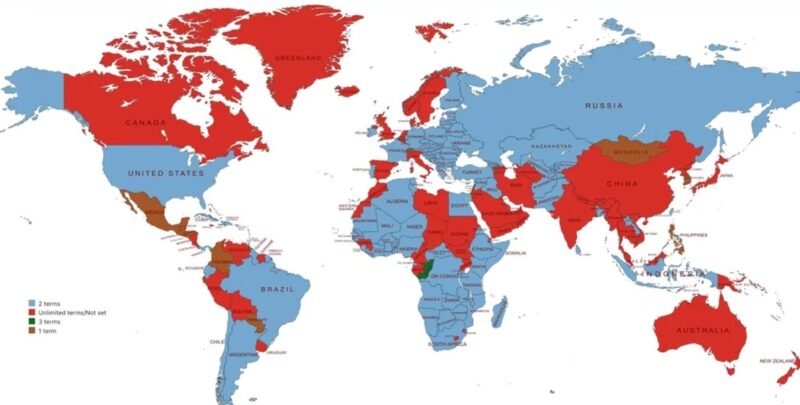
Figure above shows map of term limits worldwide.
_
Pro-term-limit:
The greatness of power must be compensated by the brevity of the duration.
Charles Montesquieu, The Spirit of the Laws, 1748
_
Anti-term-limit:
Nothing renders government more unstable than a frequent change of the persons that administer it.
Roger Sherman, open letter, 1788.
_______
Section-1
Prologue:
In the spring of 2018, addressing a crowd of donors during an event at his Florida estate, President Donald Trump was talking about the recent amendment of China’s Constitution to remove presidential term limits, allowing President Xi Jinping to serve in that office indefinitely. About Xi, Trump said: “He’s now president for life. And look, he was able to do that. I think it’s great. Maybe we’ll have to give that a shot someday.” In his second term, President Donald Trump has repeatedly floated or commented on the idea of serving a third presidential term, while simultaneously acknowledging that the U.S. Constitution prohibits it. Many foreign observers, however, would probably urge caution, as the evasion of constitutionally mandated presidential term limits is strikingly common around the world. China’s Xi Jinping is not the only incumbent who successfully extended term limits by amending the constitution: Leaders such as Rwanda’s Paul Kagame, Colombia’s Alvaro Uribe, and Algeria’s Abdelaziz Bouteflika, among many others, have taken this path. Bolivia’s Evo Morales stacked the highest court with sympathetic judges who are willing to reinterpret the constitution’s term limit provision. Peru’s Alberto Fujimori’s used a strategy of calling a constitutional assembly and arguing that the new constitution hits the reset button on term limits. These kinds of strategies are surprisingly common around the world. While many observers have pointed out that term limits are not set in stone, few have noted how regularly leaders attempt to evade those limits.
_
Limiting the term in office served by elected politicians has been a controversial issue in many countries since the early 1990s, although not for the same reason. In a number of countries, for example in Latin America, politicians can only serve one term at a time in an elected office. There are usually no restrictions upon serving in a post for a second time, providing a period out of office has elapsed since the previous term, and politicians are free to stand for other offices instead, so a representative in a state senate might move on to the national parliament and later return to the state senate. Nonetheless legislatures around the world are full of career politicians who have been re-elected regularly, sometimes for decades. This seeming dominance of incumbency is seen by those who are opposed to term limits as a natural and desirable part of democratic systems, with legislators who are competent enough to be continuously reaffirmed by the public and whose experience and political acumen, garnered from years of political activity, are invaluable to the effective working of government. Critics of the status quo, however, argue that there is a need for new voices in legislatures, that incumbents are often corrupted by power and compromised by interest groups. These critics contend that by instituting term limits, the problems of the status quo can be solved, and more responsible, accountable legislators will arise. Debates hinge around the right of people to choose who represents them, and on whether term limits will produce more effective politicians.
_
A term limit is a legal or constitutional restriction that limits the number of terms or the length of time an elected official can serve in their elected position. Once an official reaches term limit, they cannot run for re-election to the same position, though they may seek a different office. In the United States, term limits currently apply to the presidency, the governorships of 37 states, and the state legislatures of 16 states. The concept traces back to the founding era ideal of rotation in office. Early Americans believed citizens would serve briefly in government and then return to private life, preventing any single person from accumulating too much power. The idea behind term limits is pretty simple: set some rules so leaders can’t hold onto power forever. Term limits help keep things fresh in government, encourage new ideas, and make sure no one person has too much control. While these rules are a big part of many modern democracies, not every country handles them the same way. The way term limits are used—or sometimes skipped altogether—often depends on a country’s unique political journey, its traditions, and what people expect from their leaders. Term limits are one of those political topics that seem simple at first glance and then get complicated fast. The headline version is easy: cap how long elected officials can serve, or keep elections open and let voters decide. But once the discussion moves past slogans, the real questions start piling up. Do term limits reduce corruption, or do they just shift power to lobbyists and staff? Do they create fresh leadership, or do they remove experienced lawmakers right when they become effective? That tension makes term limits an ideal subject for debate and discussions.
_
Few practical questions:
- Are we discussing legislature term limits only, or also presidents, governors, and prime ministers?
- Are proposed limits lifetime bans, consecutive term caps, or chamber-specific rules?
- What outcomes matter most – anti-corruption, legislative expertise, voter choice, responsiveness, or institutional stability?
- What counts as evidence – state-level comparisons, public opinion, constitutional design, or historical case studies?
_
Term limit versus age limit:
Term limits restrict the total length of time a person can serve in a specific office (counting years or terms served, regardless of age). For example, a 50-year-old who has hit the maximum allowed number of terms is barred.
Age limits restrict eligibility based on a person’s chronological age (counting birthdays, usually setting a maximum/ceiling age). For example, an 80-year-old running for their first term is barred, while a 50-year-old veteran with decades in office is not.
_
Upper age limit for presidents and prime ministers:
In my Christmas Message of 2024 posted on Facebook, I have suggested that nobody above the age of 75 years should be allowed to hold highest offices like President and Prime Minister. There is evidence that brain’s capacity for memory, reasoning and comprehension skills (cognitive function) deteriorate with aging resulting in declines in speed of processing, working memory, and executive cognitive function. The ability to pay attention to more than one task at once declines with aging. Fluid intelligence, the ability to solve new problems, declines with age, and most critical and dangerous situations are novel ones which require peak performance from a leader. Although there is divergence in cognitive decline after age of 60, we don’t want to take chance with the highest position occupied by cognitively impaired individual. The case studies of aging heads-of-state all over the world show that certain social, behavioral, and ideological failings commonly appear in longtime political leaders at or near the pinnacle of national power. For democracy in general, it’s good to have turnover of leaders and space should be freed up for new entrants instead of allowing the same people running the show.
_
This article is on term limits.
Thomas Jefferson strongly advocated for term limits and the “rotation in office” to prevent government officials from becoming entrenched, acting like a hereditary monarchy, or losing touch with the public. Proponents of term limits argue that restricting the service of lawmakers prevents politicians from amassing too much power and becoming too alienated from their constituents. The thinking is that many lawmakers view the work as a career and not a temporary assignment, and therefore spend much of their time posturing, raising money for their re-election campaigns and running for office instead of focusing on the important issues of the day. Those who favor term limits say they would remove the intense focus on politics and place it back on policy.
The most common argument against term limits goes something like this: “We already have term limits. They’re called elections.” The primary case against term limits is that, indeed, our elected representatives in the legislature and higher offices must face their constituents every few years and get their approval. Imposing term limits, opponents argue, would remove the power from voters in favor of an arbitrary law. For example, a popular lawmaker seen by his constituents as being effective and influential would want to re-elect him to legislature or higher office – but could be barred from doing so by a term-limit law.
I have written articles on ‘Farce of democracy’ and ‘Age limit’ and this article on ‘Term limit” is continuation of my journey across political science although I belong to the realm of physical science.
______
______
Terminology to Understand the Discussion:
Ballot initiative: A proposed law that is placed on an election ballot and voted on by the entire electorate.
Gerrymandering: The manipulation of the geography of voting districts by the legislature in an attempt to give one political party an unfair advantage over another.
Incumbent: Term used to refer to the current holder of an office up for re-election.
Rotation: In politics, this term refers to politicians voluntarily limiting the number of terms they will serve.
Term limit: A term limit is a legal or constitutional restriction that limits the number of terms or the length of time an elected official can serve in a specific office. Rules vary significantly by country, level of government, and position type.
Head of govt: Head of government is the highest official in the executive branch who leads the daily administration, manages government ministers, and oversees the execution of laws.
Head of state: Head of state is the highest-ranking public official of a sovereign nation. Depending on the country’s political system, this role may belong to a president in a republic, a monarch (such as a king or queen) in a constitutional monarchy, or a governor in sub-national state systems.
Legislature: Legislature is an elected group of people who have the power to make and change laws in a state or country. The Union Legislature (Parliament) is always bicameral and makes laws for the entire country on national subjects, whereas State Legislatures can be unicameral or bicameral and make laws restricted to their specific state territories. American Congress is a bicameral legislature divided into two equal institutions: the House of Representatives and the Senate. Member of legislature could be MP, MLA, senator, congressman etc depending on the type of legislature & country.
Different countries use different names for formal meeting of people’s representatives at federal, state, district and municipal level.
Lower house = House of Representatives = House of Commons = Lok Sabha
Upper house = senate = house of lords = Rajya Sabha
Congressman = member of a national legislature known as a congress
Senator = member of a senate, which is the upper house or chamber of a legislature
MP = Member of Parliament
MLA = Member of Legislative Assembly
PM = Prime Minister (typically also a Member of Parliament)
CM = Chief minister (typically also member of state legislature)
A legislator is an individual person who makes, amends, or repeals laws (such as a senator, representative, or member of parliament); while a legislature is the organized, collective governing body or deliberative assembly made up of those individual legislators (such as the U.S. Congress or the Indian Parliament).
_______
Head of state versus head of government:
The head of state is the highest-ranking official who represents a country as a national symbol, while the head of government is the person who runs the executive branch and directs day-to-day policy.
In the Parliamentary System (e.g., India, United Kingdom) the roles are separated. The head of state (such as the President in India or the Monarch in the UK) is largely ceremonial. The head of government (such as the Prime Minister) holds real executive power.
In the Presidential System (e.g., United States), single person—the President—combines both roles, serving simultaneously as head of state and head of government.
In the Semi-Presidential System (e.g., France), the power is split or shared between a directly elected president (head of state with substantial powers) and a prime minister (head of government) appointed to lead the cabinet.
________
________
Section-2
Democracy:
The word Democracy is derived from Greek language where demos mean people and kratos means power. Democracy means power to people whereby political government is carried out directly by people (direct democracy) or by elected representative of people (representative democracy). Referendum is an example of direct democracy where policy decision is taken by people directly as in Switzerland but the world has yet to see large working examples of direct democracy. The essence of democracy is to ensure equality and freedom. Constitution in democracy supports and protects equality and freedom. Equality means equality before law, equality for power, equality of educational/employment opportunity etc and freedom means freedom of speech, freedom of movement, freedom of press etc. The most essential process of democracy is the process of electing people’s representative who is empowered to rule to benefit people. The hallmark of democracy is majority rule but without responsible government, it is possible to oppress the dissenting individuals (minority) by tyranny of majority.
_
Democracy is a system of government in which power is vested in the people and exercised by them directly or through freely elected representatives. In a direct democracy, citizens vote directly on laws, policies, and government decisions without intermediaries, whereas in a representative democracy, citizens elect officials to make and pass laws on their behalf. There are various views about democracy, yet they all have certain common characteristic: that no single person or group of persons has the warrant to rule others. They hold that “all persons are equal in many ways, and they deserve a say in how they should be governed.” Democratic theorists all share the view that member of the political community “carry elementary, rational capacities that are sufficient to judge the conduct of government.” For such judgments to have meaning, “democratic citizens are expected to be free in several important respects; including freedom of speech, assembly and conscience.”
_
The doctrine of Separation of Powers:
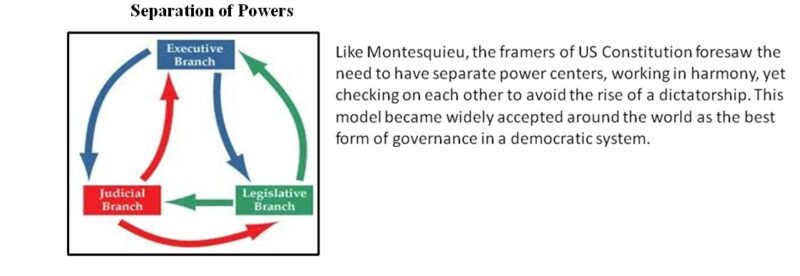
Branches of democracy like legislative branch, executive branch and judicial branch must maintain separation of power equally so that one branch does not become tyranny to destroy democracy. Also, adequate checks and balances must exist to maintain transparency, accountability and responsibility among democratic institutions. The doctrine of Separation of Powers is largely credited to French enlightenment writer and philosopher Baron de Montesquieu, who proposed the idea based on the Roman Republic and the British constitutional systems. He argued that power in England and Roman Republic was less abused because their constitutions provided for checks and balances, as no single branch could claim absolute power. This was opposed to the French system where monarchs enjoyed too much power—and usually abused it.
James Madison, also known as the “father of the Constitution of the United States” was influenced by Montesquieu’s ideas on constitutional guarantees that limited the powers of leaders. The proponents of the principle of Separation of Powers sought to avoid the rise dictatorship resulting from unchecked power of leaders. The three arms of government—the Executive, Legislature, and the Judiciary—are kept under checks and balances with and by each other to avoid abuse of power by any branch.
_
Figure below shows Montesquieu’s Separation of Powers:
_
Under the presidential system, the elected President is the head of the Executive branch and government. He appoints ministers, judges, and heads of other key institutions, depending on the constitutional provisions. He is also Commander-in-Chief of the armed forces, with the power to declare war. The Legislature makes laws, but needs the presidential assent before they come into force. The judiciary on the other hand interprets laws, and has the power to declare some laws unconstitutional. Ordinarily, this framework is supposed to ensure checks and balances among the branches of government. When this framework dysfunctions, the result is the rise of dictatorship.
_
Checks and Balances under Separation of Powers:
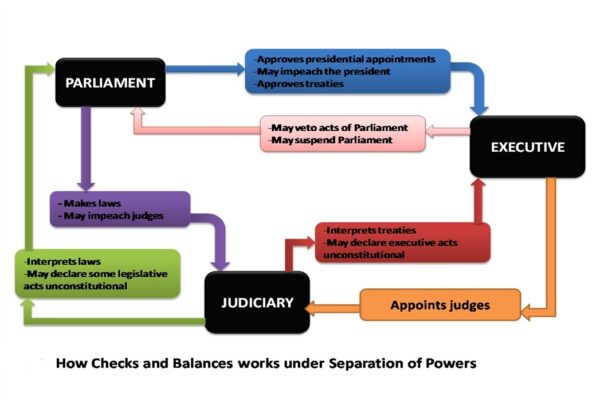
Checks and balances provide the overlapping mechanisms that allow each branch to limit, monitor, or restrain the powers of the other branches. This ensures no single organ becomes supreme or totalitarian.
_
Thomas Jefferson, Notes on the State of Virginia, 1784.
All the powers of government, legislative, executive, and judiciary, result to the legislative body [in the Virginia Constitution of 1776]. The concentrating these in the same hands is precisely the definition of despotic government. It will be no alleviation that these powers will be exercised by a plurality of hands, and not by a single one. 173 despots would surely be as oppressive as one. Let those who doubt it turn their eyes on the republic of Venice. As little will it avail us that they are chosen by ourselves. An elective despotism was not the government we fought for; but one which should not only be founded on free principles, but in which the powers of government should be so divided and balanced among several bodies of magistracy, as that no one could transcend their legal limits, without being effectually checked and restrained by the others. For this reason that convention, which passed the ordinance of government, laid its foundation on this basis, that the legislative, executive and judiciary department should be separate and distinct, so that no person should exercise the powers of more than one of them at the same time. Thomas Jefferson viewed the separation of powers and checks and balances as vital limits on centralized authority.
Thomas Jefferson strongly supported term limits and the principle of “rotation in office” for executive and legislative leaders, fearing that an unlimited tenure would cause elected positions to degrade into lifelong appointments or monarchies.
_
Term limits in the United States:
In the long history of the United States, term limits were not institutionalized until the 22nd Amendment of March 21, 1947 which came into force in February 1951 after being ratified by requisite number of states. This followed President Franklin D. Roosevelt’s successful bid for the fourth term in office, but unfortunately died before completing it. The 22nd Amendment formerly imposed a two-term limit on the president in order to further check on the perpetuity of the presidency. The former American presidents had respected the tradition of ruling for not more than two terms, and had therefore seen no need to enshrine it in the constitution. The 22nd Amendment was in the spirit that the Separation of Powers through the three branches of government was not enough to safeguard against a dictatorship. Presidential term limits was therefore an additional firewall against the rise of dictatorship of the executive branch. It has since become a widely accepted principle for most democracies around the world.
_
The idea of term limits, however, is not popular among many leaders in developing countries. History shows that even those who advocate for it at the beginning of their tenure later seek to amend the constitution in order to prolong their stay in power. In some of these countries, term limits were lifted, while in others, presidents are still struggling to amend their constitutions to do away with this limitation. In Uganda, term limits were lifted in 2005 by Parliament, which opened the door for the incumbent president to stand for re-election for as many times as he wishes.
_
There is no agreement on whether the existence of periodic elections alone without term limits is an adequate measure to control the likely excesses of the presidency. While some argue that the absence of term limits undermines institutional growth and entrenches dictatorship, others claim that the longer a President stays in power, the better he/she will be able to execute the development programs without interruption since priorities remain the same. The former group further contends that absence of term limits on the president is itself a recipe for abuse of democracy and rule of law. They argue that when leaders stay in power for long, they undermine the growth of institutions in favour of personalities. To ensure that they win the next election, state resources and apparatus such as the army, police, and the economy itself are used to ensure the survival of the ruling party.
_
The rise of democracy as the best form of governance has been a great phenomenon of the twentieth century. Only a few authoritarian regimes remain, mainly in the developing world. Although a vast majority of governments and leaders claim to be democratic, their democratic credentials are to be judged by their actions rather than what they call themselves. Fombad and Murray (2007) argue that the culture of constitutionalism is an integral element of any democratic society. For constitutionalism to thrive, there are certain conditions that must be met, and key among them is presidential term limits. Their study reveals that at the time of independence, African countries’ constitutions did not place term limits on their leaders, which helped them entrench themselves in power, often creating a myth of indispensability around themselves. Between 1960 and 2007, out of over 180 presidents who had held power in Africa, less than 20 percent of them had done so through peaceful means. Accordingly, the absence of term limits has the dangerous tendency of elevating the president into a cult and an institution, and turning the office into an inheritance, thus preventing people from choosing their leaders.
The study contends that the post-1990 constitutional rights revolution introduced term limits in an attempt to end ‘perpetual incumbency.’ However, like the transition to constitutional democracy itself, respect for constitutions, adherence to the rule of law and the proper functioning of state institutions remain a major problem. It is therefore no surprise that provisions on presidential term limits have come under assault in many African countries as many leaders still maneuver to prolong their stay in power. It is contended that, because of their increasing importance, presidential term limits must now be considered as an essential element under a presidential system because it minimizes the incumbent’s ability to override other institutions.
_
What appears to be emerging is that many African political leaders do not like the term limits. However, this phenomenon is not surprising for, even in developed countries like the United States, which has had a much longer experience of term limits, studies have shown that a majority of politicians as well as interest groups who depend on politicians for employment, patronage and other benefits are opposed to term limits because they have a misperception of democracy and hope to benefit from the incumbent’s prolonged stay in power. The study suggests that two terms are long enough for leaders to manifest their exceptional leadership qualities and to complete their programmes as well as to give others the opportunity to also display their own leadership qualities.
_
Term limits are usually misunderstood under the parliamentary democracy. Unlike in the presidential system where the president is elected directly by the people, the Prime Minister (head of government) is chosen from the party which wins majority of seats in the House. Every party has its own mechanism of choosing its leader who is most likely to lead it to victory in elections. It is therefore not possible for an individual to perpetually manipulate the party members to remain at the helm, as this could cost the party during elections. This contrasts with the presidential system where the president derives legitimacy directly from the people (majority of which in developing countries are illiterate) who can easily be manipulated. Accordingly, it is erroneous to argue that countries like the UK, Israel, Australia and Canada are strong democracies but with no term limits; without explaining how their systems differ from the presidential system.
_
The fallacy of elections:
The spread of democratic ideals after World War II has rendered all forms of authoritarianism unpalatable, both the rulers and the ruled. Even the most authoritarian regimes like North Korea want to associate themselves with the term democracy. However, the term “democracy” is one of the most misunderstood. In many countries, especially the developing world, “democracy” has come to be synonymous with “elections.” It is now trendy for leaders to legitimize their dictatorship through elections. Schedler (2002) argues that by simply identifying democracy with elections, we are in danger of forgetting that the modern history of representative elections is a tale of authoritarian manipulations as much as it is a saga of democratic triumphs.” He argues that elections have been an instrument of authoritarian control as well as a means of democratic governance.
_
According to Schedler (2002) elections have given birth to new forms of authoritarianism that do not fit into classic categories of one-party, military, or personal dictatorship. Accordingly, there is an increasing number of countries that hold elections and tolerate some level of pluralism and multi-party competition, yet they do not respect the minimal democratic principles. Hence, it makes no sense to classify them as democracies, however qualified they may seem.
_
Fareed (1997) argues that mere elections can give rise to “illiberal democracy.” Such are regimes which win elections and are declared to be “free and fair” by election observers, yet the elected officials are racist, fascist, separatist, and vehemently opposed to peace and development. Indeed, the world is continuously witnessing democratically elected regimes which are routinely ignoring constitutional limits on their power and denying their citizens basic rights and freedoms. Fareed argues that western democracy meant “liberal” democracy—a political system marked by not only free and fair elections, but by also the rule of law, a separation of powers, and the protection of basic liberties of speech, assembly, religion and property.” According to Fareed, what is being practiced in many new democracies is theoretically and practically distinct from the western model of democracy.
_
The new form of authoritarian regimes camouflage as democracies. They neither practice real democracy nor resort to naked repression. Regular elections are used for the purpose of obtaining a false image of democratic legitimacy, hoping to satisfy their populace as well as cooling external pressure especially from the donor community. Elections are placed under tight authoritarian controls; in the process they cement their continued hold on power. Such is the behavior of many popular democracies in developing countries. Schedler (2002) contends that most regimes today occupy a Foggy Zone between liberal democracy and electoral authoritarianism. While liberal democracies go beyond the electoral minimum, electoral authoritarians do not. They manage to “get elections right” but fail to uphold and sustain other vital dimensions of democratic constitutionalism, such as the rule of law, political accountability, bureaucratic integrity, and public deliberation.
_
What is a democratic election?
Robert Dahl puts forward seven conditions which must be fulfilled for any election to be called as democratic: 1) Empowerment—political elections are about citizens wielding power. Elections exist to accomplish the binding selection of the polity’s most powerful collective decision makers. 2) Free supply—the range of available alternatives cannot be something engineered by a manipulative government, but must be determined by active citizens themselves within a framework of fair and universal rules. 3) Free demand— democratic elections presuppose the free formation of voter preferences. Citizens who vote on the basis of induced preferences are no less constrained than those who must choose from a manipulated set of alternatives. 4) Inclusion—democracy demands universal suffrage. Restrictions of the franchise once commonly applied on the basis of property, education, gender, or ethnicity are not legitimate anymore. 5) Insulation—once citizens have freely formed their preferences, they must be able to express them just as freely. The use of the secret ballot is designed to shield them from undue outside pressures, whether in the form of actual or threatened coercion, bribery, or even just the disapproval of neighbors. 6) Integrity—once citizens have given free expression to their will at the polls, competent and neutral election management must count their votes honestly and weigh them equally. 7) Irreversibility—like elections that begin without choice, elections that end without consequences are not democratic. The winners must be able to assume office, exercise power, and conclude their terms in accordance with constitutional rules.
Of course, there is no single country whose elections can perfectly meet Dahl’s conditions. They just work as a yardstick to help us judge how far or how near an election is from being democratic.
_______
How long can a leader serve?
Putin has played a game of musical chairs since 1999, switching between the role of prime minister and president to avoid term limits. In fact, discussions about term limits are not unusual in countries that employ them. South Korea and Brazil, whose heads of government are subject to term limits of 5 and 8 years, respectively, have recently had discussions about extending them. Those suggestions were met with some opposition, as term limits are seen by many as a mode to keep government power in check and ensure a functioning democracy. Yet, almost no European democracies have term limits for their heads of government. Meanwhile, they are quite common in the Americas and Asia. What seems unfair is really a symptom of different styles of government.
_
European heads of government, like UK Prime Minister or German chancellor, are typically not heads of state. That function is served in many European countries by a ceremonial president, who does stick to a term-limit, or in fewer cases by a monarch, also with exclusively ceremonial powers. Prime ministers and chancellors are also not elected directly and are therefore dependent on upholding a majority in their respective parliaments or throw in the towel. It is also expected that prime ministers and chancellors can face multiple re-elections on short notice in the case of a government dissolving or withdrawing support for its leader. Term limits therefore would be hard to formulate, while toppling a leader remains rather easy. Neither of those characteristics apply to U.S. presidents or their counterparts in Asia and Latin America, bringing in term limits as an additional safeguard for leaders who are heads of state and heads of government at the same time.
_
France is the exception in Europe, with President running the country and government to a large degree. In Russia, which has a similar system of shared executive power in place, is in the same position when it comes to term limits. China, finally, removed term limits for President Xi Jinping in 2018, while none are put on the prime minister either. The most valuable office in China, Secretary of the Communist Party (also held by Xi), has had no term limits since 2017.
______
______
Democracy indices:
Democracy indices are quantitative, comparative tools used to measure the quality, strength, and form of governance across countries.
The Economist Intelligence Unit (EIU) Democracy Index evaluates 167 countries using 60 indicators across five categories (electoral process/pluralism, functioning of government, political participation, political culture, and civil liberties) on a 0–10 scale. Countries fall into four groups: full democracies, flawed democracies, hybrid regimes, or authoritarian regimes. In the EIU Democracy Index 2025, the global average score ticked up slightly to 5.19, halting an eight-year democratic decline, with leaders like Norway, New Zealand, Denmark, Iceland, and Finland topping the rankings.
Freedom House rates people’s access to political rights and civil liberties in 208 countries and territories through its annual Freedom in the World report. Individual freedoms—ranging from the right to vote to freedom of expression and equality before the law—can be affected by state or nonstate actors.
The term freedom index most commonly refers to several prominent global metrics that evaluate political rights, civil liberties, economic freedom, or press freedom:
- Freedom in the World: Published annually by Freedom House, this report evaluates political rights and civil liberties across 208 countries and territories, categorizing them as Free, Partly Free, or Not Free.
- Human Freedom Index (HFI): Published by the Cato Institute, the HFI measures a broad scope of personal and economic freedom across 165 jurisdictions using 87 distinct indicators.
- Index of Economic Freedom: Published by The Heritage Foundation, this index ranks countries based on trade freedom, business regulations, property rights, and fiscal health.
- World Press Freedom Index: Compiled annually by Reporters Without Borders, this index assesses the independence and safety of journalists and media environments across 180 countries.
Nations in Northern and Western Europe (such as Norway, Sweden, and Switzerland) and select global peers regularly top individual freedom and press indices, while countries like Syria, Yemen, and Iran score near the bottom of human freedom rankings.
The 2025 Corruption Perceptions Index shows that full democracies average a score of 71 out of 100, while non-democratic regimes average 32. Transparency International notes that declining scores are heavily driven by weakened checks and balances and the concentration of executive power.
India is world’s largest democracy. India is ranked 47th globally (placed in the “Flawed Democracy” category, grouped comparably with certain Eastern European nations) out of 167 in Economist Intelligence Unit (EIU) Democracy Index. India is rated as “Partly Free” with a total score of 62 out of 100 (Political Rights: 31/40, Civil Liberties: 31/60) in Freedom House (Freedom in the World Report). India ranks 91st out of 182 countries in the Corruption Perceptions Index 2025 published by Transparency International.
_______
_______
Section-3
History of term limits:
Term limits were in use in ancient Greece in the 5th and 4th centuries BCE, when they were used to promote rotation of people in office. In ancient Athens, Aristotle supported term limits both in order to limit government corruption, and to prevent the emergence of a permanent political class. He also argued that the periodic rotation of government officials allowed a greater number of citizens the chance to rule, producing a greater number of qualified politicians. Consuls in ancient Rome served for only one year. The Republic of Genoa elected a doge—or duke—every two years from 1528 to 1797; however, the republic was controlled by an oligarchy of merchant families, from whom the doge was elected. The Republic of Florence was governed by a council of nine, with officials picked using a lottery every two months. However, as in Genoa, several key families controlled the process; the lottery was often predetermined, with positions being handed out based on birthright or privilege.
_
During the Renaissance, the states of Venice and Florence (in modern day Italy) also practiced a form of term limits. At the same time, prominent intellectuals such as James Harrington, Algernon Sydney and Henry Neville supported term limits in England, in order to avoid corruption and to prevent the birth of professional politicians who lacked any connection to the people. Other British thinkers, however, such as Matthew Wren and David Hume, feared that term limits would promote incompetent politicians who lacked the experience gained by holding multiple terms in office. Poet John Milton argued that partial rotation, which mixed old and new office-holders, was the best answer.
_
Modern term limits arose with the spread of democracy and the use of written constitutions to define how governments operate. The United States’ Founding Fathers were inspired by ancient Greece and Rome. The founding generation debated rotation in office extensively. Thomas Jefferson and others argued that frequent turnover would prevent corruption and keep government close to the people. The framers ultimately chose not to impose term limits on Congress, trusting the electoral process to handle accountability. George Washington’s voluntary departure after two terms established a powerful norm that lasted nearly 150 years. Not all of the Founding Fathers agreed with Washington’s decision. In Federalist paper number 69, Alexander Hamilton wrote:
That magistrate [the president] is to be elected for four years; and is to be re-eligible as often as the people of the United States shall think him worthy of their confidence.
_
Nonetheless, Washington’s precedent stood, with no president serving more than two terms until the presidency of Franklin D. Roosevelt. He was elected four times: in 1932, 1936, 1940, and 1944. Roosevelt’s successor, Pres. Harry Truman, set up the Hoover Commission to look at reforms of the federal government, which included imposing term limits on the presidency. The Twenty-second Amendment, which was ratified in 1951, formally limits the service of a president to two four-year terms. If a person becomes president without election and serves fewer than two years, they may be elected to two full terms.
_
Oklahoma became the first state to adopt legislative term limits through a ballot initiative in 1990. California, Colorado, and Michigan quickly followed. By the mid-1990s, more than 20 states had some form of legislative term limit on the books. The movement peaked around 1996, then stalled as courts and legislatures began rolling back the provisions. The 1995 Supreme Court decision in U.S. Term Limits v. Thornton was a turning point. It struck down state-imposed term limits on members of Congress, ruling that only a constitutional amendment could add qualifications for federal office. That ruling closed the door on the easiest path to congressional term limits and shifted the fight to the much harder amendment process.
_
After the wave of attention to term limits in the early 1990s, the issue largely fell from prominence. While the concept of term limits remained relatively popular among citizens according to many public polls, legislators at all levels of government tended to oppose them and few elected officials voluntarily rotated out of office. Opponents argued that term limits would give too much power to lobbyists and party officials, and that the complexity of serving in a legislature requires years of experience. They also maintained that elections are the best tool for limiting the number of terms served by legislators. By the start of the 2020s only fifteen states had term limits for state legislators, while thirty-six had limits for governors in the US.
_
Europe:
The first modern constitutional term limit was established in the French First Republic by the Constitution of 1795, which established five-year terms to the French Directory and banned consecutive terms. Napoleon ended the practice of term limits in 1799 in much the same way as Julius Caesar had. The French Constitution of 1848 reestablished term limits, but this was abolished by Napoleon’s nephew, Napoleon III. There were no presidential term limits in the French Third Republic or the French Fourth Republic. The President of France did not have term limits in the current French Fifth Republic until the Constitution of France was amended in 2008, limiting the president to two consecutive 5-year terms.
There are no term limits for the Prime Minister or Members of Parliament (MPs) in the United Kingdom.
Many post-Soviet republics established presidential systems with five-year term limits after the dissolution of the Soviet Union in 1991. The president of Russia is allowed a maximum of two consecutive terms, but the 2020 constitutional amendments reset incumbent president Vladimir Putin’s term count, allowing him to stand for two additional terms. The president of Belarus was limited to two terms, but the limit was abolished in 2004 under Alexander Lukashenko. The president of the European Commission has no term limit.
_
Latin America:
As the countries of Latin America modelled presidential republics after the government of the United States in the 19th century, they established term limits for their presidents based on the two-term precedent of the United States. However, the implementation of legislative term limits in Latin America, while intended to foster elite renewal, occurs in a region already characterized by exceptionally high rates of legislative turnover (around 70% on average between 1985 and 2023), significantly higher than in Europe and other democratic regions. In response to presidents overstaying their term, some of these term limits were eventually replaced by a limit of one term without re-election.
_
Asia:
In 1948, the Temporary Provisions against the Communist Rebellion abolished the term limit for the President of the Republic of China and established Chiang Kai-shek as the country’s military leader. Between 1982 and 2018, the Constitution of China stipulated that the president, vice president, premier and vice premiers could not serve more than two consecutive terms, though there was no term limit for the General Secretary of the Chinese Communist Party, who usually represented the paramount leader of China. In March 2018, the National People’s Congress passed a constitutional amendment which abolished the term limits for the president and vice president, as well as enhancing the central role of the Chinese Communist Party (CCP), allowing CCP General Secretary Xi Jinping to continue as paramount leader and president indefinitely. A 2023 study found, using survey experiments, that there was not majority support among the Chinese public for removing the term limits.
The Philippines established term limits following independence from the United States, but they were abolished by Ferdinand Marcos in the 1970s. Term limits were restored in the 1987 constitution, after Marcos was deposed in the People Power Revolution. The President is limited to one six-year term.
The Prime Minister of Pakistan was limited to one five-year term until the limit was abolished in 2011.
The King of Malaysia is subjected to a single five-year non-consecutive term, which rotates among the monarchs of Malaysia. This rule makes Malaysia among two constitutional monarchies in the world that is subjected to a term limit, the other being Andorra (with the President of France serving as one of its co-princes). In February 2026, the Constitution (Amendment) Bill 2026 was tabled to the Parliament of Malaysia, seeking to limit the Prime Minister’s term in office to an aggregate total of 10 years. It however failed to secure two-third majority support at the lower house by merely two votes when it was put up for vote in March 2026.
_
Sub-Saharan Africa:
Liberia briefly limited its presidents to an eight-year term between 1944 and 1951. As the countries of sub-Saharan Africa were decolonised in the mid-20th century, most of the new governments established presidential systems, but term limits were rarely established. The Democratic Republic of the Congo, Gabon, Rwanda, and Togo were the only countries to establish them, but they were abolished soon afterward. After the revolutions of 1989 and ensuing wave of democratization in Eastern Europe, many African states moved to remove one-party regimes and establish term limits.
In Sub-Saharan Africa, as of 2023, only 15 countries have experienced a peaceful transition of power from one president to another after the expiration of term limits. Some countries have either scrapped the requirement or do not have it in their laws.
_
Middle East and North Africa:
Term limits were one of the major demands of protesters during the Arab Spring. The 2019 Egyptian constitutional referendum included amendments to expand the presidential term from four to six years and allow President Abdel Fattah el-Sisi to stand for a third term over the constitutional limit of two terms.
______
______
Section-4
Term Limits Around the World:
Term limits exist in democracies worldwide, though their design varies dramatically. Most presidential systems impose some form of limit, while parliamentary systems typically do not restrict the head of government’s tenure. Not every country respects its own term limit laws. Some leaders have rewritten or ignored constitutional limits to extend their rule.
Russia amended its constitution in 2020 to reset Vladimir Putin’s term count, effectively allowing him to remain in power until 2036. The change passed through a national referendum that international observers widely questioned.
China removed presidential term limits entirely in 2018, clearing the way for Xi Jinping to serve indefinitely. The National People’s Congress approved the change overwhelmingly, though critics saw it as a step toward one-man rule.
These examples show why term limits matter to advocates of democracy. When limits can be removed or reset, they stop functioning as a check on power. The pattern is consistent globally. Leaders who remove term limits tend to consolidate authority, suppress opposition, and weaken independent institutions over time.
_
From the strict two-term tradition in the United States to countries where leaders can hold power indefinitely, the landscape of presidential tenure is complex and ever-changing. Below is a comprehensive overview of political term limits for heads of state and government across the world, broken down by continent.
______
Africa:
Africa really shows just how all over the map term limits can be. Some countries have clear limits written right into their constitutions, trying to keep things stable and give everyone a fair shot at running the place. In others, though, leaders have found ways to stretch or even toss out these rules when it suits them, so folks can end up staying in power for a very long time. It makes for a lively political scene where there’s always a bit of tension between wanting fresh starts and wanting to hold onto power.
Nations with Two-Term Limits:
Plenty of African countries have put two-term limits in place for their top leaders, usually as part of efforts to leave their authoritarian days behind. Most of these rules mean a president gets four or five years per term.
- Nigeria: As a regional powerhouse, Nigeria’s adherence to term limits is influential. Its constitution, adopted in 1999, allows the president to serve a maximum of two four-year terms. This rule was a deliberate move to prevent the kind of prolonged military dictatorships that marked much of its post-independence history.
- Ghana: Often cited as a model of democratic stability in West Africa, Ghana has a firm two-term limit for its presidents, each term lasting four years. The peaceful transitions of power since its 1992 constitution have reinforced its democratic credentials.
- Kenya: Following a period of political turmoil, Kenya adopted a new constitution in 2010 that established a strict two-term limit of five years each for the president. This reform was aimed at reducing the high-stakes, winner-take-all nature of its presidential elections.
- South Africa: After the end of apartheid, South Africa’s 1996 constitution set a two-term limit for its president. The president is elected by the National Assembly for a five-year term, and this limit has been respected, contributing to the country’s democratic consolidation.
- Tanzania: Tanzania has maintained a two-term limit for its president since the reintroduction of a multi-party system. Each term is five years, and the country has seen regular, peaceful transfers of power.
- Zambia: The Zambian constitution limits the president to two five-year terms. The country has experienced several leadership changes through the ballot box, although its political scene remains highly competitive.
- Liberia: After devastating civil wars, Liberia’s 1986 constitution implemented a two-term limit for its president, though each term is a lengthy six years. Adherence to this rule is seen as critical for maintaining peace and stability.
Other countries in Africa adhering to a two-term limit include Algeria (five-year terms), Angola (five-year terms), Benin (five-year terms), Botswana (five-year terms), Cape Verde (five-year terms), Mauritania (five-year terms), Mozambique (five-year terms), Namibia (five-year terms), Senegal (five-year terms), Sierra Leone (five-year terms), and Zimbabwe (five-year terms).
_
Countries with Unlimited or Extended Terms:
There are plenty of African countries where term limits don’t really stick—or have been scrapped altogether. In places like these, leaders can end up staying in charge for as long as they want, and it’s not unusual to see the same faces at the top for decades. Moves to ditch term limits usually spark a lot of debate and claims of “constitutional coups,” since they let presidents hold onto power way longer than most folks expected.
- Uganda: President Yoweri Museveni has been in power since 1986. The original two-term limit was removed in 2005, and a presidential age limit of 75 was controversially scrapped in 2017, effectively allowing him to rule for life.
- Cameroon: President Paul Biya, one of Africa’s longest-serving leaders, has been in office since 1982. A 2008 constitutional amendment removed presidential term limits, allowing him to extend his rule indefinitely through seven-year terms.
- Republic of the Congo: A 2015 referendum allowed President Denis Sassou Nguesso to run for a third consecutive term and changed the term length to five years. The constitution now allows for up to three terms.
- Djibouti: Term limits were abolished in 2010, enabling President Ismaïl Omar Guelleh to continue his rule. He has been in power since 1999.
- Gambia: Under former leader Yahya Jammeh, there were no term limits. While there have been discussions about reintroducing them after his ouster, the current system still allows for unlimited five-year terms.
- Equatorial Guinea: While the constitution technically imposes a two-term limit, it has not been enforced. President Teodoro Obiang Nguema Mbasogo has ruled since 1979, making him the world’s longest-serving current president.
_
Transitional and Monarchical Systems:
Some countries in Africa are in the middle of big political changes or have different types of government altogether.
- Burkina Faso, Mali, Niger, and Sudan: Following recent military coups, these nations are under transitional governments with no set term limits for their current leaders. The path back to constitutional rule remains uncertain.
- Eswatini (formerly Swaziland), Lesotho, and Morocco: These countries are monarchies. The King serves for life through hereditary succession, though the prime minister, who holds administrative power, typically serves renewable terms with no set limits.
_______
The Americas:
When it comes to the Americas, presidential term limits are a pretty big deal—and you can thank the U.S. for setting the trend. Most countries in this part of the world have some kind of rule for how long their leaders can stick around, but the details can really vary. Some places let presidents come back after a break, while others keep things short and sweet with a hard cap. It’s a mix of old habits, cultural expectations, and lessons learned the hard way about giving too much power to one person.
The Two-Term Model: Consecutive and Non-Consecutive:
The usual setup in the Americas is a two-term limit, though there’s a lot of variety in how countries handle the details.
- United States: The U.S. Constitution’s 22nd Amendment, ratified in 1951, formally limits the president to two four-year terms. This followed the tradition set by George Washington, which was broken only by Franklin D. Roosevelt’s four-term presidency. The limit is absolute, meaning a president who has served two terms can never run again.
- Brazil: The president of Brazil can serve two consecutive four-year terms. After serving two terms, a former president must sit out at least one term before becoming eligible to run again.
- Argentina: Similar to Brazil, Argentina allows for two consecutive four-year presidential terms. A former president can seek a third term after a one-term interval.
- Chile: Chile has a unique system where the president serves a four-year term and cannot be re-elected consecutively. However, a former president is eligible to run again after waiting out one presidential period. This has allowed for leaders like Michelle Bachelet and Sebastián Piñera to serve two non-consecutive terms.
- Uruguay: The Uruguayan constitution also prohibits immediate re-election for a president. A leader must wait five years (one full presidential term) before being eligible to run again.
_
The Single-Term Presidency:
Some countries in Latin America cut things off after just one term to make sure no one gets too settled in the big chair. This “one-and-done” rule is usually a direct response to old-school strongmen who stuck around way too long. It’s all about stopping anyone from locking down power for years on end and keeping the political game open for fresh faces.
- Mexico: Mexico has one of the world’s strictest term limits, known as the sexenio. The president is elected for a single six-year term and is barred from ever holding the office again. This rule was enshrined in the constitution after the Mexican Revolution to prevent the emergence of another dictator like Porfirio Díaz.
- Colombia: After a period where two consecutive terms were allowed, Colombia reinstated a single four-year term for its president in 2015. A president is ineligible for re-election.
- Paraguay: The president of Paraguay is limited to a single five-year term and cannot be re-elected. Attempts to amend this rule have been met with significant public protest.
- Guatemala: Like Mexico, Guatemala enforces a strict one-term limit of four years, with no possibility of re-election at any point in the future.
_
Nations with Relaxed or Abolished Term Limits:
Most countries in the Americas stick with term limits, but there are a few places that have gone the other way—usually when a popular leader wants to hold onto power a bit longer. In these countries, rules get changed or dropped so presidents can stay in office way past what used to be allowed.
- Venezuela: In 2009, a constitutional referendum under President Hugo Chávez removed term limits for all public offices, including the presidency. This allowed him, and his successor Nicolás Maduro, to seek re-election indefinitely for six-year terms.
- Nicaragua: President Daniel Ortega, through judicial rulings and constitutional changes, eliminated presidential term limits in 2014. This has enabled him to remain in power continuously since 2007.
- El Salvador: In a highly controversial 2021 ruling, the Supreme Court reinterpreted the constitution to allow for immediate presidential re-election, despite explicit text to the contrary. This paved the way for President Nayib Bukele to run for and win a second consecutive five-year term.
_
Parliamentary Systems and Constitutional Monarchies:
Not every country in the Americas runs on a presidential system, as some follow a totally different playbook when it comes to choosing who’s in charge. In these places, the prime minister (or equivalent) can stick around as long as they keep their party’s support in parliament and keep winning elections. Term limits pretty much don’t exist here, so leadership can change hands quickly, or not at all, depending on how things shake out politically.
- Canada: As a parliamentary democracy and constitutional monarchy, Canada has no term limits for its prime minister. The prime minister is the leader of the party with the most support in the House of Commons and can remain in office as long as they maintain that support and win general elections, which are held roughly every four years.
- Jamaica, The Bahamas, Belize: These and other Caribbean nations are also parliamentary systems within the Commonwealth. Their prime ministers have no fixed term limits and serve as long as they command the confidence of their respective parliaments.
______
Asia:
Asia covers a lot of ground—literally and politically. When it comes to term limits, you’ll find just about every setup imaginable. Some countries have had the same political party or leader running things for years, others are famous for their ancient royal families, and plenty have tried different term limit ideas in their journey toward democracy. It’s a real mix, and the rules about how long someone can stay in charge often tell you a lot about a country’s history and what the people there want from their leaders.
Democracies with Term Limits:
A lot of democracies in Asia have set up term limits for their presidents, whether they’re running the show or mainly playing a ceremonial role. These rules are meant to keep power from sticking with one person for too long and to make sure new folks get a shot at leading.
- South Korea: South Korea has a strict single-term limit for its president, who serves for five years. This rule was implemented in its 1987 constitution as a definitive break from the country’s history of military dictatorships and is seen as a crucial safeguard of its democracy.
- Indonesia: As the world’s third-largest democracy, Indonesia limits its president to two five-year terms. This was a key reform following the fall of the authoritarian Suharto regime in 1998, which had lasted for over 30 years.
- Philippines: The 1987 constitution of the Philippines limits the president to a single six-year term. The vice president, however, can serve up to two consecutive six-year terms. This single-term rule for the president was a direct response to the 21-year rule of Ferdinand Marcos.
- Taiwan: The president of Taiwan is limited to two consecutive four-year terms. This democratic rule has been firmly in place since the country’s transition from single-party rule.
- Sri Lanka: The president of Sri Lanka can serve a maximum of two five-year terms. Term limits were briefly removed but reinstated in 2022 following widespread protests and political crisis.
_
Systems with No Term Limits or Weak Restrictions:
In a lot of Asian countries, leaders don’t have to worry much about a time limit—there just aren’t many rules saying when they need to step down. Some can run over and over, sticking around for years on end if they keep winning (or just keep the system in their favor). It’s a setup that makes it possible to see the same folks in charge for decades, especially when there aren’t any serious restrictions holding them back.
- China: In 2018, China’s National People’s Congress abolished the two-term limit for the presidency, allowing Xi Jinping to rule indefinitely. While the positions of General Secretary of the Communist Party and Chairman of the Central Military Commission—his two more powerful roles—never had term limits, this constitutional change solidified his long-term grip on all levers of power.
- Russia: While geographically spanning Europe and Asia, Russia’s political system is often analyzed in an Asian context of centralized power. Constitutional changes in 2020 reset President Vladimir Putin’s previous terms, allowing him to run for two more six-year terms and potentially stay in power until 2036.
- Singapore: As a parliamentary republic, Singapore has no term limits for its prime minister. The People’s Action Party (PAP) has been in power since 1959, with leadership transitions occurring smoothly within the party.
- India: In the world’s largest democracy, the prime minister has no term limits. They serve as long as their party or coalition commands a majority in the Lok Sabha (the lower house of Parliament).
- Japan: Japan is a constitutional monarchy with a parliamentary system. The prime minister has no term limits and can serve as long as they maintain the leadership of their party and the confidence of the House of Representatives.
- Kazakhstan: After decades of rule by the same leader, Kazakhstan transitioned to a single seven-year presidential term in 2022. While this is a limit, the long term length is notable.
_
Monarchies and Theocracies:
In some parts of Asia, who gets to be in charge isn’t really up for a public vote—power just stays in the family or with the top religious leader, and that’s that. Kings, emirs, sultans, and supreme leaders can end up with the job for life, passing it on or handing off whenever they decide (or whenever the system says so). There aren’t any real “terms” in these setups—just a lot of tradition and, sometimes, a good dose of ceremony.
- Saudi Arabia, Qatar, UAE, Oman, Bahrain, Kuwait, Brunei: These nations are absolute or constitutional monarchies where the king, emir, or sultan rules for life. Power is transferred through established lines of succession within the ruling family.
- Iran: Iran is a theocracy where the ultimate authority is the Supreme Leader, who is appointed for life by an Assembly of Experts. The president, who handles the day-to-day administration of the country, is limited to two consecutive four-year terms but is subordinate to the Supreme Leader.
- Thailand and Cambodia: These are constitutional monarchies where the king is the head of state and serves for life, but the prime minister, as head of government, is subject to political processes. Thailand recently introduced an eight-year cumulative limit for its prime minister.
_______
Europe:
When you look at Europe, you’ll see that most countries run things through a parliamentary system. That means the real power usually sits with the prime minister or chancellor, who doesn’t have to worry about term limits—if they keep their party happy and win elections, they can stay in charge for years. The head of state is often just the monarch or a president who handles ceremonies and traditions, and for those presidents, there are usually some rules on how long they can serve.
Parliamentary Systems without Term Limits for Heads of Government:
In these countries, prime ministers or chancellors can keep the job as long as they’ve got enough backing in parliament. There’s no set limit, so if they play their cards right, they might stick around for quite a while.
- United Kingdom: The prime minister can theoretically serve indefinitely, provided they remain leader of their party and their party wins general elections, held at least every five years.
- Germany: The chancellor, Germany’s head of government, has no term limits. Leaders like Helmut Kohl and Angela Merkel served for 16 years each, providing long periods of stability.
- Spain, Italy, Sweden, Netherlands, Belgium, Norway: These and many other European nations operate under a similar parliamentary model. Their prime ministers or equivalents have no constitutional term limits.
_
Republics with Executive or Semi-Presidential Systems:
Some of the bigger European countries do things differently—they actually let people vote directly for presidents who have real power, not just a ceremonial role.
- France: The French president is elected for a five-year term and is limited to two consecutive terms. This system, part of the Fifth Republic, creates a powerful head of state who is also held in check by term limits.
- Portugal: The president of Portugal is limited to two consecutive five-year terms. Though the system is semi-presidential, the prime minister holds significant executive power as well.
- Poland: The Polish president is also limited to two five-year terms. The role is active in foreign policy and as a check on the government.
- Romania: The president of Romania serves a maximum of two five-year terms.
_
Republics with Ceremonial Presidents and Term Limits:
For most European countries that aren’t monarchies, the president’s job is mainly about representing the nation and keeping up with traditions. These presidents usually don’t have a ton of power, and they’re typically capped at two terms before someone else takes over.
- Germany: The federal president is limited to two five-year terms but holds a largely symbolic role.
- Italy: The president serves a seven-year term and can be re-elected, though serving more than one term is rare. The role is primarily to act as a guarantor of the constitution.
- Austria, Finland, Greece, Hungary, Ireland, and Croatia: In these countries, the president is popularly elected (or elected by parliament) and serves a limited number of terms, usually two. Their powers are mostly ceremonial, with the prime minister acting as the true head of government.
______
Oceania:
When it comes to politics in Oceania, most countries follow the British-style parliamentary system, so you’ll see a lot of familiar patterns if you know how things work in the UK. That means parliaments call the shots, and leaders don’t usually have to worry about term limits—as long as they keep winning elections. Still, you’ve got a handful of island republics out here too, each with their own twists and rules about how long someone can stay at the top.
______
Commonwealth Realms:
- Australia and New Zealand: As constitutional monarchies, their head of state is the British monarch, represented by a governor-general. The head of government is the prime minister, who, as in the UK and Canada, has no term limits and serves as long as they lead a majority party in parliament.
- Papua New Guinea, Solomon Islands, Tuvalu: These Pacific island nations also operate as Commonwealth realms with no term limits for their prime ministers.
_______
Republics in the Pacific:
A bunch of the island nations in the Pacific are republics, and most of them give their presidents a set limit on how long they can serve. Usually, that means a couple of terms—and in most cases, these presidents aren’t running the show day-to-day, since their jobs are mostly ceremonial anyway.
- Fiji: The president is limited to two three-year terms and is appointed by the parliament. The role is largely ceremonial.
- Kiribati: The president, known as the Beretitenti, can serve a maximum of three four-year terms.
- Federated States of Micronesia: The president is limited to two consecutive four-year terms.
- Palau: The president is limited to two consecutive four-year terms.
- Vanuatu: The president serves a single five-year term in a mostly ceremonial capacity.
_______
_______
Section-5
Overview of term limits:
A term of office, electoral term, or parliamentary term is the length of time a person serves in a particular elected office. In many jurisdictions there is a defined limit on how long terms of office may be before the officeholder must be subject to re-election. Some jurisdictions exercise term limits, setting a maximum number of terms an individual may hold in a particular office.
A term limit is a legal or constitutional restriction on the number of terms or the length of time an elected official can serve in a specific office. When term limits are found in presidential and semi-presidential systems, they act as a method to eliminate the potential for “president for life”, check the concentration of power in the executive, and curb authoritarianism. Term limits may be a lifetime limit on the number of terms an officeholder may serve, or a limit on the number of consecutive terms.
_
Term limits are legal restrictions placed, typically in a country or region’s constitution, on the length of time an official may serve in their elected position. Term limits are applied to ensure political leaders do not continue in office indefinitely, a practice that could lead to a dictatorship. They are most commonly applied to the office of the head of government of the country, typically the president. Despite defined term limits, political leaders have been known to violate or circumvent them to remain in power.
Term limits typically take one of two forms. They may mandate the number of consecutive terms a leader can serve. After a defined period of time, the official can again seek office. Term limits can also be imposed on total number of terms in an official’s lifetime. Term limits are not typically used in parliamentary systems, in which the head of the executive branch, usually the prime minister, is chosen from among elected representatives.
_
Some countries where fixed-term elections are uncommon, the legislature is almost always dissolved earlier than its expiry date. “Until removed from office” refers to offices that do not have fixed terms; in these cases, the officeholder(s) may serve indefinitely until death, abdication, resignation, retirement, or forcible removal from office (such as impeachment). In most cases where the head of government is a different person from the head of state, its term of office is identical to the chamber that elected it (the legislature if it is unicameral, or more usually the lower house if it is bicameral), unless it does not survive a vote of no confidence.
_
Term limits fall into two broad categories: consecutive limits and lifetime limits. Understanding this distinction is essential to answering what are term limits in practical terms.
Consecutive limits cap how many terms an official can serve in a row. Once they hit the cap, they must step aside. However, they can return and run again after sitting out for a required break. That required break is called a cooling-off period. During this time, the former officeholder cannot appear on the ballot for that position. After the cooling-off period ends, they regain eligibility.
Lifetime limits are stricter. They permanently bar an official from holding that office again after they reach the maximum number of terms. There is no cooling-off period and no path back. The U.S. presidency operates under a lifetime limit. Once a president serves two full terms, they can never hold the office again, no matter how long they wait.
State legislatures use a mix of both systems. Some states impose consecutive limits with a waiting period, while others enforce lifetime bans on returning to the same chamber.
_
TERM LENGTH AND TERM LIMITS OF THE HEAD OF STATE, a 2009 study:
Term length refers to the number of years an office-holder may serve once elected. A term limit is a legal restriction on the number of terms an office- holder may serve. Explicit term limits are usually found in presidential and mixed constitutions as a way of preventing dictatorial tendencies. Authors describe below the range of constitutional provisions regarding the term length and term limits for the head of state.
As of this writing in 2009, the project’s sample includes 570 of the roughly 800 constitutions put in force since 1789, including more than 90% of constitutions written since World War II.
82% of constitutions in the sample specify the maximum term length for the head of state. However, only about 59% of constitutions impose restrictions on the number of terms the Head of State may serve.
The most common term lengths for head of states are 4 and 5 years. A 4-year tenure has been on the decline since early 1900s. In 1900, 45% of constitutions that had a specified term provided for a 4- year tenure for the head of state. In 2000, however, that number decreased to about only 10% of constitutions. The number of constitutions granting a 5-year term, on the other hand, has increased dramatically since 1930s from almost none to about 45% of constitutions with a specified term.
_
Barring rare exceptions, the provisions on presidential term limits are enshrined in the constitutions of all republics in the world. Comparison of the current versions of constitutions alone will demonstrate in an enormous variety of provisions on presidential term limits. In different constitutional systems, relevant provisions limit the term of head of state in a republic to several years at one extreme, and provide for an indefinite term, at the other.
In case of monarchies, the preliminary assessment of the content of constitutions, constitutional provisions and customs enables us to argue that they also set out various requirements as to term limits of a sovereign. The monarch’s oath, adulthood, marriage, religion, place of residence, and other legal provisions constitute the system of term limits of this institution. The constitutions in different monarchies provide for fairly diverse requirements as to term limits of head of state, and the content of these requirements depends on the constitutional definition of this form of government.
_
A Comparison of Term Limits Around the World:
|
Country/Organization |
Term Limits |
Outcome |
Key Takeaway |
|
United States (Presidency) |
2 terms (8 years max, per 22nd Amendment) |
Allowed rotation of leadership (e.g., Reagan, Clinton, Obama) |
Balances stability with fresh leadership |
|
Russia (President) |
2 terms (8 years max, but Putin bypassed via constitutional changes) |
Led to authoritarian rule; term limits were ignored to extend power |
Term limits can be undermined by political will and lead to electoral dictatorship |
|
India (Prime Minister) |
No federal term limits |
Allowed long tenures (e.g., Indira Gandhi, Narendra Modi) |
Lack of limits can lead to power consolidation and weakening democratic institutions |
|
Nebraska (State Legislature) |
2 terms for senators, 4 for representatives |
Reduced career politicians; increased turnover |
Works well for local governance but may not fit national politics |
__
Term limits aren’t just some rule tucked away in the constitution—they really show what a country values and how much trust it puts in its leaders. In places where democracy is strong, term limits are a big part of making sure leaders don’t overstay their welcome and that power passes peacefully from one person to the next. But in countries where things are a little shakier or more authoritarian, the fight over term limits can be a real struggle over who gets to call the shots and for how long.
Looking around the world, it’s clear there’s no “one size fits all” when it comes to how long leaders should stay in power. Some countries, like Mexico and South Korea, have really strict single-term limits, often as a reaction to folks who just wouldn’t give up control. Other places, like the UK and Germany, don’t have any term limits at all, but their democracies seem to manage just fine. Then you’ve got spots like Russia, China, and Uganda, where getting rid of term limits is usually a sign leaders want to hang onto power for as long as possible.
Seeing how different countries handle term limits really gives you a feel for what they value in terms of leadership and fairness. The way a country sets (and actually follows) its rules says a lot about how much it cares about things like accountability, healthy competition, and the idea that leadership should get a refresh every so often. It’s all part of the bigger, ever-changing conversation about what makes good government work.
_
Term limits for political leaders are widely debated as a mechanism to promote democratic accountability and prevent power monopolization. Globally, nations like the U.S. enforce limits on executive terms, while others like Germany and India allow indefinite re-election. The concept of term limits traces back to ancient Rome, where limitations aimed to curb tyranny. In modern times, term limits are seen as a safeguard against authoritarianism but are also critiqued for curbing experienced leadership. Recent debates around extended presidencies, like in Russia and China, have reignited this discussion.
Quick Facts and Key Statistics:
Global Prevalence: 90+ countries enforce term limits on heads of state (Freedom House, 2023).
U.S. Example: Presidents can serve a maximum of 8 years across two terms.
Term limit evasion: Around one-third (roughly 29% to 33%) of global political leaders reaching the end of their prescribed terms attempt or succeed in evading, extending, or violating term limit.
Democracy Index: Countries with enforced term limits score 15% higher on democratic health metrics (Economist Intelligence Unit, 2023).
_
The global spread of presidential term limits sparked conversation about the costs and benefits of placing an expiry date on an elected leader’s time in the highest office. The most common argument for presidential term limits is that they overcome the potentially unfair advantages of incumbency. Overall, incumbency has been estimated to increase the probability of re-election by 63 percent. Incumbents are visible, enjoy name recognition, and can easily generate free publicity for themselves. Those are normal and licit advantages of incumbency. Illicit advantages deployed by an unscrupulous incumbent might include manipulated electoral rules, doctored election results, withdrawal or provision of public services to punish or bribe voters, misuse of military or security services, and weaponization of the legal system against opponents. Often, an incumbent’s control over state resources allows use of the public purse to woo interest groups. A study of Latin American democracies from 1973 to 2008 found that fiscal deficits measured as a share of Gross Domestic Product rose an average of 74 percent during election years, the so-called political budget cycle.
_
Achievements of term limits:
Prevention of Power Monopolization: Ensures rotation in leadership and reduces risks of authoritarianism. 90+ countries enforce term limits, reflecting their importance in curbing authoritarianism.
Enhanced Accountability: Leaders prioritize short-term achievements within their limited tenure.
Democratic Health: Evidence suggests nations with term limits experience lower corruption rates.
_
Supporters of term limits believe that rotating office-holders helps prevent government corruption and keeps elected officials in tune with—and accountable to—the electorate by forcing them to become private citizens after their terms end. It is also believed that term limits help prevent government officials from becoming loyal to lobbyists or to other special interest groups that could exercise undue influence over the political process. In addition, term limits might prevent incumbents from maintaining power through gerrymandering and financial advantages.
Opponents of terms limits believe that elections should decide when government officials leave office. They also argue that term limits can lead to incompetent government officials who are forced to learn on the job, thereby punishing experienced incumbents and the citizens who deserve efficient, effective government.
_
Over the decades support for term limits has come from both sides of the political aisle, with both conservatives and progressives putting their own spins on the belief that public officials should be private citizens rather than professional politicians more interested in maintaining their positions than in serving the people. In the early 1990s a wave of term limits were passed at the state level through ballot initiatives in the United States. Republican legislators attempted to pass an amendment to the US Constitution requiring term limits, but ultimately failed to garner enough votes for the measure. Increasing partisan political polarization in the early twenty-first century brought renewed attention to the issue of term limits at the federal level, including in bodies such as the US Supreme Court.
_______
_______
The case for term limits:
The main pro-term-limits argument is that long tenure can entrench power, reduce accountability, and make elected office function like a permanent career.
Power is highly intoxicating; it can corrupt even the most scrupled individual given enough exposure over time. For this reason, power should not be left in the hands of specific individuals for too long. Supporters of term limits argue that they are essential in preventing the accumulation of unchecked power by long-serving politicians. Over time, these officeholders can develop strong connections with lobbyists, special interest groups, and established bureaucratic frameworks, which can lead to corruption and diminished accountability. Supporters view term limits as a safeguard against these issues, facilitating a regular influx of new representatives and reducing opportunities for undue influence.
Incumbency advantage is a well-documented phenomenon in American politics, where sitting officials have a higher chance of re-election due to their established name recognition, fundraising capabilities, and access to resources. People have a tendency to vote for whom they recognize, and firms tend to support past winners who will likely continue to benefit their interests. Term limits can mitigate this advantage by creating a more level playing field for challengers. Because of term limits, incumbents are less able to use the state’s institutions to manipulate elections or erode the power of rival branches of government and political adversaries. When incumbents are barred from running after a set number of terms, it opens the door for new candidates, allowing for greater competition in elections. It sounds like a paradox, but even as term limits prevent a popular president from remaining in office, they promote the healthy competition needed to strengthen democratic institutions and the democratic process.
A major focus of a legislator hoping to serve another term is on the next election and on vote getting. It is often the case that hard decisions need to be made by legislators, but it is difficult for them to do so when they are fixated on being re-elected. The need to constantly fight elections compromises a politician’s ability to make the difficult and unpopular decisions that may be needed at a given time. Term limits, just like voluntary retirement, leads legislators to vote more on the basis of principle than on party stance. The result of this is a more independent legislature, with a greater interest in actually serving the people.
Advocates also emphasize the potential for term limits to introduce fresh perspectives and ideas into the political arena. By ensuring a rotation of leaders, term limits can enhance civic engagement, lower entry barriers for new political candidates, and prevent legislative bodies from stagnating. In theory, this could result in more responsive governance, particularly in an environment where innovation and reform are often hindered by established leadership.
Term limits can shift focus from how long someone has served to what they’ve accomplished. In some systems, seniority alone grants power, regardless of performance. Term limits force leaders to prove their worth repeatedly, rewarding competence over longevity. Because of term limits, individuals no matter how powerful and popular, cannot become indispensable.
Term limits restore a concept of rotation in public office, and reestablish the concept of the citizen legislature. Without term limits, the temptation to remain in office for life will keep people seeking re-election long after they have accomplished all the legislative good of which they are capable. It does not take long for legislators to become more occupied with their relationships with each other and with lobbyists, than with their constituents. Representative assemblies work best when they function as citizen legislatures, in which people who pursue careers other than politics enter the legislative forum for a brief time to do their country service, and then leave again to re-enter society as private citizens. Such citizen legislators who enter politics to make their mark and then leave are far more desirable than the career politicians of today who focus only on building their own power influence, rather than considering the people they were elected to represent.
Research has shown that term limits can lead to increased voter engagement and participation. A study by the National Conference of State Legislatures found that states with term limits often see higher voter turnout in elections. This increased participation can foster a more dynamic political environment, where elected officials are held frequently accountable for their actions and decisions, ultimately leading to a more responsive government. Studies have shown that the presence of term limits can lead to more electoral competition. For example, research from the Journal of Politics indicates that states with term limits experience a higher rate of contested elections and increased turnover in legislative bodies. This shift can empower voters, as they have a broader range of candidates to choose from and may feel more invested in the electoral process.
Term limits can bring fresh perspectives into the political arena by ensuring a constant influx of new representatives. This diversity of thought can lead to innovative solutions for pressing public issues. When long-serving incumbents dominate legislative bodies, there is a risk of stagnation, as entrenched interests may resist change. By rotating new leaders into office, term limits can invigorate policymaking and allow for different viewpoints to be heard.
Furthermore, new legislators may be more willing to challenge the status quo and propose bold initiatives. A report from the Brookings Institution notes that the introduction of term limits has led to increased legislative productivity in some states, as new representatives are often eager to make their mark and prove their worth. This drive for accomplishment can produce a more ambitious legislative agenda, tackling issues that may have been neglected by seasoned politicians.
_____
The case against term limits:
Democracy—the government of, by and for the people—means that the citizenry, regardless of their social, economic and political status, have the power to make choices on who and how they should be ruled. It is therefore grossly undemocratic, arguably, to prevent people from choosing a leader they like because he has completed a permissible number of terms in office. Critics contend that term limits can undermine democracy while masquerading as a reform. They argue that such limits restrict voter choice. If constituents are satisfied with their elected officials—whether it’s a two-term city council member or a six-term senator—why should they not have the opportunity to re-elect the individuals who represent them effectively? It’s argued that elections are meant to serve as the ultimate mechanism of accountability, allowing the public to remove those they feel are corrupt or ineffective while also permitting them to choose to maintain continuity and experience if they prefer. Term limits are undemocratic and suggest, falsely, that voters cannot make intelligent decisions about their representatives without guidance. Term limits could prevent proven leaders from finishing what they started, especially in crises like pandemics or wars.
One of the biggest risks of term limits is the loss of deep institutional knowledge. Leaders who have served for decades often understand complex policies, bureaucratic processes, and historical context better than newcomers. Governance is inherently complex, involving tasks such as drafting legislation, navigating bureaucratic systems, and managing crises. Political experience can be invaluable, and opponents of term limits assert that forcibly ousting seasoned lawmakers can result in legislative bodies filled with inexperienced individuals who lack a deep understanding of the system. Evidence suggests that term limits force legislators to rely heavily on staff and lobbyists, since they have less time to become experts themselves on their subjects. This dynamic might inadvertently strengthen the influence of unelected entities (such as lobbyists and political consultants) who remain engaged long after term-limited officials exit the political scene. Paradoxically, term limits could undermine public influence while enhancing the power of behind-the-scenes operatives.
Although proponents argued that term limits would increase legislative diversity, research comparing the rate of female and minority representation in term-limited and non-term-limited states does not bear out this expectation. There is no statistically significant difference in diversity between the two groups of states. Although term limits may have produced more open seats, additional barriers to holding office can still exist and affect the willingness of women and minorities to run for office. In addition, women and minorities are subject to the same term limits as men, and given their low numbers among candidates for office, on balance a legislature can lose more women or minorities than it gains.
______
______
Types of term limits:
Term limits, a legal restriction on the number of terms a leader can serve in their office, prevent one person from holding power too long, ensuring fresh leadership and regular democratic turnover. Term limits are an element of constitutionalism that serves to limit the negative effects of democracy. Term limits may take the form of consecutive term limits or lifetime term limits. With consecutive term limits, an officeholder can only serve a certain number of terms before they have to stop running for that office. After a set period of time, the clock resets on the limit, and the officeholder may run for election to their original office and serve up to the limit again. With lifetime limits, an officeholder may never again run for election to that office when they have served up to the limit. Lifetime limits are much more restrictive than consecutive limits.
_
Countries that operate a parliamentary system of government are less likely to employ term limits on their leaders. This is because such leaders rarely have a set “term” at all: rather, they serve as long as they have the confidence of the parliament, a period which could potentially last for life. In many parliamentary countries like Canada, the UK, and Australia, leaders must retain their party’s support and parliamentary confidence to stay in power. Many parliaments can be dissolved for snap elections which means some parliaments can last for mere months while others can continue until their expiration dates. Nevertheless, such countries may impose term limits on the holders of other offices—in republics, for example, a ceremonial presidency may have a term limit, especially if the office holds reserve powers.
_
Term limits can be classified according to jurisdiction involved, according to number of terms and according to consecutive or lifetime term limits.
_
Jurisdictional classification of term limits:
United States is a classic example of different types of term limit based on jurisdiction. There are a number of term limits to offices in the United States, which restrict the number of terms an individual can hold a certain office.
-1. Federal term limits:
The Amendment XXII, United States Constitution says that no person can be elected President of the United States more than twice. Term limits are a particularly important issue in the United States.
President George Washington originally started the tradition of informal Presidential term limits by refusing to run for a third term. Franklin Roosevelt was the first and only President to successfully break Washington’s tradition, and he died in office while serving his fourth term.
Congressional term limits were featured prominently in the Republican Party’s Contract with America in the United States House 1994 election campaign and may well have contributed to the Republicans gaining control of the United States House of Representatives from the Democratic Party for the first time since the United States 1952 elections. The Republican leadership brought to the floor of the House a constitutional amendment that would limit House members to six two-year terms and members of the Senate to two six-year terms. However, this amendment did not gain the approval of U.S. Term Limits, the largest private organization pushing for Congressional term limits. (U.S. Term Limits wanted House members to be limited to three two-year terms.) With the Republicans holding 230 seats in the House, the amendment did receive a simple majority in the House. However, a two-thirds majority (290 votes) is required to pass a constitutional amendment, and thus the bill failed. The concept subsequently lost momentum by the mid-1990s.
In May 1995, the United States Supreme Court ruled 5-4 in U.S. Term Limits, Inc. v. Thornton, that states cannot impose term limits upon their U.S. Representatives or U.S. Senators.
Term limits at the federal level are restricted to the executive branch and some agencies. The U.S. Congress, however, remains without electoral limits.
-2. State term limits:
Term limits for state governors or others within the state executive branch and other high constitutional offices have existed since the beginning of the United States. One of the first such limits of its kind, the Delaware Constitution of 1776, limited the Governor of Delaware to a single three-year term; the governor of Delaware can now serve two 4-year terms. As of present, 36 states have adopted term limits of various types for their governors. One variation allowed a governor to be re-elected, but only to non-consecutive terms. (To circumvent this provision, George Wallace, the governor of Alabama, announced in 1966 that voters should elect his wife, Lurleen Wallace, their next governor. It was clear during the campaign that Mrs. Wallace would be a governor in name only, and thus she was elected the first female governor of Alabama.)
Beginning in the 1990s, term limit laws were imposed on twenty state legislatures through either successful ballot measures, referenda, legislative acts, or state constitutional changes.
Since 1997, however, six state legislatures have either overturned their own limits or state supreme courts have ruled such limits unconstitutional. The following six legislatures have had their term limits nullified:
-Idaho Legislature: the Legislature repealed its own term limits in 2002.
-Massachusetts General Court: the Massachusetts Supreme Judicial Court overturned term limits in 1997.
-Oregon Legislative Assembly: the Oregon Supreme Court ruled term limits unconstitutional in 2002.
-Utah State Legislature: the Legislature repealed its own term limits in 2003.
-Washington State Legislature: the Washington Supreme Court voided term limits in 1998.
-Wyoming Legislature: the Wyoming Supreme Court ruled term limits unconstitutional in 2004.
-3. Municipal term limits:
As of 2025, nine of the ten largest cities in the United States impose term limits on elected municipal officials, according to U.S. Term Limits, which, according to its website, “advocates for term limits at all levels of government.”
________
Term limits can be categorized as lifetime term limits or consecutive term limits, as defined below:
- Lifetime term limits: Prevent an individual from holding the same office for more than a set number of terms, regardless of any breaks between terms.
- Consecutive term limits: Prevent an individual from holding the same office for more than a set number of terms back-to-back. They may run for office again after a break.
_
Consecutive and lifetime term limits are the two main frameworks states use to restrict elected officials. Understanding the difference is essential for anyone tracking a politician’s eligibility or studying election law.
A consecutive limit caps how many terms someone can serve in a row. Once they hit the cap, they must step aside, but they can return later after a reset period. The typical reset is one full term out of office. This approach lets popular politicians cycle back into power while still forcing regular turnover.
A lifetime limit is stricter. Once an official reaches the cap, they are permanently barred from holding that office again, regardless of how long they sit out. Supporters of lifetime limits argue they better serve the goal of bringing fresh perspectives into government. Critics say they discard experienced lawmakers who voters genuinely want.
Several states blend the two approaches. California applies lifetime limits to its legislators, while Arizona and Colorado use consecutive limits. The choice between consecutive and lifetime frameworks often reflects the political climate and the intentions of whoever drafted the original ballot initiative or constitutional amendment.
The practical difference is significant. Under a consecutive limit, a skilled politician might serve eight years, sit out four, and then return for another eight. Under a lifetime limit, the same politician would be permanently retired from that office after the first stint, forced to seek a different position or leave government entirely.
_
Some countries, such as Indonesia, follow the United States format of two terms, consecutive or not, after which the president is not allowed to seek office again. Several other countries, such as Peru, allow an unlimited number of terms in office for the president, as long as they are non-consecutive. Several countries set the term of office but allow an unlimited number of terms. For example, the president of India is chosen by an electoral college composed of popularly elected federal and state representatives for a term of five years but can be re-elected for an unlimited number of five-year terms. (Only one Indian president, Rajendra Prasad, has been elected for two terms.)
These two methods are often combined, with a limit on consecutive terms coupled with a specification of the number of terms the official must stay out of office. For example, in Argentina the president can serve for a maximum of two consecutive four-year terms but must then stay out of office for at least one four-year term before being eligible for re-election to another two consecutive four-year terms. The tiny European republic of San Marino elects two captains regent for terms of six months, after which they must wait for three years before being eligible again for the post. Some countries allow only a single term in office, as seen for the office of president in Guatemala (one four-year term) and Malta (one five-year term).
______
Two term limits, single term limits and no term limits:
A two-term limit restricts a head of state—such as a president—to a maximum of two terms in office to prevent indefinite rule or the concentration of power.
United States (22nd Amendment)
- The Rule: No person can be elected to the office of the President more than twice.
- Maximum Time: A president can serve up to 8 years through two normal terms, or up to 10 years if they take over more than two years of another president’s unexpired term.
- History: George Washington started the voluntary two-term tradition. Franklin D. Roosevelt broke it by winning four elections, which led to the ratification of the Twenty-Second Amendment on February 27, 1951.
Global Variations:
- Two-Term Limits: Many presidential systems limit leaders to two consecutive or non-consecutive terms (e.g., France, Argentina, Indonesia).
- Single-Term Limits: Some nations restrict presidents to a single, non-renewable term (e.g., Mexico, South Korea, Guatemala, Malta).
- Unlimited Terms: Parliamentary systems or select republics place no legal limit on how long a prime minister or head of state can serve (e.g., India, United Kingdom, Canada, or countries that abolished limits like China)
______
Term Limits of Heads of Government Around the World:
Term limits, a legal restriction on the number of terms a leader can serve in their office, prevent one person from holding power too long, ensuring fresh leadership and regular democratic turnover. Term limits can be categorized as lifetime term limits or consecutive term limits.
Table below show the term limits and term lengths of various heads of government around the world.
|
Type of Term Limit |
Country |
Term Limit for World Leader |
Election Cycle/Term Duration |
|
Lifetime |
United States |
2 terms |
4 years |
|
Lifetime |
South Korea |
1 term |
5 years |
|
Lifetime |
South Africa |
2 terms |
5 years |
|
Lifetime |
Russia |
2 terms |
6 years |
|
Consecutive |
Brazil |
2 consecutive |
4 years |
|
Consecutive |
France |
2 consecutive |
5 years |
|
No term limit |
Australia |
No term limits |
3 years |
|
No term limit |
Canada |
No term limits |
4 years |
|
No term limit |
Germany |
No term limits |
4 years |
|
No term limit |
Japan |
No term limits |
4 years |
|
No term limit |
China |
No term limits |
5 years |
|
No term limit |
India |
No term limits |
5 years |
|
No term limit |
Italy |
No term limits |
5 years (parliamentary elections) |
|
No term limit |
United Kingdom |
No term limits |
5 years |
Removing or extending term limits, as seen with China’s Xi Jinping in 2018, helps incumbents consolidate power indefinitely. Besides Xi Jinping, other world leaders have sought to extend their time in office by amending rules around term limits, such as Russia’s Vladimir Putin. In 2020, Putin implemented several constitutional amendments, including changing Russia’s two-term limit from consecutive to lifetime, while also resetting his term count to zero. This allowed him to run and win re-election in 2024, and gives him the option to do so again in 2030, potentially extending his presidency until 2036. Putin is already among the longest-serving world leaders, with 25 total years in power. He has served as the president or prime minister of Russia since 2000. In comparison, the U.S. imposes a strict lifetime two-term limit on its president, but some Trump loyalists are pushing to amend the constitution to allow a third term for Trump.
_______
Why are the details on the rule type important?
There are three major implications here.
First, the number of permitted terms affects the time that a president has available for the implementation of their policy agenda. In Latin America, most presidents rule for either four or five years. If the constitution allows two consecutive terms in office, the president seeking re-election has in total more time – eight to ten years – to implement their policy programme.
Second, the number of permitted terms influences just how far the incumbent’s advantages can be consolidated. The longer the time in office, the larger the risk of patronage networks sprawling out or state resources being embezzled.
Third, the option to stand again for presidential office after a break influences the role of former presidents. If the door is left open to a potential return, they have a strong incentive to keep pulling the strings from behind the scenes and to maintain their power networks. At the global level, the circumstances surrounding Russia’s Vladimir Putin are the most prominent example of such a staged comeback.
The incentives to wait in the wings for a return to the presidency are particularly strong if presidents are still young, and further if they are not offered alternative career options due to a weak private sector. This is why the Mo Ibrahim Foundation launched a prize for leadership achievements that grants selected former heads of state an award of USD 5 million paid over 10 years. The Ibrahim Prize for Achievement in African Leadership was last awarded in 2020 to former President Mahamadou Issoufou of Niger for stepping down after serving two constitutional terms (2011–2021), boosting democratic governance, and improving economic and social conditions in Niger.
- Strict Criteria:
The Mo Ibrahim Foundation only awards the prize to former democratically elected executive African leaders who
- Have left office within the last three years.
- Respected their constitutionally mandated term limits.
- Demonstrated exceptional leadership and measurable improvements in safety, rule of law, sustainable development, and economic opportunity.
_______
_______
Case for term limits in parliamentary democracy:
Most parliamentary democracies do not have formal legal or constitutional term limits for the head of government (the Prime Minister, Chancellor, or equivalent).
Key Characteristics:
- No Fixed Limit: Unlike presidential systems (such as the United States or South Korea, which cap a president’s tenure), parliamentary systems allow a Prime Minister to serve an unlimited number of consecutive terms.
- Condition of Tenure: A leader stays in office only as long as they retain the confidence and support of the legislative majority (parliament or the lower house) and maintain leadership of their political party.
- Natural Checks: Instead of term limits, accountability is maintained through:
-Regular general elections.
-Parliamentary mechanisms like votes of no confidence.
-Internal party leadership challenges (“spills” or party-room votes).
Examples:
- India: The Prime Minister of India has no constitutional term limit and can serve as long as they enjoy the confidence of the Lok Sabha.
- United Kingdom & Australia: Neither country imposes a legal limit on how long a Prime Minister can serve, though political realities and party dynamics usually cause leadership to change over time.
- Israel: The Prime Minister of Israel serves a four-year term that is renewable indefinitely as long as they command a majority in the Knesset.
_
India needs limit terms of CMs and PM:
India is the world’s largest democracy by electorate and population size, governed under a parliamentary system established by the Constitution of India.
India has seen leaders who have occupied office for almost 25 years. Pawan Kumar Chamling, Jyothi Basu, Gegong Apang, Lal Thanhawla, Naveen Patnaik, Prakash Singh Badal, Karunanidhi and many other leaders have served for almost two decades.
Longest-Serving Prime Ministers (Total Time in Office) include Jawaharlal Nehru 17 years, Indira Gandhi 15 years and Narendra Modi 12+ years. A prime minister with long-term rule gains extraordinary influence over the bureaucracy, the judiciary, and their own political party resulting in autocracy. Civil liberties, independent media, and public dissent could be tightly restricted or criminalized.
As far as third terms are concerned, it is important to remember that no leader who has been elected for a third term of five years anywhere in the world has done well. Whether it is the odd British prime minister in the 18th century, or more recently like Tony Blair, or closer home like Jawaharlal Nehru or Indira Gandhi, or first the Marxists and then Mamata Banerjee in West Bengal and Shivraj Chauhan in MP, the third term has been terrible for them and those they governed. The exception was Modi who abandoned his third term as Chief Minister to become Prime Minister. But now he, too, has run into the old third term problem. It’s early days yet but the signs are not very propitious. India need a constitutional amendment that limits any prime minister or chief minister — but not his or her party — to just two terms. The unlimited terms system doesn’t seem to work either to the advantage of prime ministers, their parties or, by corollary, the country.
The major advantage of changing this system is that it could encourage a change in policymaking. Stopping the practice of unlimited terms helps in involving new generations in policymaking. This allows for fresh ideas and healthy competition, strengthening democracy. A new crop of leaders are also less likely to manipulate elections. Individuals cannot become, no matter how necessary, indispensable.
When Indian leaders take office for 15-20 years, it decreases the opportunity for a young mind to be a part of shaping the country. Due to decades of experiences, people tend to become calmer and passive. That is not what you want for a developing and transforming nation.
There are only a few young leaders in India and most of them got that power due to their predecessor’s death, health issues or because they wanted to go to higher positions. India practically has not seen strong, young leaders who rose to power due to their skill.
To strengthen our democracy, India need a constitutional mandate to limit the terms of heads of state and country. This solves the problem of improving decision-making and allows for the emergence of new leadership. From tackling environment issues to reforming laws due to technology, India needs young leaders.
_
The Europeans also don’t have any restriction on how long the head of government can serve. That is why Angela Merkel went on and on. But her chancellorship became increasingly prone to trouble after the first two terms.
The Koreans allow only one term of five years for their president. There is thus a vibrant and constant leadership churn in parties. Not to labour the point, countries that limit the terms of the heads of government and/or state generally avoid embarrassing political stalemates. It’s not the best solution but it’s better than unlimited terms.
Note that there is no limitation on the parties. All they need to do, as in many countries, is to find a new leader. They always manage to do that.
_
There is, of course, the French model or exception where the head of state and head of government need not be from the same party. Though the French constitution is parliamentary, it gave relatively extensive powers to the executive (President) compared to other western democracies. The president is elected directly by universal suffrage for a 5-year term (limited to two consecutive terms). The prime minister is appointed by the President, manages day-to-day government operations, leads domestic policy, and is accountable to the French Parliament. The Prime Minister of France has no constitutional term limits. Georges Pompidou is the longest-serving Prime Minister of France in modern history and served for 6 years, 2 months, and 26 days.
_______
_______
Presidential Term Limits in Africa and Latin America as of 2020:
-A presidential term limit is the constitutional rule that restricts the number of terms that the president of a given state may serve. In presidential systems, such limits are a key check on the power of the incumbent. Their goal is to constrain personalism, prevent power abuse, and to promote party competition and alternation in power.
-In practice, term limits have not always been an effective instrument to stop the president from taking office again and again. Since the 1990s, Latin America and sub-Saharan Africa have been hit by an amendment fever that today accumulates to about 60 approved reforms and additional failed attempts. Term limits have been abolished, amended, or re-interpreted recurrently, but have certainly not disappeared from the political scene entirely.
-In contrast to power holders’ attacks on term limits, survey results from Africa show that the societies they govern value this constitutional rule. Besides, in several countries popular protests have repeatedly sought to defend term limits against incumbents aspiring to extending their time in office beyond the term limits imposed by their constitutions.
_
Surprising to many in Europe, the regulation of presidential term limits has become a key battleground in many Africa and Latin American democracies. Constitutional rules that restrict the number of terms that the president of a given state may serve are typical of political systems with directly elected presidents: namely, presidential and semi-presidential modes of government. In such systems, terms are fixed and parliaments typically cannot vote the president out of office during their incumbency. Term limits were first adopted in Latin America in the early nineteenth century, and remained a rare institution outside this region until the middle of the twentieth one. However when (semi-)presidential systems of government began to diffuse globally and the direct election of the president thereafter became de rigueur (Elgie 2016), particularly with the third wave of democratisation in the 1980s and 1990s, many countries resumed or adopted presidential term limits. This rule is perhaps the most important contribution of Latin America to the theory and practice of liberal democracy (Corrales 2018: 194).
_
In theory, the intention behind the rule is to prevent personalism and power abuses through the limitation of the executive’s time in office. Since Ancient Greece and the Roman Empire, term limits have been associated with democracy and perpetual rule with tyranny. Incumbents have plenty of advantages – agenda control, appointment powers, greater media coverage, unaccountable entourages, patronage resources, ones which they accumulate with the passing of time, and often to the detriment of political adversaries. These advantages are reflected in their electoral success. If incumbents stand for re-election, they win in 70 per cent of cases, as Przeworski (2015: 104) has shown in a study of 2,230 contested presidential elections held around the globe between 1788 and 2008. Term limits put a brake on incumbents’ ability to perpetuate their stay in office by promoting competition and alternation in power. Certainly, they constrain electoral accountability (Manin 1997) and are probably too blunt as an institution to protect citizens against presidents taking advantage of incumbency (Cheibub 2007: 167). However, as a constraint on majority rule, term limits are regarded as an institution that strengthens liberal democracy.
_
In practice, the term-limit rule has not always been an efficient instrument to stop the president from seeking office again and again. Two indicators of this difficulty can be cited here.
For one thing, the rule does not look the same everywhere. There is not such a thing as a term-limit rule, and different rule types have potentially different implications. At the extreme ends of the spectrum, there are those rules that prohibit any presidential re-election and alternately those that allow for indefinite re-election. However term-limit rules may take other forms too. Moreover, when combined with the length of the presidential term, the range and level of potential restrictions on presidential power vary even further.
A second indicator of this difficulty, meanwhile, is that compliance with the rule and rule enforcement also noticeably vary across both countries and time. In fact, there is a tension between rulers and rules because term limits test the political actors’ amenability to accepting constraints on their personal interest in remaining in power. The lack of compliance is a highly personalised scenario wherein rulers prevail over rules (Baturo 2014). It manifests in varied forms and intensities, such as rule manipulation, circumvention, or alteration. The excessively high rate of institutional change indicates that the rule does not manage to prevail over fluctuations in the distribution of power and in preferences (Brinks, Levitsky, and Murillo 2019). Therefore, a certain rule stability is necessary to genuinely constrain power.
_
Since the late 1990s, Latin America and sub-Saharan Africa have been swept by a corrective amendment fever that today accumulates to approximately 60 approved reforms and additional failed attempts. The recurrent reforms of the term-limit rule may not come as a surprise given that personalism – either in the form of “Big Man rule” or continuismo – is a widespread political feature. However, the comparison of the two world regions in the last few decades has also revealed that strong executives often fail to eradicate this rule for once and for all. A more common pattern is the opposition, civil society, and the president themself engaging in debates on term limits, making the story of presidential term limits a never- ending one.
_
We have seen that in theory, presidential term limits are rules that strengthen liberal democracies, but that, in practice, their assessment is difficult. They exist in authoritarian and democratic settings alike, and we need to analyse them in context to understand what role they play. This is particularly important regarding term-limit reforms. Very often such reforms take place in a grey zone wherein democratic and authoritarian practices co-exist. Their amendment may work in either direction depending on the broader context. By looking at the adopted rule types, the direction, and the frequency of reform, we can better assess the consequences of the reform enacted. Despite the variety of individual trajectories, the – usually frequent and progressive – relaxation of the term-limit rule brings about a democratic weakening. In the extreme cases, term-limit abolition is a good indicator of a democratic backlash – and usually the last step in a series of institutional assaults that have previously led to executive aggrandisement (Bermeo 2016).
_
Yet, compliance with term limits and the occurrence of the electoral turnover of power alone do not guarantee democracy. We have learnt that the association of term limits with democracy in practice is more complex than the theory suggests. Sometimes leaders elected in a turnover do not pursue agendas that foster democracy and socio-economic development, as we have seen in Senegal in 2000 – where the turnover president Wade subsequently ruled in an autocratic way. In weak democratic contexts, the sound functioning of other political institutions, civil society, and the media, as checks on the executive, is crucial. However if electoral turnovers are a credible possibility in competitive settings, they provide a horizon to navigate towards and fuel expectations of change – which in turn enhance commitment to the rules and may induce stronger checks and balances, such as independent courts.
_
Even if the consequences of term limits and electoral turnover are not straightforward, what we do know is that term limits are potentially important checks on power and also that they are increasingly socially valued. This is noticeable in Africa, where the rule – in spite of its only rather short existence to date – seems to be taking root. The Afrobarometer survey reveals that a large majority of the interviewed Africans support presidential term limits. In the most recent survey round, 74 per cent of respondents across 33 countries agreed with the idea of two-term limits; the level of support for it remained stable in comparison to the last survey rounds (Afrobarometer 2020). Moreover, presidents’ manipulations have driven numerous people to the streets to demand rule reinstatement, as we have recently seen in Guinea.
_
Presidential term limits have repeatedly come under political pressure. As a principle, they are likely to remain in the respective constitutions even while their contestation continues here and there. The form and path that their reform follow in practice will need to be monitored closely, because they always have something to tell us on the state of democracy, the risk of backlash, or regarding the chances of regime liberalisation.
______
______
EUROPEAN COMMISSION FOR DEMOCRACY THROUGH LAW (VENICE COMMISSION) REPORT ON TERM-LIMITS: Part II, Members of Parliament, and Part III, Representatives elected at Sub National and local level and executive officials elected at sub national and local level, adopted by the Venice Commission at its 118th Plenary (Venice, 15-16 March 2019):
There is no absolute human right to hold office, i.e. to be part of a particular government institution. The rights to vote and to be elected and the right to political participation are not absolute. The general right to participate in government is based on rules established by law, which also define the framework of exercise of the rights to elect and be elected, with due respect for international standards. What distinguishes representative (i.e. institutional) democracy from direct democracy is that only those hold office, who are trusted by the voters (following an established procedure). Both international treaties and national constitutions establish restrictions on the right to vote and to be elected, which may differ in scope and aims. Such restrictions must be established by law and must be reasonable and objective. Voters’ capacity to elect freely thus is always limited by the rules that regulate the right to stand for office and access to the ballot or nomination rules. The most common requirements are citizenship and age, and there may be additional ones.
The Venice Commission has examined the numerous arguments in favour and against term limits for members of parliament. It considers that they are not per se arbitrary or disproportionate interferences with the right of the people to vote and participate in public life. Nor are they arbitrary or disproportionate limitations of the right to be elected.
The Commission stresses, however, that MPs, unlike Presidents, exercise a representative mandate and form part of a collegiate body. Term limits for MPs therefore are not required in order to prevent the equivalent of an unlimited exercise of power by the Executive. There is academic research that supports the idea that term limits for MPs may have a positive effect in terms of avoiding concentrating power in the hands of a few professional politicians and fostering more accurate representation and increased responsiveness of the elected representatives toward the electorate. However, they also weaken the legislature’s power vis-à-vis the executive branch and diminish the legislature’s role, even when both branches are subject to similar limits. They also may increase the influence of party leaderships, as well as of lobby groups and legislative staff, thus contributing to a migration of power from elected representatives to nonelected officials, which risks impacting on voters’ ability to hold representatives accountable.
On balance, therefore, the Commission does not recommend the introduction of term-limits for MPs, although it recognises that it is up to each Constitutional or legal system to decide on their opportunity in the light of the prevailing particular circumstances and the will of the population. The Commission is of the view nonetheless that if term limits are to be introduced for a legislative body, they should be less strict than those that apply to an executive body.
If term limits are introduced, at least two consecutive terms should be allowed. This appears to be a reasonable mitigation of the adverse effects of term limits indicated above, and would preserve in particular the need for accountability towards the electorate. It would also be more respectful of the principle of proportionality in the interference with the rights to vote and be elected. The introduction of term limits should be applied so as to allow for a gradual renewal of the MPs, thus guaranteeing continuity.
The Commission has reached a similar conclusion as regards representatives elected at the sub-national and local level. The imposition of term limits on executive officials directly elected at the sub-national and local level could appear more justifiable, as their position may be more comparable to that of a president. By contrast, the position of executive officials who are indirectly elected by subnational or municipal councils is more similar to that of a Prime Minister in a parliamentary system. For this reason, in the Commission’s view, imposing term limits on them does not seem justified.
______
______
Success of term limits:
Term limits act as a structural insurance policy for democracy, successfully preventing the rise of permanent political classes, checking the accumulation of individual executive power, and forcing the peaceful rotation of leadership. The most historically prominent success story of term limits is the formalization of the two-term presidential limit via the 22nd Amendment in 1951.
In younger democracies, the enforcement of term limits has been the single most critical factor in averting authoritarian decay and avoiding civil unrest.
|
Country |
Success Metric / Outcome |
Impact on Stability |
|
Ghana |
Respected a rigid two-term rule since its 1992 constitution. |
Induced critical electoral turnovers between rival parties in 2000 and 2008, cementing the country as one of Africa’s most stable democracies. |
|
Liberia |
President Ellen Johnson Sirleaf adhered to the constitutional limit and stepped down. |
Enabled the nation’s first peaceful transfer of executive power in over 70 years when George Weah took office. |
|
Nigeria & Zambia |
Legislatures and civil societies successfully blocked attempts by incumbents (like Olusegun Obasanjo in 2006 and Frederick Chiluba in 2001) to alter the constitution. |
Upheld constitutional fidelity over personal loyalty, preventing democratic backsliding into “rulers for life”. |
______
Failure of term limits:
Term limits are often introduced to reduce corruption, curb the power of career politicians, and bring fresh perspectives into government. However, extensive political science research and real-world outcomes demonstrate that strict term limits frequently backfire, creating severe unintended consequences. The failure of term limits is not typically one of overt corruption, but rather of institutional weakening, a shift in power to unelected special interests, and a sharp decline in policy expertise.
_____
Term limits and corruption:
Term limits have a complex, two-way relationship with political corruption, acting as both a deterrent and a potential catalyst depending on how and when they are applied.
Dual Impact of Term Limits:
- Frequency vs. Magnitude: Research published in ScienceDirect shows that term limits increase the frequency (incidence) of corrupt acts while decreasing their average cost (magnitude). Tsur (2022) finds that stricter term limits increase the frequency of corruption incidents but reduce the expected cost per incident. This means that if a political office holder is forced to leave office due to constitutional restrictions on tenure, they are more likely to engage in a larger number of corruption incidents, but the average cost of the incident is likely to be lesser. A study into term limits in Brazil found that “mayors with re-election incentives are significantly less corrupt than mayors without re-election incentives. In municipalities where mayors are in their first term, the share of stolen resources is, on average, 27 percent lower than in municipalities with second-term mayors.”(Ferraz, 2010). Because term-limited executives cannot seek re-election, they may prioritize immediate personal or political gains over long-term public interest.
- Lame-Duck and Penultimate Effects: As leaders approach their final or second-to-last terms, the fear of losing re-election disappears. According to studies highlighted via SSRN, this “lame-duck” or “shrinking horizon” phase can temporarily raise the rate of small-scale or opportunistic infractions. Term limits may enhance the chances for opportunistic lame duck leaders to engage in corruption. Furthermore, lame duck politicians can devote time to buddying up to businesses and organizations in order to get appointments to lucrative board seats after they leave office. This has often been the case in Western democracies, where former parliamentarians, cabinet ministers, senators, etc. find themselves being offered highly profitable positions upon their retirement (Wynne, 2004). Imposing term limits necessarily increases this sort of behavior, as politicians look more toward their retirement during their final years of office, rather than to the interests of the people.
- Smaller Networks: Shorter maximum tenures prevent politicians from building deeply entrenched, large-scale patronage or embezzlement networks over decades, limiting the overall financial damage of corruption. A politician who has to constantly concern himself with re-election has a much greater likelihood of being beholden to special interest groups and lobbyists than one who is term-limited so will actually engage in more corruption. Presidential term limits are intended to prevent corruption by promoting turnover and limiting opportunities for power consolidation. By introducing fresh leadership, term limits may help deter long-term abuses of power and foster accountability within government institutions.
_______
Term limits tend to increase partisanship between political parties and factions:
Term limits on legislators serve to exacerbate partisan tensions between political parties. This is due to several causes. First, the increased iteration of primary elections, caused by politicians being forced out of office by term limits, in which there tends to be low voter turnout, and higher voter apathy when they happen to regularly. This leads to the selection of more conservative candidates from the right, and more radical candidates from the left. These more opposed groups forming large portions of political parties’ representation will lead to more tension in the legislature. Second, newly elected politicians are often more likely to readily take the party whip when they enter the legislature. These results in more disciplined voting, which restricts the ability of moderates on either side to build consensuses on legislation. Third, the ability to build consensus and support from other parties relies on experience and deft political acumen, which are usually garnered through lengthy participation in the legislative process. Term limits exclude many skilled politicians from being able to use their expertise in the building of such consensus efforts. Fourth, concerns for their post-legislative career can lead to greater partisanship from retiring legislators. This is due to their need to court appointments to positions at party-affiliated, or party-leaning, think tanks, and on corporate boards favorable to their party. All of these factors lead to a less cooperative legislature when term limits are instituted.
_______
Alternatives to Term Limits: Other Solutions:
-1. Rotating Leadership Panels
Instead of one leader serving long-term, use a committee or council where roles rotate. For example:
Sweden’s Prime Minister is chosen by Parliament, allowing frequent leadership changes based on performance.
-2. Performance-Based Renewal
Instead of fixed terms, renew leadership based on results:
Mayors could be re-elected only if they meet specific KPIs (e.g., economic growth, crime reduction).
-3. Voluntary Term Limits
Some leaders choose to step down early to avoid burnout or allow fresh ideas:
-Jacinda Ardern (NZ Prime Minister) stepped down after one term.
-4. Independent Oversight Bodies
Instead of term limits, create independent commissions to:
-Monitor corruption and ethics (e.g., U.S. Office of Government Ethics).
-Evaluate leader performance annually.
-Remove leaders only if they fail, not just based on time served.
-5. Independent redistricting commissions
Fair districts reduce incumbency advantages and promote competition, improving electoral accountability without imposing hard term caps.
-Other reforms often mentioned to address entrenched incumbency include redistricting changes, campaign finance rules, primary reform, transparency measures, and stronger electoral competition. A serious debate should compare term limits with those alternatives instead of treating them as the only option.
- Limiting Executive Authority by other means:
To prevent the consolidation of power within the executive branch, mechanisms for limiting the authority of the President are vital in maintaining a system of checks and balances.
One way to achieve this is through the delineation of specific powers granted to the President in the constitution, ensuring that their authority is clearly defined and constrained. Additionally, the system of separation of powers, with distinct branches of government having their own set of responsibilities, serves as a foundational principle in limiting executive authority.
In addition, the establishment of independent oversight bodies, such as the judiciary and legislature, provides avenues for scrutinizing presidential actions and decisions. By subjecting executive actions to legal review and legislative approval, these bodies act as safeguards against potential abuses of power.
Furthermore, the concept of federalism, where power is shared between the national government and state governments, serves to decentralize authority and prevent excessive concentration of power in the hands of the President.
Essentially, limiting executive authority is vital in upholding the principles of democracy and preventing authoritarian tendencies.
________
________
Public opinion:
A democracy should reflect the will of the people, not the will of career lawmakers:
Americans overwhelmingly support term limits, and that desire should be reflected in our democracy.
According to a January 2025 poll, 83 percent of Americans supported congressional term limits. And the support is overwhelmingly bipartisan: 86 percent of Republicans, 84 percent of Independents, and 80 percent of Democrats. The poll matches a March 2023 Program for Public Consultation (PPC), which found 83 percent of registered voters support a congressional term limit amendment. Furthermore, the support has been unwavering since PPC first asked the question in 2017. Even in our time of highly contentious, polarizing partisan politics, Americans of all political stripes agree on the necessity of congressional term limits. Voters have plenty of reasons to be frustrated with Congress’ ability to address the persistent challenges facing the country, and with the institution for regularly struggling to complete its basic governing responsibilities. Frequent threats of government shutdowns and high levels of gridlock do not inspire public confidence.
_
What is also clear, given Congress’s failure to pass any term limits bill in over two centuries, is that career members of Congress do not support such limits. As of June 2023, only 112 of the 435 representatives and 21 of 100 senators had pledged to support a congressional term limits amendment. That’s well below the 290 representatives and 67 senators needed for a supermajority to pass such limits. Clearly, our representatives will not self-impose limits on their power. Such restraints will have to be imposed on them.
_
Even congressional members who say they support term limits do not practice what they preach. Senator Ted Cruz (R-TX) sponsored S.J. Res 2 in January 2023, which would limit senate terms to two, the fourth time he’s sponsored such a bill. Meanwhile, Cruz ran for re-election in 2024, and is now serving his third term. When asked about the disconnect between his campaign and his support for term limits, Cruz replied, “I’ve never said I’m going to unilaterally comply…. I will be more than happy to comply by the same rules that apply for everyone.”
_
Implementing term limits for federal lawmakers would likely require a constitutional amendment, and few sitting politicians would be eager to support it. As a result, most term limit efforts come from ballot initiatives at the state level, or via grassroots organizations lobbying for a Constitutional amendment.
At the state level, some progress has been made. Although the outcomes have varied, fifteen US states currently have term limits for their legislatures. Some studies suggest these limits encourage turnover, while others raise concerns about reduced legislative effectiveness.
_
Term limits would make representatives more responsive to their constituents.
The Program for Public Consultation (PPC) found in a 2023 poll that 87 percent of registered voters (including 90 percent of Republicans, 88 percent of Independents, and 84 percent of Democrats) agree that “because incumbents are so secure, they don’t need to be attentive to their constituents and increasingly lose touch with the people back home. If we were to have term limits, we would have more open-seat races in which both candidates would really have to earn the votes of the people, including by paying attention to their views.”
Senator Cynthia Lummis (R-WY), who supports term limits, added:
Too often, Senators and Members of Congress become out of touch with the rest of the country when they find themselves in Washington for too long. Congress was designed to be a body representative of the people, so ensuring we have elected officials who truly understand what it is to work, raise a family and live their lives in their home districts is essential.
Career members of Congress also tend to be much older than their constituents. The 118th Congress (2023–25) is one of the oldest in American history. The median age for senators is 65 and for representatives it’s 58, and the age of members is steadily increasing. Meanwhile, the median age for Americans is 38.2. As a result, Representative Dean Phillips (D-MN) called for “generational diversity” in Congress.
_
Term limit is the most popular and most bipartisan issue in America:
What term limit will do:
-Restores a citizen legislature – With term limits, there would be no more squatting in an office for 30, 40 or 50 years. The framers did not intend career politicians. They wanted people from all walks of life who could serve for a short time and come home to live under the laws they made. They wanted rotation in office. Term limits would accomplish it. It would deliver fresh faces and ideas.
-Demolishes the seniority system – Washington is run in a top-down structure where seniority equals influence. Even if we vote in better members, they are still buried under the power of Pelosi and Schumer. Term limits would replace seniority with a merit system.
-Address the incumbent advantage – Term limits make elections more winnable and competitive by tackling the advantage of the incumbent. Open seat races give voters more options.
-Fixes Congress – Right now members are only thinking about how to get re-elected, by pandering to special interests. They spend more time fundraising than doing their jobs. Term limits would change this culture and make members focused on solving problems.
-Frustrates Lobbyists – There are 12,000 lobbyists in DC and they all hate the idea of term limits. They never want to lose access to their favored members. Term limits would sever these ties with special interests.
-Increases Voter Turnout – Term limits increase voter turnout. More candidates knocking doors and campaigning bring more voters to the polls.
_______
Paradox of term limits:
The more fundamental and largely unchallenged objection was that term limits were undemocratic because they prevented voters from freely exercising their judgment to retain experienced representatives if voters wished. Term limits further seemed to have no redeeming prodemocratic virtue; if a majority of voters wanted to replace experienced incumbents with newcomers, they could do so without term limits. Just vote the bums out.
Indeed, no account of term limits can be satisfactory unless it explains an apparent paradox: why do the same voters who vote overwhelmingly for term limits also vote overwhelmingly to return their senior incumbents to office? At the same time that term limits were being passed in twenty-four states (with 70 percent support in some states), voters were generally returning 90 percent of state incumbents and up to 98 percent of federal incumbents who ran for re-election, the bulk of whom exceeded the term limits those voters had just approved. To many, the simultaneous votes for senior incumbents and term limits that would oust them as inconsistent, suggesting that votes for term limits reflected little more than an irrational temper tantrum at odds not only with democratic principles but with voters’ own revealed preferences.
_
The paradox disappears, however, once we realize that there is no inconsistency between the two votes. Voters who wish to oust incumbents face a collective action problem. Incumbents by definition have more seniority than challengers, and this seniority gives them more legislative clout. Any individual district that ousts its incumbent is thus penalized by a smaller share of legislative power and governmental benefits unless the other districts also oust their incumbents. This penalty grows with the seniority of the incumbent and can coerce districts to vote for incumbents whose ideological views the individual districts disfavor and who deliver pork that on balance harms all districts as a group. Each district might thus prefer ousting its senior legislator if others would do the same because that would reduce ideological divergence and pork levels without any district suffering a smaller share of governmental power and benefits. But because each individual district’s vote on whether to re-elect an incumbent does not affect whether other districts re-elect theirs, each district rationally re-elects its own senior legislator to get a greater share of governmental power and benefits. The districts will thus continue to re-elect senior incumbents even if they would be better off collectively ousting them all. By ousting all legislators over a certain seniority level and reducing the penalty for replacing incumbents below that level, term limits can both decrease ideological slack and lessen overall pork. The result is not to fetter democratic preferences but to further them. With term limits, each district gets both ideological representation closer to its views and a lower overall amount of pork it prefers.
Note:
Pork is a metaphor for allocating government spending to localized projects in the representative’s district or for securing direct expenditures primarily serving the sole interests of the representative.
_______
_______
Section-6
22nd amendment to US constitution:
The Twenty-Second Amendment to the United States Constitution limits the number of times a person can be elected to the office of President to two terms.
- Two-Term Limit: No person shall be elected to the presidency more than twice.
- Unexpired Terms: If a person serves more than two years of a term to which someone else was elected, they can only be elected president once.
_
The Twenty-second Amendment was a reaction to Franklin D. Roosevelt’s election to an unprecedented four terms as president, but presidential term limits had long been debated in American politics. Delegates to the Constitutional Convention of 1787 considered the issue extensively (alongside broader questions, such as who would elect the president, and the president’s role). Many, including Alexander Hamilton and James Madison, supported lifetime tenure for presidents, while others favored fixed terms. Virginia’s George Mason denounced the life-tenure proposal as tantamount to elective monarchy. An early draft of the U.S. Constitution provided that the president be restricted to one seven-year term. Ultimately, the Framers approved four-year terms with no restriction on how many times a person could be elected president.
_
Though dismissed by the Constitutional Convention, term limits for U.S. presidents were contemplated during the presidencies of George Washington and Thomas Jefferson. As his second term entered its final year in 1796, Washington was exhausted from years of public service, and his health had begun to decline. He was also bothered by his political opponents’ unrelenting attacks, which had escalated after the signing of the Jay Treaty, and believed he had accomplished his major goals as president. For these reasons, he decided not to run for a third term, a decision he announced to the nation in his September 1796 Farewell Address. Eleven years later, as Thomas Jefferson neared the halfway point of his second term, he wrote:
If some termination to the services of the chief magistrate be not fixed by the Constitution, or supplied by practice, his office, nominally for years, will in fact, become for life; and history shows how easily that degenerates into an inheritance.
_
Since Washington made his historic announcement, numerous academics and public figures have looked at his decision to retire after two terms, and have, according to political scientist Bruce Peabody, “argued he had established a two-term tradition that served as a vital check against any one person, or the presidency as a whole, accumulating too much power”. Various amendments aimed at changing informal precedent to constitutional law were proposed in Congress in the early to mid-19th century, but none passed. Three of the next four presidents after Jefferson—Madison, James Monroe, and Andrew Jackson—served two terms, and each adhered to the two-term principle; Martin Van Buren was the only president between Jackson and Abraham Lincoln to be nominated for a second term, though he lost the 1840 election and so served only one term. At the outset of the Civil War, the seceding states drafted the Constitution of the Confederate States of America, which in most respects resembled the United States Constitution, but limited the president to a single six-year term.
_
In spite of the strong two-term tradition, a few presidents before Roosevelt attempted to secure a third term. Following Ulysses S. Grant’s re-election in 1872, there were serious discussions within Republican political circles about the possibility of his running again in 1876. But interest in a third term for Grant evaporated in the light of negative public opinion and opposition from members of Congress, and Grant left the presidency in 1877 after two terms. Even so, as the 1880 election approached, he sought nomination for a non-consecutive third term at the 1880 Republican National Convention, but narrowly lost to James A. Garfield, who won the 1880 election.
_
Theodore Roosevelt succeeded to the presidency on September 14, 1901, following William McKinley’s assassination (194 days into his second term) and served the final 3 years and 6 months of McKinley’s term and was handily elected to a full term in 1904. Roosevelt declined to seek a second full term in 1908, but did run for a non-consecutive third term in the 1912 election, losing to Woodrow Wilson. Both Wilson and Roosevelt sought a third term in the 1920 election, but in 1919 Roosevelt died and Wilson suffered a serious stroke. Roosevelt was seen as the Republican front-runner for the 1920 Republican National Convention before his death, after which the nomination went to Warren G. Harding. Many of Wilson’s advisers tried to convince him that his poor health after the stroke precluded another campaign, but he asked that his name be placed in nomination for the presidency at the 1920 Democratic National Convention. Democratic Party leaders were unwilling to support Wilson due to his widespread unpopularity and poor health, and the nomination went to James M. Cox, who lost to Harding. Wilson contemplated and devised a strategy for securing a third term in 1924, but died that February.
_
Franklin Roosevelt spent the months leading up to the 1940 Democratic National Convention refusing to say whether he would seek a third term. His vice president, John Nance Garner, along with Postmaster General James Farley, announced their candidacies for the Democratic nomination. When the convention came, Roosevelt sent a message to the convention saying he would run only if drafted, saying delegates were free to vote for whomever they pleased. This message was interpreted to mean he was willing to be drafted, and he was renominated on the convention’s first ballot. Roosevelt won a decisive victory over Republican Wendell Willkie, becoming the only president to exceed eight years in office. His decision to seek a third term dominated the election campaign. Willkie ran against the open-ended presidential tenure, while Democrats cited the war in Europe as a reason for breaking with precedent.
_
Four years later, Roosevelt faced Republican Thomas E. Dewey in the 1944 election. Near the end of the campaign, Dewey announced his support of a constitutional amendment to limit presidents to two terms. According to Dewey, “four terms, or sixteen years [a direct reference to the president’s tenure in office four years hence] is the most dangerous threat to our freedom ever proposed.” He also discreetly raised the issue of the president’s age. Roosevelt exuded enough energy and charisma to retain voters’ confidence and was elected to a fourth term.
_
While he quelled rumours of poor health during the campaign, Roosevelt’s health was deteriorating. On April 12, 1945, only 82 days after his fourth inauguration, Roosevelt died, and was succeeded by Vice President Harry S. Truman. In the midterm elections 18 months later, Republicans took control of the House and the Senate. As many of them had campaigned on the issue of presidential tenure, declaring their support for a constitutional amendment that would limit how long a person could serve as president, the issue was given priority in the 80th Congress when it convened in January 1947.
_____
Twenty-Second Amendment:
Section 1
No person shall be elected to the office of the President more than twice, and no person who has held the office of President, or acted as President, for more than two years of a term to which some other person was elected President shall be elected to the office of the President more than once. But this Article shall not apply to any person holding the office of President when this Article was proposed by the Congress, and shall not prevent any person who may be holding the office of President, or acting as President, during the term within which this Article becomes operative from holding the office of President or acting as President during the remainder of such term.
Section 2
This article shall be inoperative unless it shall have been ratified as an amendment to the Constitution by the legislatures of three-fourths of the several States within seven years from the date of its submission to the States by the Congress.
The 22nd Amendment to the U.S. Constitution, ratified on February 27, 1951, legally limits any individual to being elected to the presidency no more than twice.
______
Why the U.S. President is Limited to Two Terms:
The peaceful transfer of power is often cited as the singular measure of a stable democracy, yet the structures that protect this stability often fade into the background. Among the most critical, and perhaps most taken for granted, is the mechanism that ensures no single individual can consolidate power indefinitely: the presidential term limit. This seemingly simple rule, now enshrined in the U.S. Constitution, was not always a formal law, but a powerful tradition built on the humility of a founding figure. Its codification was a direct response to a fundamental anxiety about concentrated power. The core purpose of the Twenty-second Amendment was to institutionalize the rotational nature of the executive branch. Its passage transformed Washington’s honorable tradition into a binding legal requirement. This constitutional guardrail is fundamentally a check on power, reinforcing the democratic principle that the office belongs to the system, not the person who currently holds it.
_
The Institutional Rationale: Preventing the ‘Imperial Presidency’
The arguments for limiting presidential terms are centered on protecting institutional health and preventing democratic backsliding:
-1. Limiting Patronage and Power Consolidation: A president with the guaranteed prospect of long-term rule gains extraordinary influence over the bureaucracy, the judiciary, and their own political party. The term limit ensures that this network of influence is periodically broken and must be rebuilt, limiting the potential for a president to turn the executive branch into a permanent personal power structure.
-2. Encouraging Accountability and Action: The limit forces the executive to be more accountable and efficient in their first term, knowing their time is finite. However, the requirement of stepping down introduces the concept of the “lame duck” period, which cuts two ways. While a president in a final term may be free to pursue courageous, long-term policies (e.g., treaties, major reforms) without fear of electoral backlash, they simultaneously lose significant political leverage with Congress and foreign leaders, who know the administration’s power is expiring.
-3. Ensuring Fresh Mandates: Democratic systems require regular renewal. Limiting terms forces the political system to constantly introduce new leadership, new ideas, and new mandates from the electorate. This helps to prevent political stagnation and ensures the government remains responsive to evolving public needs.
-4. Protecting the Balance of Power: The term limit is an implicit safeguard for the separation of powers. By rotating the executive, it prevents a single president from appointing so many judges or controlling the legislative agenda for so long that the other branches of government lose their intended structural independence.
The Twenty-second Amendment acknowledges the fundamental tension in a democracy: the need for strong leadership versus the necessity of preventing authoritarianism. It serves as a structural solution to this challenge, ensuring that power remains provisional and never permanent.
_
Democratic implications:
The two-term limit is a vital, non-negotiable pillar of American democracy. It means that even the most successful, popular, or powerful individual in the nation must eventually return to the status of private citizen. What does this mean for democracy? It means the office is designed to be temporary, reinforcing the fundamental constitutional structure over the personality of the incumbent. The limit is the ultimate institutional proof that the presidency is a public trust, not a personal possession.
What happens if this fails?
The failure of the term limit, whether by repeal or evasion, would signal a profound shift toward an executive-dominant system. It would dramatically concentrate power, diminish the accountability of the office, and significantly increase the risk of executive overreach, transforming the American presidency from a constitutional office into one with monarchical tendencies.
________
Tyrants and term limit violations:
In the 1980s, political scientist Juan Linz identified that presidential systems are less stable than other forms of democracy, such as parliamentary systems. The difference seems to be that presidential systems concentrate more power in the hands of a single person, the president. This makes it easier to remove the checks and balances that democracies depend on.
As scholars have noted, violation of presidential term limits and other methods of increasing executive power are a common form of democratic backsliding – state-led debilitation or elimination of the political institutions that sustain a democracy.
Law professor Mila Versteeg and her colleagues have shown that in recent years presidents around the globe have used various tactics to try to violate presidential term limits. These tactics include trying to amend their country’s constitution, trying to get the courts to reinterpret the constitution, finding a replacement leader who the former president can control once out of office and attempting to delay elections. They note that most of the time when a president’s attempt to violate term limits fails it is “because the attempt encountered widespread popular resistance.” They conclude that this finding implies that “broad resistance movements” may be the best means to prevent violation of presidential term limits.
_____
Presidential Term Limits FAQ:
Common inquiries regarding the legal and political nuances of executive term restrictions in the United States.
-1. How did Franklin D. Roosevelt’s presidency lead to the 22nd Amendment?
The 22nd Amendment was ratified in 1951 primarily as a reaction to Franklin D. Roosevelt’s unprecedented four-term presidency, which broke the long-standing “two-term tradition” established by George Washington.
Proponents argued that codifying term limits was necessary to prevent the executive branch from accumulating excessive power or evolving into a de facto monarchy. This legal shift effectively institutionalized a constitutional check against potential life-long incumbency and executive overreach.
-2. Can a term-limited president serve as Vice President under the 22nd Amendment?
Legal scholars remain divided on whether a two-term president can serve as Vice President, as the 12th Amendment states that no person “constitutionally ineligible to the office of President” shall be eligible for Vice President. While the 22nd Amendment specifically restricts “election” to the presidency, it does not explicitly address “succession” from the vice presidency. However, most constitutional experts argue that the 12th Amendment’s eligibility requirements likely preclude a term-limited president from the role to avoid a constitutional crisis.
-3. How do term limits influence the stability of a nation’s foreign policy?
Presidential term limits often create “lame duck” periods that can undermine foreign policy stability and weaken a nation’s bargaining position during international negotiations. Global allies and adversaries may delay long-term agreements, anticipating that a successor might reverse the current administration’s commitments. This cyclical disruption can result in a fragmented diplomatic strategy, as institutional memory is drained with each executive transition.
Ultimately, the debate over presidential term limits is a trade-off between the security of institutional rotation and the efficiency of seasoned leadership. While they remain a cornerstone of American democratic stability, the resulting shift in power dynamics toward unelected bodies remains a critical point of concern for political scientists.
______
______
Section-7
Why term limits for presidents (and prime ministers, governors and chief ministers):
Presidential term limits offer accountability and prevention of authoritarianism, fostering fresh ideas and democracy. They curb power abuse and promote diverse leadership. Presidential term limits serve as a constitutional safeguard designed to prevent the consolidation of power, most notably codified in the U.S. via the 22nd Amendment. The purpose of presidential term limits is to protect democracy and ensure democratic competition. In recent years, however, many African presidents have attempted to amend constitutions to pursue extended mandates. While they promote democratic turnover and prevent the rise of lifetime autocracies, they also introduce a loss of experienced leadership and a ‘lame duck’ period where executive influence over the legislature significantly wanes.
_
Two factors – length of term and re-election – interact.
Systems that have abnormally long presidential terms also tend to sharply restrict re-election. For example, Mexico has a comparatively long presidential term of six years. But it allows only one presidential term in a lifetime. In Kenya, the current system restricts presidents to serving two five-year terms, which may be consecutive or non-consecutive, in a lifetime. There is Seven-Year term proposal and change to term length would potentially allow Kenyan presidents to stay in power for 14 consecutive years. This would be an unusually and dangerously long time.
______
Main reasons for term limit:
-1. Preventing Executive Consolidation
Term limits ensure no single individual can maintain a permanent grip on the executive branch, effectively safeguarding the Republic against the rise of autocracy. The core philosophy behind restricted tenure is the mitigation of Autocracy Prevention. By mandating a departure date, the constitutional framework prevents the executive from evolving into a de facto monarchy where the machinery of state becomes synonymous with the individual leader. This structural barrier is essential for maintaining the balance of power among the branches of government.
_
-2. Prevention of Authoritarianism
Implementing presidential term limits plays an essential role in preventing authoritarianism by guaranteeing a healthy rotation of power and preventing the concentration of authority in the hands of a single individual over an extended period. Term limits promote a democratic system where leaders are held accountable and power is distributed among different individuals, thereby reducing the risk of authoritarian rule. By limiting the number of terms a president can serve, the potential for a leader to amass excessive power and control is curtailed, fostering a more balanced and diverse political landscape.
|
Pros of Term Limits |
Cons of No Term Limits |
|
Prevents power abuse |
Risk of entrenched power |
|
Encourages fresh ideas |
Potential for dictatorship |
|
Guarantees leadership turnover |
Limits voter choice |
|
Promotes diverse leadership |
Undermines democratic principles |
_
-3. Institutional Renewal and Fresh Perspectives
A primary benefit of these constraints is the guaranteed influx of new ideas. Forced turnover ensures that the executive branch remains responsive to shifting cultural and economic realities rather than remaining tethered to the ideologies of a previous generation. This cycle of renewal prevents the calcification of federal policy and promotes a more dynamic administrative approach.
Fresh leadership often brings a new mandate from the electorate, which can revitalize stagnant departments. By periodically introducing a new chief executive, the government is forced to reassess its priorities and methodologies, preventing the executive office from becoming an echo chamber for a single person’s worldview.
_
-4. Mitigating the Incumbency Advantage
The power of the incumbency can be overwhelming, often stifling democratic competition through superior fundraising, media access, and control over state resources. Term limits serve as a structural reset, levelling the playing field for challengers and ensuring that the democratic process remains competitive rather than ceremonial.
- Encourages diverse leadership by providing periodic openings for non-traditional candidates who might otherwise be blocked by a permanent incumbent.
- Reduces the risk of dynastic politics where specific families or factions control the executive office for decades through name recognition alone.
- Forces political parties to innovate candidates and refine their platforms to stay relevant to the evolving needs of the electorate.
Mandated turnover protects the democratic process from becoming a vehicle for personal power. While rotation ensures freshness, it fundamentally alters the efficacy of a sitting leader.
_
-5. Promotion of Democratic Values
The promotion of democratic values through the establishment of presidential term limits is crucial for upholding the principles of accountability, transparency, and equality in governance. By limiting the number of terms a president can serve, term limits help prevent the consolidation of power in the hands of a single individual, thereby fostering a system where no one person becomes indispensable or irreplaceable. This practice encourages regular turnover in leadership, allowing for fresh perspectives and ideas to enter the political arena. Moreover, term limits contribute to a more level playing field by providing opportunities for new candidates to run for office without facing long-term incumbents with significant advantages. This helps diversify the pool of leadership and guarantees that different voices and interests are represented in government.
Ultimately, the rotation of leaders through term limits promotes a healthy democratic process by preventing the entrenchment of power and encouraging a more dynamic and responsive political environment.
_
-6. Preventing Abuse of Power
Implementing robust accountability measures is essential for preventing abuse of power and avoiding the entrenchment of authority within the executive branch. Term limits play a significant role in ensuring that power is not concentrated in the hands of a single individual for an extended period. By limiting the number of terms a president can serve, there is a natural check on their ability to abuse their authority and become entrenched in power.
Term limits help prevent the development of a political dynasty that could stifle democracy and lead to authoritarian tendencies. When leaders are aware that their time in office is finite, they are more likely to focus on achieving meaningful results during their tenure rather than consolidating power for future terms.
This can lead to more effective governance, as leaders are motivated to make positive changes within their limited time frame. In this way, term limits serve as a safeguard against the abuse of power and the entrenchment of authority, promoting a healthier democratic system.
_
-7. Ensuring Democratic Turnover
To maintain a dynamic and constantly evolving political landscape, mechanisms ensuring regular turnover of leadership are essential in safeguarding against the entrenchment of power within the executive domain.
By limiting the number of terms a president can serve, term limits contribute to democratic turnover, preventing individuals from amassing excessive power and influence over an extended period. This turnover fosters the introduction of fresh perspectives, ideas, and policies, promoting innovation and responsiveness to the evolving needs of society.
Moreover, term limits help prevent the consolidation of power within a single individual or party, promoting a more balanced distribution of authority and encouraging greater accountability to the electorate.
Without term limits, there is a risk of incumbents becoming entrenched in their positions, potentially leading to stagnation, corruption, and a lack of responsiveness to the changing will of the people.
As a result, by ensuring democratic turnover, term limits play an important role in maintaining the vitality and integrity of a democratic system.
______
______
A STUDY ON THE RELATIONSHIP BETWEEN PRESIDENTIAL TERM LIMITS AND THE DOCTRINE OF SEPARATION OF POWERS IN UGANDA, a 2013 study:
Presidential term limits are a measure through which citizens prevent the retention of a popular president or a leader from becoming a perpetual dictator. The clamour for democracy in recent years has tremendously changed the way many people aspire to be governed. Universal democratic values, including presidential term limits, are widely accepted. However, many presidents around the world have prolonged their stay in power after the expiry of their constitutionally allowed terms by amending the constitution, sometimes by using a rubber-stamp legislature or a referendum. Consequently, the initial purpose of having term limits in the first place—to prevent a dictatorship—has been defeated. The practice of amending or disregarding the constitution for the sake of a particular incumbent does harm to the development of democratic institutions and governance based on the rule of law. This paper reviews the normative debate over presidential term limits and identifies the key claims of proponents and opponents. It focuses on Uganda, Venezuela, Cameroon and Egypt as key examples where absence of term limits has in one way or the other skewed the balance of power in favour of the executive, leading to a dictatorship. The study then considers alternatives measures that a country like Uganda can take to minimize the tendency of executive dictatorship in the absence of term limits. However, this study concludes that there is no perfect substitute for term limits especially in a young democracy where fragile institutions need to be nurtured. As a way forward, the study recommends that the people of Uganda, together with their representatives, should seriously consider a future where term limits are restored and strict constitutional guarantees put in place to avoid the past mistakes.
_
Arguments for term limits:
Term limits are a necessary check on executive power to prevent it from becoming a dictatorship. It may be argued that the legislature and judiciary are also likely to become dictatorships if they become too independent. However, unlike the legislature and judiciary which are composed of diverse views, with members of various political parties and inclinations represented, the executive of a country usually is a single entity, speaking with one voice. Cabinet ministers are usually appointed by the president, and those who express divergent views are forced to resign from the executive. Executive power rests solely in the hands of the president, with full power over the decisions of the executive branch of government. Cabinets, which form part of the executive in practice, are usually directly answerable to the president. It is thus necessary to have a check on the highly individual power of the president and term limits are the best such check. By observing the trends in Cameroon, Venezuela, Egypt and Uganda, this study found that it becomes necessary that when the president enacts his policies over a set time period, there must come a time when they are ushered out of office. This is essential because too much power in the hands of one individual or group can in the long run upset the balance of power in a country, usually in favour of the executive.
_
The study further reveals that absence of term limits brings the president closer to the temptations of being corrupted by power and become insensitive to the interests of the people. This is true in Uganda, Cameroon and Egypt under Mubarak where dissenting voices are suppressed using force and other unjust laws.
The study reveals that when a leader is firmly entrenched, he will usually seek to enrich himself at the expense of the public. The only way to ensure his survival is by placing family members and close friends in strategic positions in government. The military, police, public service and key parastatals are put in the hands of people who may not necessarily be competent to run them, but pay allegiance to the president. This, in the long term, becomes counter-productive. In Uganda, a clear family tree of the president is firmly in control of key agencies including the cabinet, the army, police, business sector and social affairs. Case in point is the president’s wife who is a cabinet minister, his younger brother an army general, his son a commander of the Special Forces, and close relatives heading key ministries like Foreign Affairs and Agriculture. All these are signs that prolonged stay in power results in personalization of state power and resources by the all-powerful leader.
_
This study also finds that where there are no term limits, the powerful president is more likely to turn the executive into a personal club, rather than an office of first servant of the people, as it should be. In Uganda, for example, state funds are used to generate electoral support from key groups and to maintain the loyalty of essential supporters. Even donor money is used for populist programs that make the leaders popular for the upcoming elections. In Venezuela, President Chavez was able to personalize power for 14 years. When he was unable to execute the duties of his office due to ill-health, the constitution was disregarded on who would take on the presidential duties in Chavez’s absence. In this case, term limits would have served to limit the ability of individuals like Chavez to enact self-aggrandizing policies and to retain power for as long as they live.
_
From the facts analyzed, the study finds that presidential term limits are an important firewall against entrenchment of dictatorship of the executive president. As former British legislator William Pit put it, “unlimited power is apt to corrupt the minds of those who possess it.” An analysis of Venezuela, Cameroon, Egypt and Uganda in regards to presidential term limits lead to a common conclusion: unlimited power in the hands of leaders undermines institutions and the democratization process. The Legislature and Judiciary are the first casualties of unlimited terms, as they fail to exercise their constitutional powers due to pressure from the executive. If they resist pressure, they are persecuted; if they give in, their independence is further eroded. In the end, it is the citizens who suffer the repressive and unresponsive regime—corruption, press censorship, poor service delivery and uncertainty.
________
________
Section-8
Why no term limits for presidents (and prime ministers, governors and chief minsters):
Unlimited terms for heads of state can allow for continuity in leadership, enabling experienced leaders to implement long-term policies without disruption due to term limit. Additionally, it can provide stability during crises, as established leaders may be better equipped to handle complex challenges.
_
Reasons for no term limits:
-1. Loss of Experienced Leadership
The primary drawback of term limits is the forced removal of effective, experienced leaders, often during national crises, regardless of the electorate’s preference. Governance is a highly specialized skill that requires years of navigating complex domestic and international landscapes. When analyzing what is an advantage and disadvantage of presidential term limits, the “brain drain” of executive talent stands as a significant concern for administrative stability. Leaders are often forced to step down just as they have mastered the intricacies of the office. This forced exit can occur during periods of extreme volatility, such as economic depressions or international conflicts. By prioritizing the calendar over competency, the state risks losing its most capable crisis managers. This creates a vulnerability where the nation’s security and economic health are subjected to the learning curves of a series of temporary leaders.
In countries which are still battling fundamental problems like internal divisions, poverty, and civil war, it can be argued that continuity and experience are very important elements in providing steady and transformational leadership. Experienced leaders can easily navigate the difficult path of politics, and such experience is critical in the executive. In Rwanda, for example, after the 1994 genocide that killed almost 1 million people and left the country deeply divided on ethnic lines, it has been necessary to have a strong president for more than the usual two-terms in order to stabilize the country and set it on the path of recovery. Uganda was equally in the same situation after 1986. However, it would be important that in such unique circumstances, term limits are opened up for a specified time rather than forever.
Historical evidence suggests that having no term limits allows visionary leaders to focus on long-term national development programs that might take more than the time allotted to them under term limits. When new leaders come to office, always take some time getting used to their new responsibilities, thus not putting to efficient use the valuable time they have in effective delivery. In some situations, new leaders want to break ties with the old systems, thus taking much time to deliver. Arguably, South Korea was able to build a solid economic foundation during the leadership of dictator Park Chung-hee. Although democracy fell casualty to his reign, he laid the foundation of modern South Korea through his strong, visionary leadership. Developing countries at times have to make a choice between democracy and human rights on one hand, and economic and orderly development on the other. Finding a leader who can strike the balance between the two is a challenge, but if poor countries have to make a choice now, they may choose the latter.
_
-2. The Shift to Unelected Power
Term limits can inadvertently shift power toward unelected lobbyists and permanent bureaucrats who outlast the temporary executive, diminishing direct voter accountability. This “Stability-Stagnation Paradox” suggests that while we limit the elected leader to prevent tyranny, we inadvertently empower those who are never on a ballot. This Power Migration creates a government managed by a “permanent state” of career officials who possess the longevity the executive lacks. This transfer of power often happens silently, moving away from the transparent executive office toward the opaque corners of the bureaucracy.
As executives cycle out every four to eight years, they lack the time to master the nuances of complex industries and regulatory frameworks. Consequently, they become increasingly reliant on external experts and special interests to draft policy. This dependency erodes the executive’s ability to lead independently and places the actual levers of power in the hands of those who do not face the electorate.
Lobbyists and corporate interests maintain a multi-decade presence in the capital. Their long-term relationships with the bureaucracy often outweigh the temporary influence of a term-limited president. When considering what is an advantage and disadvantage of presidential term limits, one must account for the fact that “knowledge is power,” and lobbyists possess the historical data that new presidents lack.
Because these unelected actors remain while presidents leave, they become the primary source of policy continuity. This creates an environment where the “permanent state” can effectively stall any presidential agenda they dislike, knowing they can outlast the current administration’s tenure. The result is a diminished executive branch that is more easily captured by well-funded interest groups.
_
-3. The Lame Duck Phenomenon
During a second and final term, leaders immediately face an expiration date on their authority. This can reduce their political leverage, diminish incentives to work hard on difficult long-term problems, or shift their focus toward post-office career plans and cozying up to outside interests. Knowing they cannot run again, leaders may focus on short-term political posturing or quick fixes rather than multi-decade infrastructure, economic, or strategic plans. As the executive’s departure date approaches, their political capital diminishes, and legislative partners often pivot toward future successors. This loss of influence can lead to prolonged periods of policy stagnation and gridlock. Opponents in the legislature or in foreign capitals simply wait out the clock, knowing the current administration will soon lack the authority to enforce its agenda or fulfill long-term commitments. This creates a period of diminished executive function that can last for years, hindering the nation’s ability to act decisively on the world stage.
|
Metric |
First-Term Legislative Momentum |
Second-Term Gridlock |
|
Political Capital |
High; mandate for change from recent election. |
Diminished; focus shifts to next election cycle. |
|
Legislative Success Rate |
Often peaks during the “honeymoon” period. |
Declines as the ‘Lame Duck’ status takes hold. |
|
Staff Retention |
High stability and competitive talent pool. |
High turnover as advisors seek future roles. |
_
-4. Erosion of Institutional Memory
Presidential term limits exacerbate the loss of institutional memory, perpetuating a cycle of limited continuity and experience within the governance structure. When a president is restricted to a certain number of terms, there is a constant turnover of leadership, leading to a lack of historical knowledge and understanding of past decisions and policies. This loss of institutional memory can hinder effective decision-making processes and the ability to learn from past successes and failures. Furthermore, the absence of experienced leaders due to term limits can result in a lack of mentorship and guidance for new officials entering government positions.
Seasoned politicians bring valuable expertise and insights that can only be gained through years of service, which is essential for the stability and effectiveness of governance.
_
-5. Disruption in Governance
The frequent turnover of leadership due to presidential term limits often results in a lack of continuity and experience within the governance structure. This disruption in governance can have significant implications for the effectiveness and stability of the government.
Here are four key points to examine:
(1. Policy Shifts: With new presidents come new policies and agendas, causing frequent shifts in the direction of governance. This constant change can lead to inconsistencies in decision-making and implementation.
(2. Lack of Institutional Knowledge: As experienced leaders exit office, valuable institutional knowledge leaves with them. This loss can hinder the ability of the government to learn from past successes and failures.
(3. Training Periods: Incoming presidents may require time to acclimate to their new role, leading to initial periods of uncertainty and potential inefficiency in governance.
(4. Limited Strategic Planning: Shorter presidential terms may limit the government’s ability to engage in long-term strategic planning, as leaders focus more on short-term goals to secure their legacy within a limited timeframe.
_
-6. Inhibition of Popular Choice
Mandatory caps prevent voters from keeping a leader they genuinely support and trust, taking away a direct democratic check and restricts voter choice. Inhibiting the popular choice by restricting presidential term limits can have significant implications for democratic processes and representation. Limiting the number of terms a president can serve may prevent the electorate from expressing their full support for a leader who is effectively carrying out their duties. This can lead to a sense of frustration among the population, feeling that their voices are not being heard and their choices are being limited artificially. Additionally, it can stifle the evolution of political leadership by preventing experienced and capable presidents from continuing their work for the betterment of the country.
Cons of Inhibiting Popular Choice:
– Limits democratic expression
– Reduces voter agency
– Hinders continuity in governance
– Restricts popular support for effective leaders
– Impedes political evolution
– Undermines democratic principles
– May lead to public disillusionment
– Diminishes representation
– Weakens political legitimacy
_
-7. Term limit may not stop dictatorship:
As Meredith (2003) points out, where leaders have wrested power from the other branches and become dictators, as in Cameroon, the cause of the problem is not a lack of term limits, but rather a lack of adequate separation of powers in government. Term limits cannot stop the rise of dictatorship, as a would-be dictator can easily remove term limits by use of his powers. The solution to dictatorship, therefore, is the establishment of robust democratic institutions and a genuine separation of powers.
Meredith further argues that “a strong leader may be necessary to counter the potential tyranny of a dominant legislature as much as the reverse. Removing term limits may therefore ensure balance among the power centres of government and thus avoid a dictatorship.” However, in most developing countries, there are rare cases where the legislature has become so powerful to threaten the executive. In Uganda, for example, members of the legislature who have become outspoken against the government have been silenced either through giving them ministerial appointments, business contracts, or disciplinary actions taken against them. In the end, the balance of power still tilts in favour of the executive.
________
________
Section-9
Why term limit for legislators (like MPs, MLAs, congressman, senators):
While members of the U.S. House of Representatives serve two-year terms and U.S. Senators serve six-year terms, all Congresspeople are eligible for re-election indefinitely. As of 2023, U.S. Representatives served an average term of 8.5 years, while U.S. Senators served an average term of 11.2 years. The U.S. Congress has no term limits, while 16 state legislatures enforce term limits on state lawmakers.
Congressional term limits are a proposed constitutional amendment that would limit the number of terms a member of Congress can legally serve. Under Article V, the Constitution can be amended by either (1) a two-thirds vote of support in both chambers of Congress, or (2) a constitutional convention called by two-thirds of all states; and ratified by three-fourths of all states. Term limits reached their highest level of political salience in the 1990s. In 1992, Arkansas voters attempted to impose term limits on their state’s federal congresspeople via an amendment to their state constitution. In U.S. Term Limits, Inc. v. Thornton, the Supreme Court decided that this amendment was unconstitutional and that states cannot impose term limits on their own federal delegation; the only way to impose congressional term limits is to amend the U.S. Constitution.
In 2024, Representative Ralph Norman (R-SC) introduced a joint resolution to amend the Constitution and enact a three-term limit for Representatives and a two-term limit for Senators. The resolution died in committee. In January 2025, Senators Ted Cruz (R-TX) and Katie Britt (R-AL) introduced a resolution with the same provisions. Their proposed amendment was co-sponsored by 17 senators, all of whom are Republicans.
The idea of restricting the number of mandates of elected representatives is based on the presumption that power is a privilege which spoils inevitably. Imposing term limits also implies a conviction that the democratic procedures fail to guarantee that unwanted representatives will not be re-elected. While the idea that “every election is a term limit” makes sense in theory, in reality it ignores the undeniable fact that politicians design the electoral system to benefit themselves, conferring built-in advantages upon the incumbent class and limiting the ability of challengers to mount viable campaigns.
_
Reasons for term limits for legislators (federal or state level) center on the following arguments:
-1. Term limits motivate politicians to get more done while in office.
One common argument in favor of congressional term limits is that the policy will incentivize politicians to act more efficiently and effectively during their term given the knowledge that they cannot serve indefinitely. Some argue that today, legislators avoid taking immediate action on hot-button issues like immigration and healthcare because they know those issues drive voters to the polls. These proponents argue that congressional term limits would help shift lawmakers’ core objective from winning re-election to creating effective, long-term policy solutions.
-2. Congressional turnover eliminates the incumbent funding advantage.
Advocates for congressional term limits also express concern that members of Congress are unrepresentative of their constituents, especially in terms of economic status. They highlight that funding has become a barrier to becoming an elected official and that incumbency is often linked with disproportionately high campaign funds, making it difficult for newcomer candidates to win against an incumbent. Proponents of term limits say the policy would reduce this incumbent advantage, levelling the funding playing field every two or three terms so that candidates have more of an equal financial footing heading into their race. By limiting terms, it reduces the financial and institutional advantages that incumbents typically enjoy, making it easier for newcomers to compete. Supporters also suggest that term limits could indirectly decrease the role of corporate funders in politics by deterring companies from making major investments in lawmakers who will only hold power for a short period.
-3. Term limits reduce careerism in politics.
Term-limit advocates argue that limits have a positive influence on legislative behaviour: they minimize the incentives for re-election based on “pork-barrel” legislation [main idea behind pork barrel politics is using government funds for localized projects that primarily benefit a politician’s home district rather than broader national interests]; the parliamentary mandate ceases to be seen as a career instead of a temporary assignment to public service, and consequently MPs spend less time posturing, raising money for their re-election campaigns and running for office. Term limits thus foster better representation, reduce the ideological divergence between the electorate and their representatives, and increase the elected representatives’ responsiveness toward the electorate. They remove the intense focus on politics and place it back on policy. Term limited politicians may also be willing to take positions of principle on politically controversial issues that protect the interests of minorities and human rights.
Other proponents of congressional term limits argue that the policy would limit careerism in Congress by making room for people with more real-world expertise to service. They highlight that the average duration of time served in Congress has been steadily increasing from 8.9 years to 11 years, arguing this demonstrates that congressional office is viewed as a career plan instead of a post of service. In the absence of indefinite congressional roles, proponents argue, everyday Americans with more recent connections to the job market would have more opportunities than career politicians who are insulated from the communities they represent.
-4. Congressional term limits have widespread support.
Proponents of congressional term limits highlight that the majority of Americans support the policy. A 2023 Pew Research Center study found that 87% of respondents favored limiting the number of terms one person can serve in congress. A different 2023 study from the Maryland School of Public Policy found support for congressional term limits transcended political party, with 86% of Republicans, 80% of Democrats, and 84% of Independents in favor of the policy.
-5. New ideas.
When the same people keep getting elected to Congress time and time again, the same debates happen over and over again. Low turnover rates in Congress create a foundation of stale ideas. New perspectives can provide different types of influence and that can inspire changes which may benefit the whole of society. Limiting terms encourages new candidates to enter politics, bringing diverse viewpoints and innovative solutions to governance. Term limits will make it easier for reformers to push new ideas, as members will be less bogged down by the inertia of doing things “the way we’ve always done them.” Fresh thinking will have a fighting chance when presented to members who are not entrenched in the ways of Washington.
-6. Increased Voter Turnout.
Many people vote in every election, but a majority of people in a district not voting is becoming an all-too-common occurrence. If people know that their Senator or Representative is likely to be re-elected, they feel like there isn’t a need to get involved in the political process. By establishing term limits, more people could come out to vote because there would be more opportunities for change. Voters would know that even if their preferred candidate loses, term limits set a specific deadline that cannot be changed. New candidates often energize the electorate, leading to higher participation in elections.
-7. Encourage democratic representation.
Term limits allow for a more diverse pool of individuals to hold public office. By preventing entrenched incumbency, they create opportunities for fresh talent, new ideas and increased competition. This fosters a more dynamic political landscape and enhances democratic representation.
-8. Mitigate corruption and abuse of power.
With term limits, politicians have a limited timeframe to serve in office. This can discourage complacency, prevent the concentration of power and reduce the risk of corruption. Frequent turnover of elected officials can help maintain a healthy balance of power and limit the influence of special interest groups.
-9. Promote accountability.
Term limits hold elected officials accountable to the electorate. Knowing they have a limited time in office, politicians may feel compelled to take more decisive actions, fulfill campaign promises and deliver tangible results. This can foster a greater sense of responsibility and responsiveness to the needs and aspirations of the people they were elected to represent.
-10. It would limit the influence of lobbying.
Special interests lobby many of their efforts toward keeping specific people in power once they’ve been elected to Congress. They do this because those people can represent their specific interests. The only problem is that special interests are often contrary to what the will of the people happen to want. By establishing term limits in legislature, more new candidates would be able to present their ideas and that could help to balance out the scales of influence in each election.
“As a lobbyist, I was completely against term limits, and a I know a lot of people are against term limits, and I was one of the leaders, because why?” asked Jack Abramoff. “As a lobbyist, once you buy a Congressional office, you don’t have to re-buy that office in six years, right?”
Anyone can lobby the government at any time. If you are dissatisfied with the way that your elected officials are behaving, then you can write a letter to them which conveys your feelings. The problem with our current system of lobbying is that the people and businesses which have the most money get to have the highest levels of influence in the government.
When lobbying actions take place, then there is a specific goal to that behavior. The effort is to create an outcome which is favorable to the business or the individual that wouldn’t be available to them otherwise. It is not unusual for these requests to be contrary to what the rest of the people want, which is why their influence can be so harmful. Term limits could help to stop this behavior.
_______
_______
Section-10
Why no term limits for legislators (like MPs, MLAs, congressman, senators):
A broad range of scholars agree, limiting members of the House and Senate to a certain number of terms would do little to address the real challenges facing Congress. Indeed, it would do more harm than good. Seniority in Congress has clear benefits for individual members and their constituents. From the perspective of legislators themselves, members get better at both advancing bills and at getting language from proposals they offer included in other bills over the course of their careers. The longer a member serves as a committee or subcommittee chair, the more effective at that job he or she appears to become. Longer service also allows members to build meaningful relationships with their colleagues, which can pay dividends as they pursue their legislative goals.
_
At its heart, legislating is fundamentally a job, and inexperience can leave members uncertain about the best ways to approach the tasks for which they are responsible. When Congress resumed the practice of congressionally directed spending (defined as spending provisions in federal legislation, included at the request of a legislator, for specific projects in their state, city or congressional district) in 2021, for example, many members who were not in office when the institution paused the practice in 2011 were left playing catch-up as they figured out the best way to secure funding for projects that would meet key needs in their states and districts. The institution itself also reaps benefits from having members build longer careers. On congressional committees, more senior members convene more oversight hearings and participate more in those sessions.
_
No matter how one defines democracy, at core, it’s supposed to represent the will of the people. Or, as Mencken once put it, “Democracy is the theory that the common people know what they want and deserve to get it good and hard.” The idea that the people’s will cannot be reflected because an elected official has served for too long is therefore antithetical to democracy. A term limit does not simply remove an officeholder. It removes a choice from the voters. It says that even if citizens wish to keep an elected official in office, they may not do so. It replaces democratic judgment with an arbitrary rule.
_
Elections are the Democratic Term Limit!
The principal argument for congressional term limits is that incumbents are difficult to remove. There is some truth to that. Incumbents enjoy name recognition, fundraising advantages, experienced staffs, and often represent districts that heavily favor one party. Those advantages are real. But they do not justify taking choices away from voters.
If elections are insufficiently competitive, the remedy is to improve elections, not to forbid qualified candidates from running. Draw fairer districts. Strengthen primary competition. Reduce unnecessary barriers to third party challengers. Make voting easier. Those reforms preserve democratic choice instead of restricting it.
Nor are incumbents as secure as re-election statistics suggest. The re-election rate counts only members who actually seek another term. It ignores prospective retirements prompted by declining health, difficult primaries, changing districts, inadequate fundraising, scandals, or the expectation of defeat. Elections shape congressional turnover long before Election Day.
Experience in Congress should not be viewed as a democratic defect. In almost every profession, experience is considered an asset. Legislating is no different. Members learn procedure, budgeting, oversight, coalition building, and the practical realities of governing. A legislature composed largely of newcomers would not necessarily be more democratic. It might simply become more dependent on lobbyists, party leaders, bureaucrats, and permanent staff.
The question is not whether legislators become experienced. The question is whether experienced legislators remain accountable to voters. They do. The average tenure of a member of the U.S. House is just under ten years; in the Senate, it is just under twelve. Those averages have remained remarkably stable for decades. If congressional tenure has not steadily increased, what problem are term limits solving?
_
The value of long incumbencies:
Advocates of term limits often point to a striking statistic to support the reform: the consistently high re-election rates of congressional incumbents. Current members of Congress enjoy a strong advantage from their status as an elected representative – that is, more name recognition and campaign resources than their challengers. Advocates for term limits say they are necessary to cut long-term incumbents’ service short in favor of new blood.
But term limits, often set at eight years in state legislatures, undervalue the benefits of representatives who have been serving in office for a long time. These members have had more time to gain knowledge and experience about Congress as an institution; develop policy expertise in issues important to their districts; and cultivate working relationships with fellow members that help them make policy more effectively.
Data from the Center for Effective Lawmaking, a research center with the University of Virginia and Vanderbilt University, which tracks members’ success rates for legislation they sponsor, strongly supports this perspective:
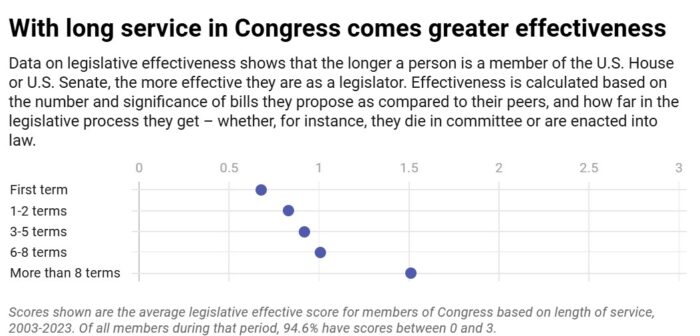
Figure above shows the longer members serve, the more effective a lawmaker they are likely to become.
Fresh perspectives in Congress are important, which is why the U.S. has elections. But term limits would stifle members’ lawmaking careers just as they’re getting off the ground. Even worse, losing well-seasoned members with issue expertise would leave inexperienced lawmakers vulnerable to influence from lobbyists and special interest groups that would highlight their own expertise and seek to influence legislation in their favor.
This is precisely what has happened in state legislatures that instituted term limits around the turn of the century.
________
Reasons for no term limits for legislators:
-1. Term limits fail to address political corruption:
On the surface, the case for term limits is strong given their potential to curtail the forces of corruption that so many assume dictate the ways of Washington. Opponents of term limit argue that congressional term limits fail to curtail political corruption, and may even worsen the problem. They hold that imposing term limits will cause lawmakers to work more closely with lobbyists for two reasons. First, given that term limits will cause a sharp increase in the number of “freshmen” lawmakers with limited legislative experience, critics argue that more politicians will rely more closely on lobbyists and special interest groups to write or recommend laws to “fill [lawmakers’] own informational and policy gaps.” Second, critics warn that term limits will only exacerbate the “revolving door” phenomenon in which retired legislators seek to maintain political influence by securing careers as lobbyists or private sector government affairs consultants. They cite a 2023 study that found that state governments with term limits saw an increase in the frequency of political corruption events. The study observed a “penultimate effect”, where state legislators under a term limitation devoted more of their last term to securing their personal power than to passing policy. Given that the frequency of last terms will increase significantly under term limit policy, opponents worry about an accompanying increase in political corruption.
_
-2. Term limits ignore the value of the incumbency and institutional knowledge.
Opponents of term limits also argue that the values of political incumbency in the legislative process are taken for granted. They argue that policymaking is a specialized skill that must be developed over time, highlighting examples of how bills with loopholes and contradictions – the result of unskilled policymaking – harm the public. They hold that incumbency’s value is its ability to maintain legislative efficiency and institutional knowledge. Given that federal policymaking is a skill that can only be learned on-the-job, critics say incumbency gives lawmakers the opportunity to become the specialized professionals their constituents deserve. Lawmakers accumulate expertise in complex policy areas, oversight, and interbranch coordination. Term limits interrupt this accumulation, reducing the institutional memory that informs sound legislation and diligent oversight. Without experienced members, oversight committees may rely more on staff or bureaucrats, potentially diminishing direct legislative checks on the executive branch.
Meanwhile, continuity helps bipartisan consensus, especially on long-standing issues such as healthcare, infrastructure, and education reform. Sudden leadership changes can stall ongoing investigations, delay the passage of critical funding, and hinder the momentum needed to address systemic challenges that require sustained, informed attention.
_
-3. Frequent congressional turnover shifts power away from the legislative branch.
The third core criticism of term limits is that the policy would shift power to the executive and the private sector at the detriment of democracy. As lawmakers are denied longer tenures, opponents argue, lobbyists and staffers become the primary voice of experience in the legislature. Additionally, critics suggest that a decrease in experienced legislators with cross-aisle relationships will further hinder Congress’ ability to efficiently pass legislation, catalysing an increase in executive orders and other executive branch actions. This will create hurdles to the traditional system of checks and balances.
_
-4. Undemocratic:
There are numerous counterarguments to the wisdom of term limits for MPs. The most general one is that they are undemocratic in that they restrict voters’ rights, reducing representatives’ accountability through elections, and hence the right and the capacity of citizens to hold those in power accountable. From this point of view, restrictions on re-election or term limits directly affect one of the foundations of a democracy: the capacity to choose representatives freely, by popular vote, without restraints. It takes power away from voters: Perhaps the most obvious consequence of establishing congressional term limits is that it would severely curtail the choices of voters. A fundamental principle in our system of government is that voters get to choose their representatives. Voter choices are restricted when a candidate is barred from being on the ballot.
_
-5. Poor policies and poor legislation.
Policymaking is a profession in and of itself. Our system tasks lawmakers with creating solutions to pressing societal problems, often with no simple answers and huge likelihoods for unintended consequences. Crafting legislative proposals is a learned skill; as in other professions, experience matters. In fact, as expert analysis has shown with the recently passed Senate tax bill, policy crafted by even the most experienced of lawmakers is likely to have ambiguous provisions and loopholes that undermine the intended effects of the legislation. The public is not best served if inexperienced members are making policy choices with widespread, lasting effects.
The seminal study of John M. Carey shows that term limits do not improve policies, nor do they eliminate the impact of private interests on legislative behaviour. Another study shows that legislators who can no longer seek re-election sponsor fewer bills, are less productive on committees, and are absent from more floor votes. Term- limited politicians dedicate less effort to their office, engage in opportunistic behaviour, and frequently run for another office or for a different party. Recently, a 2017 study of the effects of term limits on representation in US state legislatures provided no evidence that term limits improve collective representation. Moreover, term-limited officials pay less attention to local matters, focusing instead on nationwide issues.
_
-6. Term limits are ineffective to curb dynasties.
An assessment of the introduction of term limits in the Philippines found that the ability of term limits to dismantle political dynasties is not obvious, as term limited incumbents may be replaced by relatives or may run for a different elected office. Moreover, term limits deter high-quality challengers from running prior to the expiration of an incumbent’s term. Challengers prefer to wait for the incumbent to be termed out and run in an open-seat race. As a consequence, incumbents are safer in their early terms prior to the limit. These results suggest that political reforms that do not modify the underlying sources of dynastic power may be ineffective in changing the political equilibrium. Examples of how term limits were ineffective may be found in the Russian Federation, where President Putin and Prime Minister Medvedev exchanged roles, and in the United States, where some time limited State officials have moved to Congress, the Senate or other political roles within the same electoral orbit.
_
-7. Automatically kick out effective lawmakers:
No matter how knowledgeable or effectual a member may be in the arduous tasks of writing and advancing legislation, term limits would ensure that his or her talents will run up against a strict time horizon. In what other profession do we force the best employees into retirement with no consideration as to their abilities or effectiveness on the job? Doesn’t it make more sense to capitalize on their skills, talents and experience, rather than forcing them to the sidelines where they will do their constituents, the public and the institution far less good? Kicking out popular and competent lawmakers simply because their time runs out ultimately results in a bad return on the investment of time spent learning and mastering the ins and outs of policymaking in Congress.
_
-8. Economic Impact of Term Limits.
Term limits can disrupt the development of long-term economic policy by shortening lawmakers’ time horizons. Fresh legislators may struggle to implement complex, multi-year plans that require sustained oversight and gradual budgeting. This can lead to frequent policy reversals, which increases uncertainty for businesses and investors. In some cases, term-limited bodies rely more on executive agencies or lobbyists to set economic agendas, potentially favoring short-term incentives over durable growth strategies.
Additionally, institutional knowledge about budgeting, tax policy, and regulatory frameworks tends to erode with high turnover. Committees that once provided sophisticated economic analysis may become less effective as experienced members rotate out. While new members bring energy, the learning curve can delay sensible reforms and create gaps in fiscal discipline during transitions.
_
-9. Policy Consistency and Innovation.
Frequent turnover can fragment long-term policy programs, leading to discontinuities in funding, regulatory approaches, and program evaluations. Term-limited legislators might prioritize immediate wins over principled, patient reform, slowing progress on complex issues that require long planning horizons. Innovation can still occur, but it often emerges in bursts when experienced policymakers return or when new members align with particular agendas, potentially creating cyclical policy shocks.
Consistency is important for regulatory certainty. Businesses and non-profits rely on predictable rules and stable governance. High turnover risks erratic policy signals, undermining confidence in public institutions and complicating strategic planning for stakeholders who must adapt to changing legislative directions.
_
-10. Political Dynamics and Power Concentration.
Term limits may inadvertently concentrate power in the hands of a smaller cadre of insiders, such as party leadership or well-funded donors, who remain in institutional roles longer or who influence amateur newcomers. This can intensify leadership battles, backroom manoeuvring, and the importance of fundraising prowess. In some cases, term limits shift leverage from legislators to executives or unelected staff, altering how policy is shaped and implemented.
Critically, term limits do not inherently reduce influence over outcomes. They can simply relocate where power sits, potentially increasing the influence of political consultants, interest groups, and party machines that organize campaigns and issue advocacy around short-term gains rather than public welfare.
_
-11. There is no term limit for judiciary and bureaucracy, so why term limit for legislators?
The judiciary in its own right and part of the bureaucracy needs continuity. Administration of justice calls for meritocracy, a certain level of insulation from societal forces, and a long-term perspective. The perfection of the delivery of justice cannot be acquired in five years. Countries that have managed development agendas effectively have long-term bureaucracies. In Japan, for instance, it is said that politicians rule and bureaucrats reign. Politicians come and go, but bureaucracies shall always be there. To subject the judiciary and the bureaucracy to term limits is likely to result in miscarriage of justice and distortion of development agendas.
_
-12. It changes the learning curve.
There’s a saying that goes, “It takes 6 months to learn a job and another 6 months to become good at it.” Being a Senator or Representative has a learning curve, just like every other job. For Representatives especially, their entire first term might be dedicated to learning how things work in Congress. By enforcing term limits, more politicians would be forced to go through this learning curve and that could mean even less stuff gets done.
______
______
Section-11
Term limit evasion:
Term limits—regulations governing the length and number of terms a president can serve—are a core safeguard in presidential and semi-presidential democracies. By restricting the amount of time an incumbent can remain in office, they constrain the accumulation of power by individual leaders, promote the rotation of power among political parties, and ensure that elections continue to be competitive. These time-bound restrictions also encourage executive-office holders to concentrate on achieving policy goals before their term is up.
_
Term limits have a long history as a way of limiting power. In ancient times, some Greek city-states and the Roman Republic term-limited holders of certain offices. Builders of democracy have long seen term limits as a bulwark against the rise of authoritarianism. While they did not make it into the 1787 Constitution of the United States, George Washington made it a point to serve only two terms. His example ruled until the four terms of President Franklin D. Roosevelt (spanning the Great Depression and Second World War), after which the Twenty-second Amendment (approved by the U.S. Congress in 1947 and ratified by the states in 1951) formalized the two-term rule. Globally, term limits did not spread widely until the 1990s. Over the past three decades, however, term limits have become a cornerstone of young democracies in Africa and Latin America. In Africa, all but fifteen of the 48 constitutions adopted during the 1990s included presidential term limits. In Latin America, where most constitutions have long limited a leader’s time in office, the consolidation of democracy that began in the 1980s brought wider adherence to term limits.
_
Efforts to evade term limits can have lasting consequences for a country’s democratic trajectory. Unlimited incumbency helps enable power-hungry presidents to undermine institutions, appoint loyalists and relatives, and enrich themselves and their allies with taxpayers’ funds. Term-limit evasion can also trigger protests from angry citizens, which have sometimes been met with state violence. Authoritarian leaders’ efforts to remove term limits by forcing undemocratic constitutional changes may inspire even more anti-institutional actions—such as military coups aiming to overthrow leaders seeking to remain in office for life.
_
Upon taking power following a military rebellion in 1986, Ugandan President Yoweri Museveni declared that “the problem of Africa in general, and Uganda in particular, is not the people but leaders who want to overstay in power.” Four decades later the 81-year-old remains in office. Like a growing number of heads of state worldwide, Museveni has been able to achieve his long tenure by removing presidential term limits.
_
Around the world, presidents are increasingly circumventing term-limit restrictions. In 2025 alone, presidents in Cameroon, Chad, Côte d’Ivoire, Djibouti, El Salvador, and Guinea-Bissau paved the way to extend their tenure in office through term-limit revisions or by removing barriers to future re-election. Other common tactics of term-limit evasion include constitutional amendments, manipulated referendums, and election delays. This is a global problem: in at least 36 countries worldwide, current heads of state have altered the rules or benefited from such changes to remain in power. Over 85 percent of presidents seeking to prolong their time in office govern countries rated Not Free in Freedom House’s Freedom in the World report, while the remainder serve in Partly Free countries. The checks and balances provided by democratic institutions in democracies tend to provide safeguards against this phenomenon.
_
According to a 2020 analysis, nearly one in four incumbents who face term limits seek to circumvent the term limits through various strategies, including constitutional amendments, working with the judiciary to reinterpret the term limits, let a placeholder govern for the incumbent, and cancelling or delaying elections. Incumbents that seek to circumvent term limits frequently use repression of the opposition, electoral manipulation and foreign support to enable their circumvention. According to a 2025 research project, attempts to circumvent term limits had become increasingly prevalent in African states over time, with few such attempts prior to 2000 and many such attempts post-2000. Removing or extending term limits, as seen with China’s Xi Jinping in 2018, helps incumbents consolidate power indefinitely. Besides Xi Jinping, other world leaders have sought to extend their time in office by amending rules around term limits, such as Russia’s Vladimir Putin.
_
Between 1960 and 2010, more than one quarter of term-limited presidents successfully extended or violated their term limits to stay in power, and the enforcement of term limits is recognized as one of the great challenges in democratic development. Term limits typically receive greater domestic and international recognition than other mechanisms of democracy, and attempts to violate term limits are typically met with strong resistance by a country’s population and on the world stage. The violation of term limits is strongly correlated with democratic backsliding and the erosion of human rights.
_
A president may attempt to circumvent term limits indirectly by extending their rule without an additional term. This may be done by extending the length of the term or postponing elections. In some cases, a president may circumvent term limits by officially stepping down from office but maintaining de facto control of the government. Whether a president seeks to subvert term limits may be affected by how much wealth can be gained from the office, opportunities for acquiring wealth after leaving office, what constraints are in place to enforce term limits, how much control leader has over other branches of government or a political party, precedent in the region, and the likelihood of facing criminal prosecution upon leaving office. Presidents are more likely to be successful in violating term limits if they control the other branches of government, whether through their political parties or through insufficient checks and balances. Though violation of term limits is more common in less democratic countries, political opposition, foreign governments, and the citizenry can still enforce term limits in nondemocratic countries.
_______
_______
Tactics of term limit evasion:
Heads of state seeking to extend their hold on power have employed several tactics to overcome term limits. In some cases, leaders—often aided by pliant legislators and judges—have rewritten the rules to remove term-limit mandates from the constitution or legal frameworks. Other tactics are less subtle and include delaying elections or shifting to a new executive position, from which they exercise paramount authority or control a figurehead replacement.
_
Rewriting the rules:
In many countries, aspiring autocrats have organized tightly controlled referendums to amend or altogether remove constitutionally enshrined term limits. In Tajikistan, a broadly worded and heavily manipulated 2016 constitutional referendum saw 95 percent of voters approve the cancelation of term limits. This change permitted President Emomali Rahmon, who with 32 years in office is the second longest-serving leader in Eurasia, to win the tightly managed 2020 presidential election and further his decades-long crackdown on independent media, religious freedom, and free expression.
Major changes to constitutions can also be facilitated by pliant legislatures and courts. In 2008, Cameroon’s National Assembly pushed through constitutional changes that cleared the way for President Paul Biya to seek re-election in 2011 after the expiration of his second term per the 1996 constitution. Biya—at 93 the world’s oldest head of state—has ruled Cameroon for over 40 years and, alongside his ruling party, has maintained power through rigged elections, political patronage, and repression. President Nayib Bukele of El Salvador—which is rated Partly Free by Freedom House—has similarly used a loyalist-packed legislature to pass a constitutional amendment extending presidential terms from five to six years and abolishing term limits altogether.
Other long-serving leaders including Museveni in Uganda have remained in office by removing age caps as well as term limits. In October 2025, lawmakers in Djibouti overwhelmingly voted to remove the age ceiling for presidential candidates to allow incumbent Ismail Omar Guelleh, who has been in office since 1999, to run for a sixth term. Much like the removal of term limits, the arbitrary scrapping of age limits is another tactic that incumbents have used to bypass constitutional protections against indefinite rule.
_
Judicial assault:
Latin American presidential term limits are oftentimes in peril. Today, term limits, which have historically acted as an important check on authoritarianism, face a new threat: judicial assaults based upon human-rights considerations purportedly tied to international human-rights treaties. The ruling administration says that the American Convention on Human Rights prohibited term limits, arguing that they violate the people’s sovereignty and harm their basic rights. Today, the region’s surviving term limits face a novel threat: judicial assault. In Bolivia, El Salvador, Honduras, and Nicaragua, opponents of term limits, citing international and local human-rights law, have persuaded supreme courts to weaken or invalidate term limits. These precedents represent a threat to democracy in a period when Latin America’s democratic institutions are exceedingly vulnerable, beset by widespread popular discontent, the erosion of support for traditional political parties, populism, and a concentration of presidential power that accelerated during the covid-19 pandemic. Presidents have used courts to reinterpret term limits, as seen in Nicaragua in 2009, when the Supreme Court blocked restrictions on term limits, allowing Daniel Ortega to continue being elected to office. Worryingly, the judicial tactic for doing away with term limits gives cover to authoritarian tendencies, allowing politicians desirous of indefinite tenure in office to cloak their ambitions in the language of human rights and appeals to the democratic value of participation. In fact, term limits are a bulwark against authoritarian creep, facilitating the rotation of political elites and stripping would-be caudillos of the chance to consolidate control.
_
Delaying elections is one of the most brazen methods for sidestepping term limits. For example, a Supreme Court ruling allowed Guinea-Bissau’s President Umaro Sissoco Embaló to postpone elections scheduled for November 2024 for a year and extended his mandate from February 2025 until September 2025. During the November 2025 election, however, the military deposed Embaló in a move that some civil society experts claimed was designed to interrupt the processing of election results.
_
Castling, a term borrowed from chess, occurs when an incumbent shifts to a different executive position after their term has ended. This allows the entrenched leader to maintain power while also complying with constitutional constraints. Russian President Vladimir Putin popularized this maneuver when he transitioned to the role of prime minister in 2008 to avoid exceeding a legal limit of two consecutive presidential terms. As prime minister, Putin then pushed through a law that increased term limits for future presidents from four to six years. He returned to the presidency in 2012, and in 2020 orchestrated the approval of constitutional amendments that capped presidential tenure at two terms, but which also stated that current and previously served terms would not count toward that total. Thus, Putin allowed himself to run for an additional two terms and potentially extended his rule to 2036.
_
In Togo, President Faure Gnassingbé upended the entire political system to secure an indefinite hold on power. In 2024, the National Assembly pushed through a new constitution that replaced the presidential system with a parliamentary system. Under the new system, Gnassingbé, who inherited power following the death of his father in 2005, became the president of the Council of Ministers—a new post with sweeping executive authority that is unelected and has no term limit.
_
Several presidents have attempted to continue in office beyond the legal completion of their term. The most common approach is through an amendment of the country’s constitution, eliminating term limits altogether, or extending the number of terms the president can stay in office. In 2018 the Chinese Communist Party passed an amendment allowing Chinese Pres. Xi Jinping to serve an unlimited number of five-year terms; the previous limit was two consecutive five-year terms. In Algeria Pres. Abdelaziz Bouteflika amended the constitution in 2008, allowing him to run for a third term. The term limit of two five-year terms was restored in 2016 after protests, and Bouteflika continued in power until 2019 when he was forced to resign after further demonstrations.
_
Several other approaches have been used. In Sudan Pres. Omar al-Bashir delayed elections from 2009 to 2010, with his administration citing logistical issues, and then attempted to implement an entirely new constitution after his 2015 win, renewing the maximum tenure of two five-year terms applicable to the president, before his 2019 ouster. Changes to constitutions are usually not applied retroactively, allowing incumbents to start over with a clean slate.
_
In instances in which incumbent presidents are unable to influence lawmakers or courts to support their continued presence in office, they may handpick a successor whom they believe can be controlled from behind the scenes. In Russia Vladimir Putin endorsed Dmitry Medvedev as his successor in 2008, shortly before the second of his two terms was due to end. Medvedev won the election, and Putin became prime minister before returning to the presidency in 2012. In 2021 Putin signed a new law that would allow him to remain in power until 2036.
_______
_______
Harms of term limit evasion:
The damage caused to a country’s democratic institutions by term limit evasion can be long-lasting. When incumbents stay in power indefinitely, and without accountability, it becomes easier for them to use state institutions to enrich themselves at the expense of the public, prosecute perceived enemies, and to harness the state security apparatus to silence dissent. In some cases, term-limit evasion has given way to serious instability in the form of military coups undertaken to dislodge the long-standing incumbent from power.
_
The elimination of term limits and subsequent concentration of power in an unaccountable executive can fuel corruption, kleptocracy, and fraud. Since Azerbaijan eliminated term limits in 2009, for example, President Ilham Aliyev and his family have deepened their involvement in rampant corruption and money laundering schemes that enrich the ruling family and their political allies. Government-aligned courts only selectively investigate officials who have fallen afoul of the regime and criminalize whistleblowers that expose these schemes.
_
Overstaying in office generates political stagnation, as leaders become increasingly unrepresentative of the populations they govern. This disconnect has fueled youth-led protests in recent years, including in Uganda following President Museveni’s re-election in January 2026, where anti-government demonstrators were met with violence by state security officials. Some crackdowns have been even more severe. After Burundian President Pierre Nkurunziza ran for an unconstitutional third term in 2015, protests erupted across the country. In response, security forces opened fire on demonstrators, killing dozens of people.
_
Presidential term-limit violations can invite additional unconstitutional actions like military coups. In 2009, democratically elected President Manuel Zelaya of Honduras attempted to hold a controversial referendum on abolishing term limits. Pushback from both the Supreme Court and the opposition escalated into a political crisis that resulted in the military arresting and exiling Zelaya. A military coup in Guinea in 2021 came after an authoritarian incumbent made changes to the country’s constitution that allowed him to seek additional terms. Following the enactment of a new constitution that allowed President Alpha Conde to reset his term count and win a third term in a violently contested October 2020 election, the military ousted the unpopular leader.
Military coup leaders themselves have rewritten the constitution to cement their own power. In October 2025, Chad’s military government abolished presidential term limits and extended the presidential term from five to seven years. The move potentially paved the way for indefinite rule by President Mahamat Idriss Déby, who had been installed by coup leaders in 2021.
_______
_______
Safeguarding Democracy:
Democracies are resilient political systems because they allow citizens to choose their own leaders and provide tools to rein in ones who abuse power or fail to act in the people’s interests. Leaders who seek to remain in office indefinitely through term-limit extensions typically use the advantages of a long incumbency to consolidate power, sideline political opposition, and weaken the system of checks and balances that prevent executive abuses and overreach. This is why presidential term-limit evasion is antithetical to democracy, and why the practice’s global spread is a threat to freedom globally.
_
Importantly, not all attempts to evade term limits are successful. In Senegal, then President Macky Sall’s efforts to remain in office by delaying February 2024 elections were met with a show of democratic resilience. There was strong pushback from civil society, the Constitutional Council blocked Sall from delaying the vote, and elections were ultimately held that March.4. In Indonesia, key power brokers within the ruling coalition prevented President Joko Widodo from vying for an unconstitutional third term in February 2024. (However, the Constitutional Court did effectively create an exception to an elections law that allowed one of Widodo’s sons to run for vice president in 2024 even though he didn’t meet the age requirement.) Nevertheless, in Free and Partly Free countries, democratic institutions with healthy checks and balances can backstop efforts by civil society and lawmakers to push back against power-hungry incumbents seeking to extend their rule.
_
Alongside other authoritarian tactics, accelerating attempts to evade term limits have contributed to the 20 consecutive years of decline in global freedom. Participatory democracy is vital to thwarting these maneuvers, as civil society and interventions from other officials can serve as checks on this tactic of executive overreach. Citizens in democracies should consistently demand good governance and hold those who attempt to overstay in office accountable. And, democratic leaders must recognize term limits as a sacrosanct democratic norm, and condemn efforts to evade them.
_____
_____
Term Limit Evasions and Coups in Africa: Two Sides of the Same Coin:
Extraconstitutional extensions of power have shaped the contours of Africa’s governance landscape in recent years. Leaders of 14 African countries have held onto power for more than two terms after evading term limits. This continues a pattern of term limit evasion observed since 2015, reversing an evolving trend of term limit adherence between 2000–2015. Another eight African countries have endured military coups that suspended or disrupted their constitutions since 2015. In none of these cases have the military authorities demonstrated a commitment to relinquishing power, thereby effectively eliminating term limit provisions that had been in place. Combined with an additional 8 countries that do not have any existing term limit restrictions, 30 out of 54 African countries (56 percent) are operating without functioning limits on an executive’s time in power.
_
Notably, 18 African countries are actively upholding term limit norms, including the noteworthy case of Nigerian President Muhammadu Buhari who stepped down after his two terms in office. Another six countries have term limit restrictions on the books, though these have yet to be applied. Upholding term limits has direct effects on leaders’ and regimes’ longevity in power. The average time in office for the 18 leaders in countries that uphold term limits is 5 years. For the 14 leaders who have evaded term limits, the median time in office is 16 years. These figures understate the stranglehold on power effected by term limit evasions, however. The current authorities in Algeria and Burundi, for example, replaced longtime leaders who had previously evaded term limits. They, like the dynastic succession in Togo, represent a continuation of these regimes rather than a fresh start. When that is considered, the median time in power for regimes in the “term limit modified” category expands to 26 years.
_
Relationship between term limits evasion, coup and democracy:
- Term limit evasions are also directly linked to the surge of coups observed in Africa. Five of the eight countries that have suffered coups since 2015 had leaders who evaded term limits—Chad, Gabon, Guinea, Sudan, and Zimbabwe. The median time in office for those deposed leaders was 30 years.
- This highlights that extraconstitutional actions of one type (i.e., term limit evasions) beget extraconstitutional actions of another (i.e., seizures of power via military coups).
- Africa’s recent coups should not be misinterpreted as reformist, however. Military coups that occurred within already authoritarian governments—Chad, Gabon, Sudan, and Zimbabwe—were led by actors who were a part of or worked closely with the previous regime. Accordingly, they are a continuation of the closed power structures that have dominated these countries—and disregarded term limits—for decades.
- The coups against democratically elected leaders in Niger, Mali, and Burkina Faso, furthermore, are attempts to restore military governance in countries with long (and disastrous) legacies of military rule. In each of these cases, the coups have jettisoned nascent norms of leaders respecting term limits.
- The relationship between military government and term limit evasions operates in both directions. Ten of the fourteen leaders who have evaded term limits have come to power via military coup, civil conflict, or military support. In other words, leaders who gained power through extraconstitutional means, subsequently tend to violate legal constraints on their time in power.
_______
_______
Term Limit evasions weaken Governance in Africa:
Africa has seen a reversal in term limit norms since 2015. Since that time, leaders of 13 countries have evaded or overseen the further weakening of term limit restrictions that had been in place:
- Algeria
- Burundi
- Chad
- Comoros
- Côte d’Ivoire
- Democratic Republic of the Congo
- Egypt
- Guinea
- Republic of the Congo
- Rwanda
- South Sudan
- Togo
- Uganda
On the other hand, Several African countries have strengthened or upheld term limits since 2015. These include Benin, Liberia, Mauritania, Senegal, and the Seychelles. They are part of a group of 21 African countries that continue to uphold term limits. Moreover, Central African Republic and Burkina Faso have held or will hold constitutional referendums to institute term limits.
_____
Damaging Implications for Governance:
The evasion of term limits is directly responsible for the prolonged tenures of certain leaders. Ten African leaders have been in power for 18 years or longer. All of these have evaded term limits or are in countries without them as seen in figure below.
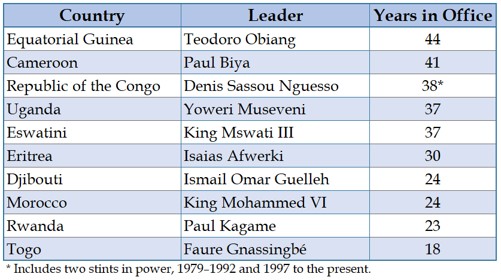
_
The evasion of term limits has broader consequences for democratic governance in Africa. The median score on Freedom House’s Global Freedom Index, which measures the upholding of civil liberties and political rights, is 65 for African countries that uphold term limits (on a scale of 0–100). In countries where leaders have evaded these limits, the median score is only 21 as seen in figure below.
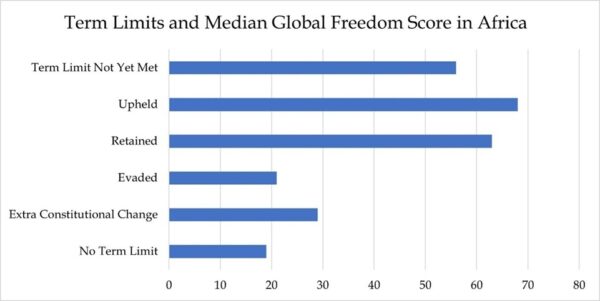
_
The stark variation in governance scores accentuates that term limit evasions are rarely isolated events. Rather, they are typically part of a pattern of leaders undermining the rule of law and restricting civil and political liberties. According to the Africa Center for Strategic Studies, African nations that uphold executive term limits hold a median Transparency International’s Corruption Perceptions Index (CPI) ranking of 83, compared to a median ranking of 142 for countries where leaders modified or bypassed those limits—a 60-place difference.
Term limit evasions are linked to other serious governance failures. Just under 40 percent of countries where leaders have evaded term limits or term limits do not exist are in conflict. In contrast, just 11 percent of countries that have upheld or retained term limits are in conflict (i.e., 2 out of 18 countries, with Nigeria and Mozambique being the exceptions).
Strong regional patterns with regards to upholding term limits are apparent. Central Africa is the locus of term limit evasions with leaders in seven countries having bypassed these limits. While West Africa has been the focal point for the surge of coups observed on the continent in recent years, the region is also a leader in upholding term limits, with eight countries having done so. This illustrates the sharply divergent visions for governance norms playing out in the region and across the continent. Southern Africa is also distinctive. With the notable exception of Zimbabwe, Southern Africa has largely institutionalized the process of executive transitions after two terms in office.
_____
The erosion of term limits is a setback for good governance in Africa:
-All eight of the African countries facing civil conflict (excluding insurgencies by militant Islamist groups) are those without term limits.
-Of the 10 African countries that are the largest source of Africa’s 32 million refugees and internally displaced populations, 7 are countries lacking term limits.
-Corruption is a challenge in many African countries, though it is particularly pernicious in countries without term limits. For countries that have modified or eliminated term limits, the median ranking on Transparency International’s annual Corruption Perceptions Index is 134 out of 180 countries. This is 46 places lower than the average ranking for African countries that have adhered to term limits.
The institutionalization of term limits in Africa is part of a reform effort started in the 1990s to address the legacy of overconcentrated power in the executive. Term limits are seen as an especially important element of checks and balances in Africa given the relative weakness of independent democratic institutions such as the legislature, judiciary, civil service, security forces, media, public protector, and central bank.
______
______
Section-12
Term limit and voter turnout:
A fundamental question in democratic societies is why people vote at all. According to rational choice theory, the decision of whether to vote depends on the benefits and costs individuals expect to derive from the act of voting. The benefits depend on the expected utility of electing the preferred candidate and on the probability that the vote is pivotal. However, since the latter is usually very small and easily outweighed by the trouble of going to the voting station, the expected payoff of voting is nearly zero (Downs, 1957; Owen and Grofman, 1984). Yet, many people actually vote, which is known as the paradox of voting (Fiorina, 1976; Grofman, 1993).
_
Theories to explain observed participation levels at elections can be grouped into five groups (Dhillon and Peralta, 2002): instrumental, expressive, boundedly rational voter, group based, and information-based. Instrumental theories presume that individuals vote because they care mainly about the consequences of the electoral process, including the need to avoid the collapse of democracy (Downs, 1957). Under this assumption, when elections are close races the payoffs of voting increase because the probability of a single vote being pivotal is higher, which leads to higher turnout (Downs, 1957; Riker and Ordeshook, 1968). Expressive theories suggest that people derive utility from expressing their attitudes when voting, and the utility from voting may increase from bandwagon effects in elections (Fiorina, 1976; Schuessler, 2000; Hamlin and Jennings, 2011; Brennan and Brooks, 2013; Blais and Galais, 2016). Boundedly rational voter theories weaken the assumption of full rationality of voters, while group-based theories explore the coordination mechanisms between members of a group of voters (namely, parties) that may increase the likelihood of determining the outcome of the election. Finally, the last group of theories highlights the importance of information on the decision of whether to vote or not. It argues that less informed voters may be better off delegating their decision to informed voters (Feddersen and Pesendorfer, 1996, 1999; Matsusaka, 1995).
_
Since the 1960s, numerous studies have analyzed empirically the determinants of voter turnout. The explanatory variables used in turnout studies are generally grouped into three main categories: socio-economic, political, and institutional (Geys, 2006a; Cancela and Geys, 2016). Regarding socio-economic variables, population size, concentration, and proportion of minorities are generally found to have negative effects on turnout, while population stability, income and ethnic homogeneity, education, and past turnout have positive effects. As for political variables, close elections, campaign expenditures, and higher political fragmentation are found to promote turnout. Institutional variables are arguably the most powerful determinants of turnout (Jackman, 1987; Franklin, 1996). Proportional electoral systems seem to increase turnout relative majoritarian/plurality systems (Blais and Aarts, 2006). Additionally, compulsory voting and concurrent elections generally promote turnout, while more stringent registration requirements tend to decrease it (Garmann, 2016; Jaitman, 2013). Taking advantage of a larger sample of studies, Cancela and Geys (2016) separately analyze the determinants of turnout in national and subnational elections. They find that campaign expenditures, closeness of elections and registration requirements have greater explanatory power in national election studies, while population size and composition, concurrent elections, and the electoral system are more important in subnational elections.
_
In democratic societies public decisions should reflect the will of citizens. Elections allow voters to choose their representatives, i.e. those who have the power to take public decisions. Therefore, the citizens’ decision of whether to vote or not has political and economic consequences. For several decades, many scholars have studied the determinants of voter participation. There is now an extensive and fast-growing literature on voter turnout, which covers a wide variety of its potential socio-economic, political and institutional determinants. It is surprising that this huge literature on the determinants of voter turnout has almost ignored the potential effects of term limits, especially because some studies (Jackman, 1987; Franklin, 1996) argue that institutions are the most powerful determinants of turnout. The explanations of voter turnout underlying instrumental, expressive voting, and information-based theories provide us good reasons to believe that term limits may influence turnout.
_
First, instrumental theories suggest that term limits may increase voter participation by making elections more competitive and dynamic. By forcing out incumbents, they increase the number of open races, encouraging more candidates to run. Second, by ousting entrenched and disconnected incumbents, the introduction of term limits may inspire more citizen confidence in the system, increase the utility derived from expressing one’s preferences, and lead to bandwagon effects. Finally, information-based theories predict both a positive and a negative effect of term limits on voters’ mobilization. On the one hand, they may increase voter confusion and disinterest by introducing a greater number of unknown non-incumbents into electoral contests, leading to lower turnout. But, on the other hand, particularly at the time of the introduction of the institutional change, media coverage of local elections may increase significantly, decreasing the costs of acquiring relevant information for voting. The results of Nalder (2007) regarding the effects of state legislative term limits in California support the former view, suggesting that they decreased voter turnout. However, in the Portuguese case, given the significant attention devoted by the national and local media to the 2013 local elections, the latter result prevailed.
_
Nalder’s (2007) study of California legislative elections presents evidence that term limits may actually reduce voting rates. Given the counterintuitive nature of those findings and the dearth of other studies on legislative term limits and voter turnout, it is not immediately clear whether this result holds in other term-limited states. California has the most professionalized state legislature in the United States, the most populous legislative districts, and is considered a national leader for policy innovation (see Boehmke and Skinner 2012). Do these unique features, among others, make it the exception or the rule? Without a broader, comparative analysis, it is difficult to assess the effects of legislative term limits on voter turnout. So, researchers conducted an analysis of turnout in state legislative elections in all states that have adopted term limits from 1988 to 2010. Consistent with the claims of term limits advocates, they find that the imposition of term limits increases voter turnout in state legislative elections.
_____
_____
Term limits increase voter turnout:
Expanding the choice of candidates at the polls is one of the arguments utilized to advocate for term limits for state legislators. Supporters of these reforms argue that term limits would increase the number of competitive elections through creating more open-seat elections. Open-seat elections create equal playing fields where “new blood” can have a chance to win elective office without having to run against entrenched incumbents. As a result, citizens should have more electoral choice and turn out to vote more often. Importantly, competitive electoral systems are a means for citizens to have the ability to drive policy and, as a result, the allocation of resources. Accordingly, institutional arrangements that expand vote choice and increase competition are also generally supported by democratic theorists because they rejuvenate citizen participation and interest in politics (see Franklin 2004; Hill and Leighley 1992; Piven and Cloward 1988; 2000; Riker 1988; Teixeira 1992).
_
Term limits are expected to increase turnout because they make elections more competitive. Instrumental theories of turnout suggest that the turnout decision is in part driven by the citizens’ expectation that their vote is pivotal, that is, that by going to the polls their vote is decisive (Downs, 1957; Riker and Ordeshook, 1968). The probability of casting the decisive ballot, and therefore turnout, increases as the closeness of election increases (Fauvelle-Aymar and François, 2006; Simonovits, 2012). Such competitiveness is greatly helped if incumbency advantage is eliminated and open seats with more quality candidates are generated by term limits (Veiga and Veiga, 2018). Open seats without entrenched incumbents create an equal playing field where more candidates stand a chance to win and citizens have a wider vote choice (Kuhlmann and Lewis, 2017). The result is an increase in turnout. But the positive effect of term limits on turnout is also expected to have an expressive component because term limits may inspire greater citizen trust in the system if entrenched incumbents are not allowed to run (De Benedetto and De Paola, 2019; Nalder, 2007; Veiga and Veiga, 2018).
_
The empirical support for this perspective is robust. Despite early evidence that the adoption of term limits did not spur turnout in the Californian state legislature (Nalder, 2007), the overall experience of US state legislatures strongly suggests a substantial contribution to turnout where term limits apply (Kuhlmann and Lewis, 2017). Consistent with this perspective, a difference-in-differences approach following a municipal reform in Portugal reports an over one percentage point increase in turnout where term limits prevented mayors from running (Veiga and Veiga, 2018). Similarly, a difference-in-discontinuities research design leveraging an Italian term limit reform reported an even larger effect (over 5-point decrease) in turnout in municipalities where incumbent mayors were suddenly allowed to run for a third term (De Benedetto and De Paola, 2019).
In a nutshell, Turnout will be higher in municipalities with term-limited mayors.
_
Legislative Term Limits and Voter Turnout, a 2017 study: United States:
According to reformers, legislative term limits should increase voter turnout by enhancing electoral competitiveness for legislative seats. However, this claim has been largely untested. The only existing study of the effect of legislative term limits on voter turnout, to date, finds that turnout in California did not increase after the imposition of term limits and may have decreased turnout. Yet, it is unclear whether this result generalizes to other states. This study employs a comparative state analysis of both aggregate turnout and district-level turnout rates in state legislative elections. Authors find that term limits significantly increase voting rates in state legislative elections.
Contrary to prior research on California, but consistent with theoretical arguments of reformers, authors find that term limits are significantly associated with higher turnout in state legislative elections. This effect is not only statistically significant, but substantively consequential as well. For states with strict term limits, voter turnout in state legislative elections is predicted to increase by up to 6 percentage points, on average, compared with states without term limits in effect. This effect is also evident in ballot roll-off rates, with term limits associated with lower roll-off between the top-of-the ticket and state legislative races. These results are consistent with prior works that find that term limits increase electoral competition (Daniel and Lott 1997; Engstrom and Monroe 2006; Nalder 2007; Niemi et al. 2006). Furthermore, the results at the state level were mirrored in the district-level analyses.
Daniel C. Lewis and Robynn Kuhlmann examine the effects of term limits in the 15 US states that have introduced them since the 1990s. They find that term limits can significantly increase voter turnout as well as encouraging people to vote in down-ballot races.
Note:
Voter drop-off, roll-off, or under-voting occurs when a voter selects fewer options in a contest than the maximum number allowed or makes no selection at all for a particular election. TargetSmart’s analysis found an average state legislative roll-off rate of 16.44% nationally. That means that on average, about 16 out of every 100 ballots cast did not include a vote in the state legislative race analyzed.
The top of the ticket refers to the most prominent, high-profile candidate or position listed on an election ballot, such as the candidate running for President, Prime Minister, or Governor.
_
Term limits and voter turnout, a 2017 study: Portugal:
This paper studies the impact of term limits on voter turnout, using the recent introduction of term limits at the local government level in Portugal as a natural experiment. Although instrumental, expressive, and information-based theories of voter participation imply effects of term limits on turnout, this is clearly an under-researched topic. Applying a difference-in-differences approach to data at both the municipal and parish levels, authors find strong evidence that the introduction of term limits increased voter participation. These results contrast with previous findings for California and demonstrate that more research on this topic is clearly necessary. Contrary to previous findings, which suggest a negative effect (Nalder, 2007) or no effects (Hajnal and Lewis, 2003), authors result clearly and robustly indicate that term limits increased voter turnout.
_________
_________
Term limits depress voter turnout:
Instead of providing a boon to voter participation, a contradictory perspective notes that turnout is actually depressed by them. Two main theoretical arguments support this view. First, as a part of the incumbency advantage incumbents’ name recognition could reduce information costs for voters, so it is less costly to go to the polls. The fact that incumbents run in an election increases the clarity of responsibility, so more voters use this opportunity to hold them accountable for past performance (Dettrey and Schwindt-Bayer, 2009). Second, in settings where clientelist voter linkages are pervasive, introducing term limits is expected to decrease turnout because re-electable incumbents stimulate voter participation by providing patronage and services to citizens (Korzi and Hoddie, 2018). Since non-incumbents do not control these government resources, fewer voters would be mobilized by these clientelist mechanisms if term limits would force the incumbents out of competition.
_
The evidence for these assertions comes from two cross-national comparative studies of presidential elections. Both report a substantial reductive effect of term limits on turnout. Turnout is sizably higher where incumbents run (by about 6 points) compared to open seat contests, controlling for other variables (Dettrey and Schwindt-Bayer, 2009). The clientelist mechanism through which term limits depress turnout is validated by an interactive finding that the negative effect of term limits is much more pronounced in low-quality democracies but lessens as the quality of democracy increases (Korzi and Hoddie, 2018). Because clientelism is more pervasive in less democratic countries, this gives some support to the notion that the turnout buying political machines run out of steam if incumbents are prevented by term limits from running.
_
Note:
Clientelist (adjective) or clientelistic relates to clientelism—a political or social system based on an asymmetric, reciprocal exchange where political actors (patrons or brokers) distribute targeted material goods, jobs, cash, or special privileges to individuals or groups (clients) in exchange for political backing, votes, or financial support. A clientelist voter is an individual who trades their electoral support, vote, or political participation for material benefits, private favours, or targeted resources provided by politicians, parties, or local brokers.
_
Term Limits: Effects, but Not as Advertised, a 2013 study:
Term limits in the US were a reform aimed at forcing greater turnover of legislators from office. As with many electoral reforms, it was promoted for the broader, indirect effects it would have on the political system. By changing the composition of legislatures, term limits would improve public regard for legislators, increase electoral competition, and, by extension, increase voter turnout. Although turnover of representatives may have increased, the transformative effects that reformers promoted did not materialize. In particular, there is no evidence of higher levels of turnout after adoption of term limits, and public regard for legislators continued to erode after term limits took effect
_
Term limits and voter turnout in presidential democracies: an empirical analysis: 2017:
This article considers the relationship between term limits and voter turnout in presidential democracies. Based on the analysis of a cross-national dataset of presidential elections held between 1950 and 2004, authors find that voter turnout is lower in elections in which term limits prevent an incumbent president from running for office. Authors further demonstrate that term limits contribute to the sharpest declines in voter turnout among those states at lower levels of relative democratic achievement. Authors suggest that recent theoretical work on both retrospective voting and clientelism offer plausible explanations for these empirical findings.
______
______
Moral of the story:
_
-1. Western democracy means “liberal” democracy—a political system marked not only by free and fair elections, but also by rule of law, separation of powers, and protection of basic liberties of speech, assembly, religion and property. In many countries, especially the developing world, “democracy” has come to be synonymous with “elections.” It is now trendy for leaders to legitimize their dictatorship through elections and elections have been an instrument of authoritarian control. The new form of authoritarian regimes camouflage as democracies. They neither practice real democracy nor resort to naked repression. Regular elections are used for the purpose of obtaining a false image of democratic legitimacy, hoping to satisfy their populace as well as cooling external pressure especially from the donor community. Term limit serves great purpose in such pseudo-democracies.
_
-2. Thomas Jefferson strongly supported term limits and the principle of “rotation in office” for executive and legislative leaders, fearing that an unlimited tenure would cause elected positions to degrade into lifelong appointments or monarchies.
_
-3. Branches of democracy like legislative branch, executive branch and judicial branch must maintain separation of power equally so that one branch does not become tyranny to destroy democracy. Separation of powers is sought to avoid the rise of dictatorship resulting from unchecked power of leaders. The three arms of government—the Executive, the Legislature, and the Judiciary—are kept under checks and balances with and by each other to avoid abuse of power by any branch. Checks and balances provide the overlapping mechanisms that allow each branch to limit, monitor, or restrain the powers of the other branches. This ensures no single organ becomes supreme or totalitarian. Adequate checks and balances must exist to maintain transparency, accountability and responsibility among democratic institutions. The separation of powers of the three branches of government may not be enough to safeguard against a dictatorship, so presidential (or prime ministerial) term limit is essential against the rise of dictatorship of the executive branch.
_
-4. Parliamentary systems differ from the presidential system:
In the presidential system the president is elected directly by the people. The elected President is the head of the Executive branch and government. He appoints ministers, judges, and heads of other key institutions, depending on the constitutional provisions. He is also Commander-in-Chief of the armed forces, with the power to declare war. The Legislature makes laws, but needs the presidential assent before they come into force. Such a person cannot hold onto power forever. Since the three branches of government are not enough to safeguard against a dictatorship; Presidential term limits is a must against the rise of dictatorship of the executive branch. In fact, absence of term limits on the president is itself a recipe for abuse of democracy and rule of law. Two terms are long enough for leaders to manifest their exceptional leadership qualities and to complete their programmes as well as to give others the opportunity to also display their own leadership qualities.
In parliamentary system, the Prime Minister (head of government) is chosen from the party which wins majority of seats in the House. Every party has its own mechanism of choosing its leader who is most likely to lead it to victory in elections. It is therefore difficult for an individual to perpetually manipulate the party members to remain at the helm, as this could cost the party during elections.
The presidential systems are less stable than parliamentary systems. The difference seems to be that presidential systems concentrate more power in the hands of a single person, the president. This makes it easier to remove the checks and balances that democracies depend on. Violation of presidential term limits and other methods of increasing executive power are a common form of democratic backsliding – state-led debilitation or elimination of the political institutions that sustain a democracy. Presidents around the globe have used various tactics to try to violate presidential term limits.
Note:
The head of the state/ government must be elected directly by people, for example election of the president in US. The process of electing prime minister as a head of the government from elected members of parliament as in Britain/India is unwise because there is no link/rapport between people and the prime minister; and a person unworthy of people’s will may become prime minister. But president is more likely to abuse power than prime minister, so term limit for president can prevent power consolidation and rise of authoritarianism. In other words, presidential system with term limit is a better form of democracy than parliamentary system.
_
-5. Aristotle supported term limits both in order to limit government corruption, and to prevent the emergence of a permanent political class. He also argued that the periodic rotation of government officials allowed a greater number of citizens the chance to rule, producing a greater number of qualified politicians.
_
-6. A term of office, electoral term, or parliamentary term is the length of time a person serves in a particular elected office. It could be 2 years in American congress, 4 years as American president, 5 years as Indian MP in lower house, 6 years in American senate etc. A two-term limit is a legal or constitutional restriction that caps the number of times an elected official can hold a specific office at two terms.
_
-7. Term limit:
Term limits—regulations governing the length and number of terms an elected representative can serve—are a core safeguard in presidential and semi-presidential democracies. A term limit is a legal or constitutional restriction that limits the number of terms or the length of time an elected official can serve in their elected position. By restricting the amount of time or number of terms an incumbent can remain in office, they constrain the accumulation of power by individual leaders, promote the rotation of power among political parties, and ensure that elections continue to be competitive. Term limits are applied to ensure that political leaders do not continue in office indefinitely, a practice that could lead to a dictatorship. They are most commonly applied to the office of the head of government of the country, typically the president. Term limits are not typically used in parliamentary systems, in which the head of the executive branch, usually the prime minister, is chosen from among elected representatives.
_
-8. The idea behind term limits is pretty simple: set some rules so leaders can’t hold onto power forever. Term limits are an element of constitutionalism that serves to limit the negative effects of democracy. The primary argument against term limits is that elections are term limits.
_
-9. Types of term limits:
Term limits can be classified according to jurisdiction involved (federal, state, municipal); according to number of terms (one term, two terms); and according to consecutive or lifetime term limits.
Term limits fall into two broad categories: consecutive limits and lifetime limits. Consecutive limits cap how many terms an official can serve in a row. Once they hit the cap, they must step aside. However, they can return and run again after sitting out for a required break. That required break is called a cooling-off period. Lifetime limits are stricter. They permanently bar an official from holding that office again after they reach the maximum number of terms. There is no cooling-off period and no path back. The U.S. presidency operates under a lifetime limit. Once a president serves two full terms, they can never hold the office again, no matter how long they wait. The choice between consecutive and lifetime frameworks often reflects the political climate and the intentions of whoever drafted the original ballot initiative or constitutional amendment.
_
-10. Stats:
90+ countries enforce term limits, ensuring rotation in leadership and reduces risks of authoritarianism. Around one-third (roughly 29% to 33%) of global political leaders reaching the end of their prescribed terms attempt or succeed in evading, extending, or violating term limit.
_
-11. Term limits less likely in parliamentary system:
Countries that operate a parliamentary system of government are less likely to employ term limits on their leaders. This is because such leaders rarely have a set “term” at all: rather, they serve as long as they have the confidence of the parliament, a period which could potentially last for life. In many parliamentary countries like Canada, UK, and Australia, leaders must retain their party’s support and parliamentary confidence to stay in power. Many parliaments can be dissolved for snap elections which means some parliaments can last for mere months while others can continue until their expiration dates.
Instead of term limits, accountability in parliamentary system is maintained through:
(1. Regular general elections.
(2. Parliamentary mechanisms like votes of no confidence.
(3. Internal party leadership challenges (“spills” or party-room votes).
_
-12. Need for term limits in parliamentary democracy:
India is the world’s largest democracy by electorate and population size, governed under a parliamentary system established by the Constitution of India. India needs to limit terms of CMs and PM: When Indian leaders take office for 15-20 years, it decreases the opportunity for a young mind to be a part of shaping the country. The unlimited terms system doesn’t seem to work either to the advantage of prime ministers, their parties or, by corollary, the country. A prime minister with long-term rule gains extraordinary influence over the bureaucracy, the judiciary, and their own political party resulting in autocracy. Civil liberties, independent media, and public dissent could be tightly restricted or criminalized. As far as third terms are concerned, it is important to remember that no leader who has been elected for a third term of five years anywhere in the world has done well. The major advantage of changing this system is that it could encourage a change in policymaking. Stopping the practice of unlimited terms helps in involving new generations in policymaking. This allows for fresh ideas and healthy competition, strengthening democracy. New crop of leaders are also less likely to manipulate elections than entrenched incumbents. Individuals cannot become, no matter how necessary, indispensable. To strengthen democracy, India need a constitutional mandate to limit the terms of heads of state and country. This solves the problem of improving decision-making and allows for the emergence of new leadership. From tackling environment issues to reforming laws due to technology, India needs young leaders.
_
-13. Term limits and power of incumbency:
No matter how one defines democracy, at core, it’s supposed to represent the will of the people. The idea that the people’s will cannot be reflected because an elected official has served for too long is therefore antithetical to democracy. Elections are the Democratic Term Limit. While the idea that “every election is a term limit” makes sense in theory, in reality it ignores the undeniable fact that politicians design the electoral system to benefit themselves, conferring built-in advantages upon the incumbent class and limiting the ability of challengers to mount viable campaigns.
The intention behind the term limit rule is to prevent personalism and power abuses through the limitation of the executive’s time in office. Incumbents have plenty of advantages – agenda control, appointment powers, greater media coverage, superior fundraising, control over state resources, unaccountable entourages, and patronage resources, ones which they accumulate with the passing of time, and often to the detriment of political adversaries. These advantages are reflected in their electoral success often stifling democratic competition.
Incumbents are visible, enjoy name recognition, and can easily generate free publicity for themselves. Those are normal and licit advantages of incumbency. Illicit advantages deployed by an unscrupulous incumbent might include manipulated electoral rules, doctored election results, withdrawal or provision of public services to punish or bribe voters, misuse of military or security services, and weaponization of the legal system against opponents.
If incumbents stand for re-election, they win in 70 per cent of cases, as Przeworski (2015: 104) has shown in a study of 2,230 contested presidential elections held around the globe between 1788 and 2008. Term limits put a brake on incumbents’ ability to perpetuate their stay in office by promoting competition and alternation in power. Term limits serve as a structural reset, levelling the playing field for challengers and ensuring that the democratic process remains competitive rather than ceremonial.
Often, an incumbent’s control over state resources allows use of the public purse to woo interest groups. A study of Latin American democracies from 1973 to 2008 found that fiscal deficits measured as a share of Gross Domestic Product rose an average of 74 percent during election years, the so-called political budget cycle.
Counterview:
If elections are insufficiently competitive, the remedy is to improve elections, not to forbid qualified candidates from running. Reforms often mentioned to address entrenched incumbency include redistricting changes, campaign finance rules, primary reform, transparency measures, draw fairer districts. strengthen primary competition. reduce unnecessary barriers to third party challengers, make voting easier and stronger electoral competition. These reforms preserve democratic choice instead of restricting it.
_
-14. Alternatives to term limits to curb executive tyranny:
(1. Rotating Leadership Panels
(2. Performance-Based Renewal
(3. Voluntary Term Limits
(4. Independent Oversight Bodies
(5. Independent redistricting commissions:
(6. System of separation of powers
A serious debate should compare term limits with alternatives instead of treating them as the only option.
Limiting Executive Authority by other means includes the system of separation of powers, with distinct branches of government having their own set of responsibilities, serves as a foundational principle in limiting executive authority. In addition, the establishment of independent oversight bodies, such as the judiciary and legislature, provides avenues for scrutinizing presidential actions and decisions. By subjecting executive actions to legal review and legislative approval, these bodies act as safeguards against potential abuses of power.
Furthermore, the concept of federalism, where power is shared between the national government and state governments, serves to decentralize authority and prevent excessive concentration of power in the hands of the President. However, there is no perfect substitute for term limits especially in a young democracy. In younger democracies, the enforcement of term limits has been the single most critical factor in averting authoritarian decay and avoiding civil unrest.
_
-15. Public opinion on term limits:
Term limit is the most popular and most bipartisan issue in America. The Afrobarometer survey reveals that a large majority of the interviewed Africans support presidential term limits. In the most recent survey round, 74 per cent of respondents across 33 countries agreed with the idea of two-term limits. Moreover, presidents’ evasion of term limits has driven numerous people to the streets to demand rule reinstatement in many countries. A democracy should reflect the will of the people, not the will of career lawmakers. Americans overwhelmingly support term limits but that desire is not reflected in their democracy as career members of Congress do not support such limits.
_
-16. The term-limit rule has not always been an efficient instrument to stop the president from seeking office again and again. Two indicators of this difficulty can be cited here. For one thing, the rule does not look the same everywhere. There is not such a thing as a term-limit rule, and different rule types have potentially different implications. A second indicator of this difficulty is that compliance with the rule and rule enforcement also noticeably vary across both countries and time. Nonetheless, Uganda, Venezuela, Cameroon and Egypt are key examples where absence of term limits has in one way or the other skewed the balance of power in favour of the executive, leading to a dictatorship. Leaders who remove term limits tend to consolidate authority, suppress opposition, and weaken independent institutions over time.
_
-17. Term limits have a complex, two-way relationship with political corruption, acting as both a deterrent and a potential catalyst depending on how and when they are applied. Because term-limited executives cannot seek re-election, they may prioritize immediate personal or political gains over long-term public interest. Term limits may enhance the chances for opportunistic lame duck leaders to engage in corruption. On the other hand, shorter maximum tenures prevent politicians from building deeply entrenched, large-scale patronage or embezzlement networks over decades, limiting the overall financial damage of corruption.
_
-18. Advocates of term limit:
The main pro-term-limits argument is that long tenure can entrench power, reduce accountability, and make elected office function like a permanent career. Incumbency advantage is a well-documented phenomenon in politics, where sitting officials have a higher chance of re-election due to their established name recognition, fundraising capabilities, and access to resources. Because of term limits, incumbents are less able to use the state’s institutions to manipulate elections or erode the power of rival branches of government and political adversaries. Because of term limits, individuals no matter how powerful and popular, cannot become indispensable. Also, the need to constantly fight elections compromises a politician’s ability to make the difficult and unpopular decisions that may be needed at a given time. Term limit reduces the risk of dynastic politics where specific families or factions control the executive office for decades through name recognition alone.
Opponents of term limit:
Critics contend that term limits can undermine democracy while masquerading as a reform. They argue that such limits restrict voter choice. If constituents are satisfied with their elected officials—whether it’s a two-term city council member or a six-term senator—why should they not have the opportunity to re-elect the individuals who represent them effectively? It’s argued that elections are meant to serve as the ultimate mechanism of accountability, allowing the public to remove those they feel are corrupt or ineffective while also permitting them to choose to maintain continuity and experience if they prefer. Term limits are undemocratic and suggest, falsely, that voters cannot make intelligent decisions about their representatives without guidance. Term limits could prevent proven leaders from finishing what they started, especially in crises like pandemics or wars.
One of the biggest risks of term limits is the loss of deep institutional knowledge. Governance is inherently complex, involving tasks such as drafting legislation, navigating bureaucratic systems, and managing crises. Leaders who have served for decades often understand complex policies, bureaucratic processes, and historical context better than newcomers.
_
-19. 22nd amendment and presidential term limits:
The Twenty-Second Amendment to the United States Constitution limits the number of times a person can be elected to the office of President to two terms. This is the mechanism that ensures no single individual can consolidate power indefinitely; just like Putin, Xi Jinping, and Modi. It means that even the most successful, popular, or powerful individual in the nation must eventually return to the status of private citizen. The failure of the term limit would dramatically concentrate power, diminish the accountability of the office, and significantly increase the risk of executive overreach, transforming the American presidency from a constitutional office into one with monarchical tendencies. A president with the guaranteed prospect of long-term rule gains extraordinary influence over the bureaucracy, the judiciary, and their own political party. By rotating the executive, it prevents a single president from appointing so many judges or controlling the legislative agenda for so long that the other branches of government lose their intended structural independence. Unlimited power in the hands of leaders undermines institutions and the democratization process. The Legislature and Judiciary are the first casualties of unlimited terms, as they fail to exercise their constitutional powers due to pressure from the executive. If they resist pressure, they are persecuted; if they give in, their independence is further eroded. In the end, it is the citizens who suffer the repressive and unresponsive regime—corruption, press censorship, poor service delivery and uncertainty. Presidential term limits offer accountability and prevention of authoritarianism, fostering fresh ideas and democracy. They curb power abuse and promote diverse leadership. Presidential term limits serve as a constitutional safeguard designed to prevent the consolidation of power. The Twenty-second Amendment acknowledges the fundamental tension in a democracy: the need for strong leadership versus the necessity of preventing authoritarianism.
Counterview:
Unlimited terms for heads of state can allow for continuity in leadership, enabling experienced leaders to implement long-term policies without disruption due to term limits. Additionally, it can provide stability during crises, as established leaders may be better equipped to handle complex challenges. In countries which are still battling fundamental problems like internal divisions, poverty, and civil war, it can be argued that continuity and experience are very important elements in providing steady and transformational leadership. Mandatory caps prevent voters from keeping a leader they genuinely support and trust, taking away a direct democratic check and restricts voter choice.
_
-20. Term limits for legislators:
One common argument in favor of congressional term limits is that the policy will incentivize politicians to act more efficiently and effectively during their term given the knowledge that they cannot serve indefinitely. By limiting terms, it reduces the financial and institutional advantages that incumbents typically enjoy, making it easier for newcomers to compete. The parliamentary mandate ceases to be seen as a career instead of a temporary assignment to public service, and consequently MPs spend less time posturing, raising money for their re-election campaigns and running for office. Term limits remove the intense focus on politics and place it back on policy. Limiting terms encourages new candidates to enter politics, bringing diverse viewpoints and innovative solutions to governance. It would limit the influence of lobbying.
Counterview:
At its heart, legislating is fundamentally a job, and inexperience can leave members uncertain about the best ways to approach the tasks for which they are responsible. Lawmakers accumulate expertise in complex policy areas, oversight, and interbranch coordination. Term limits interrupt this accumulation, reducing the institutional memory that informs sound legislation and diligent oversight. Data shows that the longer members serve, the more effective a lawmaker they are likely to become. Legislators who can no longer seek re-election sponsor fewer bills, are less productive on committees, and are absent from more floor votes.
Being a Senator or Representative has a learning curve, just like every other job. By enforcing term limits, more politicians would be forced to go through this learning curve and that could mean even less stuff gets done. While new members bring energy, the learning curve can delay sensible reforms and create gaps in fiscal discipline during transitions.
Term limit for legislature weakens the legislature’s power vis-à-vis the executive branch and diminish the legislature’s role, even when both branches are subject to similar limits. Term limits may increase the influence of party leaderships, as well as of lobby groups and legislative staff, thus contributing to a migration of power from elected representatives to nonelected officials, which risks impacting on voters’ ability to hold representatives accountable.
_
-21. Term limit and lobbying:
Lobbying is any attempt by individuals or private interest groups to influence the decisions of government. Anyone can lobby the government at any time. If you are dissatisfied with the way that your elected officials are behaving, then you can write a letter to them which conveys your feelings. The problem with our current system of lobbying is that the people and businesses which have the most money get to have the highest levels of influence in the government.
When lobbying actions take place, then there is a specific goal to that behavior. The effort is to create an outcome which is favorable to the business or the individual that wouldn’t be available to them otherwise. It is not unusual for these requests to be contrary to what the rest of the people want, which is why their influence can be so harmful. Term limits could help to stop this behavior. Term limits break cozy, long-term relationships between career politicians and special interest groups, forcing lobbyists to rely on the merits of an argument rather than personal connections.
Counterview:
Critics and political researchers argue that removing experienced lawmakers leaves a vacuum filled by unelected staff, bureaucrats, and permanent lobbyists who know how the legislative process work. So, term limits force legislators to rely heavily on staff and lobbyists, since they have less time to become experts themselves on their subjects. Also, with forced exits, outgoing lawmakers may look ahead to private-sector or lobbying jobs, potentially making them more vulnerable to outside influence during their remaining time in office.
_
-22. Term limit and voter turnout:
Reasons why term limits increase voter turnout:
(1. Many people vote in every election, but a majority of people in a district not voting is becoming an all-too-common occurrence. If people know that their Senator or Representative is likely to be re-elected, they feel like there isn’t a need to get involved in the political process. By establishing term limits, more people could come out to vote because there would be more opportunities for change. Voters would know that even if their preferred candidate loses, term limits set a specific deadline that cannot be changed.
(2. New candidates often energize the electorate, leading to higher participation in elections.
(3. Term limits increase the number of open races, encouraging more candidates to run and expanding the choice of candidates.
(4. By ousting entrenched and disconnected incumbents, the introduction of term limits may inspire more citizen confidence in the system, increase the utility derived from expressing one’s preferences, and lead to bandwagon effects.
Examples:
-Researchers conducted an analysis of turnout in state legislative elections in all states that have adopted term limits from 1988 to 2010 in the US, and find that the imposition of term limits increases voter turnout in state legislative elections.
-A municipal reform in Portugal reports an over one percentage point increase in turnout where term limits prevented mayors from running.
Counterview:
Term limits contribute to the sharpest declines in voter turnout among those states at lower levels of relative democratic achievement where clientelism is common. A clientelist voter is an individual who trades their electoral support, vote, or political participation for material benefits, private favours, or targeted resources provided by politicians, parties, or local brokers. In settings where clientelist voter linkages are pervasive, introducing term limits is expected to decrease turnout because re-electable incumbents stimulate voter participation by providing patronage and services to citizens. Since non-incumbents do not control these government resources, fewer voters would be mobilized by these clientelist mechanisms if term limits would force the incumbents out of competition.
_
-23. Term limit evasion:
In at least 36 countries worldwide, current heads of state have altered the rules or benefited from such changes to remain in power. Over 85 percent of presidents seeking to prolong their time in office govern countries rated Not Free in Freedom House’s Freedom in the World report, while the remainder serve in Partly Free countries.
The violation of term limits is strongly correlated with democratic backsliding and the erosion of human rights. Leaders who seek to remain in office indefinitely through term-limit extensions typically use the advantages of a long incumbency to consolidate power, undermine institutions, sideline political opposition, prosecute perceived enemies, silence dissent and weaken the system of checks and balances that prevent executive abuses and overreach. That is why presidential term-limit evasion is antithetical to democracy, and that is why the practice’s global spread is a threat to freedom globally.
In some cases, term-limit evasion has given way to serious instability in the form of military coups undertaken to dislodge the long-standing incumbent from power. Term limit evasions and coups in Africa are two sides of the same coin. The extraconstitutional actions of one type (i.e., term limit evasions) beget extraconstitutional actions of another (i.e., seizures of power via military coups).
Term limit evasion tactics include trying to amend their country’s constitution, manipulated referendums, trying to get the courts to reinterpret the constitution, finding a replacement leader who the former president can control once out of office and attempting to delay elections.
The broad popular resistance movements may be the best means to prevent violation of presidential term limits. The checks and balances provided by democratic institutions in mature democracies tend to provide safeguards against this phenomenon.
_
-24. Term limit vs no term limit: Africa proves the point:
(1. The evasion of term limits has broader consequences for democratic governance in Africa. The median score on Freedom House’s Global Freedom Index, which measures the upholding of civil liberties and political rights, is 65 for African countries that uphold term limits (on a scale of 0–100). In countries where leaders have evaded these limits, the median score is only 21
(2. According to the Africa Center for Strategic Studies, African nations that uphold executive term limits hold a median Transparency International’s Corruption Perceptions Index (CPI) ranking of 83, compared to a median ranking of 142 for countries where leaders modified or bypassed those limits—a 60-place difference.
(3. Just under 40 percent of countries where leaders have evaded term limits or term limits do not exist are in conflict. In contrast, just 11 percent of countries that have upheld or retained term limits are in conflict.
In nutshell, countries with enforced term limits score higher on democratic index and lower on corruption rates & conflicts.
______
______
My view:
The world counts approximately 87 democracies, 92 autocracies, and 43 to 44 sovereign monarchies (note that some monarchies also function as constitutional democracies). The Economist Democracy Index breaks 167 tracked countries down into 74 democracies (26 full, 48 flawed), 32 hybrid regimes, and 61 authoritarian regimes. Among democracies, about 36% of regimes are parliamentary democracies, about 25% are presidential, and 39% are semi-presidential or hybrid systems (which combine elements of both).
_
A term limit is a legal or constitutional restriction that limits the number of terms or the length of time an elected official can serve in their elected position. Once an elected official reaches term limit, they cannot run for re-election to the same position, though they may seek a different office. The idea behind term limits is pretty simple: set some rules so leaders can’t hold onto power forever. Term limits help keep things fresh in government, encourage new ideas, and make sure no one person has too much control.
_
Upper age limit for presidents and prime ministers:
In my Christmas Message of 2024 posted on Facebook, I have suggested that nobody above the age of 75 years should be allowed to hold highest offices like President and Prime Minister. There is evidence that brain’s capacity for memory, reasoning and comprehension skills (cognitive function) deteriorate with aging resulting in declines in speed of processing, working memory, and executive cognitive function. The ability to pay attention to more than one task at once declines with aging. Fluid intelligence, the ability to solve new problems, declines with age, and most critical and dangerous situations are novel ones which require peak performance from a leader. Although there is divergence in cognitive decline after age of 60, we don’t want to take chance with the highest position occupied by cognitively impaired individual. The case studies of aging heads-of-state all over the world show that certain social, behavioral, and ideological failings commonly appear in longtime political leaders at or near the pinnacle of national power. For any nation, democratic or otherwise, it’s good to have turnover of leaders and space should be freed up for new entrants instead of allowing the same people running the show.
_
Term limits and age limits are distinct legal and political mechanisms, though they frequently overlap in public debates about governance, representation, and the aging makeup of legislative bodies. While distinct, both tools serve as mechanical shortcuts to force turnover. An effective term limit can indirectly lower the average age of a legislature by preventing older members from accumulating decades of tenure. Conversely, an age cap limits how long older individuals can stay, which can create vacancies similar to term-limited seats.
_
Now I will discuss term limits. Discussion is divided in two segments; term limit for head of state/government and term limit for legislators.
-1. Term limit for presidents and prime ministers
-2. Term limit for legislators (MPs, MLAs, congressman, senators)
________
Term limit for presidents and prime ministers:
Restrictions on re-election or term limits directly affect one of the foundations of a democracy: the capacity to choose representatives freely, by popular vote, without restraints. It takes power away from voters. However, term limits exist in democracies worldwide, though their design varies dramatically. Most presidential systems impose some form of limit, while parliamentary systems typically do not restrict the head of government’s tenure. 90+ countries enforce term limits on heads of state (Freedom House, 2023).
_
I strongly recommend term limits for presidents (directly elected by people) and prime ministers (indirectly elected by people in parliamentary system). We need a mechanism that ensures no single individual can consolidate power indefinitely. Full stop.
(1. A president/prime minister with long-term rule gains extraordinary influence over the bureaucracy, the judiciary, and their own political party. Unlimited power in the hands of leaders undermines institutions and the democratization process. The Legislature and Judiciary are the first casualties of unlimited terms, as they fail to exercise their constitutional powers due to pressure from the executive. If they resist pressure, they are persecuted; if they give in, their independence is further eroded. The checks and balances provided by democratic institutions in democracies tend to provide safeguards against this phenomenon but these institutions are undermined by unlimited power of entrenched leaders. Separation of Powers is a must avoid the rise dictatorship resulting from unchecked power of leaders. The 22nd Amendment was in the spirit that the Separation of Powers through the three branches of government was not enough to safeguard against a dictatorship. Presidential term limits was therefore an additional firewall against the rise of dictatorship of the executive branch. It has since become a widely accepted principle for most democracies around the world.
The legislature and judiciary are also likely to become dictatorships if they become too independent. However, unlike the legislature and judiciary which are composed of diverse views, with members of various political parties and inclinations represented, the executive of a country usually is a single entity, speaking with one voice. So judicial and legislative tyranny is unlikely as compared to executive tyranny.
(2. We have to mitigate the Incumbency Advantage. While the idea that “every election is a term limit” makes sense in theory, in reality it ignores the undeniable fact that politicians design the electoral system to benefit themselves, conferring built-in advantages upon the incumbent class and limiting the ability of challengers to mount viable campaigns. The power of the incumbency can be overwhelming, often stifling democratic competition through superior fundraising, media access, and control over state resources. Those are normal and licit advantages of incumbency. Illicit advantages deployed by an unscrupulous incumbent might include manipulated electoral rules, doctored election results, withdrawal or provision of public services to punish or bribe voters, misuse of military or security services, and weaponization of the legal system against opponents. A study of Latin American democracies from 1973 to 2008 found that fiscal deficits measured as a share of Gross Domestic Product rose an average of 74 percent during election years, the so-called political budget cycle. Term limits serve as a structural reset, levelling the playing field for challengers and ensuring that the democratic process remains competitive rather than ceremonial.
(3. Democratic systems require regular renewal. Limiting terms forces the political system to constantly introduce new leadership, new ideas, and new mandates from the electorate. This helps to prevent political stagnation and ensures the government remains responsive to evolving public needs. By limiting the number of terms a president/prime minister can serve, term limits contribute to democratic turnover, preventing individuals from amassing excessive power and influence over an extended period. This turnover fosters the introduction of fresh perspectives, ideas, and policies, promoting innovation and responsiveness to the evolving needs of society.
(4. At the time of independence, African countries’ constitutions did not place term limits on their leaders, which helped them entrench themselves in power, often creating a myth of indispensability around themselves. Between 1960 and 2007, out of over 180 presidents who had held power in Africa, less than 20 percent of them had done so through peaceful means. Accordingly, the absence of term limits has the dangerous tendency of elevating the president into a cult and an institution, and turning the office into an inheritance, thus preventing people from choosing their leaders.
(5. When limits can be removed or reset, they stop functioning as a check on power. The pattern is consistent globally. Leaders who seek to remain in office indefinitely through term-limit evasion typically use the advantages of a long incumbency to consolidate power, sideline political opposition, and weaken the system of checks and balances that prevent executive abuses and overreach. That is why presidential term-limit evasion is antithetical to democracy, and that is why the practice’s global spread is a threat to freedom globally. Uganda, Venezuela, Cameroon and Egypt as key examples where absence of term limits has in one way or the other skewed the balance of power in favour of the executive, leading to a dictatorship. Though violation of term limits is more common in less democratic countries; political opposition, foreign governments, and the citizenry can still enforce term limits in nondemocratic countries.
(6. Term limits are seen as an especially important element of checks and balances in young democracies given the relative weakness of independent democratic institutions such as the legislature, judiciary, civil service, security forces, media, public protector, and central bank. There is no perfect substitute for term limits especially in a young democracy where fragile institutions need to be nurtured.
(7. Most parliamentary systems do not impose fixed term limits on the head of government (such as a Prime Minister), allowing them to serve for an unlimited number of terms as long as they maintain the confidence of the legislature. Prime ministers and chancellors can face multiple re-elections on short notice in the case of a government dissolving or withdrawing support for its leader. Term limits therefore would be hard to formulate in parliamentary democracy. The Indian Constitution makers believed that in a parliamentary system, the Prime Minister remains accountable to Parliament and can be removed at any time through a no-confidence motion. B.R. Ambedkar argued that “daily assessment” through parliamentary questions, adjournment motions, and no-confidence motions is more effective than a fixed term limit.
However, this logic has weakened over time. The anti-defection law under the Tenth Schedule has reduced the effectiveness of no-confidence motions. MPs who vote against the party whip risk disqualification, making it difficult for ruling party MPs to challenge their own leader.
Long tenures may allow the executive to gradually influence institutions such as:
- Appointment bodies
- Regulatory agencies
- The Election Commission
- The higher judiciary
- Media and information environment
A leader serving multiple consecutive terms may shape policies and institutions for electoral advantage across several cycles.
Considering every piece of information, fact, or argument, I conclude that the Chancellor/Prime Minister’s term in office ought to be an aggregate total of 10 years. India need a constitutional amendment that limits any prime minister or chief minister’s tenure — but not his or her party — to an aggregate total of 10 years.
_
- My judgement:
I recommend maximum 10 years tenure for president/prime minister of any nation, democratic or otherwise. Two terms of 5 years length each or an aggregate total of 10 years, are long enough for leaders to manifest their exceptional leadership qualities and to complete their programmes as well as to give others the opportunity to also display their own leadership qualities. It’s not the best solution but it’s better than unlimited terms. This decision of 10 years tenure will help mitigate status-co, authoritarianism, personal corruption, stagnation of ideas, blockage of innovation, weakening of democratic institutions and electoral dictatorship.
Note:
There is no limitation on the parties. All they need to do, as in many countries, is to find a new leader. They always manage to do that.
_________
Term limits for legislators (MPs, MLAs, congressman, senators):
Initially I was favouring term limits for legislators but I changed my mind. Why?
(1. MPs, unlike Presidents/Prime ministers, exercise a representative mandate and form part of a collegiate body. Term limits for MPs therefore are not required in order to prevent the equivalent of an unlimited exercise of power by the Executive. Term limits weaken the legislature’s power vis-à-vis the executive branch and diminish the legislature’s role, even when both branches are subject to similar limits.
(2. No matter how knowledgeable or effectual a member may be in the arduous tasks of writing and advancing legislation, term limits would ensure that his or her talents will run up against a strict time horizon. In almost every profession, experience is considered an asset. Legislating is no different. Members learn procedure, budgeting, oversight, coalition building, and the practical realities of governing. Policymaking is a specialized skill that must be developed over time, highlighting examples of how bills with loopholes and contradictions – the result of unskilled policymaking – harm the public. Fresh perspectives in legislature are important, that is why we have elections. But term limits would stifle members’ lawmaking careers just as they’re getting off the ground. The seminal study of John M. Carey shows that term limits do not improve policies, nor do they eliminate the impact of private interests on legislative behaviour. Another study shows that legislators who can no longer seek re-election sponsor fewer bills, are less productive on committees, and are absent from more floor votes.
(3. Term limits may increase the influence of party leaderships, as well as of lobby groups and legislative staff, thus contributing to a migration of power from elected representatives to nonelected officials, which risks impacting on voters’ ability to hold representatives accountable. A legislature composed largely of newcomers would not necessarily be more democratic. It might simply become more dependent on lobbyists, party leaders, bureaucrats, and permanent staff. Losing well-seasoned members with issue expertise would leave inexperienced lawmakers vulnerable to influence from lobbyists and special interest groups that would have their own agenda and seek to influence legislation in their favor.
(4. Term limits don’t solve the core problems in politics that make people dislike Congress — things like gerrymandering, political polarization and the influence of special interests, as well as money in politics.
_
- My judgement:
No term limit for legislators in a democratic nation. People can vote them out if they are corrupt, incompetent or unaccountable.
______
______
Dr. Rajiv Desai. MD.
November 16, 2026
______
Postscript:
Term limits stop politicians from making a career out of office, reduce the risk of authoritarianism, safeguard against autocracy and avoid the emergence of president/prime minister for life. Term limit of an aggregate total of 10 years or age limit of 75 years, whichever is earlier, must be legally or constitutionally imposed on the head of state/government to protect democracy.
______