Dr Rajiv Desai
An Educational Blog
Cloud Seeding
Cloud Seeding:
_
_
Section-1
Prologue:
In the 1956 movie The Rainmaker, Burt Lancaster plays a con man catering to the dreams of spinster Katharine Hepburn. And while both stars triumph in the end — the rain does fall, and she comes out of her shell. In Hindu tradition, mortals prayed and performed elaborate rituals to please Indra, the god of rain. Legend has it that musician Tansen’s melodious voice could summon showers from cloudless skies. Humans have long sought to purposefully alter such atmospheric phenomena as clouds, rain, snow, hail, lightning, thunderstorms, tornadoes, hurricanes, and cyclones. The modern era of scientific weather modification began in 1946 with work by Vincent J. Schaefer and Irving Langmuir at the General Electric Research Laboratories in Schenectady, N.Y. Schaefer discovered that when dry ice (frozen carbon dioxide) pellets were dropped into a cloud composed of water droplets in a deep-freeze box, the droplets were rapidly replaced by ice crystals, which increased in size and then fell to the bottom of the box. Cloud seeding, a weather modification technique involves injecting ‘seed’ particles into suitable clouds to enhance rainfall. These particles called cloud condensation nuclei or ice nuclei act as surfaces on which water droplet can consolidate or freeze. These particles are types of aerosol particles naturally suspended in the atmosphere, but in cloud seeding, additional particles are introduced to boost the cloud’s ability to produce precipitation. Water vapor does not condense spontaneously. It needs tiny particles or a surface on which to form a drop. Atmospheric scientists call these tiny particles cloud condensation nuclei, or CCN for short. These CCN are just dirt or dust particles that have been lifted by the wind and are floating around in the atmosphere. At its core, cloud seeding mimics natural processes within clouds but enhances them by adding particles that stimulate and accelerate precipitation. These particles serve as nuclei around which water droplets or ice crystals form. The process uses either hygroscopic seeding with salt at the base of warm clouds or glaciogenic seeding with silver iodide particles in cold clouds to form ice particles. At least 50 countries are already using this weather modifying technology, from China (with the world’s largest programme covering some 50% of its land area) to cloud seeding technology in the Gulf.
_
Water is one of the most basic commodities on earth sustaining human life. Earth has entered an “era of water bankruptcy” due to over-consumption and global warming, with 3 in 4 people living in countries that face water shortages, water contamination or drought. In many regions of the world, traditional sources and supplies of ground water, rivers and reservoirs are either inadequate or under threat from ever increasing water demands. The global water shortage has continuously intensified by rapid population growth and economic development around the world. Conventional water resources such as rivers, lakes, and groundwater have become very limited, which is driving scientists and engineers to look for alternative water resources. Atmospheric water is one such alternative resource. In the Middle East and North Africa, the need to boost desalinated water production to make up the shortfall from depleted groundwater stocks is imposing further energy costs that are straining national budgets. As a consequence, some regional governments are looking at rain enhancement as an underexplored option for arid and semi-arid countries to strengthen their water sustainability. Cloud seeding is a form of weather modification that mimics what naturally occurs in clouds but enhances the process by adding particles that can stimulate and accelerate the precipitation process.
_
Increasing population, urbanization, and the impacts of a changing climate require that water resources be managed most effectively to alleviate the shortages that manifest themselves, from time to time, in various geographic settings. At the other extreme, precipitation processes on occasion may be so intense and prolonged that damage results to crops and structures, and there can be injuries and loss of life. In addition, nonprecipitating clouds may obscure visibility to the extent that transportation and other human activities are significantly hindered. One tool available for mitigating some of these weather impacts is planned weather modification through cloud seeding. In its most common form, specially formulated aerosols or very cold materials are dispersed in targeted locations within clouds to achieve precipitation enhancement, hail damage mitigation, fog clearing, and other intentional effects. In Malaysia, cloud seeding has been used for three purposes: filling up dams, lessening the effects of haze, and fighting forest fires. Cloud seeding techniques have been developed over nearly 80 years through experimentation and trials. Rain enhancement, also known as cloud seeding, offers a sustainable source of fresh water by enhancing rainfall from specific clouds under specific conditions. This technology can boost the rainfall of a specific cloud by up to 15% under optimal conditions.
_
All fresh-water, whether on the surface or underground, comes from the atmosphere in the form of precipitation. Nevertheless, a large volume of water present in the clouds is never transformed into precipitation on the ground. Lelieveld (1993) depicted that 80 % of cloud droplets cannot reach the ground, which implies that the transformation of cloud droplets to raindrops could be more efficient. Cloud seeding is a common approach to make cloud droplets turn into raindrops to create more water resources. The seeding technique is expected to provide an increase in precipitation from the cloud and provide rain almost immediately at the targeted region/ location. This is done by dispersing suitable substances into the cloud that serve as cloud condensation or ice nuclei. Cloud seeding got its start because of a problem with planes. When pilots began to fly through clouds, ice sometimes accreted on the wings, impacting their ability to fly. During World War II, this was a major issue for American planes flying from India over the Himalayas to supply Chinese forces, a treacherous trip known as “The Hump.” Many planes turned back after icing up. After the war, General Electric began studying how supercooled water in clouds — water that is below freezing temperature but still liquid — became ice. They were creating the supercooled water clouds in the freezer, and threw some dry ice in there. The dry ice caused the supercooled water to form ice crystals — snow. Soon, General Electric scientists were running experiments in real clouds, first with dry ice, then with silver iodide, crystals of which resemble ice. Dry ice has a temperature of -80 °C or colder. If a piece the size of a pea is dropped into a supercooled cloud it will fall as far as three kilometres before evaporating completely, leaving a wake of ice crystals. In the right conditions, each crystal will feed on cloud droplets to form a large snowflake which melts to a raindrop as it reaches lower and warmer levels. When silver iodide particles are released into a cloud, droplets of supercooled water form crystals around them, which fall to the ground as snow. Clouds can be seeded from rockets, planes, or from the ground by burning silver iodide in acetone, so the particles rise in smoke. This is cold cloud seeding. Warm cloud seeding for rain works somewhat differently. Instead of silver iodide, “giant aerosols” such as salt are released into clouds by planes, causing larger droplets to form among the trillions of droplets too small to fall, which can lead to precipitation.
More recently researchers have been experimenting, particularly in the Middle East, with using charged particles — inducing static electricity from an aircraft or drone to give the developing droplets a static charge so that they attract each other and start sticking together to form large droplets heavy enough to fall down.
_
The growing interest in cloud seeding is fueled by multiple factors:
- Climate Change: Unpredictable weather patterns and prolonged droughts are becoming more common.
- Water Scarcity: Over 2 billion people globally live in water-stressed regions, according to the UN.
- Urban Pollution: Cloud seeding has also been explored as a way to clear pollutants, particularly in highly polluted cities.
- Agricultural Demands: Farmers are among the biggest beneficiaries, especially in rain-fed regions.
With the global water crisis escalating, artificial rain is no longer just an experiment—it’s becoming policy.
_
We cannot make clouds or chase clouds away but there are possibilities for managing and modifying weather — from making rain to reducing the severity of hurricanes. Although many projects around the world have successfully demonstrated a considerable increase in precipitation due to seeding, majority of the projects, however, yielded inconclusive results on precipitation enhancement. The reason for this inconsistency is that the physical mechanisms of aerosol effects on cloud and precipitation development are much more complex than anticipated earlier. There are many ongoing operational cloud seeding programs and the number has been steadily increasing with time. Despite this, there is still a great need for more intensive field experiments to standardize the cloud seeding technology for increased reliability and enhancement of precipitation from clouds. Weather-modification supporters face a perceived negative bias in the scientific community. For instance, a 2003 report from the US National Research Council publicly doubted whether weather-modification techniques work at all, although it did call for more investment in the field. Natural variability of rain has been the rain-makers’ single biggest headache. It makes it terribly difficult to prove anything. You can go to an area and influence rain-potential clouds so that it looks as if you have increased the rainfall. But how much rain would have fallen if you hadn’t interfered with them? On one occasion you simply can’t tell. But if you keep on repeating the experiment, and keep on increasing the rain, eventually you can prove you caused the increase.
______
______
Abbreviations and Synonyms:
CCN = Cloud Condensation Nuclei (small size 0.06–0.2 μm, most numerous in atmosphere)
LCCN = large CCN (size 1µ)
GCCN = giant CCN (size 1 and 10 µ)
UGCCN = ultra giant CCN (size 10µ)
FN = Freezing Nuclei
IN = Ice Nuclei
SIP = Secondary Ice Particles
DSD = drop size distribution
AgI = silver iodide
ASCE = American Society of Civil Engineers
EPA = Environmental Protection Agency
FAA = Federal Aviation Administration
LIDAR = Light Detection and Ranging
NEXRAD = Next Generation Weather Radar
NOAA = National Oceanic and Atmospheric Administration
NSF = National Science Foundation
UAS = Unmanned Aircraft Systems
USDA = U.S. Department of Agriculture
WMO = World Meteorological Organization
GAO = Government Accountability Office
CSIRO = Commonwealth Scientific and Industrial Research Organisation,
AMS = American Meteorological Society
CAPS = Cloud, Aerosol, and Precipitation Spectrometer
CART = Cloud and Radiation Test bed
CDS = Cloud Droplet Spectrometer
CIP = Cloud Imaging Probe
CPI = Cloud Particle Imager
DOE = Department of Energy
ETL = Environmental Technology Laboratory
FSSP = Forward Scattering Spectrometer Probe
GPS = Global Positioning System
LWC = Liquid Water Content
SLW = Supercooled Liquid Water
NAS = National Academy of Sciences
NASA = National Aeronautics and Space Administration
NCAR = National Center for Atmospheric Research
NRC = National Research Council
NWS = National Weather Service
OAP-260X = Optical Array Probe
TITAN = Thunderstorm Identification Tracking Analysis and Nowcasting
TRMM = Tropical Rainfall Measuring Mission
MSL = mean sea level
CAIPEEX = Cloud Aerosol Interactions and Precipitation Enhancement Experiment
RCPR = Rain and Cloud Physics Research
CSIR = Council of Scientific and Industrial Research
Ro = run-off
SNOWMAX = Commercial snow inducer, a protein-based additive from the bacterium Pseudomonas syringae, that freezes water.
Micron (µ) = micrometer (µm) = one-millionth of a meter
Nanometer (nm) = one-thousandth of a micron
PM 2.5 = particulate matter 2.5 µ or less
PM 10 = particulate matter 10 µ or less
C = Celsius/Centigrade
F = Fahrenheit
______
______
Glossary and terminology:
Precipitation: Rain, snow, or other forms of moisture falling from the clouds.
Cloud droplet: Water drops having a size in the range of 2-50 micrometer and suspended in the air. An aggregation of cloud droplets forms the cloud.
Cloud base: Height above the MSL where clouds start forming due to condensation of water vapour in the atmosphere on the aerosol particles
Cloud depth: Difference between the cloud top and cloud base heights
Glaciation of a cloud: The process of formation of complete ice particles without any liquid water left over. This process forms ice clouds
Mixed-phase clouds: Clouds with the presence of both cloud water and ice
Supercooled water: Liquid water at temperatures below the freezing point (0 C or 32 F).
Warm cloud: A cloud composed of liquid water drops at temperatures above the freezing point (0 C or 32 F).
Cold cloud: Cold clouds are defined as those clouds with tops colder than 0 C and can be comprised of water, super-cooled water and ice.
Cloud liquid water: Cloud liquid water refers to the tiny, visible droplets or ice crystals suspended in clouds, formed from water vapor condensing around particles like dust (aerosol), and is measured by its Liquid Water Content (LWC), a key factor in aircraft safety (icing risk), cloud optical properties (climate cooling), and precipitation. Clouds aren’t just vapor; they’re collections of these minuscule water (or ice) bits, which clump together and eventually fall as rain, snow, or hail. The liquid water content (LWC) is the measure of the mass of the water in a cloud in a specified amount of dry air. It is typically measured per volume of air (g/m3) or mass of air (g/kg).
Cloud seeding: Cloud seeding is a weather modification technique that aims to increase precipitation by dispersing substances into the cloud that serve as cloud condensation or ice nuclei, altering the microphysical processes within the cloud. Cloud seeding uses additional known and well-characterized aerosols, other than those present in the atmosphere, that can form different-sized cloud droplets with the intention to influence the process of raindrop formation. The most frequently used agents are silver iodide, granulated solid carbon dioxide (dry ice), and salt.
Collision coalescence: Primary process, affected mainly by the turbulent flow inside a cloud, through which warm rain formation occurs. The seemingly chaotic movement of fine cloud droplets makes them collide and coalesce to form bigger droplets. The large enough (having size >24 micrometers) cloud droplets feel the force of gravity and fall through the cloud. During this fall, they collide with other small droplets and become even larger in size finally leading to the formation of raindrops of size 0.5 to 2mm.
Aerosol: An aerosol is a suspension of fine solid particles or liquid droplets, in air or another gas. Aerosols are small suspended particles from natural and human sources that reflect sunlight and promote cloud formation, reducing the energy trapped in the climate system. Natural aerosols are tiny solid or liquid particles in the atmosphere from non-human sources, like sea salt, dust, volcanic ash, and organic matter from plants, playing crucial roles in cloud formation, Earth’s radiation balance, and climate. Examples of anthropogenic aerosols are haze, particulate air pollutants and smoke.
Nuclei: A particle of any nature upon which, or the location at which, molecules of water or ice accumulate as a result of a phase change to a more condensed state; an agent of nucleation.
Nucleation: Nucleation is the initiation of a phase change of a substance to a lower thermodynamic energy state (i.e., vapor to liquid condensation, vapor to solid deposition, or liquid to solid freezing).
Cloud nucleation: Cloud nucleation is the essential process where water vapor in the atmosphere condenses onto microscopic airborne particles (aerosols like dust, pollen, salt) to form tiny liquid droplets or ice crystals, initiating cloud formation. This requires supersaturation (more vapor than air can normally hold) and relies on these particles, called Cloud Condensation Nuclei (CCN) or ice nuclei, acting as surfaces for water to cling to, allowing visible clouds to form from invisible vapor.
Homogeneous nucleation: Nucleation that occurs without the intervention of a preexisting foreign particle. Homogeneous nucleation requires temperatures below -40°C.
Cloud Condensation Nuclei (CCN): Cloud condensation nuclei or CCNs (also known as cloud seeds) are small particles typically 0.2 µm, or 1/100th the size of a cloud droplet on which water vapor condenses. Water requires a non-gaseous surface to make the transition from a vapour to a liquid; this process is called condensation. Condensation is the physical process by which a vapor becomes a liquid; the opposite of evaporation. Typical cloud seeds are dust, minerals, mold, bacteria, metals, and black carbon.
Ice Nucleating Particles (INPs) aka Ice Nuclei (IN): Ice formation (like cirrus clouds) can proceed via heterogeneous (different types of particles) nucleation aided by aerosol particles known as ice nucleating particles (INPs). Many different types of atmospheric particulate matter can act as ice nuclei, both natural and anthropogenic (man-made), including those composed of desert dust, soot, organic matter, bacteria (e.g. Pseudomonas syringae), pollen, fungal spores, volcanic ash, and silver iodide (the most widely used IN in cloud seeding projects). At temperatures above −38 C, a special subset of aerosols known as ice nucleating particles are required for ice crystals to form.
Aggregation: The process by which ice crystals stick together and grow in size and mass.
Dendrites: Pristine ice particles in the cloud that grow on the ice nucleating particles by depositing water vapour in the atmosphere. These are formed in the region where the ambient temperature is between -12 to -16 C
Deposition: The physical process that occurs in subfreezing air when water vapor changes directly to an ice without becoming a liquid first; the opposite of sublimation.
Ionization: Ionization or ionisation, is the process by which an atom or a molecule acquires a negative or positive charge by gaining or losing electrons, often in conjunction with other chemical changes. Rainfall requires three things: a cloud seed, water vapor, and ionization (or static electricity, to make water vapor stick to the cloud seed). Ionization can come from natural sources like galactic cosmic rays (GCR) or man-made sources like antennas and lasers. Ionization is also used to describe methods that add charged particles to a cloud to encourage the formation of larger water droplets.
Atmospheric Rivers: Atmospheric rivers are relatively long, narrow regions in the atmosphere – like rivers in the sky – that transport most of the water vapor outside of the tropics. These columns of vapor move with the weather, carrying an amount of water vapor roughly equivalent to the average flow of water at the mouth of the Mississippi River. When the atmospheric rivers make landfall, they often release this water vapor in the form of rain or snow.
Pyrotechnic cloud seeding: It uses burning flares, often containing silver iodide, to release fine smoke particles into clouds, acting as artificial ice nuclei to trigger or enhance precipitation (rain/snow) or suppress hail, relying on the particles’ similar crystal structure to ice to encourage supercooled water droplets to freeze and fall.
Cloud seeding Flare: Compressed cloud seeding material which is burnt to produce smoke containing numerous CCN
Burn-in-place flare: Cloud seeding Flare that is fitted on the wing of the aircraft and ignited with a short circuit.
Ejectable flare: Flares that are dropped from the aircraft’s fuselage into a growing cloud
Ground generators: In weather modification, usually refers to silver iodide smoke generators that are operated from the ground (as opposed to airborne equipment).
Static seeding: A strategy for optimum nucleation; exploiting the preexisting situation where less-than-optimal ice crystal concentrations exist, which leads to prolonged periods of supercooled water, with no attempt to modify the dynamics of the seeded clouds.
Glaciogenic seeding: Introducing ice-forming particles (CCN for ice formation) in the cold region of the clouds. This is usually carried out at the top of the cloud having a sufficient supercooled liquid water content.
Hygroscopic seeding: Process of enhancing water droplet size distribution in clouds by introducing hygroscopic nuclei with the objective of rain enhancement or hail suppression. Hygroscopic seeding includes types of salt, such as sodium chloride (NaCl), to encourage the formation of larger water droplets.
Dynamic seeding: Seeding to increase a cloud’s potential for rainfall by causing it to grow larger and last longer than it would have grown without seeding. Transformation of water droplets to ice crystals is sought to release the latent heat of fusion to enhance buoyancy and invigorate cloud growth. Need large amount of AgI than static seeding.
Evaluation site: Region where cloud seeding evaluation is carried out by checking the natural rainfall
Orographic cloud: A cloud whose form and extent is determined by the disturbing effects of orography (i.e., mountains), which causes lifting and condensation in the passing flow of air. Because these clouds are linked to the terrestrial relief, their location changes very slowly, if at all.
Overseeding: Condition in a cloud where an excess of nuclei are available, thereby creating a competition for the available cloud droplets or water vapor, possibly preventing any of them from growing to the appropriate size necessary to reach the ground.
Fog dissipation: removal of fog by artificial means.
Hail suppression: a technique aimed at lessening crop damage from hailstorms by converting water droplets to snow to prevent hail formation or, alternatively, by reducing hailstone size
Hydrometeor: Hydrometeor is any water or ice particles that have formed in the atmosphere or at the Earth’s surface as a result of condensation or deposition of atmospheric water vapor.
Run off (RO): Run-off is the flow of water that occurs when excess storm, meltwater, or other floodwaters cannot be absorbed into the soil. Runoff occurs when there is more water than land can absorb. The excess liquid flows across the surface of the land and into nearby creeks, streams, or ponds. Runoff can come from both natural processes and human activity. Runoff is a component of the hydrological cycle, where a portion of the total rainfall is calculated as runoff and the rest can be lost to factors like evaporation or infiltration into the soil.
Acre-foot: An acre-foot is the amount of water required to cover one acre of land, or approximately one football field, to a depth of one foot.
Synoptic conditions: Synoptic conditions refer to large-scale atmospheric patterns (like high/low-pressure systems, fronts, and wind patterns) that influence regional weather and climate, studied using observations across vast areas to understand phenomena like cyclones and air pollution dispersion.
Precipitation suppression: Precipitation suppression is used to divert precipitation away from an area where rain is unwanted. For example, a country may induce precipitation before a storm reaches an already flooded area to avoid exacerbating the flooding or so outdoor events can take place without rain.
______
______
Section-2
Cloud and precipitation:
Almost everyone watches clouds, among the most fascinating and easily observed of all-weather phenomena. Clouds form through the process of condensation when water vapor, primarily from the oceans, rises into the atmosphere where it cools and condenses into cloud formations. Clouds form when moist air rises, cools, and condenses into tiny droplets or ice crystals. This process typically begins when warm air containing water vapor is lifted over cooler areas, mountain ranges, or fronts where two air masses meet. As the air ascends, the temperature drops. When it reaches the dew point, the air becomes saturated, and water vapor condenses around small particles such as dust or salt, creating visible clouds. The temperature in the atmosphere and the availability of moisture play critical roles in cloud formation. Without enough moisture or cooling, clouds may never fully develop. Additionally, the shape and size of clouds depend on air currents and atmospheric stability. If the condensed droplets in a cloud get large enough, they’ll fall as precipitation.
_
Clouds are enigmatic formations of condensed water vapor which drift above our heads, forming rivers in the sky. One thing is clear: without microscopic particles for water vapor to latch onto — like dust or salt from the sea — clouds cannot form. Small particles of water scatter in the air and require another speck of something microscopic in order to come together into larger, more visible water droplets. The effect is demonstrated well in a simple video taken in 2008 by scientists in the Arctic, who show that their breath fails to form visible water vapor due to the low atmospheric particle count (at sea, in areas with little to no wind, atmospheric aerosol levels are very low). They then proceed to steep a cup of tea, which also fails to form much of a visible cloud as the tea evaporates into the cold air. But when they spark a lighter over the top, small particles produced during fuel combustion grab onto the surrounding water vapor and a small cloud form instantly. As you know, water has the ability to exist as liquid, gas or solid. The transformation from liquid to gas is called evaporation; the reverse process, from gas to liquid, is called condensation; from liquid to solid is known as freezing; and from solid to liquid, melting. Water can also be transformed directly from solid to gas (sublimation), or the reverse, through a process called deposition. We will see these various processes in the formation of clouds.
_
Water vapor in atmosphere:
- Water vapor constitutes approximately 0-4% of the atmosphere by volume
- Unevenly distributed both vertically and horizontally in the atmosphere
- Serves as the primary source for cloud formation and precipitation
- Plays a significant role in atmospheric energy balance and heat transfer
-Absorbs and emits infrared radiation
-Releases latent heat during condensation processes
_
The saturation point is the maximum water vapor air can hold at a given temperature (100% humidity), while the dew point is the specific temperature at which this saturation occurs, causing water vapor to condense into dew, fog, or clouds. Saturation refers to the condition when air holds the maximum possible amount of water vapour at a given temperature and pressure. At this stage, the air is said to be fully saturated, and relative humidity reaches 100%. If any more moisture is added or if temperature drops, condensation begins. Saturation point is crucial for the formation of clouds, fog, dew, and precipitation.
The Dew Point is the temperature at which air becomes saturated and condensation begins, without any addition or removal of moisture. At dew point, the air has cooled enough to no longer hold all its water vapour, leading to condensation into dew, fog, or cloud droplets. Example: If the dew point is 16°C, and the air temperature drops to 16°C, dew will form.
_
Water cycle, Evaporation and Condensation:
Water cycle:
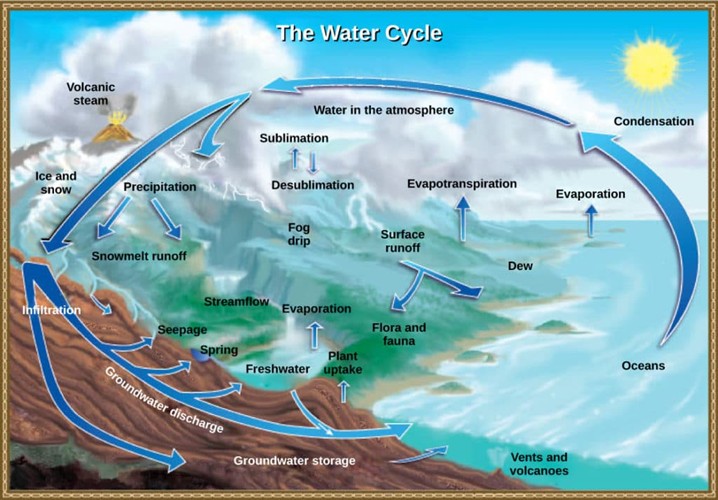
The water cycle (or hydrologic cycle or hydrological cycle) is a biogeochemical cycle that involves the continuous movement of water on, above and below the surface of the Earth across different reservoirs. The mass of water on Earth remains fairly constant over time. However, the partitioning of the water into the major reservoirs of ice, fresh water, salt water and atmospheric water is variable and depends on climatic variables. The water moves from one reservoir to another, such as from river to ocean, or from the ocean to the atmosphere due to a variety of physical and chemical processes. The processes that drive these movements, or fluxes, are evaporation, transpiration, condensation, precipitation, sublimation, infiltration, surface runoff, and subsurface flow. In doing so, the water goes through different phases: liquid, solid (ice) and vapor. The ocean plays a key role in the water cycle as it is the source of 86% of global evaporation.
_
Before understanding about the formation of clouds, let us understand evaporation and condensation.
Evaporation:
It is a process where an increase in temperature or pressure causes a substance to change from liquid state to gaseous state. It is a fundamental process in the water cycle.
So how does that water get up into the sky? Consider the water on the surface of Earth—that means the oceans, lakes, and streams but also the soil and even the drops and puddles that collect on leaves, buildings, and rocks. Remember that water is made up of tiny particles and that those particles are in motion.
As long as the air above isn’t completely saturated with water vapor (meaning it has less than 100 percent humidity), some fraction of the particles in the liquid water have enough energy to “escape,” and they can rise into the air above the surface and evaporate. The warmer the water is, the more thermal energy the particles have. On average, as the temperature increases, the number of particles with enough energy to escape into the air increases. Likewise, the drier the air, the faster the water can evaporate.
Another important source of water vapor is plants. Plants draw water through their roots, stems, and leaves by regularly letting water vapor and other gases out of the pores (tiny holes) in their leaves. Because of the tendency of water particles to stick to each other (called cohesion), as this water exits the plant, it draws up the water behind it. This allows the roots to take in more water from the soil. The release of water vapor by plant pores is called transpiration. Together, evaporation and transpiration contribute the water vapor in the air that can eventually form clouds.
Condensation:
Essentially the reverse of evaporation, a substance converts from a gaseous state to a liquid state. It is crucial in the formation of clouds.
Warm, moist air is less dense than the air around it, so it begins to rise higher into the sky. Wind can also push the parcel of air containing the water vapor to higher elevation or up the side of a mountain. Air temperatures tend to decrease the higher you go in the atmosphere. This is because the pressure decreases as you go higher, allowing the air to spread out and become thinner and, therefore, cooler.
Eventually, when the water vapor rises to an elevation where the temperature is cool enough (the dew point, or point of saturation), it will start to condense into liquid form.
_
A cloud is a visible mass of tiny water droplets or ice crystals suspended in the atmosphere, forming when water vapor cools and condenses around microscopic particles (condensation nuclei) like dust or salt. Clouds are made up of water vapor (gas), tiny water droplets (liquid water), and ice particles (frozen water) within the atmosphere. Water molecules can take many forms depending on the atmospheric conditions. Water molecules commonly become “supercooled” in colder and/or mixed phase clouds due to the surrounding temperatures.
There are three types of clouds:
- All Liquid clouds: exist entirely of liquid water molecules at temperatures at/above 0 C/32 F
- Ice-Crystal clouds: Ice clouds, like cirrus, form at high altitudes where temperatures are well below freezing, typically starting around -10°C (14°F) and often found much colder, down to -38°C (-36°F) or lower, where pure water droplets spontaneously freeze, but can form at warmer temperatures with ice nuclei.
- Mixed-Phase clouds: Mixed-phase clouds, which contain both supercooled liquid water droplets and ice crystals, generally occur within a temperature range of approximately 0 °C (32 °F) down to -40 °C (-40 °F).
_
At standard pressure, water freezes at 0 C/32 F. However, under the right conditions, liquid water can exist at temperatures below freezing temperatures (below 32 F). This liquid water is called “Supercooled Liquid Water” (SLW). This form of water is one of the most common states of water in clouds. SLW can freeze into solid form (ice) instantly if the SLW is physically disturbed. When SLW comes in contact with a surface, it will freeze on contact, creating a particle of ice that will grow in size as it collides with other SLW molecules. When the ice particle becomes heavy enough, it falls from the sky as precipitation. Precipitation occurs naturally as a result of impurities such as dust, smoke, and aerosol particles that exist within the atmosphere, creating a nucleus for ice formation.
_
Cloud formation:
A cloud is defined as a visible aggregate of minute droplets of water or particles of ice or a mixture of both floating in the free air. Each droplet has a diameter of about a hundredth of a millimeter and each cubic meter of air will contain 100 million droplets. Clouds at higher and extremely cold levels in the atmosphere are composed of ice crystals – these can be about a tenth of a millimeter long.
Clouds form when the invisible water vapor in the air condenses into visible water droplets or ice crystals. For this to happen, the parcel of air must be saturated, i.e. unable to hold all the water it contains in vapor form, so it starts to condense into a liquid or solid form. Clouds are formed when air contains as much water vapor (gas) as it can hold. This is called the saturation point, and it can be reached in two ways.
(a) By increasing the water content in the air, e.g. through evaporation, to a point where the air can hold no more.
(b) By cooling the air so that it reaches its dew point – this is the temperature at which condensation occurs, and is unable to ‘hold’ any more water. In general, the warmer the air, the more water vapor it can hold. Therefore, reducing its temperature decreases its ability to hold water vapor so that condensation occurs.
Method (b) is the usual way that clouds are produced, and it is associated with air rising in the lower part of the atmosphere. As the air rises it expands due to lower atmospheric pressure, and the energy used in expansion causes the air to cool. Generally speaking, for each 100 meters/330 feet which the air rises, it will cool by 1 °C. The rate of cooling will vary depending on the water content, or humidity, of the air. Moist parcels of air may cool more slowly, at a rate of 0.5 ° C per 100 meters/330 feet.
Therefore, the vertical ascent of air will reduce its ability to hold water vapor, so that condensation occurs. The height at which dew point is reached and clouds form is called the condensation level.
Another important factor to consider is that water vapor needs something to condense onto. Floating in the air are millions of minute salt, dust and smoke particles known as condensation nuclei which enable condensation to take place when the air is just saturated.
_
Air can reach the point of saturation in a number of ways. The most common way is through air rising from the surface up into the atmosphere and cooling. As a block of air (a “parcel”) rises, it expands due to the lower pressure higher in the atmosphere. This expansion results in cooling. When the temperature changes due to expansion or contraction of the parcel rather than from heat transfer between the parcel and surrounding atmosphere, this is called the adiabatic process.
For each 1000-foot increase in elevation that the parcel rises, its air temperature will decrease by 5.5°F. (9.8°C per kilometer) until it reaches saturation. This is called the “dry lapse rate”.
Once the parcel reaches saturation temperature (100% relative humidity), water vapor will condense onto the cloud condensation nuclei, resulting in the formation of a cloud droplet.
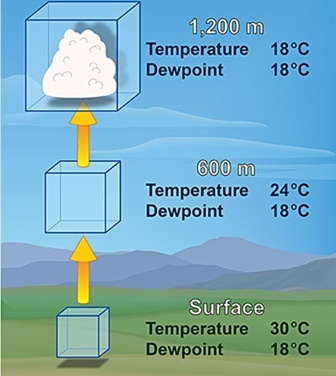
In an ideal atmosphere, the saturation level of a parcel with a surface temperature of 30°C (85°F) and a dew point of 18°C (65°F) will cool to the saturation point at about 4,000 feet in elevation as seen in figure above.
_
As a simple explanation, when air rises, it cools, much like when you are going up a mountain and the air tends to get colder. Cold air can’t hold as much water vapour than warm air can, so as the air cools, it becomes saturated and the water vapour in it condenses. This means it turns from a gas to a liquid, much like when you get condensation on a cold window. When this rising air cools to its dew point, water vapor condenses into tiny droplets, forming clouds. Temperature plays a key role in this process. Rising air triggers a drop in temperature, leading to condensation. When the water vapour turns to a liquid in the sky, it forms lots of tiny little water droplets which cling to little bits of dust; it is this group of little water droplets suspended in the air that becomes visible as the cloud we see. These droplets of water are only about a hundredth of a millimetre in diameter, but the cloud is made up of a large collection of these. If the cloud is high up enough in the sky and the air is cold enough, the cloud is made of lots of tiny ice crystals instead and gives a thin, wispy appearance.
There is also the fact that a cloud can form when more water vapour has been added to the air, for example if it has passed over a lake, it can pick up moisture. There is then more water vapour in that air and it condenses to form the cloud. Humidity affects how clouds develop. High humidity levels mean more moisture is available for cloud formation. When air is saturated with moisture, it can lead to enhanced cloud development.
_
Note that the atmosphere is in constant motion. As air rises, drier air is entrained, or mixed into the rising parcel, and both condensation and evaporation are continually occurring. As a result, cloud droplets are constantly forming and dissipating. When more water condenses on nuclei than evaporates from them, clouds form and grow. Conversely, if there is more evaporation than condensation, clouds dissipate. This is why clouds appear and disappear as well as constantly change shape.
_
As a lone entity, a water vapor molecule is not attached to other molecules; the only bonds it has are the covalent bonds (the solid lines) attaching each hydrogen atom (blue sphere) to the “parent” oxygen (red sphere) atom as seen in figure below.
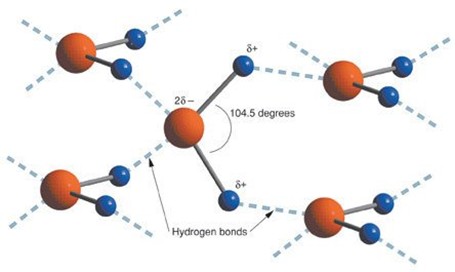
However, when this water vapor molecule comes closer to others, each hydrogen atom is encouraged to form bridges with the nearby oxygen atoms using hydrogen bonds (the dotted lines). Adding a hydrogen bond decreases the overall energy of the molecule. Since physical states are always moving towards the lowest energy state at a given temperature and pressure, water vapor molecules will choose to connect with each other whenever possible.
_
Water can exist as a solid (ice), liquid (water liquid), or gas (water vapor). The basic molecular formula for the water molecule is the same in each H2O. But, as the temperature of the system changes the hydrogen bonds between water molecules change drastically. In ice, the crystalline lattice is dominated by a regular array of hydrogen bonds which space the water molecules farther apart than they are in liquid water. This accounts for water’s decrease in density upon freezing. In other words, the presence of hydrogen bonds enables ice to float, because this spacing causes ice to be less dense than liquid water. In ice, each water forms four hydrogen bonds with O—O distances of 2.76 Angstroms to the nearest oxygen neighbor. The O-O-O angles are 109 degrees, typical of a tetrahedrally coordinated lattice structure. The density of ice is 0.931 gm/cubic cm. This compares with a density of 1.00 gm/cubic cm. for water.
_
Cooler temperatures favor condensation. A large mass of water vapor molecules condenses (attach to each other through hydrogen bonds) to make liquid water droplets in clouds. Hydrogen bonds are stronger the colder they are. Thus, at a height 2,000 – 6,000 feet water vapor molecules will bind together with strong hydrogen bonds. Thus, when water vapor molecules are released up into the very cold environment of the higher troposphere, rather than condensing into liquid water, they form ice crystals (this is how snow forms). The groups of water vapor molecules will come together to form webs of strongly connected molecules. The very cold-water vapor high in the troposphere freezes into an ice crystal netting before it has a chance to condense into liquid water.
_
When microscopic liquid droplets are formed at higher altitudes, they have several competing forces that force them to change from liquid water to an iced water vapor network:
- It is true that at colder temperatures, hydrogen bonds stronger. This tends to keep liquid droplets firmly held together.
- However, higher altitudes produce lower vapor pressures for water (water boils at 70º C at the top of Mt Everest, 30,000 feet above sea level). This predisposes liquid droplets to vaporize as they are lifted higher in the Troposphere.
- Moreover, microscopic droplets have a minute surface area, which further predisposes the droplets to dissipate into separate water vapor molecules
- Finally, there are the updrafts within the cloud that force the droplets higher into the troposphere to repeat the cycle of vaporizing the liquid water and freezing the water vapor molecules into an icy netting.
_
Note that the water vapor will not readily condense without help from other particles. The air making up our atmosphere is full of microscopic floating particles of dust, soil, smoke, sea salts, and other matter. These particles are called condensation nuclei (singular: nucleus) when they assist in cloud formation. Just as water particles condense on grass to form dew, the tiny airborne particles of water vapor condense into liquid or ice on the surfaces of dust particles in the air. As more water vapor condenses into water droplets, a visible cloud forms.
_
Since clouds are liquid or solid water, why don’t they immediately fall out of the sky as rain or snow?
Think about the fine dust particles you can often see floating in a shaft of light. These particles are solid, but their mass is so small that they remain airborne with even the slightest of updrafts; that is, until they collide and merge with enough other particles that they get big enough to fall. Similarly, the liquid droplets or ice crystals making up clouds are tiny enough to stay aloft. Only when enough collect and collide to form larger droplets do they begin to fall as precipitation.
_
It should be noted that condensation by itself does not cause precipitation (rain, snow, sleet, hail). The moisture in clouds must become heavy enough to succumb to gravity and return to earth’s surface. This occurs through two processes. In cold clouds ice crystals and water droplets exist side by side. Due to an imbalance of water vapor pressure, the water droplets transfer to the ice crystals. The crystals eventually grow heavy enough to fall to earth. In the second process, water droplets in warm clouds collide and change their electric charge. Droplets of unlike charge attract one another and merge, thereby growing until they have sufficient weight to fall.
_
There is no difference between fog and clouds other than altitude. Fog is defined as a visible moisture that begins at a height lower than 50 feet. If the visible moisture begins at or above 50 feet, it is called a cloud. Two common types of fog are called radiation fog and advection fog. Radiation fog forms during the night as the earth’s surface cools and the air immediately above it cools in turn by conduction. If the air is moist enough, the cooling causes it to reach saturation and visible water droplets form. We often call this type of fog, ground fog, because it lies so close to the surface. Advection fog forms when warm moist air moves over a colder surface (advection means to move horizontally). A perfect example is on the west coast of continents. Prevailing westerly winds move moist air from over a warm ocean area to over the colder waters off the coast. Fog forms and is carried by the westerly over the land.
_
What influences the color of clouds?
Light from both the sky and from clouds is sunlight which has been scattered. In the case of the sky, the molecules of air (nitrogen and oxygen) undertake the scattering, but the molecules are so small that the blue part of the spectrum is scattered more strongly than other colors. The water droplets in the cloud are much larger, and these larger particles scatter all of the colors of the spectrum by about the same amount, so white light from the sun emerges from the clouds still white. Sometimes, clouds have a yellowish or brownish tinge – this is a sign of air pollution.
Rain clouds are typically grey or dark because they are thick and dense with water droplets, blocking sunlight from passing through, making their undersides appear dark, while their tops, seen from above, can still look white; they get darker as more moisture gathers, becoming less transparent.
_
Why do clouds stop growing upwards?
Condensation involves the release of latent heat. This is the ‘invisible’ heat which a water droplet ‘stores’ when it changes from a liquid into a vapor. Its subsequent change of form again releases enough latent heat to make the damp parcel of air warmer than the air surrounding it. This allows the parcel of air to rise until all of the ‘surplus’ water vapor has condensed and all the latent heat has been released. Therefore, the main reason which stops clouds growing upwards is the end of the release of latent heat through the condensation process. There are two other factors which also play a role. Faster upper atmospheric winds can plane off the tops of tall clouds, whilst in very high clouds, the cloud might cross the tropopause, and enter the stratosphere where temperatures rise, rather than decrease, with altitude. This thermal change will prevent further condensation.
_
Why are there no clouds on some days?
Even when it is very warm and sunny, there might not be any clouds and the sky is a clear blue. The usual reason for the absence of clouds will be the type of pressure, with the area being under the influence of a high pressure or anticyclone. Air would be sinking slowly, rather than rising and cooling. As the air sinks into the lower part of the atmosphere, the pressure rises, it becomes compressed and warms up, so that no condensation takes place. Warm air can hold more water vapor than cold air, so clouds tend to evaporate as air sinks. In simple terms, there are no mechanisms for clouds to form under these pressure conditions.
_______
_______
There are various ways by which air rises to form clouds:
-1. Some clouds form as air warms up near the Earth’s surface and rises. Heated by sunshine, the ground heats the air just above it. That warmed air starts to rise because, when warm, it is lighter and less dense than the air around it. As it rises, its pressure and temperature drop causing water vapor to condense. Eventually, enough moisture will condense out of the air to form a cloud. Several types of clouds form in this way including cumulus, cumulonimbus, mammatus, and stratocumulus clouds.
-2. Orographic clouds are formed by the rise of warm, humid air over mountains. There are several types of orographic clouds, such as lenticular, rotor and flag clouds. These clouds can influence the precipitation and climate of a region. This process can also happen without a dramatic mountain range, just when air travels over land that slopes upward and is forced to rise. The air cools as it rises, and eventually clouds form. Other types of clouds, such as cumulus clouds, can also form above mountains too as air is warmed at the ground and rises.
-3. Clouds also form when air is forced upward at areas of low pressure. Winds meet at the center of a low-pressure system and have nowhere to go but up. All types of clouds are formed by these processes, especially altocumulus, altostratus, cirrocumulus, stratocumulus, and stratus clouds.
-4. Weather fronts, where two large masses of air collide at the Earth’s surface, also form clouds by causing air to rise.
- At a warm front, where a warm air mass slides over a cold air mass, the warm air is pushed upward forming many different types of clouds, from low stratus clouds to midlevel altocumulus and altostratus clouds, to high cirrus, cirrocumulus and cirrostratus clouds. Clouds that produce rain like nimbostratus and cumulonimbus are also common at warm fronts.
- At a cold front, where heavy a cold air mass pushes a warm air mass upward, cumulous clouds are common.
_
Clouds form via four primary atmospheric processes as seen in figure below:
- Convection
- Lifting along topography (Orographic Clouds)
- Convergence of air
- Frontal lifting
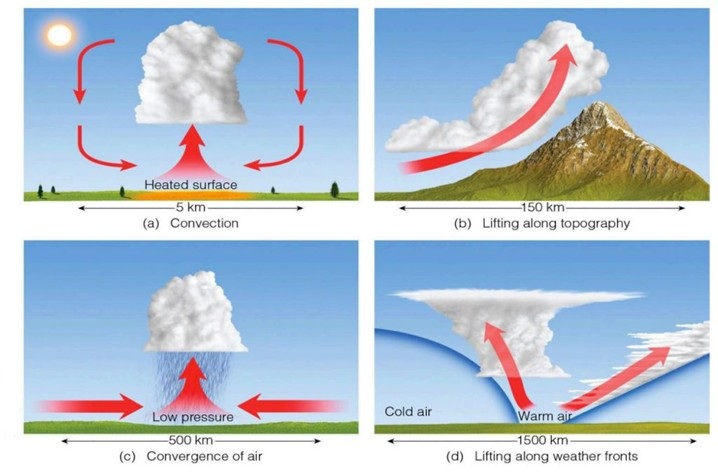
Figure above shows atmospheric lifting processes that form clouds.
______
______
Brief summary of cloud formation:
Although the formation of clouds can be quite complex in full detail, we can simplify the process.
First, we need two basic ingredients: water and dust.
On Planet Earth, naturally occurring clouds are composed primarily of water in its liquid or solid state. (On other planets, clouds may form from other compounds such as the sulphuric acid clouds on Venus.) Thus, we begin by collecting a sufficient quantity of water in the vapor state that we will soon transform into the liquid or solid states. The water vapor content of the atmosphere varies from near zero to about 4 percent, depending on the moisture on the surface beneath and the air temperature.
Next, we need some dust. Not a large amount nor large particles and not all dusts will do. Without “dirty air” there would likely be no clouds at all or only high altitude ice clouds. Cloud condensation nuclei (CCN) concentrations typically range from 100 to 1,000 per cubic centimeter, necessary to act as nuclei for cloud formation. CCN are sites on which water vapor may condense or deposit as a liquid or solid. Certain types and shapes of dust and salt particles, such as sea salts and clay, make the best condensation nuclei.
With proper quantities of water vapor and dust in an air parcel, the next step is for the air parcel mass to be cooled to a temperature at which cloud droplets or ice crystals can form to make clouds.
Ascent and Expansion are two of the main processes that result in the cooling of an air parcel in which clouds will form. We mostly think of moving air as wind flowing horizontally across the surface. But air moving vertically is extremely important in weather processes, particularly with respect to clouds and precipitation.
There are four main processes occurring at or near the earth’s surface which give can rise to ascending air: convergence, convection, frontal lifting and physical lifting.
Convergence occurs when several surface air currents in the horizontal flow move toward each other to meet in a common space. When they converge, there is only one way to go: Up. A surface low pressure cell is an example of an area of convergence and air at its center must rise as a result.
Convection occurs when air is heated from below by sunlight or by contact with a warmer land or water surface until it becomes less dense than the air above it. The heated parcel of air will rise until it has again cooled to the temperature of the surrounding air.
Frontal lifting occurs when a warmer air mass meets a colder one. Since warm air is less dense than cold, a warm air mass approaching a cold one will ascend over the cold air. This forms a warm front. When a cold air mass approaches a warm one, it wedges under the warmer air, lifting it above the ground. This forms a cold front. In either case, there is ascending air at the frontal boundary.
Physical lifting, also known as orographic lifting, occurs when horizontal winds are forced to rise in order to cross topographical barriers such as hills and mountains.
Whatever the process causing an air parcel to ascend, the result is that the rising air parcel must change its pressure to be in equilibrium with the surrounding air. Since atmospheric pressure decreases with altitude, so too must the pressure of the ascending air parcel. As air ascends, it expands. And as it expands, it cools. And the higher the parcel rises, the cooler it becomes.
Now that we have begun cooling the air parcel, we are almost ready to form a cloud. We must continue to cool the parcel until condensation is reached.
As the air cools, its relative humidity will increase. Although nothing has yet happened to change the water vapor content of the air, the saturation threshold of the air parcel has decreased as the air cooled. By decreasing the saturation threshold, the relative humidity increases. Cooling is the most important method for increasing the relative humidity but it is not the only one. Another is to add more water vapor through evaporation or mixing with a more humid air mass.
If we are to form a cloud, humidification may eventually bring the air within the parcel to saturation. At saturation the relative humidity is 100 percent. Usually a little more humidification is required which brings the relative humidity to over 100 percent, a state known as supersaturation, before a cloud will form. When air becomes supersaturated, its water vapor looks for ways to condense out. If the quantity and composition of the dust content is ideal, condensation may begin at a relative humidity below 100 percent. If the air is very clean, it may take high levels of supersaturation to produce cloud droplets. But typically condensation begins at relative humidity a few tenths of a percent above saturation.
Condensation of water onto condensation nuclei (or deposition of water vapor as ice on freezing nuclei) begins at a particular altitude known as the cloud base or lifting condensation level. Water molecules attach to the particles and form cloud droplets which have a radius of about 20 micrometers (0.02 mm) or less. The droplet volume is generally a million times greater than the typical condensation nuclei.
Clouds are composed of large numbers of cloud droplets, or ice crystals, or both. Because of their small size and relatively high air resistance, they can remain suspended in the air for a long time, particularly if they remain in ascending air currents. Cloud droplets fall incredibly slowly, often just 1-2 centimeters per second (cm/s), because their tiny size (around 10-20 micrometers) face significant air resistance, preventing them from reaching the ground quickly unless they grow much larger through collisions, eventually becoming drizzle or rain. Raindrops typically fall at terminal velocities between 7 to 10 m/s.
_
Cloud lifespan:
A cloud’s lifespan varies dramatically, from mere minutes for small cumulus clouds (sometimes only 10-15 mins) to hours for larger storm clouds, and even months for high-altitude cirrus clouds, depending on humidity, temperature, air stability, and wind. Clouds are constantly forming and dissipating as water droplets evaporate and reform, meaning they’re always in flux, with some parts dying while new ones grow, rather than having a fixed “birth-to-death” moment. No matter how long a cloud lives, its state is constantly changing. The particles that make it up are constantly evaporating and reappearing. Even if at first sight the cloud does not change its height, it constantly moves. This is because the droplets in it descend, pass into the air under the cloud, and evaporate.
______
______
Cloud Microphysics:
Cloud microphysics explores the intricate processes of cloud formation and evolution. It delves into nucleation, droplet growth, and ice crystal formation, providing crucial insights into precipitation patterns and atmospheric energy balance. Understanding cloud particle size distributions and microphysical processes is key to predicting weather and climate. From collision-coalescence to riming and evaporation, these mechanisms shape cloud structures and precipitation formation, influencing global climate dynamics.
_
Cloud microphysics is the study of the physical processes that occur within clouds, including condensation, accretion, and precipitation. Water is always present in Earth’s atmosphere in some form. However, water molecules on their own are too small to bond together in the formation of cloud droplets. They need a “flatter” surface, an object with a radius of at least 0.1 micrometer on which they can condense. Those objects are called cloud condensation nuclei (CCN). These nuclei are minute solid and liquid particles found in abundance in the atmosphere, such as smoke from fires or volcanoes, ocean spray, or tiny specks of wind-blown soil. They are hygroscopic, meaning they attract water molecules, and are about 1/100th the size of a cloud droplet which forms when water condenses on these nuclei. This means that every cloud droplet has a speck of dirt, dust, or salt crystal at its core. However, even with its condensation nuclei, a cloud droplet is still essentially made up of pure water.
Cloud condensation nuclei (CCN) are the centers on which cloud droplets can form. These particles range in diameter from about 0.06 μm to greater than 2 μm. This wide range of sizes has traditionally been subdivided into three classes (e.g., Pruppacher and Klett, 1978): small (∼0.06–0.2 μm), large (0.2–2 μm) and giant (>2 μm). Since small CCN are the most numerous in the atmosphere, they effectively determine the total concentration of droplets in a cloud.
Typically, a cloud is composed of tiny spheres of water that range in diameter from a few micrometres to a few tens of micrometres. The number of cloud droplets per cubic centimetre ranges from less than 100 to more than 1,000; 200 droplets per cubic centimetre is approximately an average value. Clouds over the ocean typically have fewer cloud droplets per cubic centimetre than their counterparts over land, since fewer CCN are present in marine air.
CCN concentrations are generally less than 100 per cubic centimeter over oceans, and range from a few hundred to 1,000 per cubic centimeter over remote land areas, up to several thousand per cubic centimeter in areas affected by human activities. Clouds with low CCN concentrations and high liquid water contents are most efficient at producing warm rain by collision and coalescence.
_
The relative size of water molecules (0.0002 micron) to large condensation nuclei (1 micron) is depicted in figure below:
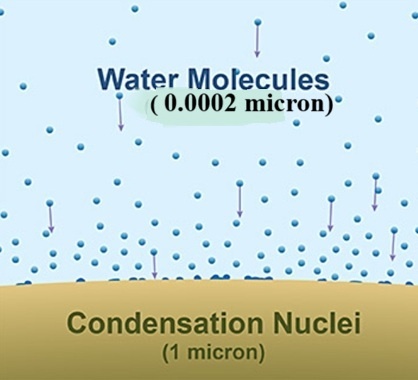
_
Nucleation:
Cloud formation is a complex process that involves the nucleation of water vapor onto aerosol particles. Nucleation is the process by which a new phase (e.g., liquid or ice) forms from a pre-existing phase (e.g., vapor). There are two main types of nucleation: homogeneous and heterogeneous.
- Homogeneous Nucleation: This type of nucleation occurs when a new phase forms spontaneously, without the presence of a nucleus. Homogeneous nucleation occurs when water vapor molecules cluster together without a surface. It requires extremely high supersaturation levels (>400%) rarely found in the atmosphere. Homogeneous nucleation requires random, chance collisions of water molecules into a stable ice cluster, which needs very slow molecular motion (low temperature below -35°C to -40°C).
- Heterogeneous Nucleation: This type of nucleation occurs when a new phase forms on the surface of a pre-existing particle, such as an aerosol. Heterogeneous nucleation is the dominant mechanism for cloud formation.
The rate of nucleation is influenced by several factors, including:
- Temperature
- Humidity
- Aerosol concentration and composition
- Surface tension
_
Cloud microphysical processes are influenced by the presence of aerosols, which can act as cloud condensation nuclei (CCN) or ice nuclei (IN). Condensation nuclei (CCN) help water vapor turn into liquid droplets (clouds), while ice nuclei (IN) help water freeze into ice crystals in cold clouds, with CCN being common (dust, salt) and IN being rarer (specific clays, bacteria) but crucial for most precipitation, acting as seeds for liquid or ice formation at different temperatures and pressures. Essentially, CCN form clouds, IN form ice within those clouds, but CCN can sometimes become IN through evaporation cycles.
The following are some key cloud microphysical processes:
- Condensation: The process by which water vapor condenses onto aerosol particles to form cloud droplets.
- Accretion: The process by which larger cloud droplets or ice crystals collide and merge with smaller ones, growing larger and more massive.
- Precipitation: The process by which cloud droplets or ice crystals become too heavy to remain suspended in the air, falling to the ground as precipitation.
Aerosols play a crucial role in cloud formation and precipitation. The presence of aerosols can influence the number and size of cloud droplets, as well as the intensity and distribution of precipitation.
_
The following table summarizes the effects of aerosols on cloud microphysics:
|
Aerosol Type |
Effect on Cloud Microphysics |
|
Cloud Condensation Nuclei (CCN) |
Increases cloud droplet number, decreases cloud droplet size |
|
Ice Nuclei (IN) |
Enhances ice crystal formation, influences precipitation intensity and distribution |
|
Absorbing Aerosols (e.g., black carbon) |
Warms clouds, influences cloud lifetime and precipitation |
_
Each droplet of liquid water in a cloud without ice originally began as a minuscule aerosol particle in the atmosphere. These particles belong to the category known as cloud condensation nuclei (CCN), characterized by favorable physical and chemical attributes. These CCN can rapidly expand through the condensation of water vapor when the air’s relative humidity exceeds 100% (referred to as water supersaturation). However, to enhance comprehension of the CCN activation process, an investigation delved into the impact of various controlling factors. These factors encompass the formation rate, growth rate, background particle distribution, hygroscopicity, and surface tension of the particles (Ovadnevaite et al. 2017, Cai et al. 2021).
______
Cloud-aerosol interactions:
Aerosol effects on cloud droplets:
- Aerosols serve as cloud condensation nuclei (CCN), influencing droplet number and size
- Higher aerosol concentrations generally lead to more numerous, smaller cloud droplets
- This can affect cloud albedo, lifetime, and precipitation efficiency (first and second indirect effects)
- Absorbing aerosols (black carbon) can alter atmospheric stability and cloud formation processes
Cloud condensation nuclei:
- CCN are particles on which water vapor can condense to form cloud droplets
- Common CCN include sea salt, sulfates, nitrates, and organic compounds
- CCN activation depends on particle size, chemical composition, and ambient supersaturation
- The CCN spectrum describes the relationship between supersaturation and activated particle concentration
Ice nuclei:
- Ice nuclei (IN) are particles that facilitate ice crystal formation in clouds
- Effective IN include mineral dust, biological particles, and some anthropogenic aerosols
- IN activity varies with temperature, supersaturation, and particle properties
- The scarcity of effective IN at warmer subzero temperatures influences mixed-phase cloud processes
______
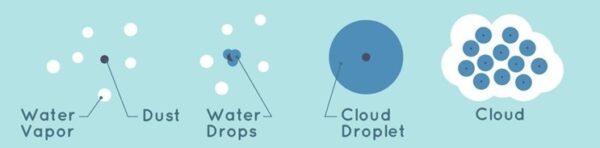
Figure above shows how dust and other particles floating in the air provide surfaces for water vapor to turn into water drops. The tiny drops of water condense on the particles to form cloud droplets. Clouds are made up of a bunch of cloud droplets bundled together with raindrops.
We usually think of clouds as being up in the sky, but when conditions are right, a cloud can form at ground level, too. Then it’s called “fog.” If you’ve ever walked through fog, you’ve walked through a cloud.
_______
Ice formation in cloud:
Ice crystal formation
- Homogeneous freezing of pure water droplets occurs at temperatures below -38°C
- Heterogeneous ice nucleation involves ice-nucleating particles (INPs) between 0 and -35°C
- Ice crystal habits (shapes) depend on temperature and supersaturation conditions
- Secondary ice production mechanisms include rime splintering and collisional fragmentation
_
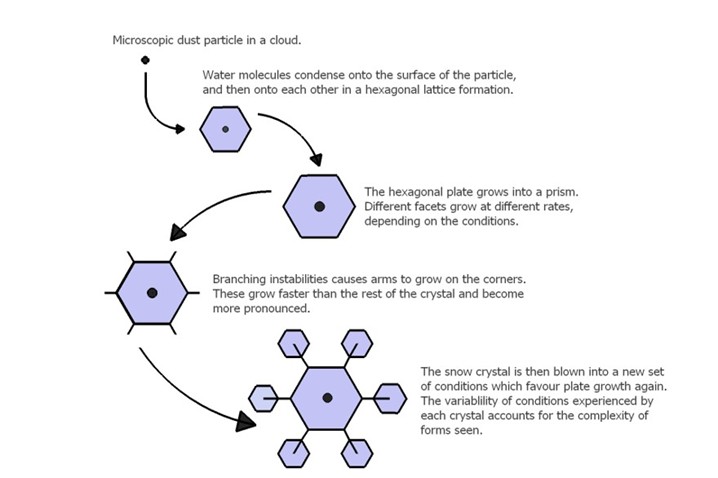
Figure above shows how ice crystals form in nature.
-1. A microscopic dust particle (ice nuclei) is present in a cloud. This acts as the nucleus or “landing pad” for water droplets to freeze and form an ice particle.
-2. Water molecules condense onto the surface of the particle and then onto each other in a hexagonal lattice formation.
-3. The hexagonal platelets grow into a prism. Different “facets” or branches of ice grow at different rates depending on the conditions.
-4. Branching instabilities cause arms to grow on the corners of the structure. These grow faster than the rest of the crystal and become more pronounced.
-5. The crystal is then carried by winds from the storm and will experience varying conditions as it goes, which favors new plate growth again and again, until the particle or snowflake becomes heavy enough to fall from the sky.
The variability of weather conditions experienced by each ice particle or snowflake accounts for the complexity of forms seen… Thus why “every snowflake is unique!”
_______
Temperature’s role:
The presence of water-attracting nuclei alone is not enough for a cloud to form; the air temperature must also be below the dew point, the point of saturation where evaporation equals condensation.
Liquid water changes into a gas when water molecules get extra energy from a heat source such as the Sun or from other water molecules running into them. These energetic molecules then escape from the liquid water in the form of gas. In the process of changing from liquid to gas, the molecules absorb heat, which they carry with them into the atmosphere. That cools the water they leave behind.
Heat causes some of the liquid water – from places like oceans, rivers and swimming pools – to change into an invisible gas called water vapor. This process is called evaporation and it’s the start of how clouds are formed.
The air can only hold a certain amount of water vapor, depending on the temperature and weight of the air – or atmospheric pressure – in a given area. The higher the temperature or atmospheric pressure, the more water vapor the air can hold. When a certain volume of air is holding all the water vapor it can hold, it is said to be “saturated.”
What happens if a saturated volume of air cools or the atmospheric pressure drops?
The air is no longer able to hold all that water vapor. The excess amount changes from a gas into a liquid or solid (ice). The process of water changing from a gas to a liquid is called “condensation,” and when gas changes directly into a solid, it is called “deposition.” These two processes are how clouds form.
Condensation happens with the help of tiny particles floating around in the air, such as dust, salt crystals from sea spray, bacteria or even ash from volcanoes. Those particles provide surfaces on which water vapor can change into liquid droplets or ice crystals. A large accumulation of such droplets or ice crystals is a cloud.
_______
Cloud electrification:
Charge separation mechanisms:
- Non-inductive charging involves collisions between ice particles in the presence of supercooled water
- Inductive charging occurs when polarized particles collide in an existing electric field
- Convective charging results from the vertical transport of charged particles in updrafts and downdrafts
- The magnitude and polarity of charge transfer depend on temperature, liquid water content, and particle sizes
_
Lightning formation:
- Charge accumulation within clouds creates strong electric fields
- When the electric field exceeds the breakdown threshold, an initial lightning leader forms
- Stepped leaders propagate in a branching pattern, seeking opposite charges in the cloud or ground
- Return strokes produce the visible flash and thunder, neutralizing the charge difference
______
______
Cloud Physics:
Most attempts at modifying weather in the modern era have aimed at initiating the onset, or accelerating the rates of, the physical-chemical processes involved in precipitation formation. Significant amounts of precipitation can occur only when low level atmospheric convergence and upward movement of air parcels provide water vapor for conversion into cloud drops. Thus, a complete understanding of the formation of natural precipitation requires understanding the dynamics of atmospheric motions as well as the physical processes governing formation and growth of cloud and precipitation particles.
_
The physical processes taking place within a cloud that led to precipitation are very complex and depend, among other things, on the number and characteristics of aerosol particles in the cloud-forming air. The atmosphere contains a tremendous amount of particulate matter from a wide variety of natural and anthropogenic sources. These include, for example, soot, sea salt, volcanic ash, wind-blown sand and dust, biogenically-derived materials such as pollens and spores, and a variety of sulfur, nitrogen, and carbon compounds (which often result from industrial pollution, biomass burning, and other combustion processes). Soluble and hydrophilic particles absorb water and can eventually act as CCN. Some insoluble particles with wettable surfaces may adsorb water and serve as large cloud drop nuclei or ice nuclei. Some insoluble particles have a crystalline structure that provides an efficient starting place for ice crystals to grow and thus are referred to as ice nuclei (IN); the exact composition of most IN is not well known.
_
Differences in the initial population of atmospheric aerosols affect the cloud particle and cloud drop populations, which subsequently affect the amount of precipitation reaching the ground. There is considerable uncertainty as to just how the various IN and CCN activate, how concentrations vary of giant CCN or ultra-giant particles (UGP) and their impact on coalescence broadening, how cloud particles interact and evolve by collision and breakup processes, how winds and electric fields in a cloud evolve and affect the growth and interaction of cloud particles, and how individual clouds interact, among other fundamental questions.
There are several different physical pathways (often called mechanisms) through which precipitation may form in natural clouds. Local conditions of updraft speed, temperature, pressure, initial aerosol characteristics, and cloud and precipitation particle concentrations and size distributions govern the rates of progress along these pathways. Several mechanisms may be active simultaneously, each affecting the others. Often one of the mechanisms proceeds faster than the others and becomes dominant. At the risk of oversimplification, it is useful to group these mechanisms into those that involve the formation of ice particles and those that do not.
_
The so-called coalescence mechanism—or warm-cloud precipitation mechanism—is an all-liquid process wherein raindrops form by the merging of the cloud droplets (Bowen, 1950; Ludlam, 1951; Young, 1975). This mechanism proceeds most rapidly in clouds having a high liquid water content (LWC) and a broad spectrum of cloud drops. The sources and characteristics of atmospheric aerosol particles capable of forming drops large enough to initiate the coalescence mechanism are largely unknown and the subject of much research. Typical conditions for the formation of collision coalescence rain are (a) convective clouds with bases warmer than about +15°C and accompanying large LWC and (b) stratified clouds of sufficient lifetimes that are too warm to initiate ice particles on the existing IN. Coalescence rain occurs when drops grow large enough to fall to the Earth before they are carried by the updraft to levels cold enough to cause them to freeze.
_
The so-called Bergeron (1935) mechanism—or cold-cloud mechanism—postulates the nucleation of ice particles in supercooled clouds followed by their growth by vapor diffusion into snow particles. Under favorable conditions they may aggregate as snow or rime to form low-density graupel or snow pellets. This mechanism was first postulated by Bergeron, building on earlier work by Alfred Wegener, and developed into a conceptual model of precipitation by Findeisen (1938). The sources and characteristics of natural IN are largely unknown. In general this mechanism may be important in clouds of all types where temperatures are colder than about –15°C, including the upper parts of cumulonimbus clouds at all seasons and latitudes. It accounts for most wintertime snow.
_
Ice may also form in clouds through the freezing of drops. It is well established that the probability of drop freezing is inversely proportional to temperature and directly proportional to drop size. Thus, large drops are more likely to freeze at warmer temperatures than smaller ones. The nature and concentrations of nuclei capable of inducing drop freezing (freezing nuclei, FN) are largely unknown and the subject of current research. A variant of the warm rain mechanism—sometimes called the coalescence-freezing mechanism—comes into play in clouds having both an active coalescence mechanism and an updraft strong enough to carry drizzle drops upward to levels where they freeze through the action of FN. In many situations this may occur at temperatures as warm as –5qC to –10qC. Upon freezing, the drizzle drops become small ice pellets. Further growth through riming with cloud drops produces high-density graupel and small hail. These particles then melt into raindrops upon descending below the 0 C level. This mechanism appears to be very important in convective clouds having bases warmer than about +15 C and with low sub-cloud CCN concentrations.
_
Under certain cloud conditions the process of riming may result in the creation of small ice particles (so-called secondary ice particles, SIP) in numbers vastly exceeding the original number of ice nuclei. Although the details of this process are still a matter of research, this mechanism may be very important in natural precipitation. The occurrence of SIP was first elucidated from physical measurements obtained in a scientific cloudseeding experiment, and is still the subject of research (Hoffer and Braham, 1962; Koenig, 1963; Braham, 1964, 1986a; Hallet and Mossop, 1974).
______
______
Nephology:
Nephology is the science of clouds, which is undertaken in the cloud physics branch of meteorology.
How do meteorologists measure cloud cover?
-1. Oktas is the measurement unit that is used to measure the amount of visible sky that is covered by clouds.
-2. An okta estimates how many eighths of the sky is covered in clouds.
-3. The clear sky is measured as 0 oktas.
-4. An overcast or grey sky is measured as 8 oktas.
_____
Cloud impacts on climate:
- Clouds play a crucial role in Earth’s energy balance and hydrological cycle
- Understanding cloud-climate interactions is essential for accurate climate modeling and prediction
- Cloud feedbacks represent a significant source of uncertainty in climate change projections
Albedo effect:
- Clouds reflect incoming solar radiation back to space, cooling Earth’s surface
- Low, thick clouds have a higher albedo than thin, high clouds
- Global cloud cover influences planetary albedo and energy balance
- Changes in cloud properties due to climate change can amplify or dampen warming
- Cloud albedo effect varies with cloud type, thickness, and geographical location
Greenhouse effect:
- Clouds absorb and re-emit longwave radiation from Earth’s surface
- High, thin clouds (cirrus) have a stronger greenhouse effect than low clouds
- Cloud greenhouse effect depends on cloud altitude, temperature, and composition
- Nighttime cloud cover can lead to warmer surface temperatures
- Interactions between cloud greenhouse and albedo effects determine net climate impact
Precipitation processes:
- Clouds are essential for the formation and distribution of precipitation
- Cloud microphysics influence precipitation efficiency and intensity
- Changes in cloud properties can affect global and regional precipitation patterns
- Cloud-aerosol interactions impact precipitation formation and distribution
- Extreme precipitation events are often associated with specific cloud types and structures
______
______
Types of clouds:
Clouds can form anywhere in the troposphere, and although condensed liquid, they are light enough to float in the air and move from place to place by the wind. Clouds are classified according to appearance and height. Based on appearance, there are two major types: Clouds of vertical development, formed by the condensation of rising air; and clouds that are layered, formed by condensation of air without vertical movement. When clouds are classified by height, there are four classes: high, middle, low, and vertical development. Clouds with vertical development begin in the low section of the atmosphere and travel all the way up through the higher section.
_
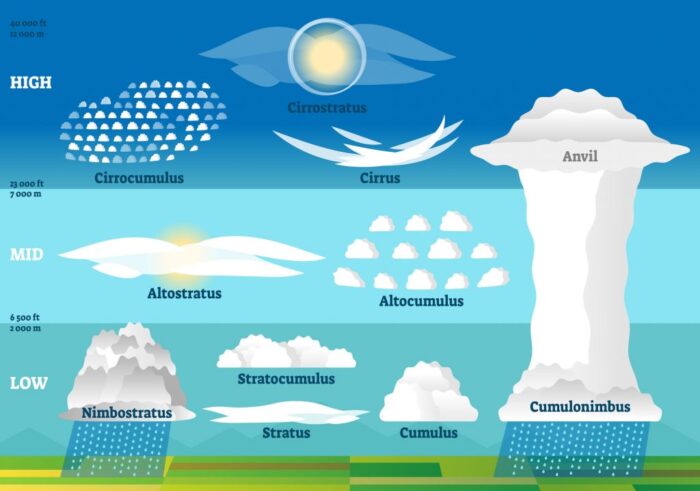
In 1803 a retail chemist and amateur meteorologist called Luke Howard proposed a system which has subsequently become the basis of the present international classification. Howard recognised four types of cloud and gave them the following Latin names:
Cumulus – heaped or in a pile
Stratus – in a sheet or layer
Cirrus – thread-like, hairy or curled
Nimbus – a rain bearer
If we include another Latin word altum meaning height, the names of the ten main cloud types are all derived from these five words and based upon their appearance from ground level and visual characteristics.
The cloud types are split into three groups according to the height of their base above mean sea level. Note that ‘medium’ level clouds are prefixed by the word alto and ‘high’ clouds by the word cirro. All heights given are approximate above sea level in mid-latitudes. If observing from a hill top or mountain site, the range of bases will accordingly be lower.
_
Low-level clouds:
- Form below 6,500 feet (2,000 meters) in the troposphere
- Consist primarily of water droplets due to warmer temperatures at lower altitudes
- Include stratus, stratocumulus, and nimbostratus cloud types
- Often appear as flat, layered, or lumpy sheets covering large areas of the sky
- Influence local weather conditions by producing light precipitation or fog
Mid-level clouds:
- Develop between 6,500 and 20,000 feet (2,000 to 6,000 meters)
- Composed of water droplets, ice crystals, or a mixture of both depending on temperature
- Encompass altocumulus and altostratus cloud formations
- Typically appear as parallel bands or rounded masses in the sky
- Can indicate approaching weather systems or atmospheric instability
High-level clouds:
- Form above 20,000 feet (6,000 meters) in the upper troposphere
- Consist entirely of ice crystals due to extremely cold temperatures at high altitudes
- Include cirrus, cirrostratus, and cirrocumulus cloud types
- Appear thin, wispy, or veil-like, often creating halos around the sun or moon
- Serve as indicators of upper-level atmospheric conditions and approaching weather fronts
_
Different Cloud Types:
Warm and cold clouds:
- Warm clouds consist entirely of liquid water droplets, with cloud tops below the freezing level. Water clouds consist of liquid water droplets with diameters typically ranging from 1 to 100 micrometers.
- Cold clouds contain ice crystals or a mixture of ice and supercooled water droplets. Ice clouds contain ice crystals with various shapes (plates, columns, dendrites).
- Warm clouds typically produce precipitation through collision-coalescence processes
- Cold clouds often involve more complex microphysical processes, including the Bergeron process
- Cloud particle size distribution affects cloud radiative properties and precipitation efficiency
- Chemical composition can be influenced by aerosol particles acting as cloud condensation nuclei
Mixed-phase clouds:
- Contain both liquid water droplets and ice crystals, typically between 0°C and -40°C
- The Wegener-Bergeron-Findeisen process facilitates rapid ice crystal growth at the expense of droplets
- Complex interactions between liquid and ice phases influence precipitation formation and cloud electrification
- Mixed-phase clouds play a crucial role in global precipitation and radiative balance
_
Convective vs stratiform clouds:
- Convective clouds form through strong vertical air motions, often associated with instability
- Stratiform clouds develop in stable atmospheric conditions with gentle lifting over large areas
- Convective clouds (cumulonimbus) can produce intense, localized precipitation
- Stratiform clouds (altostratus, nimbostratus) generate widespread, longer-duration precipitation
_
Cloud Density:
- Refers to the concentration of water droplets or ice crystals within the cloud
- Affects cloud opacity and ability to transmit or reflect solar radiation
- Influences cloud buoyancy and vertical development potential
- Varies widely between different cloud types and within individual clouds
- Impacts precipitation formation processes and cloud electrification
_
Rain Clouds:
Certain types of clouds produce precipitation. Rain clouds, or nimbus, produce everything from drizzle to downpours; more violent relatives of theirs may unleash rain as part of intense thunderstorms. Rain or “nimbus” clouds may appear as low, sheeted “stratonimbus” producing sprinkles or steady drizzle or as tall “cumulonimbus” clattering with thunder and flashing with lightning. The cumulonimbus’s forerunner, cumulus congestus, may also drop rain.
Nimbus is an ancient Latin word meaning “rain storm.” Rain or nimbus clouds tend to appear dark grey because their depth and/or density of large water droplets obscures sunlight. Depending on temperature, nimbus clouds may precipitate hail or snow instead of liquid rain.
Clouds with the prefix “nimbo” or the suffix “nimbus” bring rainfall and snowfall. Nimbostratus clouds bring continuous rainfall or snowfall that may continue for a very long duration.
Cumulonimbus clouds are also called thunderheads. Thunderheads produce rain, thunder, and lightning.
Clouds produce the bolt of electricity called lightning and the sound of thunder that accompanies it. Lightning is formed in a cloud when positively charged particles and negatively charged particles are separated, forming an electrical field. When the electrical field is strong enough, it discharges a superheated bolt of lightning to Earth. Most of what we consider to be single lightning strikes are in fact three or four separate strokes of lightning.
The sound of thunder is actually the sonic shock wave that comes when the air, heated by the lightning bolt, expands very rapidly. Thunder sometimes sounds like it comes in waves because of the time it takes the sound to travel. Because the speed of light is faster than the speed of sound, lightning will always appear before its thunder is heard.
_
Anthropogenic cloud:
A homogenitus, anthropogenic or artificial cloud is a cloud induced by human activity. Although most clouds covering the sky have a purely natural origin, since the beginning of the Industrial Revolution, the use of fossil fuels and water vapor and other gases emitted by nuclear, thermal and geothermal power plants yield significant alterations of the local weather conditions. These new atmospheric conditions can thus enhance cloud formation.
_
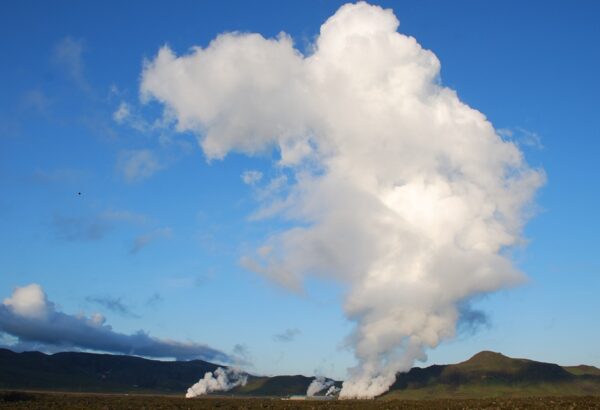
Figure above shows Cumulus homogenitus produced by the emissions of the geothermal power station located in Nesjavellir (Iceland, August 2009).
Three conditions are needed to form an anthropogenic cloud:
-1. The air must be near saturation of its water vapor,
-2. The air must be cooled to the dew point temperature with respect to water (or ice) to condensate (or deposit) part of the water vapor,
-3. The air must contain condensation nuclei, small solid particles, where condensation/deposition starts.
The current use of fossil fuels enhances conditions for cloud formation. First, fossil fuel combustion generates water vapor. Additionally, this combustion also generates the formation of small solid particles that can act as condensation nuclei. Finally, all the combustion processes emit energy that enhance vertical upward movements.
Despite all the processes involving the combustion of fossil fuels, only some human activities, such as, thermal power plants, commercial aircraft or chemical industries modify enough the atmospheric conditions to produce clouds that can use the qualifier homogenitus due to its anthropic origin. By far the greatest number of anthropogenic clouds are airplane contrails (condensation trails) and rocket trails.
_
Condensation trails (contrails):
These are thin trails of condensation, formed by the water vapor rushing out from the engines of jet aircraft flying at high altitudes. They are not true clouds, but can remain in the sky for a long time, and grow into cirrus clouds. Condensations trails (“contrails”) are line-shaped cloud formations produced by aircraft engine exhaust. The air is considerably colder at aircraft flight altitudes, several miles above the Earth’s surface. Cloud formations develop when hot gas from aircraft exhaust collides with very cold air in the atmosphere. When the exhaust gases from an aircraft cool and mix with surrounding air containing moisture, visible ice is formed, and a condensation trail or “cloud formation” develops.
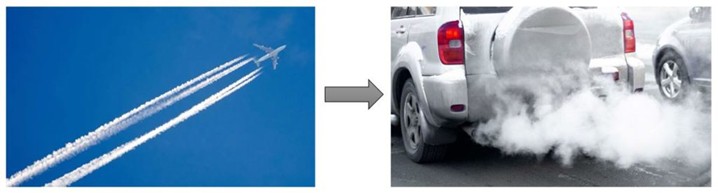
The image above-left shows a condensation trail (contrail) formed by the hot exhaust from the airplane mixing with cold air in the atmosphere, resulting in the water to condense into a visible cloud formation. This is the exact same process that creates fog on a window or exhaust from a car on a cold winter day. See image above-right. However, on the ground, there are not high enough wind speeds to create a “trail” of condensation.
_
Are condensation trails and cloud seeding the same thing? No.
A common misconception is that condensations trails from aircraft, otherwise known as “Contrails”, are a result of cloud seeding. Water exists in the atmosphere at all times, even when the sky appears to be clear and blue (gas form). Clouds are the existence of water in liquid/solid form that can be seen visibly, and are the result of water converting from gas form to liquid water droplets or ice. The physical process of water changing from gas to liquid form to create a cloud occurs due to water vapor saturation at dew point and condensation nuclei like dust, salt, smoke provides surfaces for water vapor to condense upon, facilitating cloud droplet formation. Contrails are thin trails of condensation, formed by the water vapor rushing out from the engines of jet aircraft flying at high altitudes. Very cold atmospheric air is already nearly saturated with water vapor and cannot hold additional water vapor from exhaust resulting in condensation on exhaust particles like black carbon, sulfuric acid droplets, and various metals, that serve as cloud condensation nuclei for water droplets that freeze to form ice particles that compose a contrail.
Cloud seeding is the process of inputting a solid particle (nucleus) into an EXISTING cloud formation, that liquid water can formulate ice around, and essentially deplete the cloud by turning its water content into ice. When the ice crystal becomes heavy enough, it falls from the sky as precipitation, thereby reducing the cloud structure.
______
______
The formation of precipitation:
Different mechanisms drive precipitation in various regions and conditions. Warm rain processes dominate in the tropics, while cold rain processes involving ice are more common in mid-latitudes. Orographic, convective, and frontal precipitation each play unique roles in global water distribution.
Rain forms when cloud droplets collide and merge into larger drops. This starts with clouds containing abundant moisture and strong upward movement of air to keep droplets suspended long enough to grow. As droplets become heavy, gravity pulls them down as rain.
Cumulonimbus clouds are prime producers of rain and thunderstorms. They form in unstable atmospheres where warm moist air rapidly rises. The vertical growth in these clouds creates towering structures, with upper parts freezing into ice crystals that fall and melt to form raindrops. Nimbostratus clouds are another major rain bringer, producing steady, prolonged rainfall rather than intense storms. They generally occur with warm or occluded fronts as a large air mass slowly rises, cooling moisture steadily and saturating thick cloud layers.
Clouds formed along weather fronts often lead to rain because the meeting of different air masses results in air being forced upward, cooling, and condensing moisture efficiently. The type of front and temperature differences determine if the precipitation is light, steady, or heavy. Clouds go through formation, growth, maturity, and dissipation phases. During growth, hydrometeors (water or ice particles) grow in size until they precipitate. Mature clouds with strong updrafts and ample moisture tend to drop rain efficiently. As clouds dissipate, evaporation dominates and rain stops. This cycle explains why some rain showers are brief and localized, while others last longer and cover wide areas.
Temperature gradients in the atmosphere affect cloud precipitation. Warmer temperatures allow clouds to hold more moisture, but if the air is too warm or dry below the cloud base, raindrops might evaporate before reaching the ground.
High humidity near the surface favors rain reaching the ground. When humidity is low, precipitation can evaporate in the dry air, creating virga. Therefore, even though a cloud may produce rain, the surrounding atmosphere determines whether it reaches us.
_
When there is a lot of warm water vapor molecules pushing up into the cloud and forming water droplets, the frozen hydrogen bonds weaken. The droplets of water that develop within the cloud are no longer held suspended through the help of a frozen netting of hydrogen bonds; these droplets fall down as rain. Note that it is not only the size of the droplets that allow them to fall; it is the loss of the holding power of hydrogen bonds. One can have small or largish droplets within the clouds. As long as there is attachment to the hydrogen-bonded frozen web of water crystals and enough buoyancy from the surrounding air, the droplets will remain suspended in the clouds. Of course, if the drops become large enough (through a mass of warm and humid water vapor rising into the cloud), even frozen hydrogen bonds will not be strong enough to hold them in place.
_
We know that not all clouds produce rain that strikes the ground. Some may produce rain or snow that evaporates before reaching the ground, and most clouds produce no precipitation at all. When rain falls, we know from measurements that the drops are larger than one millimeter. A raindrop of diameter 2 mm contains the water equivalent of a million cloud droplets (0.02 mm diameter). So, if we are to get some precipitation from a cloud, there must be additional process within the cloud to form raindrops from cloud droplets. We must increase the cloud water content before we can expect any precipitation. This requires a continuation of the lifting process. It is assisted by the property of water of giving off heat when changing from vapor to liquid and solid states, the latent heats of condensation and of deposition, respectively. (If the vapor first changes to a liquid before freezing, then we also have the latent heat of condensation released and followed by the release of the latent heat of freezing.) This additional heat release warms the air parcel. In doing so, the buoyancy of the parcel relative to the surrounding air increases, and this contributes to the parcel’s further rise. We can see the continued ascent of these parcels in cumulus clouds that reach great vertical growth.
Now in the cloud, there must be growth of cloud droplets to sizes that can fall to the ground as rain without evaporating. Cloud droplets can grow to a larger size in three ways.
The first is by the continued condensation of water vapor into cloud droplets and thus increasing their volume/ size until they become droplets. While the first condensation of water onto condensation nuclei to form cloud droplets occurs rather quickly, continued growth of cloud droplets in this manner will proceed very slowly.
Second, growth by collision and coalescence of cloud droplets (and then the collision of rain drops with cloud droplets and other drops) is a much quicker process. Turbulent currents in the clouds provide the first collisions between droplets. The combination forms a larger drop which can further collide with other droplets, thus growing rapidly in size.
As the drops grow, their fall velocity also increases, and thus they can collide with slower falling droplets. A 0.5 mm-radius drop falling at a rate of 4 m/s can quickly overtake a 0.05 mm (50 micrometer) drop falling at 0.27 m/s. When drops are too large, however, their collection efficiency for the smallest drops and droplets is not as great as when the drops are nearer in size. Small droplets may bounce off or flow around much larger drops and therefore do not coalesce. A drop about 60% smaller in diameter is most likely to be collected by a large drop.
Clouds with strong updraft areas have the best drop growth because the drops and droplets stay in the cloud longer and thus have many more collision opportunities.
Finally, it may seem odd, but the best conditions for drop growth occur when ice crystals are present in a cloud. When in small droplet form, liquid water must be cooled well below 0 ° C (32 °F) before freezing. In fact, under optimal conditions, a pure droplet may reach -40 °C before freezing. Therefore, there are areas within a cloud were ice crystals and water droplets co-exist.
When ice crystals and supercooled droplets are near each other, there is a movement of water molecules from the droplet to the crystal. This increases the size of the ice crystal at the expense of the droplet. When the crystals grow at temperatures around -10 °C (14 °F), they begin to develop arms and branches, the stereotypical snow crystal. Such crystals not only are efficient at growing at the expense of water droplets, they also easily stick to one another forming large aggregates we call snowflakes.
Finally, the drops have grown to a size that they can fall in a reasonable time to the surface without evaporating. Most rain falls in the range of 0.2 to 5 mm (0.008 to 0.20 inch).
Of course, not all precipitation falls as rain. A fair amount of the world’s precipitation falls as snow or some other solid water form. Actually, outside the tropical regions, it is likely that the much of the precipitation begins in the solid form and only becomes liquid rain when it melts while falling through air with temperatures above freezing.
Most people call almost any frozen form of precipitation, other than hail or ice pellets, a snowflake. But meteorologists are a bit fussier. Technically the term snowflake refers to an assemblage of individual snow crystals that have bumped together and remain joined during their fall. Snowflakes typically fall when air temperatures near the earth’s surface are not far from the freezing mark. Snow crystals adhere to each other better at these temperatures. At very cold temperatures, snowflakes are uncommon and we see mostly snow crystals during a snow fall.
Snow crystals are typically 0.5 to 5 millimeters (0.02 to 0.20 inches) in size whereas snowflakes are about 10 mm in size (0.4 inches) and may be as large as 20 to 40 mm (0.79 to 1.57 inches).
Other common forms of solid precipitation are: hail, sleet or ice pellets, graupel or soft hail or snow grains, and a special form: freezing rain, also known as glaze or rime. The latter falls as a liquid but freezes on contact with an object. When clear ice forms, freezing rain is called glaze. When the ice is milky, it is called rime.
_
Hail is a phenomenon of severe thunderstorms, requiring strong updrafts to form hailstones by passing the hailstone seed many times through air laden with drops and ice crystals. Hail often occurs when atmospheric instability is great, and when other factors such as strong upper-level winds are present. Thunderstorm ingredients include: atmospheric instability (warm air at the surface and cold air aloft), abundant moisture, and a weather feature such as a cold or warm front to initiate storm development. While a small percentage of storms produce hail on the ground, a much larger percentage develop hail during their lifecycles that falls and melts before it reaches the ground.
_______
There are two theories that explain how minute cloud droplets develop into precipitation.
-1. The Bergeron-Findeisen ice-crystal mechanism for cold clouds
Ice phase precipitation processes (when most or all of the cloud is below 0°C) include vapor deposition growth of ice crystals, ice particles collecting cloud droplets (riming), and collision and coalescence of ice crystals (aggregation).
Precipitating clouds will typically have a mix of ice crystals, supercooled water (at temperatures below freezing), water droplets and water vapor. During the Bergeron process, ice crystals in a cloud grow at the expense of supercooled liquid water droplets. There are more water molecules surrounding the water droplets than there are surrounding the ice crystals. This occurs because the saturation vapor pressure over a water surface is greater than that over an ice surface at the same [subfreezing] temperature. Saturation vapor pressure describes how much water vapor is needed to make the air saturated at any given temperature and in effect, is the pressure that the water vapor would exert if the air were saturated with respect to a given temperature. The supercooled liquid droplets are more readily able to evaporate and contribute to the vapor pressure in the surrounding air than the ice crystals are able to sublimate and contribute to the vapor pressure. Therefore, when ice and liquid coexist within a cloud, water vapor must evaporate from the drop and flow toward the ice crystal in order to maintain equilibrium. As this water vapor diffuses toward the ice crystal, the droplet must evaporate more in order to keep the vapor pressure in equilibrium with its surroundings. Therefore, what happens, is a vicious cycle of water vapor evaporating from the drop, collecting on the ice crystal, and freezing so that the crystal continuously grows at the water droplet’s expense. Riming involves ice particles settling through and colliding with cloud droplets, which then freeze onto the particles. Bergeron process facilitates droplet growth in mixed-phase clouds through vapor pressure differences. This process continues until the flakes fall back towards the ground. As they fall through the warmer layers of air, the ice particles melt to form raindrops. However, some ice pellets or snowflakes might be carried down to ground level by cold downdraughts.
-2. Longmuir’s collision and coalescence theory for warm clouds
Warm cloud precipitation processes (above 0°C) involve larger-sized droplets settling through the cloud relative to smaller ones and colliding and coalescing to form still larger droplets. Precipitation growth proceeds very rapidly once droplets exceed 40 microns in diameter. The efficiency of the process depends on the time available for precipitation formation, the liquid water content of the cloud, and the concentration of cloud droplets that form.
_______
Precipitation mechanisms synopsis:
Precipitation mechanisms are the heart of atmospheric water cycling. From rain to snow, sleet to hail, these processes shape our weather and climate. Understanding how droplets form, grow, and fall is crucial for forecasting and modeling Earth’s complex atmospheric systems.
_
Liquid precipitation forms:
- Rain constitutes the most common liquid precipitation type
- Drizzle consists of smaller water droplets with diameters less than 0.5 mm
- Virga describes precipitation that evaporates before reaching the ground
- Freezing rain occurs when liquid droplets freeze upon contact with surfaces
_
Frozen precipitation forms:
- Snow forms when water vapor condenses directly into ice crystals
- Sleet results from partially melted snow refreezing before reaching the ground
- Graupel or soft hail develops when supercooled water droplets freeze onto falling snowflakes
- Hail forms in strong updrafts within thunderstorms, creating layered ice structures
_
Warm rain process:
- Occurs in clouds with temperatures above freezing throughout
- Collision-coalescence drives droplet growth
- Cloud condensation nuclei (CCN) initiate droplet formation
- Droplets grow by colliding and merging with other droplets
- Process typically produces lighter rainfall intensities
_
Cold rain process:
- Takes place in clouds with temperatures below freezing
- Ice crystals play a crucial role in precipitation formation
- Involves both liquid and solid water phases
- Produces a wider variety of precipitation types (rain, snow, mixed)
_
Size distribution:
- Raindrop sizes typically range from 0.1 mm to 6 mm in diameter
- Snowflake sizes can vary greatly, from less than 1 mm to over 10 mm
- Hailstones range from pea-sized (5 mm) to grapefruit-sized (over 100 mm)
_
Fall velocity:
- Terminal velocity depends on particle size, shape, and atmospheric conditions
- Raindrops reach terminal velocities between 2 m/s and 9 m/s
- Snowflakes fall more slowly, typically between 0.5 m/s and 1.5 m/s
- Hailstones can achieve higher velocities, sometimes exceeding 30 m/s
_
Shape variations:
- Raindrops are not tear-shaped but tend to be spherical or oblate
- Snowflakes exhibit diverse crystal structures (dendrites, plates, columns)
- Graupel particles are typically cone-shaped or spherical
- Hailstones often have irregular shapes with layered structures
_______
_______
Why some Clouds don’t bring Rain:
Not all clouds bring rain for several reasons. A key factor is cloud thickness and moisture content. Thin clouds, such as cirrus, have limited moisture and particles, so the water droplets or ice crystals are sparse and light. These clouds can indicate moisture at high altitudes but lack the density to produce precipitation that reaches the ground.
Clouds also require sufficient vertical development to generate rain. When the upward movement of air is weak, droplets remain small and can evaporate before falling. This evaporation, known as virga, is often seen under clouds when precipitation falls but disappears mid-air due to dry air beneath.
Atmospheric stability affects clouds’ ability to produce rain. In a stable atmosphere, vertical air movement is suppressed, leading to flat, layered clouds with limited precipitation potential. Unstable conditions promote stronger updrafts causing cloud droplets to combine, grow, and eventually fall as rain.
Clouds that commonly don’t bring Rain include:
Cirrus clouds are thin and wispy and indicate moisture far above without rain. They often precede weather changes but don’t produce precipitation themselves.
Altocumulus clouds are patchy and scattered, generally not thick or moist enough to cause rain. However, their presence may hint at atmospheric instability.
Stratocumulus clouds close to the earth’s surface may produce drizzle but usually no significant rain, mostly because of limited moisture and weak vertical motion.
____
Indicators that Clouds may bring Rain:
Growing cumulus clouds, especially those developing vertical towers, are clear signs rain could follow. Their towering nature shows strong convection and moisture, precursors to thunderstorms or showers.
Darkening cloud bases and thickening clouds often mean increasing moisture loads, making rain more likely.
Nimbostratus clouds, which are dense and cover wide sky areas as grey sheets, often arrive with consistent rains or snow.
_______
Geography influences Cloud and Rain formation:
Geography such as mountains and bodies of water influences cloud formation dramatically. Mountains force air upwards, cooling it to form clouds that often produce rain on windward slopes. This orographic effect leads to wetter areas on one side and drier conditions, or rain shadows, on the other.
Lakes and oceans provide moisture that feeds clouds and precipitation nearby. Coastal areas often see more clouds and rain due to these moisture sources combined with land heating cycles.
Urban areas can modify cloud formation patterns through heat islands and pollution. Particles from pollution provide nuclei that can increase cloud droplet formation but sometimes reduce rainfall by producing many tiny droplets that don’t merge well into raindrops.
Climate change also influences clouds and rainfall patterns. Increasing global temperatures affect moisture distribution and atmospheric stability, which can alter how clouds develop and whether they produce rain.
_
In a nutshell
In essence, whether clouds produce rain depends on several interrelated factors: moisture availability, air temperature, atmospheric stability, vertical air currents, and environmental conditions like geography and humidity. Thick, moist clouds with strong upward motion generate raindrops that fall to the ground, while thin or stable clouds may carry moisture but fail to precipitate. Understanding these factors helps explain why some clouds are just a lovely backdrop in the sky while others deliver the rain that shapes our weather patterns and ecosystems.
_______
_______
Section-3
Cloud property measurement for weather modification:
Cloud seeding is a weather modification technique designed to enhance precipitation by introducing ice-nucleating particles, commonly silver iodide (AgI), into clouds. These aerosols serve as nuclei around which water droplets can form, or initiate ice nucleation, facilitating the coalescence process and increasing the likelihood of precipitation. AgI is widely used due to its crystal structure, which closely resembles that of ice, promoting ice formation in supercooled clouds. Cloud seeding methodologies are commonly classified as glaciogenic or hygroscopic. Glaciogenic seeding introduces efficient ice-nucleating particles, most often AgI or, in some programs, calcium chloride, into mixed-phase clouds to stimulate the Bergeron–Findeisen process, enlarge ice crystals, and hasten their descent as snow or rain. Hygroscopic seeding, by contrast, releases micron-scale salt aerosols into warm convective clouds, broadening the droplet spectrum, intensifying collision–coalescence, and ultimately increasing rainfall at the surface. Current operations integrate high-resolution numerical weather prediction, radar nowcasting, and in situ cloud-physics measurements to optimize launch timing from aircraft, ground generators, rockets, or autonomous uncrewed aerial platforms. At present, more than forty sustained programs employ cloud seeding for diverse objectives that include winter orographic snowpack enhancement in the western United States, warm-cloud rainfall augmentation across the Arabian Peninsula and Southeast Asia, hail suppression initiatives in parts of Europe and Canada, and fog-dispersion at major transportation hubs.
_
The past few decades have seen the development of a multitude of new tools for measuring and modeling physical processes of cloud and storm systems. It is becoming feasible to carry out detailed studies of the chain of physical events in the evolution of a cloud system. This will lead to more definitive assessments of the effects of seeding, refinements of physical hypotheses, and “prospecting” information about suitable seeding targets.
_
Several large weather modification research programs were carried out in the late 1960s and early 1970s, including the National Hail Research Experiment aimed at hail suppression, the Sierra Cooperative Pilot Project aimed at snowpack enhancement, and the High Plains Experiment aimed at warm-season rainfall enhancement. These experiments contributed to the development of many new observational instruments and facilities such as the Wyoming King Air research aircraft, the NCAR CP-2 dual-wavelength radar, the CHILL dual-wavelength and Doppler radar systems, NCAR and NOAA Doppler radars, and the NCAR Portable Automated Meso network. These systems defined the state of the art at the time and contributed much to our current understanding of precipitation processes. Although weather modification research has declined since that time, observing technologies with which the field could benefit have continued to advance. Cloudseeding research activities can now employ revealing measurements that were unavailable in earlier decades, particularly in terms of remote sensing. The new observations offer more accurate and higher resolution precipitation measurements and three-dimensional depictions of the structure, airflow, and hydrometeor composition of clouds before and after seeding.
_____
_____
Cloud properties are measured using various ground-based, airborne, and satellite-based instruments to characterize their impact on weather and climate. Key properties measured include:
Macrophysical Properties
- Cloud Amount (Cloud Cover): The fraction of the sky covered by clouds, typically reported in oktas (eighths of the sky) by human observers or as a percentage.
- Cloud Height: Measured as cloud base height (CBH) and cloud top height (CTH) in meters or feet.
-Cloud Base Recorders (Ceilometers): Ground-based instruments using pulsed diode laser LIDAR (light detection and ranging) technology to determine the height of cloud bases.
-Satellite Observations: Spaceborne LIDAR systems, such as the Cloud-Aerosol Lidar with Orthogonal Polarization (CALIOP) on the CALIPSO satellite, provide vertical profiles of cloud layers and top heights.
- Cloud Type: Classified based on the World Meteorological Organisation criteria, using form and features (e.g., cumulus, stratus, cirrus).
Microphysical and Optical Properties:
- Cloud Optical Thickness (COT) / Optical Depth: A dimensionless measure of how effectively a cloud extinguishes light, retrieved using a combination of visible and shortwave infrared satellite measurements.
- Cloud Effective Radius (CER) / Effective Particle Size: A representation of the average size of water droplets or ice crystals within the cloud (in micrometers).
- Cloud Thermodynamic Phase: Whether the cloud is composed of liquid water, ice crystals, or a mixture, determined using multi-spectral infrared methods.
- Liquid Water Content (LWC) and Ice Water Content (IWC): The total mass of water or ice per unit volume, which can be integrated vertically to find the Liquid/Ice Water Path (LWP/IWP). LWP is often validated using microwave radiometers.
- Cloud Top Temperature (CTT) and Pressure (CTP): Inferred from thermal infrared measurements and atmospheric profiles.
_
Measurement Techniques:
- Ground-based: Human observers, laser ceilometers, millimeter-wave radar (MMWR), and microwave radiometers.
- Airborne (In situ): Aircraft equipped with probes and radiometers to directly sample cloud particles and properties during flight campaigns.
- Satellite Remote Sensing: Passive sensors like MODIS (Moderate Resolution Imaging Spectroradiometer) and active sensors like CALIPSO lidar and CloudSat radar provide global data by measuring reflected/emitted radiation, often used in combination for comprehensive analysis
_
Radiometer measures electromagnetic radiation (like microwaves, infrared) from clouds to determine properties such as liquid water content, droplet size, temperature, and water vapor.
Ceilometer is a weather instrument that measures the height and thickness of clouds. The principle of operation is based on either laser pulses or photodetectors.
Lidar is an active remote sensing device that uses a laser as the emitting light source and optoelectronic detection technology.
_
Weather forecasting relies heavily on cloud observations to anticipate precipitation. Recognizing the types of clouds and their behavior helps meteorologists predict whether rain will occur soon or if a dry spell persists.
Cloud radar, satellites, and ground observations combine to provide real-time data on cloud thickness, moisture content, and vertical development. These tools improve rain predictions and help warn about severe weather. Cloud and rain properties are determined through various observations such as instrumentation placed on aircraft, radar, satellites and surface observations (automatic rain gauges, disdrometers etc.).
______
______
Weather radar:
Radar is a radio wave detection technology that is an active microwave atmospheric remote sensing device. Weather radars use a wide range of radio wavelengths, from 1 centimeter to 1,000 centimeters. They are often divided into different bands to indicate the primary function of the radar. Any radar that does not have Doppler performance is called conventional weather radar, and a radar with Doppler performance is called Doppler radar. Weather radars can detect the height and thickness of clouds that have not formed precipitation, as well as the physical properties within the clouds, so as to analyze the distribution, movement and evolution of precipitation.
_
Weather radars generate high-resolution and real-time estimates of cloud and precipitation properties above the surface by emitting electromagnetic signals and analyzing backscatters from intercepted hydrometeors. They return continuous volumetric scans of cloud systems which provide critical information on their microphysical and thermodynamic evolution throughout their lifetime. As such, weather radars have been a key instrument in several cloud seeding experiments and evaluation programs. Reinking and Martner conducted one of the earlier attempts of using circular-polarization radar to track the dispersion of seeding aerosols (using radar chaff as a proxy) released at convective cloud bases. They derived quantitative measurements of seeding aerosol dispersion and dilution rates at multiple levels to demonstrate the effectiveness of cloud base seeding for both rainfall enhancement and hail suppression purposes. Consolidating the outcomes of the South African Rainfall Enhancement Program, Terblanche, et al. compiled a radar-based storm climatology over a 10,000 km2 seeding target area using thresholds of 15 min and 30 dBZ for storm lifetime and radar reflectivity, respectively. They found that seeded storms produce approximately twice as much radar-estimated rainfall as the control (unseeded) storms. More recently, volume-scans from Doppler radars have been increasingly used to identify physical differences between seeded and unseeded cloud properties including storm volume, area cover, lifetime, rain flux/mass, top height, and precipitable water content. Ground-based radar measurements are often complemented by in-situ airborne measurements from specialized cloud physics aircraft, when available.
Note:
dBZ is Nondimensional “unit” of radar reflectivity which represents a logarithmic power ratio (in decibels, or dB) with respect to radar reflectivity factor, Z. The value of Z is a function of the amount of radar beam energy that is backscattered by a target and detected as a signal (or echo). Higher dBZ means stronger echoes from more or larger water/ice particles (rain, snow, hail), ranging from light drizzle (low dBZ) to intense storms with hail (high dBZ, >50-60 dBZ)
_
The use of radar in rainfall and storm structure studies has become an important tool over the past twenty years. Because meteorological radars provide a wealth of information about precipitating cloud systems, it has also become essential to employ state-of-the-art software systems to display and analyze the data. While networks of weather radars are common in many western countries, large parts of Africa and other developing countries are currently not covered by weather radars. Recently, several African countries have also started to acquire weather radars but in many cases lacked the infrastructure to maintain, calibrate the radars, and interpret and analyze the data collected from these radars.
_
Doppler Radars:
Doppler radar is a radar system which differentiates between fixed and moving targets by detecting the change in frequency of the reflected wave caused by the doppler effects. Radars (such as C-band polarimetric Doppler weather radar) can give information on reflectivity (which is a measure of the size of drops/ice particles in the cloud), condensed water content or ice water or rain water in the cloud, etc can be determined. These parameters are quite useful in understanding clouds and their ability to make rain and also to understand how much radiation they reflect, or whether they have the ability to make lightning and severe weather.
Research led to operational deployment of Doppler radars for precipitation measurement, severe weather detection and warning (the Next Generation Radar, or NEXRAD, network), and for detection and warning of hazardous wind shear at airports. These radars produce data that are of research quality and the data are becoming available in real time (for instance, through the Collaborative Radar Acquisition Field Test [CRAFT]).
Airborne Doppler radars have been flown on NCAR and NOAA research aircraft as well as on the NASA ER-2. These radars have produced information of unprecedented accuracy and resolution in precipitating systems, leading to improved understanding of the structure of and air motion fields in hurricanes (Heymsfield et al., 2001), severe storms, and even in optically clear air (Wakimoto and Liu, 1998). New understanding of the genesis and evolution of tornadoes and the intensity of hurricanes has been gained from these observations. Highly mobile ground-based radars have also demonstrated their utility for high-resolution measurements in the challenging conditions prevalent in severe storm environments (Wurman and Gill, 2000).
_
Atmospheric Profiling:
Much progress has been made in the arena of atmospheric profiling, and sensitive wind profilers now are available commercially. These devices measure profiles of tropospheric winds continuously and when coupled with acoustic sounders, also measure profiles of temperature (May et al., 1990). Ground-based GPS receivers can routinely measure path-integrated water vapor. Progress has also been made in optical sensing of the atmosphere. Differential absorption and Raman-scattering lidar are capable of measuring water vapor profiles (Ismail and Browell, 1994; Melfi and Whiteman, 1985). Solid-state and reliable Doppler lidars have been used very effectively for measurements of winds and turbulence (Poon and Wagoner, 1995). Scientists have recognized the importance of better water vapor measurement techniques and completed the most comprehensive research project ever attempted to better characterize the three dimensional structure of water vapor.
_
Microwave Radiometry:
In glaciogenic seeding the objective is to use a seeding agent (nuclei or dry ice) to convert tiny supercooled water droplets to ice crystals, which grow rapidly and precipitate out of the cloud. Thus, locating regions of high concentrations of supercooled liquid in natural clouds is of paramount importance. A promising tool for this “prospecting” work is the dual-channel microwave radiometer, which retrieves the path-integrated total amount of liquid water and water vapor along its beam by simultaneously measuring emissions from vapor and liquid at frequencies near 21 GHz or 23 GHz and 31 GHz (Westwater, 1993). Ground-based, unattended vertically pointing microwave radiometers have been used for monitoring aircraft icing conditions aloft and in atmospheric radiation climate research programs. These units, based on technology developed in the 1980s, are now commercially available, as are newer ones that monitor additional frequencies to provide coarse vertical profiles of cloud liquid water content and temperature. The ability of a scanning microwave radiometer to observe cloudseeding opportunities was demonstrated by the NOAA/ETL in the Sierra Cooperative Pilot Project orographic snowpack enhancement experiment (Snider and Rottner, 1982). Aircraft-mounted microwave radiometers are also now available and may be suitable for cloud-seeding activities.
_
Polarimetric Radar:
Polarization-diversity (dual-polarization) radars measure signals backscattered from targets in two orthogonal orientations to discriminate between water and ice in clouds, detect hail, identify the types of particles present, and attain more accurate estimates of rainfall rates using differential phase (KDP) methods (Bringi and Chandrasekar, 2001). These capabilities are of great potential value in assessing cloudseeding experiments. For individual cloud studies, polarimetric particle classifications have the potential to reveal the transformation of supercooled liquid water droplets to ice crystals in glaciogenic seeding and the development of large drops in hygroscopic seeding. They can also follow the movement and dispersion of seeding aerosols using microwave chaff fibers as tracers. Three-dimensional depictions of these processes may be observed as they occur using ground-based or airborne polarimetric radars. The particle classifications also can refine conventional reflectivity-based rainfall estimates by identifying regions of echo that are not rain or contain rain with contaminations of hail, snow, ground clutter, or insects. The new differential phase estimation of rainfall rate offers a method for measuring the ground-level result of seeding that is free from several factors that have historically degraded the simple reflectivity-based estimates of precipitation. The method avoids or minimizes problems related to hardware calibration errors, attenuation, partial beam filling, partial beam blockage, the presence of hail, and variability of drop size distributions (Zrnic and Ryzhkov, 1996).
Note:
In weather radar, Kdp (Specific Differential Phase) measures how much the radar beam’s horizontal and vertical signals slow down differently through precipitation, indicating heavy rain by its gradient (change over distance), not just the total phase shift. Different phases in Kdp refer to positive Kdp (more horizontal delay, big raindrops) for intense rain, negative or near-zero Kdp (hail/melting ice).
_
Polarization-diverse radars are available only in the research community, but their numbers are expanding. Most dual-polarization research in the United States has been conducted with the large S-band (3 GHz) weather surveillance radars, such as those at NCAR, NOAA’s National Severe Storms Laboratory, and Colorado State University. NOAA’s Environmental Technology Laboratory uses polarimetric methods with much smaller millimeter-wave radars (35 GHz) for cloud hydrometeor identifications and at X band (9 GHz) for chaff tracer tracking and differential-phase rainfall estimations. Even smaller, highly mobile polarization-diversity millimeter-wave radars are operated on trucks by the University of Massachusetts and on research aircraft by the University of Wyoming. The technology now exists to inexpensively upgrade radars to multiparameter capability; and the national network of operational S-band weather surveillance radars (WSR-88D or NEXRAD) may be upgraded to include polarimetric capabilities by the end of this decade, depending in part on results of the Joint Polarization Experiment demonstration in Oklahoma in 2002–2003 (NRC, 2002).
_
Millimeter-Wave Cloud Radar:
Millimeter-wave cloud radars use wavelengths of 8 mm or 3 mm that are more than an order of magnitude shorter than those of S-band weather surveillance radars. Lhermitte (1987, 1988) pioneered the use of 3 mm wavelength for sensitive and high resolution observations of developing clouds and precipitation. Use of this short wavelength offers unique opportunities for both airborne research (Leon and Vali, 1998; Pazmany et al., 1994) and ground-based studies (Martner et al., 2002).
The primary attributes of these radars are superb sensitivity and resolution (<50 m), which enable them to detect very weak targets, such as non-precipitating clouds, with remarkable detail and without the need for large antennas and powerful transmitters. The small size and weight of their hardware components make mobility highly feasible. Trailer-mounted, truck-mounted, and airborne versions are now in operation and the first space-borne cloud radar (CloudSat) have been launched. The main disadvantages of millimeter-wave radar are severe attenuation by liquid water clouds and rain and limited range coverage. Thus, cloud radars are best suited for short-range observations of the fine-scale structure of clouds, snowstorms, and weak rainfall.
_
These radars can possess all the scanning, Doppler, and polarization-diversity capabilities that have been developed originally for the much larger microwave radars. A decade of research at NOAA/ETL on polarimetric identification of cloud hydrometeors with millimeter-wave radar (for the purpose of remote detection of aircraft icing) has derived hydrometeor polarimetric signatures that have obvious applications to cloud-seeding experiments (e.g., Reinking et al., 2002). Short-wavelength cloud radars, especially airborne units, hold great promise for revealing the physical transformations in the seeded regions of clouds. Longer wavelength radars, however, are likely to remain the primary tool for observing and assessing the ultimate desired result of seeding in terms of precipitation reaching the ground.
_
Combining simultaneous cloud radar and radiometer observations of clouds overhead to retrieve estimated profiles of hydrometeor mass content, median size, and concentration has become a routine procedure at the U.S. DOE CART sites and in other cloud/climate research experiments. Millimeter-wave radar data are combined with microwave radiometer data for retrievals in liquid clouds, such as stratus (Frisch et al., 1995), and with infrared radiometer data for retrievals in optically thin ice clouds, such as cirrus (Matrosov et al., 1992). Retrievals of properties in mixed-phase clouds are more problematic. These kinds of active/passive remote sensing combinations could benefit cloud-seeding research, particularly if the theory and technology can be extended to scanning applications.
_
GPS and Radar Cell Tracking Software:
In recent years cloud-seeding operations have relied heavily on sophisticated real-time displays of the radar reflectivity of storms and the location of seeding aircraft to manage and assess seeding operations. Although there are many cell-tracking programs, such as the one described by Rosenfeld (1987), the TITAN software package developed at NCAR is most used among these systems (Dixon and Wiener, 1993). This software objectively identifies discrete storm cells, follows their movement and development, and keeps statistics. In addition to providing guidance for real-time operations, TITAN (Thunderstorm Identification Tracking Analysis and Nowcasting) is used extensively in subsequent analysis to examine the effects of seeding, in terms of reflectivity enhancements, on treated storm clouds. It has become an important tool in many operational convective cloud-seeding operations and represents a valuable aid for automating the display and analysis of radar data. TITAN has evolved since 1993 and has several features that are specifically aimed at weather modification applications. Among these are the ability to distinguish independent cells within merged cells, and the use of an altitude threshold that mitigates the effects of the Earth’s curvature. In weather modification research an annulus between 15 km and 90 km is usually used as the region in which echoes are reliably tracked.
For TITAN to be effective, accurate location of seeding and research aircraft is essential. This was a significant impediment to many weather modification studies in the past. The advent of the GPS now provides a superb and inexpensive tool for this purpose. In addition ground-based GPS receivers, in combination with other co-located routine temperature and pressure measurements, are now available as a national network (Ware et al., 2000) for measurements of column-integrated water vapor, a necessary measurement in weather modification research. Dense networks of such measurements could be cost-effectively deployed in future experiments. Finally, GPS tracking is now used with radiosondes to provide very high-resolution vertical profiles of temperature, humidity, and winds (Hock and Franklin, 1999; Aberson and Franklin, 1999).
_____
_____
Aircraft Observations:
Of particular interest is the influence of aerosols and cloud microphysics (size and concentration of water droplets and ice particles inside clouds) on buoyancy, convergence, intensification of convection, and potential for enhancement of the natural precipitation. Aircraft operations are being conducted to assess the feasibility of any future precipitation enhancement potential. The aerosol and microphysical measurements will determine the optimal seeding method that may have potential for enhancing precipitation. The potential for such manmade increases is strongly dependent on the natural microphysics and dynamics of the clouds that are being seeded. These factors can differ significantly from one geographical region to another, and even between seasons in the same region. In some instances, clouds may not be suitable for seeding, or the frequency of occurrence of suitable clouds may be too low to warrant the investment in a cloud seeding program. Both factors need to be evaluated in a climatological sense. It is therefore important to conduct preliminary studies on the microphysics and dynamics of the naturally forming clouds prior to commencing a larger experiment. It is also important to conduct hydrological studies relating rainfall with river flows and reservoir levels, and to determine hydrological regions where reservoir catchments are most efficient.
_
In Situ Measurements:
Robert Knollenberg pioneered the development of laser based measurements of the particle size distributions in clouds. These revolutionary devices, usually mounted on the tips of research aircraft wings, use laser light to image and count particles. Knollenberg probes rapidly became the tools of choice for cloud physics researchers. These Particle Measuring Systems, Inc. (PMS) probes (Knollenberg, 1981) together with hot-wire liquid water probes (King, 1978) have been the principal instruments for characterizing aerosol and cloud particle properties for the past two decades. They are useful for understanding the types and numbers of hydrometeors and their evolution. They have also been used to develop interpretative algorithms for ground-based radar measurements. In many weather modification experiments the probes have been deployed to observe the hydrometeor evolution that takes place before and after seeding.
_
Through the years new probe designs have evolved, and they now cover a wide range of particle sizes. Some designs use forward scattering to detect very small particles, including aerosols. At present, however, no single instrument can provide simultaneous, accurate information about cloud particle spectra and liquid water content. A combination of instruments is needed, and this situation seems unlikely to change in the near future.
The Passive Cavity Aerosol Probe measures the size distribution of aerosol particles between 0.1 µm and 3 µm diameter in 15 size channels. The Forward Scattering Spectrometer Probe (FSSP-100) measures cloud droplet distributions between 0.5 µm and 47 µm diameter in 15 size bins. Another version of this probe (FSSP-300) with higher size resolution for aerosol and cloud droplet sizes between 0.3 µm and 20 µm diameter has also been used extensively. The Fast-FSSP (Brenguier et al., 1998), an improved version of the FSSP-100, provides better sizing of the droplets and more accurate determination of the concentration of particles.
_
Several optical array probes have been developed to measure the concentration and sizes of larger particles. The technology in use currently is the Optical Array Probe (OAP-260X) which measures the concentrations and sizes of particles between 40 µm and 640 µm diameter. Optical array probes have also been developed to provide two dimensional images of hydrometeors, with a resolution of 25 µm for cloud particles and 300 µm for larger hydrometeors such as large ice crystals and raindrops.
_
The aircraft measurements of clouds give microstructure of clouds, i.e. information on the cloud droplets (a few tens of micrometers), drizzle (a few hundreds of micrometers), ice particles (from a few tens to hundreds of micrometers), and raindrops (a few millimeters). These are measured with the help of scattering or imaging principles. The range of cloud droplets to the raindrop measurements requires 3-4 instruments, depending on the details required.
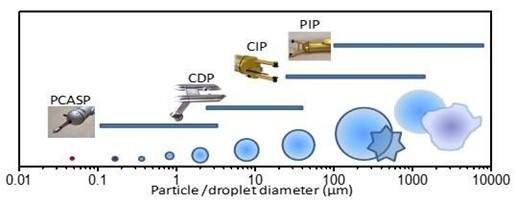
Figure above shows different instruments (spectrometers) used on the aircraft to monitor tiny dry aerosol particles to cloud droplets of different sizes, rain and drizzle drops and ice particles of different sizes.
PCASP (Passive Cavity Aerosol Spectrometer Probe) is a crucial airborne instrument that measures tiny atmospheric particles (aerosols) in the size range of about 0.1 to 3.0 micrometers, revealing how these aerosols act as cloud condensation nuclei (CCN), influencing cloud formation, droplet numbers, and ultimately, cloud properties and climate. By flying through clouds, researchers use PCASP data to understand aerosol impacts on cloud brightness, precipitation, and the Earth’s radiation balance, often alongside other probes like the CDP (Cloud Droplet Probe) for larger droplets. CDP is a key airborne instrument that uses a laser to measure the size and concentration of tiny water droplets (3-50 micrometers) within clouds, helping scientists understand cloud formation, properties, and how aerosols affect them.
_
The Cloud, Aerosol and Precipitation Spectrometer (CAPS) (Baumgardner et al., 2000) instrument consists of five sensors: the aerosol and cloud droplet spectrometer (CAS) (0.35 µm – 50 µm diameter), the cloud imaging probe (CIP) (25 µm–1550 µm diameter), the liquid water detector (0.1 to 0.65 g/m³), the air speed sensor, and a temperature probe. The CAS measures the conventional forward-scattering light from single particles but also the back-scattered light that provides an estimation of the aerosol refractive index. In addition, the sample volume is defined similar to that used in the FSSP-300X (Baumgardner et al., 1992). These improvements provide an extended size range of particle measurement that covers much of the accumulation mode aerosols and up to small drizzle drops in clouds. Due to the improved electronics many of the limitations associated with the FSSP-100 have been overcome. The principal improvements of the CIP are added stability against vibration, decreased response time, and decreased dead time that provides for better resolution, sizing, and more accurate particle concentrations. The liquid water content detector uses technique described by King (1978). Preliminary results using the CAPS have shown increased capability compared to the conventional PMS probes.
_
A new generation of particle spectrometers uses optical response rather than direct single-particle collection. The Gerber Particle Volume Monitor (Gerber et al., 1994) measures the liquid water content, drop surface area, and effective radius. The light scattered in the forward direction by an ensemble of drops is optically weighted and summed on a photodetector. The Cloud Droplet Spectrometer (CDS) (Lawson and Cormack, 1995) measures the forward-scattered light from an ensemble of drops. The CDS also computes drop size from the raw scattered light by inverting the measurements. The measurement has inherent advantages to overcome the limitations of single particle sizing and counting methods. Lawson et al. (1996) describe preliminary measurements with this instrument.
_
Another instrument, the Cloud Particle Imager (CPI) uses innovative new technology to record high-definition digital images of cloud particles and measure particle size, shape, and concentration (Lawson, 1997; Lawson and Jensen, 1998). The high quality of the CPI images supports the generation of individual size distributions for different types of particles (see Figure below).
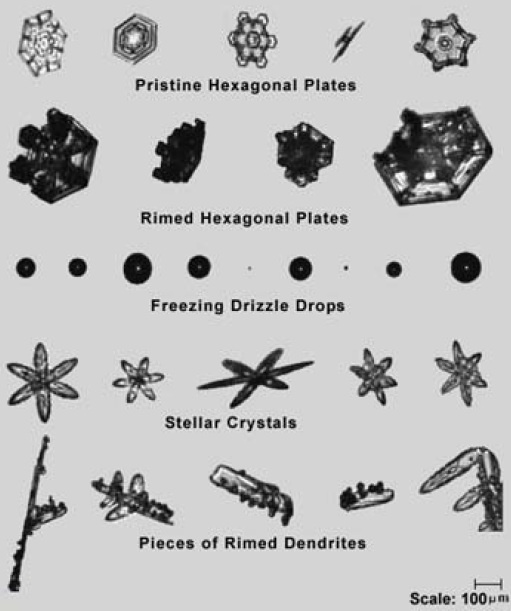
Figure above shows Particle images from the CPI instrument.
Due to varying depth of field (depending on the size of the particles), the imaging sample volume of the CPI varies from about 0.002 cm3 to 0.2 cm3. A drop-off in particle detection efficiency starts at about 25 µm, thus the small end of narrow particle distributions (such as a typical distribution of cloud drops) will be undercounted. Research is ongoing to interpret the measurements from this instrument and its operational limitations. Korolev et al. (1999) described some recent measurements using this instrument.
_
Another important parameter is the measurement of LWC. While LWC can be calculated from the FSSP, the most widely used instruments have been the JohnsonWilliams and CSIRO-King probes. The LWC is determined from the cooling effect of cloud droplets impinging on a heated sensor element that is exposed to the airflow outside the aircraft. Limitations exist for all instruments measuring LWC, but for the King probes, errors occur when droplet diameters become greater than 50 µm as droplets break up on the sensing element and are removed by the airflow before they evaporate completely; this causes an underestimation of liquid water. Large quantities of ice particles also are a limiting factor (Fleishauer et al., 2002). The Gerber and CDR probes are also used to measure LWC. A comparison of more than 20 different types of probes (Strapp et al., 2000) indicated that the Nevzorov total-water-content probe (Korolev et al., 1998) is the most accurate hot-wire estimate of LWC in water-only clouds with large droplets.
_______
_______
Satellite Imagery:
The first satellite-based observation of glaciogenic cloud seeding signatures was recorded in 2005, when the Advanced Very High-Resolution Radiometer (AVHRR) imagery captured a distinct cloud track resulting from the seeding of a thick supercooled cloud layer over central China, with microphysical retrievals revealing glaciation and cloud top sinking, which were further validated by simulations of seeding material dispersion. Similarly, Yu et al. (2005) combined NOAA-14 satellite imagery with numerical modeling to document a seeded cloud formation over Shaanxi, China, with evolution and duration matching simulated silver iodide dispersion, further confirming the seeding’s impact. Wang et al. (2021) used the Moderate Resolution Imaging Spectroradiometer (MODIS) and FengYun-3C polar-orbiting meteorological satellite, CINRAD/CB radar (C-band component of the China New Generation Doppler Weather Radar), and PARSIVEL disdrometer (Particle Size Velocity) data to track AgI cloud seeding in central China. Satellite imagery captured a glaciated seeding track shortly after treatment, confirming ice formation and cloud top collapse; subsequent radar and disdrometer measurements validated the track’s expansion and increased precipitation, thereby supporting the effectiveness of cloud seeding. Utilizing MODIS-derived cloud characteristics, Morrison et al. (2013) identified areas with supercooled liquid water, which are considered optimal targets for glaciogenic cloud seeding. Observations from the Himawari-8 satellite, a geostationary satellite operated by Japan, confirmed these effects by detecting a rise in cloud brightness temperature (BT) after seeding, attributed to ice particle fallout and the subsequent collapse of the cloud top within the seeding track. These studies highlight the role of satellite remote sensing in monitoring and evaluating cloud seeding impacts, providing valuable insights for weather modification research.
_
Satellite-borne instrumentation provides horizontally contiguous observations of water vapor fields, aerosol amounts and particle sizes, cloud-top temperature, particle size and thermodynamic phase, and to a limited extent in-cloud processes and precipitation over a large aerial extent. For instance, the Tropical Rainfall Measuring Mission (TRMM) includes precipitation radar, a microwave imager, and a visible infrared radiometer, all of which will help improve modeling and prediction of rainfall processes. CloudSat, an upcoming multisatellite, multisensor mission, utilizes a millimeter-wave radar to profile the vertical structure of clouds, and measure the profiles of cloud optical properties, cloud liquid water, and ice-water content. These data can be used to evaluate and improve the way clouds are parameterized in models. The Global Precipitation Measurement (GPM) Microwave Imager will utilize a series of passive microwave radiometers to provide near-global measurements of precipitation.
These capabilities have opened a new era in cloud physics and could provide many new opportunities for assessing the effects of weather modification. Satellite observations already are playing an important role in studies of inadvertent weather modification by tracking plumes of industrial pollution and their effects on precipitation suppression, as well as hygroscopic effects of salt aerosols that aid in restoring precipitation. Rosenfeld and Lensky (1998) developed a new methodology for using TRMM and the Advanced Very High Resolution Radiometer sensors to infer the microstructure of convective clouds and their precipitation-forming processes with height.
_
Advancements in Geostationary Satellite Capabilities:
The Geostationary Operational Environmental Satellites (GOES) have played a key role in advancing meteorological observations and forecasts since their deployment. These satellites provide continuous, high-temporal-resolution monitoring of atmospheric conditions, including cloud development, convection, cloud top properties essential for weather analysis, and cloud seeding assessments. The GOES-R series introduced significant technological advancements, enhancing data quality and expanding application capabilities for atmospheric monitoring. These improvements in spatial, temporal, and spectral resolution, along with enhanced radiometric accuracy, have particularly benefited cloud microphysics studies and atmospheric analyses relevant to cloud seeding. ABI is an acronym for the Advanced Baseline Imager, a primary instrument on the latest generation of U.S. geostationary weather satellites (GOES-R series) used for a wide range of atmospheric and cloud observations. The ABI serves as the primary imaging device on NOAA’s GOES-R Series satellites, capturing data on various surface and atmospheric features such as clouds, moisture levels, and smoke. The ABI enhances the monitoring of these features with improved spectral bands, enabling more precise observations of atmospheric conditions and surface changes. This capability is particularly valuable for tracking weather events, wildfire activity, and cloud characteristics relevant to cloud seeding applications. ABI operates with 16 spectral bands, comprising 2 visible, 4 near-infrared (NIR), and 10 infrared (IR) channels. Furthermore, ABI’s data assimilation into numerical weather prediction models has led to improved forecast accuracy. Comprehensive observations of atmospheric parameters enhance model initialization, resulting in better predictions of weather patterns and climate phenomena.
_
Satellite remote sensing has enabled effective monitoring of cloud seeding and its effects on cloud microphysics, precipitation, and aerosol–cloud interactions using advanced retrieval methods. Moreover, the integration of geostationary satellite data with ground-based and airborne observations is helping to identify microphysical signatures of seeded clouds in near real time, contributing to improved targeting and post-event validation. Combining GOES-R multispectral satellite data with NEXRAD radar revealed clear seeding-induced cloud microphysical changes, including droplet-to-ice phase transitions, cloud top cooling, and optical thickening. Satellite and radar together provide a practical way to track seeding impacts.
______
______
Tracers:
A difficult problem that has plagued many cloud-seeding experiments and operations is the question of whether the seeding material actually reaches the targeted regions of cloud, and whether it arrives there in effective concentrations. This is especially true for ground-based seeding operations, but it also applies to seeding from aircraft. Tracer techniques offer valuable information on nucleant (seeding agents) transport and dispersion. The tracer is released together with the seeding material, and its location and concentration is subsequently measured as a proxy for the nucleant.
The most widely used tracer for cloud seeding is SF6, an inert, anthropogenically produced compound that can be detected in incredibly small concentrations (Stith and Benner, 1987) but requires in situ sampling, which can be difficult. Other in situ techniques include airborne ice-nuclei counters and chemical analysis of the silver content (i.e., seeding material) in snowfall.
_
A particularly promising remote-sensing tracer method uses radar to track microwave chaff, which consists of very thin aluminum-coated glass fibers cut to half the wavelength of the observing radar. Chaff fibers released with or without seeding material show by direct measurement the actual transport and dispersion occurring within clouds. The fibers can be detected by radar in extremely small concentrations. The depolarization of the radar signal (the depolarization ratio) caused by the chaff allows it to be isolated from the signal of cloud intensity (reflectivity) and to be effectively tracked (Martner et al., 1992; Reinking and Martner, 1996). The volume treated and the location of treatment effects thus can be identified and assessed in relation to the total cloud volume. The concentration of chaff fibers can be computed from the radar measurements to yield information about diffusion rates. Although the chaff fibers fall faster than silver iodide aerosols (i.e., the seeding material), they provide a good approximation of the aerosol movement for several minutes after a release. This allows a polarization-diversity radar to observe and provide three-dimensional depictions of seeding aerosol movement to a treated cloud. Chaff tagging offers additional opportunities to remotely sense microphysical changes between tags. For instance, using such tagging, ice particle production and enlargement by seeding has been followed from the source to snow on the ground (Klimowski et al., 1998; Reinking et al., 1999, 2000).
_
All of these tracer methods have had modest demonstrations in weather modification research experiments, such as the 1993 North Dakota Tracer Experiment, a summer convective cloud-seeding research experiment that emphasized the use of a variety of tracer methods (Stith et al., 1996). But none has yet gained widespread, routine usage. Nevertheless, tracers are likely to be an important part of future seeding research because they offer vital observations of both the seeding material delivery and the cloud response.
_______
_______
Measurement uncertainty:
It should be noted that a survey article by Tanre’ et al (2009), reviewed the impact of aerosols on precipitation and concluded: “Even though we clearly see in measurements and in simulations the strong effect that aerosol particles have in cloud microphysics and development, we are not sure what is the magnitude or direction of the aerosol impact on precipitation and how it varies with meteorological conditions. Even the most informative measurements so far on the effect of aerosols on precipitation do not include simultaneous quantitative measurements of aerosols, cloud properties, precipitation and the full set of meteorological parameters. The main limitation is very similar to the problems inherent in quantifying the impacts of artificial seeding of winter orographic clouds. That is the observing systems that we apply to quantifying the impacts have large measurement uncertainties and are of a magnitude similar to the expected aerosol influence on precipitation. Tanre’ notes that satellite and radar measurements have 20-30% errors in the measurement of aerosol optical depth, while aircraft sampling in-cloud can introduce changes in the cloud that can compromise the utility of the aircraft observations. Indeed measurements of surface precipitation, especially snowfall water equivalent can have 10-15% measurement uncertainty given gauge location and thus exposure to wind, minimum threshold/resolution, and such problems as capping. These types of measurement uncertainties require longer term on-going statistical analyses to reduce the random noise in the observations much like is required for cloud seeding experiments, thus reducing the influence of measurement uncertainty so as to extract the small signal that might exist.
_______
_______
Section-4
Weather modifications:
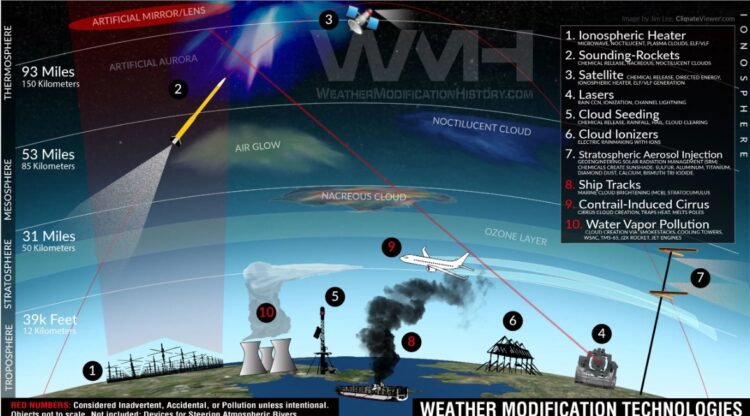
_
Humans have sought to purposefully alter atmospheric phenomena such as clouds, rain, snow, hail, lightning, thunderstorms, tornadoes, hurricanes, and cyclones. Weather modification refers to the deliberate or inadvertent alteration of atmospheric conditions by human activity on a local or regional scale. Weather modification includes attempts to alter precipitation processes, stop hail, or mitigate the damage from storms and hurricanes. Weather modification can be the deliberate intervention in the Earth’s atmosphere to influence local weather conditions, typically through techniques like cloud seeding. This primarily involves dispersing substances into clouds to alter precipitation patterns to increase rainfall, reduce hail, or dissipate cloud cover. Weather modification is focused on local to regional spatial scales and corresponding timescales, while climate intervention is primarily focused on the global scale and climate timescales, and there can be regions of overlap between weather modification and climate intervention (e.g. marine cloud brightening). To make sure there was no rain over the Olympic opening ceremony in Beijing, the Chinese had fired over 1,000 rain dispersal rockets into the sky to overseed clouds to limit rainfall. Miles Research, Climate Control Global Trading LLC, and China’s Tianhe (“sky river”) Project all claim the ability to alter the direction and flow of atmospheric rivers using electromagnetic signals. The Waste Isolation Pilot Plant in New Mexico claims to use cloud ionization “palm tree” antennas to protect the facility from lightning strikes. It should be realised that the energy involved in weather systems is so large that it is impossible to create cloud systems that rain, alter wind patterns to bring water vapour into a region, or completely eliminate severe weather phenomena. Weather Modification technologies that claim to achieve such large scale or dramatic effects do not have a sound scientific basis (e.g. hail canons, ionization methods) and should be treated with suspicion.
_
Inadvertent Weather Modification:
Inadvertent weather modification can also occur due to human activities, such as industrial emissions that inadvertently enhance precipitation downwind or contribute to phenomena like ice fog.
Pulp and paper mills produce vast quantities of large-and giant-diameter cloud condensation nuclei (CCN) in the effluent from their exhaust stacks. Downwind of these mills, precipitation appears to be enhanced about 30 percent above what was observed before the construction of the mills. It is also thought that the heat and moisture emitted by these mills may play an active role in precipitation enhancement. One specific study of a paper mill near Nelspruit in the eastern Transvaal region of South Africa has indicated that storms modified by the mill emissions lasted longer, grew taller, and rained harder than other nearby storms occurring on the same day. Radar measurements supported the theory that hygroscopic particulates released by this mill accelerated or amplified the growth of unusually large-diameter raindrops.
An egregious example of inadvertent weather modification is the formation of ice fog over Arctic cities in Siberia, Alaska, and Canada. During winter, cities such as Irkutsk, Russia, and Fairbanks, Alaska, experience drastic reductions in visibility as particles released by combustion act as nuclei for the formation of minute ice crystals. No techniques are available to modify ice fogs.
_______
_______
The most common weather modification methods are:
- Cloud seeding for enhanced precipitation
- Ionospheric heaters
- Fog dispersal
- Hail suppression
Here are some examples of weather modification programs:
|
Method |
Purpose |
|
Cloud seeding |
Cause precipitation (artificial rain) |
|
Ionospheric heaters |
Change temperature patterns |
|
Fog dispersal |
Clear dense fog at airports |
|
Hail suppression |
Reduce the size of hailstones |
______
-1. Cloud Seeding: [vide supra/infra]
Cloud seeding is one of the most common weather modification methods. It means seeding materials like silver iodide/salt into clouds to make them rain. This method tries to increase precipitation in places that are dry or need water. Aircraft or ground-based generators disperse seeding agents into clouds, where they act as nuclei for ice crystal/droplet formation. The increased presence of ice crystals or raindrops can lead to enhanced rainfall. Scientists in Dubai are trying out drones with strong lasers to zap clouds and make raindrops stick together and drop as rain.
_______
-2. Ionospheric Heaters:
Ionospheric heaters, like the High-Frequency Active Auroral Research Program (HAARP) in Alaska, are facilities that emit high-frequency radio waves into the ionosphere. This can influence the electrical properties of the ionosphere and potentially impact temperature patterns. Ionospheric heaters typically consist of arrays of antennas that emit radio frequency energy. By modulating the frequency and intensity of the waves, scientists can study and potentially manipulate the ionosphere, affecting local meteorological patterns.
_______
-3. Fog Dispersal:
In order for aircraft to take off and land, it is necessary that the ceiling (the height of the cloud base above the ground) and visibility be above certain minimum values. It has been estimated that, in the United States alone, airport shutdowns by fog were costing the airlines many millions of dollars annually. The vital effect of low ceilings and visibilities on military aircraft operation was forcefully emphasized during World War II when Allied aircraft flew out of foggy England.
During the late 1930s attempts were made to dissipate fogs by seeding them with salt particles, in particular calcium chloride. Some success was experienced, but this technique did not appear to be practical. During the mid-1940s large quantities of heat were used to clear airport runways. The scheme called FIDO (Fog Investigation Dispersal Operations) employed kerosene burners along the runways. The heat they released decreased the relative humidity of the air and caused droplet evaporation and a sufficient improvement in ceiling and visibility to allow aircraft to land or take off.
The dissipation of supercooled fogs by means of ice nuclei has been going on for many years. Tables have been prepared that specify the quantities of dry ice to be dispersed, depending on such factors as wind speed, cloud thickness, and temperature. A typical seeding rate might be about two kilograms per kilometre of flight. Special equipment has been developed for the purpose of dispensing dry ice flakes or pellets from an airplane or from the ground. Ground-based dispensing systems can also release hygroscopic materials, like calcium chloride or potassium hydroxide, into foggy areas. These materials absorb moisture from the air, reducing the size of water droplets and clearing the fog.
Investigations have been made of the value of acoustical techniques for clearing fogs. Such schemes work well in a cloud chamber where standing sound waves can be set up, but there is no evidence that reasonable sound sources can effectively change the characteristics of fogs in the free atmosphere.
______
-4. Hail Suppression [vide infra]:
This technique aims to reduce the size of hailstones before they reach the ground. By seeding clouds with substances that promote the formation of smaller ice particles, the severity and damage of hailstorms can potentially be lessened. Hail suppression by seeding clouds with artificial ice nuclei has been practiced in many parts of the world for several decades. It is still widespread, although it is controversial and there has been no definitive demonstration of positive effects. In many areas of the world hail does enormous destruction to agriculture, particularly fruit orchards and grain fields. There have been cloud-seeding projects aimed at reducing hail damage. Some operations have attempted to put so many nuclei into the supercooled parts of cumulonimbus that they would be almost totally converted to ice crystals. Such a procedure, called overseeding, is not considered practical because of the large quantities of material needed to seed the clouds over an area great enough to have an appreciable effect.
_______
_______
Anthropogenic climate change is transforming the human-weather relationship through increasingly frequent and severe weather events. In Asia alone, over 2000 people lost their lives in such events in 2023, with over 9 million directly affected by storms/flood. In 2022, climate extremes pushed 56.8 million people in 12 countries into food insecurity, with global income reduced by 19% until 2050. While growing calls for climate intervention (or geoengineering) remain highly controversial, governments are exploring local and regional weather modification technologies. China, for instance, has been funding of a nation-wide cloud seeding program to enhance precipitation and mitigate hailstorms, and continues to upscale its operations. In Japan, the national government has started funding a large-scale long-term project aiming to modify the weather as part of its Moonshot Goals. Technologies include cloud seeding, large-scale arrays of wind turbines, ocean-based heat pumps, wave modification, and the use of offshore ‘sea curtains’ (Figure below). Cloud seeding technologies have traditionally been used for precipitation enhancement and hail suppression, but cloud seeding for heavy rainfall mitigation are on the cutting edge of weather modification techniques. The program also foresees ‘typhoon control,’ which could mitigate the threat of catastrophic flooding and provide Japan with abundant renewable energy, contributing to a decarbonised energy society.
Figure below shows overall image of weather modification technologies developed within the Japanese government’s Moonshot R&D program to mitigate torrential rainfall disasters.
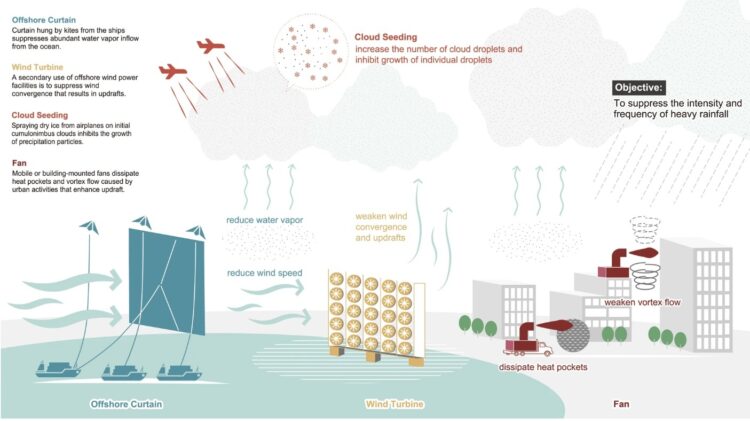
______
Importance of Weather Modification in Various Fields:
Weather modification has far-reaching implications across various sectors, including:
Agriculture: Enhancing precipitation to support crop growth and reduce drought impacts.
Disaster Prevention: Mitigating the effects of severe weather events like hurricanes and droughts.
Environmental Conservation: Modifying weather patterns to support ecosystems and biodiversity.
The effectiveness of precipitation enhancement techniques can be evaluated using statistical models, such as the following equation:
P = β0 + β1X + ϵ
where P is the precipitation amount, X is the seeding variable, β0 and β1 are regression coefficients, and ϵ is the error term.
______
Storm mitigation:
Storm mitigation strategies aim to reduce the impacts of severe weather events. These strategies include:
-Cloud seeding to reduce hail or lightning
-Storm surges mitigation using coastal defenses
-Weather forecasting to provide early warnings
_
The following table summarizes some of the storm mitigation strategies used in different regions:
|
Region |
Storm Mitigation Strategy |
|
USA |
Cloud seeding to reduce hail |
|
Japan |
Storm surges mitigation using coastal defenses |
|
Australia |
Weather forecasting to provide early warnings |
______
______
Hurricane modification:
Hurricanes can cause widespread destruction and human misery. An average hurricane has tremendous energy. The cyclone always derives its energy through the evaporation of water from the ocean surface. Since the rotating winds of a tropical cyclone mainly result from the conservation of angular momentum imparted by earth’s rotation as air flows inwards toward the axis of rotation, they rarely form within 5° of the equator. In one day the energy released is about 1.6 × 10^13 kilowatt-hours, or at least 8,000 times more than the electrical power generated each day in the United States. This quantity is equivalent to a daily explosion of 500,000 atomic bombs of the 20-kiloton Nagasaki variety. Some analyses state that a hurricane releases the heat equivalent of a 10-megaton nuclear bomb every 20 minutes. While a nuclear bomb gives a single, intense blast, a hurricane provides continuous power for days, powering the US for years, or generating the planet’s electricity for weeks, highlighting its vastly greater, sustained power. These numbers should make it clear that it would be impractical to attempt to modify hurricanes by a brute force approach. It is necessary to find a means whereby a small input of energy may upset a natural instability and lead to large results. Ice-nuclei seeding is one such approach that has been investigated in the past.
The first hurricane-seeding test was carried out in 1947 by Irving Langmuir and his colleagues, who distributed about 91 kilograms of crushed dry ice in a storm. They apparently were convinced that the seeding caused a change in the track followed by the storm.
From 1962 through 1983, the National Oceanic and Atmospheric Administration pursued a program, called Project STORMFURY, in order to experiment hurricane modification. The STORMFURY was an ambitious program of experimental research on hurricane modification. The proposed technique involved artificial stimulation of convection outside the eyewall through seeding with silver iodide. Since a hurricane’s destructive potential increases sharply as its maximum winds become stronger, a small reduction would still have been worthwhile.
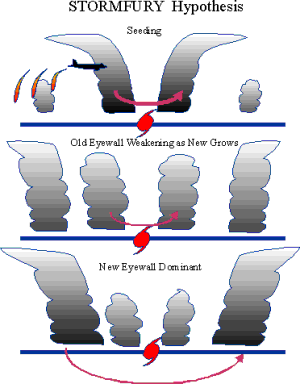
Project Stormfury (figure above) was an attempt to weaken tropical cyclones by flying aircraft into them and seeding them with silver iodide. With regard to hurricanes, it was hypothesized that by seeding the area around the eyewall with silver iodide, latent heat would be released. This would promote the formation of a new eyewall. As this new eyewall was larger than the old eyewall, the winds of the tropical cyclone would be weaker due to a reduced pressure gradient. The hypothesis was that the silver iodide would cause supercooled water in the storm to freeze, disrupting the inner structure of the hurricane, and this led to seeding several Atlantic hurricanes. However, it was later shown that this hypothesis was incorrect. It was determined that most hurricanes do not contain enough supercooled water for cloud seeding to be effective. Additionally, researchers found that unseeded hurricanes often undergo the same structural changes that were expected from seeded hurricanes. This finding called Stormfury’s successes into question, as the changes reported now had a natural explanation.
_
In addition to seeding clouds that have been considered over the years, various other ideas for manipulating hurricanes have also been suggested. They include, among others:
- cooling the ocean with cryogenic material or icebergs;
- retardation of surface evaporation with monomolecular films;
- changing the radiational balance in the hurricane environment by absorption of sunlight with carbon black;
- blowing the hurricane apart with hydrogen bombs;
- injecting air into the centre with a huge manoeuvrable tube to raise the central pressure;
- blowing the storm away from land with windmills.
_
The violent nature of tornadoes would appear to dictate substantial programs of research to increase our understanding and control of these storms. In fact, very little scientific attention has been devoted to attempts to modify tornadoes. It had been speculated that they might be influenced by firing rockets into them and distributing materials to modify their temperature structure or electrical properties. Unfortunately, so little is known about the tornadoes that few scientists have confidence that such schemes would be effective.
______
______
Marine Cloud Brightening:
Marine Cloud Brightening (MCB) is a proposed geoengineering technique to combat global warming by increasing the reflectivity (albedo) of low-lying marine clouds. It involves spraying sea salt particles into the atmosphere to make clouds whiter and brighter, reflecting more sunlight away from Earth and reducing sea surface temperatures.
When sea temperatures rise above seasonal averages, corals become stressed and expel the algae that give them their vibrant colour. This causes the coral to turn white in what is referred to as bleaching. Unprecedented coral bleaching in Australia has scientists searching for ways to shade the ocean from the sun’s harmful rays. Experimental trials of a new technology that will brighten clouds have been carried out by a team of scientists in Australia. “Cloud brightening” deflects heat away from coral reefs stressed by global warming. This could provide an interim solution to help save important marine environments from the damaging effects of climate change.
Using two high-pressure turbines, the team sprayed microscopic droplets of saltwater into the air. These then evaporate leaving behind very small salt crystals, which water vapour clings to, making existing clouds to reflect the sun more effectively. “We tested the hypothesis at one-tenth of the scale we’re aiming for, using a drone in the atmosphere and a sampling vessel 5km away on the sea surface,” says project leader Dr Daniel Harrison. “[It] showed how we can successfully create hundreds of trillion of these sea salt crystals per second which float up into the atmosphere to bolster the reflectivity of the existing clouds.” He explains that by using these reflective clouds to shade the reef, it could be possible to reduce the severity of bleaching during heat waves. Cloud brightening could potentially protect the entire Great Barrier Reef from coral bleaching in a relatively cost-effective way, buying precious time for longer-term climate change mitigation to lower the stress on this irreplaceable ecosystem.
_______
_______
Section-5
Brief history of cloud seeding:
Weather modification has evolved from ancient rainmaking rituals and 19th-century anti-hail cannon fire to modern scientific cloud seeding. It could date back as early as the late 1890s into the 1900s. That’s when C. W. Post, the cereal tycoon, was doing the first experiments in Texas, where he was exploding dynamite on kites. He was hoping that the percussion would agitate the supercooled liquid water in the cloud enough to force freezing to occur. So, you could go all the way back into the early 1900s and read those stories from C. W. Post and others.
_
Discovery of Cloud Seeding (1946):
The proof of concept was first discovered by Vincent J Schaefer, Bernard Vonnegut, and Irving Langmuir in 1946. Schaefer and Langmuir were researching icing on aircraft at the General Electric Company’s research laboratory after World War 2. By investigating the production of particles of various sizes and their behavior in the atmosphere, they discovered that tiny particles could be used to produce ice. They were able to nucleate ice by introducing small particles in a laboratory made cloud in a freezer with dry ice to create snow. Vonnegut later discovered that silver iodide (AgI) was an even more effective at generating ice formations- a breakthrough discovery for operational cloud seeding.
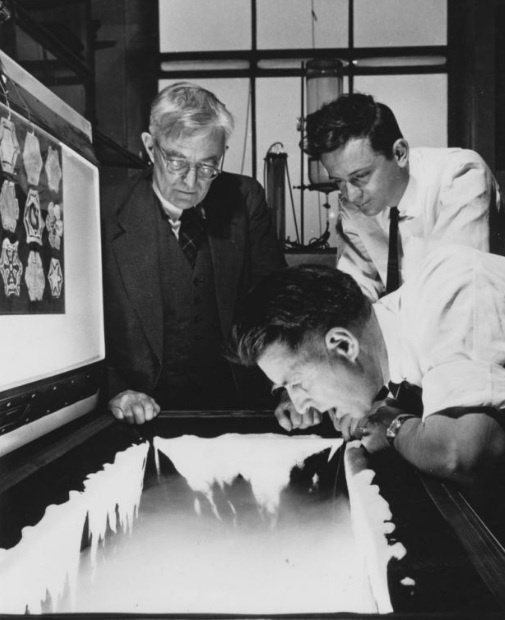
Figure above shows Vincent J. Schaefer, Bernard Vonnegut, and Irving Langmuir observing ice nucleation in a lab, 1946.
_
Supercooled water is water that remains in a liquid state despite being surrounded by below freezing (0 degrees C) air. Only water in its purest form, without sediments, minerals, or dissolved gases, can supercool. It won’t freeze unless it either reaches minus 40 degrees C, or it hits something and freezes on it. Schaefer tested this theory in the lab by exhaling into a deep freezer, thereby creating “clouds” with his breath. Then, he dropped various materials, such as soil, dust, and talcum powder, into the “cold box” to see which would best stimulate the growth of ice crystals. Upon dropping tiny grains of dry ice into the cold box, a flurry of microscopic ice crystals formed. In this experiment, Schaefer discovered how to cool a cloud’s temperature to initiate condensation and thus precipitation. A few weeks later, fellow GE scientist Bernard Vonnegut discovered that silver iodide served as equally effective particles for glaciation because its molecular structure closely resembles that of ice. This research soon garnered widespread attention. The government partnered with GE to investigate how viable cloud seeding might be for producing rain in arid regions and in weakening hurricanes.
_
First Cloud Seeding Experiment (1947):
The first cloud seeding experiment called “Project Cirrus” happened in 1947. A modified B17 bomber dropped dry ice (solid carbon dioxide) into a stratus cumulus cloud. This experiment proved successful when they witnessed a “Racetrack” form in the cloud deck where the plane has seeded. This was evidence that ice was produced and that cloud physics and precipitation could be altered.
_
The modern day programs were built on the 1946 discovery by General Electric’s Bernard Vonnegut of silver iodide acting as an ice-nucleating agent. Once this was discovered, programs started to pop up all over the Mountain West and Midwestern states and down into Texas as a response to the 1950s Dust Bowl. So, projects in Texas, Idaho, and Utah, among others, started to get going. In fact, in 1950, President Harry S. Truman’s Water Resources Policy Commission generated a report called A Water Policy for the American People. In that report, it was stated that the attempt to use science and technical skill to force water from the clouds is symbolic of the modern determination to control and use water rather than submit to it. These early initiatives led to states like Texas and Utah creating laws to license, permit, and oversee these activities.
_
The Chronology of events in the weather modification around the world
1940:
- Dry ice into supercooled liquid cloud cause glaciation (Schaefer 1946)
- Silver iodide (AgI), glaciated supercooled clouds (Vonnegut 1947)
- National Academy of Sciences reports, WMO reports, and more.
- Special Commission on Weather Modification (1966)
- Statistical analyses using target and control approaches were flawed (Rangno 1979)
1970:
- Airborne optical array probes and use of radars (polarization) advancing
- Indian cloud physics studies and cloud seeding experiments by IITM
1980-90s:
- (After the report by Kerr 1982), no funding for cloud seeding research
- Orographic cloud systems in Wyoming and Idaho, Rainfall enhancement research from convective storms from South Africa and Thailand (Silverman 2001a, 2003)
- Chinese hail suppression experiment in 1980. Currently, the Beijing Weather Modification Office, China, is believed to be the world’s largest with 37,000 people nationwide working on the cloud seeding aspect
- 11-year cloud seeding by IITM (Murty et al., 2000)
2003:
- NAC Report: Potential application of new technology for evaluating cloud seeding
- Physical evaluations for cloud structure with aircraft and radar and to model these clouds
2008:
- Beijing Summer Olympic rain suppression program
- CAIPEEX Phase I 2009, CAIPEEX Phase II (2010-2011)
2015:
- Significant advances (radars of different types, radiometers, airborne probes) in observing technologies and modeling capabilities (Geerts et al. 2015)
- CAIPEEX Phase III (2014-15) pilot experiment
2016:
- 56 countries had active weather modification operations (Bruintjes 2016, WMO).
2018:
- WMO Peer review Report 2018: Physical chain of events demonstrated the need for further research on ice and mixed-phase clouds. More research studies are recommended.
- 36 active weather modification programs in the USA. About half of the projects operate in summer and the other half in winter. Projects are funded by the state government, local government, private sector, and insurance companies. Some projects incorporate a research component.
2019:
- Several programs exist: The Wintertime cloud seeding to increase snowpack reservoirs, Hail-suppression operations in North Dakota, Rain enhancement from convective storms in Texas, Orographic clouds for the Snowy Mountains of Australia (Manton and Warren 2011), CAIPEEX (Since 2009),
2020:
- Documented evidence on snow enhancement on the ground from SNOWIE for glaciogenic seeding
2021:
- Documented evidence for convective cloud hygroscopic seeding from CAIPEEX using randomization experiment
- Seed particle tracking in the cloud
_______
_______
Section-6
Overview of cloud seeding:
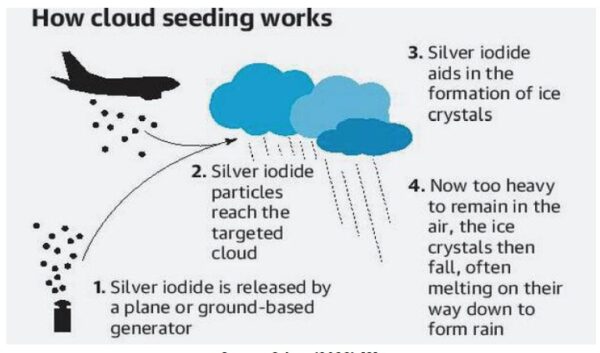
Figure above shows Cloud Seeding using Silver Iodide.
_
Water evaporates from water bodies to form water vapor, a process that has been happening since water first appeared on Earth. This vapor then condenses and forms a large water droplet. This droplet precipitates when it becomes too heavy due to the effect of gravity. Thus occurs the phenomenon of rainfall. Humans have a history of messing with natural processes, so unsurprisingly, we have discovered a way to manipulate the amount of rain that falls, and can even alter some other weather events, such as hail and fog.
_
Water is a necessity on Earth, and global water consumption is increasing significantly. In many regions of the world, traditional sources and supplies of ground water, rivers and reservoirs, are either inadequate or under threat from ever increasing demands on water from changes in land use and growing populations. Water is the most significant naturally occurring renewable resource. Water availability has been steadily deteriorating across a large portion of the globe in recent years. Numerous nations, many of which are in semiarid parts of the world, are currently engaged in climate engineering projects in the hope of expanding their access to freshwater resources. Only a small part of the available moisture in clouds is transformed into precipitation that reaches the surface. This has prompted scientists and engineers to explore the possibility of augmenting water supplies by means of cloud seeding.
_
Clouds form when supercooled water vapor condenses on CCN and/or deposits on ice nuclei. In order for precipitation to occur, the presence of clouds is necessary. Once the cloud has cooled sufficiently, water begins to accumulate on tiny particles called condensation nuclei that occur naturally in the atmosphere. As a result of this accumulation, water droplets grow and fall downwards under the influence of gravity. Cloud seeding is a 75-year-old technique (the first pioneering attempts were documented by Schaefer 1946 and Vonnegut 1947) used to modify suitable clouds with ‘seed’ particles to increase rainfall. These seed particles are ‘cloud condensation nuclei (CCN), a particle on which water vapour condensates’ or ‘ice nuclei particles, a particle on which water freezes’, a subset of suspended particulates in the atmosphere named aerosol particles. These CCNs have an affinity for water vapour to form cloud droplets. The ice nuclei particles can form ice particles. Droplets of pure water can’t form an ice crystal nucleus until the temperature drops to –40 °C. Yet if clouds contain aerosol particles, water molecules can use the solid surfaces of these “seeds” to organize themselves into a crystalline form at much warmer temperatures, from –20 to –5 °C. However, if there are not enough condensation nuclei in the environment, condensation does not occur and precipitation does not occur. At this point, artificial rainfall applications come into play. Silver iodide could transform supercooled water into ice crystals at temperatures of –10 to –5 °C. Typically an aircraft is used to dispense these particles near the cloud base or cloud top. Cloud base seeding is where particles are released below the base of cumulus clouds (appear as a cauliflower) that have a warm base (the temperature of the cloud base is warmer than zero degrees). Cloud top seeding is done in cold clouds (where the temperature is below zero degrees). Warm cloud base seeding is called hygroscopic seeding and cold cloud seeding is called glaciogenic seeding. When clouds do not grow tall and cold enough to produce precipitation through the process of ice crystal growth (that occurs in mixed-phase clouds), it may be possible to stimulate precipitation by seeding these warm clouds with hygroscopic (water-absorbing) seeding agents. This approach can be quite successful through stimulation of the warm cloud precipitation processes. Hygroscopic seeding is normally done from aircraft flying below clouds in order to affect the initial cloud droplet development that occurs in this zone. Silver iodide is seeding agent for cold cloud seeding.
_
Cloud seeding is a weather modification technique designed to enhance a cloud’s ability to produce precipitation. This is achieved by dispersing substances into the atmosphere that act as cloud condensation or ice nuclei. These substances, such as silver iodide or sodium chloride, provide surfaces for moisture to condense upon, forming snowflakes or raindrops. The primary goal of cloud seeding is to increase precipitation from clouds that would otherwise produce little to no rain or snow.
_
Cloud seeding involves injecting materials that act as ice and condensation nuclei into clouds with sufficient moisture to enhance updraft strength or increase ice-phase precipitation (Rogers and Yau 1989). In cold (<0°C) clouds, ice-crystalline nuclei such as silver iodide (AgI) are used, while hygroscopic substances like calcium chloride (CaCl2) and sodium chloride (NaCl) are used in warm (>0°C) clouds (Drofa et al. 2010; Jung et al. 2015; Segal et al. 2004). The characteristics and activation temperatures of aerosols in clouds influence the conversion of seeding materials to precipitation. For example, AgI is most effective below −8°C (Vonnegut 1947; Zipori et al. 2012). Depending on the type of cloud, seed particles can behave differently. In warm clouds, seed particles can quickly act as cloud condensation nuclei, promoting the formation of large water droplets that lead to rain. In contrast, in cold or mixed-phase clouds, seed particles may contact supercooled water droplets to serve as nuclei for ice formation, undergoing ice nucleation at low temperatures before falling as rain or snow.
_
Weather modification firms launch silver iodide flares from planes or from the ground into cloud formations to try to increase rainfall or mitigate hailstorms.
Cloud seeding process is depicted in figure below:
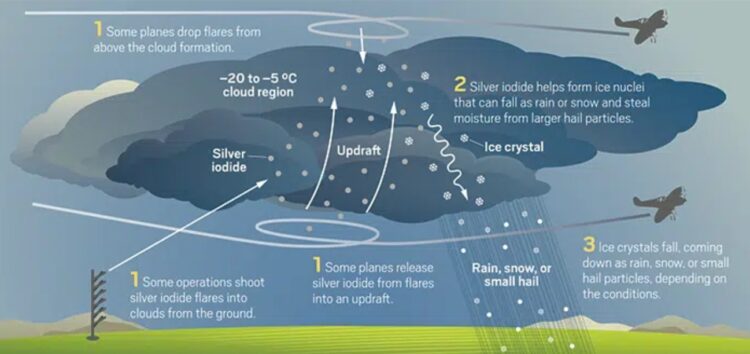
-1. Some planes drop flares from above the cloud formation. Some planes release silver iodide from flares into an updraft. Some operations shoot silver iodide flares into clouds from the ground.
-2. Silver iodide helps form ice nuclei that can fall as rain or snow and steal moisture from larger hail particles.
-3. Ice crystals fall, coming down as rain, snow, or small hail particles, depending on the conditions.
_
Most U.S. rainstorms are caused by a process called the Bergeron, or ice crystal, process. Precipitating clouds will typically have a mix of ice crystals, supercooled water (at temperatures below freezing), water droplets and water vapor. During the Bergeron process, ice crystals in a cloud grow at the expense of supercooled liquid water droplets. All clouds need “seeds” called condensation nuclei or ice nuclei to properly develop. This could be a speck of dust, clay or pollen in the atmosphere. There are several temperature, moisture and air motion processes that come into play. However, ice nuclei are very important for the formation of ice crystals in the upper part of clouds. As ice crystals grow larger through clumping with other ice crystals or taking on available water in the clouds, they eventually fall out of the cloud as snow. However, the temperature is often above the freezing mark, so they melt, and rainfall is observed at the ground. If temperatures are below freezing all the way down to the ground, it remains as snow as seen in figure below.
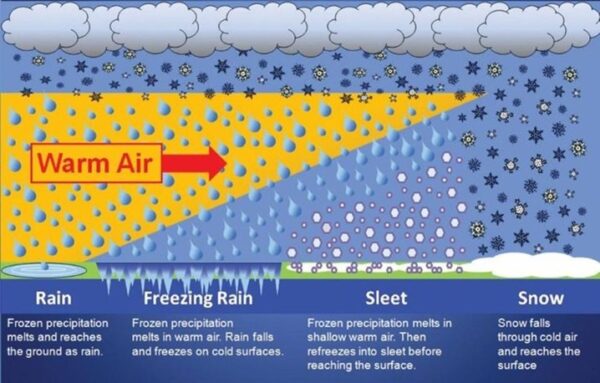
_
Cloud seeding modifies clouds already containing moisture; it cannot create rain out of clear skies. The basic principle of cloud seeding involves introducing particles into clouds that encourage the formation of water droplets or ice crystals. These particles provide a surface for water vapor to condense upon, which can lead to increased precipitation. Seeding materials like AgI act as artificial ice nuclei in supercooled clouds (liquid water below 0 °C). Once ice crystals form, they grow at the expense of nearby droplets and eventually fall as precipitation. In warm clouds, tiny salt particles attract water vapor to form larger droplets. The techniques include: spraying silver iodide flares or generators (for cold clouds) and dispersing salts (for warm clouds). Cloud seeding chemicals may be dispersed by aircrafts or by dispersion devices located on the ground. For release by aircraft, Silver Iodide flares are ignited and dispersed when an aircraft flies through the inflow of a cloud. In the case of ground dispersion, generators or canisters fired from anti-aircraft guns or rockets are generally used to spread the particles. The fine particles are then carried downwind and upward by air currents after they are released.
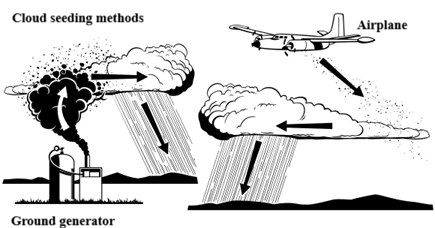
_
Dispersion Techniques:
- Aircraft: Planes release seeding agents directly into the clouds.
- Ground Generators: These devices emit particles into the atmosphere, which then rise to the clouds.
- Drones: Emerging technology uses drones to deliver seeding materials.
- Laser Pulses: Infrared lasers can stimulate particle formation in clouds. Laser cloud seeding involves using lasers to ionize moisture-laden air, which leads to raindrop formation. This method promises more precision and potentially fewer ecological side effects than chemical seeding.
_
Common materials used include:
- Silver iodide
- Potassium iodide
- Dry ice (solid carbon dioxide)
- Hygroscopic substances like table salt
- Liquid propane expands into a gas at low pressures
- Calcium chloride (CaCl₂) — used in some Indian experiments (e.g., Solapur).
- Aluminum oxide
- Liquid carbon dioxide
These agents help facilitate the formation of precipitation by encouraging water droplets or ice crystals to grow.
_
Classification of cloud seeding:
- By Target Area: Agricultural Areas, Water Supply Areas, Drought-Prone Regions, Hydroelectric Power Generation Areas, Urban Areas, Others
- By Method of Cloud Seeding: Ground-based Cloud Seeding, Airborne Cloud Seeding, Remote Cloud Seeding (using drones or unmanned aircraft), Hygroscopic Cloud Seeding, Ice Nucleation Cloud Seeding, Silver Iodide Cloud Seeding, Others.
- By Type of Clouds: Cumulus Clouds, Stratocumulus Clouds, Orographic Clouds, Cirrus Clouds, Convective Clouds, Others.
- By Application: Precipitation Enhancement, Hail Suppression, Fog Dispersal, Snowpack Augmentation, Pollution Reduction, Others
_
Clouds don’t form out of thin air. Water vapour floating through the air can only condense or freeze when it finds a surface to cling to—usually specks of dust or salt suspended high in the atmosphere. Moisture clings to these particles and creates ice crystals or water droplets, forming the building blocks for clouds as mammoth as a cumulonimbus and as delicate as a wispy cirrus. Precipitation forms when rising air forces these cloud droplets to collide together. The new droplets grow with every collision until they’re too heavy to remain suspended and fall to the ground. The theory of cloud seeding relies on the process of artificially forcing cloud droplets to grow until they fall as precipitation. Researchers have had varying levels of success in seeding clouds with materials such as dry ice or tiny particles known as silver iodide—both of which can kick-start the process needed to grow cloud droplets. By introducing these particles into clouds, scientists hope to force cloud droplets to grow and merge to the point that they develop precipitation.
_
Cloud seeding can only happen if there is a sufficient number of clouds and a particular depth to these clouds. Inside, there needs to be an adequate number of cloud droplets. Cloud seeding is done to increase the radius of the cloud droplets so that they will grow bigger and because of gravity, they will come down as rainfall. But with a clear sky, you can’t do it. Cloud seeding experiments originally involved mostly cumulus clouds, the most common, widely distributed cloud form and the world’s most important precipitation source. The short life span and instability of such clouds complicated seeding operations. Orographic clouds, which form over mountainous areas, are preferable for seeding because they last longer, and weather modification experiments can be more readily arranged. Orographic clouds are the source of both rain and snow. In the mid- latitudes nearly all precipitation begins as snow. If it is much warmer than freezing below the cloud base the snow melts and reaches the ground as rain.
_
Although not fully understood, cloud seeding components, such as CCN or ice nucleating particles (INPs), may be washed out without contributing to precipitation growth. Owing to the complexity of the interactions between CCN, INP, and atmospheric conditions, evaluating the effectiveness of cloud seeding is challenging, and current research presents mixed opinions on its impact. Despite sophistication of cloud seeding technology, seeding’s effect is inherently limited. Experts note clouds must already have sufficient moisture; you can only “get more rain out of the cloud that nature provides”. In practice, long-term projects in U.S. mountain regions and Australia have reported snowpack boosts of roughly 5–15% at most. Even these figures come from idealized conditions (strong updrafts in cold clouds). During droughts or in flat dry areas, seeding often fails to produce noticeable rain. As one meteorologist warns, cloud seeding is not a quick fix – it cannot “make it rain out of thin air” and turn parched deserts into wetlands overnight.
_
Caution must be exercised in cloud seeding; otherwise negative consequences may occur. For example, situations such as increased hail or decreased rainfall may occur. During the application, factors such as wind condition, weather conditions, air rise rate, cooled water droplets, growth characteristics of the droplets and nucleus concentration are taken into consideration. After the seeding process, rainfall can usually be received within 15 minutes to 1 hour. Cumulus clouds in summer and low clouds in winter are generally suitable for artificial precipitation. It has been determined that cloud seeding can cause an increase in precipitation in orographic clouds rising from slopes. Since stratiform clouds are generally thin clouds, they release precipitation by seeding and then disperse.
_
In 2021, three-quarters of the western US experienced the worst drought in 20 years. This increased fire dangers, required severe water restrictions, compromised agricultural systems, and impacted ecosystems. As a result, states such as Wyoming and Utah turned to cloud seeding technologies to add water to their basins and aim to use it as part of their ‘drought contingency plan’ in the future. While experts agree that it isn’t a perfect solution as it does nothing to address the root causes (e.g. climate change), it nevertheless helps. Other than rain creation and reducing the impact of drought, this technology has other benefits:
- Keeps agricultural production steady and boosts the economy
- Helps to regulate the weather by reducing cloud cover, evaporating fog, and clearing pollution
- Improves the standard of living for people living in arid areas
- Reduces the threat that heavy storms (e.g. hailstorms) have on crops by changing the formation of storm clouds
- Can be used to create stable micro-climates that enable a specific region (e.g. airports) to operate optimally
- Doesn’t necessarily require the use of aircraft. It can also be done using ground-based machines and drones.
_
Cloud seeding is a controversial technology that sceptics caution needs more development and study:
- What are the consequences of introducing chemicals into the clouds that we get our drinking and bathing water from? How does this affect the natural environment, the plants and animals living there, and the food that we get from it?
- What happens when wind pushes seeded clouds to an area where it wasn’t intended, not needed, and unauthorised?
- Can making it rain in one region deprive another of theirs?
- The technology is expensive. Developing countries and communities in regions that arguably need it the most (e.g. sub-Saharan Africa) can’t afford it although it is cheaper than desalination.
_
Effects of cloud seeding:
The effects of cloud seeding depend on the conditions of the cloud into which the substance is introduced.
For example, snowfall can be induced instead of rain when a substance such as silver iodide is introduced into subfreezing clouds (clouds with temperatures of between -20 and -7 degrees Celsius). The substance acts as an ice nucleus and allows snowflakes to form around it. Research from the National Center for Atmospheric Research (NCAR) suggests that cloud seeding can enhance precipitation by up to 15 % in ideal conditions.
Applied correctly, cloud seeding can:
-Increase precipitation by more than 10%.
-Reduce hail damage by as much as 50%.
-Reduce or eliminate fog.
Here are some of cloud seeding outcomes:
Enhanced Rainfall:
In warm clouds, seeding with salt or other hygroscopic materials can attract moisture, enhancing rainfall to increase freshwater reserves, support agriculture, and improve water security.
Snowpack Augmentation:
In mountainous regions, cloud seeding can increase snowfall, which is crucial for water supply in arid areas.
Hail Suppression:
Cloud seeding can reduce the size of hailstones by promoting the formation of smaller ice crystals, minimising damage from hailstorms to crops, buildings, cars, property, vital infrastructure machinery, and industry.
Weather Modification:
In regions prone to drought, cloud seeding can be used to mitigate the adverse effects of prolonged dry periods.
Fog Dispersal:
Used at airports and other critical areas to clear fog and improve visibility and safety.
Agricultural Benefits:
Enhanced rainfall can support agriculture by providing essential water during dry periods.
Hydropower Generation:
Increased precipitation can raise water levels in reservoirs, aiding hydropower generation.
Pollution control:
Artificial rain can temporarily lower particulate pollution (PM2.5/ PM10) by washout but reductions are short-lived and do not address emission sources (vehicles, industry, crop fires). Reliance on seeding as a pollution control strategy is therefore limited and must be integrated with emission reduction.
_
Since the discovery that AgI can nucleate ice crystals when seeded into supercooled clouds (Vonnegut, 1947), efforts to enhance precipitation by seeding clouds with AgI particles have been conducted worldwide (e.g., Smith et al., 1984; Krauss et al., 1987; and many others summarized in Bruintjes, 1999). However, owing to the lack of scientific and convincing evidence of its effectiveness (Kerr, 1982), the global weather modification industry and related research activities have declined over the past 4 to 5 decades. Some countries maintain AgI cloud seeding operations and sporadic scientific research experiments (e.g., Manton et al., 2011, 2017; Breed et al., 2014; and others in Flossmann et al., 2019). It was not until the Seeded and Natural Orographic Wintertime clouds: the Idaho Experiment (SNOWIE) took place in 2017 (Tessendorf et al., 2019), that the effectiveness of AgI seeding was convincingly demonstrated by comprehensive observations (French et al., 2018; Friedrich et al., 2020; Geerts & Rauber, 2022).
However, a 2024 U.S. Government Accountability Office report found:
-1. Reliable information is lacking on the conduct of optimal, effective cloud seeding and its benefits and effects. Without such information, operations will be less effective and the return on funding investments is unclear.
-2. Cloud seeding operations can only enhance precipitation when the right kind of clouds are present, which limits opportunities for success.
-3. The public may not fully understand cloud seeding.
______
______
Why cloud seeding:
Water covers 70% of our planet, and it is easy to think that it will always be plentiful. However, freshwater we drink, bath in, and irrigate our farm fields is incredibly rare. Only 3% of the world’s water is fresh water, and two-thirds of that is tucked away in frozen glaciers or otherwise unavailable for our use. As a result, some 1.1 billion people worldwide lack access to water, and a total of 2.7 billion find water scarce for at least one month of the year. Inadequate sanitation is also a problem for 2.4 billion people; they are exposed to diseases, such as cholera and typhoid fever, and other waterborne illnesses. Two million people, mostly children, die each year from diarrheal diseases alone. Many of the water systems that keep ecosystems thriving and feed a growing human population have become stressed. Rivers, lakes and aquifers are drying up or becoming too polluted to use. More than half of the world’s wetlands have disappeared. Agriculture consumes more water than any other source and wastes much of that through inefficiencies. Climate change is altering patterns of weather and water around the world, causing shortages and droughts in some areas and floods in others. At the current consumption rate, this situation will only get worse.
_
Not since Charlemagne was crowned Holy Roman Emperor in 800 A.D. has the American West been so dry. A recent study in Nature Climate Change found the period 2000 to 2021 was the driest 22 years in more than a millennium, attributing a fifth of that anomaly to human-caused climate change. The megadrought has meant more fires, reduced agricultural productivity, and reduced hydropower generation. In 2022, the United States’ two largest reservoirs — Lake Mead and Lake Powell — reached their lowest levels ever, triggering unprecedented cuts in water allocations to Arizona, Nevada, and Mexico.
Desperate for water, several Western states have expanded decades-old programs to increase precipitation through cloud seeding, a method of weather modification that entails releasing silver iodide particles or other aerosols into clouds to spur rain or snowfall. Within the past two years, Idaho, Utah, Colorado, Wyoming, and California have expanded cloud seeding operations, with seeding a key plank in the Colorado River Basin Drought Contingency Plan.
_
Cloud seeding operations have also expanded in water-stressed regions outside the U.S. The United Arab Emirates, which currently gets more than 40 percent of its water through desalination plants, has built a weather enhancement factory that can churn out 250 cloud seeding flares a week. China has long had a far more substantial weather modification infrastructure, with millions of dollars spent each year seeding clouds in the semi-arid north and west, often with anti-aircraft guns launching silver iodide flares into the sky. In 2020, the central government announced that the weather modification program would expand to include more than half of the country, with a grand vision of a “sky river” carrying water from the humid south to the drier north.
_
Cloud seeding is used all over the world for increasing winter snow and mountain snowpack. The Russian Federation and Thailand use cloud seeding for heat waves and wildfires. The U.S., China and Australia rely on the technology to enhance water supply. The United Arab Emirates uses it for heat reduction and agriculture. It has also been used to increase snowfall, especially for snow tourism. In Nevada, snowpack has increased by 10% and in Wyoming, over a 10-year period, 5% to 15% higher snowpack was observed. In New South Wales, Australia, a 14% increase was found in snowfall. In fact, in the U.S., its primary purpose is to increase snowfall. This can also provide water for millions in the spring when it melts. However, it can also be used to mitigate risks from severe storms and trigger rainfall in drought-stricken areas.
_
Drought in India is a regular event occurring almost every year in some Indian states. Because droughts are a normal part of virtually any climate, it is important to develop plans to reduce their impacts. Drought declaration and response management in India have always been a large and complex operation, requiring close, often challenging and coordination between various government levels. It has been observed that affected rural communities suffer from scarcity of drinking water, non-availability of fodder for cattle, migration along with families, and increased indebtedness. Each of these situations has a negative impact on education, nutrition, health, sanitation and the care and protection of children. Drought has resulted in tens of millions of deaths over the course of the 18th, 19th, and 20th centuries in India. Indian agriculture is heavily dependent on the climate of India as a favorable southwest summer monsoon is critical in securing water for irrigating Indian crops. In some parts of India, the failure of the monsoons results in water shortages, resulting in below-average crop yields. This is particularly true of major drought-prone regions such as southern and eastern Maharashtra, Karnataka, Andhra Pradesh, Gujarat, Odissa, Telangana and Rajasthan. The Government of Andhra Pradesh has declared nearly 555 Mandals under Rain Shadow in the year 2005. Cloud seeding was done from 2004-2009. Farmers have been instructed to dial a helpline if they sight clouds that appear to be rain-bearing, so that the moisture can immediately be precipitated through aerial seeding. Two aircraft loaded with flares were equipped to take off at a moment’s notice to seed the clouds. Cloud Seeding has been effective in Ananthapur, Cuddapah, Kurnool, Mahbubnagar, Nalgonda and Ranga Reddy districts.
_
Thus, cloud seeding holds immense significance in addressing global water scarcity especially in the context of climate change. This technology helps to mitigate the impact of prolonged droughts by boosting rainfall in arid regions. It also contributes to ecosystem restoration and replenishes depleted aquifers, reducing the need for unsustainable groundwater extraction. Essentially, cloud seeding strengthens water resource management and enhances climate resilience, marking it a valuable tool in combating climate change.
______
______
Requirements of cloud seeding:
Seeding cannot create clouds — it only enhances rainfall from existing ones. The availability of clouds is a basic requirement. To attempt cloud-seeding, there have to be clouds to begin with – and secondly, they should be the right kind of clouds. Not all clouds are seedable. Not every condition will work. Cloud-seeding is a complex process with many variables; deeper research is needed before outcomes become predictable. Clouds are very complex phenomena. Typically, orographic clouds (over mountainous areas with a natural lifting process) and convective clouds (having convective updrafts) are selected for seeding. The rapid transformation of convective clouds makes it even more difficult to target them at the right time. The type and location of seeding, cloud base height, cloud depth and liquid water content in the clouds, the diurnal cycle of precipitation, etc. are very important in decision making. The formation and growth of clouds, and the precipitation they bring depend on various factors such as moisture, aerosols (suspended small solid particles or liquid droplets in the atmosphere), and anthropogenic emissions (gases and particles released into the atmosphere as a result of human activities). A lot of particulates are released into the atmosphere through anthropogenic emissions, including biomass burning, which can suppress cloud formation.
_
The availability of clouds is a basic requirement; rain cannot be induced in a cloudless sky. The availability of moisture is also very important. Further, the cloud must have an optimum level of instability (convection). These conditions allow the vertical growth of clouds. If horizontal winds are too strong, they may prevent the cloud from growing tall. In short, growing cumulus or deep convective clouds with moderate instability and sufficient moisture, and conditions that are not too windy are suitable.
_
Clouds that bring rain are those with the prefix “nimbo” or the suffix “nimbus” in their name, specifically
nimbostratus and cumulonimbus. Nimbostratus clouds produce long-lasting, continuous rain, while cumulonimbus clouds are responsible for heavy downpours, thunderstorms, and hail.
Nimbostratus:
- Appearance: Dark, grey, and featureless, covering the entire sky.
- Precipitation: Steady, continuous rain or snow that can last for many hours.
- Altitude: Low-level clouds.
Cumulonimbus:
- Appearance: Tall, dense, and towering, often with a cauliflower-like shape and an anvil-shaped top.
- Precipitation: Heavy rain, hail, thunder, and lightning.
- Altitude: Extend through all cloud layers.
_
How to identify growing clouds:
Cloud seeding is conducted in suitable clouds when there are growing clouds (cumulus or deep cumulus or embedded convection in the upper-level stratus clouds or in the deep convective clouds) during their growing stages. There needs to be an optimum level of instability (convection) in the cloud, and the atmosphere needs to be moderately humid. These conditions provide vertical growth of clouds. However, if the horizontal winds are too strong, clouds may not grow tall and will be carried by the wind. Clouds that are not precipitating and have a level and clear cloud base, can have upward motion at the base of clouds and within the clouds may be considered. The water content in the clouds will also be large. These cloud properties are considered for choosing seedable clouds.
_
Is moisture availability important for Cloud seeding?
Moisture availability is very important for cloud seeding. The moisture is available through advection, evaporation etc. In a dry atmosphere, the cloud parcels must travel to a higher altitude to condense. As a parcel of air rises, it expands and cools. The cooling will continue until a temperature is reached where the air gets saturated. The saturation means that available water vapour in the atmosphere can condense onto a surface. (An example is the condensation formed on the outer surface of a glass filled with ice-cold water. This is the water available in the air surrounding the glass, which has condensed on the glass surface as the air close to the glass surface is cold and saturated with 100 percent humidity).
When there are more moist conditions, the cloud can form at a lower altitude (notice the clouds during the monsoon season) and at a higher altitude during dry conditions. This fundamental difference is important for cloud seeding. If the base of the cloud is situated at a greater altitude very close to /below the zero-degrees temperature, hygroscopic seeding may not be applicable. Glaciogenic seeding is more suitable in cold clouds.
_
For cloud seeding to be considered as an effective water supply solution, several factors must align:
Temperature requirements:
- Glaciogenic seeding most effective in cloud temperatures between -5°C and -25°C
- Silver iodide activation temperature typically around -5°C, varying with particle size and composition
- Hygroscopic seeding can occur in warmer clouds, even above freezing temperatures
- Temperature inversions may limit vertical mixing of seeding agents, reducing effectiveness
Moisture content thresholds:
- Relative humidity should exceed 75% for effective cloud seeding
- Liquid water content of at least 0.5 g/m³ required for significant precipitation enhancement
- Presence of supercooled liquid water essential for ice crystal growth in cold cloud seeding
- Moisture advection and convergence patterns influence seeding potential and timing
Favourable winds:
- The wind conditions must be suitable for the project.
- Wind direction must transport the seeding material toward the intended area.
- Wind speed must not be so high that it prevents clouds from growing tall or blows the seeding agents away from the target zone.
- Vertical air currents – Clouds with strong vertical updrafts are considered ideal because they help disperse the seeding agents and promote cloud development.
______
______
How Cloud Seeding Works:
In nature, precipitation forms when tiny water droplets suspended within clouds grow large enough in volume to fall without evaporating. These droplets grow by colliding and joining with neighboring droplets, either by freezing onto solid particles having crystalline, ice-like structures, known as ice nuclei, or by attracting onto specs of dust or salt, known as condensation nuclei. Cloud seeding boosts this natural process by injecting clouds with additional nuclei, thus enhancing the number of droplets that grow large enough to fall like raindrops or snowflakes, depending on air temperatures within and beneath the cloud. These synthetic nuclei come in the form of chemicals like silver iodide (AgI), sodium chloride (NaCl), and dry ice (solid CO2). All are dispensed into the heart of precipitation-producing clouds via ground-based generators that emit chemicals into the air, or aircraft that deliver payloads of chemical-filled flares.
_
Cloud seeding is a method of weather modification focused on producing short-term changes in precipitation. The Weather Modification Reporting Act of 1972 defines weather modification as “…any activity performed with the intention of producing artificial changes in the composition, behavior, or dynamics of the atmosphere.” According to NOAA, the common reasons for seeding clouds are to enhance precipitation or suppress hail. The most frequently used cloud seeding approaches rely on the introduction of tiny particles (nuclei) into certain cloud types to trigger the formation of ice crystals (glaciogenic seeding) or rain droplets (hygroscopic seeding) from water already carried in the cloud that is not being efficiently turned into precipitation. Clouds amenable to these methods include cold season clouds associated with mountainous terrain and warm season clouds associated with convective systems, including thunderstorms. Such clouds are seeded to
(1) increase snowfall from clouds overlying mountains (cold season orographic) by converting more supercooled liquid water to ice crystals as seen in figure below.
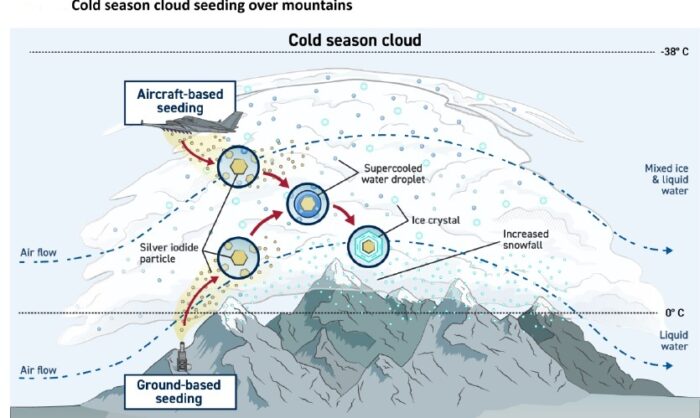
(2) increase rainfall from warm or mixed (i.e., cold and warm) clouds (warm season convective) by encouraging tiny cloud droplets to collide and coalesce, creating more raindrops that can reach the ground as seen in figure below.
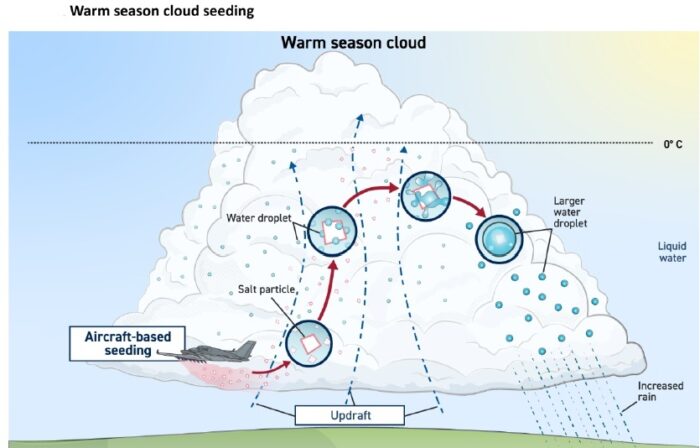
Particles that are hygroscopic have a chemical affinity for water. Some warm season, mixed-phase seeding programs also use silver iodide and other forms of glaciogenic seeding. For example, North Dakota’s cloud seeding program uses glaciogenic seeding in warm season clouds.
_
Scientists demonstrated the basis of cloud seeding in the 1940s, when they observed in the laboratory that water present in clouds could be artificially induced to create ice crystals using dry ice or silver iodide crystals (the latter is the most commonly used seeding agent in the U.S.). Extensive federal funding of research and development, including field experimentation, followed this discovery. For example, in fiscal year 1978, total federal funding for weather modification was approximately $68 million, in 2024 dollars. During this period, researchers hypothesized chains of events (or “conceptual models”) to describe conditions and processes needed for cloud seeding to work. But by the 1980s, inconclusive results led the federal government to cut funding. Nevertheless, non-federal cloud seeding operations and research have continued in parts of the U.S. and in other countries.
_
Over the past few decades, computer model and radar and sensor technology advances have improved evaluations of cloud processes and may help improve understanding of cloud seeding effects. For example, in 2017, a cold season field experiment directly observed the cloud interactions, but this research is in an early phase conducted with models and they are still years from making field measurements of the effects of cloud seeding on hurricanes. Research efforts in Japan and Australia are focused on typhoons and cyclones, respectively, which are types of tropical cyclones like hurricanes. One researcher at Argonne National Laboratory says she supports Australia’s research program with her personal expertise in modeling hurricanes and aerosol formation of ice crystals from supercooled liquid water following seeding and their fallout to the mountain surface—key documentation of the chain of events for this seeding approach. A subsequent review of precipitation enhancement progress by the World Meteorological Organization (WMO) noted that the chain of events for cold season orographic cloud seeding is now reasonably well understood. Other cloud seeding approaches remain emergent or in development. For example, the WMO review noted that substantial uncertainties remain to understand the chain of events when warm season clouds are seeded. In addition, research to develop approaches to reduce lightning strikes or suppress hurricanes continues despite uncertain scientific plausibility. Australia and Japan are currently investigating the feasibility of tropical cyclone (e.g., typhoon or hurricane) suppression.
_
Cloud seeding Process:
The artificial rain process, also known as cloud seeding, involves several key steps to induce or enhance precipitation. Here’s an overview of the typical procedures:
- Cloud Identification: Meteorologists pinpoint clouds with potential for precipitation but require assistance.
- Seeding Agent Selection: Common agents like silver iodide or dry ice are chosen to act as nuclei for ice crystal formation.
- Agent Dispersion Methods: Agents are dispersed via Aircraft: Flares release seeding agents from overhead, Ground-Based Generators: Cannons or generators release agents into the atmosphere.
- Nucleation and Cloud Enhancement: Seeding agents serve as nuclei, promoting the formation of ice crystals or water droplets within clouds.
- Precipitation Initiation: A sufficient number of droplets or crystals lead to precipitation (rain, snow) depending on atmospheric conditions.
- Monitoring Weather Conditions: Ongoing observation by meteorologists to evaluate the success of cloud seeding.
- Evaluation of Effectiveness: Assessment of precipitation patterns to determine the overall impact of the artificial rain process.
- Meteorological Factors: Success depends on factors like cloud type, temperature, and humidity.
- Multi-Purpose Applications: Cloud seeding is utilized for increasing water resources, mitigating drought, and managing weather patterns for agriculture and environmental needs.
__
Cloud Seeding Chemicals:
Cloud Seeding Chemicals are the primary agents used to stimulate precipitation by altering microphysical processes within clouds under specific conditions. These substances act as condensation or ice nuclei depending on cloud type and ambient temperature. Key Seeding Agents used in this process are:
-1. Silver Iodide (AgI): Most commonly used chemical due to its crystalline structure resembling ice; ideal for cold clouds.
-2. Sodium Chloride (NaCl): Used for warm clouds in coastal or tropical regions; encourages droplet formation through hygroscopic growth.
-3. Potassium Iodide (KI): Acts similarly to silver iodide but less toxic; preferred in environmentally sensitive areas.
-4. Dry Ice (Solid CO₂): Used in aircraft-based seeding; rapidly cools cloud moisture, forming ice crystals.
-5. Liquid Propane: Expands into ice nuclei when sprayed in supercooled clouds; used for targeted, short-duration precipitation.
-6. Calcium Chloride (CaCl₂): Promotes droplet coalescence in warm cloud systems; tested in India’s arid regions like Rajasthan.
_____
Silver iodide particles:
- Most commonly used seeding agent due to its ice-nucleating properties
- Crystalline structure similar to ice, facilitating ice crystal formation at higher temperatures
- Typically dispersed as smoke or flares, with particle sizes ranging from 0.1 to 1 micrometer
- Effectiveness depends on concentration and distribution within the cloud
_____
_____
How cloud seeding works in America:
We have winter snowpack augmentation and then we have summer convective precipitation enhancement. Both of these types of cloud seeding are built on the same physics, but operationally are conducted a bit differently. First and foremost, clouds that are nearing precipitation or that are already precipitating must be present and must include supercooled liquid water. When this is determined, winter projects—so, for snowpack augmentation—typically use ground-based generators that rely on the orographic lift to transport the material to areas where supercooled liquid water exists. The goal here is to enhance the snowpack on the mountain areas of the Mountain West. The material that we use, called silver iodide, acts as an ice-nucleating agent thanks to its crystalline structure. Once it’s in contact with supercooled liquid water, it tricks that supercooled water into thinking it’s ice, and then you allow for more efficient droplet growth through the ice-nucleating process, and the snowflakes grow to become heavy enough and fall as additional precipitation. Some programs will use aircrafts to fly either within or just above the cloud, and then they use pyrotechnic flares to distribute the material. Most recently, we started to use drones. Actually, in these cases, we’re getting drones into lower parts of the cloud where the supercooled water is present without having to deal with any icing issues in the aircraft and potentially putting a pilot into any type of danger.
Meanwhile, for convective programs, we have to have storms that are present along with inflow along the leading edge. Without inflow, we can’t get the material into the cloud, so the aircraft will fly in what we call “visual flight rules,” or VFR. This allows the pilot to fly wherever he needs to. There’s the meteorologist on the ground showing the pilot exactly where to go and how much of the flares to use. But that pilot, when he gets into the portion of the cloud that has inflow, is able to look at the vertical speed indicator of the airplane and really feel the inflow. From there, we’re burning what’s called “burn-in-place” pyrotechnic flares. The inflow transports the material to just above the freezing level, where that supercooled water exists, and once again acts as an ice-nucleating agent. And this method is done both for rain enhancement [and snowpack augmentation]. So, we’re trying to increase the precipitation but also do hail suppression, because what we’re trying to do is spread more ice nuclei across the cloud. That limits the ability for some of the particles to become larger and grow as larger hail embryos. The program in North Dakota is specifically doing hail suppression.
_
Convective programs—these are the programs that operate during the summertime—are limited to just a few states. We just talked about North Dakota and their hail-suppression efforts, but in Texas and New Mexico they’re doing cloud seeding in the summer to focus on precipitation enhancement, mainly for agricultural purposes or for aquifer recharge and water supply. We do have a new program that could be coming online in Arizona. As far as winter projects go, the focus is on the Mountain West states of Utah, Colorado, Wyoming, Nevada, and California.
_
We do have a new program developed in Oregon, and then we have possible programs in the near future in Montana and Washington. All of these have a focus on precipitation enhancement, although there is one company in Idaho that does cloud seeding for the purpose of increasing hydroelectric power via increased streamflow. In Utah’s case, 95 percent of water resources in the state are generated from the snowpack. So, any increase in the snowpack can have a major impact on its water supply over the years, especially with the challenges in place here in the state of Utah, where we have to make sure we’re providing enough water for water users, but we also have enough left over to try to bring the Great Salt Lake back to a healthy level.
_
Three big takeaways about the modern-day research on how cloud seeding works:
The 2017 Idaho SNOWIE study, which was conducted by a team from the National Center for Atmospheric Research, proved that, yes, cloud seeding does indeed work. What we still don’t know is how well it works and in what kinds of situations it works really well in, as opposed to others. The physics are there, and the physics have yet to fail us. So, we need to just continue to look at what SNOWIE did and expand upon that.
A second take is that a lot of these different states have conducted evaluations on their own, and they’ve all been applied in different ways. But they all come to the same solution: they’re increasing precipitation in the 5 percent to 15 percent range. So, despite different techniques and convective seeding versus what we’re seeing in the winter programs, it’s been pretty consistent: increased precipitation by 5 percent to 15 percent, closer to 10 percent to 15 percent.
The third thing we should focus on is that cloud seeding for precipitation enhancement should be looked at as a long-term water resource–management tool. Cloud-seeding operations cannot and will not fill a lake or reservoir overnight, but long-term projects can help replenish aquifers over time, increase agricultural production, and increase water supply for these reservoirs over a combination of years.
If you think about it, a 10 percent increase over a decade is an additional year of precipitation for these areas. In the West Texas city of San Angelo, during the drought of 2011, the director of water utilities there said, “We would’ve run out of water had it not been for our long-term cloud seeding program.” So, water users or water managers are starting to really look at this as a true water resource–management tool, but it has to be looked at in a long-term way.
______
______
Cloud seeding using electric charge:
So far, we discussed chemical cloud seeding.
Researchers at University of Reading and University of Bath used drones to zap clouds with electrical pulses. United Arab Emirates have been using drones equipped with a payload of electric-charge emission instruments and customized sensors that fly at low altitudes and deliver an electric charge to air molecules. According to the University of Reading, this electric charge method ionizes the cloud droplets, making them stick to each other, thereby boosting their growth rate. As it eliminates the need for chemicals like silver iodide (which can be toxic to aquatic life), it could become more eco-friendly seeding option. It’s rooted in a simple theory. The bottoms of rain clouds are naturally filled with negatively charged water. Hit the cloud with a stream of positively charged particles and the water droplets will collide and coalesce. This method produced a significant rainstorm in July 2021. For instance, in Al Ain it rained 6.9 millimeters (¼ inch) on 20–21 July.
_
Another UAE-funded project is experimenting with nanotechnology, by seeding clouds with special nanoengineered particles using advanced nanocomposites such as graphene that are potentially better than traditional materials such as silver iodide and are safer for the environment. AI-powered analysis will guide the design of these materials. The emirates is funding a separate effort that uses artificial intelligence to build algorithms that can more accurately predict the kinds of weather conditions best suited for cloud seeding.
_
Infrared laser pulses:
An electronic mechanism was tested in 2010, when infrared laser pulses were directed to the air above Berlin by researchers from the University of Geneva. The experimenters posited that the pulses would encourage atmospheric sulfur dioxide and nitrogen dioxide to form particles that would then act as seeds. The technique works by creating nitric particles in the clouds that cause condensation with laser pulses.
_______
_______
Cloud Seeding Projects and Case Studies:
The World Meteorological Association (WMO) noted that the development of meteorological projects, such as weather modification activities, has grown significantly due to an increase in social-economic demand for drought relief, water resources, and fire forest prevention. Weather modification has been proposed as a means to minimize environmental problems and secure water resources at a relatively low cost. Thus, cloud seeding experiments and analysis technologies are needed. Currently, weather modification projects are underway worldwide, including in the United States, China, Japan, the United Arab Emirates, and Russia. Cloud seeding experiments using aircraft have been performed to gain meaningful results. Furthermore, the method shows high success for rain enhancement. The United States and Thailand are conducting cloud seeding experiments with aircraft to increase long-term precipitation; they suggested an increase in annual precipitation through cloud seeding. Various other cloud seeding studies have been conducted using aircraft.
_
The Wyoming Weather Modification Pilot Project (WWMPP) was performed to statistically evaluate the effectiveness of cloud seeding with silver iodide in the Medicine Bow and Sierra Madre Ranges of south-central Wyoming. The cloud seeding program over the Sierra Nevada mountains region resulted in six successful and five unsuccessful cases. The Seeded and Natural Orographic Wintertime Cloud: the Idaho Experiment (SNOWIE) project was performed to verify the cloud seeding effect using meteorological radar and cloud droplet instrument. The Queensland Cloud Seeding Research Program (QCSRP) was carried out in Australia to investigate the cloud seeding effect on cloud and precipitation in a clean aerosol environment. In South Africa, seeding with hygroscopic seeding flares from the wings of an aircraft resulted in an increase in radar-measured rain mass. The cloud seeding experiments in Israel showed the precipitation enhancement over the target area with strong low pressure, precipitation, and wind of synoptic condition. In India, cloud seeding from aircraft-based hygroscopic flares attributed an approximate 17% of the total rainfall. The growth rate was shown to be sensitively affected by aerosol size distribution, vertical velocity, pressure, temperature, and relative humidity. These cloud seeding experiments have been attempted using various types of aircraft, such as helicopters, drones, rockets, and airplanes.
_
Cloud Seeding Projects for Precipitation Enhancement:
In regions grappling with water scarcity and drought, cloud seeding projects aimed at precipitation enhancement have shown promising results. For instance, the United Arab Emirates (UAE) has implemented cloud seeding initiatives to augment rainfall and replenish water supplies in arid areas. By deploying aircraft to disperse seeding agents into suitable clouds, the UAE has successfully induced precipitation and alleviated water stress in key regions, supporting agricultural activities and ensuring water security for communities.
Similarly, cloud seeding efforts in the western United States, particularly in states like California and Colorado, have targeted mountainous regions prone to drought conditions. By seeding winter storms with silver iodide or other agents, these projects aim to enhance snowpack accumulation and augment water resources for downstream users during the dry season. While the effectiveness of these programs is subject to scientific scrutiny, they represent proactive measures to address water challenges in water-stressed regions.
Successful Hail Suppression Programs:
Hail suppression programs have proven effective in mitigating the damaging effects of hailstorms on crops, property, and infrastructure. One notable example is the Alberta Hail Suppression Project in Canada, which has employed ground-based generators to seed developing thunderstorms with silver iodide particles. By inducing the formation of smaller hailstones or delaying hail formation, this program has reduced the intensity of hailfall and minimized agricultural losses in vulnerable areas, benefiting farmers and communities.
Fog Dispersal Initiatives in Various Regions:
Fog dispersal initiatives have been implemented in diverse regions to improve visibility and enhance safety for transportation and aviation. In airports such as San Francisco International Airport (SFO) and London Heathrow Airport, fog dispersal systems are deployed to mitigate the impacts of fog-related delays and disruptions. By releasing seeding agents into fog layers, these initiatives promote the dispersion of water droplets and facilitate clearer conditions for aircraft operations, reducing flight cancellations and enhancing efficiency.
__
Case Studies of Cloud Seeding: UAE, China, U.S., India, Australia:
Examining real-world programs highlights both ambitions and drawbacks:
- United Arab Emirates (UAE):
Facing an arid climate, the UAE pioneered weather modification in the Gulf. Its clouds are seeded by rockets, artillery and even drones, with the goal of up to 30–35% more rain in clear skies. The UAE has invested tens of millions in research and operations. However, scientists caution that the long-term effects are unpredictable. A 2022 study in International Journal of Environmental Science and Technology found that months of seeding coincided with higher particulate matter across Dubai, possibly from leftover AgI crystals not washed out by rain. Environmental authorities note it’s hard to conduct controlled experiments, so measuring true impact is difficult. In April 2024, a massive storm dumped nearly triple Dubai’s annual rainfall in one day, leading to catastrophic flooding. Social media conjectured that cloud seeding had backfired. Meteorologists and independent experts immediately debunked this: “with cloud seeding, it may rain, but it doesn’t really pour or flood,” they said. As one former NOAA chief scientist put it, “you can’t create rain out of thin air… 6 inches of water – that’s akin to perpetual motion.” In short, the UAE’s record flood was due to extreme weather, not seeding. This episode underscores the point: cloud seeding aims to wring out existing moisture, not generate storms.
- China:
By far the world’s largest seeder, China has spent billions on weather modification. The government employs tens of thousands of people and reportedly conducted half a million seeding missions between 2002–2012. China uses long-endurance drones, artillery and ground generators to seed vast areas – even planning to cover half the country by 2025. In May 2025, Chinese scientists reported a trial in Xinjiang where drones released AgI over 8,000 km² and achieved just a 4% increase in rainfall. This generated about 70,000 cubic meters of extra water – roughly 30 Olympic pools worth – using 1 kg of silver iodide. These figures illustrate the massive scale needed for small gains. Despite China’s heavy spending, neighboring India and Pakistan worry about lost rain, and Iran has accused China’s weather projects of affecting regional monsoons. Researchers note that China’s “authoritarian weather projects” face few domestic checks, raising the spectre of unchecked experimentation.
- United States and Australia:
In Western U.S. states like Utah, Colorado and California, cloud seeding has been conducted for decades as a drought-fighting tool. Similarly, Australia’s Snowy Mountains have been seeded since the 1960s to boost snowpack for hydroelectric power and water supply. Some long-term projects report roughly 5–10% additional snowfall annually in targeted zones. The recent WMO synthesis echoes this: under optimal, cold-cloud conditions (mountains in winter), seeding can add up to ~20% precipitation. However, success is highly conditional. The GAO notes that only about a dozen recent studies exist, and they show mixed results. In many U.S. plains or during hot summers, seeding yields nothing. Australian meteorologists likewise admit gains have limits – extra inches of snow won’t end a multi-year drought. Importantly, many U.S. programs were adopted more for political reasons during droughts than for scientifically proven benefit. Some farmers and ski resorts vouch for it, but independent analyses often find the results inconclusive.
- India:
Indian governments have increasingly turned to seeding as well. Delhi conducted its first major cloud seeding trials in late October 2025, led by IIT Kanpur, to combat severe pollution by inducing artificial rain, but the attempts yielded minimal rain due to low cloud moisture. Experts openly criticized this as misplaced: one scientist said it was merely “temporary relief” that wasted resources, diverting attention from fixing pollution sources. Similarly, drought-prone states like Karnataka and Maharashtra seed monsoon clouds to help crops, but these projects have drawn scrutiny. A 2022 parliamentary report warned that without strict protocols, seeding could backfire (e.g. causing hail in unexpected areas). Public opinion in India is divided. Some rural communities appreciate any extra rain; others fear storm damage or claim local climates have shifted unnaturally after seeding. As in other countries, lack of definitive data means many Indian seeding programs proceed amid controversy and calls for better regulation.
_
Each of these case studies illustrates a common theme: governments invest heavily in cloud seeding, hoping to boost water supply, but the scientific payoff remains uncertain. Many programs continue mainly because of political pressure or the sheer appeal of “making it rain”. Meanwhile, communities and scientists raise alarms about the unintended side effects outlined above. Scientific evidence to date suggests only modest rainfall increases under ideal conditions. Meanwhile, a host of negative impacts loom: ecological toxicity, unpredictable weather shifts, international disputes and ethical dilemmas. As experts warn, the risks of maladaptation are real – we could end up doing “more harm than good” if we treat weather like a vending machine. Before cloud seeding is embraced as a global solution, policymakers and citizens need full transparency and robust debate. More high-quality research (including satellite observations and field experiments) is essential. Regulatory frameworks must be updated to consider cross-border effects and public consent. And any application should be weighed against simpler water-saving measures.
______
______
Pros and cons of cloud seeding:
Pros of Cloud Seeding:
- Increased Precipitation: Enhances rainfall or snowfall in regions facing water scarcity, supporting agriculture and replenishing water reservoirs. Particularly effective with cold clouds (ice-phase seeding) and in orographic settings where moist air rises over terrain. Increasing mountain snowpack raises spring/summer runoff and can smooth seasonal supply for downstream uses (domestic, hydropower, irrigation).
- Drought Mitigation: Provides a potential solution to reduce the impact of prolonged droughts by increasing water availability.
- Agricultural Benefits: Boosts crop yields by ensuring adequate rainfall, especially in arid and semi-arid regions.
- Wildfire Control: Reduces the risk of wildfires by increasing moisture levels in the environment.
- Hail Suppression: Prevents crop and property damage by reducing the size of hailstones during storms.
- Fog Dissipation: Improves visibility in airports and roadways by clearing fog, enhancing transportation safety.
- Hydroelectric Power: Supports hydroelectric power generation by increasing water levels in dams and rivers.
- Localized Application: Targets specific areas, making it a flexible tool for addressing regional water and
- Cost-effective: Compared to other water augmentation strategies, cloud seeding is relatively inexpensive. Relative to large infrastructure (dams, desalination), seeding is low-cost per hectare treated; flexible and deployable using aircraft or ground generators.
_____
Cons of Cloud Seeding:
- Scientific uncertainty and variable effectiveness: The effectiveness of cloud seeding is variable and dependent on atmospheric conditions. Results vary widely by cloud type, humidity, atmospheric dynamics, and seeding method; attribution of precipitation increases to seeding is challenging. Quantitative effectiveness often shows modest gains (typical reported increases range from ~5–15% in favorable conditions) and is situation dependent.
- Measurement and attribution problems: Distinguishing seeded-induced precipitation from natural variability requires careful randomized experiments or advanced statistical/hydrometeorological analysis, which are costly and not always performed.
- Environmental and health concerns: There are concerns about the potential toxicity of the chemicals. For example, excessive sodium degrades soil and affects plant growth, while silver is toxic to aquatic life. Silver iodide has low solubility and toxicity at environmental concentrations reported in studies, but long-term ecological impacts remain a concern in some communities and require monitoring. Use of salts (hygroscopic seeding) can increase localized salinity; potential effects on soils and freshwater ecosystems must be considered.
- Legal, ethical, and transboundary issues: Manipulating weather patterns in one area inadvertently affects weather elsewhere. Rain enhancement in one area may reduce downwind precipitation; disputes can arise between jurisdictions (upstream/downstream, neighboring regions, countries). Water rights and liability for unintended consequences (flooding, property damage) create governance challenges.
- Operational and logistical limits: Requires appropriate meteorological conditions; cannot create rain from clear, dry air. Needs aircraft, pilots, or ground-based generators and trained meteorological teams—operational costs and safety considerations exist.
- Risk of over-reliance and opportunity cost: Treating seeding as a substitute for integrated water management, conservation, or infrastructure investment can be risky if expectations exceed realistic outcomes.
_____
_____
Why cloud seeding is not a solution to drought?
Cloud seeding can be used for multiple purposes. The one commonly thought of is prompting precipitation but it can also be used to remove clouds or fog, for example on an airport runway when the fog is too dense for pilots to see. Cloud seeding works by putting small particles, called condensation nuclei, into an already existing cloud. This existing cloud can be thought of as a large body of air molecules with moisture or water vapor molecules inside. When the small particles are injected into the body of air and moisture, it causes the water vapor to condense onto them; this is why the particles are called condensation nuclei. When cloud seeding is used to prompt precipitation, or rain, the technique relies on already existing water molecules in the atmosphere to condense onto the particles, or “seeds.” To generate rain using cloud seeding, the first step is to find a body of air with moisture inside. This moisture must be present to form rain with cloud seeing because the seed particles do not contain moisture. They just cause the existing moisture in the atmosphere to condense on them. Once this moisture condenses on the particles, they will continue to grow inside the cloud by having more moisture condense on them. Eventually the particles with water on them become large enough to form rain. Meteorological drought is defined as a shortfall in precipitation over a certain time period, typically over a long period of time like months. This means that there is a lack of precipitation in a region that comes from a lack of moisture in the air. Because moisture is the first ingredient for cloud seeding to produce rain, cloud seeing cannot be used as a solution to create rain during drought conditions.
_
Cloud seeding augments rainfall only when clouds already contain sufficient moisture and the microphysical conditions are right (cold or mixed-phase clouds for silver iodide; warm clouds for hygroscopic salts). Many droughts in India are caused by prolonged lack of moisture transport (monsoon failure) or large-scale circulation anomalies; without clouds, seeding does nothing. A drought is characterized by clear skies or with only a few small, puffy clouds. Seeding can’t do anything to make clouds where there are none, nor can seeding make rain from a small cloud. Though drought is sometimes the impetus for implementing a cloud seeding program, it is not generally advocated for such purposes. The reason for this is that droughts are caused by prolonged periods that do not produce clouds conducive to precipitation production. Therefore, cloud seeding opportunities during these periods are few, often providing limited results. A long-term and well-designed cloud seeding program can potentially soften the impact of drought, however, since increased precipitation before and after drought would temper the reduction of rainfall during the drought period.
_
If during drought, there are indeed moist clouds unable to precipitate, only then cloud seeding will work. But droughts cover thousands of square kilometers, while seeding can enhance precipitation only over limited areas (tens to a few hundred km² per operation), so it cannot restore basin- or region-wide water budgets reliably. Research indicates drought could affect three-quarters of the planet by 2050. There will certainly be year-to-year variability due to things like El Niño but the trend line will only get worse—more widespread and intense heat and drought, in the absence of concerted climate action. Cloud seeding may have a small impact on the drought, but governments will need to do everything they can to address climate change and deal with these long-term problems. That could mean continuing to implement expensive desalination projects, increasing water use efficiency, and especially moving towards carbon emissions goals rapidly.
______
______
Pollution and Precipitation:
Cloud seeding can temporarily lower particulate pollution (PM2.5/ PM10) by washout but reductions are short-lived and do not address emission sources (vehicles, industry, crop fires). What we are going to discuss is impact of pollution on precipitation.
_
Due to relationship between water vapor and atmospheric aerosols, human activities impact clouds in a number of ways. Atmospheric aerosols now include a wide range of pollutants produced by industrial emissions, tiny bits of plastics and rubber that wear from car tires and brakes, and vehicle tailpipe emissions. Not all atmospheric aerosols have the same impact on clouds. Research has shown that air pollution can prevent rainfall, because the water droplets in polluted clouds are too small – they float around in the atmosphere without merging to form large enough droplets to fall to the ground. A single drop of precipitation requires more than one million of these small droplets to converge. These pollutants can also prevent ice formation in subfreezing clouds. This means that our everyday activities in urban and industrial areas are already altering global rainfall patterns.
_
Depending on its concentration, pollution can have opposite effects on the precipitation process. Addition of a few particles that act as ice nuclei can cause ice particles to grow at the expense of supercooled water droplets, resulting in particles large enough to fall as precipitation. An example of this is commercial cloud seeding, with silver iodide particles released from aircraft to induce rain. If too many such particles are added, none of them will grow sufficiently to cause precipitation. Therefore, the effects of pollution on precipitation are not at all straightforward. There have been some indications, although controversial, of increased precipitation downwind of major metropolitan areas. Urban addition of nuclei and moisture and urban enhancement of vertical motion due to increased roughness and the urban heat island effect have been suggested as possible causes. A prominent mechanism, termed “condensational invigoration,” occurs when pollution-sized aerosols create many small droplets with high surface areas, enhancing condensation, latent heat release, and rainfall. This mechanism appears to be the main driver of aerosol-induced cloud invigoration in polluted settings. On the other hand, there are many reports of reduced precipitation due to pollution.
_
Several studies (Rosenfeld 2000; Givati and Rosenfeld 2004; Rosenfeld and Givati, 2006; Griffith et al. 2005; Hunter 2007) have described decreases in orographic precipitation due to pollution. This specifically impacts the collision coalescence process and what is called warm rain, i.e. no ice processes involved. These studies discuss that pollution can slow down the collision coalescence process by narrowing the drop-size distribution. This, in turn, slows down the warm rain process and would have the largest impacts in the low-elevation coastal ranges along the west coast where the freezing level is well above the elevations of the coastal mountains, i.e. around Los Angeles where it has been proposed to reduce precipitation. Typically the decrease in orographically enhanced precipitation is greatest downwind of a major metropolitan area that is producing pollution. Givati and Rosenfeld (2004) showed precipitation losses near orographic features downwind of coastal urban centers corresponding to 15-25% of the annual precipitation. This loss of precipitation can be greater than the gain claimed by precipitation enhancement techniques in portions of California (Hunter 2007). Hindman et al (2006) noted that the trend over the past 20 years, from cloud droplet measurements at Storm Peak in the northern Rockies, has shown a decrease in CCN and an increase in cloud drop size. The conclusion was a decrease in upwind CCN concentrations (less pollution) but no relationship was found with precipitation rate. Thus, the change in cloud droplet spectra was not impacting riming growth efficiency (Borys et al 2003). It was noted by Creamean (2013) that pollutants, such as from human activity, were found mostly in the boundary layer and with frequently higher concentrations preceding surface cold fronts. The pollutants become trapped in the stable air as the air warms aloft and surface flows tend to be from the southeast to east tapping polluted sources from the central valley of CA. Once the front passed, the air-mass off the ocean did not contain these pollutants. It is the post–frontal cloud systems that have been identified as the most seedable in the northern and central Sierra (Heggli and Reynolds, 1985). It is not anticipated that pollutants play a significant role in these post-frontal shallow orographic clouds.
______
The Double-Sided Sensitivity of Clouds to Air Pollution & Intentional Seeding: a 2007 study:
First how cloud seeding occurs:
Similar to how dewdrops form on cooled surfaces on the ground, cloud drops form on pre-existing aerosol particles in cooled ascending air streams. Polluted air provides many of these cloud drop condensation nuclei (CCN). Cloud water is comprised of many water drops 10-20 microns in size that are small relative to the range of droplet size in a cloud, float in the air, and are too small to combine into raindrops. Rain might be enhanced by seeding such clouds with two- to five micron hygroscopic particles (relatively large compared to many aerosols) that nucleate large cloud drops, and then can become embryos of rain drops. Small drops are also slower to freeze into ice crystals and are less efficiently collected by the ice crystals that do form, so they produce less snow. Therefore, cloud seeding to augment precipitation is most effective in “super-cooled” water clouds, clouds that are composed of small water drops that remain liquid at subfreezing temperatures. Because super-cooled clouds of small drops are slow to freeze, precipitation can also be enhanced by seeding with ice nuclei, such as silver iodide, that initiate the ice crystals that subsequently collect the remaining cloud water into snowflakes.
Pollutant Seeds Have Opposite Effect:
Cloud seeding for enhancing precipitation is the opposite of inadvertent suppression of precipitation caused by small CCN aerosols from smoke and urban particulate air pollution. We “seed” the clouds negatively with pollution aerosols on a much grander scale than we do positively with silver iodide and large hygroscopic particles. Thus, we can learn much about how to intentionally enhance rain by observing how we inadvertently suppress it.
The recently acquired ability to detect the composition of clouds from weather satellites revealed tracks of super-cooled small drops in clouds downwind of major urban and industrial areas over many parts of the world (see image below, left). The same satellite technique was used to show how cloud seeding with silver iodide has the opposite effect of converting the small super-cooled cloud drops into falling snow (see image below, right).
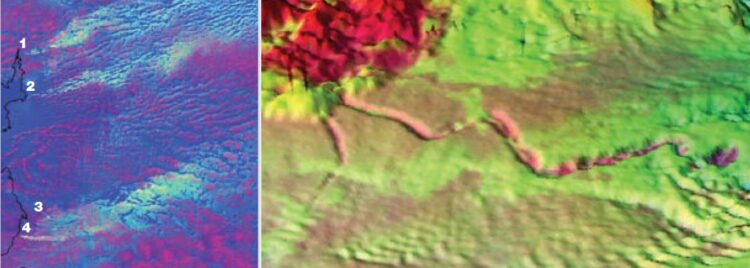
Satellite visualization of NOAA/AVHRR images illustrate the opposite effects of air pollution (left) and cloud seeding (right). At left, shown in yellow are small cloud drops that are not conducive to precipitation; clouds composed of large drops are purple, and snow clouds are red (see Rosenfeld and Lensky, 1998). The image, covering 350 x 450 km, shows pollution tracks manifested as reduced cloud drops over South Australia, originating from the Port Augusta coal power plant (1), Port Pirie lead smelter (2), Adelaide city (3) and oil refineries (4). The image at right shows a silver iodide icy seeding track in clouds composed of small super-cooled liquid water drops over central China. The ~300-km long track appears red because the cloud drops froze and converted to snow that fell from the cloud top and left behind a channel the size of the Grand Canyon.
_
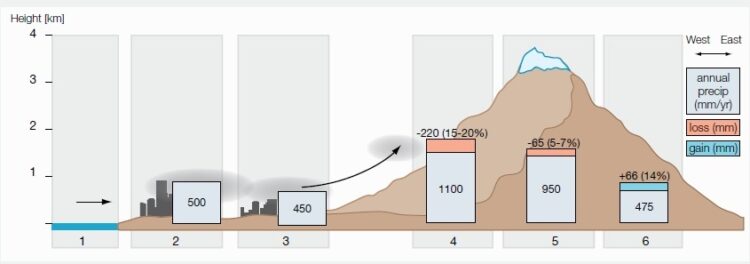
Figure above shows Topographic cross section showing the effects of urban air pollution on precipitation as the clouds move from the California coast east to the Sierra Nevada Mountains. Maritime air (zone 1) is polluted over the coastal and Central Valley urban areas (zones 2, 3): no precipitation decrease occurs. The polluted air rises over mountains and forms new polluted clouds (zone 4): decreases occur in the precipitation ratio of the western slopes to the coastal and plains areas. The clouds reach the high mountains (zone 5) where all precipitation is snow: slight decreases occur in the ratio of the summits to the plains areas. The clouds move to the high eastern slopes (zone 6): some unprecipitated water from the western slop falls there and increases the ratio of the eastern slopes to the plains.
_
The western United States is particularly vulnerable to the effects of pollution, because much of its water comes from pristine oceanic air masses that become polluted by the major urban areas during their trek inland. When the polluted air ascends the mountain ranges it forms new clouds with reduced drop size, which dissipate when they pass the ridge line and are forced to descend on the lee side. The short lifetimes of clouds mean that pollution-induced slowing of the conversion of cloud drops to precipitation translates to a net loss of water on the ground. Consequently, we would expect urbanization and the resulting added aerosols during the last century to have caused a reduction in mountain precipitation with respect to coastal and upwind lowland precipitation, defined here as the orographic enhancement factor, Ro (Run-off).
_
The Evidence:
This hypothesis was validated, as reductions of 10 to 25 percent in Ro were recorded during the past decades in much of the mountain ranges of the western United States, including the California Sierra Nevada, the Cascades east of Seattle, the Wasatch Mountains east of Salt Lake City, the Sandias east of Albuquerque, and parts of the Rocky Mountains west of Denver and Colorado Springs (see Givati and Rosenfeld, 2004 and Rosenfeld and Givati, 2006). The estimated loss of precipitation at the central Sierra Nevada alone is estimated at 4×10^9 cubic meters per year (3.2 million acre-feet per year [afy]). A new study by Rosenfeld documented similar effects over Israel, with losses of usable water to the Lake of Galilee amounting to about 1×10^8 m3 per year (81,000 afy), approximately six percent of the overall water potential of Israel.
These alarming findings prompted the California Energy Commission to support cloud physics aircraft measurements of pollution aerosols and their interactions with the potential rain clouds over California. These measurements, which took place during the latter part of the winters of 2005 and 2006, confirmed that urban aerosols are ingested into potential rain clouds and suppress their precipitation (Rosenfeld, 2006). Model simulations of these processes provide additional support and insights.
_
Testing Ro Sensitivity:
Cloud seeding for precipitation enhancement is being conducted extensively in the western United States, but assessment of its efficacy requires a randomized seeding scheme, yet to be conducted here in a scientific manner that benefits these new insights. Experimental randomized cloud seeding with silver iodide in northern Israel, which was reported to enhance rainfall there by 13 to 16 percent, has continued operationally since 1975. Givati and Rosenfeld (2005) analyzed the orographic enhancement factor over the hills of northern Israel for the whole period of 1950 to 2002, during which time Ro decreased by 15 percent despite the reported positive seeding effect over the hills there. When separating the time series to seeded and unseeded conditions they found that the trend line of Ro shifted upward by 12 to 14 percent for the seeded rain time series compared to the unseeded time series. The sensitivity of Ro to both seeding and pollution effects was greatest in the hilly areas with the greatest natural orographic enhancement factor and practically non-existent in the low-lying areas where no orographic enhancement occurs.
The double-sided sensitivity of clouds to the damaging effects of pollution aerosols and potential corrective effects of cloud seeding provides another powerful tool for assessing the potential for enhancement of orographic precipitation. Areas that have experienced significant reductions in the trends of the orographic enhancement factor are likely manifesting the sensitivity of the clouds to aerosols, and hence could benefit from cloud seeding.
______
Cloud seeding causing pollution?
Effect of cloud seeding on aerosol properties and particulate matter variability in the United Arab Emirates, a 2021 study:
In this study, satellite data and those obtained from air quality monitoring stations were used to evaluate the effect of cloud seeding missions conducted from January 2017 to March 2017 in the United Arab Emirates (UAE). To determine PM variability during and after the cloud seeding missions, information on daily mean particulate matter (PM10 and PM2.5) concentrations obtained from 20 air quality ground-based stations was analyzed from January 2017 to April 2017. The stations were divided according to four distinct geographic zones, which include petrochemical and non-petrochemical industrial, residential, and low populated areas. Moreover, data from the MAIAC 1-km product (MCD19A2) obtained using the Moderate Resolution Imaging Spectroradiometer onboard the Terra satellite were used to identify the correlation between aerosol optical depth and ground PM concentrations. The results showed that among the areas, the petrochemical and non-petrochemical industrial areas had the highest PM2.5 levels. Urban areas located adjacent to deserts had significantly higher PM10 concentrations than other urban areas. The PM concentration was high during the period of cloud seeding missions. This finding indicated that silver iodine crystals fired during the missions might have increased the concentration of PM in the air. Moreover, cloud seeding missions might have a more significant effect in increasing PM10 concentrations compared with PM2.5 concentrations. Hence, local weather conditions might have affected the decay of silver iodine particles during the missions. Long-range air mass transport may have an influence on the natural and anthropogenic particle concentrations in land and water bodies surrounding the UAE.
______
______
Cloud seeding impact on climate:
Cloud seeding alters local weather by boosting precipitation, but its climate impact is negligible globally and complex regionally.
Regional Climate Impacts:
While cloud seeding is designed to have localized effects, its potential regional climate impacts warrant consideration. If cloud seeding is conducted over large areas or for extended periods, it could potentially alter regional precipitation patterns and water cycles. For instance, increasing precipitation in one area might, in theory, reduce it downwind, although evidence for this “water stealing” effect is not conclusive and remains a topic of research. Furthermore, widespread cloud seeding could have unintended consequences on regional weather systems. It is important to note that the scale of current cloud seeding operations is relatively small compared to the vastness of the atmosphere and the natural climate system. Therefore, the regional climate impacts of existing cloud seeding programs are likely to be limited and difficult to detect amidst natural climate variability.
Cloud Seeding and Global Climate System:
From a global climate perspective, the direct impact of current cloud seeding practices is considered negligible. The scale of existing operations is too small to exert a measurable influence on global climate parameters such as global mean temperature or large-scale atmospheric circulation patterns.
One key area of academic inquiry is the potential feedback mechanisms associated with cloud seeding. For example, increased precipitation in certain regions could alter surface albedo (reflectivity) due to snow cover changes or vegetation responses, which could in turn affect regional energy balance and atmospheric circulation. Cloud seeding could also influence cloud radiative properties, potentially affecting both solar radiation reflection and terrestrial radiation trapping. These feedback loops are complex and not yet fully understood, requiring sophisticated climate modeling studies to investigate.
_
Is Cloud Seeding a viable Climate Solution?
Framing cloud seeding as a direct “climate solution” is misleading. Cloud seeding, in its current form and foreseeable future applications, is not designed to address the root causes of climate change, such as greenhouse gas emissions. It is primarily a weather modification technique focused on enhancing precipitation at local or regional scales. Therefore, it should not be considered a substitute for emissions reduction or other climate mitigation strategies.
However, cloud seeding could potentially play a role in climate adaptation. In regions facing increased drought risk due to climate change, cloud seeding might offer a tool to augment water resources and mitigate some of the impacts of water scarcity. This would require careful assessment of the specific regional climate context, potential environmental impacts, and ethical considerations. Moreover, the effectiveness of cloud seeding in a changing climate, where cloud properties and atmospheric conditions may be altered, needs further investigation.
Opportunities for cloud seeding in climate change mitigation:
- Enhancing water security – In the face of climate change-induced droughts, cloud seeding offers a method to potentially enhance water availability, particularly in arid and semi-arid regions. By increasing precipitation, it could play a role in securing water for agriculture, drinking, and other essential uses.
- Cooling urban heat – In urban areas, where the “heat island effect” exacerbates temperature extremes, cloud seeding could be employed to trigger cooling rainfall, thereby reducing the demand for energy-intensive air conditioning and contributing to urban climate resilience.
- Supporting ecosystem health – By potentially increasing precipitation in drought-affected ecosystems, cloud seeding could aid in the preservation of biodiversity, offering relief to stressed natural habitats and contributing to the overall health of ecosystems.
It is crucial to avoid overstating the potential of cloud seeding as a climate solution. While it may offer localized benefits in certain contexts, it is not a global-scale fix for climate change. Focusing on cloud seeding as a primary response to climate change risks diverting attention and resources from more fundamental and sustainable solutions, such as transitioning to a low-carbon economy and building climate resilience through broader adaptation measures. A balanced perspective is needed, recognizing the potential utility of cloud seeding for specific water resource challenges while acknowledging its limitations as a climate change solution.
Cloud seeding is not a climate change solution in itself, but it could be a tool for climate adaptation in specific regions facing water scarcity, requiring careful evaluation and responsible implementation.
______
______
FAQ:
-1. How long after seeding before a treated cloud starts to change?
Seeding effects can range from almost immediate to up to 30 minutes depending on the seeding delivery method (direct injection at cloud top, or base seeding – releasing seeding agent in the updraft below the cloud base). Direct injection is more immediate, but involves flying in-cloud and working at higher altitudes, requiring aircraft with higher performance (and costlier) capabilities. Updraft treatment at cloud base is easier to accomplish, but requires the seeding agent be transported by the cloud’s updraft to where it can become effective, thus taking a little longer.
-2. Who decides when clouds are seeded?
The radar meteorologist is the director of operations for cloud seeding missions. A number of factors play a part in the decision-making process, including safety criteria, radar information, pilot observations, and aircraft instrument data.
-3. If a cloud is seeded, does it rain somewhere other than where it would have rained naturally?
Evidence indicates that seeded storms often rain over larger areas than unseeded storms. This means some areas that would not have received rain often do as a result of seeding. By seeding developing clouds before they start to produce precipitation, the precipitation process is accelerated and rain falls sooner, and from smaller clouds than it would naturally. Some redistribution of rainfall can occur within the scope of the storm itself, with computer models suggesting that regions of very intense precipitation may be slightly reduced while the total storm rain volume is increased.
-4. Isn’t flying aircraft around thunderstorms dangerous?
Flying around thunderstorms can be dangerous if pilots are not properly trained. For this reason, all pilots that fly seeding aircraft on the North Dakota project are trained through classroom education, intern experience, and/or field experience with a qualified weather modification pilot instructor. With these requirements in place the flight safety record in North Dakota has been excellent.
-5. What effects do cloud seeding chemicals have on the environment?
The published scientific literature clearly shows no environmentally harmful effects from cloud seeding with silver iodide aerosols (WMA, 2009). The silver concentration in rainwater from a seeded storm is well below the acceptable environmental concentration of 50 micrograms per liter as set by the U.S. Public Health Service. Also, the concentration of iodine in iodized salt used for human consumption is far above the concentration found in rainwater from seeded clouds. Because silver iodide is such an effective ice nucleus, it is used in minute quantities. Based on the average rate of silver iodide use in North Dakota each summer, it would take nearly 500 years for one gram of silver iodide (1/28th of an ounce) to be evenly spread out over an area equal to a full-sized basketball court!
-6. Does rain water from a seeded cloud taste or smell different than natural rain?
No. There is no discernible difference between rainwater from a seeded cloud and rainwater from a non-seeded cloud.
-7. What is the aerial coverage of cloud seeding?
Cloud seeding typically can be done with one aircraft in a 100 x 100 km2 area. The clouds will move from the location of its intervention and could be monitored in the surveillance area of a C-band radar over nearly 200 km2 downwind of the seeded location.
-8. Who decides if and when clouds are seeded?
Typically, a meteorologist is the director of operations for cloud seeding missions. A number of factors play a part in the decision-making process which includes local atmospheric conditions, weather forecasts, seeding suspension criteria, and aircraft safety concerns.
-9. How can seeding effects be measured?
Seeding effects and benefits can be demonstrated in a number of ways. The most direct method would be to conduct a project over several years in which half of the storms were randomly selected for seeding and the resulting precipitation from the seeded and unseeded storms were compared. The problem with this method, however, is that project sponsors usually want all of the seedable clouds treated (not half) to attain the maximum benefit possible from the program.
Evaluations of precipitation data, streamflow data, crop insurance data, and crop yield data are useful if done properly. These evaluations require long term climatological relationships to be established between seeded and unseeded areas, and a long period of operations for comparison purposes, but do not require that only half of the suitable clouds be treated.
Recently developed methods include snow trace-chemistry analysis, objective radar-based analysis, evaluation of satellite data, and even numerical modeling to help discern the effects of cloud seeding.
-10. What are the typical benefits of cloud seeding?
Numerous evaluations have indicated that cloud seeding, when properly applied, can produce precipitation increases up to 10% or greater (AMS, 1998). Studies of hail suppression seeding indicate hail damage reductions up to 45% (Smith et al., 1997). Agricultural wheat production in seeded areas has increased by 5.9% in North Dakota (Smith et al., 1992).
-11. What are the economic benefits of cloud seeding?
Evaluations indicate runoff from additional snowpack in the range from $1 to $15 per acre foot (Kansas Water Office, 2001). Benefit to cost ratios on summer season agricultural economic production approach 40 to 1 (Sell and Leistritz, 1998).
-12. What are the effects of the Overuse of seeding material on clouds?
Overseeding can evaporate the cloud as too many particles may share available water vapour in the atmosphere and the size of cloud particles thus formed may be too small to form any collisions and raindrops.
-13. Which is the best RADAR to identify clouds during seeding?
C-band radar is recommended for use in a cloud seeding project due to the range and resolution and lower attenuation than the X-band radars. The radars should be able to make quick scans to document the cloud evolution and precipitation. Often the precipitation forms within 15 min of seeding and that should be documented within the radar scan interval and clouds need to be traced during their lifetime, which can last for an hour or more.
-14. After seeding, the cloud rains, but sometimes rain does not reach the ground!
Clouds do rain but do not reach the ground as a result of the environment being very dry and the droplets evaporating.
-15. Is silver iodide toxic?
No. The silver used in cloud-seeding is silver iodide (AgI, or silver bonded to iodine), which can be confused with other molecular forms of silver. When silver is isolated as an ion (Ag+) it is biologically active, meaning it interacts with bacterial or fungal cell walls — which is why it’s often used for medicinal purposes and for sterilizing drinking water. Silver ion (Ag+) can be hazardous in aquatic environments because it can also interact with proteins and other parts of cell membranes, but silver iodide (AgI), not silver ion (Ag+), is used for seeding clouds. Silver iodide retains its form in water and does not break down into the potentially toxic silver ion. When the silver iodide particle falls to the ground with rain or snow, it separates from the water molecules that formed an ice crystal around it, essentially becoming a speck of dust no different from the silver naturally occurring in the soil.
______
______
Section-7
The Science Behind Cloud Seeding:
Cloud seeding is a process that aims to enhance precipitation by introducing artificial ice nuclei into clouds. The first stage in the growth of raindrops or snowflakes in a cloud is condensation, which occurs from a nucleus or particle on whose surface the water vapor present in the atmosphere begins to deposit. The idea behind cloud seeding is that these nuclei are not always present in the required quantity in the air, even when all the physical conditions to produce rain are, so to speak, present. Cloud seeding provides the final ‘push’ for rain to occur by ‘seeding’ a cloud with these particles that will serve as a substrate for water vapor or supercooled water to deposit on, thus rapidly increasing the size of these particles that will eventually give rise to rain. Cloud precipitation efficiency, defined as the ratio of the amount of rain reaching the ground to the amount of water vapor entering the cloud base, is often clearly below unity. The idea of cloud seeding, first conceived after World War II, is to increase the precipitation efficiency artificially, and despite many scientific uncertainties that still persist, it has become a much practiced activity at many arid regions of the world.
_
There are two principal cloud seeding techniques:
Hygroscopic cloud seeding aims at speeding up droplet coalescence in liquid clouds, leading to production of large droplets that start to precipitate. Cloud seeding material consists usually of large salt particles dispersed by some means to the cloud base. In warm cloud seeding, salt particles attract water droplets. These droplets collide and merge, growing larger until they can fall as rain. This process, known as coalescence, is critical for enhancing precipitation in warmer clouds. During the cloud seeding, the hygroscopic nuclei dispersed at the cloud base are expected to form larger cloud droplets than in a naturally developing cloud. The hygroscopic flares provide larger CCN than naturally available. Water vapour condenses on these particles readily. These droplets further grow by collision and coalescence with other droplets and accelerating rain formation.
The idea of the other technique, glaciogenic cloud seeding, is to trigger ice production in supercooled clouds, leading to precipitation. Glaciogenic cloud seeding is usually done by dispersing efficient ice nuclei, such as silver iodide particles into the cloud, causing heterogeneous ice nucleation. Another possibility is to use dry ice (solid carbon dioxide) or liquid carbon dioxide which cools the cloud sufficiently so that the supercooled water droplets freeze homogeneously. Glaciogenic cloud seeding is usually applied to convective clouds, or winter orographic clouds. The largest body of scientific research on cloud seeding has been done on AgI seeding on these two cloud types. Cloud seeding is done in cold clouds with glaciogenic particles, which can form ice particles. The ice particles thus formed will grow by accumulating water as well as ice or colliding with other ice particles. They journey to the ground as they are heavy and fall through the melting region. At temperatures warmer than zero degrees, these ice particles will melt and produce raindrops. In monsoon clouds, a combination of warm and cold rain processes is important.
_
Dry ice and AgI were first shown to be efficient ice nucleating materials by Vincent Shaefer in 1946 and Berndt Vonnegut in 1947, respectively. The crystal lattice of AgI is very close to that of hexagonal ice, which was originally suggested to be the reason for its ice nucleation efficiency. That view has later been contested to some extent due to conflicting laboratory experiments and hydrophobicity of pure AgI surfaces. Whatever the exact reasons for AgI’s ice nucleation efficiency, it remains the most common cloud seeding material both in scientific studies and in practical operations although other commercial alternatives are available.
_
Most cloud-modification activities have been concerned with supercooled clouds and have involved seeding with ice nuclei. The first substance found to be effective as a cloud-seeding agent was dry ice (solid carbon dioxide). Its temperature is so low (about −78° C) that it causes ice crystals to form spontaneously from water vapour. It has been estimated that a gram of dry ice will produce at least 3 × 10^10 ice crystals. The most common procedure for seeding with dry ice is to fly over a cloud and disperse crushed pellets, less than a millimetre to a few millimetres in diameter, along the path of flight. A typical seeding rate might be several kilograms of dry ice per kilometre of flight. Dry ice is no longer widely employed as a cloud-seeding agent because it suffers from the disadvantage of having to be delivered to the supercooled regions of the cloud and from the fact that, once a pellet of dry ice has evaporated, it can no longer affect the cloud. This method is not economical as 250 kg of dry ice is required for seeding one cloud. To carry the heavy dry ice over the top of clouds special aircrafts are required, which is an expensive process.
_
Artificial stimulation of snowfall is conducted through the application of aerosols that mimic natural ice nuclei to enhance the heterogeneous freezing of available SLW or by chilling the air below -40 C to initiate homogenous nucleation. It is well known that the effectiveness of the heterogeneous seeding agent is highly temperature dependent. Artificial cloud nucleating substances (AgI, CO2, Liquid propane, SNOWMAX) are dependent on the presence of SLW at temperatures slightly below 0 C for CO2, propane, and SNOWMAX (Ward and Demott 1989) or below -5 C to -8 C for AgI mixtures. These seeding agents act in different ways. Solid or liquid CO2 and liquid propane work by homogenous nucleation. These seeding agents need to be directly released in the presence of SLW for them to be effective. AgI and SNOWMAX work by heterogeneous nucleation, meaning they mimic the structure of natural ice nuclei. They do not have to be released directly into cloud or SLW. The aerosol can be carried aloft into clouds and when it encounters SLW at the right temperatures will begin generating ice crystals by contact nucleation. SNOWMAX is not used in any operational seeding program but is used almost exclusively for snowmaking at ski resorts. The effectiveness of AgI to nucleate ice crystals increases by orders of magnitude from -5 C to -12 C (Super 2005). It should be noted that under transient water supersaturations, AgI can activate more rapidly and at temperatures near -5 C through the condensation freezing mechanism (Pitter and Finnegan 1987). Chai (1993) explained the only way AgI could have been an effective seeding agent in the Lake Almanor seeding experiment (Moony and Lunn 1969) was through the fast activating condensation freezing process. If the AgI is burned below cloud base or at temperatures warmer than -5 C, the aerosol will not produce sufficient ice embryos until temperatures colder than -8 C are reached (Super and Heimbach 2005). Huggins (2009) found the best temperatures for SLW in the Bridger Range Experiment occurred at < -9 C using AgI, which suggests the AgI acted through contact or deposition nucleation.
_
Supercooled clouds are now most commonly seeded with tiny particles of silver iodide. There are many techniques for seeding with silver iodide. All of them produce large numbers of minute particles that range in diameter from about 0.01 to 0.1 micrometre. A common procedure is to dissolve silver iodide in a solution of sodium iodide in acetone. The concentration of silver iodide may range from 1 to 10 percent. When the solution is burned in a well-ventilated chamber at a temperature of about 1,100° C, a very large number of ice nuclei are produced. The concentration increases rapidly as the temperature decreases. A typical quantity at −10° C is 10^13 ice nuclei per gram of silver iodide. Exposure to ultraviolet light causes rapid deactivation of the silver iodide nuclei. The concentrations of nuclei may decrease by perhaps a factor of 10 for each hour of exposure.
_
After the original discoveries of Schaefer and Vonnegut, cloud seeding research became very intensive for decades especially in the U.S. Two pathways to glaciogenic cloud seeding were developed. Static seeding aims at using modest or “optimal” amount of seeds with the target of forming ice (or snow) crystals that collect supercooled droplets in a process called riming, which leads to formation of graupels and their precipitation. The dynamic seeding aims at rapid glaciation of the whole cloud by using large amounts of seeds. By the end of the 1990s there were some strong indications from individual cases that the seeding is effective, but in the big picture, large uncertainties remained. In order to have confidence that the technique actually works, both statistical and physical evidence is needed. Difficulties in obtaining reliable statistical evidence have to do with large natural variability compared to the signal (precipitation enhancement) and proper design of the tests in statistical terms, e.g. selection of the target area and control area. The physical evidence has to do with proving the physical model of precipitation enhancement to be correct. The physical model is not only about ice nucleation, as a large number of microphysical processes such as condensation/evaporation, melting, coalescence, riming, splintering etc. can occur depending on cloud type and environmental conditions. In order to obtain physical evidence, both the model of the cloud development and the technology to detect the evolution of the processes inside the cloud need to be adequate.
_
Cloud seeding is a physical process whereby a seeding agent comprised of minute particles is released into an EXISTING cloud formation with Supercooled Liquid Water (SLW). These particles provide a surface (nucleus, or a “landing pad”) for the SLW molecules to bond and formulate ice particles. Water molecules freeze on contact with the particles and begin to grow into a snowflake as it encounters other water molecules, until the snowflake reaches a density heavy enough to fall to the ground as precipitation. This occurs naturally as a result of impurities in the atmosphere such as aerosols and dusts present in clouds. Seeding essentially provides more “landing pads” for SLW to freeze upon, mimicking physical processes of precipitation that are occurring naturally.
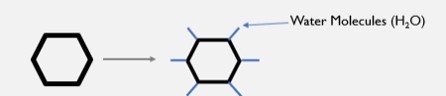
Figure above shows points at which water molecules can form ice on a particle.
_
Figure below shows Silver Iodide chemical compound structure.
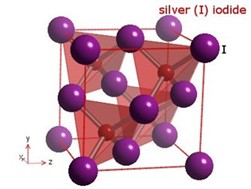
Silver Iodide (AgI) is the most common seeding agent used to conduct cloud seeding. The benefit of using silver iodide for cloud seeding is its high insolubility and its structure. Lack of solubility means that it is not easily broken down by water. The second big plus is it has a similar crystal lattice to ice crystals. This is what allows it to work well as a supplemental ice crystal or nuclei for a rain drop. AgI’s molecular structure has the same physical shape (hexagonal) as naturally occurring ice. Nucleation is the process by which ice crystals form around a nucleus. Silver iodide’s crystalline structure makes it an effective nucleating agent, closely mimicking the structure of natural ice. Silver iodide functions at warmer temperatures than naturally occurring ice, allowing for ice formation, and thus precipitation, to begin sooner. Silver Iodide (AgI) is burned and released into the atmosphere. These particles of AgI are the size similar to that of a smoke particle. These particles are microscopic particles and released in extremely small quantities.
Since the synthetic compound silver iodide’s structure is similar to that of ice crystals, forming a kind of hexagonal lattice (Figure below), this molecule can be used to “deceive” the water droplets and then make them condense using this crystal as a substrate.
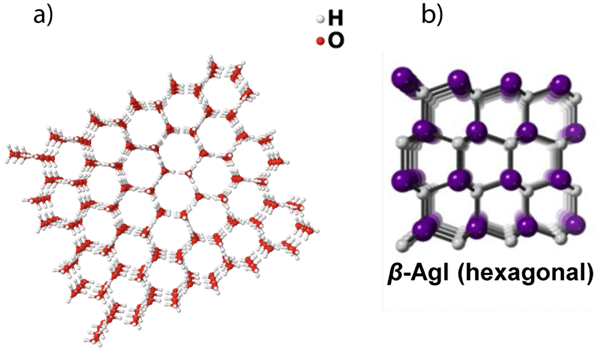
Figure above illustrates the similarity between the structure of an ice crystal and a silver iodide molecule.
Silver-iodide gives surface to water droplets to converge around, allowing them to form an ice crystal. Every snowflake you’ve ever seen has initially formed this way – a small speck of dust or pollen floating around the atmosphere collects freezing drops of water, forming the intricate designs that we’re familiar with. The only difference between cloud-seeding and natural precipitation is that instead of dust or pollen, the nucleus of the ice crystal is a tiny particle of silver iodide that scientists released into the cloud.
_
Figure below shows how ice crystals are formed in a cumulus cloud due to AgI.
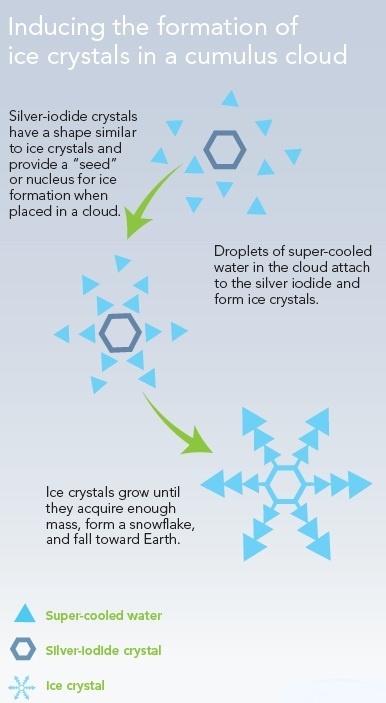
Snowpack/Water Enhancement:
-1. Moist air rises as it flows over the mountains, cooling and creating clouds composed of supercooled water droplets.
-2. Minute amounts of silver iodide in solution are sprayed across a propane flame or released from an aircraft-mounted flare. The air flow up the mountain barrier carries the particles into the clouds.
-3. The silver-iodide crystals provide nuclei for the formation of ice crystals.
-4. By freezing and deposition of supercooled water droplets, ice crystals form and grow progressively larger, forming snowflakes large enough to precipitate to the ground. The effects of cloud seeding can sometimes be seen within 30 minutes, but more generally between 30 minutes and an hour.
_
AgI is inert in the natural environment. This means that it is a stable compound and does not react with other chemicals. It is also “insoluble” in water, meaning it cannot “disassociate” or break apart to become free silver (Ag+) available to aquatic organisms. With nearly 80 years of cloud seeding operations having occurred worldwide, there remains no evidence of adverse impacts to humans, biological systems, or the environment from use of AgI for cloud seeding. This is largely because of quantities of AgI used, the large geographic areas where its distributed, and the short periods of time under which operations occur. For these reasons, bioaccumulation is unlikely to occur. Silver Iodide (AgI) is used for a number of applications beyond cloud seeding. AgI is relevant in the medicine and photography industries. Silver Iodide is used in certain treatments acting as an antiseptic to prevent infections due to its antibacterial properties. Concentrations of AgI used for these purposes typically far exceed those used for cloud seeding.
_
Since the 1940s, it has been known that under laboratory conditions, silver iodide is effective in increasing the number of nuclei that exist naturally in the atmosphere, which are essential to sustain crystal growth (Vonnegut, 1947). However, although it works well in the laboratory, this mechanism presents various complexities when put into practice. On one hand, it requires that the cloud be in a particular temperature state (below -3°C) and, on the other hand, that there is a deficit of these ice condensation nuclei. Increasing the condensation nuclei in a situation where they are already abundant could have the opposite effect, as the water vapor would be “shared” among a larger number of smaller droplets or crystals. In addition, increasing precipitation through seeding does not imply increasing the amount of water present in the cloud but simply increasing its efficiency for rain.
Despite the practical difficulties, there is evidence that the proposed mechanism for increasing precipitation using silver iodide seeding has been effective in its application under natural conditions.
_
During the past decade or two, the ability to detect events within clouds related to the seeding has improved, thanks especially to advancements in radar technology. Weather models have also been developed that incorporate improved descriptions of the microphysical processes. For example, Xue et al. developed a comprehensive scheme (Figure below) of the cloud seeding microphysics of AgI, with parametrized representations of deposition nucleation, immersion freezing, contact nucleation and condensation nucleation efficiencies based on laboratory experiments.
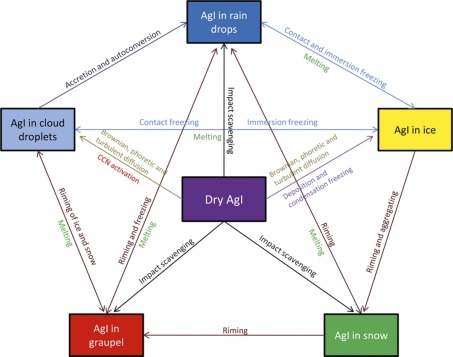
Figure above shows Schematic of the microphysical processes of AgI involved in cloud seeding.
These developments have enabled better comparisons of the model predicted cloud development after seeding and actual events within the cloud. Current models are even used in operational prediction of seeding outcome in the case of winter orographic clouds. Nevertheless, the predictions cannot yet be considered quantitative. A major reason for this is inadequate understanding of the natural ice nucleation mechanisms in orographic clouds. Thus, improvements in measurements, modeling, as well as statistical detection of the cloud seeding signals are still needed.
_
By introducing hygroscopic particles in warm clouds, cloud seeding increases the number of droplets, leading to enhanced coalescence and, ultimately, precipitation. In cold clouds, ice nucleation leads to rapid freezing, increasing the concentration of ice crystals and resulting in enhanced precipitation rates. Artificial seeding modifies cloud optical properties by changing the size, concentration, and phase of cloud particles. By enhancing droplet or crystal size, seeding affects cloud albedo, which impacts the cloud’s ability to reflect solar radiation. This property is important in climate models, as clouds with higher albedo have a cooling effect by reflecting more sunlight, while clouds with lower albedo have a warming effect. By altering the microphysical properties of clouds, seeding and nucleation can impact cloud lifetime. Hygroscopic seeding can increase the number of large droplets, which hastens the onset of precipitation and reduces cloud longevity. In contrast, ice nucleation may lead to the rapid glaciation of supercooled clouds, shortening their lifetime.
_
Ice nuclei (IN) and hygroscopic aerosols can invigorate cumulus clouds and influence rainfall. Seeding clouds with ice-forming nuclei like silver iodide (AgI) may increase cloud height and rainfall by releasing latent heat when droplets freeze, though large-scale trials show inconsistent results. High concentrations of cloud condensation nuclei (CCN) also impact cloud dynamics by creating numerous droplets that reach supercooled levels and freeze, boosting updrafts and rainfall, especially in warm maritime environments. Cloud seeding with silver iodide is a commonly used technique in weather modification. Silver iodide particles are dispersed into clouds either by ground-based generators or by aircraft. These particles serve as ice nuclei, which facilitate the formation of ice crystals within the cloud. As a result, the ice crystals can grow and eventually fall as precipitation, enhancing rainfall or snowfall. Hygroscopic flares involve the use of flares containing hygroscopic materials, such as potassium chloride or sodium chloride. These flares are ignited in the lower part of clouds, releasing the hygroscopic particles. The particles absorb moisture from the cloud, causing the cloud droplets to grow and potentially leading to increased rainfall.
_
Case Studies and Examples:
-1. SNOWIE Project: The SNOWIE (Seeded and Natural Orographic Wintertime Clouds: The Idaho Experiment) project used advanced radar and cloud-measuring technology to demonstrate that cloud seeding could produce significant snowfall. The study showed that seeded clouds produced enough snow to fill 282 Olympic-sized swimming pools over approximately two hours.
-2. Australian Snowy Mountains: Over five years, cloud seeding in Australia’s Snowy Mountains resulted in a 14% increase in snowfall. This project used silver iodide and demonstrated the effectiveness of cloud seeding in enhancing winter precipitation.
______
______
Debate about ice nucleation by AgI:
Freezing of water, a phase transition that affects all life on Earth, is typically initiated by heterogeneous ice nucleation on solid particles. While homogeneous ice nucleation in pure water to ice requires temperatures as low as −38°C, silver iodide (AgI) can trigger ice formation already at −4°C. This remarkable ice-nucleating efficiency has been attributed to the near-perfect lattice match (less than 2%) between the AgI and hexagonal ice basal planes. However, the lattice match alone is insufficient to explain the remarkable ice-nucleating ability.
_
Silver iodide has been used in atmospheric weather modification programs around the world for several decades. Silver iodide is the seeding agent of choice for cold clouds, although firms also deploy potassium chloride and dry ice. Reasoning that precipitation must be limited by the scarcity of natural ice nuclei in the air, Schaefer and Vonnegut in 1940s began atmospheric trials to inject artificial nuclei into clouds, and an industry was born. The researchers suggested that silver iodide was a good nucleating agent because its hexagonal crystalline lattice is nearly identical to the lattice that water molecules form in ice and snowflakes—one in which units of six water molecules assemble. But there is no basis for this claim because scientists have not yet established the exact mechanism of the freezing process. We still know rather little about the structures water forms as it transforms from the liquid to the solid state, particularly when this process happens at the surfaces of other materials such as silver iodide. Ice nucleation is hard to probe experimentally because current imaging instruments don’t produce clear pictures of individual molecules as they freeze.
_
American atmospheric scientist Bernard Vonnegut, who suggested in 1947 that introducing small silver iodide (AgI) crystals into a cloud could provide nuclei for ice to grow on. But this simple picture is not entirely accurate. The stumbling block is that nucleation occurs at the surface of a crystal, not inside it, and the atomic structure of an AgI surface differs significantly from its interior. To investigate further, Balajka and colleagues used high-resolution atomic force microscopy (AFM) and advanced computer simulations to study the atomic structure of 2‒3 nm diameter AgI crystals when they are broken into two pieces. The team’s measurements revealed that the surfaces of both freshly cleaved structures differed from those found inside the crystal. More specifically, when an AgI crystal is cleaved, the silver atoms end up on one side while the iodine atoms appear on the other. This has implications for ice growth, because while the silver side maintains a hexagonal arrangement that provides an ideal template for the growth of ice layers, the iodine side reconstructs into a rectangular pattern that no longer lattice-matches the hexagonal symmetry of ice crystals. The iodine side is therefore incompatible with the epitaxial growth of hexagonal ice. “Our works solves this decades-long controversy of the surface vs bulk structure of AgI, and shows that structural compatibility does matter,” Balajka says.
_
In 2009, Michaelides and his team collaborated with experimentalists at the University of Liverpool who used scanning tunneling microscopy to detect water freezing on a copper surface. The simulations run on the resulting imaging data provided strong evidence that the 1-nm-wide chains that formed on the copper surface were not built from water hexagons—the traditional ice lattice—but from groups of five water molecules bonded into pentagons (Nat. Mater. 2009, DOI: 10.1038/nmat2403). These results suggested that perhaps Schaefer and Vonnegut’s hypothesis about what makes silver iodide such a good nucleating agent wasn’t correct. So more recently, Michaelides and his team computationally designed a theoretical set of surfaces, varying the extent to which their crystal structures matched ice. Researchers have created nanoscale computer simulations that interpret results from physical images. The simulations predict the interactions between molecules on the basis of the rules of quantum mechanics. Allowing ice to nucleate on the surfaces via a computer simulation, the scientists found that there was no simple correlation between the similarity of a surface to ice and its ability to nucleate ice (J. Am. Chem. Soc. 2015, DOI: 10.1021/jacs.5b08748).
_
Similarly, a recent investigation of ice-nucleating bacteria also suggests that surfaces don’t have to match the structure of ice crystals in order to nudge water into its solid phase. Ski resorts dose their snowmaking machines with the bacteria Pseudomonas syringae because proteins on its surface freeze water at temperatures around the melting point of ice (0 °C). “Yet no one understood the molecular mechanism by which the proteins trigger freezing of water,” says Tobias Weidner, a physicist at the Max Planck Institute for Polymer Research. Weidner and his colleagues used sum frequency generation spectroscopy and computer simulations to demonstrate that the proteins on the outer membrane of the bacteria create alternating hydrophobic and hydrophilic sites (Sci. Adv. 2016, DOI: 10.1126/sciadv.1501630). This simple arrangement promotes ice crystal formation by manipulating water molecules into tight patterns of high and low density. If someone wanted to make a new cloud-seeding agent, maybe a polymer particle, “it might be possible to engineer this hydrophobic and hydrophilic pattern on a nanoscale,” Weidner says.
_
Vonnegut’s proposal that silver iodide is an effective ice-nucleating agent because it provides a hexagonal crystalline template similar to that of ice is now disputed. Findings of various studies are getting scientists closer to identifying what makes a good ice-nucleating agent and why. This will lead to a general theory that will have predictive value used to design and identify new materials we can control ice formation with.
______
______
Section-8
Cloud Seeding Technique and Technology:
The most common application of cloud seeding is to increase precipitation, possible with both warm and cold clouds. There are two primary methods employed to stimulate precipitation. One, hygroscopic seeding, affects warm cloud processes. The other, glaciogenic seeding initiates cold cloud processes. Figure below shows hygroscopic and glaciogenic seeding.
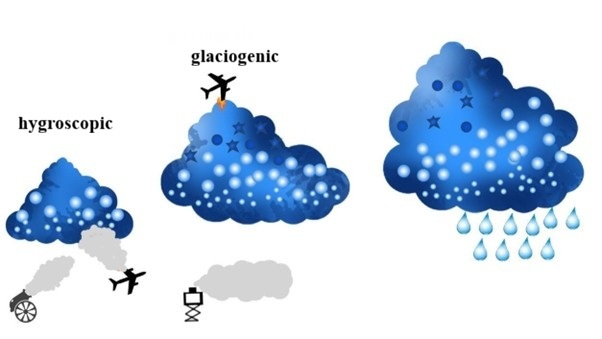
_
(A) Glaciogenic Seeding:
Seeding of clouds with appropriate ice nuclei (e.g., silver iodide) or cooling agent (e.g., dry ice, liquid propane) to create or enhance the formation of ice crystals, particularly the conversion of supercooled water to ice. The two general approaches are
-1. Static seeding, which focuses on microphysical processes; creation of ice crystals and particles; enhances graupel and snow production by increasing the number of ice particles and triggering precipitation process earlier in the cloud’s lifetime. Examples: Climax I and II; Israel; Project Whitetop.
-2. Dynamic seeding, which increases buoyancy of cloud by converting supercooled liquid drops to ice. The subsequent release of latent heat of fusion increases cloud buoyancy, cloud lifetime, and rain production. Examples: FACE I and II; Texas.
(B) Hygroscopic Seeding:
Enhance rainfall by seeding clouds with appropriately sized salt particles or droplets, promoting the coalescence process.
-1. Large hygroscopic particle seeding, which seeds clouds with large salt particles (e.g., >10 µm dry diameter) to short-circuit the condensation growth process and provide immediate raindrop embryos to start the coalescence process. Examples: Project Cloud Catcher, India, Thailand.
-2. Hygroscopic flare seeding, which focuses on broadening the initial drop spectrum during the nucleation process by seeding with larger than natural CCN (0.5µ to 3µ dry diameter) to enhance the coalescence process in warm and mixed-phase clouds. Examples: South Africa, Mexico experiments.
_
Who conducts Cloud Seeding?
In North America, cloud-seeding programs are conducted in California, Colorado, Idaho, Nevada, Utah, Wyoming, Kansas, North Dakota, and Texas, as well as Alberta, Canada. Cloud seeding is also conducted through major programs in the countries of Australia, Chile, China, France, Greece, India, Israel, UAE, Saudi Arabia, and Spain.
______
Glaciogenic Cloud Seeding:
This involves the injection of ice-producing materials into a super cooled cloud to stimulate precipitation by ice particle growth. The objective of glaciogenic seeding is to introduce seeding material that will produce the optimum concentration of ice crystals for precipitation formation. In a cloud with a temperature below freezing (0˚C), typically, silver iodide (AgI) is used as the seeding agent, and the seeding method is called glaciogenic seeding. Silver Iodide (AgI) is used as a cloud-seeding agent because it has a crystalline structure similar to an ice crystal; it acts as an effective ice nucleus at T = – 4˚C and lower. The idea is to trigger ice production in supercooled clouds and enhance precipitation. The seed particles (AgI pellets) will act as sites where water in the subzero temperatures (supercooled water) deposits and forms ice crystals. These ice crystals grow by depositing more water as well as colliding with other ice crystals falling from above. They further fall through the warmer temperatures and melt to form raindrops.
_
Glaciogenic cloud seeding typically involves dispersing effective ice nuclei, like silver iodide particles into the cloud to induce heterogeneous ice nucleation. An alternative option is to utilize liquid or solid carbon dioxide to locally briefly cool the air to −80°C. This will locally cause uniform freezing of droplets within the cloud, in contrast to heterogeneous or aerosol-mediated freezing. (Laaksonen and Malila 2021). Glaciogenic cloud seeding is typically utilized on convective clouds or winter orographic clouds because these cloud types are most suitable for the process of enhancing precipitation through ice crystal formation. Glaciogenic cloud seeding, designed for cold clouds (below freezing), primarily uses two methods: Static Seeding, and Dynamic Seeding.
_______
Static Cloud Seeding:
In static-mode seeding, two primary assumptions are typically held: that a lack of natural ice crystals leads to delays or even the failure of precipitation formation under specific cloud conditions; and that moderate rises in ice crystal concentrations, achieved through glaciogenic seeding of these clouds, will enhance rainfall either by improving the efficiency of the already existing rain formation process or by triggering precipitation in clouds that would not have precipitated on their own (Gagin 1986). This technique entails dispersing a substance such as silver iodide into clouds. The silver iodide acts as a nucleus for moisture to gather and form droplets. The clouds already contain moisture, but silver iodide effectively enhances the ability of rain clouds to release their water.
Physical studies and inferences drawn from statistical seeding experiments suggest that there exists more limited window of opportunity for precipitation enhancement by the static mode of cloud seeding than originally thought. The static mode of cloud seeding has been shown to cause the alterations in cloud microstructure including increased concentrations of ice crystals, reductions of super cooled liquid water content, and more rapid production of precipitation elements in both cumuli and orographic clouds. Recent experiments and basic physical modeling suggest that the window of opportunity for precipitation enhancement by this glaciogenic cloud seeding is limited to:
- clouds that are relatively cold based and continental;
- clouds having top temperatures in the range of -10°C to -25°C;
- a timeframe constrained by the presence of substantial supercooled water until it is depleted by entrainment and natural precipitation events.
This limited scope of opportunities for rainfall enhancement by the static mode of cloud seeding that has emerged in recent years may explain why some cloud seeding experiments have been successful while others have yielded inferred reductions in rainfall from seeded clouds or no effect. A successful experiment in one region does not guarantee that seeding in another region will be successful unless all environmental conditions are replicated as well as the methodology of seeding.
The temperature window is critical: at cloud temperatures colder than -25°C, natural ice crystal concentrations can be high, and seeding could produce too many small ice crystals, resulting in an “overseeded” cloud. Alternatively, seeding materials are less effective in nucleating crystals above -10°C. Timing is also important. If winds are weak, sufficient time may exist for natural precipitation processes to occur efficiently. Stronger winds may prohibit efficient natural precipitation, so seeding could speed up precipitation formation. But if the wind is too strong, seeded ice crystals will not have enough time to grow to precipitation before they are blown over the mountain crest and evaporate in the sinking subsaturated air on the lee side. Normally National Weather Service model forecasts and synoptic analyses of winds and temperatures are used to determine if conditions are optimum for seeding clouds.
The Seeding Process:
Most cloud-seeding operations use silver iodide (AgI), which has a crystalline structure similar to ice. Its ice-nucleating ability depends on the mode of generation, which typically is by acetone generators in which AgI is suspended in acetone. The acetone is burned, producing a smoke of IN. This method allows generators to be located on the ground where they can use natural turbulence to carry IN into the cloud.
Cloud seeding typically uses small quantities of silver iodide (AgI), ranging from 5–25 grams per hour for ground generators to a few kilograms per hour from aircraft. A single cloud seeding event often involves 10–100 grams of AgI. This, because one gram can produce up to 10^15 ice-forming nuclei, allowing for efficient cloud modification. Cloud seeding flares typically contain between 10 and 20 grams of silver iodide (AgI) per cartridge. Typically 2-4 flares are used per seeding event of a single cloud.
Seeding with liquid propane generators is also possible, relatively inexpensive, and suitable for remote computer-controlled generation. However, the generators must be located within the cloud to be effective; not all supercooled clouds reach the surface. Moreover, placement of generators at the tops of mountains is not feasible in designated wilderness areas.
______
Dynamic Cloud Seeding:
While the fundamental concept of the `static mode’ of cloud seeding is that precipitation can be increased in clouds by enhancing their precipitation efficiency, alterations in the dynamics or air motion in clouds due to latent heat release of growing ice particles, redistribution of condensed water, and evaporation of precipitation is also inevitable. Alterations in the dynamics of clouds, however, is not the primary aim of the strategy. By contrast, the focus of the `dynamic mode’ of cloud seeding is to enhance the vertical air currents in clouds and thereby vertically process more water through the clouds resulting in increased precipitation. The main difference in implementation of the strategy is that larger amounts of seeding material are introduced into clouds. A goal in the static mode of seeding is to achieve something like 1 to 10 ice crystals per liter at temperatures warmer than -15C. In the dynamic mode of seeding the target ice crystal concentration is more like 100 to 1000 ice crystals per liter, which corresponds to seeding as much as 200 to 1000 g of silver iodide in flares dropped directly into the high supercooled liquid water content updrafts of cumuli.
The idea of dynamic seeding involves introducing adequate ice nuclei into cold clouds to quickly cause them to freeze. Because of seeding, the liquid water in the cold cloud transforms into ice particles, which releases latent heat. It boosts buoyancy and consequently elevates the cloud’s upward movement. In optimal circumstances, it leads to increased cloud formation, higher water vapor levels, and enhanced precipitation outcomes. Moreover, the formation of precipitation can lead to stronger downward movement and engagement with the convective surroundings. The procedure is regarded as more intricate than static cloud seeding since it relies on a series of events functioning correctly. Dr. William R. Cotton, a professor of atmospheric science at Colorado State University, and other researchers break down dynamic cloud seeding into 11 separate stages. An unexpected outcome in one stage could ruin the entire process, making the technique less dependable than static cloud seeding. Dynamic cloud seeding can enhance both the depth of clouds and the intensity and duration of rainfall. This can be achieved by spreading chemicals using aircraft or through devices located on the ground (Gagin 1986). For instance, aircraft can ignite and spread silver iodide flares as it navigates through a cloud.
In a pioneering study of dynamical cloud seeding conducted in west Texas by Rosenfeld and Woodley in 1993, the examination of 183 convective cells indicated that seeding boosted the maximum cloud height by 7%, the cell areas by 43%, the durations by 36%, and the rain volumes of the cells by 130%. In general, the findings are promising; however, these minor enhancements in the vertical growth of the clouds do not align well with previous exploratory seeding studies (Rosenfeld et al. 2010).
_____
_____
Hygroscopic Cloud Seeding:
Hygroscopic seeding involves introducing seed particles close to the base of convective clouds to either promote or diminish precipitation via several intricate microphysical processes. Initial experiments (in South Africa, India, Thailand, and Mexico) established the basis for hygroscopic seeding (Gayatri et al., 2023). This method of weather modification is designed to accelerate droplet coalescence in warm liquid clouds, resulting in the formation of larger droplets that initiate precipitation (Renggono et al., 2022). Cloud seeding materials usually contain large salt particles of various compositions, with particle size varying based on the injection technique (e.g., ground salt particles, combustion flares); however, a particle diameter of a few micrometers is generally regarded as ideal for increasing rainfall (Tonttila et al., 2022). These particles spread through ground-based generators or flares. Ground-based generators may utilize air-based dispersion systems for salt powders or pyrotechnic flares. They are usually utilized in mountainous areas where the relative humidity exceeds 50%. Flares may include various kinds of salts, like potassium or calcium.
Hygroscopic seeding is used in warm or mixed-phase clouds. Cloud seeder disperses salt powder milled to 2 to 5 microns (for optimal hygroscopic seeding) that are injected into a cloud to increase the concentration of “collector drops” that can grow into raindrops by collecting smaller droplets and enhancing the formation of frozen raindrops and graupel (snow-like ice) particles. This method of seeding may also be effective in wintertime orographic clouds because it may counteract the negative influences on precipitation of high concentrations of CCN in polluted airmasses.
The term ―hygroscopic seeding has been associated with warm cloud seeding. The objective is to enhance rainfall by promoting the coalescence process using hygroscopic salt nuclei generated by pyrotechnic flare or a fine spray of highly concentrated salt solution. In addition, Cooper et al. illustrated that hygroscopic seeding might have a beneficial effect on precipitation development through either of two distinct mechanisms:
(i) Introduction of embryos on which raindrops form.
(ii) Broadening of the initial droplet size distribution resulting in acceleration of all stages of the coalescence process.
In 1990, G. Mather reported a case of inadvertent seeding of clouds by hygroscopic particles emitted from Kraft Mill in South Africa that resulted in enhanced coalescence and rainfall. This observation led to further hygroscopic cloud seeding experiments in South Africa, Thailand, Mexico and India with highly encouraging results. Additional experiments have been conducted more recently in Texas using powdered salt having particle diameters of 2 to 5 microns.
_
Hygroscopic seeding for rain enhancement in convective clouds is aimed at accelerating auto-conversion (i.e., the conversion of cloud water to precipitation). This was reviewed extensively by Bruintjes (1999) and Silverman (2003). Three main conceptual models have guided the hygroscopic-seeding experiments.
(1) The rain embryo particles: seeding with ultra-giant cloud condensation nuclei (UGCCN; size 10µ), which serve as embryos for raindrops. This has been done by dumping milled salts from aircraft into the clouds. Because of their large particle sizes, hundreds of kilograms–tons of salts had to be used to have a detectable signal on the rainfall (Braham et al. 1957; Biswas and Dennis 1971; Silverman and Sukarnjanaset 2000). The salt powder– seeding method is more productive by two orders of magnitude than the hygroscopic flares in producing GCCN that can initiate rain in clouds with naturally suppressed warm rain processes, because of a combination of change in the particle size distribution and the greater seeding rate that is practical with the powder.
(2) The competition effect: seeding with large CCN (LCCN; diameter near 1µ) for greater competition for the vapor, decreasing peak super saturation at cloud base, and hence reducing cloud drop number concentrations and broadening the drop size distribution (DSD). This causes larger drops that coalesce faster into raindrops (Cooper et al. 1997).
(3) The tail effect: seeding with giant CCN (GCCN; between 1 and 10 µ) adds drops to the large tail end of the cloud drop size distribution, and hence accelerates the further widening of the DSD and leads to the formation of raindrops (Segal et al. 2004). Model simulations (Segal et al. 2007) show that seeding with large and giant CCN accelerates the auto-conversion, mainly by the tail effect with very little contribution from the competition effect.
Accelerating the auto-conversion can produce rain showers from clouds that are too shallow to precipitate naturally, as has been demonstrated by Biswas and Dennis (1971). However, too fast acceleration of auto-conversion in clouds with warm bases induces early warm rain without release of the latent heat of freezing, which leads to a greater reduction of rainfall later in the life cycle of the cloud [see Rosenfeld et al. (2008a) and references therein].
_
Considerations for effectiveness of hygroscopic seeding:
Hygroscopic seeding of shallow clouds has less potential to add significant amounts of water than deeper clouds because of the smaller fraction of vapor that condenses in these clouds. Therefore, the added water in very shallow clouds can be rather small even if the seeding is very successful in terms of percentage increase. For example, the average rain volume from the experimental units in the warm cloud hygroscopic-seeding experiment in Thailand was 10^5 m3 (Silverman and Sukarnjanaset 2000), whereas the rain volume within the identically defined experimental units in the cold cloud glaciogenic seeding experiment in the same area was on the average about 6 X 10^7 m3 (Woodley et al. 2003). This rain produced by cumulonimbus convection is a factor of 600 more than by warm rain clouds. Therefore, from a practical standpoint, hygroscopic seeding should address the deep convective clouds that can reach cumulonimbus stature. This means that the impacts of hygroscopic seeding on the mixed-phase precipitation forming processes must be addressed.
To avoid the possible negative effects of early warm rain (Rosenfeld et al. 2008a) due to hygroscopic seeding of convective clouds that reach the freezing level, hygroscopic seeding of such clouds should not be done in a way that would cause such early warm rainfall. Because seeding with UGCCN creates raindrops already very low in the cloud (Johnson 1982), using UGCCN is probably not a good idea in deep convective clouds. Seeding with LCCN and GCCN appears more appropriate, because it would increase the general population of the cloud drops and widen the DSD that reach the supercooled levels without premature warm rain.
Hygroscopic-seeding experiments have been done in deep continental convective clouds that extend well above the 8 C isotherm level in South Africa (Matheretal. 1997) and Mexico (World Meteorological Organization 2000). Therefore, the hygroscopic-seeding effects on the mixed phase have to be considered. It has been postulated that enhancement of coalescence in supercooled clouds can enhance also the ice precipitation processes (Braham1964). Ice is produced faster in clouds with larger drops (Hobbs and Rangno 1985). Larger cloud drops are rimed more effectively on ice crystals and graupel, thereby accelerating the growth of these hydrometeors and expediting the conversion from cloud water to ice. The enhanced rate of freezing of clouds with larger cloud and raindrops was postulated to produce dynamic invigoration of the updraft, prolong the precipitation, and enhance the volumetric rain production of the cloud (Rosenfeld and Woodley 1993).
_
During the dry season (i.e., October to April) in Taiwan, clouds are typically warm and relatively shallow, with a cloud base around 500 m above mean sea level. Therefore, the warm-cloud seeding method specifically, hygroscopic cloud seeding is primarily used (Lin et al., 2023). Hygroscopic cloud seeding aims to increase the mean droplet diameter and enhance the precipitation amount by efficient cloud condensation nuclei (CCN) and giant cloud condensation nuclei (GCCN: diameter > 1 μm), which plays a crucial role in strengthening the condensation and collision–coalescence process (Feingold et al., 1999; Jensen and Lee, 2008; Lehahn et al., 2011; Dadashazar et al., 2017; Jensen and Nugent, 2017; Jung et al., 2015; Tessendorf et al., 2021; Lin et al., 2023). Segal et al. (2004) depicted that the larger hygroscopic particles can more efficiently widen the drop size distribution (DSD), known as the tail effect, whereas lots of smaller particles can compete for water vapor and cause the number of small raindrops, known as the competition effect. According to several research studies (Silverman and Sukarnjanaset, 2000; Tonttila et al., 2021), the process of hygroscopic cloud seeding, from the spreading of seeding agents to the development of rainfall, typically requires approximately 10–20 min.
_
Warm-Cloud Hygroscopic Seeding in India:
Method: Disperse hygroscopic salts (e.g., NaCl) into warm clouds (above 0 °C) to enhance droplet growth via collision-coalescence.
Agent: Sodium chloride or other salts.
Cloud Selection: Warm cumulus clouds with liquid water content > 0.5 g/m³ and vertical thickness > 1 km. Indian experiments in Pune region showed ~24 % increase.
_______
_______
Winter Orographic Cloud Seeding:
In its most basic form, artificial seeding of clouds for precipitation enhancement can be divided into two broad categories: 1 – cloud seeding to enhance rainfall i.e. summer convection, 2 – winter orographic cloud seeding to enhance snowfall. Here I am discussing the latter. Winter orographic cloud seeding occurs when very small particles, typically silver iodide, are introduced into a cloud which is below freezing. The cloud moisture collects onto the small particles, freezing the moisture into tiny ice crystals which continue to grow until they become too heavy to remain in the cloud and then fall out as precipitation (typically snow). This process can happen rapidly on the windward slopes of mountains allowing the snow to fall near the crest of the mountain which causes a local enhancement to the amount of precipitation that would have fallen naturally as seen in figure below.
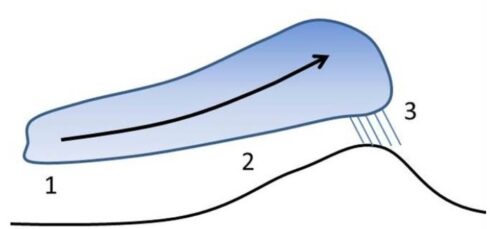
(1) – Introduction of seeding material, (2) forced ascent due to topography, (3) – enhanced precipitation falling out of cloud. Winter orographic seeding has been attempted by Government organizations, the scientific community and private industry. Currently there are many private companies actively involved in both winter orographic cloud seeding and summer convective cloud seeding.
_
Compelling evidence suggests that seeding supercooled orographic clouds, those formed by air lifting over mountains, can increase precipitation on the ground and cause significant increases in the snowpack. Although the amounts of precipitation increase are under debate, a 10 percent increase is conservatively estimated.
In the Colorado River Basin, we focus on glaciogenic seeding (using ice-forming materials) of winter orographic clouds because the strongest scientific evidence that seeding can increase precipitation comes from this method. In addition, western reservoirs are replenished primarily from snowmelt, derived largely from snowfall from winter orographic clouds, when conditions minimize losses to evaporation. In contrast, rainfall from summer convective clouds contributes much less to reservoirs, as it is largely absorbed locally by vegetation and lost via evaporation and evapotranspiration.
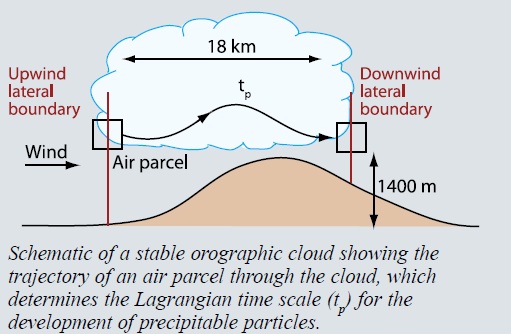
Figure above shows schematic of a stable orographic cloud showing the trajectory of an air parcel through the cloud, which determines the Lagrangian time scale (tp) for the development of precipitable particles. The Lagrangian timescale represents the time over which the velocity of a particle is self-correlated. It is roughly the time over which a particle maintains its initial velocity before experiencing a turbulent “collision”.
The figure above illustrates the formation of an orographic cloud as air is forced to lift in order to pass over mountains. Updraft velocities, which can be several meters per second, depend upon the speed and direction of the wind and the height of the barrier. Orographic clouds may be quite transitory, although with steady winds, they can last for hours. Precipitation can form in the time it takes the air parcel to move from the upwind lateral boundary to the downwind boundary, typically around 20 minutes. Because stable, wintertime orographic clouds have low liquid water content, usually less than 0.5 grams per kilogram, precipitation production requires efficient conversion of cloud droplets to precipitation.
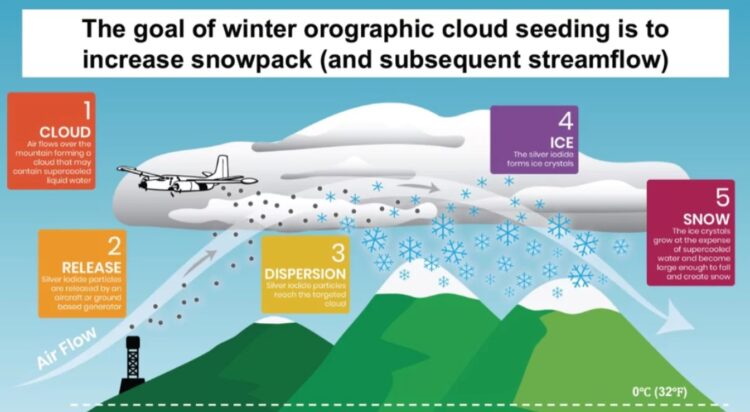
The goal of seeding these clouds is to reduce the timescale of precipitation formation so that precipitation is optimized on the upwind side of the mountain crest. Orographic clouds offer several advantages over cumulus clouds for seeding: they are persistent and produce precipitation even in the absence of large-scale meteorological disturbances, and much of the precipitation is spatially confined to high mountainous regions, simplifying set-up of ground-based seeding and observational networks.
______
______
Effective ways of dispensing seed particles in the clouds:
Targeting Clouds:
Effective cloud seeding requires careful selection and targeting of suitable cloud systems. Meteorologists use a combination of satellite imagery, radar data, and atmospheric modeling to identify clouds with optimal characteristics for seeding. Factors such as cloud type, altitude, temperature, and moisture content are taken into account when determining seeding targets.
_
Cloud seeding operations rely on specialized delivery mechanisms to disperse seeding agents into target clouds effectively. These mechanisms include:
- Aircraft seeding: Fixed-wing aircraft or drones equipped with dispensing systems for releasing seeding agents into clouds at specific altitudes and locations.
- Ground-based generators: Stationary devices that emit seeding agents into the atmosphere, often positioned in strategic locations to target passing clouds.
- Remote sensing and control systems: Advanced technologies for monitoring cloud parameters, analyzing weather data, and remotely triggering seeding operations based on predetermined criteria.
______
Aerial Cloud Seeding:
Aerial cloud seeding is the process of delivering a seeding agent by aircraft – either at the cloud base or cloud top. Top seeding allows for direct injection of the seeding agent into the supercooled cloud top. Base seeding is the release of the seeding agent in the updraft of a cloud base. Typically, aerial cloud seeding is the most effective way to accurately target a particular cloud because it allows for close proximity to the potential cloud candidates.
_
Cloud seeding is done by burning flares near the cloud base or within the cloud. Flares and ground-based burners or ground-based artillery are used in various countries for cloud seeding. Ground-based systems are reported to be less efficient in introducing seed material into clouds. The most efficient way is using an aircraft equipped with flares on its wings (called burn-in place: BIP) and below the fuselage (ejectable: EJ) as seen in figure below.
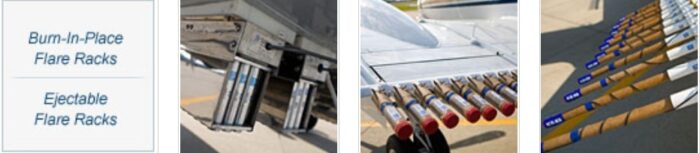
Aerial-Cloud Seeding is anticipated to contribute the largest share of the market owing to its ease to cover large areas in a short span of time. Aerial cloud seeding offers greater success rates. Aerial cloud seeding is the most effective way of seeding clouds, particularly at higher altitudes. Unlike ground-based methods, aerial cloud seeding allows greater control and flexibility to achieve desired results. Aerial cloud seeding targets specific clouds at different altitudes to achieve the right amount of moisture, temperature, and wing conditions.
Cloud seeding materials are released in the form of flares. The flares are released into convective clouds under the guidance of licensed meteorologists, who communicate with pilots in real time to ensure optimal placement based on live weather data.
Burn-In-Place wing mounted flares emit a fine silver iodide smoke directly into the cloud during flight. The flares are released directly in the cloud when the plane flies through the cloud, for as long as conditions remain suitable for the aircraft safety and for seeding to occur.
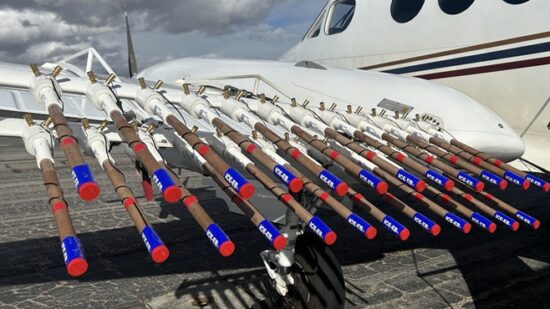
Figure above shows Wing Mounted “Burn-In-Place” (BIP) Flares.
_
Ejectable, belly mounted flares (EJ) are released into the cloud when the plane flies above the cloud; the aircraft drops seeding material into the cloud system by ejecting it from the belly of the plane. This is used when the conditions in the cloud present too hazardous for the aircraft and its crew.
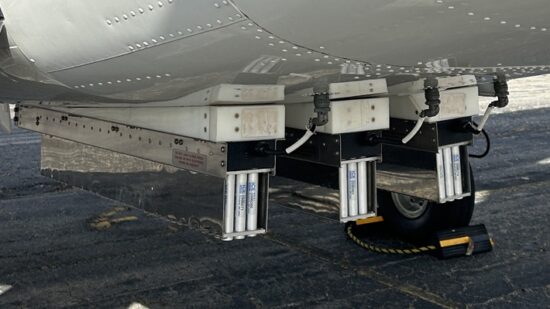
Figure above shows Belly Mounted Ejectable (Ej) Flares.
_
Cloud seeding aircraft will be a modified aircraft that will have flare racks attached beneath both wings and there will be triggering electronic circuits inside the plane. Pilots will ignite the flares with the electronic switch. The minimum Specifications (in India) of the seeder aircraft can be the following:
|
Parameter |
Specification (at maximum gross weight) |
|
Minimum lowest operating altitude |
500-1000 ft AMSL |
|
Minimum highest operating altitude |
25000 to 28000 ft AMSL with full load and full fuel (Note: The aircraft should be able to do the cloud top seeding) |
|
Sampling Speed |
60-120 m/s |
|
Ascent rate |
400 – 500 ft /min |
|
Endurance |
4 – 5 hours |
|
Range |
2000 km minimum |
|
Special requirements |
Air inlets (isokinetic inlet and reverse flow inlet) instrument racks |
|
Instruments |
Certification for listed instrument inlets and related modifications |
|
Research power |
> 5kW at 28VDC > 2kW at 220VAC 60Hz > 1kW at 115VAC 60Hz |
A series of permissions for importing and operating the aircraft etc. are needed. The set of permissions is from various authorities (in India) such as DGCA, AAI, DRI, MHA, Customs, Ministry of Defense, Regional and local airport authorities, local law enforcement, etc.
_
Aerial cloud seeding is the most effective way of seeding clouds, particularly at higher altitudes. Aircraft spray iodide substances using specialised flares at different altitudes depending on the type of cloud and availability of moisture. Aerial cloud seeding is performed for a variety of reasons, including recharging groundwater supplies in desert regions, fighting droughts, or minimising the impact of wildfires.
Aerial cloud seeding programs generally utilise General Aviation (GA) aircraft because of their flexibility and aftermarket modification capabilities. A range of aircraft types, including fixed-wing, turboprops, and remotely controlled unmanned aerial vehicles (UAVs), can be configured for cloud seeding missions. The type selection depends on the capability, seeding technology, desired outcome, and environmental constraints.
The common types of aircraft used for cloud seeding are Beechcraft King Air, Cessna Caravan, and Piper Seneca II. With the ability to fly at higher speeds and altitudes, these aircraft offer greater effectiveness at diverse locations.
The modified Beechcraft King Air 260/350 is the most commonly used type for cloud seeding, thanks to its design and adaptability for weather and atmospheric research. Fargo Jet Center, an expert in aircraft modification for special missions, has modified more than 100 King Air 350s, installing specialised equipment for aerial dispersion and measurement missions.
_
Rocket and Drone Seeding:
In recent years, advancements in technology have led to the development of rocket and drone-based cloud seeding techniques. Rockets equipped with seeding payloads can be launched into clouds from the ground, while drones offer the flexibility to access and seed clouds in remote or challenging terrain. These innovative approaches enhance the precision and efficiency of cloud seeding operations, opening up new possibilities for weather modification.
_______
Ground-Based Cloud Seeding:
There are times when it’s beneficial to seed from the ground. For example, ground seeding is an excellent option for the treatment of low-level clouds over complex terrain. In some cases, seeding from fixed locations is acceptable; in others, mobility is needed. There are specially designed and manufactured solutions to meet the specific challenges of ground-based cloud seeding. Both incorporate the latest in ground-based pyrotechnic applications, and are self-contained. When controlled via satellite, they can be sited virtually anywhere. When weather at the seeding location is critical, complete meteorological stations can be co-located with both fixed and mobile ground-based units:
Ground-Based Seeding Generator:
There are two types of ground-based generators: Remote Controlled Ground-Based Generators and Manual Ground-Based Generators. These solution-burning ice nuclei generators are most often used to seed orographic clouds in areas of rugged topography.
Remote Controlled Ground-Based Seeding Generators:
The remote system utilizes a communication link, such as Iridium. The method of communication is determined by the location, and the data link is integrated with the microprocessor for complete remote control. A centrally located computer provides real-time control of the system, including access to system status and weather station data. This rugged system is designed to withstand the extremes of any storm system that may pass over the site. They are constructed to function even in extreme rime icing and operate under the most demanding of weather conditions.
Manual Ground-Based Seeding Generators:
The manual system is similar to the remote system, except there is no need for communication link, microprocessor or weather data collection equipment. The relatively simple task of operating the valves and switches is performed onsite.
Ground-Based Flare Tree:
Cost-effective, simple to maintain and easy to install, the ground-based flare tree, or GBFT, comes in two versions to accommodate different flare types: glaciogenic (108 flares) and hygroscopic (60 flares). All designs offer remote, real-time control of the system, utilizing cellular/satellite technology in conjunction with microprocessor technology.
_
The major problem with artillery firing from the ground is that often the target cloud is missed, especially when the clouds are small, and updrafts are in a narrow region. The ground-based flares may be applicable if the cloud bases are closer to the ground. The released seed particles from the ground-based burners get dispersed in the boundary layer and may also form an environmental issue. In the case of airborne seeding, the cloud seeding flares are fitted in the racks attached to the wings of the aircraft and are the most effective way to dispense seed particles at the cloud base.
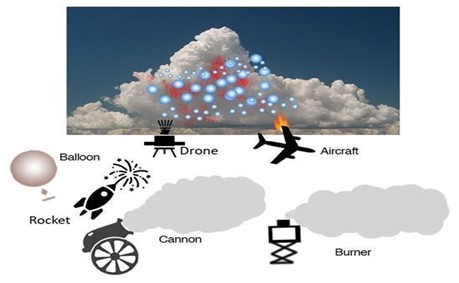
Figure above shows different seed dispersal methods (Rockets, artillery, drone or aircraft mounted flares, ground-based flares or burners and balloons)
_______
_______
Ground Releases:
Flow over complex terrain is not a simple and straightforward problem therefore making targeting a challenge. Trying to disperse AgI from ground based generators has proven to be very difficult (Super and Heimbach 2005). There are two critical issues here. One is whether a parcel of air starting out near the foothills or a valley location will be carried over the mountain in the prevailing wind direction or whether it will flow around the mountain. This is determined by the static stability of the air mass and the strength of the flow perpendicular to the mountain, often noted by the Froude number. When the velocity of the flow is strong enough to overcome the air parcels static stability, a Froude number greater than 1 is produced, meaning the parcel of air will pass over the mountain and not flow around the mountain. The depth of the boundary layer is also very important as ground based cloud seeding efforts are located within this layer. If AgI is released below cloud or at temperatures warmer than -5 C, the aerosol will have to be carried up into the cloud to a level where the temperature is colder than -8 C. If the boundary layer is shallow and does not allow the aerosol to reach the appropriate temperature level or that level is reached very near the crest of the mountain, there will be no impact on the windward slopes of the mountain. The depth of the boundary layer is a function of low level wind shear (Xue 2014), which is the change in direction or velocity of wind with height. The stronger the wind shear, the greater the depth of the boundary layer. Strong low level flow perpendicular to the mountain, along with strong wind shear and at times weak embedded convection, will provide the mechanism for lifting the aerosol up the mountain. This allows dispersal of the aerosol to seed more cloud volume. If the temperatures are cold enough and SLW is continuous, an increase in snowfall will occur on the windward slopes and increase the precipitation efficiency of the orographic cloud. The targeting issue has been described by many weather modification researchers (Super and Heimbach 2005; Reynolds 1988; Warburton et al. 1995a and b) as the single most critical issue that has compromised the success of both operational as well as research field projects. Again, reason to emphasize that effective cloud seeding is an engineering problem.
It has been shown that ample seeded crystals with sufficient concentration need to be dispersed so that a substantial volume of cloud over the target is treated for more than trace snowfall rates to occur (Super 2005; Huggins 2009). The seeding material must be injected into the SLW in sufficient quantities to generate 50 to 100/L or more initial ice embryos. This will then utilize the available SLW and fall out of the cloud prior to the snowflakes passing over the summit of the mountain and sublimating in the lee of the mountain.
_
Seeding from Valley Locations:
Many operational cloud seeding projects have placed AgI generators in valley locations as they are easily accessible and can be manually ignited when needed. However, a considerable body of evidence indicates valley released AgI plumes are often trapped by stable air (high static stability), especially when valley-based inversions are present (Langer et al. 1967; Rhea 1969; Super 2005). Often times in past projects AgI plumes from valley located generators were not tracked sufficiently to determine exactly where the aerosol plumes drifted (Smith and Heffernan 1967; Super 2005). This is a recurring issue that has been raised in many winter orographic cloud seeding review articles (Rango 1986; Reynolds 1988; Super 2005; Hunter 2007; Huggins 2009). The aerosols may pool in the valley or may move in a direction around the mountain, only to be carried aloft when the static stability of the airmass decreases and low level winds increase. This usually occurs near and behind the surface cold fronts associated with winter storms. Thus, the AgI aerosol may travel far distances from the intended target and have unintended effects farther downwind.
_
Seeding from High Elevation Locations:
Many studies suggest that seeding plumes released between half-to-two-thirds up the windward slope of the barrier routinely transport the seeding material over the mountain crest given favorable winds (Super 1974; Holroyd et al. 1988; Super and Heimbach 1988; Holroyd et al. 1995; Super and Heimbach 2005a). Super (1970) reported that AgI generators need to be placed at least halfway up the windward slope to be above the inversion commonly found in the Bridger Range of MT. The Bridger Range Experiment (Super and Heimbach,1983) proved successful in routinely seeding clouds by placing AgI generators two-thirds of the way up the windward slope (Super 1974; Heimbach and Super 1988; Super and Heimbach 1988). This however does reduce the time available for the crystals to grow and fallout prior to passing over the intended target. If the AgI generators are in cloud or above ice saturation, then the AgI will be fast acting in terms of nucleation and reduce the lag time between release and ice crystal formation (Pitter and Finnegan 1987).
______
Seeding from Airplanes:
Seeding by aircraft can be an alternative mechanism in locations where there is insufficient time to activate the seeding agent and grow the crystals to sufficient size for fallout to occur on the windward slopes of the barrier. These situations mainly occur within coastal mountains where the SLW near the crest of the mountain is only slightly sub-cooled. Typically the clouds extend up to a kilometer above and well upwind of the crest such that cloud top temperatures are -6 C to -8 C or colder. In these situations, the aircraft can fly in the tops of the clouds and either drop crushed dry ice, AgI droppable flares, or ignite AgI wing-tip generators or stationary flares that will directly inject the seeding material into the cloud. Using crushed dry ice or droppable flares will create a curtain of ice crystals some 1000 m below the aircraft. This will spread at a rate of 1-2 m/s dependent upon the amount of vertical wind shear (Hill 1980; Reynolds 1988). For these seeding curtains to merge together over the intended target area, the length of the seed line cannot be more than 30 to 40 km long (Deshler et al. 1990). However, the watershed of a large river basin can be several hundred kilometers wide. One aircraft will treat only a small portion of the watershed. In addition, the duration of the seeding aircraft is usually about 2 to 4 hours, with the possibility of the aircraft having to descend to deice several times during the seeding mission. Aircraft operations are also expensive. For these reasons, many operational seeding programs use ground based seeding platforms, even if they are only viable a small percentage of the time.
_____
Sampling:
It is possible to take samples in the spring snowpack to determine if silver concentrations exceed normal background levels when AgI is used as the seeding agent (Warburton 1969; Warburton 1996). The method takes a vertical profile of 2 cm samples in various locations throughout the intended target area. The depth of the sample can be related back to particular precipitation events utilizing a nearby snow gage precipitation record. Samples associated with seeding events can be analyzed for silver content above a background level determined for samples taken prior to seeding occurring. If silver is found above background levels it only indicates that silver from the seeding fell out in the target area. It does not differentiate as to whether the silver acted as active ice nuclei or was simply scavenged by natural snowflakes and precipitated out in the target area. Silver in snow analyses performed over many different geographic locations in the western US after seasonal seeding with ground-based AgI generators have shown just a small percentage, 10-20%, of the samples having silver content above natural backgrounds (Warburton 1995 a,b; Reynolds et al . 1989; Long 1984; Super et al. 2003). Samples taken during a winter season (Warburton, 1995b) within PG&Es Lake Almanor project, where Mooney and Lunn (1969) had reported statistically significant increases in snowfall during what was classified as “cold-westerly” wind cases, found 42% of the westerly wind cases had silver in snow above background levels. However, 80% of all seeded cases lacked evidence of silver in snow. There are three projects that stand out as having been successful in targeting ground based AgI: McGurty (1999) for the So Cal Edison project near Bear Creek in the San Joaquin drainage; Huggins (2006) for the Tahoe-Truckee and Walker river basins; and Manton et al (2011) for the Snowy Mountains of Australia. These projects reported between 70% and 100% of the 2 cm samples taken within the target area had AgI above background levels.
A non-nucleating aerosol can be co-released with the AgI ground generator plume in order to determine if the AgI seeding agent actively participated in the precipitation process. The tracers tested have been rubidium and indium susquioxide. This has been done in the Walker Carson basin of Nevada, the upper American in California and in Australia’s Snowy Mountain project.
Other sampling methods to determine successful targeting have utilized an ice nucleus counter mounted either in a vehicle or, most commonly, on an aircraft (Super and Heimbach 2005 Appendix B). The most important conclusions reached in this analysis state that AgI generators located halfway-to-two-thirds up the windward slope of the intended mountain will be much more successful in impacting the target area.
When AgI is not used as the seeding agent, other tracers may be utilized to determine the transport and dispersion of the seeding agent. Sulfur hexafluoride, SF6 , has proven to be a very effective tracer when propane has been released from the ground (Reynolds 1996). Samples can be taken either using sequential syringe samplers at surface locations within the intended target area, (Krasnec et al. 1984), or a continuous SF6 sampler can be mounted on an aircraft (Stith et al. 1987; Reynolds 1996) that can fly downwind of the release points to monitor the vertical and horizontal dispersion of the trace gas that acts as a proxy for the seeding produced ice crystals.
Another method that has been used to try to tag air parcels that would emulate the seeding plume is the use of chaff (Reinking et al. 1999). Chaff are very small aluminum particles that are highly reflective to weather radars. Chaff is used routinely by the military as a countermeasure to radar surveillance. The chaff particles are suspended in the air and carried with the wind, similar to a seeded volume of air. While this has not obtained wide-spread use, it was identified in the NRC 2003 report as a potential tracer for transport and dispersion studies.
_____
Extended Area Effects from Winter Orographic Cloud Seeding:
Hunter (2009) prepared an extensive literature review of the current state of knowledge on extra or extended area effects from winter orographic cloud seeding. The main impetus for this report was to present any documented evidence that determined that seeding on one mountain barrier resulted in a possible reduction of the amount of precipitation downwind. This has been coined “Robbing Peter to pay Paul”. In every case, the seeding agent was silver iodide. These results indicate that once the AgI nuclei are released into the atmosphere, they can remain active for many hours, if not several days. If pooled in high concentrations, the AgI nuclei can seed areas well away from the intended target areas. However, the impacts of these extra-area effects are just as uncertain as the increase documented in the primary target areas. That is, without strong physical observations to compare with rigorous statistical analyses, there is still a significant level of uncertainty as to the efficacy of seeding with AgI to increase precipitation within large areas outside the intended target area.
________
Suitability of seed particles:
The seed particles could be tested with several instruments available and can check their suitability for cloud formation. Seed particles could be improved by studying the aerosol composition and their hygroscopicity and CCN activity (how the particles can form cloud droplets under increasing saturation above 100% as inside the cloud). These parameters are important to decide on the efficacy of the seed particles to form cloud droplets. These parameters depend on the particle size and the chemical composition/coating on the seed particles. For e.g. Potassium iodide, sodium chloride, and calcium chloride have a natural affinity for water vapour (high hygroscopicity). The seed particles are supposed to be of higher hygroscopicity compared to the particles in the ambient air that will readily form cloud droplets. The size of particles has a crucial role as larger size particles will form cloud droplets easily due to a large surface area on them. Sea salt for e.g. is a good CCN due to its large size and hygroscopicity. It is important to understand the particle size and composition before choosing the seed particle.
The AgI pellets are traditionally used in glaciogenic seeding where the particles act as ice nucleation particles. Burning of AgI with acetone may make it more hygroscopic and could act as a hygroscopic seeding agent, first acting on shallow warm cloud layers (and may also act as ice nuclei). The introduction of these seeding particles is expected to increase the chances of rain formation through quick pathways such as collision coalescence or ice formation processes (such as deposition or rimming and rain or snow forming through the chains of microphysical processes).
_
Typically cloud seeding is done with flares (pyrotechnic material together with a burning agent which is compressed inside a tube encase) attached to the wings of an aircraft. These flares dispense the seeding material at the cloud base or within clouds. Typically 2-4 flares are used per seeding event of a single cloud. The flares contain several thousands of seed particles within a cubic centimeter of air. Hygroscopic flares contain sodium chloride or calcium chloride, producing small salt particles in the size range 2 to 5 micrometer diameter. The flares are in cardboard containers (12 cm long 7 cm diameter) and get triggered while attached to the wings. The Glaciogenic flares are in thin tubing containing ice-nucleating Silver iodide (AgI), which can form ice particles in clouds. The linear burning rate of the flare is ~ 0.66 mm per second. Clouds have varied liquid water in them, and some clouds may have only ice in them. The glaciated clouds are not suitable for seeding. There has to be liquid water in the cloud for any type of seeding.
_
Practical difficulties during seeding?
One major aspect is that clouds grow rather rapidly and we need to target clouds in the early part of their growth before they start raining. The seeding in raining clouds will wash out seed particles into the boundary layer and will not serve the purpose. So, one needs to decide the correct time to intervene. The pilot needs to be well trained and knowledgeable about the way to seed near the cloud base in the updrafts and also be proactive in the requirements. There are several safety needs as flying in the upper-level clouds can lead to icing on the aircraft, which is hazardous. Several precautions need to be taken for the proper conduct of the experiment and a coordinated effort is needed. One should also know the correct details of weather conditions and any imminent severe weather, which may be of concern for safety. Another aviation safety concern is regarding birds.
_______
_______
Brief description of Cloud Seeding Technology:
Cloud seeding mainly requires advanced equipment and facilities, including aircraft, a meteorological station network to monitor the clouds, a rainfall monitoring ground network, a network for data collection and processing, and a satellite image transmission networks. Materials used for cloud seeding include silver iodide (in the form of pyro-technique), azotic cooling liquid, dry ice (CO2) and propane. Cooling materials and silver iodide are usually used at a concentration of 2%, for seeding clouds with a graded microstructure. Dispensing the material from the top of the cloud produces better results than dispensing it from the bottom. This is typically done by airplanes or ground generators, with the goal of facilitating the optimal distribution of seeding largest portion of super cooled water. Cloud seeding projects require establishment of a technical and administrative organization containing:
- A radar and electronic maintenance division.
- Aviation affairs division.
- A data collection division.
_
The interaction between cloud dynamics and its microphysics is the most challenging topic in understanding the impact of seeding. The hydrodynamic changes within a cloud upon introduction of cloud seeding particles is envisioned as an aerosol-cloud-precipitation interaction, where more aerosol particles (cloud condensation nuclei) depending on their cloud activation properties may form cloud droplets or ice particles and grow by diffusion at different super saturations as available. Globally, the atmosphere contains approximately 12,900 cubic kilometers of water vapor at any given time, approximately 7 times more than all the world’s rivers combined. Though this water is invisible to us in its vapor state, it plays a huge role in weather patterns, cloud formation, and even climate. Not all water is removed from the atmosphere in the form of rain at the surface. The global warming scenario introduces the idea that dry places get drier and wet places get wetter. The need for freshwater resources is sought in various ways, including rain enhancement through cloud seeding.
_
Current and emerging cloud seeding technologies:
Cloud seeding approaches rely on a set of technologies to deliver seeding particles to clouds suitable for seeding, at specific locations and times, to stimulate or enhance precipitation processes. Table below describes key categories of technologies that support cloud seeding. According to the WMO and other stakeholders, alternative technologies such as acoustic wave generators (e.g., “hail cannons”), electric field generators, and lasers have yet to be scientifically demonstrated and are therefore not included.
Table below depicts examples of the categories of cloud seeding technologies:
|
Category |
Purpose |
Technologies in regular use |
Technologies in development or used infrequently |
|
Seeding agent |
Promote the formation of ice crystals or water droplets that grow and fall |
Silver iodide, sodium chloride or other salts, dry ice, liquid propane |
Organic matter from microbes, electrically charged water, engineered nanomaterials |
|
Delivery mechanism |
Disperse seeding particles into clouds |
Pyrotechnic flares on aircraft, ground generators, artillery, rockets |
Balloons, uncrewed aircraft systems (UAS) |
|
Real-time sensors |
Evaluate in-cloud conditions for seeding potential or effects of seeding activities afterwards |
Remote: Doppler radar, LIDAR, radiometers In-situ: liquid water probes, instruments to measure droplet or ice crystal sizes and shapes |
Remote: phased array or portable radar, satellite-based sensors In-situ: miniaturized sensors for UAS, airborne mass spectrometers |
|
Models and software |
Plan seeding operations or assess effectiveness afterwards |
Numerical weather forecast models, radar return analysis software |
Cloud seeding models, and combined seeding and hydrology models |
|
Observational infrastructure |
Measure precipitation at the ground surface |
Rain and snow gauges |
Stream gauges, remote sampling by UAS |
|
Experimental facilities |
Examine properties of clouds and seeding agents under controlled conditions |
Laboratory cloud chambers that replicate some natural conditions |
Larger cloud chambers to simulate stronger updrafts and permit use of more advanced instrumentation |
LIDAR, or light detection and ranging, is a remote sensing method that can measure aerosol particles, ice crystals, water vapor, and other constituents of the atmosphere using laser pulses.
_______
Weather Instrumentation:
Weather Balloon:
Weather balloons provide meteorologists with verticals profiles of temperature moisture and winds in the atmosphere. The weather balloons are used in select locations every 12 hours.
Ice Rate Sensors:
Ice rate sensors provide meteorologists with real-time observations of liquid water at a point location.
Radiometer:
Radiometers provide meteorologists with real-time atmospheric water values.
Radar:
Radars detect, transmit, and receive electromagnetic waves to determine properties of objects and recognize distances of objects.
Web Cams:
Web cams provide meteorologists visual confirmation of current conditions.
Precipitation Gauge:
Precipitation gauges provide meteorologists with near real-time, high resolution, snow and rainfall rates and quantities.
Surface Station:
A meteorological surface station provides meteorologists with wind, temperature, dew point, wind speed, and wind direction values.
______
Table below shows ARM/CART Site Instruments:
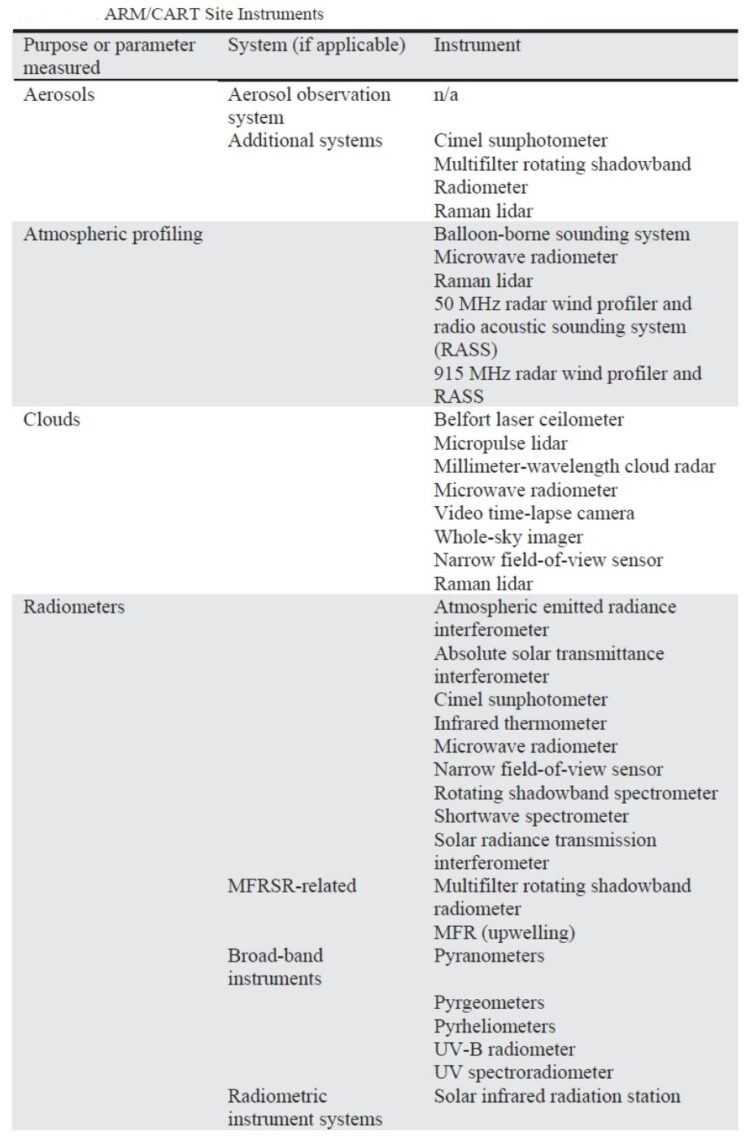
The CART/ARM site has an extensive array of observing systems detailed in Table above. NASA is planning as part of the GPM to significantly enhance the CART/ARM site.
ARM = Atmospheric Radiation Measurement program
CART = Cloud And Radiation Test bed
GPM = Global Precipitation Mission
_____
_____
Technological Innovations in cloud seeding:
Technological advancements are significantly reshaping the Cloud Seeding by enhancing operational accuracy, efficiency, and environmental monitoring. Advanced weather forecasting systems integrated with AI and machine learning are now used to predict optimal seeding times and locations, improving success rates and reducing resource wastage. Real-time atmospheric data collection via satellites, drones, and high-resolution radar has improved cloud profiling and enabled more targeted interventions.
-1. Drones:
Drones and unmanned aerial vehicles (UAVs) are revolutionizing delivery mechanisms by offering cost-effective, precise, and safer cloud seeding alternatives compared to manned aircraft. Drones can operate in diverse weather conditions, reach remote areas, and precisely disperse seeding materials where they are most needed. This method reduces costs and minimizes risks associated with manned flights. Drones can operate in hazardous conditions that would be unsafe for human pilots, allowing for more frequent and targeted seeding operations. Drones have a quick deployment time, can also fly close to hurricanes and storms and send important information to ground control stations in real-time. The use of drones for cloud seeding is gaining traction. For example, in 2021, the UAE’s National Center of Meteorology launched a series of drone-based cloud seeding tests to enhance rainfall. The National Center of Meteorology (NCM) in the United Arab Emirates (UAE) has been using drones to fly into clouds and release the electrical charges needed for cloud seeding. These electrical charges work similarly to silver iodide by helping water droplets to merge and form precipitation. In using this method, the UAE can avoid releasing chemicals into the air and simply release electrical charges with the same result.
-2. New Seeding Agents:
-Nanotechnology: Researchers are exploring the use of nanomaterials to enhance the efficiency of seeding agents. These materials can provide more effective nucleation sites, potentially improving precipitation outcomes.
-Environmental Considerations: New seeding agents are being developed with a focus on reducing environmental impact and improving safety.
-3. Real-Time Data Integration:
Real-time monitoring and data analysis have also revolutionized cloud seeding operations. Advanced meteorological instruments and satellite technology enable continuous tracking of atmospheric conditions, allowing for timely and informed decision-making. Data collected from these sources are analyzed using sophisticated algorithms to optimize seeding efforts, ensuring that materials are dispersed at the optimal time and location. This integration of real-time data and analytics not only enhances the immediate effectiveness of cloud seeding but also contributes to a deeper understanding of its long-term impacts, facilitating more sustainable and scientifically informed practices.
-4. Use of AI:
With advancements in Artificial Intelligence (AI) and drone technology, Cloud Seeding is becoming more precise and data-driven. Data Analytics utilizing big data and machine learning algorithms to analyze weather patterns and optimize seeding strategies. AI Algorithms analyze satellite imagery and weather data to predict the most effective time and location for seeding. Autonomous Drones can deliver seeding materials with higher accuracy, reducing operational costs and human risk. This integration of technology is expected to make Artificial Rain more efficient, eco-friendly, and scalable in the near future.
Cloud service modelling software has also evolved, enabling better simulation of cloud dynamics and outcome forecasting. These technological innovations are increasing the reliability, scalability, and public acceptance of cloud seeding operations, driving global adoption across agricultural, municipal, and environmental sectors.
_______
Radar, satellites, weather models and AI working together:
Hail can damage crops, livestock, homes, vehicles, aircraft on the ground and local businesses, leading to costly repairs, lost income and safety risks for people caught in severe storms. Hailstorms do more than damage fields. They can break windows and roofs, dent cars and farm equipment, shut down businesses and affect airports, runways, and aircraft parked on the ground. When severe hail is expected or hits unexpectedly, flights may be delayed, vehicles and outdoor workers must be moved to shelter, and communities face higher repair bills and insurance costs.
For decades, the North Dakota Cloud Modification Project (NDCMP) has seeded thunderstorms in hopes of reducing hail damage and supporting agriculture. Pilots fly into selected storms and release tiny particles into the clouds to encourage many small ice particles instead of a few large hailstones
Now University of North Dakota (UND) team is training an interpretable AI system that estimates the chance of small hail (less than 1 inch), medium hail (1–2 inches), or very large hail (greater than 2 inches) in different parts of each storm. By comparing seeded and unseeded storms under similar conditions, the system will measure how often seeded storms appear to produce smaller or less intense hail. The results will be summarized by county, season and hail-size range, with uncertainty clearly stated so users know how accurate the estimates are. The goal is to move from yes-or-no answers to quantitative, county-level metrics that are easy to understand. For example, in this area, during this part of the season, how often did seeding shift storms from very large hail to smaller hail?”
In building and applying this AI system, the UND team will connect the radar, satellite, and Weather Research and Forecasting (WRF) model fields inside a single fusion framework. Dual-polarization radar will scan deep into storms to show where hail is forming and how strong the storm cores are. Weather satellites will monitor cloud tops from space, tracking tall, intense storm towers and signatures linked to hail. The WRF model will provide the larger-scale conditions — such as instability, wind shear and moisture — that help hail form and grow. By bringing these views together, the researchers can see both the ingredients that went into each storm and the hail that came out of it. The interpretable machine-learning system will learn from many past storms to produce reliable, size-resolved hail probabilities and to compare seeded and unseeded storms in a consistent, transparent way.
_______
IoT and weather monitoring systems:
Another useful – and less controversial – application of cloud seeding technology is in the management of micro-climates (the distinctive climate of a small-scale area, e.g. national parks, airports, coastal regions, forests). IoT devices use the same rain management technologies to monitor the weather and are incredibly useful:
- Devices that use sensors and automotive electronic equipment to collect, store, and track data on all the different characteristics of the climate (temperature, wind speed/direction, rain etc.)
- The system analyses the data generates accurate microclimate forecasts, and displays it in real-time on a screen
- Allows sensor devices to be placed in areas that have been difficult/dangerous to access geographically and collect data safely
- Wireless weather monitoring allows information to be shared with businesses and homes that are impacted by severe weather changes, quickly
- Processes can be fully automated and don’t require much human attention, making them cost-efficient, time-saving, and smart
Weather monitoring systems also have useful applications at an individual level. Not only can you have your own weather station at home, but you can use it to complement and connect to other IoT devices. For example, a smart garden with sensors that are set to turn on the sprinklers when the soil moisture is at a specific level, can receive a message from the smart weather station to not do so on days when rain is forecast.
______
______
Section-9
Benefits and utility of cloud seeding:
If successfully deployed, cloud seeding may have benefits in the following areas as depicted in figure below:
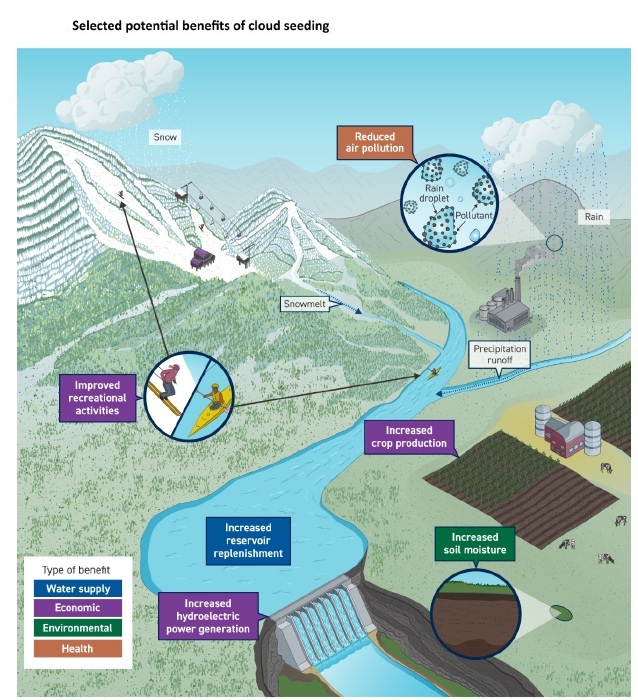
_
Cloud seeding offers several key benefits, primarily in the areas of water resource management, agriculture, and weather mitigation. It is used as a tool to supplement natural processes and address specific environmental challenges.
-1. Water Resource Management
- Increasing Precipitation: The most common application of cloud seeding is to increase precipitation, possible with both warm and cold clouds.
- Drought Mitigation: Cloud seeding is employed to increase precipitation in drought-prone regions, helping to alleviate the effects of prolonged dry spells.
- Reservoir and Groundwater Recharge: By enhancing rainfall and snowfall, the practice helps replenish surface water sources like reservoirs and lakes, as well as underground aquifers.
- Snowpack Enhancement: In mountainous areas, cloud seeding increases winter snowpack. The subsequent spring snowmelt then feeds rivers and streams, providing a crucial, delayed water supply for surrounding communities and supporting hydroelectric power generation.
- Hydropower generation: Increased precipitation can contribute to higher water levels in reservoirs used for hydropower generation, increasing electricity production. Cloud seeding experiments have shown to augment production of hydroelectricity during the last 40 years in Tasmania, Australia.
-2. Agriculture and Economy
- Crop Support: Increased water availability from enhanced precipitation directly supports agriculture, boosting crop yields and food production, which in turn can improve the local economy.
- Economic Improvement: By making arid or semi-arid regions more habitable and productive, cloud seeding can have positive economic impacts beyond farming, potentially attracting investment or tourism.
- Cost-Effective Solution: Offers an economical approach to managing water resources compared to other methods.
-3. Weather and Environmental Mitigation
- Air Quality Improvement: Artificial rain can temporarily help clear the air of pollutants and particulate matter in highly urbanized or industrialized areas experiencing severe air pollution episodes.
- Fog Dissipation: Cloud seeding techniques can be used to dissipate dense fog, improving visibility and safety for transportation, particularly around airports.
- Hail Suppression: The process can modify severe storms to reduce the size of hailstones, minimizing property and crop damage caused by large hail.
- Wildfire Control: By increasing moisture levels in the environment, cloud seeding may help reduce the risk and intensity of wildfires.
- Event Weather Control: China’s 2008 Olympics used it to ensure clear skies.
-4. Climate change mitigation
The increasing challenges posed by climate change have prompted exploration of innovative methods to improve environmental resilience, with cloud seeding emerging as a potential tool in this regard. By enhancing precipitation, cloud seeding can considerably ease drought conditions and mitigate water scarcity, thereby contributing to a more sustainable water supply. The use of silver iodide as a cloud condensation nucleus promotes ice crystal formation, potentially leading to increased rainfall. This could positively impact agriculture and natural ecosystems, though it is crucial to assess any long-term environmental impacts. Consequently, cloud seeding presents a promising strategy within the broader strategy of climate change mitigation.
-5. Potential to cool urban heat islands and regulate local temperatures
While urban heat islands pose a significant challenge to metropolitan areas, cloud seeding could offer a strategic approach to mitigating these temperature disparities. By introducing more precipitation, this method of weather modification can assist in regulating local temperatures and promote climate adaptation in densely populated regions.
It is important to note that while cloud seeding offers these potential benefits, its effectiveness can vary by project and location, and it is generally considered a supplementary tool within broader water management strategies.
______
______
Cloud seeding for hail suppression:
Hailstorms are among the most damaging weather-related hazardous events, generating climate risk exposure for agriculture. In the United States (U.S.) alone, severe hail events caused an estimated $35.8 billion in losses between 2003 and 2023 (NOAA, 2025). Climate simulations further suggest that hailstone size may increase in the central U.S., potentially amplifying future risks to livelihoods and crop production (Fan et al., 2022). Managing hail risk is central to building a more resilient agricultural sector. Many regions have adopted cloud seeding for hail suppression as a strategy to address these climate risks. Since the 1970s more than 50 countries—including the U.S., Russia, France, and Argentina — have experimented with dispersing particles into storm clouds in an effort to reduce the size and frequency of hailstones (Foote and Knight, 1977). While the meteorological processes of hail formation are well studied (Lamb and Verlinde, 2011; Allen et al., 2020), the effectiveness of hail suppression through seeding remains contested.
_
Hail formation requires both supercooled water and ice embryos. Supercooled droplets, which remain liquid below 0 ◦C, freeze upon contact with embryos such as frozen raindrops, graupel, or ice crystals. Through riming—the accretion of supercooled droplets onto these embryos—hailstones grow as successive layers of ice accumulate. Hailstones continue to grow while suspended in strong updrafts and fall once their weight exceeds the strength of the updraft, often causing significant damage.
_
Cloud seeding for hail suppression seeks to alter this microphysical process. By introducing artificial ice nuclei (commonly silver iodide or dry ice) into the supercooled regions of a storm, seeding is expected to change hail development pathways. Several theoretical mechanisms have been proposed: (1) Competition theory, which posits that increasing the number of ice embryos produces more numerous but smaller hailstones that are more likely to melt before reaching the surface (Knight and Squires, 1982; Sulakvelidze et al., 1967); (2) Precipitation acceleration or early rainout, whereby seeding accelerates the conversion of supercooled water into rain, thereby depleting liquid water available for hail growth (Abshaev and Karisivadze, 1973); and (3) Trajectory lowering, which suggests that seeding alters the microphysical and dynamical balance of the storm, lowering the trajectories of hailstones so that they exit the updraft earlier and fall before reaching damaging sizes (Foote, 1984).
_
Most hail-suppression attempts have been based on the concept that damage will be reduced if the hailstone sizes are reduced. This does not require overseeding. Consider, for example, an unseeded cloud that produces one hailstone having a two-centimetre diameter in each cubic metre of air. If ice-nuclei seeding could cause 100 uniform hailstones in the same volume from the same available quantity of supercooled water, their diameters would be about 0.4 centimetre. The small stones would melt as they fell through the layer of warm air below the freezing level. Even if they did not melt completely to form rain, by the time the hailstones reached the ground they would be too small to do any serious damage.
_
Silver iodide seeding of potential hailstorms has been carried out in many countries. Most of the ice nuclei have been dispersed from ground-based or aircraft-mounted generators. In Switzerland it appeared that there may have been more hail produced by seeding. In Argentina the results seemed to depend on the type of weather situation. In the United States varying results have been reported. Soviet experimenters injected ice nuclei directly into the supercooled parts of clouds by means of rockets or artillery. In the latter technique a projectile explodes and disperses the nuclei. The rockets carry a cylinder of a pyrotechnic substance impregnated with silver iodide or lead iodide. It passes through the cloud while burning for a period of 45 seconds. Spectacular success in hail reduction was reported by Soviet scientists. The benefit-to-cost ratios cited ranged from 4 to 1 up to 17 to 1. There have been no independent tests of these procedures, and as a result many other atmospheric scientists have hesitated to accept the claims of success at face value.
_
Anti-hail rockets are depicted in figure below:
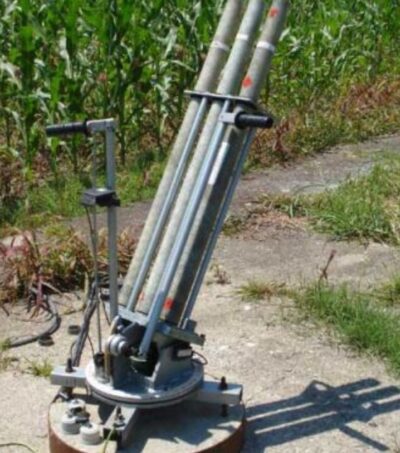
The firing of anti-hail rockets can be seen in almost all parts of Bulgaria. This is so, because there are over 200 anti-hail facilities on the territory of this country, which fire rockets when hail clouds threaten to destroy the crops. When rockets are fired against a hail cloud the crops suffer 20%-30% damage, or in the best case scenario they are fully protected. However, it all depends on the weather conditions and the cold atmospheric fronts which enter the Bulgarian territory.
There is a widespread belief that anti-hail rockets actually break the hail into pieces. However, the truth is that anti-hail rockets cannot break the ice in the cloud. Once the hail fragments form inside the cloud the hailstorm cannot be avoided. The anti-hail system works on a completely different principle called competition. When an anti-hail rocket is fired, it reaches an altitude of 3 kilometers, where it starts to disperse smoke containing silver iodide. The crystal lattice of this chemical substance is similar to the crystal lattice of the ice. When a water drops sticks to the crystal lattice of the silver iodide it freezes immediately. Later other water drops stick to the ice particle and form a hail grain, i.e. to bring artificial ice into the ice grain and prevent the formation of large hailstones. For instance, the silver iodide helps the formation of 100 million small hail grains with the size of a wheat grain in a given hail cloud, instead of 1 million large hailstones with the size of a walnut. Most of the small hail grains melt on their way to the ground and those which reach the earth surface do not have the power and the size to destroy the agricultural produce. They may puncture some leaves, but the damage over the plants is insignificant, which is in fact the purpose of the anti-hail rockets.
Unfortunately, the hailstorm cannot be predicted in advance. The whole process lasts between 7 to 10 minutes only-from the time the hail cloud is formed to the moment hail hits the ground. That is why experts are forced to work in extremely short terms. Special Doppler devices send information about the processes happening within the clouds every 3 minutes. An intelligent system situated at the control center determines the coordinates of the hail cloud and sends the information to the given firing ground, where well-trained employees fire anti-hail rockets into the cloud. They have under a minute to fulfill the instructions.
_
Efficacy analysis of cloud seeding program in Kansas agriculture, a 2025 study:
Hailstorms cause significant economic losses worldwide, with the central United States particularly vulnerable due to the frequency and intensity of sever hail events. Cloud seeding, a weather modification technology, has been adopted for hail suppression in more than 50 countries since the 1970s. While existing research predominantly focuses on assessing the impact of cloud seeding on hailstone size or storm frequency, its effects on crop damage and productivity remain understudied. This study evaluates the effectiveness of cloud seeding in Kansas using county-level data from 2002 to 2020, considering a broader set of measurements: hail size, hail frequency, crop damage, crop yields, and potential downwind effects. The findings reveal that cloud seeding reduces hailstone size in target areas but does not significantly decrease crop damage from hail or drought. Conversely, it is associated with increased flood damage to crops. Additionally, cloud seeding enhances corn productivity in target areas but negatively affects sorghum productivity in downwind regions, suggesting potential spillover effects. A cost-benefit analysis indicates positive net present value overall, though several downwind counties experience net losses. These findings highlight the limitation of traditional evaluation metrics and underscore the need for comprehensive assessments of weather modification programs. By integrating agricultural and economic outcomes, this study provides new evidence to guide policy decisions on cloud seeding for hail suppression.
_____
_____
Russia seeds clouds in Siberia to douse raging wildfires in 2020:
Russian firefighters have been seeding clouds to bring down rain over wildfires raging in Siberia. The Russian forestry agency said active work was underway to battle 158 forest fires covering 46,261 hectares. Firefighters have used planes to fire chemicals into the clouds above fires in northern, remote parts of the Krasnoyarsk and Irkutsk regions of Siberia. Sweltering heat and dry weather have helped wildfires spread across the region and into the boreal forest and tundra that blanket northern Russia. Environmental group Greenpeace, which monitors the spread of wildfires in Russia, confirmed that rain has helped reduce fires in northern Siberia.
______
______
The Role of Cloud Seeding in Agriculture:
Water is a critical input for agricultural production, and the availability of consistent, sufficient rainfall is essential for healthy crop growth. In regions where natural precipitation patterns are becoming increasingly erratic due to climate change, cloud seeding could serve as a tool to stabilize agricultural output.
Improved Crop Yields: Cloud seeding can increase rainfall during crucial planting and growing seasons, ensuring that crops receive the water they need to thrive. This is particularly valuable in areas where irrigation infrastructure is limited or where aquifers have been overexploited.
Emergency Drought Mitigation: In severe drought conditions, cloud seeding can provide immediate relief by generating rainfall to replenish soil moisture levels and water reservoirs. This can prevent crop failures, protect livestock, and reduce the socioeconomic impacts of drought.
Water Management: Beyond direct rainfall, cloud seeding can play a role in managing water resources by increasing the flow of rivers, streams, and reservoirs that are essential for irrigation systems. Enhancing precipitation in watershed areas can help maintain critical water supplies for agricultural use throughout the year.
_
Several countries have implemented cloud seeding programs to combat drought and boost agricultural productivity. Here are a few key examples:
China:
China has been a global leader in cloud seeding technology, particularly in its agricultural regions. The country has invested heavily in weather modification efforts to ensure a stable food supply for its large population. In drought-prone areas like the northern plains, cloud seeding is used to boost rainfall and support wheat and maize production. During the Beijing Olympics in 2008, China successfully used cloud seeding to clear rain from the skies before the opening ceremony, demonstrating its advanced capabilities in weather modification.
United States:
In the western United States, particularly in states like California and Texas, cloud seeding has been employed to increase rainfall in times of water scarcity. The agricultural regions of California, which produce a significant proportion of the nation’s fruits, vegetables, and nuts, have benefited from cloud seeding efforts aimed at replenishing reservoirs and groundwater supplies during prolonged droughts.
United Arab Emirates:
The UAE is one of the most arid countries in the world, with very little natural rainfall. In recent years, the country has turned to cloud seeding as part of its water management strategy. While agriculture is limited in the UAE due to its desert environment, cloud seeding has helped increase rainfall, supporting the development of sustainable agricultural projects and reducing dependence on desalination.
India:
India has also experimented with cloud seeding, particularly in regions like Maharashtra and Karnataka, where farmers face extreme drought conditions. The technology is being explored as a way to improve rainfall during the critical monsoon season and support water-stressed regions that rely heavily on agriculture for livelihoods.
______
______
Section-10
Success and effectiveness of cloud seeding:
The practice of cloud seeding has remained a point of contention in the scientific community for over half of a century. Early laboratory experiments were able to readily demonstrate precipitation enhancement mechanisms through the conversion of supercooled water to ice by the introduction of suitable ice nuclei (Schaefer 1946), and these laboratory experiments were followed by a field demonstration on individual clouds by Kraus and Squires (1947). However, the extension of cloud seeding impacts from individual clouds to a sustained precipitation increase over a substantial surface area has proven to be an elusive goal, especially at the high level of proof required by the wider scientific community.
_
The 2003 U.S. National Research Council (NRC) report, titled “Critical issues in weather modification research,” includes an abridged history of the development of various methods of cloud seeding with numerous references to static glaciogenic (of both cumulus and winter orographic regimes), dynamic glaciogenic, and hygroscopic seeding field experiments. Despite these considerable research efforts spanning decades, the report goes on to highlight the persistence of key uncertainties, which are broadly classified as “cloud/precipitation microphysics issues, cloud dynamic issues, cloud modeling issues and seeding related issues.” The NRC report ultimately concludes that “there still is no convincing scientific proof of the efficacy of intentional weather modification efforts.”
_
Boe et al. (2004) noted that the definition of “convincing scientific proof” was ambiguous, leading to Garstang et al. (2005) further clarifying that scientific proof was defined as an understanding of “processes that can be replicated by predictable, detectable and verifiable results.” Ultimately, on the question of verification it was recognized that “the level of noise in natural systems compared to the magnitude of the signal has made verification of either the enhancement of rain or snowfall or the reduction of hail extremely difficult.”
_
In principle it is possible to overcome large variability by extending a trial so that the accepted 5% significance level can be achieved. In cloud seeding, a 5% significance level (or p-value < 0.05) means there’s only a 5% chance the observed increase in rain or snow was due to random luck, indicating a 95% confidence that the seeding actually worked, a standard borrowed from drug trials. In practice it is not clear what would constitute a suitable period given that precipitation shows variability on the time scale of hours to decades. A very practical time limit arises over the ability to maintain a consistent, extended scientific experiment. Finite funding, changing personnel, changing technology, and a changing environment all serve to prohibit field work from being sustained over decades. Moreover, statistical significance is not sufficient to provide “acceptable proof”: associated physical observations of expected changes in cloud properties need to be documented to complement any statistical evaluation.
_
From an academic perspective, evaluating the long-term costs of cloud seeding necessitates a rigorous, multidisciplinary approach that integrates atmospheric science, environmental toxicology, hydrology, social science, and international law. Current research highlights significant knowledge gaps and uncertainties regarding the long-term efficacy, environmental impacts, and societal implications of this technology, demanding a cautious and critically informed approach to its application.
The scientific literature underscores the complexity of cloud microphysics and the challenges in definitively attributing precipitation changes to cloud seeding activities. Studies employing randomized controlled trials and advanced statistical methods have yielded mixed results, with some showing statistically significant increases in precipitation under specific conditions, while others find no discernible effect or even potential decreases in certain scenarios. Meta-analyses attempting to synthesize findings across multiple studies are hampered by methodological inconsistencies and the context-dependent nature of cloud seeding effectiveness. Long-term, large-scale, and rigorously designed research programs are essential to reduce these uncertainties and provide a more robust evidence base for informed decision-making.
Academic rigor demands a comprehensive and critical assessment of cloud seeding, acknowledging the significant uncertainties and potential for long-term negative consequences.
______
Does cloud seeding work?
Well, that is the big question scientists have been trying to answer for a long, long time. It is fair to say it is still unanswered. It is quite a controversial topic actually within meteorological science, because how do you do a control experiment? You cannot find two identical clouds, seed one, do not seed the other, and see which one produces rain, if at all. You can only hypothesise, you can only go with a theory that you have done this, and that cloud produced some rain. Did it produce more rain than it was going to anyway? It is really hard to say. But still this technique has persisted, so clearly many people believe it works — even though it is extremely hard to prove. The evidence shows conditional, probabilistic enhancements of precipitation under suitable cloud regimes, with reported augmentation ranging from modest to meaningful in some monitored experiments, but methodological challenges mean results are often uncertain and context dependent.
_
Rigorous verification of cloud seeding faces statistical and physical hurdles: clouds are naturally variable, seeding targets limited spatial and temporal windows, and counterfactual construction (what would have happened without seeding) is inherently uncertain. Nonetheless, well-designed randomized or statistical experiments, ensemble modeling, and paired watershed streamflow studies have reported measurable increases in precipitation or streamflow in certain contexts. For example, recent state-level evaluations in the United States found evidence that seeded orographic storms can yield increases in snow water equivalent and streamflow under specific synoptic and microphysical conditions. Similarly, Snowy Hydro’s program and Wyoming’s Medicine Bow evaluation report streamflow increases attributable to seeding in certain seasons and conditions. However, the magnitude of reported effects varies and some independent assessments call for more controlled trials and standardized verification protocols. The U.S. Government Accountability Office noted in 2024 that reliable information is lacking on optimal practice and effects, and it urged better monitoring and research investment.
_____
How effective is it?
Cloud seeding is moderately effective, able to increase precipitation by an estimated 5% to 15% under ideal conditions, but its success is not guaranteed and depends heavily on existing atmospheric conditions and the specific cloud types. Effectiveness varies significantly by project, method, and location, with long-term projects sometimes showing more consistent results.
The Wyoming Weather Modification Pilot Program, 2014, analysis showed that cloud seeding produced a 3 percent increase in precipitation with a 28 percent probability that this result happened by chance. Most scientists and statisticians wouldn’t accept that level of uncertainty, but for water managers in drought-prone areas, it’s a different story. If you say, you are 70 percent confident that this will have an impact, well, a lot of them will think that’s not too bad.
“The results of about 70 years of research into the effectiveness of cloud seeding are mixed,” wrote atmospheric scientist William R. Cotton of Colorado State University in a 2022 article published in The Conversation. He added that it requires the right kinds of clouds with enough moisture, and the right temperature and wind conditions, and produces only small increases in precipitation. A recent study measured the snow from three cloud seeding events and calculated that they caused enough water to fill 282 Olympic-sized swimming pools over approximately two hours. “Regardless of the mixed evidence, many communities are counting on it to work,” Cotton said. The U.A.E. National Centre of Meteorology says cloud seeding can boost rainfall from a specific cloud by 25 per cent under optimal conditions, and the technology “plays a crucial role in the broader context of climate change mitigation and building climate resilience.” Hail suppression is also considered effective enough that insurance companies in Canada invest millions a year to seed clouds in Alberta.
______
______
Evaluation of effectiveness of cloud seeding:
Evaluating the effectiveness of operational cloud seeding programs is critical to advancing weather modification research and providing policymakers with realistic techno-economic metrics. According to the most recent review on global precipitation enhancement activities conducted by the World Meteorological Organization (WMO) Expert Team on Weather Modification, cloud seeding from aircraft platforms is generally more effective than other techniques, such as ground-based generators, customized rockets, and artillery shells. Results from operational cloud seeding programs spanning several countries, including Australia, China, India, Israel, South Africa, Thailand, and the United States, record increases of between 10% and 30% in precipitation and cloud “lifetime.” Alternatively, several studies reported the limited efficacy of seeding experiments for drought relief, along with inconclusive results stemming from unreliable measurements and/or co-occurring microphysical and dynamical processes that are difficult to account for.
_
The complex variability of cloud properties in both space and time makes it difficult to accurately evaluate the impact of cloud seeding. In fact, several of the difficulties of carrying out randomized experiments on cloud seeding are similar to those involved in designing randomized clinical trials in the medical field. However, clouds are more transient and less accessible than human patients, making it particularly difficult to reproduce randomized seeding experiments.
_
To overcome the limitations of field experiments, long-term statistical analyses have been carried out to evaluate seeding impacts using control-target (unseeded-seeded) regression derived from historical rainfall records. However, such analyses rely exclusively on local rain gauge measurements that fail to capture potential changes in climate circulations that may influence local rainfall patterns, far beyond seeding effects. Hence, interpreting the results requires diagnosing the physical mechanisms associated with the statistical variability in seeded rainfall amounts.
_
Weather radars generate high-resolution and real-time estimates of cloud and precipitation properties above the surface by emitting electromagnetic signals and analyzing backscatters from intercepted hydrometeors. They return continuous volumetric scans of cloud systems that provide critical information on their microphysical and thermodynamic evolution throughout their lifetime. As such, weather radars have been a key instrument in several cloud seeding programs and are an important infrastructural prerequisite for conducting weather modification research. Investigating the effects of seeding by combing through both physical and statistical analyses is considered the most systematic approach to evaluating cloud seeding experiments.
______
Direct and indirect methods:
Numerous studies using indirect and direct methods have been conducted globally to investigate whether cloud seeding causes rain enhancement. Indirect verification techniques analyze cloud properties, particle sizes, diffusion differences, cumulative precipitation through numerical simulations, and changes in radar reflectance (Chae et al. 2018; Chang et al. 2007; Deshler et al. 1990; Huff 1969, 1971; Ro et al. 2020; Spiridonov et al. 2015). Direct verification techniques involve obtaining in situ measurements of seeded areas for evidence of enhanced ice-crystal and hygroscopic cloud condensation nuclei diffusion. The temporal–spatial changes in the main components of seeding materials are analyzed through chemical analysis of in situ rain samples. To facilitate this analysis, the numerical model domain is divided into affected and nonaffected areas, based on whether rain has been enhanced by the seeding experiments. However, the magnitude or mechanism of rain enhancement through cloud seeding has not been conclusively established (Gatz 1977; Koenig 1960; Levi and Rosenfeld 1996; Warburton 1963; Zipori et al. 2012). Although Zipori et al. (2012) confirmed the enhancement of wintertime precipitation due to glaciogenic seeding in Israel’s Galilee Strait through long-term analysis, studies directly verifying the action–response mechanism between seeding substances and rain enhancement based on hourly concentration trends are lacking. These mixed results can arise from various factors such as research methods, types of target clouds, geographical locations, technologies used, and experimental conditions.
_
The complexity and uncertainty of cloud–aerosol–precipitation reactions make it difficult to interpret the results of chemical composition analyses and confirm the effects of cloud seeding (Geerts et al. 2010; Pokharel et al. 2017). To understand and demonstrate the effects of cloud seeding, it is essential to collect and analyze precipitation samples from the experimental area based on the cloud condensation nuclei-precipitation growth process. The NIMS under the KMA conducted precipitation sampling in the experimental area, following predesigned cloud seeding scenarios using numerical techniques. One hundred and one aircraft-based cloud seeding experiments were conducted from September 2020 to December 2023, with precipitation sampling carried out for about 58 cases. These samples underwent detailed chemical analysis of ionic and heavy metal materials by a specialized agency (NIMS 2020, 2021). However, interpreting the results of chemical composition analysis and specifying the effects of cloud seeding are challenging owing to the complexity and uncertainty of cloud–aerosol–precipitation reactions in the atmosphere (Geerts et al. 2010; Pokharel et al. 2017). Collecting continuous and adequate samples for chemical component analysis, considering the timing of precipitation and the definition of affected/nonaffected areas, is necessary to confirm the cloud seeding results for each experiment. Each experiment can be categorized based on seeding material and weather conditions. Long-term data on the internal and external environments of the experimental and target areas are required to enhance the reliability of experimental effects through direct verification; however, there is currently an insufficient amount of data for this purpose.
_______
Statistical and observational approach:
The statistical approach, which compares the multiple observational samples with seeding and non-seeding scenarios (Gagin and Neumann, 1981; Silverman and Sukarnjanaset, 2000), and the model simulation method are mainly used in investigating the cloud-seeding effects. However, the statistical method may contain significant uncertainty because of the challenges of conducting extended, consistent, and randomized cloud seeding experiments (Guo et al., 2015; Wang et al., 2019). The acid test adopted to determine if a seeding experiment increased precipitation was whether the indicated results were “statistically significant.” This was the model of randomized trials used in pharmaceutical testing exported to the atmosphere to “prove” that cloud seeding worked in research experiments. A 5 percent statistical significance level was written into the design of weather modification research programs. Attaining a 5 percent significance level would indicate that there was only a 5 percent chance that the experimental results would randomly occur without the cloud treatment or stated differently, 95 percent confidence that observed differences were due to seeding. Some research programs that demonstrated positive seeding results were rejected by purists because the 5 percent significance level was not obtained. These pioneering and positive experiments were unfortunately and unjustly labeled as failures.
_
Statistical analysis methods:
- Randomized experiments compare seeded and unseeded clouds under similar conditions
- Double-blind studies eliminate potential bias in data collection and analysis
- Time series analysis examines long-term trends in precipitation patterns before and after seeding programs
- Spatial analysis techniques assess downwind effects and broader regional impacts
_
The model simulation method has benefits, including efficiently generating several realizations of each scenario and the advantage of separating the cloud-seeding signal from its natural counterpart. Most of the idealized modeling results depicted that GCCNs are optimal for enhancing precipitation (Caro et al., 2002; Segal et al., 2004; Tonttila et al., 2021), due to the strengthening of the auto-conversion and the accretion process (Tonttila et al., 2021). In addition, the real-case simulation in Lin et al. (2023) also found similar features after executing hygroscopic cloud seeding in northern Taiwan.
_
Recently, several studies have attempted to obtain direct observational evidence (Kerr, 1982; Mather et al., 1997; Silverman, 2003; Flossmann et al., 2019; Tonttila et al., 2021) using improved observational methods. Most observational campaigns use airborne in-situ observation to understand the cloud information. However, only some studies successfully directly observed the broadening of DSD (Mather et al., 1997; Ghate et al., 2007; Tessendorf et al., 2021; Gayatri et al., 2023). Moreover, it is hard to ensure that the broadening of DSD is entirely affected by cloud seeding. Designing the observational experiment is an essential issue in cloud-seeding validation.
_______
_______
Various methods to verify and measure seeding performance:
Verification combines randomized statistical designs, paired catchment or watershed streamflow analysis, radar and satellite remote sensing, in situ microphysical sampling, and chemical tracing to estimate augmentation and rule out natural variability.
Best verification practices include:
- Experimental design: Randomized seeding versus non-seeding days, matched control catchments, or statistical matching to construct counterfactuals.
- Remote sensing: Weather radar and satellite data measure areal precipitation and cloud properties before and after seeding.
- Hydrologic response: Streamflow monitoring in seeded watersheds assesses whether precipitation converted to runoff and reservoir inflows.
- Chemical/isotopic markers: Tracers can sometimes detect seeding materials, though ambient background complicates interpretation.
- Operational documentation: Detailed logs of seeding times, materials dispersed, meteorological conditions, and observational datasets improve reproducibility.
Recent program evaluations explicitly use multi-method verification to strengthen inference about seeding impacts.
_______
Double ratio:
The “double ratio” in cloud seeding is a statistical method used to evaluate the effect of seeding by comparing rainfall ratios between a seeded area and a non-seeded control area. It is calculated by dividing the ratio of seeded-to-non-seeded rainfall in one area by the same ratio in another area. A value greater than 1 suggests an increase in precipitation due to seeding.
How it works:
- Define seeded and non-seeded periods/areas: Experiments are designed with a control (non-seeded) area and a target (seeded) area.
- Measure rainfall: Rainfall is measured in both areas during both seeded and non-seeded periods.
- Calculate the ratio: The calculation is a ratio of ratios:
First ratio: The average rainfall in the non-seeded area (𝑁) divided by the average rainfall in the seeded area (𝑆) during a non-seeded period.
Second ratio: The average rainfall in the non-seeded area (𝑁) divided by the average rainfall in the seeded area (𝑆) during a seeded period.
Double ratio: The first ratio is then divided by the second ratio.
Interpret the result:
A double ratio of 1.0 indicates no change in rainfall.
A double ratio greater than 1.0 suggests that the seeded area experienced relatively more rainfall than the control area during the seeded periods compared to the non-seeded periods.
The value can be represented as the square root of the double ratio to show the direct proportional change in rainfall.
Significance and application:
- Statistical significance: Researchers often use methods like bootstrapping to determine if the double ratio is statistically significant, meaning the observed increase is unlikely due to random chance. A double ratio above 1.0 from bootstrapping can indicate a likelihood of precipitation increase.
- Controlling for natural variation: This method helps control for natural variations in rainfall that occur between different periods or locations, providing a more accurate estimate of the cloud seeding effect.
- Limitations: The accuracy of the double ratio can be affected by factors like weather conditions, wind speed, and cloud moisture content, as seen in some experiments that failed to produce rain despite proper seeding.
Note:
Bootstrapping is a statistical resampling method that repeatedly samples with replacement from an existing data set to estimate the sampling distribution of a statistic.
_______
Target/Control Method:
One method that can be used to look at the additional precipitation produced is to compare precipitation data between basins with similar climatology. A comparison can be done using SNOTEL gage data between sites in the “target” area where cloud seeding is being conducted, to SNOTEL gage data in the comparatively similar “control” area, where cloud seeding does not occur.
This method develops a statistical relationship between 2 basins and then measures the difference in snow accumulation between the two areas overtime, after cloud seeding operations began. The difference in precipitation measured between the “Target” and “Control” areas is then assumed to be the result of cloud seeding. This is a statistical method that compares the relationship between the individual areas; measured as a % of change.
- Target: The area where effects from cloud seeding occur
- Control: The area outside the Target area with similar climatology where no cloud seeding occurs
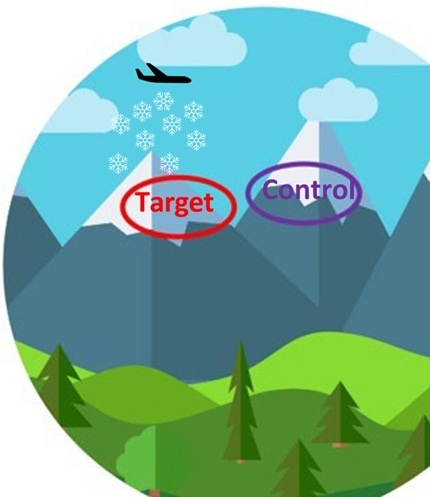
Figure above shows Conceptual diagram of the target/control method
______
Modeling:
Models can also be used to evaluate the effects from cloud seeding. Models can use historical data to assess the precipitation produced by modelled cloud seeding simulations, and for specific “case periods” or events, measure roughly an output of precipitation generated.
Going further, models can be used to understand where additional water ends up in the system. The Idaho Water Resource Board (IWRB), in collaboration with its program partners, has sponsored the development of several models; not only to better understand the effects of cloud seeding, but also to guide operations, conduct feasibility and design studies, and assess opportunities for cloud seeding across the State of Idaho.
- WRF Model [Weather Research and Forecasting model]
- WFR-WxMod (Cloud Seeding Model)
- WFR- Hydro (Hydrology Model)
- RiverWare (Planning Model)
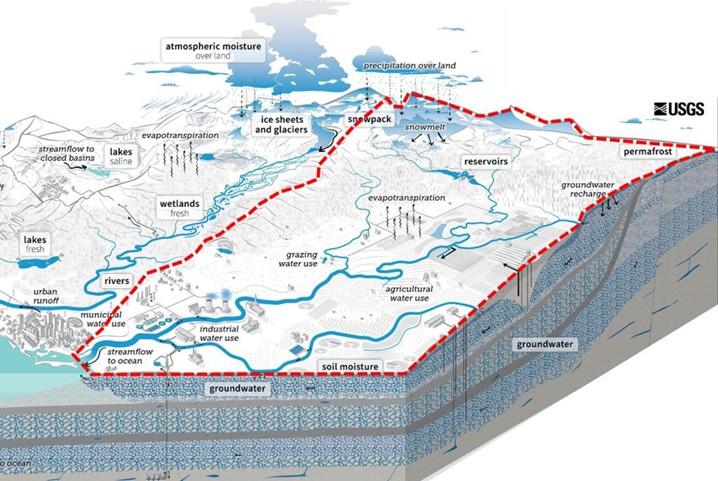
Figure above shows Hydrology Model Diagram.
______
______
Factors Influencing Cloud Seeding Effectiveness:
Cloud seeding effectiveness is influenced by a multitude of factors, ranging from the nature of the clouds themselves to environmental conditions and the characteristics of the seeding agents.
-1. Cloud Type and Characteristics
The type and characteristics of the target clouds play a crucial role in determining the effectiveness of cloud seeding. Different cloud types, such as cumulus, stratocumulus, and cirrus clouds, exhibit varying susceptibility to seeding efforts based on their composition, structure, and dynamics. Factors such as cloud base height, cloud thickness, and vertical extent can also impact the feasibility and success of cloud seeding operations.
-2. Atmospheric Conditions
Atmospheric conditions, including temperature, humidity, and wind patterns, significantly influence the outcome of cloud-seeding endeavours. Ideal atmospheric conditions for cloud seeding typically involve the presence of supercooled water droplets or ice crystals within clouds, which can interact with seeding agents to initiate precipitation. Stable atmospheric layers, favourable wind shear, and moisture availability are also critical considerations for cloud seeding success.
-3. Topography and Geography
The topography and geographical features of an area can influence cloud seeding effectiveness by affecting airflow patterns, cloud formation, and precipitation distribution. Mountainous regions, for example, often experience orographic cloud seeding, where moist air masses are forced to rise over terrain barriers, leading to enhanced cloud development and precipitation. Conversely, coastal areas may exhibit unique atmospheric dynamics that influence cloud seeding outcomes.
-4. Seeding Agent Concentration and Dispersion
The concentration and dispersion of seeding agents within target clouds play a pivotal role in determining the efficacy of cloud seeding operations. Optimal seeding agent concentrations ensure sufficient nucleation sites for ice crystal formation or droplet coalescence, promoting precipitation initiation. Effective dispersion techniques, such as uniform distribution and proper timing of seeding agent release, are essential for maximizing seeding agent interaction with cloud particles and enhancing precipitation efficiency.
______
Scientific and methodological challenges to proving effectiveness of cloud seeding:
The challenges are constructing valid control or counterfactual cases, separating seeding signal from natural variability, limited opportunities when suitable clouds exist, and inadequate standardized measurement and reporting protocols.
Key issues include:
- Natural variability: Precipitation fluctuates spatially and temporally, so distinguishing seeding signal requires careful experimental or statistical design.
- Limited seeding windows: Seeding works only when specific cloud types exist, reducing the sample size of eligible events.
- Operational complexity: Seeding platforms, timing, material dispersal, and meteorological targeting must be optimal to produce a measurable signal.
- Monitoring gaps: Robust verification needs dense observational networks, radar, hydrologic monitoring, and trace chemical or isotopic analysis to detect seeding markers.
The GAO and WMO have emphasized the need for systematic field studies, standardized reporting, and open data to strengthen the evidence base.
______
Cloud seeding operators and researchers have attempted to evaluate the effects of cloud seeding. For example, they have estimated the additional precipitation generated and, in some cases, assessed its cost effectiveness. However, it is found that the resulting estimates of additional precipitation can be imprecise and vary widely, which limits the ability to assess cost effectiveness and social benefits. For example, the WMO reports that the conceptual model for cold season cloud seeding is reasonably well understood, but that estimates of possible precipitation increases range widely, from 0 to 20 percent, for reasons that are unclear. In contrast, for warm season cloud seeding, the WMO reports that substantial uncertainties in the conceptual model remain and does not provide a range of estimated precipitation increases. Some studies in the U.S. do report estimated precipitation increases for warm season cloud seeding, but they lack key information about the statistical validity of their results. Evaluating cost effectiveness— such as by estimating the cost per acre-foot of water generated—relies on estimates of the amount of additional precipitation generated. As a result, the uncertainty associated with these estimates of additional precipitation generated limits the ability of operators and researchers to evaluate cost effectiveness.
_
The specific metrics used can also introduce estimation difficulties and make interpretation more difficult. For example, reporting effects as a percent increase would inflate results when expected precipitation before cloud seeding is low, compared to when expected precipitation is higher. As a result, policymakers may have challenges interpreting results when only the percent increase is reported. In addition, some evaluations report percent increase on an annual basis, while others report it for seeded storms. Reporting percent increase of precipitation due to cloud seeding on an annual basis is challenging because the number of storms seeded must be considered, and applying the percent increase from an individual storm to an entire year is inaccurate. As a result, some stakeholders preferred evaluating effects by determining the amount of additional water generated. For example, if a storm was expected to produce 0.1 inches of precipitation, and cloud seeding resulted in this storm producing 0.3 inches of precipitation, then the percent increase is 200 percent. If a storm was expected to produce 1 inch of precipitation, and cloud seeding resulted in this storm producing 1.2 inches of precipitation, then the percent increase is 20 %.
_____
_____
Is there evidence for the efficacy of cloud seeding?
The effectiveness of cloud seeding has been the subject of numerous scientific studies, with varying results. Overall, evidence suggests that cloud seeding can increase precipitation under certain conditions, although the extent of its effectiveness can vary. Glaciogenic seeding in orographic clouds is well documented now. Rauber et al., (2019) give a comprehensive and current state of glaciogenic seeding in orographic clouds over the western part of the USA. Orographically forced clouds have a natural lift over the terrain. The Windward side of the terrain gives convergence of moisture and forced lifting. The overall idea was to convert the liquid water present in the subzero temperatures (supercooled liquid water) in the clouds upstream of mountain ranges to increase snow precipitation by introducing more ice nuclei. That experiment is the most comprehensive one, illustrating the physical, statistical, and numerical modelling components used for addressing the underlying hypothesis. The experiment has implemented several state-oft heart instruments; however, the understanding of ice nucleation (through several mechanisms) remains elusive. The study has also indicated that advanced numerical models can be used for selecting seeding locations. There is documented evidence through physical evaluation of glaciogenic seeding that by seeding clouds containing supercooled liquid with AgI, precipitation can be traced from the cloud to the surface.
_
However, there is no documented physical evidence of hygroscopic seeding, especially in convective clouds which are more chaotic due to dominant dynamical interactions with the environment. The main caveat is that the cloud seeding signal may be several orders smaller than the natural variability and documenting the seeding effect is thus very challenging. As a result, following the chain of processes after seeding is essential to the precipitation at the surface. Often a hypothesis is formulated prior to the experiment about the chain of processes through which precipitation may develop in clouds due to seeding. This also includes tracking seeded plumes, finding out the interaction between seeded and unseeded clouds, and the extra-area effects, i.e. impact of seeding outside the target area. These aspects are studied with specially-suited model experiments supported by well-calibrated radar observations and rain gauges.
_
Ground-based seeding using Silver Iodide (AgI) and acetone burners was traditionally used in cloud seeding due to their ease of implementation. Often the ground-based AGI burners are not as effective as airborne methods in dispensing seeding material into clouds. When the seed material is dispensed from the ground, it may get suspended in the lower atmosphere and can get lost in the boundary layer, depending on the atmospheric conditions, and may not be suitable for conditions over the rain shadow region. The best option is to release the detectable concentration of seed material within the cloud.
_____
Is cloud seeding effective in alleviating drought?
The effectiveness of cloud seeding as a short-term palliative measure against drought is difficult to justify. Its effectiveness is very low in dry years but improves in the long term and, coincidentally, in wetter years. Additionally, as the additional precipitation one aspires to in the case of cloud seeding is a fraction of what actually falls, applying cloud seeding in dry years only produces small increases. Taking the case of a normal year in La Serena (100 mm of total annual precipitation), a 5% effectiveness would produce just 5 mm of additional precipitation, while applying the measure to all precipitation systems during a very rainy year (200 mm) would deliver additional precipitation of only 10 mm, which could then be “stored” in reservoirs and glaciers.
_
Currently, many countries have artificial precipitation enhancement programs. It is understood that the mere fact that everyone is doing it does not constitute an argument in favor of this technique. In many countries, rain rituals are performed without being able to evaluate their effectiveness. In fact, those who have studied the anthropological origin of rain rituals and prophecies point out the positive effect generated by having these prophecies, which, even if the drought persists, carry a certain optimistic nuance that allows societies to go through droughts with hope for the future (Pennesi, 2007). Could this be the same sociological phenomenon behind the persistence of cloud seeding as a technique despite its effectiveness not being demonstrated so far?
_
A few other countries, including the United States and Israel, have precipitation modification research programs that guide and assist in evaluating some operational experiences using these systems. However, a recent study carried out in Israel between 2013 and 2020 shows an increase of only 1.8% in precipitation (with a confidence interval between -11% and +16%), an increase that, given the characteristics of spatial variability of precipitation, cannot be statistically attributed with certainty to cloud seeding (Benjamini et al., 2023). Following this study, Israel indefinitely suspended its cloud seeding program. The cost of these programs must then be evaluated in relation to other palliative drought programs, considering the very limited possibility of increasing the amount of rainfall even under the most favorable conditions.
Cloud seeding does not seem to be an effective action to alleviate drought, not only because of its low effectiveness but also because it diverts resources from other possibly more effective solutions.
______
______
Case studies of cloud seeding:
-1. Project Skywater in the United States demonstrated 10-30% increases in snowpack in some areas.
-2. Israeli experiments showed 13-15% enhancement in annual rainfall over northern and central regions.
-3. Australian experiments yielded mixed results, with some studies showing positive effects and others inconclusive. A five-year cloud seeding project in the Snowy Mountains of New South Wales resulted in a 14% increase in snowfall, with a 97% confidence interval attributing the increase to cloud seeding.
-4. The Wyoming Weather Modification Pilot Program conducted a decade-long cloud seeding experiment in the Snowy Range and Sierra Madre Range. The results indicated a 5-15% increase in snowpack from winter storms.
-5. An older cloud seeding program in the Bridger Range of western Montana showed snowfall increases of up to 15% using high-altitude remote-controlled generators (Super and Heimbach, 1983).
-6. Long-term cloud seeding projects over the mountains of Nevada have shown to increase snowpack by approximately 10% per year.
-7. A 10-year study of weather modification operations in west Texas from 2004 to 2013 found that rainfall increased on average by 8-20% (Jennings & Green, 2014).
-8. Another study found that the dual seeding method (hygroscopic and glaciogenic materials) produced an average increase of 1.34 inches of rainfall in 2016 (LaRoche, et. Al, 2017).
-9. In the studies GAO reviewed in 2024, estimates of the additional precipitation ranged from 0 to 20 percent. However, it is difficult to evaluate the effects of cloud seeding due to limitations of effectiveness research.
______
Table below shows Cloud-seeding campaigns (2015–2020) in San Angelo, TX, USA showing the number of clouds that were seeded, days per year, and the annual rain enhancement percentage. It can be shown that the percentage of rainfall increase ranges between 9 and 20%.
|
Year |
Clouds |
Days |
% Increase in Rainfall |
|
2015 |
88 |
38 |
10 |
|
2016 |
111 |
32 |
9 |
|
2017 |
73 |
24 |
10 |
|
2018 |
54 |
21 |
12 |
|
2019 |
61 |
31 |
18 |
|
2020 |
56 |
27 |
20 |
______
______
The proof of cloud seeding efficacy: SNOWIE project:
Scientists announced that they have successfully used a combination of radars and snow gauges to measure the impact of cloud seeding on snowfall. The new research addresses decades of speculation about the effectiveness of artificial methods to increase precipitation, demonstrating unambiguously that cloud seeding can boost snowfall across a wide area if the atmospheric conditions are favorable.
On Jan. 19, 2017, a research plane roared through the grey skies above Idaho’s Payette River Basin, spewing silver iodide into the air. Assembled on the snow-capped peaks below, snow gauges and portable radar machines were poised to measure the snow that scientists hoped would follow. It was the beginning of an experiment that would turn cloud seeding science on its head. Known as the SNOWIE project—short for “Seeded and Natural Orographic Wintertime Clouds”—the study provided some of the first quantitative evidence that cloud seeding actually works.
“For three days there was cloud cover, but no snowfall, no natural precipitation,” said Katja Friedrich, an atmospheric scientist at the University of Colorado, Boulder, who helped lead the SNOWIE project. “We put the seeding material into the supercooled liquid cloud, and we were able to generate precipitation. And that was very revolutionary.” They found that injecting clouds with silver iodide generated precipitation at multiple sites at the ground, sometimes creating snowfall where none had existed. The study provides the most comprehensive evidence to date that cloud seeding can generate rain or snow. Thanks to high-tech radar equipment, the scientists were able to monitor the response of the clouds from the moment the silver iodide was released into the air until the moment snow began to fall. Over the course of those three days, the scientists estimated that around 286 Olympic swimming pools’ worth of snow fell from the clouds they seeded. Friedrich and her colleagues, including scientists from Colorado, Wyoming, Illinois and Idaho, published their findings in a groundbreaking paper last in Proceedings of the National Academy of Sciences.
_
With these new and improved technologies, the SNOWIE project catapulted cloud seeding research to the cutting edge of weather and climate science. “The question is not anymore, ‘Does cloud seeding work?’” said Sarah Tessendorf, an atmospheric scientist with the National Center for Atmospheric Research and another scientist who worked on the SNOWIE project. “The questions really are, ‘How and when does it work? How effective is it under different conditions?’” As droughts and warming squeeze water supplies in the American West, scientists are busy trying to answer those questions. Tessendorf cautioned that successfully producing precipitation requires the presence of clouds. The results are also dependent on such atmospheric factors as local winds. Even when cloud seeding enhances precipitation, there are additional factors that will determine if it is a cost-effective approach to increasing snowpack or replenishing reservoirs. “The seeding produces ice and that ice can form snow, but is it enough additional snow to make it cost effective?” she asked. “For water managers, the bottom line is the amount of snowpack that you’re building over the whole winter and how much runoff it will generate. We are looking into some promising approaches to address those bigger questions, but we still have plenty of work to do to get there.”
The 2020 study from SNOWIE, which demonstrated that seeding for snow can work in the right meteorological contexts, doesn’t apply to warm weather seeding for rain, which exploits a different mechanism within different types of clouds. And what worked in Idaho doesn’t necessarily apply elsewhere, Friedrich says; even within the SNOWIE study itself, increased snowfall was not observed after every seeding run. Further, the sophisticated radar methods used in the study are not available to analyze every operation, and many questions remain about when, where, and with what methods cloud seeding is most effective, with robust data in short supply.
______
______
Studies on effectiveness of cloud seeding:
_
The UAE Cloud Seeding Program: A Statistical and Physical Evaluation, a 2021 study:
Operational cloud seeding programs have been increasingly deployed in several countries to augment natural rainfall amounts, particularly over water-scarce and arid regions. However, evaluating operational programs by quantifying seeding impacts remains a challenging task subject to complex uncertainties. In this study, authors investigate seeding impacts using both long-term rain gauge records and event-based weather radar retrievals within the framework of the United Arab Emirates (UAE) National Center of Meteorology’s operational cloud seeding program. First, seasonal rain gauge records are inter-compared between unseeded (1981–2002) and seeded (2003–2019) periods, after which a posteriori target/control regression is developed to decouple natural and seeded rainfall time series. Next, trend analyses and change point detection are carried out over the July-October seeding periods using the modified Mann-Kendall (mMK) test and the Cumulative Sum (CUSUM) method, respectively. Results indicate an average increase of 23% in annual surface rainfall over the seeded target area, along with statistically significant change points detected during 2011 with decreasing/increasing rainfall trends for pre-/post-change point periods, respectively. Alternatively, rain gauge records over the control (non-seeded) area show non-significant change points. In line with the gauge-based statistical findings, a physical analysis using an archive of seeded (65) and unseeded (87) storms shows enhancements in radar-based storm properties within 15–25 min of seeding. The largest increases are recorded in storm volume (159%), area cover (72%), and lifetime (65%). The work provides new insights for assessing long-term seeding impacts and has significant implications for policy- and decision-making related to cloud seeding research and operational programs in arid regions.
______
Numerical Modeling in the Yeongdong Region of Korea, a 2025 study:
In this study, the effects of cloud seeding experiments were analyzed using ensemble numerical modeling. This study focuses on an aircraft seeding experiment conducted over the East Sea near the Yeongdong region of Gangwon Province on October 4, 2022. The weather research and forecasting (WRF) model was applied with parameterization to reflect the effects of hygroscopic seeding materials. The particle size distribution of domestically produced sodium chloride (NaCl) powder was measured and incorporated into the model. Fifty ensemble members (seeding start time legs) were constructed to calculate the probability of seeding-induced precipitation, which was then used to analyze the precipitation efficiency. The results showed that seeding materials were primarily dispersed to the Yeongdong and Yeongseo regions of Gangwon Province due to northeasterly winds. The 6-h (14:00–20:00 KST) cumulative simulated precipitation enhancement was 2.7, 4.4, and 0.9 mm at Bukgangneung (BGN), Gangneungseongsan (GNSS), and Daegwallyeong (DGY), respectively. Analysis of the precipitation ion components confirmed a distinct increase in seeding material-related ions at the BGN site, corresponding to 98% probability of seeding-induced precipitation, as per ensemble-based analysis. Areas with a high probability of seeding-induced precipitation exhibited increased precipitation, with an efficiency of 19.63% (median) and 23.50% (mean) in the 100% probability zones. The highest precipitation efficiency occurred at altitudes of 1000–1200 m above sea level, aligning with the seeding altitude (approximately 1.5 km above sea level) and cloud formation height.
_______
Evaluating cloud seeding initiatives for sustainable water supply in arid environments: insights from Al Baha, Saudi Arabia, a 2025 study:
Water scarcity poses a significant challenge in arid regions worldwide, prompting exploration of weather modification techniques like cloud seeding as potential solutions. This study evaluates the impact of a cloud seeding operation conducted on August 4, 2022, in Southern Saudi Arabia, assessing precipitation changes over five to six months in three cities: Al-Makhwah, Al-Baha, and Al-Mandaq. A comparison of rainfall amounts before and after cloud seeding indicate substantial increases in monthly rainfall—61.62 mm (253 %) in Al-Makhwah, 63.2 mm (550 %) in Al-Baha, and 61.63 mm (287 %) in Al-Mandaq—along with an increase in rainy days.
This study evaluated the short-term effects of cloud seeding on precipitation in Al-Makhwah, Al-Baha, and Al-Mandaq, KSA, over a six- month period (August 2022–January 2023), observing substantial increases in rainfall (253 %–550 %) and rainy-day frequency. While these results suggest that cloud seeding may enhance precipitation in arid regions, critical limitations must be emphasized to avoid overinterpretation. The narrow six-month dataset cannot conclusively separate seeding-induced rainfall from natural variability, and the absence of statistical significance testing (e.g., p-values, confidence intervals) means the observed changes could reflect seasonal or stochastic weather patterns rather than seeding efficacy. Additionally, the lack of control regions—non-seeded areas for comparison—further limits causal attribution. Despite these constraints, the findings align with global case studies demonstrating cloud seeding’s potential under optimal atmospheric conditions, particularly in moisture-rich convective clouds.
_______
A Suggestion of Verification Method for Cloud Seeding Experimental Results via Analyses of Chemical Components of Precipitation, a 2025 study:
In an attempt to minimize the adverse impacts of rapid climate change, such as forest fires and droughts, the development of cloud seeding technologies has increasingly attracted attention. However, the effects of cloud seeding have not been verified directly. In the present study, chemical analysis of precipitation samples was explored as a method of confirming the case-by-case effects of cloud seeding experiments. Hourly precipitation samples were obtained using automatic precipitation collectors placed in seeded/nonseeded areas, which were calculated in advance by numerical methods. To directly confirm the effects of cloud seeding, analyses of ionic and heavy metal components (nonsea salt Ca2+ and silver) of the samples were carried out. Three aviation experiments are presented (CaCl2, NaCl powder and CaCl2, AgI flare seedings). Each result demonstrated a noticeable increase in the main seeding materials at the rain sampling points within 1–3 h after the experiment, as confirmed by a numerical model. Although a small number of cases were considered in this study, hourly analysis method highlights the potential for direct and rapid verification of cloud seeding experiments.
Precipitation samples must be continuously collected for a follow-up study in the future of microphysical processes to further evaluate the effects of cloud seeding experiments. For the next step, authors are preparing to determine whether the precipitation enhancement was statistically significant by using an ensemble approach with numerical simulations. This precipitation chemical analysis method, which provides direct and rapid verification results, has the potential to enhance our understanding of and improve cloud seeding experiments. It could be proposed as a valuable tool for verifying outcomes immediately following each cloud seeding event.
______
Evaluating hygroscopic cloud-seeding effects by in-situ observation and real-case simulation, a 2025 study:
Evaluating the efficacy of cloud-seeding operations presents a complex challenge in atmospheric science, due to the multifaceted interactions between artificial nuclei, natural cloud processes, and local meteorological conditions. In this study, to assess cloud-seeding effects, several field experiments were conducted at Dongyanshan site (elevation 840 m) in northern Taiwan during northeast monsoon seasons from 2019 to 2022. The experiments utilized hygroscopic cloud seeding, leveraging the site’s advantages of well-established instrumentation and a semi-closed, in-cloud environment. Authors observational results indicate that the seeding agents can strengthen the competition effect, which causes an increase in liquid water content (LWC) and a decrease in water vapor mixing ratio, as well as the tail effect, which widens the drop size distribution (DSD). This important phenomenon of increased raindrop number concentration after cloud seeding was further confirmed by DSD observations at the upstream neighboring site, Xiayunping (elevation 340 m), where no cloud seeding was executed. Additionally, real-case model simulations were performed to further investigate the microphysical processes of cloud seeding. Simulation results indicate that cloud seeding enhances the cloud activation process (Pcact) while leading to the development of smaller cloud droplets, which decreases the auto-conversion process (Praut) of rain. Concurrently, an intensified accretion process (Pracw) increases raindrop diameter. These findings provide valuable insights into the mechanisms of cloud seeding, potentially improving the design and implementation of future weather modification strategies in similar atmospheric conditions.
Note:
Water vapor mixing ratio (WVMR) is the mass of water vapor per unit mass of dry air, typically expressed in grams per kilogram (g/kg), showing the actual moisture content in an air parcel. Unlike relative humidity, it’s a more direct measure of water vapor amount and doesn’t change as easily with temperature, making it crucial in meteorology for understanding. It is typically a few grams per kilogram in middle latitudes but can reach up to 20 g/kg in humid environments.
______
______
Section-11
Scepticism and failure of cloud seeding:
Humans have been trying to make it rain for millennia. We seem to always need more water, mostly to irrigate our crops, whether we are 21st century people building a highly technological dam or people 5,000 years ago doing a rain dance. Some 75 years ago, a researcher at General Electric discovered that he could use dry ice to seed supercooled water droplets and cause them to precipitate out of the atmosphere as rain. And ever since then, people have debated whether this is science or just another rain dance.
_
Certainly many have taken it for undisputed science. In preparation for the 2008 Olympics in China, the Beijing Weather Modification Office engaged in large-scale cloud seeding efforts, hoping to reduce any possible rain during the Olympic Games opening ceremonies. A large amount of chemical particles were introduced to the clouds to inhibit precipitation — a process called “overseeding” — to limit rainfall during the 2008 Olympics. Beginning four hours before the opening ceremony, from 21 locations they fired 1,100 small rockets loaded with silver iodide crystals into the clouds. The opening ceremonies ended up being mostly dry, and many hailed the cloud seeding as a great success.
In early 2024, the United Arab Emirates, which has long practiced cloud seeding to maximize the rain their dry country receives, was deluged with intense rainfall that fell across the entire Persian Gulf region. About 50 people were killed in flooding throughout the Gulf states. Unlike the praise that followed China’s effort, it was angry blame that was broadly levelled against the UAE for causing the catastrophic floods.
_
These examples — plus countless others — would seem to be evidence that cloud seeding is effective at producing rain when and where it’s needed; perhaps even too much of it. Yet the practice does not enjoy universal acceptance among atmospheric scientists. Some say it can increase the amount of rain by 30%; some say perhaps 1% at most. Results are virtually impossible to measure since rainfall amounts are never precisely predictable, and whenever we try a specific cloud seeding experiment, it’s not possible to have a control for that experiment — once you seed a cloud, you can’t compare the results to what you would have gotten if you hadn’t seeded it.
_
Cloud seeding’s highest potential comes when atmospheric moisture is supercooled. Supercooled water droplets are those that remain liquid water even though they are at subfreezing temperatures. Dropping any kind of suitable nuclei into them will form ice crystals, which catch other droplets and assimilate them as well. These then precipitate to the ground, eventually landing as snow or rain depending on the temperatures closer to the ground. Today we typically use silver iodide crystals, or sometimes potassium iodide. Spraying these into the atmosphere poses no meaningful environmental risk, as it’s not harmful to people or wildlife, and the quantities used are relatively minute and undetectable after the rain falls — far below natural levels. Also used is dry ice or even plain salt, ground very fine. When any of these particles contact a supercooled water droplet, you instantly get a tiny raindrop which will collect any other droplets it touches.
_
Deliberate cloud seeding for rain enhancement by injecting efficient ice nuclei into clouds, has been practiced since the mid-20th century. These efforts have improved our understanding about the processes that lead to cloud and precipitation formation and the effects of seeding aerosols on them. Unfortunately, only a few large comprehensive projects have been conducted in which both physical and statistical evaluations were reported. It is clear that definite proof of rain enhancement from cloud seeding projects would demonstrate that precipitation is at least partly connected to the type of aerosols that are injected into the clouds. It would also shed light on one of the poorly understood links in the long chain of processes leading from cloud initiation to precipitation on the ground.
_
The basic problem with cloud seeding is that no matter what you try, you cannot create water where none exists. Seeding in a dry environment is doomed to failure because there is no water. But seeding into a sky where moisture does exist is achievable; however, any water you take out today is gone tomorrow. The best cloud seeding can hope to accomplish, even theoretically, is to borrow from tomorrow’s rainfall. Bring it down today, and you’ll have an even drier tomorrow. With this in mind, experimentation sometimes focuses on places where “a drier tomorrow” makes no difference; for example, coastal areas where prevailing winds carry moisture-laden clouds out to sea. Upwind seeding in places like this aims to grab that moisture out of the clouds before it all goes out to sea.
_
Another related practice is called orographic cloud seeding — orographic referring to effects caused by the presence of mountains. Cloud seeding experiments near mountain ranges try to pull the moisture out of passing clouds where it can fall as snowpack on the mountains, thus ensuring an adequate water supply of meltwater to carry dependent communities through the summer. Almost by definition, this would seem to happen at the expense of communities downwind from those same mountains, and it hardly needs to be stated that efforts to steal water from one region to benefit another is going to be controversial at best. Thus, cloud seeding programs nearly always face bureaucratic challenges as well.
_
Cloud seeding also faces opposition from people who consider it a form of geoengineering, to which they object mainly on ideological bases. However the distinction should be made clear. Cloud seeding is a short-term, highly localized activity, often targeting a single cloud on a single day. Geoengineering, on the other hand, refers to long-term efforts to affect the climate — two very different types of campaign. Cloud seeding is not a form of geoengineering. By definition, geoengineering, also known as climate engineering or climate intervention, refers to deliberate, large-scale efforts to alter Earth’s climate system, primarily in response to human-caused climate change. Broadly, geoengineering concepts fall into two categories:
-1. Carbon Dioxide Removal (CDR) These approaches aim to remove carbon dioxide from the atmosphere.
-2. Solar Radiation Management (SRM) These ideas focus on cooling the planet by reflecting a small portion of incoming sunlight into space.
_
The main challenge that cloud seeding faces, however, is neither bureaucratic nor ideological: it’s the science itself. A 1999 paper in the Bulletin of the American Meteorological Society summarized the results of many published studies, and found:
‘During the last 10 years there has been a thorough scrutiny of past experiments using glaciogenic seeding. Although there still exist indications that seeding can increase precipitation, a number of recent studies have questioned many of the positive results, weakening the scientific credibility. As a result, considerable skepticism exists as to whether these methods provide a cost-effective means for increasing precipitation for water resources.’
More recently, a 2010 paper from Tel Aviv University and published in the journal Atmospheric Research concluded:
‘Re-analysis of the cloud seeding experiment and operations in Israel shows that seeding has not produced the expected enhancement in rainfall… This suggests that seeding had little or no effect on total precipitation on the ground. These results are in agreement with those presented by Rangno and Hobbs (1995), and the [daily rainfall] calculations of Kessler et al., 2006, Sharon et al., 2008.’
_
Those three studies mentioned are cited a lot in this field, and they all come to basically the same conclusions: that any effect cloud seeding might have is probably small, virtually impossible to distinguish from natural factors affecting daily rainfall, and lacking in strong experimental evidence. But if it probably isn’t very effective, what about those two popular examples at the top of the show? Why did China spend so much money cloud seeding at the Olympics, and why does the UAE (as well as a lot of other countries around the world) spend so many millions doing it every year? Let’s look at each case.
_
It had indeed been very rainy in the days leading up to the 2008 Olympics opening ceremonies, and China had long been practicing cloud seeding. Even though this has been universally reported in the world press as a great success, that may reflect a propaganda success more than a scientific achievement. China very much had an interest in showing off their technological prowess to the world. Their plan was likely to succeed. Meteorologists predicted only a 47% chance of rain on the day of the ceremony, and only a 6% chance of the feared downpour during the ceremony itself. So, it was probably not going to rain anyway. And it didn’t.
_
For the 2024 flooding in UAE and elsewhere, it’s true that they had done cloud seeding just before the rainstorm. But they have also done it for decades, almost always without any success at all. As far as this particular storm goes, the cause was a complex of thunderstorms called a mesoscale convective system driven by a massive low-pressure zone in the upper atmosphere combined with low pressure at the surface. This storm was going to nail the area whether anyone did any local cloud seeding or not. Its cause was major, spread over a huge area. The seeding is unlikely to have had any impact on it at all.
_
So why do so many continue cloud seeding, if it doesn’t help? The answer is simple. People think anecdotally. If it occasionally rains after seeding, our native confirmation bias causes us to remember the times it worked, and forget or blur together the vast majority of the times it didn’t. Often we see governments make decisions based on popular opinion and bureaucratic debate; rarely do we see them make decisions based solely upon untainted good science. And that’s really the best summary of the whole science of cloud seeding. It’s plausible and it “works” (sort of) — just not enough to make any difference or to justify the expense. But confirmation bias, combined with laypeople’s wishes and expectations, will generally eclipse the science in the decision-making process of non-experts. In so many cases across all the popular sciences, you’ll see this same upside-down process repeated; and when you do, you should always be sceptical.
______
______
Studies showing failure of cloud seeding:
_
-1. A Critical Review of the Australian Experience in Cloud Seeding, a 1997 study:
From 1947 to 1994 a number of cloud-seeding experiments were done in Australia based on the static cloud-seeding hypothesis. A critical analysis of these successive cloud-seeding experiments, coupled with microphysical observations of the clouds, showed that the static cloud-seeding hypothesis is not effective in enhancing winter rainfall in the plains area of Australia. However, there is evidence to suggest that cloud seeding is effective for limited meteorological conditions in stratiform clouds undergoing orographic uplift. In particular, two successive experiments in Tasmania show strong statistical evidence for rainfall enhancement when cloud-top temperatures are between -10 C and -12 C in a southwesterly stream. The evidence for similar effects on the Australian mainland is more controversial.
In the summer rainfall regions of northern Australia, the extreme rainfall variability makes it impossible to design a statistical experiment that can to be evaluated in a reasonable time using currently available techniques. Rainfall enhancement in these regions remains inconclusive. Over the inland plains of Western Australia, the seeding opportunities are too infrequent to permit a realistically funded cloud-seeding experiment. This is not to say that cloud seeding would not produce extra rain in these regions, but rather to recognize that currently there is no acceptable technique to demonstrate the effectiveness of seeding and that any extra rain, and monetary benefits from the operation, are not measurable.
_______
-2. Reassessment of rain enhancement experiments and operations in Israel including synoptic considerations, a 2010 study:
A re-analysis of the results from cloud seeding in northern Israel is described. The analysis covers the period of the randomized Israel II experiment (1969–1975) and the subsequent period (1975 to the present) where operational seeding is being conducted. The evaluation is carried out using the double ratio method, as was done in the past. Authors analyzed the precipitation data in the north of Israel before and during the seeding period, stratified the data based on synoptic conditions and compared the results with an area to the south that had been unseeded during the seeded days in the north. The results show that during Israel II the rain enhancement in the target area in the north of Israel was about 12%, similar to the results reported previously. However, these results have two major problems:
(1) During Israel II the rainfall ratio between the inland areas (target) and the coast (control) was unusually higher in comparison with the unseeded periods prior to the initiation of the experiment and also, in comparison with the seeded period following Israel II.
(2) Comparison of the double ratio in the north during the Israel II experiment was found to be slightly lower than that in an equivalent unseeded area to the south on the same days (1.15 vs. 1.13). This implies that the high double ratio values in the north may not be a consequence of successful cloud seeding but of preferred synoptic conditions during seeding in which inland rainfall is relatively higher, i.e. deep cyclones over the E. Mediterranean.
The analysis also shows that during Israel II the frequency of deep lows that accompanied the rainy days was higher on seeded days than during unseeded ones with stronger westerly winds. This can explain why on seeded days, rain clouds penetrated more efficiently towards inland areas resulting in higher rainfall ratios of target (inland mountainous)/control (coastal strip) on seeded days both inside and outside the seeding project area. Furthermore, the double ratio obtained for the whole study period (1.00) also strengthens the point that the high double ratio value during Israel II experiment is not the result of cloud seeding.
By comparing rainfall statistics with periods of seeding, authors were able to show that increments of rainfall happened by chance. For the first time, they were able to explain the increases in rainfall through changing weather patterns instead of the use of cloud seeding. The only probable place where cloud seeding could be successful, authors say, is when seeding is performed on orographic clouds, which develop over mountains and have a short lifespan. In this type of cloud, seeding could serve to accelerate the formation of precipitation.
Summary:
Research in Israel reveals that the common practice of cloud seeding with materials such as silver iodide and frozen carbon dioxide may not be as effective as it had been hoped. In the most comprehensive reassessment of the effects of cloud seeding over the past fifty years, new findings have dispelled the notion that seeding is an effective mechanism for precipitation enhancement.
_______
-3. Delhi’s Cloud Seeding failure in 2025:
Figure above shows buildings in New Delhi seen through heavy smog in October 2025.
_
The state government made efforts to seed clouds to produce rain to help wash away pollution. Generally, rain ends up washing away some pollutants, such as PM 2.5 and PM 10. As a raindrop falls through the atmosphere, it can attract tens to hundreds of tiny aerosol particles to its surface before hitting the ground. The process by which droplets and aerosols attract is coagulation, a natural phenomenon that can act to clear the air of pollutants like soot, sulfates, and organic particles. There should be a significant amount of rain so it washes away pollutants. It will only be temporary, but if at all it is successful, it will break the flow of pollutants.
_
At around 3 pm on October 28, a small aircraft known as the Cessna 206H conducted a cloud seeding trial in Delhi amid the recent spike in air pollution. The aircraft took off from an airstrip at IIT-Kanpur and landed in Meerut. It then flew over Delhi and covered areas including Burari, Mayur Vihar, and north Karol Bagh for the experiment. Rains were expected within four hours of the experiment. 8 flares were used in cloud seeding, each weighing around 2 to 2.5 kg. It took about two to two-and-a-half minutes to drop each flare into clouds that had 15 to 20% humidity. They have used less than one kilogram of silver iodide over 100 square kilometres — less than 10 grams per square kilometre. That’s too little to have any harmful effect on humans, animals or vegetation.
_
On October 28, IIT-Kanpur’s cloud seeding attempt over Delhi failed due to insufficient moisture in the atmosphere and unfavourable winter conditions. Despite the ambitious mission to create rain and alleviate pollution, the clouds lacked the necessary humidity, with experts indicating that winter months are unsuitable for such efforts. Despite the fanfare and political buzz, Delhi’s much-hyped cloud seeding experiment failed to deliver rain — and scientists say they saw it coming. Successful cloud seeding requires clouds with high moisture content (usually above 50%) to allow chemical nuclei to facilitate droplet formation. During Delhi’s trials, moisture levels were only about 15-20%, too low for effective rainfall induction.
_
Whether artificial rain induced by cloud seeding can help during a severe air pollution crisis is not well studied, says cloud seeding expert Thara Prabhakaran, scientist at the Indian Institute of Tropical Meteorology (IITM). “There is no documented scientific evidence yet that cloud seeding can reduce pollution,” she notes.
While cloud seeding is a serious scientific experiment, it is not a solution for air pollution. It works only when clouds with enough moisture are already present, and even then, its effect is small and short-lived. At best, it may bring a brief drizzle that washes out some dust and particles for a few hours.
Roxy Mathew Koll, a climate scientist at the Indian Institute of Tropical Meteorology, Pune, says the atmospheric conditions were not suitable for the experiment to succeed. “Cloud seeding can only enhance rainfall if there are already moist, convective clouds with sufficient liquid water. In dry or stagnant air, there’s simply nothing to seed,” Koll says. At the time of the experiment, “two storms — a depression in the Arabian Sea and a cyclone in the Bay of Bengal — were pulling the moisture into those areas and making Delhi drier”.
Sachin Ghude, an IITM scientist whose expertise lies in atmospheric chemistry, urban air quality modelling, and urban fog process, also says that the artificial rain is “sometimes very light, and there is only a momentary improvement in air quality because of the pollution.” He further points out that to bring down the air quality level from ‘very poor’ to ‘moderate,’ the city would need rain almost every alternate day. “But since cloud cover is only about 20% throughout the winter period, it’s practically impossible to actually go for cloud seeding. Moreover, when air quality is severe, cloud cover is largely absent, and only certain types of clouds can be seeded,” he adds.
Also, Delhi’s air is already packed with aerosols and particulate matter, which interferes with the cloud formation process.
_
Manindra Agrawal, Director of IIT-K says that the team knew the chances of precipitation were low because the moisture content was below 15%, significantly less than the much-needed 50%. However, they went ahead with the experiment as a way to collect data on cloud seeding’s impact on air pollution levels. “We aimed to study the relationship between moisture content, the amount of seeding material used, and its impact on local conditions. Even if no rain occurred, we wanted to know whether humidity levels increased and, if so, whether that helped reduce pollution and to what extent,” he explained. In a statement, IIT-K said that there was a reduction of 6-10% in particulate matter. The claim and the experiment itself have been disputed by other experts.
______
______
Section-12
Cost of cloud seeding:
Cloud-seeding cost per acre is not typically quoted the way land treatments (fertilizer, irrigation) are, because cloud seeding operates at the atmospheric scale — a single seeding mission affects many square miles, watersheds, or river basins rather than a single acre. To give a practical sense of cost you can use three ways to estimate: per-flight, per-hour, or per-acre-foot of additional water produced.
Key points and typical ranges (U.S., 2020–2024 projects):
-1. Typical unit costs observed in operational programs
-Cost per flight hour (aircraft-based): ~USD 1,500–5,000 per flight hour (small single engine aircraft) up to USD 5,000–15,000 per flight hour for twin engine turboprops or specialized aircraft. Helicopter operations are higher.
-Cost per ignition (ground-based generators): ~USD 100–300 per generator per day, plus fuel and maintenance.
-Annual program costs for a regional operational program: USD 200,000–2,000,000+, depending on area and intensity.
-2. Cost per additional acre-foot of water (most useful proxy)
-Published program estimates range widely: roughly USD 20–300 per acre-foot of additional consumable water created by seeding (common ballpark USD 30–100/acre-foot in many Western U.S. studies). Variability depends on seeding effectiveness, local climate, timing, and measurement method.
-Example interpretation: at USD 50/acre-foot, meaning getting 1-acre-foot (about 325,851 gallons) of water costs about USD 50—note this is the marginal water from seeding, not total precipitation.
-Practical example calculations: Conservative operational program estimate: assume USD 400,000 annual budget yields 8,000 acre-feet of additional water (after validation) → USD 50/acre-foot.
_
Practical considerations that strongly affect cost-effectiveness:
- Effectiveness uncertainty: Not every seeding operation yields measurable increases; effectiveness depends on cloud conditions, available moisture, seedability, and timing. Programs budget for many hours and treat meteorological windows.
- Scale economies: Costs per unit of water fall as the treated area and run duration increase; a watershed program spreading fixed costs over more water lowers per-unit cost.
- Monitoring and validation: Scientific measurement (radar, streamflow/ snowpack monitoring, tracers) adds 10–30% or more to program cost but is essential for estimating actual yield.
- Regulatory and permitting: Environmental reviews, permits, public outreach, and legal agreements add fixed costs.
- Technology choice: silver iodide flares, hygroscopic flares, and hygroscopic rockets/ground generators have different costs and seeding efficiencies.
______
______
Economic benefits of cloud seeding:
Weather manipulation is worth exploring, since when used properly it has so much potential to work for the greater good. It can reduce fog at airports, minimize air pollution in large cities and be used for hydropower. It is mostly used to add water to areas with chronic drought, and even a small percentage increase could go a long way toward creating better agricultural conditions. It can also prevent or reduce damaging weather, such as hail, hurricanes and tornadoes.
-1. In the Canadian province of Alberta, in 2012, scientists attempted to use cloud seeding to mitigate a hail storm. They hypothesized that seeding the clouds would redistribute the water vapor in the clouds to form smaller hailstones rather than the golf ball-sized hail that was predicted. Radar data collected afterward showed that the storm was 27 percent milder than the original forecast. It’s hard to prove cause and effect, but meteorologists involved in the project say it saved up to CAD$100 million in property damage. In places that are prone to severe storms, even a slight reduction in hail intensity could save millions and easily offset the cost of a weather manipulation program.
-2. In North Dakota, a 2019 study showed cloud seeding increased farm rainfall and significantly reduced crop damage from hail, delivering up to $53 in benefits for every $1 spent.
-3. There was a study done in Texas back in 2014 by Dr. Jason Johnson of Texas A&M at Stephenville. He looked at what one inch of additional precipitation does during the convective season and found that for every dollar that these programs are putting into the project, they’re seeing a return of $34. For the West Texas target area near San Angelo, they’re running a budget of about $350,000 a year, but they’re seeing economic returns exceeding $6 million a year.
-4. Let us look at the cost per acre foot. In 2003, a National Academies panel proclaimed that there wasn’t much evidence that cloud seeding works and that in fact, all “large-scale operational weather modification programs would be premature,” based on the available science. Wyoming researchers decided to more rigorously evaluate cloud seeding, and the results of a decade worth of work are now out. Six winters’ worth of snow in two mountain ranges in southern Wyoming were evaluated. The researchers report that in ideal conditions, seeding increased winter precipitation by 5 to 15 percent. A cloud seeding program in the region could cost $27 to $214 per acre-foot of water in a low cost scenario and $53 to $427 per acre-foot in a high-cost scenario.
In the 2018 study it was shown that they were producing an acre-foot of water for roughly $2 in Utah. Utah’s water agency estimates it costs between $5 and $10 per acre-foot to boost snowfall by 5 to 15 percent.
When you compare that to desalination or water reuse, the cost of those could exceed over $1,000 per acre-foot. So, this is some of the cheapest water you’re going to find.
Note:
Cost-wise, cloud seeding has shown promising returns but results can vary based on geography and climate. “It doesn’t work just anywhere,” cautions the Utah Division of Water Resources. “The conditions have to be right.”
______
______
The dollar-impact of cloud seeding in North Dakota:
A recent study from the NDSU Department of Agribusiness and Applied Economics (Bangsund and Hodur, 2019) describes the significant economic benefits cloud seeding provides to agricultural production in the western North Dakota counties of Bowman, McKenzie, Mountrail, part of Slope, Ward and Williams. Average annual benefits for the nine crops included in the study range from $12.20 to $21.16 per planted acre for the years 2008-2017. Considering cloud seeding operations cost about $0.40 per planted acre, the benefits far outweigh the costs as seen in figure below. The addition of hail suppression adds another $6.9 million annually, or $3.00 per planted acre.
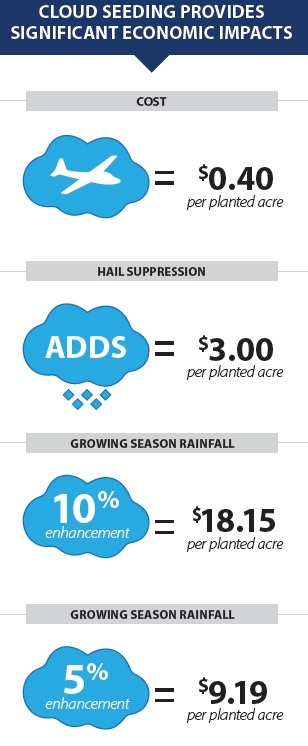
The economics of the North Dakota Cloud Modification Project (NDCMP) were evaluated based on long-term studies of the impacts of seeding on rainfall and hail. Rainfall enhancement effects were evaluated at 5 and 10 percent, which are the lower and upper bounds of typical results, while hail suppression was evaluated at a 45 percent reduction in crop loss. Impacts were computed for the eight most commonly planted crops in North Dakota plus alfalfa, which covers 96.5 percent of harvested acreage statewide on average for the study period.
Results of the study show the NDCMP is strongly economic, even with its most conservative estimates. The value of added growing season rainfall at 5 percent enhancement is estimated at $21.2 million annually, or $9.19 per planted acre. When evaluating rain enhancement at 10 percent, the number jumps to $41.9 million, or $18.15 per planted acre as seen in figure below.
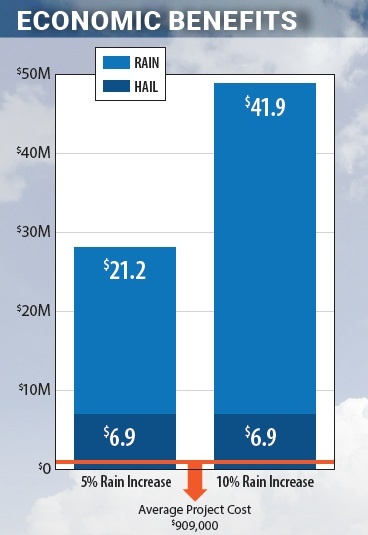
Rainfall enhancement at 10 percent and crop-hail reduction of 45 percent yields estimated economic returns of more than $53 dollars for every $1 spent on the program. Viewed more conservatively, using rainfall enhancement of 5 percent, results are still impressive, yielding nearly $31 dollars of benefit for every dollar spent. “Considering a program cost of only $0.40 per acre, the NDCMP would only need to improve yields from reduced hail damage, increased growing season rainfall, or a combination of the two, by about one-tenth to one-quarter of a bushel per acre for most crops,” said study author Dean Bangsund. “The NDCMP appears to require an extremely low threshold of efficacy to match program costs to added producer benefits.”
Enhanced agricultural production from cloud seeding is also reflected elsewhere in the economy. Tax revenue from increased crop yields is estimated to range between $576,000 to $999,000 annually, which is more than the State provides yearly in cost-share funding with participating counties.
In a nutshell the program cost about $1 million per year, but it produced direct benefits on the order of $20 million–$40 million a year, in terms of reduced hail damage, increased crop yields etc.
One thing to keep in mind when considering these results is that the study only looked at benefits to agriculture. There is no estimate in this study of what the potential reduction in hail damage to buildings and vehicles may be, but when hail is suppressed, cities and farmsteads also reap the benefits. For instance, a hail suppression program has operated in Alberta, Canada for the last 25 years specifically to reduce property damage from hail in the cities of Calgary and Red Deer.
“North Dakota remains one of the hardest hit regions for hail damage to agricultural crops in the United States,” said Bangsund. “Given the tight margins and financial risk producers face each year, having a program that works to mitigate hail damage and enhance revenue to producers is a real benefit to the state.”
__
Economic synopsis of the North Dakota Cloud Modification Project is depicted in figure below:
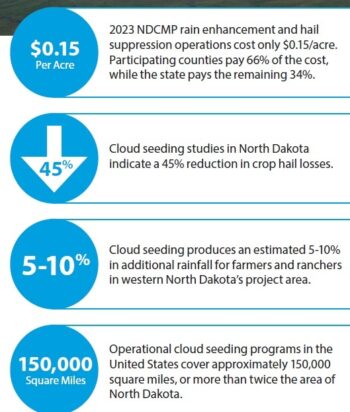
______
______
India’s cloud seeding trials ‘costly spectacle’:
India’s efforts to combat air pollution by using cloud seeding in its sprawling capital New Delhi appear to have fallen flat in 2025, with scientists and activists questioning the effectiveness of the move. Cloud seeding involves spraying particles such as silver iodide and salt into clouds from aircraft to trigger rain, that can wash pollutants from the air. Delhi authorities, working with the Indian Institute of Technology (IIT) Kanpur, began trials in October 2025 using a Cessna aircraft over parts of the city. But officials said the first trials produced very little rainfall because of thin cloud cover. The government has spent around US$364,000 on the trials, according to local media reports.
Each winter, thick smog chokes Delhi and its 30 million residents. Cold air traps emissions from farm fires, factories and vehicles. Despite various interventions – such as vehicle restrictions, smog sucking towers, and mist-spraying trucks – the air quality ranks among the worst for a capital in the world. A day after the latest trial, levels of cancer-causing PM2.5 particles hit 323, more than 20 times the daily limits set by the World Health Organisation. A study published in The Lancet Planetary Health in 2024 estimated that 3.8 million deaths in India between 2009 and 2019 were linked to air pollution.
_
Cloud seeding experiments have been carried out in Tamil Nadu, Karnataka, and Maharashtra, among other Indian states. For example, the Varshadhari project in Karnataka sought to alleviate drought conditions by causing rainfall. Cloud seeding has the potential to stabilise crop yields and guarantee water availability, which is crucial for agriculture in a country like India which is largely dependent on monsoon rains. However, there have been conflicting outcomes. Concerns regarding the cost-effectiveness of this technology exist because although some operations have successfully produced rainfall, others have failed due to unfavourable weather conditions. Small-scale cloud seeding operations can cost anywhere from $200,000 to $300,000. Each campaign costs between $200,000 and $300,000, and cloud seeding operations require specialised aircraft that cost $5 to $10 million and chemical agents that cost $25 to $50 per gram Undeniably, it can be difficult for developing economies to bear this financial burden.
_
Prakash Koliwad, founder of Kyathi Climate, which has run projects with IITM Pune and worked on several missions in Maharashtra and Karnataka between 2015 and 2019, says there has been 30 years of research in the field, establishing it as sound science. He argues that if used well, it is not as exorbitant as it is being made out to be. “The Maharashtra govt spends Rs 4,000-5,000 crore in drought relief every year and must combat problems like farmer distress and suicide. If they spend 0.1-0.2% of that amount at the beginning of the monsoon season to enhance rainfall, they will no longer have to face angry farmers or distress,” he says.
_____
_____
Cloud seeding is not a free lunch on the economic front:
- Cost vs. payoff:
Cloud seeding programs can be expensive. U.S. states spend hundreds of thousands annually (for instance, Utah’s program is about $700,000 per year). Yet, as noted, the return on that investment is highly uncertain. A GAO review found that available studies show anywhere from zero to 20% extra precipitation. This wide range means planners often “keep their fingers crossed” without knowing if rain will actually increase. In practice, many seeding initiatives produce only a few additional inches of water over a season. One climatologist wryly commented that even a well-managed program “doesn’t end a drought” or suddenly create lush landscapes in dry regions.
- Opportunity costs:
Money and effort spent on cloud seeding is money not spent on other water solutions. Some analysts warn of “maladaptation”: relying on short-term fixes (like seeding) can distract from more sustainable answers (conservation, recycling, watershed protection). For example, when smog-choked Delhi invested in seeding, critics pointed out that it was easier than tackling the true sources of pollution – so it was “not at all a good use of resources” in the long run. Similarly, a report noted cloud seeding can “obscure deeper structural drivers” of water scarcity. In economic terms, repeated seeding could perpetuate inefficient water use rather than incentivize efficient irrigation or reservoirs.
- Variable reliability:
Unlike a dam or pipeline that reliably delivers water, cloud seeding’s output fluctuates wildly. A dry winter means no suitable clouds, so sunk seeding costs yield nothing. A wet year might produce rain naturally, making seeding superfluous. This unpredictability makes budgeting and planning difficult. One study remarked that public funding for seeding is often granted on hope, not on solid science. As a result, local governments sometimes scrap programs after a few dry seasons of failure. Texas, for instance, recently stopped its state cost-share program because legislators doubted the long-term value.
- Public pushback and brand risk:
When a cloud-seeding project fails or causes controversy, it can trigger public outrage that goes beyond meteorology. In New Mexico, residents’ fears of unintended consequences led to a funded program being drastically scaled back after activists pleaded “stop playing God”. Such backlash can tarnish political careers and cost future climate initiatives support. Moreover, companies offering “rainmaking services” must balance their books, but negative press (like rumours of causing floods) can dry up contracts.
- Global market pressures:
Some experts even link cloud seeding to geopolitical prestige. In fact, researchers found a correlation between authoritarian regimes and massive seeding programs. Authoritarian governments may pour money into weather modification to showcase control over nature. This “weather race” could inflate budgets for limited gain. In contrast, more sceptical publics in democracies may question seeding’s value, making its success as much a political story as a scientific one.
Overall, the economic picture is one of high uncertainty. As one article concluded, cloud seeding is relatively cheap compared to mega-projects like desalination, but it still only offers incremental returns. The investment ceiling is low – you can only squeeze so much water from available clouds. In short, seeding should not be viewed as a silver-bullet solution, but rather a costly gamble that may or may not pay off.
______
______
Cost-effectiveness of cloud seeding compared with alternatives for water augmentation:
Cost effectiveness depends on local hydrology, the frequency of suitable seeding opportunities, program scale, and the value of incremental water; in some mountain snow augmentation contexts cloud seeding can be relatively inexpensive per cubic meter of additional runoff, but uncertainty in yield must be accounted for. Economic assessments weigh program costs (aircraft hours, fuel, materials, personnel, monitoring) against the expected incremental water value (irrigation value, hydropower revenue, avoided shortage costs). Where suitable winter orographic storms are frequent, and where added snow translates efficiently to summer water supply, cloud seeding can yield favorable cost per additional cubic meter. Conversely, in regions with few eligible clouds or weak coupling between additional precipitation and usable runoff, cost effectiveness declines. Practitioners should use probabilistic modeling and sensitivity analysis to estimate expected returns and design adaptive funding mechanisms that reflect uncertainty.
_
Cloud seeding can be relatively cheap compared with other water management strategies, like desalination, a process that removes salts and other minerals from water to make it safe for drinking. But there’s a catch. It’s notoriously difficult to design experiments that demonstrate how well the technology actually works (Climatewire, March 16, 2021). Even as researchers work to develop more effective forms of cloud seeding, scientists say it’s hard to tell for sure if it makes a difference. Cloud seeding offers the potential to tap an “atmospheric ocean” to provide additional precipitation. Contrary to popular belief, studies have indicated that precipitation is actually increased, not decreased, downwind of cloud seeding programs. Few other technologies offer the potential for producing “new” water. One example is desalinization. It is quite expensive, costing over about $1000 per acre foot compared to an estimated cost of a few dollars per acre-foot for water produced with cloud seeding.
_
Read my article on desalination at https://drrajivdesaimd.com/2024/05/07/desalination/
Desalination’s energy-intensive process is expensive and environmentally harmful, making it a costly strategy to bolster regional water supplies. The average price per acre foot of desalinated water is often 2-4 times more expensive than other water sources. The cost of desalinization is about $2000 per acre-foot, which is roughly the amount of water a family of five uses in a given year. This is equivalent to a cost of about $0.61 for every 100 gallons. Piping and pumping the water will increase these costs. Such an expense means that desalinization is usually a cost-effective option for wealthy, coastal cities. However, for elevated or inland areas, it is often cheaper to simply transport freshwater or to focus on water-conservation strategies. Desalination is affordable if you need water to drink, but not if you are using it for agriculture in a world market.
_
We are running out of freshwater. Water scarcity is a near-term crisis with global consequences. In the United States alone, more than 80 million people are affected by drought. Critical lifelines of food production, infrastructure, and reliable water supply are under strain, threatening stability at home and security abroad. Figure below shows that cloud seeding is radically efficient compared to desalination and water pipelines.
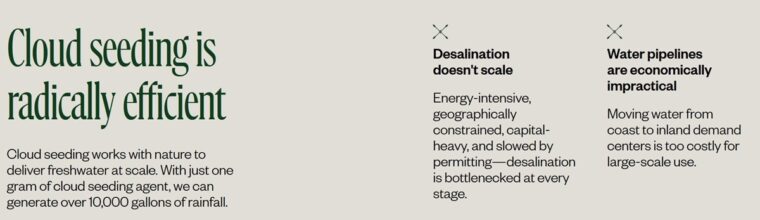
______
______
Section-13
Countries using cloud seeding:
Rain enhancement programs are implemented globally, with over 50 countries actively engaging in weather modification operations. The United States, particularly in Western states, utilizes cloud seeding to enhance snowpack for water supply. Projects are active in regions like the Rocky Mountains and the Upper Snake River Basin, relying on ground-based generators and aircraft to dispense silver iodide during the winter storm season.
China operates one of the world’s largest weather modification programs, investing heavily to increase precipitation across large areas for agriculture and drought counteraction. The Chinese approach uses a combination of ground-based rocket launchers and aircraft to deliver seeding materials. The United Arab Emirates (UAE) is a pioneer in using rain enhancement technology to combat severe water scarcity in its arid climate. The UAE’s program, which began in the late 1990s, focuses on hygroscopic seeding with salts, often conducting hundreds of missions annually. They integrate advanced technology, such as artificial intelligence and Unmanned Aerial Vehicles, to improve operational precision. Other countries like India, Thailand, and Saudi Arabia also utilize weather modification as a component of their national water resource management strategies.
_
Cloud seeding is a weather modification technique aimed at enhancing precipitation in clouds by introducing substances that act as ice nuclei (IN) or cloud condensation nuclei (CCN). This process involves dispersing materials, such as silver iodide or dry ice, into clouds to stimulate the formation of ice crystals or water droplets, ultimately increasing rainfall or snowfall. Typically orographic clouds (over mountainous areas with a natural lifting process) and convective clouds (having convective upward air motion) are selected for seeding. There is extensive scientific literature on glaciogenic seeding in orographic clouds (WMO 2018). These studies mainly come from the mid-western USA and the well-established research programs illustrate that glaciogenic seeding indeed can lead to a chain of processes leading to precipitation in the clouds (French et al., 2018). The clouds under orographically forced lifting are considered on the windward side of mountain ranges for seeding. These clouds from the Mid-western USA with supercooled liquid were targeted for cloud seeding to increase the snowpack. Cloud seeding in orographic clouds has shown some promise for precipitation formation. Quantitative evaluation of such rain enhancement has recently become available. This is mainly due to the fact that precipitation due to seeding effects (if any) is not differentiated from natural precipitation. This fact introduces significant uncertainty in the outcome of cloud seeding. Consequently, WMO recommends that seeding evaluation be carried out with both a physical and statistical experiment and numerical simulations to document the impact on precipitation.
_
Given the challenges posed by climate change, cloud seeding is increasingly being adopted as a technique to manage water resources in regions with increased drought conditions (e.g., Saudi Arabia, Australia). In Australia, prolonged droughts have affected agriculture and water supplies, leading to significant economic impacts. The USA faces similar challenges, especially in the West, where states like California experience severe droughts that threaten water security and agriculture. In China, droughts have affected the Yangtze River basin, crucial for irrigation and hydropower, prompting governmental interventions to manage water resources more effectively. Meanwhile, the UAE and Saudi Arabia grapple with arid conditions and rely heavily on desalination and groundwater extraction to meet water needs, with the region’s limited rainfall exacerbating drought risks.
_
Figure below shows map of countries that adopt cloud-seeding techniques.
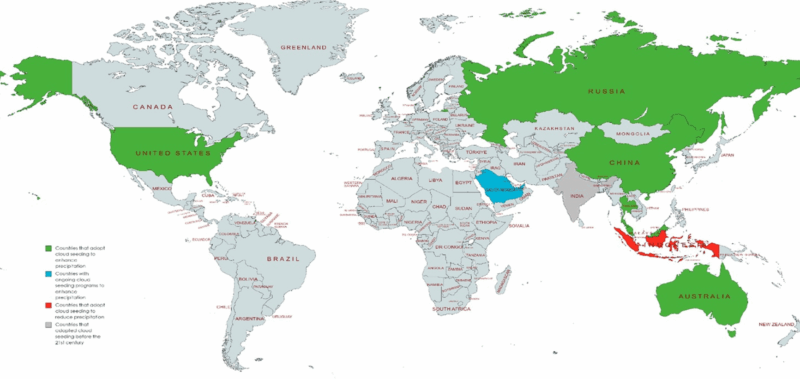
_
List of Countries that use Cloud Seeding alternatively for Rainfall:
|
Rank |
Country |
Key Focus Area |
Description/Usage |
|
1 |
China |
Drought, agriculture, and water management |
World’s largest, AI-driven program |
|
2 |
United Arab Emirates (UAE) |
Desert rainfall, water security |
Advanced technology, frequent missions |
|
3 |
United States |
Drought, snowpack, agriculture |
Many states use it as a booster for water |
|
4 |
India |
Urban pollution, agriculture |
Latest: Delhi’s anti-smog project |
|
5 |
Thailand |
Agriculture, water management |
Oldest national program, “Royal Rain” |
|
6 |
Russia |
Forest fires, drought, and agriculture |
Regional trials |
|
7 |
Australia |
Agriculture, hydroelectricity |
Tasmanian success, government efforts |
|
8 |
Saudi Arabia |
Desertification, water supply |
Multi-phase regional program |
|
9 |
Israel |
Water supply, research |
Seven-year experiment, now suspended |
|
10 |
Pakistan |
The smog crisis was the first artificial rain |
Recent success in Lahore |
______
______
Regions Implementing Cloud Seeding:
Cloud seeding is utilized worldwide to manage water resources, enhance precipitation, and mitigate the effects of drought. Here are some notable regions and their cloud seeding efforts:
_
United States:
According to NOAA, the most common uses of cloud seeding are to increase precipitation or suppress hail, usually by adding tiny particles of silver iodide. Nine U.S. states are currently using it, while ten have banned or have considered banning cloud seeding or weather modification in general. Cloud seeding in the U.S. is an ongoing practice, primarily in Western states like California, Colorado, and Nevada, to boost water supplies by increasing snowpack and rainfall using substances like silver iodide.
Nevada: The state of Nevada has been using cloud seeding since the 1960s to enhance snowfall in the Sierra Nevada mountains, which is crucial for water supply during the dry season.
Wyoming: The Wyoming Weather Modification Pilot Program demonstrated significant increases in snowpack through cloud seeding, helping to secure water resources for the state.
______
United Arab Emirates:
The UAE’s cloud seeding program was highly active in 2025, with hundreds of missions conducted to combat water scarcity, using specialized aircraft to release salt particles into clouds, aiming to boost rainfall by 10-25% using advanced tech like AI and drones for better targeting and analysis. The National Centre of Meteorology (NCM) leads these year-round efforts, aiming to supplement water resources, though desalination remains a primary source, and research continues into drones and AI for more efficient seeding. The UAE has invested heavily in cloud seeding technology to enhance rainfall. The country uses advanced techniques, including drones equipped with electric-charge emission instruments, to induce rain, addressing water scarcity in the arid region.
_
For the UAE, cloud seeding is part of its “adaptation strategy to face climate change,” says Alya Al Mazrouei, director of the UAE Research Program for Rain Enhancement Science (UAEREP). The UAE has long faced water scarcity. The desert state receives less than 100mm of rainfall per year and has limited natural groundwater recharge, so it depends heavily on large desalination plants to supply drinking water. But since the early 2000s, UAE authorities have sought to increase rainfall by inducing clouds to release more water. Today, the UAE’s rain enhancement programme has 10 pilots and four Beechcraft King Air C90s, which Mazrouei says are prepared 24/7. “Whenever we have the opportunity to do it, any weather condition, whenever we have the seedable clouds to do it, we don’t usually miss any opportunity,” she says. Each hour of flight costs $8,000, and the programme conducts an average of 1,100 flight hours annually — equivalent to nearly $9mn. Although this appears costly, Mazrouei argues that the cost per cubic metre of additional water is lower than for desalination. Meanwhile, she adds, the UAE has funded $22.5mn worth of research grants to improve cloud seeding technology. In the UAE, an aircraft swoops across the base of a convective cloud — a cloud formed by rising warm air — which is chosen for its water mass and the strength of the up-draft, or rising air current. That up-draft is critical because it carries the agents fired out by the aircraft. These agents are salt particles, which cause the water vapour in the cloud to coalesce into raindrops. Rain can begin within about 15 minutes for the cloud to rain, Mazrouei said, although success is not guaranteed.
_
How the UAE makes it Rain:
The NCM constantly monitors the skies with radars, satellites, ground stations, and 26 live cameras. When a promising cloud appears:
Aircraft go up: Pilots fly into clouds and release hygroscopic flares containing salt, magnesium, and potassium compounds.
Flares in action: During a typical three-hour flight, up to 48 flares are burned inside several clouds to speed up rainfall.
Other high-tech methods include:
Ground-based generators (GBGs): Towers in mountainous areas that release seeding materials into low clouds.
Nanomaterials: Advanced powders up to three times more effective than traditional flares.
Electric charging: Sending a charge into clouds to encourage droplet formation.
AI-powered targeting: Artificial intelligence analyzes cloud data to pick the perfect seeding moment.
Is It Working?
The UAE aims to boost rainfall by 10% to 25%, a huge impact in one of the driest parts of the world. Since the start of 2025, NCM has completed 172 cloud seeding flights, maximizing every rain-producing cloud.
______
China:
China runs the world’s largest cloud seeding program, using planes, rockets, and drones to disperse substances like silver iodide into clouds to increase rainfall for agriculture, alleviate droughts, and ensure clear skies for major events, demonstrating advanced weather modification for water security and climate control, even exploring AI-driven methods for more precise, chemical-free seeding. Notably, cloud seeding was employed during the 2008 Beijing Olympics to ensure clear weather for the events.
The U.S. pioneered cloud-seeding in the 1940s and ’50s, but the government has cooled on its effectiveness, leaving the field to specialist companies. In China, among the most water-poor nations, the state tries to squeeze every drop from above. “China has the largest rainmaking (operation) in the world,” ahead of Russia and Israel, says professor Wang Guanghe, a 20-year rainmaking veteran at China’s Meteorological Sciences Academy. “Each province reports results to us of between 10% to 25%” additional rainfall. China’s state news agency, Xinhua, says government rainmakers flew 3,000 cloud seeding flights from 2000 to 2005 and triggered rainfalls that dumped 275 billion cubic yards. That’s enough rain to fill the country’s second-largest river, the Yellow River, four times over.
_
How it works in China:
Scientists at meteorological centers in major cities monitor clouds by satellite and analyze their content. When conditions are ripe, local rainmaking teams are ordered to assemble. Teams such as Yu Yonggang’s outside Beijing can be at their guns in 10 minutes.
Rainmaking from the ground: Shells are fired from anti-aircraft guns or rocket launchers. An alternative is to burn silver iodide on hilltops. Moisture in clouds collects around the chemical particles until it is heavy enough to fall.
Rainmaking from the air: Aircraft spray the chemical from beneath their wings or fire chemical flares into clouds. Dry-ice pellets are also used. Planes are the most expensive method of rainmaking but can cover a wider area than ground-based artillery.
The arsenal:
37,000 people, mostly part-timers in the countryside – farmers and former soldiers; 30 aircraft; 4,000 rocket launchers and more than 7,000 artillery pieces used to seed clouds with silver iodide.
_
China created artificial rain in the desert using rockets, drones, and AI:
China is using artificial rain, drones, and AI to curb desertification, reduce dust storms, and test climate control on a continental scale. A desert strip in northern China has become a climate laboratory through the continuous use of artificial rain, directed planting, and advanced technologies, reducing dust storms and integrating a national program that foresees atmospheric interventions on a continental scale. A vast stretch of desert in northern China has undergone a rare transformation for arid regions, the result of a series of planned interventions over several years. About 200 kilometers previously dominated by shifting dunes have sufficient vegetation cover to reduce sandstorms and contain the advance of the desert. This process combines cloud seeding, targeted planting, land use control, and the use of technologies such as rockets, drones, and advanced weather monitoring systems.
______
Australia:
Cloud seeding in Australia began in 1947, primarily led by CSIRO, focusing on mountainous regions like the Snowy Mountains and Tasmania for water supply, with some success in increasing rainfall for hydroelectricity, though experiments in lower-lying areas like Queensland and Western Australia were largely inconclusive. Today, Snowy Hydro still runs operations in the Snowy Mountains using ground-based generators for snow enhancement, while Hydro Tasmania’s programs ended around 2016. In the Snowy Mountains of New South Wales, a cloud seeding project resulted in a 14% increase in snowfall, demonstrating the technique’s effectiveness in augmenting water resources in mountainous regions (Manton and Warren, 2011).
____
Specific Projects:
Saudi Arabia
Saudi Arabia has launched cloud seeding projects to increase rainfall and support water resource management. The country’s efforts are part of a broader strategy to enhance water security in the desert region.
India
Various states in India, including Maharashtra and Karnataka, have implemented cloud seeding programs to alleviate drought and support agriculture. These projects are crucial for sustaining water supplies during dry spells.
Thailand
Thailand’s Royal Rainmaking Project, initiated by King Bhumibol Adulyadej, has been successful in enhancing rainfall to support agriculture and replenish water reservoirs.
______
______
Key cloud seeding companies:
- Weather Modification Inc. (U.S.)
- RHS Consulting Inc. (U.S.)
- North America Weather Consultants Inc. (U.S.)
- Snowy Hydro Limited (Australia)
- Mettech S.P.A (Chile)
- 3D S.A (Belgium)
- Cloud Technologies GmbH (Germany)
- Seeding Operations and Atmospheric Research (SOAR) (U.S.)
- Ice Crystal Engineering (ICS), LLC (U.S.)
- Charter Flights Aviation (India)
- Rainmaker Technology Corporation (U.S.)
______
______
Cloud seeding market:
The global cloud seeding Market is witnessing consistent growth, driven by increasing demand for enhanced water resource management and precipitation augmentation. Rising climate variability and water scarcity have accelerated adoption across agriculture, utilities, and environmental sectors. Technological advancements in weather modification and dispersion systems further support market expansion. Cloud Seeding Market is estimated to be valued at USD 146.6 Mn in 2025 and is expected to reach USD 217.5 Mn in 2032, exhibiting a compound annual growth rate (CAGR) of 5.8% from 2025 to 2032. Another study found that the global cloud seeding market size was valued at USD 394.9 million in 2024. The market is projected to grow from USD 428.6 million in 2025 to USD 738.2 million by 2032, exhibiting a CAGR of 8.1% during the forecast period. Asia Pacific dominated the cloud seeding market with a market share of 78.12% in 2024.
_
Cloud Seeding Market by Target Area is depicted in figure below:
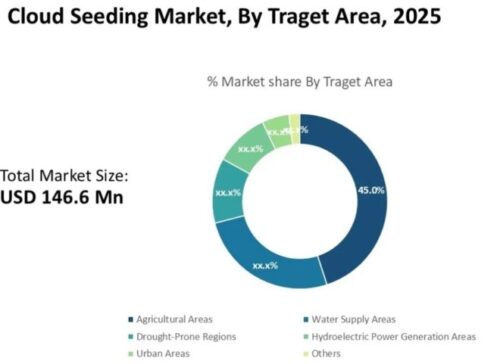
The Agricultural Areas segment is projected to dominate the global Cloud Seeding Market with a 45.0% share in 2025. This leadership is driven by increasing demand for effective precipitation enhancement to address drought conditions, boost crop productivity, and ensure food security. Governments and agricultural bodies worldwide are investing heavily in cloud seeding as a vital component of climate adaptation and water management strategies. Advances in weather monitoring and cloud seeding delivery technologies are further improving operational precision and cost-effectiveness, solidifying this segment’s prominence.
_
Cloud Seeding Market by Region is depicted in figure below:
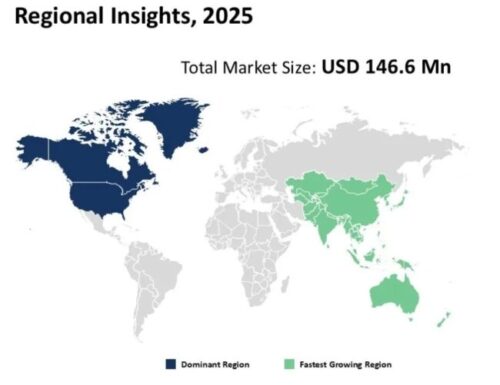
North America is anticipated to maintain a commanding position in the global Cloud Seeding Market, accounting for approximately 35% of the market share in 2025. This dominance is driven by substantial government funding, advanced meteorological infrastructure, and strategic initiatives aimed at optimizing water resources. The U.S. leads with extensive experience in cloud seeding for agriculture, snowpack enhancement, and wildfire control. Strong collaborations among research bodies, environmental agencies, and private enterprises fuel ongoing innovation. Favourable regulatory frameworks and increasing climate variability further boost adoption, cementing North America’s leadership in weather modification technologies.
______
______
Section-14
Limitations and challenges in cloud seeding:
Problems with cloud seeding include its effectiveness and consistency, potential environmental and health risks from chemical agents like silver iodide, ethical and legal concerns about weather modification, and high costs. It also faces the challenge of being weather-dependent, relying on existing clouds with sufficient moisture, and may cause unintended downwind weather changes or disputes.
_
Cloud seeding, despite being a promising technology, has its limitations:
- Cost: The process involves a substantial financial investment in aircraft, chemicals, and monitoring equipment. There are difficulties in quantifying economic benefits of enhanced precipitation or hail suppression.
- Requires existing clouds: Cloud seeding cannot create clouds; it can only work if there are already existing, suitable clouds with enough moisture.
- Weather conditions: Success is highly dependent on specific atmospheric conditions, such as high moisture content and low wind speeds.
- Ethical and legal issues: The use of cloud seeding for military purposes is prohibited under international law, following concerns raised during the Vietnam War, where cloud seeding was used to extend the monsoon season in Operation Popeye.
- Inconsistent results: The success rate is low, and the effectiveness is difficult to measure definitively because natural rainfall often coincides with seeding operations. Success is not guaranteed and can be difficult to measure precisely, leading to uncertainty about outcomes. Under less-than-ideal conditions, it may not produce any rainfall at all, as seen in some trials in Delhi where the clouds lacked sufficient moisture.
- Temporary relief: For issues like air pollution, it only provides a temporary solution as underlying sources continue to generate pollutants.
- Effect on natural water cycle: Artificial rainfall can disrupt the natural water cycle, potentially leading to drought or flooding in other areas.
- Limited scope: It cannot address large-scale weather systems or long-term drought conditions, and its impact on a given area’s water budget is often small.
- Unintended consequences: Altering weather patterns could lead to unforeseen and undesirable effects, such as flash floods or reduced rainfall in neighboring regions, raising ethical and legal concerns. There are possible impacts on ecosystems and biodiversity due to altered weather patterns.
- Lack of scientific certainty: There is a limited understanding of the microphysical processes involved, making it challenging to predict outcomes and prove effectiveness. There are ongoing debates over the efficacy and reproducibility of cloud seeding results. There are challenges in distinguishing seeding effects from natural variability in precipitation.
_______
_______
Challenges in cloud seeding:
The biggest challenge in rain enhancement is the difficulty in separating the natural and modified precipitation due to the significant natural variability (NRC, 2003), which is controlled by the non-linear processes and interaction of cloud microphysics and dynamics. The detection and quantification of precipitation due to seeding is almost impossible to isolate from the natural variability in the precipitation. The seeding signature in the precipitation will be a very small signal in the large variability of natural precipitation. This is the most intrinsic problem with assessing the efficacy of cloud seeding implementation.
_
Using the information that are gathered from agency officials, academic researchers, industry stakeholders, and the scientific literature, several challenges have been identified that can hinder the development and use of cloud seeding in ways and in situations where it may be beneficial. First, a lack of reliable scientific information and access to instrumentation for cloud seeding operations, and difficulty determining effectiveness prevent a full assessment of potential benefits and costs. In addition, uncertainty over any unintended effects of cloud seeding can lead to misunderstanding of its effect on the public. Finally, incomplete reporting of cloud seeding operational data can lead to inefficiencies in planning cloud seeding operations and hinder effective monitoring and oversight.
_
-1. Lack of reliable scientific information:
Uncertainty over cloud suitability:
Cloud seeding operations can only enhance precipitation when the right kind of clouds are present, which limits opportunities for successful cloud seeding. It is also difficult to identify which clouds are suitable. One key attribute is that such clouds contain sufficient supercooled liquid water. But this attribute is difficult to image with radar. Modeling can help predict the presence of supercooled liquid water but may not be able to forecast its location, amount, or how long it will remain in that state. The natural variability of cloud processes adds further uncertainty to the task of selecting clouds to target. This challenge is substantial for warm season clouds that contain water in multiple phases at the same time. These clouds can be seeded with glaciogenic or hygroscopic agents, but these seeding agents may interact with naturally occurring particles within the cloud in ways that are not fully understood. This interaction along with natural cloud variability makes it difficult to discern what effect the seeding had.
Climate change and air pollution may also create challenges for cloud seeding. Climate change may modify how seeding agents interact with clouds. Specifically, climate change has reduced moisture in the lowest part of the atmosphere, which may change cloud seeding efficacy and reduce precipitation. Air pollution may also reduce efficacy by adding particles that lead to the formation of too many small droplets. Small droplets tend to remain in clouds and are less likely to form larger droplets that fall as precipitation during cloud seeding.
Observational infrastructure:
Technologies for observing clouds—such as ground-, aircraft-, and satellite-based remote sensing—have advanced over the past decades, but they may be too costly for local cloud seeding operators, researchers, and state government programs. Next Generation Weather Radar (NEXRAD) is the current operational infrastructure for observations, which has coverage gaps, particularly in the western U.S. Furthermore, radar is generally “line of sight” and can be blocked by mountains. Technologies such as radiometers could provide higher-quality data but are too costly to deploy widely. Another improvement has come from using radar and LIDAR mounted on aircraft, although mountainous terrain and cloud dynamics can make it difficult to directly observe the effects of cloud seeding on a routine basis.
Seeding delivery:
The timing and placement of seeding material is crucial in increasing precipitation. Ground-based generators are one method of dispersing seeding agents. The ideal placement of these generators can be challenging due to issues like land ownership and access. Using aircraft for seeding may be more effective but also more costly. A ground-based generator may cost $50,000. Unmanned aircraft system (UAS/drone) are another option under consideration, but they are currently limited by FAA regulations. Until rulemaking is in place, a permanent UAS solution would require a combination of operating rules (that also includes operating conditions and agriculture operations) along with hazardous material dispensing and altitude waivers. For example, under FAA regulations, UAS must be operated no more than 400 feet above ground level, which may be inadequate for cloud seeding in some locations. However, Department of Transportation officials say that they currently waive this rule up to 9,000 feet above mean sea level for one operator.
_
-2. Uncertainty around unintended effects:
Environmental and health effects of silver iodide and other seeding agents:
Existing research suggests that silver iodide does not pose an environmental or health concern at current levels. However, it is not known whether more widespread use of silver iodide would have an effect on public health or be a risk to the environment. Silver iodide is nearly insoluble in water. However, when it dissolves it releases a small number of silver ions. In high enough quantities, silver ions—a known antimicrobial substance—could have harmful effects on beneficial bacteria in the environment and water resources. Other potential seeding agents—including liquid propane, other chemical salts (e.g., calcium chloride), and biological agents—are less widely used.
Downstream effects are uncertain:
Some studies have assessed whether cloud seeding can affect precipitation outside its intended area. This research suggests a potential for downstream effects, but the extent and direction of these effects are unclear. For example, some studies found seeding may cause a small increase in precipitation outside the target area, while others suggest a small decrease is possible—but more study is needed to quantify the effect. However, the uncertainties that limit the evaluation of cloud seeding effectiveness are even greater in non-target areas because of a lack of local observational data and infrastructure.
If cloud seeding expands, or robust calculation of the amount of water generated becomes feasible, communities may want to claim water from any cloud seeding operations that they funded.
_
-3. Data availability, perception, and other challenges:
Data and reporting practices:
Unreliable, incomplete, or missing data can hamper the long-term and larger-scale studies needed to measure what methods of cloud seeding are effective and in what circumstances. Without such studies, operators may be limited in their ability to enhance precipitation, and funders may hesitate to continue supporting cloud seeding operations. Operators are required to report data on cloud seeding (and other weather modification activity) to NOAA, but that information may not be complete for a variety of reasons. For example, some operators may be unaware of the requirement and what information to report. Furthermore, states may require different reporting which may make the overall data on cloud seeding more difficult to evaluate or use. In addition, some operators may be reporting cloud seeding results without conducting modeling or observational studies and may report only positive results to justify their programs to sponsors.
Stakeholder perception:
In addition to questions about effectiveness, the public and other stakeholders may hesitate to support cloud seeding for local precipitation, potentially because they associate it with seeding for geoengineering, which aims to affect climate on longer time scales, among other reasons. Tennessee lawmakers recently passed a law banning cloud seeding and some other forms of weather modification operations in the state. In addition, one official from Kansas says that a cloud seeding program was eliminated, in part, because of negative public perception and pressure on local officials. This state official also said that the reliance on annual funding from local sources was vulnerable to changes in public opinion regarding the cloud seeding program’s value.
Understanding of best practices:
Some operators may lack knowledge of or fail to adhere to cloud seeding best practices, which can reduce benefits and potentially reduce wider adoption of cloud seeding. Operators vary in their understanding of the environmental factors required for effective cloud seeding, such as how to target the right cloud. In addition, there is also a lack of agreement within the industry over how best to evaluate cloud seeding. Some contracts that do not require independent evaluations and instead use only input metrics like the number of seeding operations completed can incentivize these less-than-optimal approaches. Furthermore, when self-evaluations are done, the operators may have a vested interest in positive outcomes such as contract extensions. American Society of Civil Engineers (ASCE) guidelines for cloud seeding operations are underused in cloud seeding operations.
______
GAO identified challenges to the use and development of cloud seeding, including:
- Reliable information is lacking on the conduct of optimal, effective cloud seeding and its benefits and effects. Without such information, operations will be less effective and the return on funding investments is unclear.
- Cloud seeding operations can only enhance precipitation when the right kind of clouds are present, which limits opportunities for success.
- Existing research they reviewed, while limited to a handful of recent studies, suggests silver iodide does not pose an environmental or health concern at current levels. However, it is not known whether more widespread use of silver iodide would have an effect on public health or the environment.
- Federal reporting requirements may not include all information necessary to adequately monitor cloud seeding. As a result, opportunities to better evaluate the benefits and potential effects of cloud seeding may be missed.
- The public may not fully understand cloud seeding, including how it differs from geoengineering, which affects the climate on longer time scales.
_____
Challenge of maladaptation:
The challenge of maladaptation in cloud seeding underscores the complexities and potential pitfalls associated with weather modification practices. While cloud seeding aims to improve water supply, unexpected alterations to precipitation patterns may jeopardize ecosystems and community resources. Moreover, public skepticism often complicates its acceptance.
|
Aspect |
Benefits |
Risks |
|
Water Supply |
Increased rainfall |
Disruption of local hydrology |
|
Environmental Impact |
Improved vegetation |
Altered biodiversity |
|
Public Perception |
Solution to scarcity |
Misinformation and distrust |
|
Adaptation Level |
Immediate benefits |
Long-term maladaptation |
_______
_______
Section-15
Harms of cloud seeding:
The promise of creating rain is highly appealing in the face of increasing water shortages and disruptions to water cycles exacerbated by climate change. While cloud seeding is not a new technology—the first experiments took place in the 1940s—it fell out of favor in the 1980s for being an “unacceptable ethical and environmental hazard.” It is now back on the policy agenda as a climate adaptation strategy. Idaho, Utah, Colorado, Wyoming, and California have all expanded their cloud seeding operations in the past two years in response to the worsening drought. Despite its potential, the risks associated with cloud seeding are high, and there is significant danger that cloud seeding may do more harm than good. The debate around the safety and efficacy of cloud seeding encompasses several issues including environmental, ethical, and meteorological concerns. In recent years the practice has attracted scrutiny for its potential environmental impact and the broader implications of artificially altering weather patterns.
_
Unfortunately, altering the weather through cloud seeding may sometimes produce negative outcomes. A cloud seeding operation in China was followed by forty deaths and an estimated over $650 million in damages. In 1972, a cloud seeding operation in South Dakota resulted in overflowing a creek which resulted in $160 million in property damage and 238 deaths. A cloud seeding operation in Mongolia resulted in a death after a plane dropped a shell full of silver iodide that struck someone on the ground. The use of cloud seeding as a military weapon illustrates the risk of intentional harm from the practice. And, cloud seeding in one area can reduce desperately needed precipitation in another area, potentially exacerbating devastating droughts. In addition to the potentially harmful end results of cloud seeding, the practice of releasing chemicals such as silver iodide into the atmosphere may have negative consequences. A 2022 study using twenty air quality ground-based stations and satellite imaging in the United Arab Emirates found significantly increased seeding agent levels during cloud seeding operations.
_
Table below shows case studies when cloud seeding backfired:
|
Case |
Outcome |
|
UAE (2019) |
Rainfall increased, but groundwater contamination reports emerged. |
|
China (2008 Olympics) |
Successful rain diversion, but nearby regions faced unexpected droughts. |
|
Australia (2020) |
Seeding worsened flooding in Queensland, sparking public backlash. |
__
Negative Effects of Cloud Seeding:
-1. Environmental Pollution: Excessive silver iodide use may contaminate soil and water, impacting aquatic ecosystems and agriculture.
-2. Health Concerns: Trace silver accumulation may cause skin and organ-related conditions; WHO sets exposure limits to mitigate risks.
-3. Weather Imbalance: Artificial rain in one area may reduce precipitation elsewhere, potentially altering regional climatic equilibrium.
-4. Infrastructure Damage: Sudden heavy rainfall can trigger floods, landslides, and erosion in fragile terrains.
-5. Atmospheric Chemistry Impact: Chemical agents influence ozone and aerosol concentration, affecting long-term atmospheric quality.
-6. Cross-Border Disputes: Altered rainfall patterns can create tensions between neighboring states or countries over shared airspace or river basins.
______
______
Environmental Considerations:
Public concern regarding cloud seeding often centers on the chemicals used, particularly silver iodide, and their potential environmental impact. Studies indicate that the concentration of silver in rainwater and the environment following seeding is far below accepted limits for drinking water. The amounts of silver iodide dispersed are minute, and the compound is only sparingly soluble in water, posing no known threat to human health. Long-term studies have found no major concerns regarding the accumulation of seeding agents in the soil, water sources, or local ecosystems. However, the issue of hydrological redistribution remains a subject of ethical and political debate. The concern is that increasing precipitation in one area might inadvertently reduce rainfall in a downwind, neighboring region. Cloud seeding may not deplete atmospheric moisture but simply enhance the efficiency of existing clouds. Nevertheless, the potential for unintended consequences, such as flash floods or landslides if too much rain is produced, requires careful meteorological planning and execution. Research continues to explore less conventional and more environmentally benign alternatives to traditional seeding agents.
_
Studies regarding the possible environmental impacts of seeding are very limited in the literature. Silver is toxic and if released in large amounts, is bad for the ecosystem and humans. The soluble form is toxic in high amounts, say 10 gm of silver nitrate (which was used in early days) consumed by a human is fatal and the safety limits vary for different organisms. In fact, at room temperature, over 120 grams of silver nitrate can dissolve in just 100 millilitres of water. A 0.5% to 1% solution can cauterize small wounds, treat granulation tissue, or prevent neonatal eye infections (a practice dating back to the 1800s). The silver ion disrupts bacterial cell membranes and interferes with DNA replication—making it effective against a broad spectrum of microbes. AgI is an insoluble substance used in cloud seeding but even small amounts (0.2 micrograms) are highly toxic to fish, microorganisms, etc. (aquatic life). Iodine is 54% of the mass of AgI molecules and is not found to have toxicity levels. So far there are insufficient evidence in the literature that cloud seeding has contributed to an environmental impact. However, it is recommended that any cloud seeding program should evaluate environmental impacts.
_
Whether cloud seeding is detrimental to the environment is a complex question with no simple yes or no answer, hinging on factors like methodology, materials used, and the specific ecosystem affected. While offering potential benefits like increased precipitation in drought-stricken areas, poorly managed or inadequately researched cloud seeding programs can pose risks such as chemical contamination and unintended ecological disruptions. The primary environmental concerns surrounding cloud seeding revolve around the toxicity of the seeding agents and the potential for unintended ecological consequences.
- Toxicity of Silver Iodide: Although silver iodide is used in small quantities, silver is a known heavy metal that can be toxic to aquatic organisms. While studies generally indicate that the concentrations of silver iodide used in cloud seeding are below levels considered harmful, the long-term cumulative effects of repeated seeding operations are less understood. The bioaccumulation of silver in food chains is a particular concern. Silver iodide may accumulate in soils and waterways. Laboratory tests show that while single seeding events have low bioavailability, repeated use can gradually raise AgI concentration. A Spanish ecotoxicology study found that cumulative AgI exposure had moderate adverse effects on soil bacteria and freshwater plankton. At higher concentrations, AgI inhibited photosynthesis in algae and reduced microbial viability, suggesting repeated cloud seeding could “moderately affect biota” in both terrestrial and aquatic ecosystems. In short, years of seeding the same area could lead to toxic residues.
- Redistribution of rainfall: Perhaps the most critical concern is that rainfall gain in one locale might come at the expense of another. Cloud seeding essentially forces condensation earlier than it would occur naturally. Skeptics warn this could deprive downwind regions of moisture. As one climate source rhetorically asks, “Could increased precipitation in one area inadvertently trigger a drought elsewhere?”. The answer is uncertain – weather is complex – but some evidence suggests such redistribution is possible. For instance, “weather modification can cross borders and what may be good for one country may not be good for its neighbours”. Numerical modeling by the World Meteorological Organization indicates local rainfall increases ranged up to 20% in seeded areas, implying unseeded areas might see correspondingly less. Unintended drought in adjacent regions would heighten water scarcity and ecological stress there.
- Flooding and erosion: Conversely, too much rain in one spot can cause floods. Heavy cloud-seeding experiments have occasionally led to fears of extreme downpours. Residents exposed to unusually intense seeded storms may suffer property damage or landslides. Excessive rainfall can lead to soil erosion, nutrient runoff, and changes in plant community composition. One climate commentator warns that boosting rain can “lead to excessive precipitation, such as flooding and erosion”. Indeed, small regions might be unprepared for amplified run-off. The April 2024 UAE floods were so intense that meteorologists emphatically noted they exceeded anything seeding could produce. But lesser storms attributable to seeding could, over time, disrupt soil stability and river regimes.
- Impact on ecosystems: Wild plants and animals evolved to rely on established weather cycles. Sudden changes in timing or intensity of rain can harm them. Fish in normally dry riverbeds could drown, riparian vegetation might shift, and soil-dwelling organisms could be flooded or poisoned by silver. Critics argue that by tinkering with “delicate systems,” cloud seeding risks disrupting ecological balances and causing irreparable harm to ecosystems. We lack comprehensive studies on these ecological impacts, but the precautionary principle suggests such large-scale weather meddling could have cascading effects on biodiversity (which is effectively an ecosystem imbalance).
- Disruption of biogeochemical cycles: Altered precipitation patterns and changes in snowmelt dynamics can disrupt natural biogeochemical cycles, such as the carbon cycle, nitrogen cycle, and phosphorus cycle. These disruptions can have cascading effects on ecosystem productivity, nutrient availability, and greenhouse gas fluxes, potentially exacerbating climate change in the long run.
- Impacts on biodiversity and ecosystem services: Long-term changes in precipitation regimes and environmental conditions can alter habitat suitability for various species, potentially leading to shifts in species distributions, biodiversity loss, and degradation of ecosystem services, such as water purification, pollination, and carbon sequestration.
- Impact on Water Quality: Runoff from seeded areas could potentially contaminate water sources with silver iodide or other seeding agents, impacting drinking water quality and aquatic life.
- Unintended Consequences: The complexity of atmospheric systems makes it difficult to predict all the potential consequences of cloud seeding. Unforeseen impacts on local weather patterns and ecosystems are a possibility.
Moreover, the interaction of cloud seeding with other environmental stressors, such as climate change, air pollution, and land-use change, needs careful consideration. Cloud seeding might exacerbate existing environmental problems or create new vulnerabilities in already stressed ecosystems. A systems-based approach, incorporating ecological modeling and long-term monitoring, is crucial to understand and mitigate these complex environmental risks.
_____
_____
Harms of silver iodide used in cloud seeding:
How much silver is released into the environment by cloud seeding?
Silver iodide is usually sold by commercial chemical company distributors in granular or powder form. It is used in combination with various other chemicals, most often salts, and has been used for half a century as a glaciogenic agent (microscopic sized particles, referred to as ice nuclei, ice forming nuclei, or occasionally freezing nuclei, that spawn ice crystal formation). Silver Iodide is considered water insoluble (solubility constant at 10^-9 g[of Ag] g^-1 [of solvent-water]; which means that if one gram of the chemical is added to one gram of water, roughly one billionth of that gram of silver iodide would dissolve in to the water; the remainder will stay in the water undissolved. This property allows the silver iodide particles to maintain their structure prior to contact with supercooled (colder than freezing) cloud droplets. Silver iodide, as used in cloud seeding, is either dissolved in a flammable solution or combined with other flammable solids to produce seeding flares or other devices, which are burned to release submicron-sized, virtually invisible, silver iodide aerosol complexes into the atmosphere. These complexes are plentiful in number and increase the probability of ice crystals forming when they reach cloud environments at temperatures near or colder than the AgI ice nucleation (or crystallization) temperature threshold (about -5°C). This is significantly warmer than the threshold of most naturally occurring ice-forming nuclei, which commonly have thresholds near -15°C and colder.
_
Only small quantities of seeding material are released from individual cloud seeding generators typically in the range of 5-25 grams of silver iodide per hour from ground generators and up to a few kilograms per hour from aircraft depending on the size of the target area. Moreover, this is being done only during certain periods and locations of precipitation-producing weather systems. The reason that such small quantities can be used is that AgI dispensing systems generally produce up to 10^15 ice forming nuclei per gram of AgI expended (e.g., ASCE 2004, 2006). This means small amounts of AgI seeding material can produce tremendous numbers of ice crystal seeds that can create ice crystals, which can grow into snowflakes. The insolubility of AgI is a crucial factor for such small particles that allows them to maintain their identity (structure) intact and not dissolve in water and thus lose their structure inside a cloud droplet. Without this property there would be no cloud seeding effect.
_
As a metric of cloud seeding chemicals, silver concentrations have been measured in the snowpack of several cloud seeding target areas in the western U. S. The average concentrations throughout the snowpack have generally ranged from 4-20 x 10^-12 g[of Ag] g-1[of solvent-water], rarely exceeding 100.0 x 10^-12 g g-1 (Warburton et al. 1995a,b, 1996; McGurty 1999). Since seeding clouds could lead to rain (if snowflakes melt during their fall to earth) measurements of seeding chemical concentrations in the rainwater have also been done and found to be in similarly low concentrations (e.g., Sanchez et al. 1999).
_
Why is there concern about using silver iodide in cloud seeding?
It is well established that silver in some forms can be toxic to lower organisms without being toxic to higher animals (Kotrba 1968). Numerous controlled laboratory studies have shown that silver, silver nitrate and even silver iodide when added to laboratory aquariums, even at trace levels, can be toxic to some fish and other aquatic life when exposed over long time periods; the toxicity is related to specific compounds, concentrations and other factors such as water hardness, etc (e.g., Davies & Goettl 1978). However, these laboratory conditions bear little resemblance to outdoor freshwater bodies where the mobility of any of these silver compounds is essentially zero and these compounds are rapidly converted to less toxic compounds by the presence of other chemicals found in nature. Hence, they are not freely bio-available to the environment. Laboratory results derived from biological studies cannot be taken to imply any meaningful information about silver iodide used in cloud seeding because its insoluble nature makes it nearly impossible to dissociate sufficiently or rapidly enough to ever achieve toxic levels. Meaningful evaluation must include the specifics of the chemical form of silver (i.e., ionic silver, silver nitrate, silver iodide), the quantities involved, and the chemical, even physical, nature of the environment. Hence, care must be taken when comparing the potential impact of silver iodide on the environment as used in cloud seeding programs with the impact of silver or soluble silver in laboratory settings, which are not representative of the natural environment where cloud seeding is conducted.
_
Basis for asserting that cloud seeding using silver iodide has negligible environmental impact:
The potential environmental impacts of cloud seeding programs using silver iodide have been studied since the 1960s. These studies have all concluded that ice-nucleating agents, specifically silver iodide as used in cloud seeding, represent a negligible environmental hazard, (i.e., findings of no significant effects on plants and animals), (e.g., Cooper & Jolly 1970; Howell 1977; Klein 1978; Dennis 1980; Harris 1981; Todd & Howell 1985; Berg 1988; Reinking et al. 1995; Eliopoulos & Mourelatos 1998; Ouzounidou & Constantinidou 1999; Di Toro et al. 2001; Bianchini et al. 2002; Tsiouris et al. 2002a; Tsiouris et al. 2002b; Christodoulou et al. 2004; Edwards et al. 2005; Keyes et al. 2006; Williams & Denholm 2009).
_
The U.S. Public Health Service established a concentration limit of 50 micrograms of silver per liter of water in public water supply to protect human health (e.g., Erdreich et al. 1985). The concentrations of silver potentially introduced by modern cloud seeding efforts are significantly less than this level. The literature embodies tens of thousands of samples collected from cloud seeding program areas over a thirty-year period showing the average concentration of silver in rainwater, snow and surface water samples is typically less than 0.01 micrograms per liter. More importantly, these measurements represent the total amount of silver contained in any given sample and are not specific to the form of silver present in a sample. Nevertheless, these measurements show that silver is virtually undetectable in any form in the vast majority of the tens of thousands of samples collected from these areas.
_
More than 100 Sierra Nevada lakes and rivers have been studied since the 1980’s (e.g., Stone 1986); no detectable silver above the natural background was found in seeded target area water bodies, precipitation and lake sediment samples, nor any evidence of silver accumulation after more than fifty years of continuous seeding operations (Stone 1995; Stone 2006). Many of these alpine lakes have virtually no buffering capacity, making them extremely susceptible to the effects of acidification and sensitive to changes in trace metal chemistry. Therefore, studies were conducted as part of environmental monitoring efforts to determine if cloud seeding was impacting these lakes. No evidence was found that silver from seeding operations was detectable above the background level. There was also no evidence of an impact on lake water chemistry, which is consistent with the insoluble nature and long times required to mobilize any silver iodide released over these watersheds. Comparisons of silver with other naturally occurring trace metals measured in lake and sediment samples collected from the Mokelumne watershed in the Sierra Nevada indicate that the silver was of natural origin (Stone 2006). Similarly, Sanchez et al. (1999) analyzed the chemistry of water bodies and rainwater from samples collected during a summer cloud seeding program in Spain, and determined the silver input from cloud seeding to be indistinguishable from natural inputs. Greek scientists studying the effects on soils, plants and their physiology, atmospheric precipitation, plankton, animals and man, as well as the impact of irrigation and organic matter to AgI leaching from the Greek cloud seeding activities found similar results following the analyses of 2500 soil samples (e.g., Tsiouris et al. 2002a; Tsiouris et al. 2002b).
_
In a nutshell:
The published scientific literature clearly shows no environmentally harmful effects arising from cloud seeding with silver iodide aerosols have been observed, nor would be expected to occur. Based on this work, the WMA finds that silver iodide is environmentally safe as it is currently being used in the conduct of cloud seeding programs.
Note:
Very large and very small numbers are often expressed in scientific or powers of 10 notation. The 10^15 means 10 multiplied by 10, 15 times and it equals 1,000,000,000,000,000. When 10 is raised to a negative power it means 1 divided by 10 the power number of times; for example, 10^-1 equals 1 divided by 10 equals 0.1.
Units note: g g^-1 as used here means grams of chemical divided by grams of water in the sample, so that 10^-12 g g-1 means 0.000000000001 grams of silver per 1.0 gram of water.
______
Counterview:
Potential risk of acute toxicity induced by AgI cloud seeding on soil and freshwater biota, a 2016 study:
Silver iodide is one of the most common nucleating materials used in cloud seeding. Previous cloud seeding studies have concluded that AgI is not practically bioavailable in the environment but instead remains in soils and sediments such that the free Ag amounts are likely too low to induce a toxicological effect. However, none of these studies has considered the continued use of this practice on the same geographical areas and thus the potential cumulative effect of environmental AgI. The aim of this study is to assess the risk of acute toxicity caused by AgI exposure under laboratory conditions at the concentration expected in the environment after repeated treatments on selected soil and aquatic biota. To achieve the aims, the viability of soil bacteria Bacillus cereus and Pseudomonas stutzeri and the survival of the nematode Caenorhabditis elegans exposed to different silver iodide concentrations have been evaluated. Freshwater green algae Dictyosphaerium chlorelloides and cyanobacteria Microcystis aeruginosa were exposed to silver iodide in culture medium, and their cell viability and photosynthetic activity were evaluated. Additionally, BOD5 exertion and the Microtox® toxicity test were included in the battery of toxicological assays. Both tests exhibited a moderate AgI adverse effect at the highest concentration (12.5µM) tested. However, AgI concentrations below 2.5µM increased BOD5. Although no impact on the growth and survival endpoints in the soil worm C. elegans was recorded after AgI exposures, a moderate decrease in cell viability was found for both of the assessed soil bacterial strains at the studied concentrations. Comparison between the studied species showed that the cyanobacteria were more sensitive than green algae. Exposure to AgI at 0.43μM, the reference value used in monitoring environmental impact, induced a significant decrease in photosynthetic activity that is primarily associated with the respiration (80% inhibition) and, to a lesser extent, the net photosynthesis (40% inhibition) in both strains of phytoplankton and a moderate decrease in soil bacteria viability. These results suggest that AgI from cloud seeding may moderately affect biota living in both terrestrial and aquatic ecosystems if cloud seeding is repeatedly applied in a specific area and large amounts of seeding materials accumulate in the environment.
Note:
1µM/liter = 108µg/liter
_____
_____
Health Impacts:
There are two seeding compounds used in Texas. They are silver iodide and calcium chloride. The environmental and health impacts of calcium chloride are considered negligible. It is a common salt that naturally occurs in much higher concentrations than the amount that is released during cloud seeding. Calcium chloride is considered food-safe and is used as a firming agent in food production. Silver iodide is more widely used as a seeding compound. It is formed by a very strongly bonded compound of silver and iodide and is non-toxic in concentrations used for cloud seeding. The strong chemical bond between silver and iodide makes it stable and virtually insoluble. This means that silver iodide will not dissolve in the atmosphere or groundwater to potentially cause contamination. Silver iodide (AgI) in cloud seeding poses minimal direct risk to drinking water quality in typical applications because it’s largely insoluble and disperses at extremely low, safe concentrations (often thousands of times below WHO limits), settling in soil/sediments rather than easily dissolving.
_
A recent report by the U.S. Government Accountability Office stated that “existing research we reviewed, while limited to a handful of recent studies, suggests silver iodide does not pose an environmental or health concern at current levels. However, it is not known whether more widespread use of silver iodide would have an effect on public health or the environment” (GAO, 2024). The amount of material used in a cloud seeding operation is miniscule compared to the area of effect. The current concentrations of material are highly diluted and pose no risk to human health or the environment. A comprehensive paper on potential effects of silver iodide on humans and the environment from cloud seeding in Utah concluded there was no threat from silver iodide releases from cloud seeding (Cardno ENTRIX, 2011).
_
Although concerns often arise concerning the potential health impacts of cloud seeding, extensive research over several decades has largely mitigated these apprehensions. The primary agent used in this process, silver iodide, has not demonstrated significant toxicity at the concentrations released into the environment. The US Environmental Protection Agency and the World Health Organization both note that post-seeding silver levels in rain or soil typically measure below 0.01 micrograms per litre — far below the WHO’s drinking water safety threshold of 100 micrograms per litre. Standard cloud seeding with silver iodide, when done per current protocols, is not shown to pose a significant long-term risk to humans, animals, or aquatic life, though environmental caution and monitoring continue to be recommended. Most toxic effects occur with long-term or repeated exposures to silver, and one time or infrequent exposures generally have not been shown to cause adverse effects. Silver ions, not silver iodide, are the main concern in aquatic ecosystems — most aquatic toxicity data uses highly soluble silver salts like silver nitrate, not silver iodide, which is much less soluble and less bioavailable. Long-term studies indicate that the silver levels in stormwater from seeding remain below 50 micrograms per liter, rendering it comparable to regular rainwater.
_
Particulate pollution:
Cloud seeding missions require firing salts and silver iodide crystals into the atmosphere. The increased concentration of particulate matter, or micro-pollutants, increases risk for respiratory illnesses. In 2017, a study was conducted before and after cloud seeding missions, which recorded an increase of particulate matter, correlating to the months of active artificial rain. Researchers attribute this to left over silver iodine crystals that were not dispersed in the rain during the cloud seeding months. The plumes released often contain not only nucleating agents but also particulate matter. For example, the UAE’s extensive cloud seeding program was linked to measurable spikes in airborne particles. One study found that after months of seeding, several UAE regions showed higher concentrations of fine particulates – likely leftover AgI crystals not washed out by rain. This raises public health alarms: breathing increased particulates can worsen respiratory problems. In one experiment, particulate counts rose during seeding months, with scientists noting a clear correlation to silver iodide dispersion. More recently, over 20 regions in the UAE that participated in cloud seeding experiments have a higher concentration of particulate matter. The overall environmental impact of cloud seeding is difficult measure due to the inability to perform controlled experiments along with the difficulty in direct tracing. In 2021, Li and his coworkers (Li et al. 2021) studied the effect of silver ions on human lungs; the research indicates that silver ions released from nanoparticles caused cell necrosis by facilitating the influx of Na+ and Ca2+ ions, leading to pulmonary inflammation through the elevation of mitochondrial-related contents released from these necrotic cells.
______
______
Unintended Hydrological Consequences:
One critical area of long-term cost lies in the potential for unintended hydrological shifts. Cloud seeding does not create water; it aims to redistribute it in space and time. While it might increase precipitation in targeted areas, it could simultaneously reduce it elsewhere. This redistribution can have significant long-term consequences for water resources and ecosystems. Consider the following potential scenarios:
- Downwind drought intensification → By seeding clouds in one region, we might be effectively “stealing” moisture from downwind areas, potentially exacerbating drought conditions in those regions over time. This phenomenon, sometimes referred to as “moisture piracy,” is a serious concern, especially in already water-stressed areas.
- Altered snowpack dynamics → Cloud seeding in mountainous regions can affect snowpack accumulation and melt patterns. While increased snowpack might seem beneficial in the short term, it could lead to altered spring runoff, impacting downstream water availability and potentially increasing the risk of floods in some years and droughts in others.
- Changes in river flows and groundwater recharge → Long-term alterations in precipitation patterns due to cloud seeding could affect river flow regimes and groundwater recharge rates. These changes can have cascading impacts on water availability for agriculture, industry, and domestic use, as well as on the health of aquatic ecosystems.
______
______
Section-16
Ethical, geopolitical and regulatory issues of cloud seeding:
The practice of cloud seeding raises complex ethical questions related to human intervention in the natural world. Some of the ethical dilemmas associated with cloud seeding include:
- Altering natural weather patterns: Is it morally justifiable to modify weather systems for human benefit, potentially at the expense of natural ecosystems and non-human species?
- Equity and distribution: How should the benefits and risks of cloud seeding be distributed among different communities and stakeholders, particularly in regions prone to water scarcity or extreme weather events?
- Informed consent and public participation: Are affected communities adequately informed and consulted about cloud seeding activities, and do they have a say in decision-making processes that may impact their lives and livelihoods?
_
Ethical Considerations:
The ethical consequences of cloud seeding include a range of concerns, including the potential manipulation of natural weather systems and the equitable distribution of water resources. As society grapples with climate change, the urgency to address water scarcity issues has intensified, yet cloud seeding raises considerable ethical questions. One major concern is the potential for unintended consequences, such as altering regional climates or affecting ecosystems. Furthermore, the allocation of cloud seeding resources can create inequities, as certain areas may benefit disproportionately, leaving others in drought.
The table below summarizes key ethical considerations in cloud seeding:
|
Ethical Consideration |
Description |
|
Manipulation of Weather |
Potentially disrupts natural weather patterns. |
|
Resource Allocation |
Unequal access to water resources among regions. |
|
Environmental Impact |
Risks to local ecosystems and biodiversity. |
|
Long-term Effects |
Uncertainty about the future consequences of seeding. |
|
Accountability |
Need for regulation and oversight in cloud seeding. |
__
Ethical Questions:
Cloud seeding raises deep ethical dilemmas about human intervention in nature:
- “Playing God” with weather:
Critics argue that deliberately altering weather is hubristic. As one environmental ethicist puts it, such interventions treat humans like “gods” in the natural world. We have only begun to understand Earth’s climate systems; seeding introduces unpredictable changes. If something goes wrong (mass flooding, ecosystem damage), who bears responsibility? The uncertainty alone makes many uneasy. In one case, New Mexicans pressured their government to halt a cloud seeding project, famously pleading “Please stop playing God with the weather”. This captures a common sentiment: people worry about unforeseen harms when we “tinker” with age-old weather patterns.
- Informed consent and transparency:
Many communities subject to cloud seeding know little about it. The practice is often run by governments or contractors without broad public discussion. Ethicists warn this opacity breaches the principle of informed consent. Residents downwind may experience unusual rain or hail without having agreed to it. Even proponents acknowledge the need for better public dialogue. For example, a Utah meteorologist stressed that scientists must “properly inform the public of what’s happening, what the advantages are, what the disadvantages might be” before proceeding. Without transparency, cloud seeding can breed suspicion (as seen with viral claims in Dubai) and leave citizens feeling powerless over their own weather.
- Fair distribution of benefits and harms:
Weather modification raises stark fairness questions. If one region gains extra rain, others might lose out. That “unequal distribution of benefits and harms” is an ethical red flag. Wealthy communities or nations could essentially bankroll rain (or snow) for themselves, worsening scarcity elsewhere. This runs counter to the idea of shared natural heritage. Internationally, it could violate norms of equitable resource sharing. Even domestically, it might favor certain farms or cities at the expense of parched rural areas. In effect, cloud seeding could re-draw political battles around water rights and property, rather than alleviating them.
- Legal voids and international law:
Legally, aside from ENMOD (which bans military weather warfare), few treaties cover civilian weather modification. Some countries have begun drafting regulations; others operate on ad-hoc permits. The patchwork of laws means guidance on liability, environmental standards, and reporting is often lacking. For example, the U.S. GAO notes federal oversight of cloud seeding is minimal. This regulatory gap leaves communities and ecosystems vulnerable. As one expert summary puts it, the ethics of weather control “demand careful examination” and “international cooperation” to balance innovation with precaution.
In short, cloud seeding sits at the crossroads of science and morality. It forces societies to ask: Do we have the right to control the weather? And if so, under what conditions and with whose permission?
______
______
Rob peter to pay pal:
Does cloud seeding ‘steal’ rain/snow that would fall in other places?
Some folks think if you seed clouds in one area, you ‘steal’ the rain from nearby areas but there’s no real evidence to support that. Cloud seeding might help in one region, but it doesn’t cancel out rain somewhere else. Cloud seeding, we need to remember, is done in a very localized manner. The goal is to produce just a bit more precipitation than what would’ve otherwise been generated. So, some ideas surrounding the theory of robbing Peter to pay Paul are inaccurate.
How much additional precipitation is produced?
Figure below shows Atmospheric water budget.
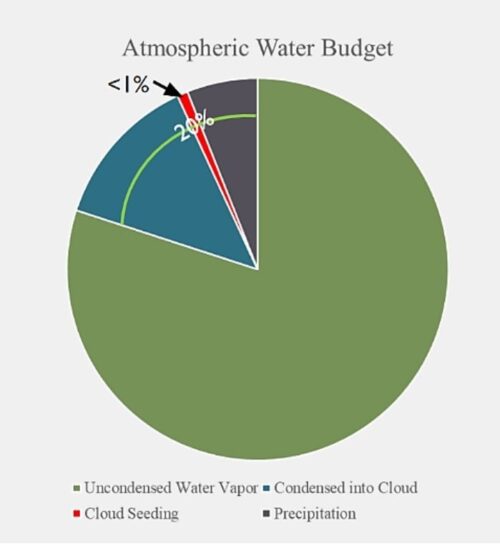
Atmospheric rivers, analogous to surface flowing rivers, are very dynamic and experience many “gains” and “losses” as they move across the continent. On average, roughly 20% of the total atmospheric water budget in a given area will condense into clouds; of that amount, only about 30% will fall to the ground as precipitation naturally (roughly 6% of the overall water budget). It is estimated that less than 1% of the total water budget in a given area is impacted by cloud seeding. Additionally, the nucleation process, once initiated in a seeded cloud, can continue for a given distance downwind, aiding downwind precipitation as a result. Once the AgI nuclei are released into the atmosphere, they can remain active for many hours; and if pooled in high concentrations, the AgI nuclei can seed areas downwind from the intended target areas. While further research is required to better address this question, evidence suggests there is either a neutral or positive benefit to downwind users.
Also, we need to remember that these clouds are not closed systems. Inflows of moisture are ongoing, replenishing what is being precipitated. Furthermore, when you take supercooled liquid water, and you change the phase from liquid to an ice crystal, you’re releasing latent heat. When that latent heat is released in the cloud, it allows the cloud to grow and expand, allowing it to last longer and tap into additional moisture in the environment than what would’ve otherwise happened. So, robbing Peter to pay Paul is more like paying Peter, paying Paul, paying everybody. Actual seeding activities to increase precipitation that generally indicate an increase in precipitation amounts in target areas also generally indicate an increase beyond the intended target areas (e.g., Langmuir, 1950, Hobbs and Radke, 1973, Brown et al., 1975, Mulvey, 1977, Brown et al., 1978, Long, 2001, Solak et al., 2003, Griffith et al., 2005, Wise, 2005). Hence, cloud seeding typically benefits both “Peter” and “Paul”. Because it’s happening in a localized manner, we’re not having large-scale impacts. If you look at precipitation maps, you’re not seeing much of a difference in terms of overall state-wide or region-wide types of changes. This is just very localized, tapping into that supercooled water that otherwise would still just be airborne. Extra area effects of cloud seeding — An updated assessment published in 2013 found that “Extra area” seeding effects may extend to a couple hundred kilometers.
_
A concern raised by rural politicians at the symposium was whether adopting a cloud seeding program in one county would end up “stealing” water that would otherwise fall in another. Kala Golden, who manages Idaho’s cloud seeding program, said it’s a common concern from stakeholders. She encourages them to think of storms and atmospheric conditions like a river in the sky, which collects and deposits water all along its course. “It’s not a single cup that dumps out, that your neighbor took … and then by the time it gets down to you, that cup is empty,” Golden said. “That system is continuing to pick up water as it goes along, just like a surface-flowing river.” In fact, since 2007, Lower Basin states on the Colorado River like California and Nevada have helped pay for and support cloud seeding programs in Upper Basin states. Contributions from those states amounted to more than $80,000 in Utah during the 2020-2021 season. “We’re at the end of the pipe,” Tom Ryan, a resource specialist with the Metropolitan Water District of Southern California, said at the symposium. “[We want to] get some folks to create additional snowfall with the hope that eventually it will cascade its way down to Southern California.”
______
______
Scare of silver iodides:
Silver iodide can be scary to people because of the term silver. Silver itself is indeed toxic, and the silver ion does have major implications when it comes to environmental impact or health. But when it’s attached to the iodide molecule, it has a very strong covalent bond, and this allows it to stay insoluble in water. That makes it great as both a seeding agent, because we are dispersing this material into supersaturated environments, but it also makes us safe on the ground. When it gets on the ground, it’s not bioavailable, because it’s in the solid form. But also, when it gets in the water, studies showed that the maximum concentration of silver when in water coming off of the silver iodide molecule is about 0.984 micrograms per liter. For reference, to have any impact on aquatic life, there needs to be four to seven micrograms per liter. And to have any negative effect on drinking water, it needs to be 100 micrograms per liter. So, we are not only well below those thresholds, but we’re also below the threshold of natural background levels of silver in our environment. In southern Utah, natural silver is about six micrograms per liter. It’s the safety of the molecule, but it’s also the amount that we use. For a general cloud-seeding mission using an aircraft, we’re firing anywhere from 2 to 4 glaciogenic flares in single cloud. Those are flares that have silver iodide in them. You’re looking at 50 grams of silver iodide across areas that can cover multiple counties in west Texas, which are very large counties. By the time it’s coming out of the rain, there’s no better filter than a cloud, and you can’t trace it. You just cannot trace the levels of silver iodide that we are using.
_____
_____
Geopolitics of cloud seeding:
Weather modification technologies have inherent potential for weaponization or for use as tools of geopolitical influence. If one nation develops and deploys cloud seeding technology unilaterally, it could create international tensions and mistrust, especially if neighboring countries perceive negative impacts on their water resources or climate. Cloud seeding is not purely a meteorological issue – it has become a geopolitical flashpoint. Weather systems do not respect political boundaries, and altering them can spark conflicts:
- Weaponization potential:
The technology could be misused for military purposes or as a tool of coercion, exacerbating international tensions and undermining global security. The United States used this technique during the Vietnam War to slow the advance of opposing troops by causing flooding.
- Cross-border disputes:
When one country increases its rainfall, neighboring states may accuse it of stealing water. In fact, a Chatham House analysis reported that Iran accused Israel of using cloud seeding to reduce Iran’s rainfall, essentially “stealing its water”. Whether that claim was accurate, it shows the level of distrust. Similarly, expanding programs in one nation can cause diplomatic alarm in others. For example, China’s ambitious plan to seed clouds over half its territory by 2025 has drawn concern from India and other neighbors. These rising tensions feed narratives of looming “water wars,” where artificial weather becomes a contested weapon.
- Lack of regulation:
Apart from the 1978 UN Environmental Modification Convention (ENMOD), there are few binding international laws on cloud seeding. ENMOD prohibits hostile weather use by signatories, but many countries have not ratified it and it only covers “widespread, long-lasting, or severe” modifications. That loophole means peaceful or borderline operations often go unchecked. One analyst notes that many nations deploy cloud seeding extensively precisely because “authoritarian” governments face fewer domestic protests and use it as a prestige project. In democratic countries, weather projects may draw public skepticism, but authoritarian regimes can roll out mass seeding with little transparency.
- Water rights and diplomacy:
Cloud seeding can complicate existing treaties. If a river relies on seasonal rains that one country seeds, downstream users may see diminished flows. International water-sharing pacts (like Nile or Indus agreements) could be strained if upstream nations artificially boost or steal precipitation. One policy expert warns that manipulating weather inherently raises questions of ownership of clouds and rain. Is it fair for one state to “control” nature’s rainfall for its own benefit? The potential inequity is stark: cloud seeding by a wealthy region might tip the balance of water access and trigger litigation or even conflict.
Within nations, political dynamics also play a role. In the U.S., some western states fund seeding programs to fight drought, while others criticize the waste of taxpayer money. The U.S. Government Accountability Office reports that nine states currently seed clouds, but about ten states have banned or considered banning the practice. This reflects a split policy landscape: where politics and drought intersect, seeding gets support; elsewhere it faces pushback.
______
Hey! You! Get off of my cloud!’
Towards a cloud war?
Cloud seeding technique raises at least two questions for the future: the property of the water it contains and the impact of the products used.
-1. The property of water: while this may seem a trivial subject today, it raises the question of whether, in the years to come, as water resources become increasingly scarce, there might not be a risk of conflicts between neighbouring countries over the ownership of rain. Indeed, if a country decides to ‘make it rain’ on its territory, it may be ‘stealing’ rain that would have fallen later in a neighbouring country. There is a precedent for this between Iran and Israel.
-2. The impact of the products used: in large quantities, silver iodide is dangerous for biodiversity, particularly in aquatic environments. An English study carried out by the Centre for Ecology and Hydrology in the early 2000s revealed that silver iodide, below a certain concentration, is not toxic for the environment, but this substance is described as “extremely insoluble”: the risk is therefore that it accumulates and can be harmful over the long term.
The debate is open as to what status should be given to clouds: should they be included in the UNESCO (United Nations Educational, Scientific and Cultural Organisation) World Heritage List? Or give them a legal personality, as is currently the case for some rivers?
My view:
The water vapour resource is not like water resources in a river, which could be intercepted from points upstream. Also, it is not like a cake – if I have a bite, others get only a smaller piece. Besides, clouds change while floating in the sky, or drift or get evaporated. If you see clouds in your sky, it is your clouds which can be seeded by you but clouds can drift to other states or neighboring nation. Then it can be seeded by other states or other nation. We do not have power to shift/drift /pull clouds. All we can do is to seed clouds in our sky in very narrow time window. Attributing a “legal title to a cloud would be ridiculous” due to the distinct nature of clouds, their perpetual change of form and location, their emergence, disappearance and renewal. Private ownership of clouds is “nonsense” as control is limited to the short moment of the cloud being above somebody’s land.
______
______
Legal and Regulatory Frameworks:
There are many issues relating to rainmaking that apparently has been ignored by the rainmakers and policymakers as well. The most important neglected issue is to answer the question of who owns the right to use the extra water that is produced by cloud seeding. Even more complicated is that of the alleged deprivation of rainfall downwind from where cloud seeding has enhanced rainfall. If the upwind landowners have used an artificial manner to receive a larger amount of rainfall than the naturally occurring rainfall, then downwind landowners feel that they have been deprived of rainfall. Given the potential environmental and ethical implications of cloud seeding, regulatory frameworks are needed to govern its use and ensure responsible stewardship. However, the regulation of cloud seeding varies widely between countries and regions, with some jurisdictions implementing strict oversight and others having limited or no regulations in place. Establishing clear guidelines for the implementation and monitoring of cloud seeding programs is essential to mitigate potential risks and safeguard environmental and ethical principles.
_
Existing international legislation:
The Environmental Modification Convention (ENMOD), formally the Convention on the Prohibition of Military or Any Other Hostile Use of Environmental Modification Techniques, is an international treaty prohibiting the military or other hostile use of environmental modification techniques having widespread, long-lasting or severe effects. It opened for signature on 18 May 1977 in Geneva and entered into force on 5 October 1978. The Convention bans weather warfare, which is the use of weather modification techniques for the purposes of inducing damage or destruction. The Convention on the Prohibition of Military or Any Other Hostile Use of Environmental Modification Techniques (ENMOD) is the only international framework related to the regulation of weather and climate modification technologies. Developed after cloud-seeding operations were conducted during the Vietnam War and the Cold War, the convention’s scope of application solely encompasses military or any other hostile uses of weather modification technologies. Indeed, the use of weather modification programs for peaceful purposes is not prohibited by the treaty. ENMOD has been criticised for its many weaknesses, notably regarding the vagueness and ambiguity of notions leaving room for various interpretations. Given the growing attractiveness of weather modification programs, the legal framework offered by ENMOD is arguably insufficient, as the question of “ownership” is not answered.
_
Quilleré-Majzoub (2004) dismisses the concept of ownership of clouds altogether, given their specific nature, rendering the idea of a cloud ever belonging to somebody unsubstantiated. Indeed, clouds are beyond occupancy – similar to air, running water, the sea and animals ferae naturae – and should thus be considered as common property. Based on this assumption, according to Quilleré-Majzoub it follows that a distinction between res communis, belonging to everybody and thus necessitating international regulation, and res nullius, belonging to nobody with states serving themselves as they please, is more suitable. Although water is generally considered as res nullius in international law, there is strong pressure to acknowledging it as res communis, but cloud moisture does currently not have a clearly defined status. She thus suggests that international law should elaborate a jurisdictional regime that takes into account both the particular nature of clouds and the implications of new technologies.
_
According to Brooks (1948) the picture changes once the moisture in the clouds is made accessible through artificial rainmaking technologies, as the rainwater can now be occupied. Typically, regarding naturally occurring precipitation, the first to reduce it to possession, normally the landowner, will gain rights in it as long as no existing rights are violated. Given that this benefit is accorded by nature, these natural rights should not allow the landowner to claim artificially induced rain. California legislation binds water generated through seeding to existing surface water rights and groundwater regulations, considering the produced water “natural supply”. Yet courts could decide that the induced rain should be designated as “additional precipitation”, permitting the cloud-seeding entity to claim a portion of this generated water. This approach would also face challenges, given the difficulty of determining the fraction of extra water procured by cloud seeding.
_
Given the lack of liability for cloud seeding and its widespread use, there is unfortunately little regulation of the practice. Because cloud seeding is controlled at the state rather than federal level, there is no centralized regulatory regime for the practice. And even at the individual state level, most states’ reporting requirements are minimal. In only one state, Montana, are all weather modification operations required to conduct an Environmental Impact Assessment. If you are a policymaker, water manager or community leader considering cloud seeding, here are concrete, evidence-based steps to take: require public release of monitoring data and an independent scientific evaluation before committing multiyear budgets; start with limited, well-measured pilot projects that include unseeded controls; budget for both operations and independent reviews; plan for transparent community briefings and a complaints/oversight process; and pair any seeding program with stronger demand-management and conservation measures so seeding is only one element of resilient water planning.
______
Case law regarding cloud seeding:
Despite the relatively unregulated nature of cloud seeding, its widespread use for over eighty years, and the potential for catastrophic harm, there is little case law on the practice. This is perhaps due to the awareness that attempts to impose liability for cloud seeding operations are nearly impossible because of the difficulty of proving causation. The following is the relevant case law directly and indirectly related to cloud seeding:
Adams v. California:
Plaintiff was unable to prove that snowpack augmentation seeding was the cause of a flooding that resulted in death and millions of dollars in damage. Plaintiff lost at trial due to an inability to prove causation.
Slutsky v. City of New York:
This case involved the owners of a year-round vacation resort who sought a temporary injunction preventing the City of New York from cloud seeding, arguing that rainfall would be harmful to their business. The court held that plaintiffs failed to prove that cloud seeding would cause irreparable injury and that plaintiffs “clearly have no vested property rights in the clouds or the moisture therein . . . .” The court went further and maintained that the balance of interests is in favor of how the cloud seeding would promote the general welfare and public good against the purely speculative dangers alleged by the plaintiffs.
Reinbold v. Sumner Farmers, Inc.:
Plaintiff who was downwind from a precipitation enhancement project sued the operator and sponsor. Plaintiff ultimately lost because testimony did not establish that the cloud seeding materials used were found on plaintiff’s property, and therefore, there was no physical, causal connection proven.
Claims against the City of San Diego:
San Diego hired Charles M. Hatfield to engage in cloud seeding operations which were followed by torrential rain, washing out a dam, resulting in death and property damage. Multiple lawsuits were filed against the city totaling almost one million dollars. The city was successful in having the cases dismissed on the grounds “that the rain was an act of God.”
Saba v. City of Bismarck:
Plaintiff was unable to prove that weather modification was the cause of their flooded property. While the court initially granted Plaintiff’s temporary restraining order, it was not made permanent as expert testimony led the court to conclude that Plaintiff failed to prove causation.
Southwest Weather Research, Inc. v. Rounsaville:
Plaintiffs were cattle ranchers who alleged that hail suppression operations occurring over their property denied them valuable rain. The court granted a temporary injunction, explaining that “the landowner is entitled to such precipitation as Nature deigns to bestow. . . . It follows, therefore, that this enjoyment of or entitlement to the benefits of Nature should be protected by the courts if interfered with improperly and unlawfully.” While the injunction only pertained to the airspace directly over the plaintiff’s property, it is a unique case in that Plaintiffs successfully proved causation against cloud seeding operators. However, it is important to note that this finding was only used to acquire a very limited injunction, not to impose any liability on the cloud seeding operation.
Pennsylvania National Weather Ass’n v. Blue Ridge Weather Modification Ass’n:
Plaintiffs sought an injunction against the defendant’s hail suppression operations arguing that it resulted in severe drought. While the court maintained that “it seems to us that one of the elements of land in its ‘natural condition’ must be weather in its natural form, including all forms of natural precipitation. . . . If we conclude that weather in its natural form is a natural incident of land ownership, it also follows that we must conclude that a landowner has some ‘right’ in the clouds, or more specifically, in the moisture in the clouds.” It nevertheless denied the injunction based on a lack of causation, holding that the plaintiffs could not prove “more than the possibility of future harm.”
Lunsford v. U.S.:
After a flash flood in South Dakota in 1972 led to property damage and over 200 deaths, Plaintiffs filed suit alleging that the cloud seeding that preceded the flood, conducted by a contractor working for the Bureau of Reclamation of the U.S. Department of the Interior, was inherently dangerous and negligently conducted under threatening weather conditions. Regarding an interlocutory appeal, the court rejected Plaintiffs’ motion to strike the government’s immunity defense based on the Flood Control Act of 1928, 33 USC § 702. The case was ultimately dismissed on class action procedural grounds.
_______
_______
Section-17
Cloud seeding as warfare:
Cloud seeding can be used as warfare by intentionally manipulating weather to disrupt an enemy through tactics like prolonging monsoons, causing floods, or damaging crops. Historically, the most well-known example is the U.S. military’s secret Operation Popeye during the Vietnam War, which used cloud seeding to extend the rainy season in an effort to hinder enemy supply lines. The practice is banned by the United Nations under the Environmental Modification Convention.
_
On November 13th, 1946, scientists successfully created the world’s first human-made snow storm in New York using cloud seeding. As Cold War tensions heightened, weather control was seen by the United States as a potential war weapon that could be more devastating than nuclear warfare. In 1953, the U.S. established the President’s Advisory Committee on Weather Control to evaluate weather control methods, perform military experiments, and decide how much the government should be involved in weather modification. Throughout the 1950s, scientists from the U.S. and the Soviet Union considered several revolutionary ideas to manipulate weather. These ideas included using dark-colored pigments on the ice caps to melt them and cause floods, spreading dust high in the atmosphere to make it rain, and constructing a massive dam with nuclear pumps across the Bering Strait to redirect the waters of the Pacific Ocean and raise temperatures in northern hemisphere.
_
An Associated Press article by science reporter Frank Carey, which ran in the July 6, 1954 edition of Minnesota’s Brainerd Daily Dispatch, sought to explain why weather control would offer a unique strategic advantage to the United States: “It may someday be possible to cause torrents of rain over Russia by seeding clouds moving toward the Soviet Union. Or it may be possible — if an opposite effect is desired — to cause destructive droughts which dry up food crops by “overseeding” those same clouds. And fortunately for the United States, Russia could do little to retaliate because most weather moves from west to east.”
_
The United States secretly used cloud seeding to dry up the Cuban sugar crop in 1969 and 1970. Cloud seeding was used to cause less rain by drying up the clouds before they reached Cuba. Fidel Castro set a harvest goal of 19 million tons of sugar. The CIA decided, after Castro’s promises, that failure would demoralize his people and make Cuban communism appear a failure. The cloud seeding brought erratic weather in Cuba and the sugar harvest fell short of its goal.
_
Operation Popeye:
Every year, from May to September, Vietnam experiences heavy monsoon rains, with up to 20 inches falling monthly. This turns the dirt roads, including the crucial Ho Chi Minh Trail used by the Vietcong for transporting supplies and personnel, into extremely slippery paths. American military strategists believed that intensifying these monsoons could disrupt the enemy’s movements for months. Cloud seeding during the Vietnam War was a classified project known as Popeye. President Johnson approved cloud seeding as a military tool that started on March 20 1967, and included North and South Vietnam, Cambodia and Laos, and continued until mid-1972. The teams involved in Project Popeye completed 2,602 flight missions and used 47,409 silver iodide flares. The officials viewed this as a more ethical and covert approach to warfare, believing that causing heavy rainfall was a better alternative to using destructive substances like napalm. For five years during the Vietnam War, American planes flew over Southeast Asia dispersing lead or silver iodide into the clouds — the same chemical that commercial cloud-seeding operations use today. The result was torrential rainfall that severely degraded road infrastructure to the point that our enemy couldn’t effectively move troops, trucks, or supply lines, according to now-declassified intelligence.
_
The secrecy of Project Popeye began to unravel in 1971 after the Washington Post got hold of a secret memo about it. Senator Claiborne Pell of Rhode Island, persistent in his efforts, brought Pentagon officials to testify in a 1974 hearing. While Pell acknowledged that using rain as a weapon was more humane than bombs, he pointed out that the rudimentary nature of cloud seeding meant that any resulting floods or landslides would affect civilians as much as military personnel. He questioned the officials intensively about floods that had severely affected North Vietnam in 1971. Upset members of the U.S. Senate passed a resolution urging the banning of environmental weapons in 1973, and by summer 1975 the Soviet Union and the United States had reached an agreement to not use weather as a weapon. Eventually, the federal government would declassify its Popeye documents and international laws aimed at preventing similar projects would be on the books in 1978 at the United Nations. Called the Environmental Modification Convention, the international treaty bars any action undertaken by military or otherwise hostile forces that could result in “earthquakes, tsunamis; an upset in the ecological balance of a region; changes in weather patterns (clouds, precipitation, cyclones of various types and tornadic storms); changes in climate patterns; changes in ocean currents; changes in the state of the ozone layer; and changes in the state of the ionosphere.”
_____
_____
Cloud seeding technique against nuclear warfare:
All nuclear weapons generate radioactive fallout. Some more so than others. Another scenario feared the world over is a conventional explosive packed with radioactive waste such as plutonium and caesium. This would blast clouds of contamination over a wide area. The result could render entire city centres uninhabitable for months on end. And every centimetre would have to be scoured clean before the threat of fallout was removed. Military scientists in China are testing weather manipulating technology in a bid to save its citizens from nuclear war. Chinese military scientists are testing weather manipulating technology as part of a plan to reduce the impact of radioactive fallout. Minimising the spread of radioactive material is the difference between life and death. Mobile, rapidly deployable aerial suppression systems currently under development can quickly implement high-altitude, wide-area suppression of explosion-generated smoke clouds immediately after detonation. In other words, rocket-launched canisters of chemical agents designed to bind with radioactive aerosols are be set off in the sky above the plume within two minutes of the blast. These coagulants bind the radioactive particles together. These heavier clumps then fall out of the sky faster. This stops the wind from spreading the radiation downrange. The results, published in the Chinese Journal of Safety and Environment, recommend civil guard networks of rocket launchers be pre-positioned around major cities, nuclear power plants and key military installations. They could be activated in the event of an attack, accident or natural disaster to prevent a Chernobyl or Fukushima-style radioactive catastrophe.
______
______
Section-18
Conspiracy theories about cloud seeding:
For decades, weather modification technology has quietly helped communities fight drought, invigorate agricultural production, and enhance water security. In recent years, this technology has become the subject of fear-inducing myths and conspiracy theories which suggest that governments and other powerful entities can intricately manipulate the weather on a large scale, and do so with malicious intentions. Cloud seeding has been the focus of many theories based on the belief that governments manipulate the weather in order to control various conditions, including global warming, populations, military weapons testing, public health, and flooding.
_
Despite the transparent science, weather modification has attracted a fleet of conspiracies that claim that manipulated weather has become a weapon against society. Some of the most common myths suggest that cloud seeding is used to create natural disasters, control populations, or even trigger large-scale climate changes. But in the field and in the literature, cloud seeding has proven to be modest in its reach and impact; cloud seeding requires specific pre-existing atmospheric conditions to work effectively, and even then, it only increases precipitation by about 10-15% in ideal circumstances. The idea that organizations could use weather modification technology to produce large-scale events like hurricanes, winter storms, or even volcanic eruptions is entirely unfounded— no current technology can manipulate earth systems in such a widespread manner or influence complex natural processes like volcanic or tectonic activity. Weather modification, including cloud seeding, is far from being the weaponized science that conspiracy theories describe, but rather a practical and carefully managed tool that benefits communities around the world.
_
In October 2024, in the aftermath of flooding caused by the remnants of Hurricane Helene, Georgia congressional candidate, incumbent Rep. Marjorie Taylor Greene, R-Ga. alleged that the federal government, then under President Joe Biden, steered hurricanes into Republican-leaning states in the Deep South. Meteorologists at that time immediately pointed out that hurricanes possess such extraordinary amounts of energy — about 200 times the total electrical generating capacity of all humans on the planet — that it can’t even be reproduced by humans, much less be put under their control.
_
Playing God with weather:
The process of cloud seeding, a long-studied method of artificially inducing precipitation, has been creating rain and snow in Utah since the 1950s. But in the era of President Donald Trump and Robert F. Kennedy’s “Make America Health Again” movement, weather modification has become a target of conspiracy theories and political attacks. In September 2025, Georgia Rep. Marjorie Taylor Greene held a hearing titled “Playing God with the Weather — a Disastrous Forecast” and is pushing legislation to heavily fine and potentially jail anyone conducting “weather modification” activities. “Modern attempts at weather control don’t appeal to divinity,” Greene said in her opening statement. “Instead, they use technology to put chemicals in the sky.” The bill that would criminalize precipitation enhancement nationwide is built on conspiracy theories and ignores the overwhelming consensus of decades of science, threatening to cut off a lifeline to the farmers, communities and families who need access to a precious, life-giving resource. When disinformation reaches the halls of Congress, the damage can harm everyday people and set back America at a time when adversaries like China are investing billions in weather and water technologies as part of broader strategies for energy independence, food productivity and global competition.
_
Can cloud seeding cause flooding? No.
While rooted in sound science, cloud seeding has been wrongly attributed to some horrific flooding events across the globe. This defies the basic principles of the process. Primarily, the problem is scale. Intense flooding can be traced back to intense tropical downpours, poor candidates for cloud seeding due to their vast stores of water vapor (they don’t need the help of silver iodide), turbulent wind profiles (difficult to seed from the ground or a plane), and long timescales (cloud seeding was intended to be used over hours, not days). Even if you attempted to seed a tropical downpour, the sheer volume of silver iodide would be mind boggling. It’s like a fart in a hurricane. Futile from the start. Cloud seeding isn’t a conspiracy to control the weather, it isn’t tied to jet contrails (what some call chemtrails), it’s not geoengineering (attempt to cool the Earth or remove certain gases from the atmosphere), and it’s not new. It’s been around for almost 80 years, and it has some tangible benefits for some parts of the world.
_
Water scarcity now poses a permanent threat to our food supply, our economy and our families. Researchers at the University of California, Berkeley estimate that nearly one million acres of farmland will be fallowed in California alone over the next 15 years due to lack of water. That means rising prices and fewer fruits and vegetables at the grocery store, but also fewer exports, fewer jobs, and more dependence on foreign supply chains in a time of global uncertainty. Soon it may also mean cities and towns running out of drinking water, the failure of critical infrastructure and ecosystems across the nation facing collapse. Farmers have always been the beating heart of nations. In many ways they are also the canary in the coal mine, which is why we should pay close attention to the issues they face and the solutions they are exploring in times of need. One such tool is cloud-seeding: a safe, scalable method that encourages more rain or snow from weather systems that are already moving through the sky. Used responsibly, it can provide supplemental water for farms, reservoirs and ecosystems at a time when every drop counts.
______
______
How cloud seeding wrongly blamed for floods from Dubai to Texas:
_
Dubai: April 16, 2024:
In a place as dry as the desert city of Dubai, whenever they can get rain, they’ll take it. United Arab Emirates authorities will often even try to make it rain—as they did in April 2024 when the National Center of Meteorology dispatched planes to inject chemicals into the clouds to try to coax some showering. But this time they got much more than they wanted. Desert cities like Dubai in the United Arab Emirates (UAE) suffered floods that submerged motorways and airport runways. Across UAE and Oman, 21 people lost their lives. Dubai recorded a record rainfall of 256mm within 24 hours. The annual average rainfall is 97mm! The UAE government media office said it was the heaviest rainfall recorded in 75 years and called it “an exceptional event.” More than a typical year’s worth of water was dumped on the country in a single day. The UAE has historically used cloud seeding to mitigate water scarcity. Reports indicated that cloud seeding operations were conducted in the days leading up to the flooding, adding fuel to these speculations. Now, many people are pointing a finger at the “cloud seeding” operations preceding the precipitation.
Cloud seeding works – but not that well. Could seeding have built a huge storm system the size of France? Let’s be clear, that would be like a breeze stopping an intercity train going at full tilt. And the seeding flights had not happened that day either. The kind of deep, large-scale clouds formed on April 16 are not the target of the experiment.
Experts and meteorological data quickly dispelled the notion that cloud seeding caused the flooding. Meteorologists clarified that cloud seeding cannot generate rain from clear skies – it can only enhance precipitation from existing clouds. Furthermore, the weather pattern responsible for the downpour was a natural meteorological event. This weather system at play was so significant that cloud seeding operations would have had a negligible effect on the outcome. The cause was a complex of thunderstorms called a mesoscale convective system driven by a massive low-pressure zone in the upper atmosphere combined with low pressure at the surface. Climate scientists think that climate change is a more likely explanation for the severity of the rainfall. Warmer air holds more moisture – approximately 7 % more for every degree Celsius increase – and is likely to have contributed to the intensity of the rainfall. Research suggests that the UAE could see up to a 30 % increase in annual rainfall by the century’s end if global temperatures continue to rise, exacerbating such extreme weather events.
_
Texas: July 4, 2025:
As the toll of disastrous flash flooding in central Texas became clear, some social media users said the devastating flooding couldn’t have happened naturally. Social media users pushed their blame for the storm, which killed more than 135 people, on cloud seeding and a company called Rainmaker Technology Corp. On X, Rep. Marjorie Taylor Greene, R-Ga., said she would introduce legislation mirroring a 2025 Florida law to prohibit people from releasing substances into the atmosphere “for the express purpose of altering weather, temperature, climate, or sunlight intensity.” Rainmaker CEO Augustus Doricko said that the company “did not operate in the affected area on the 3rd or 4th July or contribute to the floods that occurred over the region.” Rainmaker Technology Corp. had last seeded clouds on July 2, more than 24 hours before the storm that caused the flooding, when a brief cloud seeding mission was flown over the eastern portions of south-central Texas, and two clouds were seeded. The two clouds seeded dissipated between 3 p.m. and 4 p.m. Central Time that same day, more than 24 hours before the storm that caused deadly flooding.
Cloud seeding technology couldn’t cause storm powerful enough to cause this scale of flooding, meteorologists say. Travis Herzog, a Houston-based meteorologist, said in a July 6 Facebook post that the primary cause of the deadly flood was remaining moisture from what was once Tropical Storm Barry — not cloud seeding.
“Cloud seeding cannot create a storm of this magnitude or size,” Herzog said. “In fact, cloud seeding cannot even create a single cloud. All it can do is take an existing cloud and enhance the rainfall by up to 20%. Most estimates have the rainfall enhancement in a much lower range.” He said he knew of no active cloud seeding operations on July 3, but “it is physically impossible for that to have created this weather system.”
Matt Lanza, a Houston-based meteorologist and editor of the extreme weather website The Eyewall, said there is no reason to think weather modification or cloud seeding played a role in the tragedy. Cloud seeding is “typically only done in desert regions where even a few tenths of an inch more of water is highly beneficial,” Lanza said. “It’s just not a possibility due to the laws of physics and atmospheric chemistry.”
Uma Bhatt, a University of Alaska Fairbanks atmospheric science professor, said she thought it was unlikely cloud seeding could have caused the Texas rainfall because the storm was “so energetic and large scale.”
The enhanced weather satellite image shows water vapor over Texas around 6:40 a.m. July 4. Surges of atmospheric moisture from the Pacific Ocean and remnants of Tropical Storm Barry, which had emerged from the Gulf of Mexico days earlier, converged with existing moisture-rich air. The abundance of water vapor fueled historic rainfall across the Hill Country that led to deadly, catastrophic flooding. Cloud seeding could not have caused the disaster because the process increases precipitation only by a small amount, experts said. Conspiracy theorists said ‘cloud seeding’ caused Texas floods. It did not.
______
My view:
Science is no conspiracy. Conspiracy theorists are scientifically ignorant and politically motivated. People should listen to respected scientists and meteorologists and not political leaders about cloud seeding. The world knows how political leaders misled people during covid-19 pandemic. The truth is that political leaders themselves became scientists overnight during covid-19 pandemic dictating policy terms. And people have to pay price for following political pseudo-scientists.
_____
_____
Section-19
Research and technological developments for cloud seeding:
Advances include drone delivery systems, more sophisticated microphysical targeting using high resolution models and radar, alternative seeding agents, probabilistic verification methods, and interdisciplinary socioecological assessment frameworks. Ongoing research and innovation in cloud seeding hold promise for advancing the science and practice of weather modification.
Emerging technologies:
- Integration of Remote Sensing and Modeling in Cloud Seeding: The integration of remote sensing technologies and numerical modelling plays a crucial role in enhancing our understanding of cloud dynamics and guiding cloud seeding operations. Remote sensing techniques, such as radar and satellite observations, provide valuable insights into cloud properties, dynamics, and evolution, enabling researchers to identify suitable seeding targets and monitor seeding agent dispersion in real-time. Coupled with advanced numerical models, remote sensing data help forecasters predict cloud behaviour, assess seeding effectiveness, and optimize seeding strategies based on dynamic atmospheric conditions. This integrated approach facilitates evidence-based decision-making and enhances the scientific rigour of cloud-seeding research and operations.
- Drones (UAVs): Lower operational cost, flexible targeting, and safer access in contested or rugged terrain are accelerating drone trials in the UAE, China, and elsewhere. Unmanned aerial vehicles (UAVs) provide for precise and cost-effective seeding operations.
- Improved verification: Statistical methods and tracer analysis for better counterfactual construction and attribution are being developed and applied in modern evaluations.
- Alternative agents: Research explores biodegradable or lower-toxicity nucleants to reduce ecological footprints; this remains an area for further toxicology and field testing. Nanotechnology applications explore developing more efficient and environmentally friendly seeding agents. Advancements in seeding agent formulations and delivery systems aim to enhance the dispersal and interaction of seeding agents within target clouds, optimizing precipitation enhancement outcomes.
- Integration with climate services: Coupling seeding programs with seasonal forecasts and drought early warning systems could better target seeding investments and manage stakeholder expectations.
- Artificial intelligence and machine learning algorithms for optimizing seeding strategies.
______
The advances in recent years:
Remote and in situ observational tools, Polarimetric radars, Doppler lidar and airborne radars, Cell-tracking software such as Thunderstorm Identification, Tracking, Analysis, and Nowcasting; Dixon and Weiner 1993 (TITAN), Microwave radiometer, Airborne instrumentation, cloud condensation nuclei and ice-nucleating particle observations, Cloud and precipitation physics modelling involving seeding effects, Advanced targeting and evaluation tools (Models for plume tracking, seeding effects, etc.) all provide more understanding on the seeded clouds and associated precipitation.
______
______
Cloud seeding patents:
More than a dozen firms, research institutions or individuals have patented at least 19 cloud seeding technologies or methods since 2018, according to an E&E News review of international patents. Several companies have also taken an interest.
The Saudi Arabian Oil Co. — the world’s third-most valuable publicly traded firm — obtained a U.S. patent for generating rain “to support water flooding in remote oil fields.” Drillers need water to test wells and increase oil production. But that resource can be hard to come by in the desert environments where the company, also known as Saudi Aramco, mainly operates. The process Saudi Aramco patented would seed clouds using silver iodide or other materials and then collect the rainfall in reservoirs it could draw on to boost oil production. It’s unclear if the oil giant has deployed the process.
Weather modification startup WeatherTec AG is another example. Based in Zug, Switzerland, with offices in Germany and Jordan, the company uses giant umbrella-shaped devices to charge humidity and clouds with what it says are rain-producing ions. WeatherTec’s patents — obtained from the European Patent Office and the World Intellectual Property Organization — appear to be for new devices that it isn’t yet marketing to potential customers.
In 2019, U.S. aircraft maker Boeing Co. received a U.S. patent on “a system for use in inducing rainfall.” A Boeing spokesperson declined to elaborate on how the company is using the system, if at all.
Much of the recent explosion in new cloud seeding research has originated in the UAE, according to Friedrich, the University of Colorado scientist. The country has experimented with cloud seeding for decades, and its Research Program for Rain Enhancement Science (UAEREP) has awarded grants for at least 11 different research projects involving weather modification since 2015. Awarded projects receive up to $1.5 million in funding distributed over three years.
Cloud-seeding research has historically been dominated by commercial companies rather than independent scientists.
______
______
What Decision-Makers and Communities should ask about Real-World cases and what Experts Recommend:
Below are short, factual case notes drawn from recent official reports and journal research so decision-makers can compare examples and scale.
|
Program / study |
Year(s) |
Key fact or decision |
|
Snowy Hydro (Australia) — operations and review |
2023–2025 |
Snowy Hydro dispensed ~13.8 kg silver iodide in 2023; the company paused and then ended its program in 2025, citing rising costs and uncertain benefits. |
|
U.S. federal assessment (GAO) |
2024 |
GAO found cloud seeding can be effective under specific conditions, but evidence varies, and regulatory frameworks are fragmented. |
|
UAE Rain Enhancement Program |
2015–present (major investment since 2015) |
UAE invests in research and novel seeding materials and frames seeding as part of broader water security strategies. |
|
Australia ensemble modelling (ACP paper) |
2016–2019 cases examined; published 2025 |
New ensemble modelling shows seeding effects vary with meteorology and model setup; robust quantification remains challenging. |
|
China (ground-based operations) — news report |
2025 |
China increased ground-based rain enhancement activities in 2025 compared with the prior year as part of the agricultural drought response. |
|
Private sector (Rainmaker and others) |
2023–2024 reporting |
Startups are testing drone deployments and new business models, but face scientific, regulatory and public-trust hurdles. |
Together, these examples show three practical lessons that real operators and researchers now stress: monitor rigorously, set narrow objectives, and budget honestly. Monitoring means running seeded and unseeded control periods, investing in radar and ground observations, and publishing results. Narrow objectives mean choosing clear, measurable goals (for example, “increase snow water equivalent in this catchment by X% during suitable storms”) rather than vague claims of “more water.” Budget honesty means accounting for long-term aircraft/drone costs, staffing, and the repeated investments needed for science and community outreach. The GAO and independent academic studies repeatedly recommend stronger monitoring, independent evaluation and clearer policy frameworks before programs scale.
_____
_____
Progressive and Prospective Technology for Cloud Seeding Experiment by Unmanned Aerial Vehicle and Atmospheric Research Aircraft in Korea, a 2022 study:
This study investigated for the first time in Korea the possibility of cloud seeding using crewed atmospheric research aircraft and UAVs. A thorough experimental design was prepared to spray cloud seeding material with the UAV and to observe the cloud physics by using aircraft. The meteorological conditions (temperature, liquid water content, and wind speed) on April 25, 2019, were suitable for cloud seeding experiments using calcium chloride as seed material. It showed that there were low clouds with liquid status, moist conditions, and a 0-1°C dew point deficit in the experimental area. Observations showed an increase in the number concentration of cloud particles over 10 μm in diameter, an increase in radar reflectivity of over 10 dBZ, rainfall detection, and an increase in the number concentration and size of the raindrops. Therefore, these results showed the possibility of cloud seeding using UAVs and atmospheric research aircraft. The effects of cloud seeding are indicated through the increased number concentration and size of cloud particles, radar reflectivity, and ground-based precipitation detection. Although increases in precipitation and clouds in the target area after the experiment were indicated, this may have been a natural increase. Therefore, statistical verification through more experiments is needed.
_______
Scientists advance cloud-seeding capabilities with nanotechnology, a 2022 study:
The cloud seeding materials used today have been around for many decades. The information and techniques are out of date and their effectiveness is not well understood. Through the advancement in nanotechnology and nanoscience, nowadays we are working to design and engineer cloud seeding materials with optimal properties to ensure water vapor condensation will occur effectively and maximize the rainfall achieved. Nanotechnology can engineer material and design the material with well controlled size, shapes, and properties. So it has a huge possibility to improve its efficiency.
_
The conventional cloud seeding material can only be activated at a very high relative humidity in atmosphere in the cloud, such as greater than 75% relative humidity. Here researchers have changed the surface of the material to make it more reactive so it can work at a lower and wider relative humidity to make it more likely to happen. To achieve this, researchers use the nanotechnology to deposit titanium dioxide nanoparticles as a shell layer and sodium chloride crystal core. This nanoengineered shell core structured material can be activated at much broader relative humidity conditions such as about 65%. Because the coated nanolayers are more hydrophilic and porous, the water can be absorbed easily and increase the local relative humidity of the crystals and increase the probability of forming water droplets. So it is a synergistic effect.
_
Cold clouds with sub-zero temperatures are also present in the atmosphere. They are made of many super cooled water vapors, so although they are below zero, they remain as vapor. Once such cloud encounters the ice nucleation particles, they rapidly form a large number of ice crystals and bypass the liquid water phase. Ice nucleation is important. It will initiate from the thin water layer formed on the surface of the ice nuclease, and the ice will grow rapidly at the expense of the water vapor in the cloud. Researchers designed and fabricated a porous nanocomposite of 3D reduced graphite oxide and silica dioxide nanoparticles. This material can initiate ice nucleation followed by rapid growth starting from a temperature of minus 8 degrees C. This temperature is much higher than most other known ice nucleate material. Often they require minus 25 degrees C or even lower.
______
ARS Researchers develop Innovative Technique to increase rainfall using charged particles, a 2022 study:
According to Dr. Daniel Martin, research engineer in College Station, Texas, “most programs generate 10-15% additional rainfall using the conventional flare technology. Their initial numbers show about a 25-30% increase. Limited data set, but very promising.” Martin explained that for water droplets in a cloud to make rain, they must collide and coalesce to form drops that are large enough to fall to the ground. He and his colleagues have been nudging this process along by releasing charged water particles into clouds. The particles, which have the opposite electrical charge of the water in the clouds, act as cloud condensation nuclei and kickstart the natural rainmaking process. Water molecules in the clouds are attracted to the charged droplets, and collide and coalesce with them until they form drops that are large enough to precipitate out of the cloud as rain. The researchers get the particles into clouds using electrostatic nozzles mounted on an agricultural aircraft. The nozzles charge the particles as they are sprayed, the charged droplets are carried up into the clouds and distributed by updrafts that feed the clouds, and the entire process takes only 15-20 minutes from seeding to precipitation.
_______
_______
Section-20
My view:
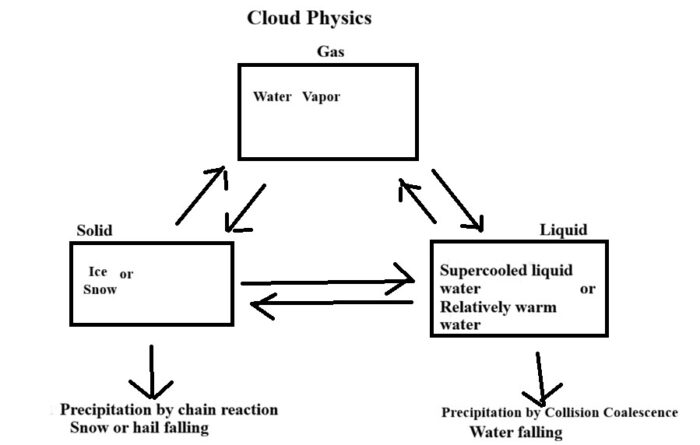
My view is depicted in figure above. A cloud is a visible mass of tiny water droplets and/or ice crystals suspended in the atmosphere. In any cloud, water vapor to liquid water conversion and vice versa, water vapor to ice conversion and vice versa, and liquid water to ice conversion and vice versa, are occurring simultaneously depending on type of cloud, ambient temperature, altitude of cloud and presence of CCN, IN, FN etc. Cloud may dissipate if vapor conversion is more than water/ice conversion. Cloud may precipitate if size of water droplets/ice crystals is sufficient to overcome updraft air flow by gravity. Water vapor to liquid water conversion occurs due to CCN. Water vapor to ice conversion occurs due to IN. Liquid water to ice conversion occurs due to FN. Cold season seeding targets cold clouds containing supercooled water (water below 32°F/0°C but still liquid) with glaciogenic agents, while warm season clouds contain water in multiple phases at the same time and can be seeded with glaciogenic or hygroscopic agents. All silver iodide does is to convert supercooled water droplets into ice crystals. All hygroscopic salt does is to convert small water droplet into large rain drops. Silver iodide should be termed as freezing nuclei (FN) as it converts SLW into ice.
_
Supercooled water droplets are those that remain liquid water even though they are at subfreezing temperatures. This happens where there is no nucleus or surface or anything around which the water molecules can crystallize. But if they are disturbed, or come into contact with anything, they crystallize instantly. Whole clouds can become supercooled when the temperature is below freezing. It requires that the water droplets be very pure, with no contaminants that would serve as a nucleus. Such conditions are very dangerous to aircraft, as supercooled droplets instantly form ice on the leading edges of the wings. Thus, supercooled clouds are the most obvious target for cloud seeding.
Supercooled liquid water (SLW) deposits on AgI particles as ice crystals and those ice crystals provide surface for further deposition of SLW. It is a chain reaction akin to nuclear chain reaction resulting in precipitation within 15 to 30 minutes if sufficient AgI particles are dispersed. Had natural freeze nuclei (FN) were present in sufficient concentration in cloud, we don’t need AgI but we are using AgI as natural FN are insufficient.
In warm cloud, water temperature is 0 to 20 C and there is no SLW. All hygroscopic salt particles do is to convert small water droplet into large raindrops for precipitation. Deposition of small water droplets on salt particles lead to large droplets that fall slowly colliding and coalescing with other droplets to develop raindrops that leads to precipitation. There is no chain reaction but physical process of collision and coalescence due to gravity and upward air drafts. Therefore, warm cloud seeding is inefficient compared to cold cloud seeding. Since SLW is found in cold and mixed clouds, their cloud seeding is efficient as compared to warm cloud without SLW. SLW is required for chain reaction.
_
Water droplets form on a cold glass due to condensation, a process where water vapor in the warm, humid air cools down when it touches the cold surface, loses energy, and changes from a gas to liquid water, appearing as beads on the glass. The glass’s surface temperature drops below the air’s dew point, forcing the invisible moisture to become visible liquid droplets, much like clouds forming in the sky. When you hold cold glass in air, large droplets will fall as rain. This is an example of cloud formation and precipitation in your home. Glass has provided very large surface for conversion of water vapor into liquid water droplets and liquid water droplets may merger into large water drops that fall down due to gravity.
Our breath typically fogs, or becomes visible as a cloud of condensation, when air temperatures fall below 7 C. It occurs because warm, moisture-laden breath (37 C) rapidly cools in the cold air, forcing the saturated water vapor to condense into visible liquid water droplets, often enhanced by high relative humidity. The condensation occurs on natural CCN in air at temperature below 7 C. Without CCN, the air would have to reach severe supersaturation (up to 400% relative humidity) for water vapor to spontaneously condense, a scenario rarely found in nature. Without CCN/IN there would be no clouds at all or only high altitude ice clouds. High altitude ice cloud occurs due to deposition of SLW into ice at – 40 C without need of any nuclei. But to form cloud water droplets/ice crystals from water vapor, CCN/IN are must. In short, no CCN no cloud.
_
Let us revisit experiment of Schaefer and Vonnegut.
Schaefer tested in the lab by exhaling into a deep freezer (-18 C), thereby creating “clouds” with his breath. His breath created cloud because it had moisture in it. Natural CCN were pre-existing but could not produce cloud till he exhaled. This extra water vapor supersaturated air and cloud (SLW) was created. Had he dropped dry ice or AgI in deep freezer, it would not produce cloud (SLW) as it had no moisture. So, you need both surface and supersaturation of water vapor for condensation into cloud formation.
Once a cloud (SLW) is formed, he dropped dry ice or AgI and a flurry of microscopic ice crystals formed.
Schaefer later determined that spontaneous ice crystal formation occurred when the temperature in his cold box was lowered below -39 C to -40 C. SLW cloud can become ice at -40 C without AgI/dry ice.
Do not mix condensation with precipitation.
Condensation of water vapor into SLW (cloud) occurred due to natural CCN.
Precipitation of SLW into ice crystals occurred due to dry ice/ AgI as natural ice nuclei were deficient.
_
Water vapor condensation occurs due to its saturation at dew point as it increases relative humidity to slightly above 100% and natural CCN provides surface for vapor condensation into liquid water; and natural IN provides surface for vapor deposition into ice if ambient temperature is below 0 C. Artificial seeding agents do not perform these functions. Throughout this article you will find that various authors/sources have depicted water vapor conversion to liquid water or ice by artificial seeding agents like AgI, but it is not wholly accurate. Yes, theoretically AgI or NaCl particles can work as CCN and can convert supersaturated water vapor into liquid water droplet but cannot achieve the concentration of natural CCN throughout the cloud volume. Bare AgI cannot cause deposition of water vapor into ice. Water vapor first condenses on AgI particle, then water droplet freezes.
Clouds typically have diameters roughly equal to their depths, for example, a fair weather cumulus cloud typically averages about 1 km in size, while a thunderstorm might be 10 km. Assuming cloud to be cylindrical, applying formula, the volume = π X radius square X height, the volume of cumulus cloud of 1 km size is 0.78 cubic km and volume of 10 km size thunderstorm (Cumulonimbus) cloud is 785 cubic km. We simply cannot put so much artificial CCN throughout entire volume of cold air that is fully saturated with water vapor at dew point. We cannot make cloud with cloud seeding agents. We have nothing that can convert water vapor into liquid water/ice to make cloud as large as natural cloud. All we can do is to increase size of water droplets/ice crystals in cloud so that they fall by gravity.
_
During cloud seeding, if silver iodide (AgI) falls outside a cloud, it won’t be effective for seeding and will simply drift with the wind as tiny, insoluble particles, eventually settling in soil or water. If AgI is released in clear skies or misses the intended cloud, the specific conditions required for ice formation and subsequent precipitation are not met, so no rain or snow is produced in that area from that material. If sodium chloride particles released during a cloud seeding operation miss the target clouds, they behave like any other naturally occurring atmospheric aerosol particles. They will disperse, circulate in the atmosphere, and eventually settle or be washed out by natural precipitation elsewhere. Neither AgI nor NaCl can make cloud even if released in very cold saturated air. Yes, if cold air is supersaturated with vapor and natural CCN are deficient, then release of AgI/salt particle can condense vapor into liquid water droplet wherever these particles are sprayed in a localized way but there is no chain reaction.
_
CCN (Cloud Condensation Nuclei) concentration in the air varies widely, typically from hundred to thousand per cubic centimeter (cm⁻³), depending heavily on location, pollution, humidity, and air mass history (e.g., marine vs. continental). Continental/polluted areas have higher CCN (often >300 cm⁻³) from sources like fires and industry, while marine/cleaner air has lower concentrations (e.g., ~100 cm⁻³), with heavy rain reducing numbers significantly through washout. It is these natural CCN that condenses water vapor and make clouds, and not silver iodide/salt.
_
In cloud seeding, Silver Iodide (AgI) particle concentration is crucial, typically dispersed from flares or generators, with effective levels varying but models suggesting concentrations from tens to hundreds per cubic centimeter (e.g., 35-350 cm⁻³ in some simulations) depending on cloud conditions, aiming to create ice nuclei for enhanced precipitation, often at temperatures around -15°C for optimal seeding. The atmospheric concentration of natural freezing nucleating particles at around −10 °C is very low, about a few to several hundred particles per cubic meter. So AgI works well in converting supercooled water droplets into ice crystals at minuscule amount dispersed into clouds, acting as a catalyst for chain reaction rather than a significant mass addition. Also, the AgI ice nucleation (or crystallization) temperature threshold is about -5°C which is significantly warmer than the threshold of most naturally occurring freezing nuclei, which commonly have thresholds near -15°C and colder. In warm cloud seeding, hygroscopic salt particles of few microns increase the mean water droplet diameter large enough to become raindrop for precipitation. All cloud seeding methods increase the diameter of water droplet/ice crystals large enough to fall by gravity. No cloud seeding agent can convert water vapor to liquid/solid at the scale of making cloud. Cloud seeding agents only increase size of water droplet/ice crystals in EXISTING cloud to cause precipitation. If we could invent any agent that can make cloud, our water problem is solved.
_________
_________
Moral of the story:
_
-1. Precipitation means rain, snow, or other forms of moisture falling from the clouds. All fresh water, whether on the surface or underground comes from the atmosphere in the form of precipitation. In many regions of the world, traditional sources and supplies of ground water, rivers and reservoirs are either inadequate or under threat from ever increasing water demands driving scientists and engineers to look for alternative water resources. Atmospheric water is one such alternative resource. Globally, the atmosphere contains approximately 12,900 cubic kilometers of water vapor at any given time, approximately 7 times more than all the world’s rivers combined. Though this water is invisible to us in its vapor state, it plays a huge role in weather patterns, cloud formation, and even climate. On average, roughly 20% of the total atmospheric water budget in a given area will condense into clouds; of that amount, only about 30% will fall to the ground as precipitation naturally (roughly 6% of the overall water budget). Large volume of water present in the clouds is never transformed into precipitation on the ground which implies that the transformation of cloud droplets to raindrops could be more efficient. Since only a small part of the available moisture in clouds is transformed into precipitation that reaches the surface, scientists and engineers are exploring the possibility of augmenting water supplies by means of cloud seeding. Cloud seeding is a common approach to make cloud droplets turn into raindrops to create more water resources. It is estimated that less than 1% of the total atmospheric water budget in a given area is impacted by cloud seeding.
_
-2. Humans have sought to purposefully alter atmospheric phenomena such as clouds, rain, snow, hail, lightning, thunderstorms, tornadoes, hurricanes, and cyclones. Weather modification refers to the deliberate or inadvertent alteration of atmospheric conditions by human activity on a local or regional scale; and cloud seeding is a type of weather modification.
_
-3. The energy involved in weather systems is so large that it is impossible to create cloud systems that rain, alter wind patterns to bring water vapour into a region, or completely eliminate severe weather phenomena. For example, energy released by hurricane is equivalent to a daily explosion of 500,000 atomic bombs of the 20-kiloton Nagasaki variety. Some analyses state that a hurricane releases the heat equivalent of a 10-megaton nuclear bomb every 20 minutes. While a nuclear bomb gives a single, intense blast, a hurricane provides continuous power for days, powering the US for years, or generating the planet’s electricity for weeks, highlighting its vastly greater, sustained power. These numbers should make it clear that it would be impractical to attempt to modify hurricanes by a brute force approach.
_
-4. The saturation point is the maximum water vapor air can hold at a given temperature (100% humidity), while the dew point is the specific temperature at which this saturation occurs, causing water vapor to condense into dew, fog, or clouds. In general, the warmer the air, the more water vapor it can hold. Therefore, reducing its temperature decreases its ability to hold water vapor so that condensation occurs.
_
-5. Water vapor constitutes approximately 0-4% of the atmosphere by volume. Together, evaporation from surface water and transpiration from plants contribute the water vapor in the air that can eventually form clouds. As the air rises in lower atmosphere it expands due to lower atmospheric pressure, and the energy used in expansion causes the air to cool. Generally speaking, for each 100 meters/330 feet which the air rises, it will cool by 1 °C. Reducing air temperature decreases its ability to hold water vapor so that condensation occurs. Therefore, the vertical ascent of air will reduce its ability to hold water vapor, so that condensation occurs. The height at which dew point is reached and clouds form is called the condensation level. Another important factor to consider is that water vapor needs something to condense onto. Clouds start forming due to condensation of water vapour in the atmosphere on the aerosol particles.
_
-6. Water exists in the atmosphere at all times, even when the sky appears to be clear and blue (gas form). Clouds are the existence of water in liquid/solid form that can be seen visibly, and are the result of water converting from gas form to liquid water droplets or ice. A cloud is a visible mass of tiny water droplets or ice crystals suspended in the atmosphere, forming when water vapor cools and condenses around microscopic particles (condensation nuclei) like dust or salt. Clouds are composed of large numbers of water droplets, or ice crystals, or both. Because of their small size and relatively high air resistance, they can remain suspended in the air for a long time, particularly if they remain in ascending air currents. Clouds are visible accumulations of tiny water droplets or ice crystals in Earth’s atmosphere; which may clump together and eventually fall as rain, snow, or hail; or may evaporate and dissipate.
_
-7. There are various mechanisms by which air rises to form cloud. Heated by sunshine warmed air starts to rise because, when warm, it is lighter and less dense than the air around it. Air rises when wind blows into the side of a mountain range or other terrain and is forced upward, higher in the atmosphere. Clouds also form when air is forced upward at areas of low pressure. Air also rises when two large masses of air collide at the Earth’s surface.
_
-8. Cloud droplets are constantly forming and dissipating. When more water condenses on nuclei than evaporates from them, clouds form and grow. Conversely, if there is more evaporation than condensation, clouds dissipate. This is why clouds appear and disappear as well as constantly change shape. During growth, hydrometeors (water or ice particles) grow in size until they precipitate. Mature clouds with strong updrafts and ample moisture tend to drop rain efficiently.
_
-9. An important characteristic of a cloud is its temperature. When it is everywhere above 0° C, the cloud is said to be warm. Often, clouds develop at altitudes where temperatures are below 0° C, but the droplets do not freeze because of the purity of the water. Such clouds are said to be supercooled. In the atmosphere, supercooling to temperatures of −10° C or even −20° C is not unusual. The lower the temperature, the greater the likelihood that the droplets will intercept so-called ice nuclei, which cause them to freeze. At temperatures below about −40° C, virtually all clouds are composed of ice crystals.
_
-10. Clouds form when moist air ascends and gets supersaturated with water vapor that condenses on aerosol particles of sufficient sizes, which then grow into cloud droplets. Cloud nucleation is the essential process where water vapor in the atmosphere condenses onto microscopic airborne particles (aerosols like dust, pollen, salt) to form tiny liquid droplets or ice crystals, initiating cloud formation. This requires supersaturation (more vapor than air can normally hold) and relies on these particles, called Cloud Condensation Nuclei (CCN) or Ice Nuclei (IN) acting as surfaces for water to cling to, allowing clouds to form from invisible vapor. The aerosol number-density and size spectrum influence the resulting cloud properties, and the supersaturation determines which aerosols can be activated into cloud drops. It should be noted that condensation by itself does not cause precipitation (rain, snow, sleet, hail). The moisture in clouds must become heavy enough to succumb to gravity and return to earth’s surface.
_
-11. Water is always present in Earth’s atmosphere in some form. However, water molecules on their own are too small to bond together in the formation of cloud droplets. They need a “flatter” surface, an object with a radius of at least 0.1 micrometer on which they can condense. This is nucleation of water vapor onto aerosol particles; these aerosol particles are called cloud condensation nuclei (CCN). Typical Cloud Condensation Nuclei (CCN) are tiny atmospheric particles, often a mix of sea salt, dust, dirt, soot, and secondary organic aerosols (SOA) from gas reactions. They are hygroscopic, meaning they attract water molecules, and are typically 0.2 µm, or about 1/100th the size of a cloud droplet which forms when water condenses on these nuclei. This means that every cloud droplet has a speck of dirt, dust, or salt crystal at its core. This is heterogenous nucleation when a new phase forms on the surface of a pre-existing particle, such as an aerosol. Heterogeneous nucleation is the dominant mechanism for cloud formation. CCN help water vapor turn into liquid droplets (clouds), while ice nuclei (IN) help water freeze into ice crystals in cold clouds. Essentially, CCN form clouds, IN form ice within those clouds. Without CCN/IN there would be no clouds at all or only high altitude ice clouds (homogenous nucleation).
Homogeneous nucleation in clouds is the spontaneous, direct formation of water droplets or ice crystals from pure vapor or supercooled liquid without foreign particles (aerosols), occurring only under extreme saturation or temperatures below roughly -35 C to – 40 C. Water vapor to liquid water droplet conversion without CCN need supersaturation of 400 % and supercooled liquid water droplet to ice crystal conversion without IN need – 40 C temperature.
_
-12. Size of water molecule 0.0002 micron. Size of most numerous CCN 0.2 micron. Size of cloud water droplet 20 micron. Clouds at higher and extremely cold levels in the atmosphere are composed of ice crystals and ice crystals involved in riming (collecting supercooled droplets) can start around 30-60 µm in width/diameter and then increase in size. The number of cloud droplets per cubic centimetre ranges from less than 100 to more than 1,000; 200 droplets per cubic centimetre is approximately an average value. Clouds over the ocean typically have fewer cloud droplets per cubic centimetre than their counterparts over land, since fewer CCN are present in marine air. Cloud condensation nuclei (CCN) concentrations typically range from 100 to 1,000 per cubic centimeter with lowest in marine environment and highest in urban pollution. The droplet volume is generally a million times greater than the typical condensation nuclei. A single drop of precipitation (rain drop) requires about one million of these small droplets to converge. A raindrop of diameter 2 mm contains the water equivalent of a million cloud droplets (0.02 mm diameter). The average diameter of a raindrop ranges from 0.5 mm to 2 mm. If we are to get some precipitation from a cloud, there must be additional process within the cloud to form raindrops from cloud droplets.
_
-13. The freezing level height (FLH) represents the altitude, at which the air temperature is at 0 °C (the freezing point of water) and it is higher in the tropics (4,500-5,000m) and lower towards the poles.
Warm cloud is cloud composed of liquid water drops at temperatures above the freezing point (0 C or 32 F).
Warm clouds consist entirely of liquid water droplets, with cloud tops below FLH. Warm clouds consist of liquid water droplets with diameters typically ranging from 1 to 100 micrometers (average 20 microns). Warm clouds typically produce precipitation through collision-coalescence processes. Unstable conditions promote stronger updrafts causing cloud droplets to combine, grow, and eventually fall as rain. Rain forms when cloud droplets collide and merge into larger drops. This starts with clouds containing abundant moisture and strong upward movement of air to keep droplets suspended long enough to grow. As droplets become heavy, gravity pulls them down as rain.
Cold cloud is any cloud extending above FLH, containing ice crystals, supercooled water, or both. Ice clouds are type of cold cloud containing ice without water. Mixed clouds are type of cold clouds containing both ice and supercooled water. Cold cloud produce precipitation through the Bergeron process. Precipitating clouds will typically have a mix of ice crystals, supercooled water droplets (at temperatures below freezing), water droplets and water vapor. During the Bergeron process, ice crystals in a cloud grow at the expense of supercooled liquid water droplets. This process continues until the flakes fall back towards the ground. As they fall through the warmer layers of air, the ice particles melt to form raindrops. However, some ice pellets or snowflakes might be carried down to ground level by cold downdraughts.
_
-14. Convective clouds form through strong vertical air motions, often associated with instability. Convective clouds (cumulonimbus) can produce intense, localized precipitation. Stratiform clouds develop in stable atmospheric conditions with gentle lifting over large areas. Stratiform clouds (altostratus, nimbostratus) generate widespread, longer-duration precipitation. Orographic clouds form when moist air is forced upwards by elevated terrain like mountains, causing it to cool, condense, and form visible clouds, often resulting in precipitation.
_
-15. Even though a cloud may produce rain, the surrounding atmosphere determines whether it reaches ground. If the air is too warm or dry below the cloud base, raindrops might evaporate before reaching the ground creating virga.
_
-16. Not all clouds bring rain for several reasons. A key factor is cloud thickness and moisture content. Thin clouds have limited moisture and particles, so the water droplets or ice crystals are sparse and light. These clouds can indicate moisture at high altitudes but lack the density to produce precipitation that reaches the ground.
Clouds also require sufficient vertical development to generate rain. When the upward movement of air is weak, droplets remain small and can evaporate before falling.
_
-17. There is no difference between fog and clouds other than altitude. Fog is defined as a visible moisture that begins at a height lower than 50 feet. If the visible moisture begins at or above 50 feet, it is called a cloud.
_
-18. Light from both the sky and from clouds is sunlight which has been scattered. In the case of the sky, the molecules of air (nitrogen and oxygen) undertake the scattering, but the molecules are so small that the blue part of the spectrum is scattered more strongly than other colors. The water droplets in the cloud are much larger, and these larger particles scatter all of the colors of the spectrum by about the same amount, so white light from the sun emerges from the clouds still white. Sometimes, clouds have a yellowish or brownish tinge – this is a sign of air pollution. Rain clouds are typically grey or dark because they are thick and dense with water droplets, blocking sunlight from passing through, making their undersides appear dark, while their tops, seen from above, can still look white; they get darker as more moisture gathers, becoming less transparent.
_
-19. Clouds play a crucial role in Earth’s energy balance and hydrological cycle.
(1) Albedo effect is when clouds reflect incoming solar radiation back to space, cooling Earth’s surface.
(2) Greenhouse effect is when clouds absorb and re-emit longwave radiation from Earth’s surface.
(3) Clouds are essential for the formation and distribution of precipitation.
_
-20. Although most clouds covering the sky have a purely natural origin, anthropogenic cloud is a cloud induced by human activity. By far the greatest number of anthropogenic clouds are airplane contrails (condensation trails) and rocket trails.
Condensation trails (contrails):
Contrails are thin trails of condensation, formed by the water vapor rushing out from the engines of jet aircraft flying at cruising altitudes several kilometres above the Earth’s surface. Cloud formations develop when hot gas from aircraft exhaust collides with very cold air in the atmosphere. Very cold atmospheric air is already nearly saturated with water vapor and cannot hold additional water vapor from exhaust resulting in condensation on exhaust particles like black carbon, sulfuric acid droplets, and various metals, that serve as cloud condensation nuclei for water droplets that freeze to form ice particles that compose a contrail.
_
-21. Cloud seeding is a weather modification technique that aims to increase precipitation by dispersing substances into the cloud that serve as cloud condensation or ice nuclei, altering the microphysical processes within the cloud. Cloud seeding uses additional known and well-characterized aerosols, other than those present in the atmosphere, that can act as condensation or ice nuclei depending on cloud type and ambient temperature with the intention to influence the process of raindrop formation. The most frequently used agents are silver iodide, granulated solid carbon dioxide (dry ice), and salt. These substances, such as silver iodide or sodium chloride, provide surfaces for moisture to condense upon, forming snowflakes or raindrops. The primary goal of cloud seeding is to increase precipitation from clouds that would otherwise produce little to no rain or snow. Cloud seeding modifies clouds already containing moisture; it cannot create rain out of clear skies.
_
-22. Cloud seeding is a short-term, highly localized activity, often targeting a single cloud on a single day. Geoengineering, on the other hand, refers to long-term efforts to affect the climate — two very different types of campaign. By definition, geoengineering refers to deliberate, large-scale efforts to alter Earth’s climate system, primarily in response to human-caused climate change. Geoengineering encompasses a broad range of activities that intentionally attempt to cool the Earth or remove certain gases from the atmosphere. Cloud seeding is not a form of geoengineering.
_
-23. Operational cloud seeding programmes in fog dispersion, rain and snow enhancement and hail suppression are taking place in more than 50 countries worldwide. The primary aim of these projects is to obtain more water, reduce hail damage, eliminate fog, or other similar practical results in response to a recognized need.
_
-24. To attempt cloud-seeding, there have to be clouds to begin with – and secondly, they should be the right kind of clouds. Clouds that are nearing precipitation must be present and must include supercooled liquid water (SLW) for glaciogenic cloud seeding. Clouds have varied liquid water in them, and some clouds may have only ice in them. The ice clouds are not suitable for seeding. There has to be liquid water in the cloud for any type of seeding. Not all clouds are seedable. Not every condition will work. Typically, orographic clouds (over mountainous areas with a natural lifting process) and convective clouds (having convective updrafts) are selected for seeding. There needs to be an optimum level of instability (convection) in the cloud, and the atmosphere needs to be moderately humid. These conditions provide vertical growth of clouds. Growing cumulus or deep convective clouds with moderate instability and sufficient moisture, and conditions that are not too windy are suitable. Glaciogenic seeding is most effective in cloud temperatures between -5°C and -25°C. Hygroscopic seeding can occur in warmer clouds, even above freezing temperatures. For effective cloud seeding, relative humidity should exceed 75% and liquid water content should be at least 0.5 g/m³.
_
-25. In cold (<0°C) clouds, ice-crystalline nuclei such as silver iodide (AgI) are used, while hygroscopic substances like calcium chloride (CaCl2) and sodium chloride (NaCl) are used in warm (>0°C) clouds. Depending on the type of cloud, seed particles can behave differently. In warm clouds, seed particles can quickly act as cloud condensation nuclei, promoting the formation of large water droplets that lead to rain. In contrast, in cold or mixed-phase clouds, seed particles may contact supercooled water droplets to serve as nuclei for ice formation, undergoing ice nucleation at low temperatures before falling as rain or snow. After the seeding process, rainfall can usually be received within 15 minutes to 1 hour. Cloud seeding typically can be done with one aircraft in a 100 x 100 km2 area.
_
-26. Drought relief?
Cloud seeding augments rainfall only when clouds already contain sufficient moisture and the microphysical conditions are right (cold or mixed-phase clouds for silver iodide; warm clouds for hygroscopic salts). Seeding can’t do anything to make clouds where there are none, nor can seeding make rain from a small cloud. Droughts are caused by prolonged periods that do not produce clouds conducive to precipitation production. Though drought is sometimes the impetus for implementing a cloud seeding program, it is not generally advocated for such purposes. There is a lack of precipitation in a region that comes from a lack of moisture in the air. Because moisture is the first ingredient for cloud seeding to produce rain, cloud seeing cannot be used as a solution to create rain during drought conditions. If during drought, there are indeed moist clouds unable to precipitate, only then cloud seeding will work. Droughts cover thousands of square kilometers, while seeding can enhance precipitation only over limited areas (tens to a few hundred km² per operation), so it cannot restore basin- or region-wide water budgets reliably. Cloud seeding does not seem to be an effective action to alleviate drought, not only because of its low effectiveness but also because it diverts resources from other possibly more effective solutions. A long-term and well-designed cloud seeding program can potentially soften the impact of drought, since increased precipitation before and after drought would temper the reduction of rainfall during the drought period.
_
-27. Overseeding:
Overseeding means introducing too many ice nuclei (like silver iodide) into a cloud, thereby creating a competition for the available cloud droplets or water vapor, possibly preventing any of them from growing to the appropriate size necessary to reach the ground; effectively dispersing heavy rain into lighter precipitation over a wider area or reducing total rainfall in a targeted spot, often used to mitigate flood risk from severe storms, as seen in Japanese research to reduce localized heavy rainfall.
_
-28. Does rain water from a seeded cloud taste or smell different than natural rain?
No. There is no discernible difference between rainwater from a seeded cloud and rainwater from a non-seeded cloud.
_
-29. Seed particle:
The seed particles are supposed to be of higher hygroscopicity compared to the particles in the ambient air that will readily form cloud droplets. The size of particles has a crucial role as larger size particles will form cloud droplets easily due to a large surface area on them. Sea salt for example is a good CCN due to its large size and hygroscopicity. It is important to understand the particle size and composition before choosing the seed particle. Silver iodide (AgI) is used for cloud seeding because its crystal structure is remarkably similar to ice, allowing it to act as an efficient ice nucleus that triggers supercooled water droplets in clouds to freeze, grow, and fall as rain or snow.
_
-30. Cloud property measurement for cloud seeding:
Cloud properties are measured using various ground-based, airborne, and satellite-based instruments to characterize their impact on weather and climate. Current operations integrate high-resolution numerical weather prediction, radar nowcasting, and in situ cloud-physics measurements to optimize launch timing from aircraft, ground generators, rockets, or autonomous uncrewed aerial platforms. Cloud radar, satellites, and ground observations combine to provide real-time data on cloud thickness, moisture content, and vertical development. Combining simultaneous cloud radar and radiometer observations of clouds overhead to retrieve estimated profiles of hydrometeor mass content, median size, and concentration has become a routine procedure.
Meteorologists use a combination of satellite imagery, radar data, and atmospheric modeling to identify clouds with optimal characteristics for seeding. Factors such as cloud type, altitude, temperature, and moisture content are taken into account when determining seeding targets.
Real-time monitoring and data analysis have also revolutionized cloud seeding operations. Advanced meteorological instruments and satellite technology enable continuous tracking of atmospheric conditions, allowing for timely and informed decision-making. Data collected from these sources are analyzed using sophisticated algorithms to optimize seeding efforts, ensuring that materials are dispersed at the optimal time and location. This integration of real-time data and analytics not only enhances the immediate effectiveness of cloud seeding but also contributes to a deeper understanding of its long-term impacts, facilitating more sustainable and scientifically informed practices.
_
-31. Cloud seeding types primarily fall into Glaciogenic (using silver iodide/dry ice in cold clouds to form ice) and Hygroscopic (using salt in warm clouds to attract moisture) with methods distinguished by the cloud temperature (warm/cold) and seeding agent, aiming to increase rain, snow, or mitigate hail/fog.
Glaciogenic cloud seeding types include static and dynamic seeding.
_
-32. Glaciogenic seeding agents act in different ways. Solid or liquid CO2 (-78.5°C) and liquid propane work by homogenous nucleation. These seeding agents need to be directly released in the presence of supercooled liquid water (SLW) for them to be effective. AgI work by heterogeneous nucleation, meaning they mimic the structure of natural ice nuclei. They do not have to be released directly into cloud or SLW. The aerosol can be carried aloft into clouds and when it encounters SLW at the right temperatures will begin generating ice crystals by contact nucleation. The effectiveness of AgI to nucleate ice crystals increases by orders of magnitude from -5 C to -12 C. Glaciogenic cloud seeding is usually applied to convective clouds, or winter orographic clouds. The largest body of scientific research on cloud seeding has been done on AgI seeding on these two cloud types.
The main difference between static and dynamic cloud seeding is in implementation of the strategy that larger amounts of seeding material are introduced into clouds in dynamic seeding. A goal in the static mode of seeding is to achieve something like 1 to 10 ice crystals per liter at temperatures warmer than -15C. In the dynamic mode of seeding the target ice crystal concentration is more like 100 to 1000 ice crystals per liter, which corresponds to seeding as much as 200 to 1000 g of silver iodide in flares dropped directly into the high supercooled liquid water content updrafts of cumuli clouds. Dynamic cloud seeding is in 11 separate stages and an unexpected outcome in one stage could ruin the entire process, making the technique less dependable than static cloud seeding.
_
-33. The window of opportunity for precipitation enhancement by glaciogenic cloud seeding is limited to:
- clouds that are relatively cold based and continental;
- clouds having top temperatures in the range of -10°C to -25°C;
- a timeframe constrained by the presence of substantial supercooled water until it is depleted by entrainment and natural precipitation events.
The temperature window is critical: at cloud temperatures colder than -25°C, natural ice crystal concentrations can be high, and seeding could produce too many small ice crystals, resulting in an “overseeded” cloud. Alternatively, seeding materials are less effective in nucleating crystals above -10°C. Timing is also important. If winds are weak, sufficient time may exist for natural precipitation processes to occur efficiently. Stronger winds may prohibit efficient natural precipitation, so seeding could speed up precipitation formation. But if the wind is too strong, seeded ice crystals will not have enough time to grow to precipitation before they are blown over.
This limited scope of opportunities for rainfall enhancement by the static mode of glaciogenic cloud seeding may explain why some cloud seeding experiments have been successful while others have yielded inferred reductions in rainfall from seeded clouds or no effect.
_
-34. Our focus should be on glaciogenic seeding (using ice-forming materials) of winter orographic clouds because the strongest scientific evidence that seeding can increase precipitation comes from this method. Compelling evidence suggests that seeding supercooled orographic clouds, those formed by air lifting over mountains, can increase precipitation on the ground and cause significant increases in the snowpack. Western reservoirs of US are replenished primarily from snowmelt, derived largely from snowfall from winter orographic clouds, where conditions minimize losses to evaporation. In contrast, rainfall from summer convective clouds contributes much less to reservoirs, as it is largely absorbed locally by vegetation and lost via evaporation and evapotranspiration.
_
-35. Hygroscopic cloud seeding method of weather modification is designed to accelerate droplet coalescence in warm liquid clouds, resulting in the formation of larger droplets that initiate precipitation. Cloud seeding materials usually contain large salt particles of various compositions, with particle size varying based on the injection technique (e.g., ground salt particles, combustion flares); however, a particle diameter of a few micrometers is generally regarded as ideal for increasing rainfall. Hygroscopic cloud seeding aims to increase the mean droplet diameter and enhance the precipitation amount by efficient cloud condensation nuclei (CCN) and giant cloud condensation nuclei (GCCN: diameter > 1 μm), which plays a crucial role in strengthening the condensation and collision–coalescence process. In the UAE, an aircraft swoops across the base of a convective cloud — a cloud formed by rising warm air — which is chosen for its water mass and the strength of the up-draft, or rising air current. That up-draft is critical because it carries the agents fired out by the aircraft. The process of hygroscopic cloud seeding, from the spreading of seeding agents to the development of rainfall, typically requires approximately 10–20 min.
_
-36. The average rain volume from the experimental units in the warm cloud hygroscopic-seeding experiment in Thailand was 10^5 m3 (Silverman and Sukarnjanaset 2000), whereas the rain volume within the identically defined experimental units in the cold cloud glaciogenic seeding experiment in the same area was on the average about 6 X 10^7 m3 (Woodley et al. 2003). So cold cloud glaciogenic seeding is far more efficient than warm cloud hygroscopic seeding, all other factors same.
_
-37. Deep convective clouds (cumulonimbus) stretch throughout the troposphere from the boundary layer, up through the middle atmosphere where mixed-phase processes become important, to the upper troposphere where they are composed entirely of ice crystals in the anvil. They therefore pass through regimes where different microphysical processes become important, such as warm and cold rain formation, secondary ice production and homogeneous freezing. They are extremely dynamic systems with updrafts in the core of up to tens of meters per second, but ice produced higher in the cloud also falls into lower parts of the cloud influencing the microphysics there. Convective clouds are Mixed Phase clouds having warm rain processes at lower levels and cold, ice-based processes at higher levels, with both co-existing in many storms. So glaciogenic cloud seeding or hygroscopic cloud seeding can be done in convective cloud depending on what is predominant, cold phase or warm phase. The AgI pellets are traditionally used in glaciogenic seeding where the particles act as ice nucleation particles but can be used even in hygroscopic seeding. Burning of AgI with acetone may make it more hygroscopic and could act as a hygroscopic seeding agent, first acting on shallow warm cloud layers and later may also act as ice nuclei on deeper cold layers in deep convective clouds.
_
-38. It is possible to take samples in the spring snowpack to determine if silver concentrations exceed normal background levels when AgI is used as the seeding agent. If silver is found above background levels, it only indicates that silver from the seeding fell out in the target area. It does not differentiate as to whether the silver acted as active ice nuclei or was simply scavenged by natural snowflakes and precipitated out in the target area.
_
-39. Hail Suppression technique aims to reduce the size of hailstones before they reach the ground. By seeding clouds with substances that increase the number of ice embryos produces more numerous but smaller hailstones that are more likely to melt before reaching the surface. Most of the small hail grains melt on their way to the ground and those which reach the earth surface do not have the power and the size to destroy the agricultural produce. Most hail-suppression attempts have been based on the concept that damage will be reduced if the hailstone sizes are reduced. While the meteorological processes of hail formation are well studied, the effectiveness of hail suppression through seeding remains contested. Some studies of hail suppression seeding indicate hail damage reductions up to 45%. In places that are prone to severe storms, even a slight reduction in hail intensity could save millions and easily offset the cost of a weather manipulation program like cloud seeding.
_
-40. Ground-based systems are reported to be less efficient in introducing seed material into clouds. The most efficient way is using an aircraft equipped with flares on its wings and below the fuselage. Aerial cloud seeding is better as it covers large areas in a short span of time particularly at higher altitudes, and targets specific clouds at different altitudes to achieve the right amount of moisture, temperature, and wing conditions. There are times when it’s beneficial to seed from the ground. For example, ground seeding is an excellent option for the treatment of low-level clouds over complex terrain.
_
-41. Practical difficulties during seeding:
One major aspect is that clouds grow rather rapidly and we need to target clouds in the early part of their growth before they start raining. The seeding in raining clouds will wash out seed particles into the boundary layer and will not serve the purpose. So, one needs to decide the correct time to intervene. The pilot needs to be well trained and knowledgeable about the way to seed near the cloud base in the updrafts and also be proactive in the requirements. There are several safety needs as flying in the upper-level clouds can lead to icing on the aircraft, which is hazardous.
_
-42. Drones for cloud seeding:
Drones (unmanned aerial vehicles) are revolutionizing delivery mechanisms by offering cost-effective, precise, and safer cloud seeding alternatives compared to manned aircraft. Drones can operate in diverse weather conditions, reach remote areas, and precisely disperse seeding materials where they are most needed. This method reduces costs and minimizes risks associated with manned flights. Drones can operate in hazardous conditions that would be unsafe for human pilots, allowing for more frequent and targeted seeding operations. Drones have a quick deployment time, can also fly close to hurricanes and storms and send important information to ground control stations in real-time.
_
-43. Limitations of cloud seeding:
The success rate is low, and the effectiveness is difficult to measure definitively because natural rainfall often coincides with seeding operations. Success is not guaranteed and can be difficult to measure precisely, leading to uncertainty about outcomes. The biggest challenge in rain enhancement is the difficulty in separating the natural and modified precipitation due to the significant natural variability, which is controlled by the non-linear processes and interaction of cloud microphysics and dynamics. The detection and quantification of precipitation due to seeding is almost impossible to isolate from the natural variability in the precipitation. The seeding signature in the precipitation will be a very small signal in the large variability of natural precipitation.
Also, cloud seeding cannot address large-scale weather systems or long-term drought conditions, and its impact on a given area’s water budget is often small.
_
-44. Difficulties in determining effectiveness of cloud seeding:
Rigorous verification of cloud seeding faces statistical and physical hurdles: clouds are naturally variable, seeding targets limited spatial and temporal windows, and counterfactual construction (what would have happened without seeding) is inherently uncertain.
(1) The level of noise in natural systems compared to the magnitude of the signal has made verification of either the enhancement of rain or snowfall or the reduction of hail extremely difficult in cloud seeding.
(2) How do you do a control experiment? You cannot find two identical clouds, seed one, do not seed the other, and see which one produces rain, if at all.
(3) The complex variability of cloud properties in both space and time makes it difficult to accurately evaluate the impact of cloud seeding.
_
-45. Cloud seeding verification combines randomized statistical designs, paired catchment or watershed streamflow analysis, radar and satellite remote sensing, in situ microphysical sampling, and chemical tracing to estimate augmentation and rule out natural variability. Recent program evaluations explicitly use multi-method verification to strengthen inference about seeding impacts. Investigating the effects of seeding by combing through both physical and statistical analyses is considered the most systematic approach to evaluating cloud seeding experiments. Well-designed randomized or statistical experiments, ensemble modeling, and paired watershed streamflow studies have reported measurable increases in precipitation or streamflow in certain contexts.
_
-46. There is extensive scientific literature on glaciogenic seeding in orographic clouds. These studies mainly come from the mid-western USA and the well-established research programs illustrate that glaciogenic seeding indeed can lead to a chain of processes leading to precipitation in the clouds. There is documented evidence through physical evaluation of glaciogenic seeding that by seeding clouds containing supercooled liquid with AgI, precipitation can be traced from the cloud to the surface. In fact, in the U.S., its primary purpose is to increase snowfall. This can also provide water for millions in the spring when it melts. On the other hand, hygroscopic cloud seeding’s efficacy is promising but there is paucity of documented physical evidence of hygroscopic seeding, especially in convective clouds. Substantial uncertainties remain to understand the chain of events when warm season clouds are seeded.
_
-47. In May 2025, Chinese scientists reported a trial in Xinjiang where drones released AgI over 8,000 km² and achieved just a 4% increase in rainfall. This generated about 70,000 cubic meters of extra water – roughly 30 Olympic pools worth – using 1 kg of silver iodide. These figures illustrate the massive scale needed for small gains.
Cloud seeding sceptic believe any effect cloud seeding might have is probably small, virtually impossible to distinguish from natural factors affecting daily rainfall, so increments of rainfall happens by chance. Yet many continue cloud seeding because people think anecdotally. If it occasionally rains after seeding, our native confirmation bias causes us to remember the times it worked, and forget or blur together the vast majority of the times it didn’t.
_
-48. Results of cloud seeding vary widely by cloud type, humidity, atmospheric dynamics, and seeding method; attribution of precipitation increases to seeding is challenging. It requires the right kinds of clouds with enough moisture, and the right temperature and wind conditions. Cloud seeding is moderately effective, able to increase precipitation by an estimated 5% to 15% under ideal conditions (strong updrafts in cold clouds) but its success is not guaranteed and depends heavily on existing atmospheric conditions and the specific cloud types. Effectiveness varies significantly by project, method, and location, with long-term projects sometimes showing more consistent results.
_
-49. Proof of efficacy of cloud seeding:
(1) In South Africa, seeding with hygroscopic seeding flares from the wings of an aircraft, researchers found that seeded storms produce approximately twice as much radar-estimated rainfall as the control (unseeded) storms.
(2) Volume-scans from Doppler radars have identified physical differences between seeded and unseeded cloud properties including storm volume, area cover, lifetime, rain flux/mass, top height, and precipitable water content.
(3) Dual-polarization radars reveal the transformation of supercooled liquid water droplets to ice crystals in glaciogenic seeding and the development of large drops in hygroscopic seeding.
(4) Satellite imagery captured a glaciated seeding track shortly after treatment, confirming ice formation and cloud top collapse; and the track’s expansion and increased precipitation, thereby supporting the effectiveness of cloud seeding.
(5) The 2017 Idaho SNOWIE study, which was conducted by a team from the National Center for Atmospheric Research, proved that, yes, cloud seeding does indeed work. Scientists announced that they have successfully used a combination of doppler radars, cloud droplet instrument, and snow gauges to measure the impact of cloud seeding on snowfall. Over the course of three days, the scientists estimated that around 286 Olympic swimming pools’ worth of snow fell from the clouds they seeded.
(6) A 2021 study of UAE Cloud Seeding Program depicted physical analysis using an archive of seeded (65) and unseeded (87) storms showing enhancements in radar-based storm properties within 15–25 min of seeding.
(7) Results from operational cloud seeding programs spanning several countries, including Australia, China, India, Israel, South Africa, Thailand, and the United States, record increases in precipitation between 10% and 30%.
_
-50. Cloud-seeding operations cannot and will not fill a lake or reservoir overnight, but long-term projects can help replenish aquifers over time, increase agricultural production, and increase water supply for these reservoirs over a combination of years. If you think about it, a 10 percent increase over a decade is an additional year of precipitation for these areas. So cloud seeding is a true water resource–management tool, but it has to be looked at in a long-term way. Before cloud seeding is embraced as a global solution, policymakers and citizens need full transparency and robust debate. More high-quality research (including satellite observations and field experiments) is essential. Regulatory frameworks must be updated to consider cross-border effects and public consent. And any application should be weighed against simpler water-saving measures.
_
-51. Pollution and precipitation:
Depending on size and type of CCN generated, pollution can have opposite effects on the precipitation process.
One specific study of a paper mill near Nelspruit in the eastern Transvaal region of South Africa has indicated that storms modified by the mill emissions lasted longer, grew taller, and rained harder than other nearby storms occurring on the same day as mills produce vast quantities of large-and giant-diameter cloud condensation nuclei (CCN) in the effluent.
On the other hand, precipitation may be suppressed by small CCN aerosols from smoke and urban particulate air pollution. Aerosols with a diameter of 0.1 micron (or 100 nanometers) are defined as ultrafine particles (UFP or PM0.1) and represent more than 80% of total particle number concentrations in urban air. Since too many small CCN particles are added by pollution, none of them will grow sufficiently to cause precipitation. Air pollution may reduce precipitation efficacy by adding particles that lead to the formation of too many small droplets. Small droplets tend to remain in clouds and are less likely to form larger droplets that fall as precipitation during cloud seeding.
Several studies have described decreases in precipitation due to pollution. The composition of clouds from weather satellites revealed tracks of super-cooled small droplets in clouds downwind of major urban and industrial areas over many parts of the world that are not conducive to precipitation. Urban aerosols are ingested into potential rain clouds and suppress their precipitation.
Cloud seeding for enhancing precipitation is the opposite of inadvertent suppression of precipitation caused by small CCN aerosols from smoke and urban particulate air pollution. We “seed” the clouds negatively with pollution aerosols on a much grander scale than we do positively with silver iodide and large hygroscopic particles. As such clouds contain too many pollutant aerosols over polluted urban areas, so what is the point of adding silver iodide or salt particles? Avoid cloud seeding to reduce urban pollution.
_
-52. Cloud lifespan (lifetime):
A cloud’s lifespan varies dramatically, from mere minutes for small cumulus clouds (sometimes only 10-15 mins) to hours for larger storm clouds, and even months for high-altitude cirrus clouds, depending on humidity, temperature, air stability, and wind. It is well-established that most clouds evaporate without precipitating.
Cloud lifetime and precipitation are intrinsically linked, as precipitation (rain, snow, hail) acts as the primary mechanism for water removal, often limiting a cloud’s lifespan. In general, precipitation decreases cloud lifespan, be it natural precipitation or precipitation induced by cloud seeding.
But during glaciogenic cloud seeding, when you change the phase from liquid to an ice crystal, you’re releasing latent heat. When that latent heat is released in the cloud, it allows the cloud to grow and expand, allowing it to last longer. The release of latent heat of fusion increases cloud buoyancy, cloud lifetime, and rain production.
Increased aerosol concentrations from pollution produce more numerous, smaller cloud droplets, which inhibits coalescence, suppresses precipitation, and extends cloud lifetime. On the other hand, clouds formed from polluted air with reduced drop size may dissipate fast reducing cloud lifetime. So both ways are possible depending on number of CCN, size of water droplets, ambient temperature and some unknown factors.
_
-53. Alternatives to cloud seeding:
We are running out of freshwater. Water scarcity is a near-term crisis with global consequences.
Cloud seeding works with nature to deliver freshwater at scale. With just one gram of cloud seeding agent, we can generate over 10,000 gallons of rainfall.
Desalination doesn’t scale. It is energy-intensive, geographically constrained, capital-heavy, and slowed by permitting.
Cloud seeding costs roughly $ 20–300 per acre-foot of additional consumable water created by cloud seeding.
When you compare that to desalination or water reuse, the cost of those could be about $1,000 to $ 2000 per acre-foot.
Cost-wise, cloud seeding has shown promising returns but results can vary based on geography and climate. It doesn’t work just anywhere. The conditions have to be right. The UAE aims to boost rainfall by 10% to 25% due to cloud seeding, a huge impact in one of the driest parts of the world and the cost per cubic metre of additional water is lower than for desalination.
Water pipelines are economically impractical. Moving water from coast to inland demand centers is too costly for large-scale use. A good rule of thumb is that a pipeline will cost $1-2 million per km, but it varies depending on the pipeline size, location and terrain.
Unlike a dam or pipeline that reliably delivers water, cloud seeding’s output fluctuates wildly. A dry winter means no suitable clouds, so sunk seeding costs yield nothing. A wet year might produce rain naturally, making seeding superfluous. This unpredictability makes budgeting and planning difficult.
Cloud seeding is relatively cheap compared to mega-projects like desalination, but it still only offers incremental returns. The investment ceiling is low – you can only squeeze so much water from available clouds. In short, seeding should not be viewed as a silver-bullet solution, but rather a costly gamble that may or may not pay off.
_
-54. Cost benefit of cloud seeding:
In North Dakota, a 2019 study showed that rainfall enhancement at 10 percent and crop-hail reduction of 45 percent yields estimated economic returns of more than $53 dollars for every $1 spent on the program. Viewed more conservatively, using rainfall enhancement of 5 percent, results are still impressive, yielding nearly $31 dollars of benefit for every dollar spent.
On the other hand, cloud seeding programs can be expensive. U.S. states spend hundreds of thousands annually (for instance, Utah’s program is about $700,000 per year). Yet, the return on that investment is highly uncertain. A GAO review found that available studies show anywhere from zero to 20% extra precipitation. This wide range means planners often “keep their fingers crossed” without knowing if rain will actually increase.
Where suitable winter orographic storms are frequent, and where added snow translates efficiently to summer water supply, cloud seeding can yield favorable cost per additional cubic meter. Conversely, in regions with few eligible clouds or weak coupling between additional precipitation and usable runoff, cost effectiveness declines.
Money and effort spent on cloud seeding is money not spent on other water solutions. Some analysts warn of “maladaptation”: relying on short-term fixes (like seeding) can distract from more sustainable answers (conservation, recycling, watershed protection).
_
-55. Cloud seeding is not a climate change solution in itself, but it could be a tool for climate adaptation in specific regions facing water scarcity. Cloud seeding, in its current form and foreseeable future applications, is not designed to address the root causes of climate change, such as greenhouse gas emissions.
_
-56. Safety of silver iodide:
(1) The U.S. Public Health Service established a concentration limit of 50 micrograms of silver per liter of water in public water supply to protect human health. The concentrations of silver potentially introduced by modern cloud seeding efforts are significantly less than this level. The literature embodies tens of thousands of samples collected from cloud seeding program areas over a thirty-year period showing the average concentration of silver in rainwater, snow and surface water samples is typically less than 0.01 micrograms per liter.
(2) The US Environmental Protection Agency and the World Health Organization both note that post-seeding silver levels in rain or soil typically measure below 0.01 micrograms per litre — far below the WHO’s drinking water safety threshold of 100 micrograms per litre. Standard cloud seeding with silver iodide, when done per current protocols, is not shown to pose a significant long-term risk to humans, animals, or aquatic life, though environmental caution and monitoring continue to be recommended. Silver iodide (AgI) in cloud seeding poses minimal direct risk to drinking water quality in typical applications because it’s largely insoluble and disperses at extremely low, safe concentrations (often thousands of times below WHO limits), settling in soil/sediments rather than easily dissolving.
(3) Studies showed that the maximum concentration of silver when in water coming off of the silver iodide molecule is about 0.984 micrograms per liter. For reference, to have any impact on aquatic life, there needs to be four to seven micrograms per liter. And to have any negative effect on drinking water, it needs to be 100 micrograms per liter. So, we are not only well below those thresholds, but we’re also below the threshold of natural background levels of silver in our environment. In southern Utah, natural silver is about six micrograms per liter.
Existing research suggests that silver iodide does not pose an environmental or health concern at current levels. Long-term studies have found no major concerns regarding the accumulation of seeding agents in the soil, water sources, or local ecosystems. However, it is not known whether more widespread use of silver iodide would have an effect on public health or be a risk to the environment.
_
-57. Does cloud seeding ‘steal’ rain/snow that would fall in other places?
No. There is no robbing Peter to pay Paul but it is more like paying Peter, paying Paul, paying everybody. Contrary to popular belief, studies have indicated that precipitation is actually increased, not decreased, downwind of cloud seeding programs, and “Extra area” seeding effects may extend to a couple hundred kilometers.
_
-58. Cloud seeding in warfare:
Cloud seeding can be weaponised by intentionally manipulating weather to cause rainfall that severely degraded road infrastructure to the point that the enemy couldn’t effectively move troops, trucks, or supply lines. For that you have to seed clouds in enemy territory. However, scientific uncertainty and limited geographic scale make reliable weaponization to cause extreme, targeted events implausible with current cloud‑seeding technology.
_
-59. Cloud ownership:
The water vapour resource is not like water resources in a river, which could be intercepted from points upstream. Also, it is not like a cake – if I have a bite, others get only a smaller piece. Besides, clouds change while floating in the sky, or drift or get evaporated. If you see clouds in your sky, it is your clouds which can be seeded by you but clouds can drift to other states or neighboring nation. Then it can be seeded by other states or other nation. We do not have power to shift/drift /pull clouds. All we can do is to seed clouds in our sky in very narrow time window. Attributing a “legal title to a cloud would be ridiculous” due to the distinct nature of clouds, their perpetual change of form and location, their emergence, disappearance and renewal. Private ownership of clouds is “nonsense” as control is limited to the short moment of the cloud being above somebody’s land.
_
-60. Conspiracy theory:
Scientists must properly inform the public of what’s happening, what the advantages are, what the disadvantages might be, before proceeding with cloud seeding. Without transparency, cloud seeding can breed suspicion and leave citizens feeling powerless over their own weather. Conspiracy theories suggest that governments and other powerful entities can intricately manipulate the weather on a large scale, and do so with malicious intentions. Cloud seeding has proven to be modest in its reach and impact; cloud seeding requires specific pre-existing atmospheric conditions to work effectively, and even then, it only increases precipitation by about 5-15% in ideal circumstances. Most ideal condition is strong updrafts in cold clouds. Cloud seeding cannot produce large-scale events like hurricanes, winter storms and massive flooding. Conspiracy theorists are scientifically ignorant and politically motivated. People should listen to respected scientists and meteorologists and not political leaders about cloud seeding. The world knows how political leaders misled people during covid-19 pandemic. The truth is that political leaders themselves became scientists overnight during covid-19 pandemic dictating policy terms. And people have to pay price for following political pseudo-scientist.
_
-61. Advances in cloud seeding include drone delivery systems, more sophisticated microphysical targeting using high resolution models and radar, alternative seeding agents, probabilistic verification methods, integration of remote sensing technologies and numerical modelling, and artificial intelligence algorithms for optimizing seeding strategies.
_
-62. North America is anticipated to maintain a commanding position in the global Cloud Seeding Market, accounting for approximately 35% of the market share in 2025.
_
-63. Throughout this article you will find that various authors/sources have depicted water vapor conversion to liquid water or ice by artificial seeding agents like AgI, but it is not wholly accurate. Water vapor condensation occurs due to its saturation at dew point as it increases relative humidity to slightly above 100% and natural CCN provides surface for vapor condensation into liquid water; and natural IN provides surface for vapor deposition into ice if ambient temperature is below 0 C. Artificial seeding agents do not perform these functions. All silver iodide does is to convert supercooled water droplets into ice crystals. All hygroscopic salt does is to convert small water droplet into large rain droplet.
In cold clouds, supercooled liquid water (SLW) deposits on AgI particles as ice crystals and those ice crystals provide surface for further deposition of SLW. It is a chain reaction akin to nuclear chain reaction resulting in precipitation within 15 to 30 minutes if sufficient AgI particles are dispersed. In warm clouds, there is no chain reaction but physical process of collision and coalescence due to gravity and upward air drafts. Therefore, warm cloud seeding is inefficient compared to cold cloud seeding.
We have nothing that can convert water vapor into liquid water/ice to make cloud as large as natural cloud. Yes, if cold air is supersaturated with vapor and natural CCN are deficient, then release of AgI/salt particle can condense vapor into liquid water droplet wherever these particles are sprayed in a localized way but there is no chain reaction. The volume of cumulus cloud of 1 km size is 0.78 cubic km and volume of 10 km size thunderstorm (cumulonimbus) cloud is 785 cubic km. We simply cannot put so much artificial CCN throughout entire volume of cold air that is fully saturated with water vapor at dew point. We cannot make cloud with cloud seeding agents. All cloud seeding methods increase the diameter of water droplet/ice crystals large enough to fall by gravity. No cloud seeding agent can convert water vapor to liquid/solid at the scale of making cloud. Cloud seeding agents only increase size of water droplet/ice crystals in EXISTING cloud to cause precipitation. If we could invent any agent that can make cloud, our water problem is solved.
_____
Dr. Rajiv Desai. MD.
February 1, 2026
_____
Postscript:
In October 2025, cloud seeding was conducted to improve the air quality over Delhi but the experiment yielded no significant results. Remember, urban aerosols are ingested into potential rain clouds and suppress their precipitation. Urban pollution provides too many 0.1 micrometer CCN particles that lead to the formation of too many small droplets who tend to remain in clouds and less likely to form larger droplets that fall as precipitation. Cloud seeding for enhancing precipitation is the opposite of inadvertent suppression of precipitation caused by small CCN aerosols from smoke and urban particulate air pollution. As such clouds contain too many pollutant aerosols over polluted urban areas, so what is the point of adding silver iodide or salt particles? Avoid cloud seeding to reduce urban pollution. It is waste of money, time and energy.
_____
Footnote:
Cloud seeding is not playing God with the weather; but giving water and food to the thirsty and the hungry thereby eligible for God’s blessing.
_____
7 comments on “Cloud Seeding”
Leave a Reply
I would like to thank you for the efforts you’ve put in writing this
website. I really hope to check out the same high-grade blog posts
by you later on as well. In truth, your creative writing abilities has motivated me to get my own, personal blog now 😉
В нашем ассортименте представлены и классические, и современные варианты ковров для любого интерьера.
[url=https://amikovry.uk/]Купить ковры онлайн[/url]
Покупка ковра в нашем интернет магазине — это просто, удобно и выгодно.
F168 – Nhà cái cá cược mới với nhiều khuyến mãi hấp dẫn 2026, truy cập ngay: https://pages-guide.za.com/
Discover the excitement and top bonuses at [url=https://66exbet.com/]Ex Bet[/url], your ultimate destination for online gaming.
The platform regularly refreshes its offerings by integrating user suggestions to enhance the experience.
Experience thrilling wins and endless entertainment at [url=https://777bet-registration.com/]777bet сasino[/url], your ultimate destination for online gaming.
These incentives not only boost the bankroll but also add excitement to the betting process.
Этот информативный материал предлагает содержательную информацию по множеству задач и вопросов. Мы призываем вас исследовать различные идеи и факты, обобщая их для более глубокого понимания. Наша цель — сделать обучение доступным и увлекательным.
Детальнее – https://vivod-iz-zapoya-2.ru/
Some really interesting information, well written and loosely user pleasant.