Dr Rajiv Desai
An Educational Blog
The Enigma of Quantum Entanglement
The Enigma of Quantum Entanglement:
_

_
Section-1
Prologue:
Physicists and philosophers of physics have been debating the meaning of quantum mechanics in general, and quantum entanglement in particular, ever since quantum mechanics was first formulated, and are still debating it today, almost 100 years later. At the heart of quantum mechanics lies a concept that feels almost magical—quantum entanglement. Imagine two particles of the same type becoming so intertwined that a change in one instantly affects the other, no matter how far apart they are. This is the essence of quantum entanglement, a phenomenon that Albert Einstein famously described as “spooky action at a distance.” Quantum entanglement stands as one of the strangest and hardest concepts to understand in physics. Two or more particles can interact in a specific way that leave them entangled, such that a later measurement on one system identifies what the outcome of a similar measurement on the second system—no matter how far they are separated in space. The standard explanation for this behavior involves what’s called nonlocality: the idea that the two objects are actually still a single quantum system, even though they may be far apart. That idea is uncomfortable to many people (including most famously Albert Einstein), but it preserves the principle of relativity, which states in part that no information can travel faster than light.
_
The importance of quantum entanglement lies not just in its strangeness but in its ability to help us redefine how we understand the universe. Entanglement raises questions about the nature of reality, locality, and information. It invites us to reconsider our classical intuitions about separateness and interconnectedness. The concept has far-reaching implications—not only does it challenge our conventional views of reality, but also it opens up innovative avenues in technology and philosophy. The importance of defining entanglement lies in facilitating discussions around its theoretical and practical applications. Entangled states are characterized by correlations that remain intact regardless of the distance separating the particles. This uniqueness makes entanglement a linchpin in quantum computing and cryptography, where computational power and security gain a radical boost from quantum principles. Importantly, entanglement transcends mere pairs of particles; it can involve multiple entities, exhibiting what’s termed multi-partite entanglement. Grasping this concept is essential for those delving into quantum theories or applications, as it offers insights into the nature of information and the fabric of the universe.
______
______
Section-2
Understand basic concepts:
_
Locality:
In physics, locality is the principle that an object is directly influenced only by its immediate surroundings and that effects cannot travel faster than the speed of light. This means interactions must be mediated by something in the space between objects, propagating from one point to neighboring points at a finite speed. It’s the opposite of “action at a distance,” which would allow for instantaneous, non-local influence across any distance. Local description holds that one particle influences another only by direct contact or via some intermediary field; this influence can travel no faster than light.
Non-locality in physics is the concept that separated objects can instantaneously influence one another, a phenomenon primarily observed in quantum mechanics through entanglement. It means that when two entangled particles are separated, a measurement on one particle instantly affects the other, no matter the distance between them, a behavior that challenges classical physics’ principle that influences cannot travel faster than light. Nonlocality would mean that one particle could influence another distant particle without anything passing between them, in an instantaneous manner, faster than light. While this connection allows for instantaneous correlation, it cannot be used for faster-than-light communication.
_
Causality:
Causality is a fundamental principle in classical physics that states every effect has a specific cause. In physics, causality is the fundamental principle that an effect cannot occur before its cause. This means a cause must precede its effect. At its core, causality is the relationship where one event (the cause) produces or contributes to another event (the effect). Causality does not necessarily mean that the future is predetermined (determinism). It simply means that for an event to happen, it must have a cause that occurred earlier in time.
However, in quantum mechanics, this relationship is not so straightforward. The breakdown of causality can allow two particles to become entangled even when they started in separate states with no entanglement. This means that the current behavior of one particle may depend on the future behavior of another, which goes against what we typically understand about physical interactions.
In quantum entanglement, measuring one particle’s property would instantly determine the corresponding property of the entangled partner, even if they were separated by vast distances. This seemed to violate locality, the idea that an object can only be influenced by its immediate surroundings, and causality, the notion that causes must precede effects.
_
Determinism:
In physics, determinism means that the state of the Universe at any given time and the basic laws of physics fully determine the Universe’s backward history and forward evolution. This idea reached its peak with the strict, precise laws about how the Universe behaves introduced by classical physics. Determinism in physics is the principle that the state of the universe at any given time, along with the laws of physics, completely determines its future and past evolution. Quantum mechanics is fundamentally probabilistic. The state of a quantum system is a superposition of possible outcomes, each with a certain probability, until measurement collapses it into one definite state.
_
Realism:
Realism in physics is the belief that the physical world is independent of the observer and exists with definite properties whether or not they are measured. In contrast, systems in quantum mechanics achieve a definite state only when measured.
_
Wavefunction:
In quantum theory, an object’s behaviour is characterized by its wavefunction: a mathematical expression calculated using an equation devised by Austrian physicist Erwin Schrödinger in 1926. The wavefunction describes a quantum state and how it evolves as a cloud of probabilities. As long as it remains unobserved, a particle seems to spread out like a wave; interfering with itself and other particles to be in a ‘superposition’ of states, as though in many places or having multiple values of an attribute at once. But an observation of a particle’s properties — a measurement — shocks this hazy existence into a single state with definite values. This is sometimes referred to as the ‘collapse’ of the wavefunction.
In quantum physics, a wave function (or wavefunction) is a mathematical description of the quantum state of an isolated quantum system. The wave function encapsulates all the information about the system, including its probabilities and expectation values of physical quantities. The most common symbols for a wave function are the Greek letters ψ and Ψ (lower-case and capital psi, respectively).
A wave function (psi) is a complex-valued function in quantum mechanics that describes the quantum state of a particle, encapsulating all information about its properties like position, momentum, and spin. Wave Functions is the mathematical description that predict the probability of finding a particle in a particular state. While the wave function itself has no direct physical meaning, its squared magnitude Ψ^2 represents the probability density of finding the particle at a particular point in space and time.
Every particle (photon/electron) is just a wave function and could be anywhere at anytime; it could even be at several places simultaneously. Swirling electrons occupy two positions at once, and possess dual natures — they can be both waves and particles simultaneously. It is the wave function that enables superposition and entanglement.
Superposition:
At the core of quantum mechanics lies the concept of quantum states. A quantum state describes the properties of a particle at a given moment. Superposition is a fundamental principle, allowing particles to exist in multiple states simultaneously until measured. In quantum mechanics, superposition is a fundamental principle where a system can exist in multiple states at the same time until a measurement is made. This is often described as a “linear combination” of all possible states, where each state has a certain probability of being measured. Examples include an electron being in a superposition of two locations at once or a quantum bit (qubit) being both a ‘0’ and a ‘1’ simultaneously or an electron can be both spinning up and spinning down; until a measurement forces it into one state. You can imagine superposition as being similar to a pendulum swinging between positions (one at the far left and one at the far right). When oscillating, the pendulum is at neither position but oscillating from one position to the other. The act of observing or measuring the system causes its superposition to “collapse” into a single, definite state. The probability of collapsing into a specific state is determined by the square of its probability amplitude.
Entanglement:
Wave Function is a mathematical description of the quantum state of a system. When two quantum particles interact in such a way that their combined state is described by a single quantum wavefunction, the result can be an entangled state. For entangled particles, the wave function cannot be separated into individual wave functions for each particle, indicating that the state of the system is a single, unified entity.
_
Hidden variables:
[local hidden variables mean properties contained within the individual particles themselves]
Hidden variable theory in quantum mechanics posits underlying variables that determine quantum event outcomes, providing a deterministic description. Physicists, including Einstein, proposed a number of alternative interpretations of quantum entanglement in the 1930s. They theorized there was some unknown property – dubbed hidden variables – that determined the state of a particle before measurement. John Bell, a brilliant Irish physicist who did not live to receive the Nobel Prize, devised a scheme to test whether the notion of hidden variables made sense. Bell produced an equation now known as Bell’s inequality that is always correct – and only correct – for hidden variable theories, and not always for quantum mechanics. Thus, if Bell’s equation was found not to be satisfied in a real-world experiment, local hidden variable theories can be ruled out as an explanation for quantum entanglement. The experiments of the 2022 Nobel laureates, particularly those of Alain Aspect, were the first tests of the Bell inequality. The experiments used entangled photons, rather than pairs of an electron and a positron, as in many thought experiments. The results conclusively ruled out the existence of hidden variables, a mysterious attribute that would predetermine the states of entangled particles. Collectively, these and many follow-up experiments have vindicated quantum mechanics. Objects can be correlated over large distances in ways that physics before quantum mechanics cannot explain. Importantly, there is also no conflict with special relativity, which forbids faster-than-light communication. The fact that measurements over vast distances are correlated does not imply that information is transmitted between the particles. Two parties far apart performing measurements on entangled particles cannot use the phenomenon to pass along information faster than the speed of light.
______
______
Section-3
Quantum mechanics:
Newtonian physics thought of the world as composed of distinct objects, much like tennis balls or stone blocks. In this model, the universe is a giant machine of interlocking parts in which every action produces an equal and opposite reaction. Unfortunately, the Newtonian world breaks down at the subatomic level. In the quantum world, everything seems to be an ocean of interconnected possibilities. Every particle is just a wave function and could be anywhere at anytime; it could even be at several places simultaneously. Swirling electrons occupy two positions at once, and possess dual natures — they can be both waves and particles simultaneously. In recent times, physicists have discovered a phenomenon called quantum entanglement. In an entangled system, two seemingly separate particles can behave as an inseparable whole. Theoretically, if one separates the two entangled particles, one would find that their velocity of spin would be identical but in opposite directions. They are quantum twins. Despite the seeming irrationality of these concepts, scientists over the last 100 years have demonstrated that this realm — known as quantum mechanics — is the foundation on which our physical existence is built. It is one of the most successful theories in modern science. Without it, we would not have such marvels as atomic clocks, computers, lasers, LEDs, global positioning systems and magnetic resonance imaging, among many other innovations.
_
Quantum mechanics is the science of the very small: the body of scientific principles that explains the behaviour of matter and its interactions with energy on the scale of atoms and subatomic particles. Classical physics explains matter and energy on a scale familiar to human experience, including the behaviour of astronomical bodies. It remains the key to measurement for much of modern science and technology. However, toward the end of the 19th century, scientists discovered phenomena in both the large (macro) and the small (micro) worlds that classical physics could not explain. Coming to terms with these limitations led to two major revolutions in physics – one being the theory of relativity, the other being the development of quantum mechanics.
_
Before the early 2000s, computers did not exhibit quantum behavior. But as technology advanced and transistors in computers got smaller (now as small as 5 nanometers, which is 5 billionths of a meter!), they started to show quantum behavior. Quantum behavior limits how small transistors can be and how fast computers can compute because it makes transistors “pesky” in that they don’t exhibit the predictable behavior that engineers want. For this reason, computers now operate on multiple “cores” to help increase computing speed and power.
_
The defining feature of the microscopic world is the wave-particle duality. Whenever we observe elementary entities (like electrons or photons) they appear as localized events. A single photon can be observed as a tiny dot on a photographic plate. A single electron can be observed as a tiny flash on a television screen. This locality (existing at a particular place) and temporality (occurring at a specific time) is what it means for a thing to exist as a particle. It interacts with its environment in a specific place at a specific time. In contrast, when we are not observing these entities interacting with their environment, they behave in a wavelike manner — extended in space, diffracting around obstacles and through openings, interfering with other elementary entities of the same type (that is, electrons interfere with electrons, and photons with photons). The nature of the waves associated with elementary entities are probability waves — unitless numbers, numerical ratios. They tell you the probability of finding a particular particle at a particular place and time and nothing else. They do not measure the value of any physical quantity. The conflict between these two aspects of microscopic reality results in the Uncertainty Principle.
_
The fundamental building blocks of quantum mechanics are:
Quantisation: energy, momentum, angular momentum and other physical quantities of a bound system are restricted to discrete values (quantised)
Wave-particle duality: objects are both waves and particles
Heisenberg principle: the more precise the position of some particle is determined, the less precise its momentum can be known, and vice versa. Thus there is a fundamental limit to the measurement precision of physical quantities of a particle
Superposition: two quantum states can be added together, and the result is another valid quantum state
Entanglement: when the quantum state of any particle belonging to a system cannot be described independently of the state of the other particles, even when separated by a large distance, the particles are entangled
Fragility: by measuring a quantum system we destroy any previous information. From this, it follows the no-cloning theorem that states: it is impossible to create an identical copy of an arbitrary unknown quantum state
No individual labels: Quantum mechanics is clear: identical particles are indistinguishable by their very nature. In practice, we do not measure ‘this particular’ particle, but ‘some’ particle at a given location. Quantum physics consistently resists any attempt to assign them individual labels
_
Fundamentally, Quantum Mechanics adds features that are absent in classical mechanics. To begin, physical quantities are “quantized,” i.e. cannot be subdivided. For example, light is quantized: the fundamental quantum of light is called the photon and cannot be subdivided into two photons. Quantum mechanics further requires physical states to evolve in such a way that cloning an arbitrary, unknown state into an independent copy is not possible. This is used in quantum cryptography to prevent information copying. Furthermore, quantum mechanics describes systems in terms of superpositions that allow multiple distinguishable inputs to be processed simultaneously, though only one can be observed at the end of processing, and the outcome is generally probabilistic in nature. Finally, quantum mechanics allows for correlations that are not possible to obtain in classical physics. Such correlations include what is called entanglement.
_
Suppose, we want to measure the position and speed of an object – for example a car going through a radar speed trap. We assume that the car has a definite position and speed at a particular moment in time, and how accurately we can measure these values depends on the quality of our measuring equipment – if we improve the precision of our measuring equipment, we will get a result that is closer to the true value. In particular, we would assume that how precisely we measure the speed of the car does not affect its position, and vice versa. In 1927, Heisenberg proved that these assumptions are not correct.
_
Quantum mechanics shows that certain pairs of physical properties, like position and speed, cannot both be known to arbitrary precision: the more precisely one property is known, the less precisely the other can be known. This statement is known as the uncertainty principle. The uncertainty principle isn’t a statement about the accuracy of our measuring equipment, but about the nature of the system itself – our assumption that the car had a definite position and speed was incorrect. On a scale of cars and people, these uncertainties are too small to notice, but when dealing with atoms and electrons they become critical.
In 1927, Werner Heisenberg argued that it’s impossible to know both a particle’s position and momentum exactly. Measuring one simply makes the other fuzzier (see figure below). Particles are fundamentally indecisive — neither precisely here nor there, and both at once. Making measurements effectively forces particles to choose how to behave.
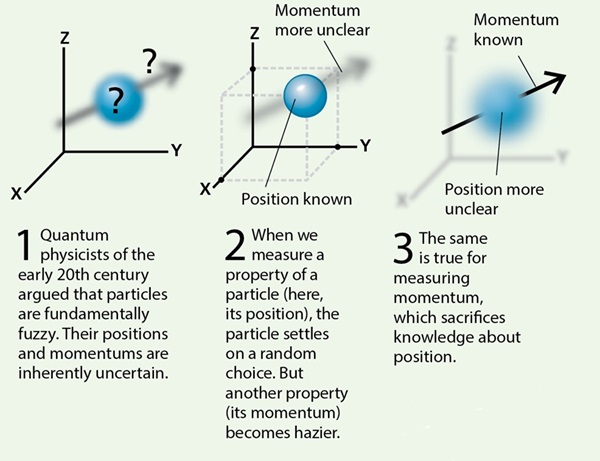
Heisenberg gave, as an illustration, the measurement of the position and momentum of an electron using a photon of light. In measuring the electron’s position, the higher the frequency of the photon the more accurate is the measurement of the position of the impact, but the greater is the disturbance of the electron, which absorbs a random amount of energy, rendering the measurement obtained of its momentum increasingly uncertain (momentum is velocity multiplied by mass), for one is necessarily measuring its post-impact disturbed momentum, from the collision products, not its original momentum. With a photon of lower frequency, the disturbance – hence uncertainty – in the momentum is less, but so is the accuracy of the measurement of the position of the impact. The uncertainty principle shows mathematically that the product of the uncertainty in the position and momentum of a particle (momentum is velocity multiplied by mass) could never be less than a certain value, and that this value is related to Planck’s constant.
_
In 1924, Wolfgang Pauli proposed a new quantum degree of freedom (or quantum number), with two possible values, to resolve inconsistencies between observed molecular spectra and the predictions of quantum mechanics. In particular, the spectrum of atomic hydrogen had a doublet, or pair of lines differing by a small amount, where only one line was expected. Pauli formulated his exclusion principle, stating that “There cannot exist an atom in such a quantum state that two electrons within [it] have the same set of quantum numbers.” A year later, Uhlenbeck and Goudsmit identified Pauli’s new degree of freedom with a property called spin. The idea, originating with Ralph Kronig, was that electrons behave as if they rotate, or “spin”, about an axis. Spin would account for the missing magnetic moment, and allow two electrons in the same orbital to occupy distinct quantum states if they “spun” in opposite directions, thus satisfying the exclusion principle. The quantum number represented the sense (positive or negative) of spin.
_
Bohr’s model of the atom was essentially a planetary one, with the electrons orbiting around the nuclear “sun.” However, the uncertainty principle states that an electron cannot simultaneously have an exact location and velocity in the way that a planet does. Instead of classical orbits, electrons are said to inhabit atomic orbitals. An orbital is the “cloud” of possible locations in which an electron might be found, a distribution of probabilities rather than a precise location. Each orbital is three dimensional, rather than the two dimensional orbit, and is often depicted as a three-dimensional region within which there is a 95 percent probability of finding the electron. Schrödinger was able to calculate the energy levels of hydrogen by treating a hydrogen atom’s electron as a wave, represented by the “wave function” Ψ, in an electric potential well, V, created by the proton. The solutions to Schrödinger’s equation are distributions of probabilities for electron positions and locations. Orbitals have a range of different shapes in three dimensions. The energies of the different orbitals can be calculated, and they accurately match the energy levels of the Bohr model.
Within Schrödinger’s picture, each electron has four properties:
(1. An “orbital” designation, indicating whether the particle wave is one that is closer to the nucleus with less energy or one that is farther from the nucleus with more energy;
(2. The “shape” of the orbital, spherical or otherwise;
(3. The “inclination” of the orbital, determining the magnetic moment of the orbital around the z-axis.
(4. The “spin” of the electron.
The collective name for these properties is the quantum state of the electron. The quantum state can be described by giving a number to each of these properties; these are known as the electron’s quantum numbers. The quantum state of the electron is described by its wave function. The Pauli Exclusion Principle demands that no two electrons within an atom may have the same values of all four numbers.
_
The idea of quantum field theory began in the late 1920s with British physicist Paul Dirac, when he attempted to quantise the electromagnetic field – a procedure for constructing a quantum theory starting from a classical theory. A field in physics is “a region or space in which a given effect (such as magnetism) exists.” Other effects that manifest themselves as fields are gravitation and static electricity. In 2008, physicist Richard Hammond wrote that sometimes we distinguish between quantum mechanics (QM) and quantum field theory (QFT). QM refers to a system in which the number of particles is fixed, and the fields (such as the electromechanical field) are continuous classical entities. QFT … goes a step further and allows for the creation and annihilation of particles . . .. He added, however, that quantum mechanics is often used to refer to “the entire notion of quantum view.”
_
Researchers still disagree widely on how best to describe the physical reality that lies behind the mathematics. At an event to mark the 100th anniversary of quantum mechanics, lauded specialists in quantum physics argued politely — but firmly — about the issue. “There is no quantum world,” said physicist Anton Zeilinger, at the University of Vienna, outlining his view that quantum states exist only in his head and that they describe information, rather than reality. “I disagree,” replied Alain Aspect, a physicist at the University of Paris-Saclay, who shared the 2022 Nobel prize with Zeilinger for work on quantum phenomena.
_
Over the past century, researchers have proposed many ways to interpret the reality behind the mathematics of quantum mechanics, which seems to throw up jarring paradoxes. In quantum theory, an object’s behaviour is characterized by its wavefunction: a mathematical expression calculated using an equation devised by Austrian physicist Erwin Schrödinger in 1926. The wavefunction describes a quantum state and how it evolves as a cloud of probabilities. As long as it remains unobserved, a particle seems to spread out like a wave; interfering with itself and other particles to be in a ‘superposition’ of states, as though in many places or having multiple values of an attribute at once. But an observation of a particle’s properties — a measurement — shocks this hazy existence into a single state with definite values. This is sometimes referred to as the ‘collapse’ of the wavefunction.
It gets stranger: putting two particles into a state of joint superposition can lead to entanglement, which means that their quantum states remain intertwined even when the particles are far apart.
_
The German physicist Werner Heisenberg, who helped to craft the mathematics behind quantum mechanics in 1925, and his mentor, Danish physicist Niels Bohr, got around the alien wave–particle duality largely by accepting that classical ways of understanding the world were limited, and that people could only know what observation told them. For Bohr, it was OK that an object varied between acting like a particle and like a wave, because these were concepts borrowed from classical physics that could be revealed only one at a time, by experiment. The experimenter lived in the world of classical physics and was separate from the quantum system they were measuring. Heisenberg and Bohr not only took the view that it was impossible to talk about an object’s location until it had been observed by experiment, but also argued that an unobserved particle’s properties really were fundamentally unfixed until measurement — rather than being defined, but not known to experimenters. This picture famously troubled Einstein, who persisted in the view that there was a pre-existing reality that it was science’s job to measure. Einstein disliked this idea of a random universe; the atheist famously proclaimed his disbelief that God played at dice. Quantum pioneer Niels Bohr supposedly replied, “Einstein, stop telling God what to do.” So peeved was Einstein that he and his friends came up with a thought experiment to show how it was possible to learn both the positions and momentums of pairs of particles. Preserving their uncertainty would require one particle in the pair to instantly know and react when the other is measured — even at the other end of the universe. Quantum entanglement first entered the scientific stage in 1935, when Albert Einstein, Boris Podolsky, and Nathan Rosen published a paper known as the EPR paradox. The EPR paradox is a 1935 thought experiment by Einstein, Podolsky, and Rosen that argues quantum mechanics is an incomplete description of reality. It uses the concept of entanglement to show that measuring a property of one particle in an entangled pair instantly determines the corresponding property of the other, even if they are far apart. This “spooky action at a distance,” as Einstein called it, appears to violate the principle of locality, leading them to conclude that “hidden variables” must exist but are not accounted for by the theory.
_
Although in 1932 von Neumann had completed basic elements of nonrelativistic quantum description of the world, it were Einstein, Podolsky and Rosen (EPR) and Schrodinger who first recognized a “spooky” feature of quantum machinery which lies at center of interest of physics of XXI century (Einstein et al., 1935; von Neumann, 1932). This feature implies the existence of global states of composite system which cannot be written as a product of the states of individual subsystems. This phenomenon, known as “entanglement”, was originally called by Schrodinger “Verschr¨ankung”, which underlines an intrinsic order of statistical relations between subsystems of compound quantum system (Schrodinger, 1935). Paradoxically, entanglement, which is considered to be the most nonclassical manifestations of quantum formalism, was used by Einstein Podolsky and Rosen in their attempt to ascribe values to physical quantities prior to measurement. It was Bell who showed the opposite: it is just entanglement which irrevocably rules out such a possibility.
_
Decades later, an amalgamation of Heisenberg’s and Bohr’s not-always-unified views became known as the Copenhagen interpretation, after the university at which the duo did their seminal work. Those views remain the most popular vision of quantum mechanics today. The Copenhagen interpretation is a collection of views on quantum mechanics, primarily developed by Niels Bohr and Werner Heisenberg, that states a quantum system’s properties are not definite until measured. It proposes that before measurement, a particle exists in a superposition of all its possible states, and the act of measurement causes the wave function collapse to a single, probabilistic outcome. This interpretation holds that only what is observed in measurements is real, and what happens between measurements is not meaningful. But others argue that Copenhagen’s emergence as the default comes from historical accident, rather than its strengths. Critics say it allows physicists to sidestep deeper questions. One concerns the ‘measurement problem’, asking how a measurement can trigger objects to switch from existing in quantum states that describe probabilities, to having the defined properties of the classical world. Another unclear feature is whether the wavefunction represents something real or just information about the probabilities of finding various values when measured.
_
Proving Einstein wrong is never easy. But in the 1960s, an unassuming physicist from Northern Ireland found a way that eventually earned him a Nobel Prize nomination. In 1964 Bell accepted the EPR conclusion — that quantum description of physical reality is not complete — as a working hypothesis and formalized the EPR deterministic world idea in terms of local hidden variable model (LHVM) (Bell, 1964). The latter assumes that (i) measurement results are determined by properties the particles carry prior to, and independent of, the measurement (“realism”), (ii) results obtained at one location are independent of any actions performed at spacelike separation (“locality”) (iii) the setting of local apparatus are independent of the hidden variables which determine the local results (“free will”). Bell proved that the above assumptions impose constraints on statistical correlations in experiments involving bipartite systems in the form of the Bell inequalities. He then showed that the probabilities for the outcomes obtained when suitably measuring some entangled quantum state violate the Bell inequality. In this way entanglement is that feature of quantum formalism which makes impossible to simulate the quantum correlations within any classical formalism. In 1964 physicist John Bell derived a mathematical inequality—Bell’s theorem—that could distinguish between quantum entanglement and any local hidden variable theory. This was a game-changer: entanglement was no longer a matter of philosophy, but something that could be tested in the lab.
________
________
Fundamental Principles of Quantum Mechanics:
To delve into the science of quantum entanglement, it is essential to start with the fundamental principles of quantum mechanics. Quantum mechanics is a branch of physics that deals with the behavior of matter and energy at an atomic and subatomic level. Here, the classical laws of physics no longer apply, and instead, the principles of wave-particle duality, superposition, and the Heisenberg uncertainty principle govern the behavior of particles. At its core, quantum mechanics introduces the concept of wave functions and probability amplitudes, which are used to predict the outcomes of measurements on quantum systems. At the core of quantum mechanics lies the concept of quantum states. A quantum state describes the properties of a particle at a given moment. The mathematical description of a particle is based on the wave function, which encodes all the information about a quantum system. The two most relevant aspects of quantum physics are the principles of superposition and entanglement.
Superposition is one of the key features of quantum mechanics that plays a critical role in entanglement. In quantum superposition, a quantum system can exist in multiple states simultaneously, which is in stark contrast to classical physics where a system can only be in one definite state at a time. For example, an electron can be in a superposition of different locations or energy levels simultaneously.
Mathematical representation:
A superposed wave function is the sum of the individual wave functions, each multiplied by a complex number. For two states with wave functions Ψ1 and Ψ2, the superposed state is Ψ=𝑐1Ψ1+𝑐2Ψ2, where 𝑐1 and 𝑐2 are complex coefficients.
Probability and measurement:
The square of the wave function’s amplitude |ψ⟩^2 gives the probability density of finding the particle at a certain point. The act of measurement causes the superposition to “collapse,” and the system settles into a single, definite state.
The process of entanglement involves the interaction of particles in such a way that their quantum states become correlated. When two particles interact, their properties, such as spin, momentum, or energy, become linked. This means that measuring the state of one particle instantly affects the state of the other entangled particle, regardless of the distance between them. In the case of entangled particles, the wave function cannot be factorized into separate wave functions for each particle, indicating that they are correlated in a non-classical way (Nielsen & Chuang, 2010). The wave function of an entangled system is typically represented as a linear combination of product states, which reflects the correlations between the particles.
For instance, in the recent experiments conducted at CERN using the Large Hadron Collider (LHC), physicists observed entanglement between top quarks, the heaviest known fundamental particles. These top quarks were produced in high-energy collisions and their spin states were found to be correlated, even when they decayed into other particles. This correlation persisted even at distances where classical communication at the speed of light would be impossible, exemplifying what Einstein termed “spooky action at a distance”.
To understand how this works, consider the production of top quarks in proton-proton collisions. When these quarks are produced, their spins are entangled, meaning that if one quark has an upward spin, the other will have a downward spin, and vice versa. Even when these quarks decay into other particles, the entanglement is preserved, allowing scientists to infer the spin orientation of the original top quarks through the properties of their decay products.
_
Many aspects of quantum mechanics are counterintuitive and can seem paradoxical because they describe behavior quite different from that seen at larger scales.
For example, the uncertainty principle of quantum mechanics means that the more closely one pins down one measurement (such as the position of a particle), the less accurate another complementary measurement pertaining to the same particle (such as its speed) must become.
Another example is entanglement, in which a measurement of any two-valued state of a particle (such as light polarized up or down) made on either of two “entangled” particles that are very far apart causes a subsequent measurement on the other particle to always be the other of the two values (such as polarized in the opposite direction).
A final example is superfluidity, in which a container of liquid helium, cooled down to near absolute zero in temperature spontaneously flows (slowly) up and over the opening of its container, against the force of gravity.
_______
_______
Behaviours at quantum level:
When you zoom in on matter at the quantum scale, nature gets granular. At this scale, we find tiny particles such as:
- Photons: particles of light that have no mass or charge.
- Electrons: subatomic particles that make up the atom, carry electricity and have charge and mass.
- Quarks: the building blocks of protons and neutrons.
Alternatively, you can think of matter like a digital image: If you zoom in enough on an image, you start to see it’s made of individual pixels. If you were able to zoom in on the atoms and subatomic particles that make up the pixel, you would see that the subatomic particles aren’t well defined. Their boundaries and behavior are somewhat unclear. This is similar to drawing a “perfect” line with a pencil and ruler. If you looked at that line with a microscope, the edges would look more wobbly than straight.
Classical physics governs the movement of things we can see, such as baseballs and planets. Quantum physics is a world we can’t easily see. If any part of quantum is substantially different from classical physics, it is that physics at the quantum scale that is not only granular but also “fuzzy.”
The lack of clarity in quantum mechanics creates unique behaviors. The consequences of these behaviors perplexed the physicists who were the first to try to understand quantum mechanics. These behaviors are as follows:
___
-1. Wave-particle duality:
Tiny particles like electrons and photons can appear to behave like waves or particles, depending on how you observe them. Wave-particle duality is a fundamental concept in quantum mechanics stating that all matter and energy exhibit both wave-like and particle-like properties, depending on the experiment being performed. This means things like light (photons) and electrons can behave as particles in some situations and as waves in others. Key experiments have confirmed this dual nature, showing light acting as a wave in a double-slit experiment and light (photons) acting as particles when explaining the photoelectric effect. The wave-like properties of particles at the quantum level are like water waves; they can interfere with one another, resulting in “ripples.” The ripples allow us to predict the particles’ behavior (where they are most likely to be found, what energy they are likely to have and how they will interact with other particles).
_
The double-slit experiment with electrons demonstrates that electrons, like light, exhibit wave-particle duality. When electrons are fired one at a time through two narrow slits, they arrive at a detector screen as individual particles but gradually build an interference pattern characteristic of waves. This means each individual electron appears to pass through both slits simultaneously, interferes with itself, and takes on a wave-like nature until its position is measured, at which point it acts like a particle.
_
In quantum mechanics, the concept of matter waves or de Broglie waves reflects the wave–particle duality of matter. The sub-atomic particles can be seen both as a particle as well as a wave. These sub-atomic particles were thought of as a particle only before because they have a finite mass. However, the notion of these sub-atomic particles being a wave did come about once De Brogile proposed his hypothesis saying that all matter and not just light has a wave-like nature. The theory was proposed by Louis de Broglie in 1924 in his PhD thesis. The de Broglie relations show that the wavelength is inversely proportional to the momentum of a particle and is also called de Broglie wavelength. Also the frequency of matter waves, as deduced by de Broglie, is directly proportional to the total energy E (sum of its rest energy and the kinetic energy) of a particle.
The De Broglie wavelength is the wavelength associated with a moving particle, which is calculated using the formula λ = h/p, where λ is the wavelength, h is Planck’s constant, and p is the particle’s momentum. This concept, proposed by Louis de Broglie, states that all matter exhibits both wave-like and particle-like properties. The wavelength can also be expressed in terms of mass (m) and velocity (v) as λ = h/mv, or in terms of kinetic energy (K) as λ = h / √(2mK)
____
-2. Superposition:
At the heart of quantum mechanics lies the concept of superposition. This principle asserts that a quantum system can exist in multiple states simultaneously until it is measured or observed. Imagine a spinning coin that is both heads and tails at the same time until it lands; this captures the essence of superposition. A quantum system in superposition is not in one state or the other, but in a combination of both. The famous Schrödinger’s cat thought experiment illustrates this by suggesting a cat inside a sealed box is both alive and dead until observed.
In quantum mechanics, superposition is a fundamental principle where a system can exist in multiple states at the same time until a measurement is made. This is often described as a “linear combination” of all possible states, where each state has a certain probability of being measured. Examples include an electron being in a superposition of two locations at once or a quantum bit (qubit) being both a ‘0’ and a ‘1’ simultaneously.
_
Mathematical representation:
Let’s say I have a physical system (a particle, for example). This system has some properties (position, momentum, spin and so on). In quantum mechanics we write the quantum state of a system as |ψ⟩ This is just a fancy way of writing a vector. These quantum states live in a vector space. We call this a Hilbert space and we say that all the possible states of the system are vectors in this space. Now, as you know, if you have some vectors in a vector space you can always write a linear combination of them. For example, |A⟩+|B⟩ is the linear combination of the states |A⟩ and |B⟩. (Again, in quantum mechanics we like to use fancy language so we call this a superposition of states. But it’s just a linear combination of vectors.)
In quantum mechanics the coefficients of each state in the superposition are called probability amplitudes, and in general they are complex numbers (since our Hilbert space is a complex vector space).
Roughly speaking, if we perform a measurement on the superposition, we will measure only one of the states in the superposition, with the probability given by the absolute value squared of the amplitude.
Here’s an example.
If my superposition is
√1/5|A⟩ + √2/5|B⟩ + √2/5|C⟩
Then I will measure A with probability 1/5, B with probability 2/5 or C with probability 2/5. (Again, the probabilities are the squares of the coefficients.)
_
Classical computers store information in bits, where each bit can be either 0 or 1. In a quantum computer, the bits are replaced by “qubits”, each having two energy levels which are usually denoted as |0⟩ and |1⟩.
Unlike the classical bit, a qubit can be in a “superposition”, meaning it can be both |0⟩ and |1⟩, until an observer checks the qubit state. This measurement yields either 0 or 1, depending on the relative share of the states |0⟩ and |1⟩ in the superposition. If the result is 0, the qubit state after the measurement becomes |0⟩. Likewise, if the result is 1, the state becomes |1⟩.
A qubit in superposition can be written as a linear combination: |ψ⟩=α|0⟩+β|1⟩
Here, |0⟩ and |1⟩ are the basis states, and 𝛼 and 𝛽 are complex numbers called probability amplitudes.
_
Measurement and collapse:
The act of observing or measuring the system causes its superposition to “collapse” into a single, definite state. The probability of collapsing into a specific state is determined by the square of its probability amplitude.
Uncertainty:
Superposition is a form of quantum uncertainty, as it is impossible to know the exact state of a particle in superposition with 100% certainty until it is measured.
Quantum computing:
Superposition is a core principle that gives quantum computers their power. A qubit can be both 0 and 1 at the same time, allowing it to perform many calculations simultaneously.
Wave-like properties:
The principle is rooted in the wave-like nature of quantum objects, such as electrons and photons. In the double-slit experiment, an electron behaves as if it passes through both slits at once, a phenomenon explained by superposition.
____
-3. The Heisenberg uncertainty principle:
Nature imposes a fundamental limit on how precisely you can measure something. The notion of uncertainty exists for measurements of all physical systems but becomes really apparent at the quantum scale. When you try to measure the state of any system, you inevitably disturb it at some level. Why? Because to observe it, you typically need to interact with it using some type of probe. For instance, we use photons bouncing off objects to see them with our eyes, a form of measurement that allows us to judge an object’s position, movement and size. The light bouncing off a skyscraper doesn’t have large enough energy to significantly disturb the skyscraper. But if the skyscraper were as small as an electron, the energy could become comparable enough to the skyscraper’s to significantly disturb its state. This is part of the essence of the Heisenberg uncertainty principle, which says that the act of measurement disturbs the quantum state of the object. As a result, there are limits to how precisely certain pairs of properties, like position and momentum, and time and energy, can be known simultaneously.
The Heisenberg Uncertainty Principle states that it is impossible to simultaneously and precisely know both the position and the momentum (or velocity) of a particle, like an electron. The more accurately one is measured, the less accurately the other can be known, a relationship defined by the mathematical inequality:
Δ𝑥 ⋅ Δ𝑝 ≥ ℎ/4𝜋 where Δ𝑥 is the uncertainty in position, Δ𝑝 is the uncertainty in momentum, and ℎ is Planck’s constant 6.626×10^−34𝐽⋅𝑠
This principle is a fundamental concept in quantum mechanics that becomes significant at the subatomic level, though it is negligible in the macroscopic world.
Key aspects of the principle:
- Inverse relationship:
There is an inverse relationship between the precision of position and momentum measurements. If you know a particle’s position with high accuracy, its momentum becomes more uncertain, and vice versa.
- Wave-particle duality:
The principle is a consequence of the wave-particle duality of matter, where particles also have wave-like properties.
- Measurement impact:
To measure a particle’s position, you must interact with it, such as by hitting it with a photon of light.
–A photon with a shorter wavelength (higher energy) can give a more precise position but will impart a larger “kick” to the particle, changing its momentum unpredictably.
–A photon with a longer wavelength (lower energy) will impart less momentum but will provide a less precise position measurement.
- Quantum vs. macroscopic scale:
While the principle applies to all objects, its effects are only noticeable for very small masses, like those of atoms and electrons. The uncertainties for macroscopic objects are so small they are negligible.
- Probability in quantum mechanics:
The principle led to a shift from classical physics’ deterministic view to a probabilistic one, where the location and momentum of a particle are described by probability distributions rather than exact value.
____
-4. Entanglement:
When two particles are entangled, their states become intertwined, meaning the state of one particle cannot be described independently of the state of the other. As an example, consider two entangled photons. If one photon is polarized horizontally, its entangled partner will, without exception, reflect the opposite polarization, no matter the distance separating them. This phenomenon, while counterintuitive, illustrates how interconnected entangled states can be even before they are individually measured. An electron and positron both originate from a decaying pi meson. The two particles are entangled because their spins must add up to the spin of the pi meson. Observing one particle’s spin reveals the other particle’s spin.
_
Two things can be so interconnected that they influence each other, regardless of distance apart. Quantum entanglement occurs when the quantum states of two or more particles become strongly correlated. This means the state of one particle can instantaneously influence the state of the other, regardless of distance. A common analogy to understand correlation is to think of two entangled photons as two coins that always land the same way when you flip them. In the quantum phenomenon known as entanglement, the properties of two particles are intertwined even if they are separated by great distances from each other.
_
Mathematical Representation of quantum entanglement:
To understand entanglement, one must be familiar with basic quantum mathematical concepts such as wave functions, Schrödinger’s equation, and Hilbert spaces.
- Wave Functions: These mathematical descriptions predict the probability of finding a particle in a particular state. For entangled particles, the wave function cannot be separated into individual wave functions for each particle, indicating that the state of the system is a single, unified entity.
- Schrödinger’s Equation: This equation governs how the wave function of a quantum system changes over time. For entangled systems, solving Schrödinger’s equation reveals the correlated behavior of the particles.
- Hilbert Spaces: These are mathematical spaces where quantum states and operators reside. Entangled states are often represented in higher-dimensional Hilbert spaces, reflecting the complex correlations between particles.
Entangled States and Probability Amplitudes:
Entangled states are characterized by their non-separability, meaning the state of the entire system cannot be expressed as a product of the individual states of its parts. This is often described using probability amplitudes, which are complex numbers that, when squared, give the probability of finding a particle in a particular state.
Mathematics provides the tools necessary to describe and quantify quantum states and their entanglement.
Entanglement is often described using the mathematical formalism of quantum mechanics, where the state of a system is represented by a wave function or density matrix. When two particles are entangled, their joint wave function cannot be factorized into separate wave functions for each particle, indicating that they are correlated in a way that transcends classical notions of space and time. This correlation can be quantified using measures such as entanglement entropy, which characterizes the amount of quantum information shared between the particles.
Density Matrices:
Density matrices offer a way to represent quantum states, especially when dealing with mixed states—situations where there is uncertainty about which state a system is in. A density matrix encapsulates all the statistical properties of a quantum system, effectively summarizing the information available about it.
One key characteristic of density matrices is their ability to represent entangled states compactly. This makes them a beneficial choice for analysis in entanglement research. A unique feature of density matrices is their trace, which sums the diagonal elements and equals one, ensuring normalization of probabilities.
However, density matrices can be complex to manipulate mathematically, posing challenges with larger systems. Despite this, their advantages in describing entangled systems make them an indispensable part of quantum theory.
Bell States:
Bell states are particular examples of maximally entangled quantum states. They are named after physicist John Bell, who formulated a way to explore the nature of entanglement through thought experiments. A key characteristic of Bell states is that they exhibit perfect correlations in measurement outcomes.
This feature makes Bell states a popular choice for illustrating the principles of entanglement in both theoretical and experimental contexts. The unique aspect of Bell states is their ability to be transformed into one another through local operations and classical communication, which is essential for quantum communication protocols.
However, working with Bell states may introduce challenges in scaling to more complex systems with multiple entangled particles. Nonetheless, they remain a powerful concept within quantum physics, showcasing the intricate nature of particle entanglement.
__
So let’s say I have two particles. Now my system is a so-called composite system of two separate systems. It’s still a vector space, just a bigger one. In this bigger Hilbert space, I can write a quantum state like so: |A⟩|B⟩. This is just a fancy way of saying that particle 1 is in the state |A⟩ and particle 2 is in the state |B⟩. (The order matters! The state on the left or right is always that of particle 1 or 2 respectively.)
Earlier we had 1-particle states, then we had superpositions of them, now we have 2-particle states. The next step is, of course, superpositions of 2-particle states. And this is where quantum entanglement happens.
Let’s say I have the following superposition of two particle states.
∣ψ⟩= √1/2|↑⟩ |↑⟩ + √1/2|↓⟩ |↓⟩ = √1/2(|↑⟩ |↑⟩ + |↓⟩ |↓⟩)
The arrows are meant to represent spin up |↑⟩ and spin down |↓⟩. But the states can be anything, they don’t have to be spin states.
The above superposition means that, if I measure the spin of the 2-particle system, I have a probability of 1/2 to get |↑⟩|↑⟩ (i.e. both particles have spin up) and a probability of 1/2 to get |↓⟩|↓⟩ (i.e. both particles have “spin down”).
And that is quantum entanglement! (Or at least, a very simple example of it.)
When two electrons have their states “superimposed” over each of them, nothing is certain until the superimposed waveforms “collapse”. At that instant an electron shows up somewhere in accordance with the probability that is the square of the absolute value of the sum of the complex-valued amplitudes of the two superimposed waveforms.
If the researcher measures the direction of one particle’s spin and then repeats the measurement on its distant, entangled partner, that researcher will always find that the pair are correlated: if one particle’s spin is up, the other’s will be down (the spins may instead both be up or both be down, depending on how the experiment is designed, but there will always be a correlation). When a pair of entangled electrons split, they must be sent spinning in opposite directions in order to conserve momentum. So, while they could theoretically have either upward or downward spin while in superposition, their measured states must be opposite. If a spin-zero particle decays into two particles, their spins must be opposite to conserve total angular momentum.
Entanglement takes many forms, not just “always the same” (e.g., “always opposite” is an option). If you can think of a property of a particle or other quantum system, then you’re thinking of something that can be entangled: particle spin (up vs. down), photon polarization (vertical vs. horizontal), particle position (left path vs. right path), and energy levels (excited vs. ground).
Interestingly, measurement itself can also cause or reinforce entanglement, especially in systems with quantum feedback. If a system of particles is prepared in an uncertain or mixed state and then a joint measurement is performed, the resulting post-measurement state can be entangled.
_
Entangled states are described mathematically using quantum state vectors, which are often expressed in Dirac notation. The simplest and most well-known example is the Bell state, a maximally entangled state of two qubits:
Bell states are specific maximally entangled quantum states of two qubits. For example:
For two qubits, the system can be entangled into a state like:
∣ψ⟩=1/√2 (|00⟩+ |11⟩)
- ∣00⟩Both particles are in state 0.
- ∣11⟩: Both particles are in state 1.
- The superposition means the two particles are correlated, even if physically separated.
Properties:
Non-locality: The state of one particle can be instantly derived from the state of another, independent of their distance from each other.
Inseparability: Entangled states cannot be expressed as a product of individual states.
Example: ∣ψ⟩=1/√2 (|00⟩+ |11⟩) is not separable as ∣ψ1⟩⊗∣ψ2⟩.
This means the two qubits are in a superposition of both being 0 or both being 1—until one is measured. These states are fundamental in quantum information theory and are often used in quantum cryptographic protocols and quantum error correction. This means that if one qubit is measured as 0, the other must also be 0; if the first is 1, the second will also be 1. However, prior to measurement, the system is in a superposition of both outcomes.
There are four Bell states in total as seen in figure below:
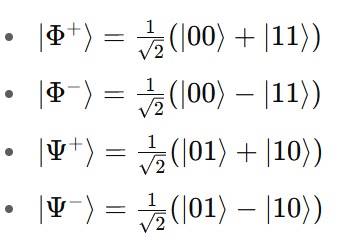
All four Bell states are entangled, meaning they are four specific, maximally entangled quantum states of two qubits. These states cannot be described as the product of two independent qubits and form an orthonormal basis for all possible two-qubit states.
_
To discuss entanglement, we need to consider at least two qubits in an entangled state. We use the state described mathematically as |Φ+⟩ (see figure below).
Let’s imagine two quantum engineers, who we named Alice and Bob in our illustration. Each takes one qubit from the pair and travels somewhere far apart. When they measure their qubits, they’ll both obtain a 0 or a 1 with equal probability.
If they repeat this experiment with many other entangled qubit pairs prepared in the same |Φ+⟩ state and record their results, both will find a random series of 0s and 1s.
But when they compare their lists, they will find something astounding: every time Alice measures a 0, Bob will have also measured 0 for his corresponding qubit, and vice versa. The results are perfectly correlated, even though both their states are undetermined prior to the measurement.
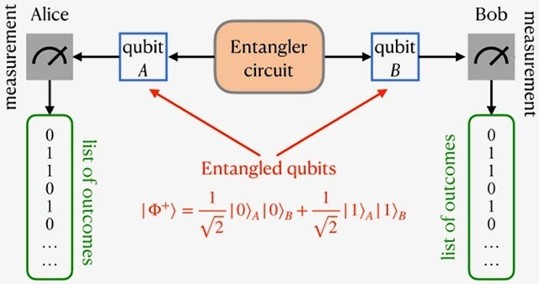
Measuring many entangled qubit pairs, all in the state |Φ+⟩, results in a perfectly correlated random series of 0s and 1s.
It is as if, when Alice makes her measurement, Bob’s qubit instantaneously “knows” and changes into the same state.
_
Quantum entanglement is a phenomenon where two or more particles become linked in such a way that they share the same fate, regardless of the distance separating them. Measuring a property of one entangled particle instantaneously determines the corresponding property of the other(s), a concept Albert Einstein famously called “spooky action at a distance”. This interconnectedness means the particles cannot be described independently, and it is a fundamental principle with applications in quantum computing and communication
- Shared quantum state:
When particles are entangled, they are described by a single quantum state that cannot be broken down into independent states for each particle.
- Instantaneous influence:
If you measure a property (like spin or polarization) of one particle, you instantly know the state of the other, even if it is light-years away.
- Non-local connection:
Entanglement creates a non-local correlation, meaning the connection between the particles is not dependent on a measurable distance or physical signal traveling between them.
- Crucial for quantum technologies:
This phenomenon is a key resource for technologies like quantum computing and secure quantum communication, enabling capabilities like quantum parallelism and quantum teleportation.
In quantum computing, entanglement is not just a theoretical curiosity—it’s a computational resource. It enables qubits to perform calculations in a highly correlated and parallel fashion, allowing quantum algorithms to solve certain problems exponentially faster than classical ones.
Entangled qubits are created through specific quantum logic gates, such as Hadamard and CNOT, which manipulate the joint state space of multiple qubits. This enables powerful phenomena like quantum teleportation, quantum error correction, and entanglement-assisted algorithms.
Teleportation and superdense coding are two quantum techniques that are based on Bell states, which are maximally entangled two-qubit states.
In quantum computing, entanglement is used to enable quantum parallelism, which is the ability of quantum computers to perform multiple calculations simultaneously. Entanglement allows quantum computers to manipulate many qubits in a single operation, instead of manipulating each qubit individually, as in classical computing. For example, consider two qubits that are initially prepared in an entangled state. If a measurement is made on one of the qubits, and it is found to be in the state |0⟩, then the state of the other qubit immediately collapses to the state |0⟩ as well. Similarly, if the first qubit is measured to be in the state |1⟩, then the state of the second qubit collapses to the state |1⟩ as well.
Entanglement enables quantum computers to implement various protocols and algorithms that are not possible with classical systems. For example, it is used in quantum teleportation, which allows for the transfer of quantum states between two distant systems. Entanglement is also a key resource for quantum error correction, which is necessary to protect quantum information from decoherence and other errors. By creating and manipulating entangled states, quantum computers can detect and correct errors in a way that is not possible for classical computers.
_
GHZ states:
A GHZ (Greenberger-Horne-Zeilinger) state is a maximally entangled quantum state of three or more qubits, characterized by non-classical correlations where all qubits are interdependent. A 3-qubit GHZ state is represented as 1/2√(|000⟩+|111⟩). These states are crucial in quantum information for applications like quantum key distribution, quantum secret sharing, and as a benchmark for quantum computing, but they are also very fragile and prone to decoherence. In GHZ states, three or more particles are entangled. The actual realization of GHZ states, first in a single molecule using nuclear magnetic resonance and then with photons that are spread out in space, is seen as a major step forward in the processing of quantum information.
___
-5. Spin:
Spin is a fundamental characteristic of elementary particles. Like mass or charge, spin determines a particle’s behavior and interaction with other particles. Spin is an intrinsic angular momentum of elementary particles.
Electron spin is a fundamental, intrinsic quantum mechanical property of electrons, representing their internal angular momentum. While often visualized as a spinning top, this analogy is imperfect because electrons do not literally spin; spin is a purely quantum characteristic like charge or mass. An electron can have one of two spin states: spin-up (+1/2) or spin-down (-1/2), which can be used to explain the magnetic properties of materials and how electrons fill atomic orbitals according to the Pauli exclusion principle.
Key aspects of electron spin:
- Intrinsic property: Spin is an inherent characteristic of an electron, similar to its mass and charge, and is a form of intrinsic angular momentum.
- Spin states: An electron’s spin is quantized, meaning it can only exist in two states: “spin-up” (+1/2) or “spin-down” (−1/2).
- Magnetic moment: The spin of an electron generates a magnetic dipole moment, making the electron behave like a tiny magnet. This is crucial for understanding the magnetic properties of materials.
- Pauli Exclusion Principle: This principle states that no two electrons in an atom can have the same set of quantum numbers. This implies that in a single orbital, there can be a maximum of two electrons, and they must have opposite spins (+1/2 and −1/2).
- Classical analogy: The idea of a spinning top is a useful but limited analogy. While it helps visualize the two possible directions, electrons do not have a physical size and are not literally rotating. The concept is more accurately understood through quantum mechanics and its effects, such as when an electron’s spin causes it to process in a magnetic field
A photon, the particle of light, has an intrinsic spin of 1, making it a spin-1 boson. This spin is not a physical rotation but a quantum property related to its electromagnetic field, and it corresponds to the two circular polarizations of light, left and right. Photons in free space only exhibit two spin states: parallel or antiparallel to their direction of motion, equivalent to spins of +ħ or -ħ
Spin in action: lasers:
The fact that photons can occupy the same space is responsible for the amazing utility of the laser. In lasers, all the photons can perfectly overlap with one another so that all the peaks and troughs of the light waves are perfectly aligned and added together. This allows lasers to create something like a superwave, so all the photons work together in the same space and at the same time. This allows lasers to cut metal, even if they operate with powers similar to a light bulb.
_______
_______
Quantum vs. Classical Physics:
Classical physics is the force governing an extremely predictable world, where an apple set on a table stays there until something causes it to move again. In the quantum world, not only can the apple end up on Mars, but, hypothetically, it could exist both on the table and on Mars at the same time. It could even be inextricably tied to another apple in some other part of the universe through entanglement. Thus, “reality” as we know it is much more uncertain, with the possibility for many solutions or outcomes to exist, rather than just one.
The concept of quantum entanglement often finds itself at the heart of a longstanding debate between quantum and classical physics. Classical physics, based on the principles of determinism and locality, struggles to explain the phenomena observed in quantum mechanics, such as entanglement and superposition.
In classical physics, particles are thought to have definite positions and properties until measured. However, quantum mechanics introduces the idea that particles can exist in multiple states simultaneously (superposition) and be instantaneously connected regardless of distance (entanglement). This discrepancy has led to various interpretations of quantum mechanics, each attempting to reconcile these seemingly incompatible views. For instance, the EPR paradox and Bell’s theorem have been crucial in understanding the limits of local hidden-variable theories, further solidifying the non-local nature of quantum mechanics.
________
Quantum mechanics and gravity:
It is quite incredible that any two points in space-time, no matter how far apart, are actually entangled. The link between entanglement and space-time may even help solve one of the biggest challenges in physics: establishing a unifying theory to connect the macroscopic laws of general relativity (which describe gravity) with the microscopic laws of quantum physics (which describe how subatomic particles behave).
The unification of gravity and quantum mechanics remains one of the most profound open questions in science. Although the other fundamental interactions—electromagnetism and the strong and weak forces—have been successfully married to quantum theory, the standard methods of quantization seem to fail for gravity. This has motivated alternative approaches to the unification of gravity with quantum theory, including string theory, loop quantum gravity and proposals that gravity is not quantized at all but remains fundamentally classical. A decisive factor in determining which route is correct has so far been lacking: experimental evidence. In a groundbreaking analysis that challenges prevailing assumptions in foundational physics, recent research reveals that classical theories of gravity may indeed produce entanglement—a quantum phenomenon previously thought to be an exclusive hallmark of quantum gravity. This paradigm-shifting insight comes from a study meticulously dissecting the interaction between mass, time duration of experiments, and the resulting gravitational effects, presenting profound implications for the interpretation of entanglement observations and the ongoing quest to confirm the quantum nature of gravity.
The concept at the center of this debate dates back to a 1957 proposal by Nobel laureate Richard Feynman, who suggested that if gravity could cause two massive objects to become quantumly entangled, then gravity itself must be quantum in nature. Entanglement between particles happens because little particles can push and pull on each other, just like big objects do in terms of gravity. The idea has recently gained traction as advances in precision measurement make such tests experimentally feasible. However, a recent paper by Richard Howl and Joseph Aziz of Royal Holloway, University of London, challenges that assumption. Their calculations indicate that even classical gravity (the non-quantum framework introduced by Albert Einstein) could, under certain conditions, create entanglement between two objects. Albert Einstein described gravity as the curvature of space-time, but whether it is also quantized remains an open question. The hypothetical carrier of this force, the so-called graviton, has never been proven.
Traditionally, physicists believed that a purely classical gravitational field could not transmit quantum information because it relies only on local operations and classical communication (LOCC). Under that framework, entanglement would require faster-than-light information transfer, which is considered “unphysical.” However, Howl and Aziz took a different approach. By combining quantum field theory (QFT) for matter with classical gravity, they showed that quantum communication could still emerge.
The key lies not in hypothetical graviton propagators (particles associated with a quantized gravitational field) but in virtual matter propagators, which are part of the quantum field description of particles such as electrons. In other words, the apparent quantum behavior may stem from the quantum nature of matter itself rather than from gravity being quantum.
Another group of researchers, Feng-Li Lin of National Taiwan Normal University and Sayid Mondal of Universidad Arturo Prat, along with their colleagues, have demonstrated that even Newtonian gravity, the classical description of gravitational force, can generate quantum entanglement between objects. This achievement establishes a framework for understanding how classical gravity influences quantum phenomena, revealing that entanglement arises from the way objects interact gravitationally through a non-local coupling.
The question of how gravity interacts with the quantum world remains one of the most profound challenges in modern physics, and recent claims suggested that even classical gravity could induce entanglement in quantum matter fields. Lajos Diósi, from the Wigner Research Center for Physics and Eötvös Loránd University, challenges this idea, demonstrating that classical gravity does not, in fact, entangle quantized matter fields. This work directly addresses a claim made by Aziz and Howl, and through careful recalculation of their example, establishes that no such entangling effect exists. This finding is significant because it clarifies the relationship between gravity and quantum mechanics, and reinforces the need for a fully consistent theory of quantum gravity.
______
______
Section-4
Introduction to quantum entanglement:
Quantum entanglement is a fundamental aspect of quantum mechanics, which describes the behavior of particles at the atomic and subatomic level. In classical physics, particles are described by their definite properties, such as position, momentum, and energy. However, in quantum mechanics, particles can exist in a superposition of states, meaning that they can have multiple properties simultaneously. When two particles are entangled, their properties become correlated in such a way that the state of one particle is dependent on the state of the other particle. This means that if something happens to one particle, it instantly affects the state of the other particle, regardless of the distance between them. Particles are considered entangled if measurements of their properties, such as spin or polarization, show strong correlations that cannot be explained by classical physics or local hidden variables. In entanglement, two particles become correlated in such a way that their properties cannot be described independently. Quantum entanglement has been demonstrated experimentally with photons, electrons, top quarks, atomic nuclei and molecules.
_
At its core, entanglement arises when particles interact in a way that their properties, such as spin, momentum, or polarization, become linked. Entangled particles can be created through various interactions, such as the decay of a parent particle or the interaction of photons with matter. Once entangled, the state of these particles is described by a single wave function, which encapsulates the correlations between them. This means that any measurement performed on one particle will instantly affect the state of the other entangled particles, a phenomenon that has been experimentally verified multiple times.
_
Quantum entanglement is the phenomenon where the quantum state of each particle in a group cannot be described independently of the state of the others, even when the particles are separated by a large distance. The topic of quantum entanglement is at the heart of the disparity between classical physics and quantum physics: entanglement is a primary feature of quantum mechanics not present in classical mechanics.
Measurements of physical properties such as position, momentum, spin, and polarization performed on entangled particles can be found to be perfectly correlated. For example, if a pair of entangled particles is generated such that their total spin is known to be zero, and one particle is found to have clockwise spin on a first axis, then the spin of the other particle, measured on the same axis, is found to be anticlockwise. However, this behavior gives rise to seemingly paradoxical effects: any measurement of a particle’s properties results in an apparent and irreversible wave function collapse of that particle and changes the original quantum state. With entangled particles, such measurements affect the entangled system as a whole.
_
Quantum entanglement is one of the central principles of quantum physics, though it is also highly misunderstood. In short, quantum entanglement means that multiple particles are linked together in a way such that the measurement of one particle’s quantum state determines the possible quantum states of the other particles. This connection isn’t depending on the location of the particles in space. Even if you separate entangled particles by billions of miles, changing one particle will induce a change in the other. Even though quantum entanglement appears to transmit information instantaneously, it doesn’t actually violate the classical speed of light because there’s no “movement” through space. One important thing to remember is that in quantum physics, the original uncertainty about the particle’s quantum state isn’t just a lack of knowledge. A fundamental property of quantum theory is that prior to the act of measurement, the particle really doesn’t have a definite state, but is in a superposition of all possible states. This is best modelled by the classic quantum physics thought experiment, Schoedinger’s Cat, where a quantum mechanics approach results in an unobserved cat that is both alive and dead simultaneously.
_
Quantum systems can be in multiple states at the same time. For example, an electron can be both spin up and spin down. The question “which is it: up or down?” genuinely doesn’t make sense, because the electron’s state can be a combination of both. We call such combinations “superpositions”. Quantum superpositions are famously delicate. You can demonstrate that an electron is in multiple states, but you have to be clever about it, because if you ever directly measure whether the electron is spin up or down, you always find that it’s one or the other, but never both. Which single state you find is fundamentally random. This “effect” of measurement, where a superposition of several states is suddenly replaced by only one of those states, is called “decoherence” or “wave function collapse” or “collapse”.
If a pair of electrons share a common state (for example by both being up and both being down, but never one up / one down), then those electrons are “entangled”. A pair of entangled particles are in a superposition of states together.
In order for two things to be entangled they need to have interacted with each other, so you can’t just cause two distant particles to become entangled. Generally speaking, you entangle two particles when they’re together, then move them apart.
When a single particle in a superposition of states is measured, it collapses to one of the states in its superposition. Entangled particles have the same rule; when you measure either of them you find that they’re in only one state. But since they’re in a shared state, a measurement on the other will yield the same result.
_
Defining Quantum Entanglement:
In its simplest terms, quantum entanglement refers to a phenomenon where two or more particles become interconnected such that the state of one particle directly influences the state of the other, regardless of the distance separating them. This relationship persists even when the particles are light-years apart, leading to what Einstein famously termed “spooky action at a distance.” Entangled particles share a quantum state, indicating that their properties are not independent. If one particle is measured and its state is known, the other particle’s state will immediately be determined. This can occur regardless of the space between them, posing significant implications for our understanding of locality and causality in physics. The implications extend far beyond theoretical interest into practical applications in areas such as quantum computing and quantum communication.
_
Entanglement twists together two or more quantum particles, replacing their individual identities with an entwined whole. In quantum physics, objects can become so inextricably intertwined that it’s no longer fair to think of them separately. They assume a new, collective identity that can persist even if they’re separated by vast distances. Two or more objects linked in this special quantum way are said to be entangled—a situation without parallel in our everyday experience. Entangled objects share a peculiar bond: When one member of an entangled collection is queried (that is, measured), its answer is always tightly linked, or correlated, to the answers of the other objects in the group. Scientists call the connection shared by entangled particles “entanglement.”
_
Correlation alone isn’t all that special. Examples of correlation abound in the world around us. For example, students at the same university will tend to have highly correlated locations during the school year—most of them are spending time on campus, after all. It would be unlikely for a random group of people, with no affiliation to the university, to cluster around the same campus. What makes entangled objects different is that they exhibit stronger correlations than the highly correlated students, displaying a kinship that couldn’t exist outside of the quantum realm. Entanglement can also occur among hundreds, millions, and even more particles. The phenomenon is thought to take place throughout nature, among the atoms and molecules in living species and within metals and other materials. When hundreds of particles become entangled, they still act as one unified object. Like a flock of birds, the particles become a whole entity unto itself without being in direct contact with one another.
_
Electrons have a quantum property called spin that makes them act like little magnets. We’ll always measure it pointing in one direction or the opposite: up or down, say. If we entangle two electrons so that their spins are always pointing in opposite directions, the two spins are said to be correlated. If we entangle the two electrons in this way – and fire them in opposite directions, we don’t know which one of the pair is up and which one is down until we make a measurement. If we find that electron 1 is spin up. We know the spin of electron 2 must be down.
Why isn’t this like a pair of gloves?
The handedness of the gloves is there from the start. It never changes. With entangled particles that’s not the case. They are in a superposition. Prior to measurement, there is no definite answer.
How do we know superposition is real?
The double slit experiment is good evidence. Entangled particles are stranger, because a measurement on one particle determines the outcome for both of them.
How are two particles entangled?
You can entangle two photons from birth or you can bring two quantum objects very close together.
Once objects are entangled, they’re not separate. They are, really two parts of a single object. In quantum mechanics, objects are described by wave functions: mathematical expressions that encapsulate all that can be said about the object. This wave function can be spread out in space. This is why particles can act as if they are waves. But if we entangle two particles, they are then described by a single wave function. They are mathematically the same object.
_
Imagine for a moment two particles of light, which scientists call photons. Photons can carry different amounts of energy, corresponding to the different colors of light that our eyes perceive. You can think of the photons as pinpoints of light.
Next, we’ll imagine that the colors of the two photons are entangled. In this particular case, that entanglement boils down to a simple rule: Each photon has a chance of being either blue or red, but, once measured, they are always different colors. If we find that the first photon is blue, we would immediately know that the second photon is red. And vice versa. Entanglement is a rule that governs how measurements of one entangled partner relate to measurements of another.
We could test this rule with an experiment. We could prepare an entangled pair of two photons and measure one of them, recording a random result of either blue or red. If we then checked the color of the second photon, we would find that it is always the other color. This perfect correlation would be there each time we run the experiment.
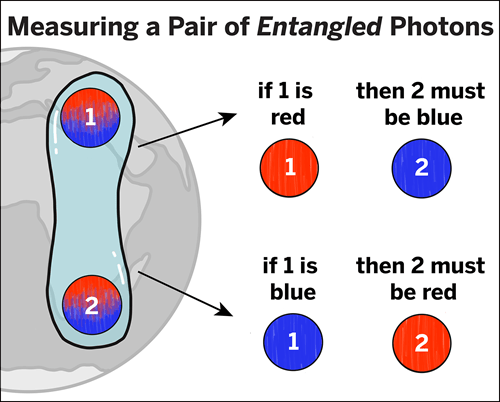
Because of how quantum measurement works, the individual photons don’t really have a color until we make a measurement. Moreover, because the photons are entangled, they are not separate entities but rather parts of a single quantum whole. There isn’t a way to completely describe the color of the first photon without accounting for the color of the second. After the measurement, the entanglement is destroyed, and we’re left with two photons that each have a definite color.
_
Entanglement has a reputation for being strange for at least two reasons.
The first is quantum indeterminacy—the fact that the photons don’t have sharply defined colors until we measure them.
The second is that entanglement can persist over long distances. We could shoot our pair of entangled photons to opposite sides of the galaxy and send astronauts to measure them. When they reported back the results, we would see the same correlation as if the photons stayed right here on Earth. Those correlations remain even though there is no possible way for information to pass between the photons.
_
These implications bothered Einstein, who argued that quantum physics as a theory must be incomplete. He called entanglement “spooky action at a distance,” and, together with a number of other physicists, thought that particles must carry around extra information—”hidden variables”—that could account for the correlations. The debate around these ideas went on for decades until scientists came up with experiments to test Einstein’s intuitions.
_
Some examples of quantum entanglement include:
- The Stern-Gerlach experiment, which shows that the spin of two electrons can be entangled
- The Aspect experiment, which shows that the polarization of two photons can be entangled
- The Schrödinger’s cat thought experiment, which illustrates the paradoxical nature of quantum entanglement
Is quantum entanglement real?
Yes, quantum entanglement is real. It has been experimentally verified in a number of experiments, including the Stern-Gerlach experiment, the Aspect experiment, and the Schrödinger’s cat thought experiment.
_____
_____
No hidden variables proved:
[local hidden variables mean properties contained within the individual particles themselves]
_
Unbreakable Correlation
When researchers study entanglement, they often use a special kind of crystal to generate two entangled particles from one. The entangled particles are then sent off to different locations. For this example, let’s say the researchers want to measure the direction the particles are spinning, which can be either up or down along a given axis. Before the particles are measured, each will be in a state of superposition, or both “spin up” and “spin down” at the same time.
If the researcher measures the direction of one particle’s spin and then repeats the measurement on its distant, entangled partner, that researcher will always find that the pair are correlated: if one particle’s spin is up, the other’s will be down (the spins may instead both be up or both be down, depending on how the experiment is designed, but there will always be a correlation). The beauty of entanglement is that just knowing the state of one particle automatically tells you something about its companion, even when they are far apart.
_
Entanglement could be explained by “hidden variables” within the particles. For example, we could hypothesize that the particles are made in pairs such that one carries a value of “up” while the other carries a value of “down”. Then, knowing the result of the spin measurement upon one particle, we could predict that the other will have the opposite value. Bell illustrated this with a story about a colleague, Bertlmann, who always wore socks with mismatching colors. “Which colour he will have on a given foot on a given day is quite unpredictable,” Bell wrote, but upon observing “that the first sock is pink you can be already sure that the second sock will not be pink.”
_
Are particles really connected across space?
Einstein’s Objection: EPR and the Search for Hidden Variables:
In 1935, Einstein, along with his colleagues Boris Podolsky and Nathan Rosen, published a paper that would become legendary in the annals of physics. Known as the EPR paper (after their initials), it was titled “Can Quantum-Mechanical Description of Physical Reality Be Considered Complete?” Their answer was a resounding NO.
The EPR paradox presented a thought experiment meant to show that quantum mechanics couldn’t possibly be a complete theory. If quantum entanglement were real, then measuring one particle’s property would instantly determine the corresponding property of the entangled partner, even if they were separated by vast distances. This seemed to violate locality, the idea that an object can only be influenced by its immediate surroundings, and causality, the notion that causes must precede effects.
To preserve these principles, Einstein and his collaborators proposed that quantum mechanics must be missing something—some “hidden variables” that determined the outcome of measurements in a deterministic way. They believed the spooky correlations predicted by entanglement were a sign that quantum theory was incomplete.
Einstein famously quipped, “God does not play dice with the universe.” He couldn’t accept that nature was inherently probabilistic and interconnected in such a ghostly fashion.
Schrödinger and the Naming of Entanglement:
Around the same time, Austrian physicist Erwin Schrödinger—already famous for his equation and his theoretical cat—coined the term “entanglement” (Verschränkung in German). Schrödinger realized that entanglement was not just a side effect or anomaly in quantum mechanics, but rather a central feature.
He noted that once two systems interact and become entangled, their quantum states become linked in a way that cannot be described independently. In his words, “Best possible knowledge of a whole does not necessarily include best possible knowledge of its parts.” This concept turned the classical view of reality on its head.
Entanglement, Schrödinger suggested, was the characteristic trait of quantum mechanics—the feature that sets it apart from classical physics.
Bell’s Theorem: The Final Blow to Hidden Variables:
For decades after the EPR paper, the debate about entanglement remained philosophical. Then, in 1964, a Northern Irish physicist named John Bell entered the scene. Bell formulated a mathematical theorem that would forever change the way we think about quantum reality.
Bell’s Theorem:
Bell’s Theorem is a huge deal in quantum physics. It was thought up in the 1960s by a physicist named John Bell. He wanted to figure out if the freaky quantum correlations between entangled particles could be explained by old-school classical physics, or if we needed something totally new – a non-classical, quantum explanation.
Basically, Bell came up with this mathematical inequality, now called Bell’s inequality. He showed that if quantum particles like photons operated under classical physics, they would obey this inequality when measured. But if the quantum theory was correct, certain measurements on entangled particles would violate Bell’s inequality.
This was big news because it meant scientists could design experiments to test Bell’s theorem. Over the years, physicists have run all kinds of tests on entangled particles. And you know what? The results have consistently shown that entangled particles violate Bell’s inequality, just as quantum theory predicts.
As a result of Bell’s theorem, it was proven that these inexplicable quantum correlations really can’t be explained by classical physics – we definitely need quantum mechanics to account for it. This was groundbreaking because it showed that the quantum realm is utterly different from the world we see around us every day. At the quantum level, reality is nonlocal and things are interconnected in mind-bending ways that classical physics just can’t grasp.
However, Bell’s theorem still needed experimental verification. In 1972, John Clauser and Stuart Freedman directed a laser at calcium atoms, causing the atoms to emit pairs of photons that quantum theory predicted would be entangled. They carefully recorded whether the photons passed through polarization filters on each side and checked how often the results matched. After hundreds of thousands of measurements, they found strong correlations that supported quantum entanglement, and their results closely matched Bohr’s quantum mechanics predictions. Experiments were carried out in 1980s, most notably by Alain Aspect and his team in France. They used entangled photons and clever detection setups to test Bell’s inequalities. The results were clear and astonishing: quantum mechanics was right. The universe violated Bell’s inequalities, ruling out local hidden variables. In 2022 Nobel Prize in Physics was awarded jointly to Alain Aspect, John F. Clauser and Anton Zeilinger “for experiments with entangled photons, establishing the violation of Bell inequalities and pioneering quantum information science.” Their groundbreaking work, including tests using devices that analyze polarization, provided strong evidence for the reality of quantum entanglement and challenged local hidden variable theories, thereby reinforcing the foundations of quantum mechanics.
_
Light from ancient quasars helps confirm quantum entanglement, a 2018 study:
What if such correlations were the result not of quantum entanglement, but of some other hidden, classical explanation? Such “what-ifs” are known to physicists as loopholes to tests of Bell’s inequality, the most stubborn of which is the “freedom-of-choice” loophole: the possibility that some hidden, classical variable may influence the measurement that an experimenter chooses to perform on an entangled particle, making the outcome look quantumly correlated when in fact it isn’t.
Recently in a paper published in Physical Review Letters, the researchers used distant quasars, one of which emitted its light 7.8 billion years ago and the other 12.2 billion years ago, to determine the measurements to be made on pairs of entangled photons. They found correlations among more than 30,000 pairs of photons, to a degree that far exceeded the limit that Bell originally calculated for a classically based mechanism. If some conspiracy is happening to simulate quantum mechanics by a mechanism that is actually classical, that mechanism would have had to begin its operations — somehow knowing exactly when, where, and how this experiment was going to be done — at least 7.8 billion years ago. That seems incredibly implausible, so we have very strong evidence that quantum mechanics is the right explanation. The Earth is about 4.5 billion years old, so any alternative mechanism — different from quantum mechanics — that might have produced such results by exploiting this loophole would’ve had to be in place long before even there was a planet Earth.
_
John Preskill, a leading quantum information scientist at the California Institute of Technology, notes that many mature technologies are already “quantum” in some sense: lasers, magnetic resonance imaging machines and multibillion-transistor computer chips all rely on quantum mechanics unfolding on subatomic scales. “But those technologies,” he says, “have only scratched the surface of how quantum theory has modified our view of what’s possible in the universe.” And, Preskill adds, “the burgeoning investments in quantum technologies now occurring all over the world are building on scientific foundations which flow from the pioneering work of Bell, Clauser, Aspect and Zeilinger.” Einstein’s “spooky action” wasn’t an illusion—it was a fact.
_
What Entanglement Really Means: Nonlocality Without Communication:
It’s crucial to understand what entanglement does and doesn’t mean. When two particles are entangled and one is measured, the state of the other becomes instantly known. But this doesn’t allow us to send messages faster than light, because the outcome of any single measurement is random. We can’t choose the result, and so we can’t encode information.
What entanglement reveals is that the universe is nonlocal in a subtle way. The correlations between entangled particles exist beyond space and time. They suggest that the entangled system must be treated as a single, inseparable whole, regardless of distance.
This challenges our classical worldview, where objects are independent and interactions are local. In the quantum world, the whole is more than the sum of its parts, and information about one part is inherently linked to the other.
_
Relativity Remains Intact:
A common misconception about entanglement is that the particles are communicating with each other faster than the speed of light, which would go against Einstein’s special theory of relativity. Experiments have shown that this is not true, nor can quantum physics be used to send faster-than-light communications. Though scientists still debate how the seemingly bizarre phenomenon of entanglement arises, they know it is a real principle that passes test after test. In fact, while Einstein famously described entanglement as “spooky action at a distance,” today’s quantum scientists say there is nothing spooky about it. “It may be tempting to think that the particles are somehow communicating with each other across these great distances, but that is not the case,” says Thomas Vidick, a professor of computing and mathematical sciences at Caltech. “There can be correlation without communication,” and the particles “can be thought of as one object.”
_
Let’s say you have two entangled balls, each in its own box. Each ball is in a state of superposition, or both yellow and red at the same time……until you observe the balls. If the first one is yellow, the other will be yellow. If the first one is red, the other will be red. The objects remain connected even over vast distances. Scientists think of entangled objects as really being a single object.
But what if one observer decides to look at their ball from a different angle or side of the box? The balls would revert back to a state of superposition and have a 50% chance of being yellow and 50% chance of being red.
The viewer might find a yellow ball now, even though the pair of balls had previously both been red!
Now, if the second observer also looks at their ball from the side view, it will match what the first observer saw. The ball are still entangled, but what the viewer sees depends on how they look at the ball. This is because the entangled information about color does not lie within any one ball but exists in the connection between the balls. There is no hidden variable, no predetermined outcome, only randomness but randomness is correlated to certainty in entanglement.
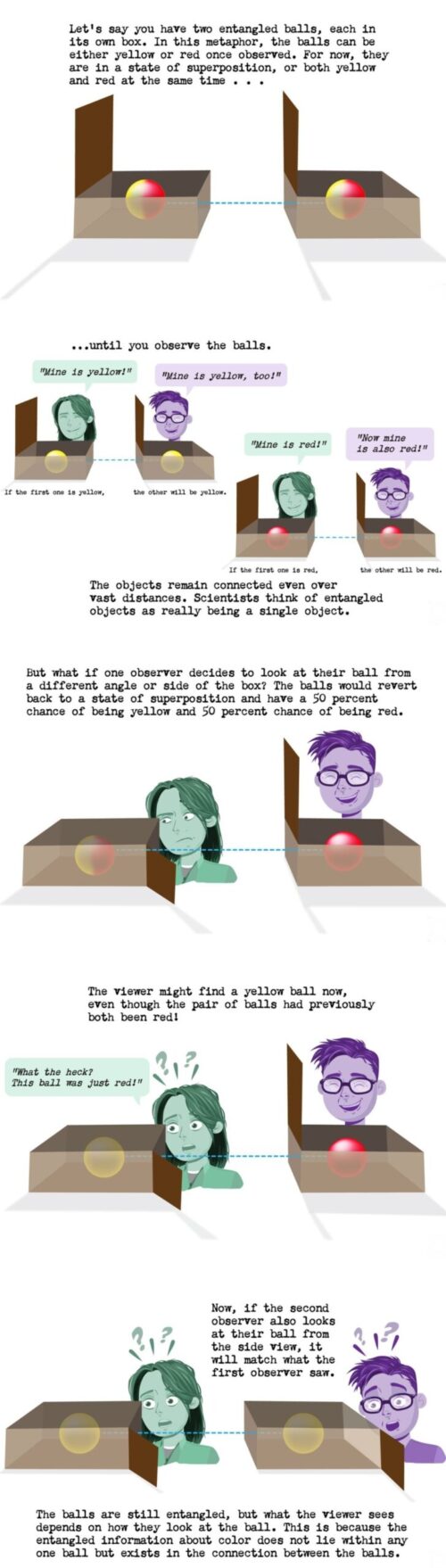
______
______
Quantum Entanglement vs Classical Correlation:
At first glance, quantum entanglement might seem similar to classical correlation. For example, if you take two gloves and send one to New York and one to Tokyo, discovering that the glove in New York is right-handed immediately tells you the glove in Tokyo must be left-handed. That’s a classical correlation—the outcome is predetermined, and the information simply reveals an already fixed fact.
Quantum entanglement, however, is fundamentally different. When two particles are entangled, their individual states are not predetermined. Instead, they exist in a shared quantum state that is only defined when one of them is measured. The moment you measure one particle, the other’s state is instantly determined—even if it’s light-years away. This behavior defies classical logic and cannot be explained by hidden variables alone.
Here’s a key distinction:
- Classical correlation can always be explained by shared information from the past.
- Quantum entanglement involves non-local correlations that violate classical probability, as confirmed by Bell’s theorem and related experiments.
In essence, entanglement isn’t just a stronger kind of correlation—it’s a different kind of connection altogether, rooted in the probabilistic and non-local nature of quantum mechanics.
______
Key characteristics of quantum entanglement:
- Non-Separability:
Entangled particles exhibit a property known as non-separability, where the state of a system cannot be described by the independent states of its individual parts. Entangled particles cannot be described independently; their properties are intertwined and exist as a single, unified system. When particles are entangled, their combined state becomes inseparable, and any measurement or change in one particle instantaneously affects the state of the other particle, regardless of the distance between them.
Mathematically, an entangled system can be defined to be one whose quantum state cannot be factored as a product of states of its local constituents; that is to say, they are not individual particles but are an inseparable whole. When entanglement is present, one constituent cannot be fully described without considering the other(s). The state of a composite system is always expressible as a sum, or superposition, of products of states of local constituents; it is entangled if this sum cannot be written as a single product term. This non-separable behavior has been experimentally verified through tests such as the violation of Bell’s inequality.
Quantum entanglement is a process whereby energetically degenerate states cannot be separated and electrons or photons in these states are essentially indistinguishable. As a result, two entangled indistinguishable particles are inextricably linked regardless of temporal or spatial separation. This entanglement is normally observed as correlations between measurements made on the angular momentum or polarizations of the entangled particles.
- Instantaneous correlation:
A measurement on one particle instantaneously affects the state of its entangled partner, no matter how far apart they are.
- Non-local connection:
Entanglement violates the principle of local realism, which states that physical processes occurring in one location cannot instantaneously affect events in another distant location. While quantum non-locality seems to imply “spooky action at a distance,” it is important to understand that this does not violate the laws of physics. It simply reflects the statistical correlations in measurements on entangled particles, without enabling faster-than-light effects. The connection exists regardless of spatial distance, which was a source of debate for physicists like Einstein who believed it conflicted with the speed of light limit.
- Not faster-than-light communication:
One of the most prevalent myths is that entangled particles allow for communication faster than the speed of light. However, this is not the case. While measuring one particle can instantly affect the state of the other, no information is actually transmitted between them. Entanglement cannot be used to send information faster than light because the outcome of any single measurement is random and unpredictable until it is made. You cannot control the outcome of the measurement on one particle to send a signal to the other; the correlations simply reveal that their properties were linked when the pair was created. You cannot force a specific outcome to send a message. It does enable the creation of secure keys through quantum key distribution, but this process is still bound by classical communication speeds.
- Demonstrated reality:
Experiments based on John Bell’s theorem have proven that entanglement is a real phenomenon and not the result of some pre-determined “hidden variables”.
- Probabilism:
Quantum mechanics is often misunderstood as being deterministic, but it is fundamentally probabilistic. The state of a quantum system is a superposition of possible outcomes, each with a certain probability, until measurement collapses it into one definite state.
- Quantum Information Processing:
The principles of entanglement have been harnessed in various technologies related to quantum information processing, such as quantum cryptography and quantum computing. These technologies rely on the ability to generate and manipulate entangled states to perform tasks that are not achievable with classical systems, further demonstrating the reality and usefulness of entanglement. The advantage to using entangled particles to send messages is you can encrypt the message in a way that it can never be intercepted and decrypted without that decryption being detected. Quantum teleportation is limited to the transfer of quantum information between particles, not the physical transport of objects.
The accumulated experimental evidence, along with the successful practical applications of entanglement, strongly supports the understanding that particles are genuinely entangled and do not carry hidden information that determines their future states at the moment of entanglement.
_______
Types of Quantum Entanglement:
Quantum entanglement can occur in various forms, including spin entanglement, momentum entanglement, and energy entanglement. Spin entanglement occurs when two particles become correlated in such a way that the state of one particle cannot be described independently of the other, even when they are separated by large distances (Einstein et al., 1935). This type of entanglement is often demonstrated using photons or electrons.
Momentum entanglement, on the other hand, occurs when two particles become correlated in such a way that their momenta cannot be described independently. This type of entanglement has been experimentally demonstrated using ultracold atoms (Bouwmeester et al., 1997). Energy entanglement is another form of entanglement where the energy levels of two particles become correlated, and it has been theoretically proposed as a means for quantum communication (Bennett et al., 1993).
Another type of entanglement is orbital angular momentum (OAM) entanglement, which occurs when two particles become correlated in such a way that their OAM cannot be described independently. This type of entanglement has been experimentally demonstrated using photons and has potential applications in quantum communication and cryptography (Mair et al., 2001). Additionally, there is also time-energy entanglement, where the energy levels of two particles become correlated with each other’s temporal properties (Franson, 1989).
The different types of quantum entanglement include bipartite entanglement, multipartite entanglement, and continuous variable entanglement. Bipartite entanglement involves two particles that are entangled, meaning the state of one particle is directly related to the state of the other, regardless of the distance separating them. Multipartite entanglement extends this concept to three or more particles, where the entangled state cannot be described independently of the others. This type of entanglement has been experimentally demonstrated using multiple photons and has potential applications in quantum computing and simulation (Pan et al., 2001). Continuous variable entanglement refers to systems where the entangled properties are not discrete, such as position and momentum, and is often used in quantum optics. These classifications are fundamental in quantum mechanics and have been experimentally validated in various studies, including those by Aspect et al. in the 1980s, which demonstrated the non-local properties of entangled particles. Furthermore, there is also entanglement swapping, where entanglement is transferred from one particle to another without physical transport of the particles themselves (Żukowski et al., 1993).
Entanglement can be classified into different categories based on its properties, such as pure vs. mixed entanglement, and separable vs. inseparable entanglement. Pure entanglement occurs when a system is in a single quantum state, while mixed entanglement occurs when a system is in a statistical mixture of states (Werner, 1989). Separable entanglement occurs when the density matrix of a system can be written as a product of two density matrices, while inseparable entanglement occurs when this is not possible (Peres, 1996).
In addition to these types of entanglement, there are also various measures of entanglement, such as entanglement entropy and concurrence. Entanglement entropy measures the amount of entanglement in a system, while concurrence measures the degree of entanglement between two particles (Wootters, 1998).
_
Entanglement entropy:
The entropy of entanglement (or entanglement entropy) is a measure of the degree of quantum entanglement between two subsystems constituting a two-part composite quantum system. Given a pure bipartite quantum state of the composite system, it is possible to obtain a reduced density matrix describing knowledge of the state of a subsystem. The entropy of entanglement is the Von Neumann entropy of the reduced density matrix for any of the subsystems. If it is non-zero, it indicates the two subsystems are entangled.
______
Can quantum entanglement be utilized in practical applications like communication?
It cannot send messages.
Entanglement is not what you think it is. A lot of people have the rather weird notion that “quantum entanglement” means “whatever you do to this particle here, happens to that one over there, too.”
That is absolutely not what entanglement is or what it means. You cannot send messages using entanglement because it absolutely positively does not mean “whatever you do to this particle also happens to that one.”
You can’t really express entanglement in intuitive language. It is, first and foremost, a mathematical correlation.
A crude analogy—and keep in mind this is an analogy, don’t mistake the map for the terrain—is to think about two ping pong balls. You paint one red and one blue. Then you close your eyes and put them in two boxes. You mix up the boxes so you don’t know which is which. You put one box on your desk and you put the other box on a rocket to Mars.
Now you open the box in your desk. You see a red ping pong ball. Instantly, you know the one on Mars is blue, even though Mars is several light-minutes away. It doesn’t take 4.3 minutes to know that the ball on Mars is blue. The instant you see your red ball, you immediately know what color ball is on Mars, no matter how long it takes light to get there.
But—and this is very, very important, because it is central to the way quantum mechanics works and it completely ruins the idea of communicating using these entangled ping pong balls—if you paint your red ball blue, the blue ball on Mars does not change color.
If you change the state of one particle, the other particle does not change. You cannot, you absolutely cannot, have a spin-up electron on your desk and an entangled spin-down electron on Mars, and change your spin-up electron to spin down, and have the electron on Mars change from spin-down to spin-up. That is not what entanglement means.
In the weird world of entanglement, the particles appear to be in an intermediate state, as if your two balls once you sealed them into boxes become something between red and blue, and it’s only at the moment you open the box and see a red ball that the other one becomes blue. But the same rule applies, painting your red ball blue does not change the blue ball to red.
You can’t force an entangled particle into a particular state and you can’t force a measurement to produce a particular outcome because the results of quantum measurement are random. Even with measurements that are perfectly correlated, no information passes between them. The sender and receiver can only see the correlation when they get back together and compare measurements. It is correlation without communication.
_
One helpful analogy is a pair of twin coins that always land on opposite sides. If you and a friend each flip one coin and later compare results, you’ll always find one heads and one tails. Classically, we could achieve this by pre-arranging one coin to be two-headed and the other two-tailed – a simple correlation with hidden properties. But an entangled “quantum coin” pair is spookier: neither coin has a fixed heads or tails until one is observed. When you look at your coin and see heads, your friend’s distant coin truly becomes tails at that moment, as if the coins share a cosmic connection that enforces opposite outcomes. What’s more, quantum mechanics allows many ways to “look” at a particle. For entangled qubits (quantum bits), you can measure different properties (for example, measuring a photon’s polarization at different angles). Amazingly, an entangled pair can be correlated in more than one way at once.
It’s important to bust a common myth: entanglement does not let us send usable signals faster than light. Continuing our coin analogy, each individual coin flip result is completely random – you can’t control whether your entangled coin comes up heads or tails, so you can’t encode a message in it. It’s only after you and your friend compare notes (via normal communication) that the magical correlation reveals itself. Until then, each of you sees a random coin flip. Entanglement’s instant link respects Einstein’s cosmic speed limit because it can’t carry any purposeful information on its own. In essence, entanglement gives randomness correlated with certainty. The universe really does allow this special kind of connection, as weird as it sounds.
______
______
Experimental Evidence of Quantum Entanglement:
With the theoretical groundwork laid by Bell in 1964, scientists began designing experiments to determine whether the universe truly behaves as quantum mechanics predicts—or if there might be hidden classical explanations.
-1. Bell’s Theorem: The Theoretical Foundation (1964)
Physicist John Bell introduced an inequality—now known as Bell’s inequality—to test whether the world operates under local realism (the idea that particles have predefined states and no influence travels faster than light). Quantum mechanics predicts violations of Bell’s inequality in certain measurements of entangled particles. If experiments violated the inequality, it would mean that local hidden variable theories (classical explanations) are insufficient—and that quantum entanglement is real.
The CHSH inequality experiment, proposed by John Clauser, Michael Horne, Shizuo Hom, and Anton Zeilinger, extended the work on quantum entanglement further. It examined the correlations formed by measurements on two entangled particles through different settings. The experiment confirmed that the correlations predicted by quantum mechanics could exceed the classical bounds set by the CHSH inequality. The outcome not only reinforced the nonlocal characteristics of entangled particles but also brought more attention to the foundational questions of quantum mechanics. The implications of this experiment have resonated in quantum theories, demonstrating the profound consequences of entangled states.
-2. Clauser–Freedman Experiment (1972)
John Clauser and Stuart Freedman performed the first direct experimental test of Bell’s inequality at the University of California, Berkeley. Using entangled photons, they obtained results consistent with the predictions of quantum mechanics, not classical physics. This was the first empirical support for Bell’s theorem, but it had certain “loopholes,” such as limited detector efficiency and possible communication between particles (locality loophole).
-3. Aspect Experiments (1981–1982)
In a landmark series of tests, Alain Aspect and his team in France closed some of the key loopholes. By using fast-switching polarizers on entangled photons, they ensured that the measurement settings could not influence each other during the experiment. Aspect’s results showed a clear violation of Bell’s inequality, giving strong evidence that entanglement exhibits true non-locality—particles really are connected in a way that defies classical explanation. Their results confirmed that entangled particles exhibit correlations that cannot be explained by classical physics, strongly supporting the predictions of quantum mechanics.
Starting in the 1980s, scientists playing with pairs of particles (figure below) in Paris, Geneva and Austria found behaviors beyond Bell’s limit. Their experiments sought to rule out alternative, entanglement-free theories that physicists had been crafting for decades.
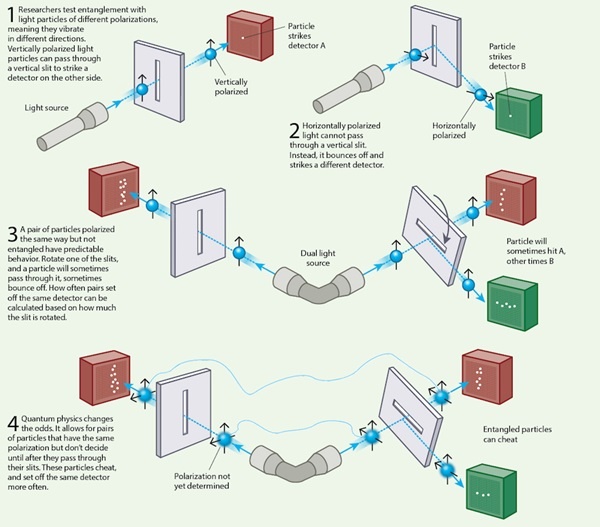
Most of the physics community accepted the results from Europe, bringing entanglement into the scientific mainstream, but each experiment had at least one shortcoming, giving hardcore skeptics room for doubt. Some of the experiments studied particles near each other, which could have sent regular, slower-than-light messages. Others lost a fraction of the particles in transit, leaving questions about whether those that were measured were representative of all particles. Closing all these loopholes in one experiment has been an enormous technical challenge, But researchers in the Netherlands finally reported the first loophole-free Bell test. Two other groups followed close on their heels. The chance that the strongest of these results could have happened without entanglement is less than 1 in 4 million.
-4. Zeilinger and Long-Distance Entanglement (1990s–2000s)
Anton Zeilinger extended these tests by demonstrating quantum entanglement over long distances—first in labs, then across tens and hundreds of kilometers using fiber optics and free-space transmission. His experiments proved that entanglement is not limited by distance, and helped pave the way for quantum communication networks.
-5. Loophole-Free Bell Tests (2015)
In 2015, three separate research groups—including teams at Delft University of Technology (Netherlands) and NIST (USA)—performed loophole-free Bell tests, simultaneously closing the detection and locality loopholes.
These were the most rigorous tests of quantum entanglement to date. The experiments used entangled electron spins and photons with fast, random setting choices and high detector efficiency—ruling out classical explanations once and for all.
-6. Light from quasars tests (2018)
In recent years, experiments have confirmed the reality of quantum entanglement in increasingly dramatic ways. One of the most striking confirmations came from a team of physicists at MIT and the University of Vienna, who used ancient quasars—cosmic beacons from billions of years ago—to demonstrate that quantum entanglement cannot be explained away by any classical mechanism. In this experiment, light from quasars that had travelled for billions of years was used to determine the settings of measurements performed on entangled photons. The results were clear: the correlations observed between the entangled photons could only be explained by quantum mechanics. If a classical mechanism were responsible, it would have had to be set in motion billions of years ago—an implausible scenario.
These findings are more than just a confirmation of quantum theory; they close loopholes that could have allowed for alternative explanations. For instance, one such loophole, known as the “freedom-of-choice” loophole, suggests that some hidden variable could influence the experimenter’s choice of measurements. By using light from ancient quasars, scientists were able to rule out any possibility that these measurements were pre-determined by such a variable.
And as if two entangled particles aren’t spooky enough, some researchers are now thinking about what it means for three, 10 or even thousands of particles to be entangled. Others hope to tie the quantum effect to gravity, or use it to explore how reality can be thought of in terms of information. The weirdest days of entanglement may still lie ahead
______
______
Entanglement swapping:
Entanglement Swapping is the process that allows for the transfer of entangled states between particles that have never interacted before, facilitating the creation of quantum networks. Entanglement swapping is a quantum phenomenon that establishes entanglement between two particles that have never interacted, by performing a specific measurement on intermediate entangled pairs. This process is crucial for quantum networks and repeaters, allowing entanglement to be distributed over long distances where direct transmission is not possible. For example, if Alice has particle A and Danny has particle D, and both A and D were initially entangled with particles B and C respectively (A-B and C-D), performing a joint measurement on the B-C pair will entangle A and D as seen in figure below. As particles B and C are subjected to a measurement in the basis of Bell states, the state of the remaining particles, A and D, collapses to a Bell state, leaving them entangled despite never having interacted with each other.
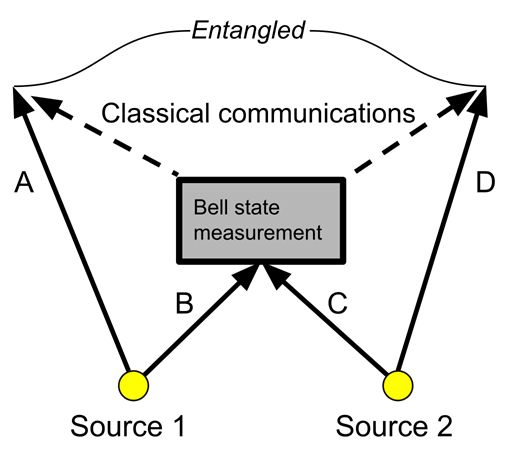
Figure above shows entanglement of states from independent sources can be swapped through Bell state measurement.
Entanglement swapping is a form of quantum teleportation. Instead of directly teleporting the state of a single particle across vast distances, researchers investigate the transfer of entanglement from one pair of particles to another, even if the two pairs have never directly interacted.
In 2017, Jian-Wei Pan’s team tested for entanglement swapping over great distances and across complex networks. Their work used satellites to swap entanglement between ground stations located hundreds of kilometers apart and was designed to identify challenges and possibilities of building large-scale quantum networks that could eventually span continents or even the globe. Physicist Douglas Youvan suggested in a 2024 paper that quantum entanglement swapping can be used to secure data transmission over vast distances through quantum relays — which extend quantum communication — and teleportation networks, among other benefits.
______
______
Quantum entanglement as physical resource:
Just as energy is a resource that facilitates mechanical operations, entanglement is a resource that facilitates performing tasks that involve communication and computation. The mathematical definition of entanglement can be paraphrased as saying that maximal knowledge about the whole of a system does not imply maximal knowledge about the individual parts of that system. If the quantum state that describes a pair of particles is entangled, then the results of measurements upon one half of the pair can be strongly correlated with the results of measurements upon the other. However, entanglement is not the same as “correlation” as understood in classical probability theory and in daily life. Instead, entanglement can be thought of as potential correlation that can be used to generate actual correlation in an appropriate experiment. The correlations generated from an entangled quantum state cannot in general be replicated by classical probability.
_
Quantum entanglement is a physical resource, like energy, associated with the peculiar nonclassical correlations that are possible between separated quantum systems. Entanglement can be measured, transformed, and purified. A pair of quantum systems in an entangled state can be used as a quantum information channel to perform computational and cryptographic tasks that are impossible for classical systems. The general study of the information-processing capabilities of quantum systems is the subject of quantum information theory.
_
The EPR argument is that quantum mechanics is incomplete because these common causes or elements of reality are not included in the quantum state description. Most physicists attributed the puzzling features of entangled quantum states to Einstein’s inappropriate ‘detached observer’ view of physical theory and regarded Bohr’s reply to the EPR argument (Bohr, 1935) as vindicating the Copenhagen interpretation. This was unfortunate, because the study of entanglement was ignored for thirty years until John Bell’s reconsideration of the EPR argument (Bell, 1964). Bell looked at entanglement in simpler systems than the EPR example: matching correlations between two-valued dynamical quantities, such as polarization in a particular direction or spin in a particular direction, of two separated systems in an entangled state. What Bell showed was that the statistical correlations between the measurement outcomes of suitably chosen different quantities on the two systems are inconsistent with an inequality derivable from Einstein’s separability and locality assumptions — in effect from the assumption that the correlations have a common cause. This inequality is now known as Bell’s inequality, and various related inequalities can be derived as a necessary condition for classical or common cause correlations.
_
Bell’s investigation generated an ongoing debate on the foundations of quantum mechanics. One important feature of this debate was confirmation that entanglement can persist over long distances, thus falsifying Schrödinger’s supposition of the spontaneous decay of entanglement as two entangled particles separate. (Free space entanglement of photons has been demonstrated over a distance of 143 km and, using satellites to distribute entanglement, between locations more than 1200 km apart on earth. See Herbst et al 2014 and Yin et al 2017.) But it was not until the 1980s that physicists, computer scientists, and cryptologists began to regard the non-local correlations of entangled quantum states as a new kind of non-classical physical resource that could be exploited, rather than an embarrassment for quantum mechanics to be explained away.
_______
_______
Philosophical Implications:
The philosophical implications of quantum entanglement touch upon fundamental questions concerning reality and perception, challenging traditional notions of how we interpret the world around us. This phenomenon raises intriguing inquiries into the relationship between consciousness and the interconnected nature of the universe, prompting contemplation on the depths of human cognition.
Reality and Perception:
A profound philosophical inquiry arises when considering the implications of quantum entanglement on the intertwined concepts of reality and perception. Quantum entanglement challenges traditional notions of perception and reality by suggesting a deep interconnectedness that goes beyond our classical understanding of the physical world.
-1. Perception of Reality: Quantum entanglement blurs the lines between what is perceived as real and what is merely a construct of our perception.
-2. Subjectivity vs. Objectivity: It raises questions about the subjectivity of our reality and challenges the idea of an objective, independent world.
-3. Observer Effect: The role of observation in collapsing the wave function highlights the influence of consciousness on the perceived reality.
-4. Interconnectedness: Quantum entanglement implies a fundamental interconnectedness that transcends physical distance, suggesting a deeper level of connection beyond our ordinary perception.
In light of quantum entanglement, the boundaries between perception and reality become blurred, inviting contemplation on the nature of consciousness and connection in shaping our understanding of the universe.
Consciousness and Connection:
Consciousness intertwines with the profound implications of quantum entanglement, prompting contemplation on the nature of interconnectedness in shaping our philosophical understanding of the universe. The exploration of consciousness in relation to quantum entanglement dives into the intricate web of universal connection that underpins reality itself. It raises questions about how our individual consciousness may be entangled with the broader fabric of the cosmos, suggesting a deeper unity beyond what our senses perceive. As we ponder the interplay between consciousness and universal connection, we are faced with the challenge of reconciling subjective experiences with the objective nature of quantum entanglement. This exploration invites us to reflect on the possibility that consciousness plays a fundamental role in shaping the interconnectedness of all things, hinting at a profound relationship between our awareness and the underlying structure of reality. In essence, the intersection of consciousness and universal connection opens a gateway to a deeper understanding of our place in the cosmos, inviting us to contemplate the intricate dance between individual awareness and the interconnected tapestry of existence.
Free Will Debate:
In the domain of philosophical discourse surrounding quantum entanglement, the debate on free will examines intricate considerations of agency and determinism within the fabric of reality. This debate delves into the fundamental nature of human autonomy and the constraints imposed by the laws of physics.
Here are important points to ponder:
-1. Determinism vs. randomness: The tension between a deterministic universe, where every event is predetermined by prior causes, and a random universe, where events occur without a discernible cause, shapes discussions on free will.
-2. Moral responsibility vs. determinism: The concept of moral responsibility hinges on the assumption that individuals have the capacity to make choices independent of external influences. However, determinism challenges this notion by suggesting that all actions are predetermined by prior conditions.
The interplay between these concepts forms the core of the free will debate in the context of quantum entanglement, inviting contemplation on the nature of human agency in a universe governed by intricate physical laws.
______
______
Section-5
Creation of Quantum Entanglement:
To entangle two particles, scientists typically use methods such as photon splitting or creating particle pairs through atomic decay, allowing the particles to share a quantum state. Two particles can be entangled by creating them from a single parent particle or event that conserves a property like spin or polarization, such as spontaneous parametric down-conversion (SPDC) of photons or an atom decaying into two photons. A common method involves a parent particle with a known, zero spin decaying into two daughter particles. Since spin is a conserved quantity, the daughter particles must have opposite spins (e.g., one “up,” one “down”) so that their spins sum to the original zero spin. Entanglement can also occur when two particles interact, causing their individual quantum states to mix into a single, joint wave function, effectively linking their fates. For example, electrons in a superconductor can form “Cooper pairs,” which are naturally entangled. Cooper pairs are pairs of electrons in a superconductor that are naturally entangled, with opposite spins and momenta, making them foundational to superconductivity.
______
Here’s a brief description of four ways you can take two objects and put them in this kind of entangled quantum state:
-1) Entanglement From Birth:
The vast majority of quantum entanglement experiments to date use photons as the entangled particles, for the simple reason that it’s really easy to entangle two photons. And most of the ways people have to entangle photons just give you an entangled state right from the get-go.
The historical way of doing this is to use a “cascade” transition, as was done by Alain Aspect and colleagues in a classic set of experiments back in the early 1980s, and by Freedman and Clauser somewhat earlier. In these experiments, they put a bunch of calcium atoms into a highly-excited energy level where the electron is forbidden to return to the ground state by emitting a single photon. Instead, they decay by emitting two photons, passing through an intermediate state with a short lifetime. The emission of one photon is followed within a few nanoseconds by the emission of the second, so if you see one, you know the other should be around somewhere. And while these photons are emitted in random directions, when it happens that they’re emitted in opposite directions, then conservation of angular requires that their polarizations have to be correlated with each other: that is, they need to be in an entangled state.
Cascade sources work, but they’re pretty slow because each atom shoots photons out in random directions, so getting two photons sent in the right directions to hit your detectors can take a while. The quantum-entanglement business was revolutionized by the development of “parametric down-conversion” sources, which use non-linear optical crystals to convert single high-energy photons into pairs of photons with half the initial energy. A violet laser shining into one of these crystals (the most common material used is “beta barium borate” or “BBO”) will produce a small number of pairs of near-infrared photons. There’s still a bit of randomness to the process, but conservation of momentum requires that the pairs come out on opposite sides of a cone around the original laser beam, allowing you to put two detectors in exactly the right place to catch the photons. And with the proper arrangement of the crystal (actually two thin crystals stuck together in the right way), the polarizations of the two photons will be correlated in exactly the way you need to demonstrate entanglement.
These parametric down-conversion sources get you a much higher count rate, allowing the experiments to achieve truly ridiculous levels of statistical significance.
-2) Second-Generation Entanglement:
Photons are great for demonstrating entanglement and transmitting information, but the world isn’t just photons, and they have some significant disadvantages. Chief among them that they’re kind of hard to keep around, since by definition they’re always moving somewhere at the speed of light. For a lot of purposes, it would be nicer to entangle material particles instead, because they’re easier to hold on to for long periods of time.
One of the simplest ways to imagine doing this is to just take a pair of photons that are produced in an entangled state, and direct them at, say, a pair of atoms that can absorb the photons in question. The end state of the photon absorption will depend on the polarization of the photons, so since the polarizations are indeterminate-but-correlated, you will end up with two atoms whose states are indeterminate-but-correlated. In practice, this is kind of tricky, since the sorts of entangled photons you can generate easily don’t connect readily to atomic states that last a long time. But you can find ways to do this kind of thing, and convert entanglement of photons into entanglement of the atoms that absorb those photons.
-3) Entanglement By Accident:
It starts with a pair of atoms at different locations that emit photons. Bringing the photons together in the right way can entangle the states of the two photons, in a way that leads to entanglement of the original atoms. Experiments by Chris Monroe’s group used ytterbium ions held in separate ion traps. The ions were excited to a state from which they could decay in one of two ways, emitting a photon with one of two polarizations. They collect the emitted photons, and bring them together on a beamsplitter, with two photodetectors placed at the two outputs of the beamsplitter. In this configuration, about 25% of the time they get two photons reaching the beamsplitter, they’ll detect one photon at each output. From quantum optics, we know that when this happens the two photons had opposite polarizations, meaning that the two ions have ended up in two different states. But they have no way of knowing which ion emitted which photon. Thus, the two ions end up entangled: if you measure the individual states, you get random results, but if you compare the lists of results for each ion over many repetitions, you find that they’re perfectly correlated. It is an exceptionally cool trick, because the two ions are never anywhere close to each other — they’re trapped in entirely separate vacuum chambers, on different parts of the laser table. The only thing that’s brought together is the light they emitted, but that’s enough to entangle the ions, with all the weird results that follow from that.
-4) Entanglement By Interaction:
The coolest bit of the previous method — that the ions are always separated — points toward the final method of generating entanglement, which is just to bring the two together and let them interact in such a way that the final states of the two particles depend on each other. That is, after all, the essential meaning of what an entangled state is.
There are a bunch of ways of doing this, mostly associated with different quantum computing schemes, but it might be easiest to picture using a “Rydberg blockade” scheme. The idea here is that if you have two ground-state atoms separated by a smallish distance, they don’t affect each other, but if you excite those atoms to a very high-energy state (a “Rydberg state” in atomic physics jargon), they interact over longer ranges, and can thus shift each other’s’ energy levels.
If you arrange things properly, exciting one atom to the Rydberg state will shift the energy levels of the other by enough that it can’t be excited by the same laser. So, you use a laser pulse to put one in a superposition of the ground state and the Rydberg state, then try to excite the second atom, it ends up in a superposition that’s perfectly anti-correlated with the first atom: the part of the first atom that’s in the ground state is paired with the part of the second atom that’s in the Rydberg level, and vice versa. In other words, the two atoms are now entangled.
This is a simple example of an interaction that leads to indeterminate-but-correlated final states, but it gets the key idea across. Any time you can bring two systems together in such a way that the final state of one particle depends on the input state of the other, you can make an entangled state by making that input state a quantum superposition. This will necessarily lead to a pair of particles each of which is in an indeterminate state, with any eventual measurements of those states being perfectly correlated (or anti-correlated). It’s a powerful idea, and central to pretty much every quantum computing scheme.
It’s worth noting, here, that all of these schemes have a common feature, namely that the entanglement is created in a local manner. That is, the schemes either involve entangled particles that are in the same place at some point (entangled photons come from the same atom or input photon, and the interacting atoms are necessarily close together), or they interact via something passing between them at no more than light speed (an entangled photon pair traveling out to separate atoms, or the photons from two ions traveling to a beamsplitter). This is a critical feature for keeping the weirdness of entanglement contained — you can’t just arbitrarily entangle two particles that have no common history.
______
Methods to create Entangled Particles are as follows:
-1. Spontaneous Parametric Down-Conversion (SPDC)
- Method: This is one of the most widely used methods for creating entangled photon pairs. In SPDC, a high-energy photon (usually from a laser) passes through a nonlinear crystal, causing the photon to split into two lower-energy photons (signal and idler) that are entangled in polarization.
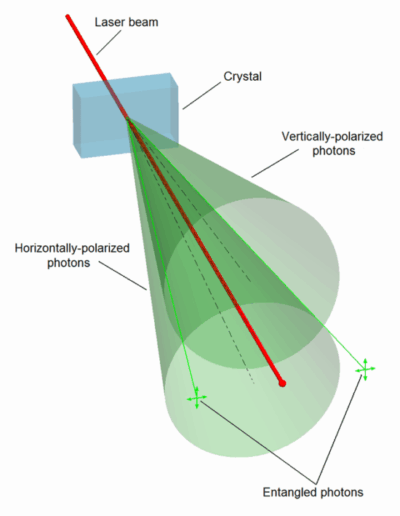
Figure above shows spontaneous parametric down-conversion process splitting photons into type II photon pairs with mutually perpendicular polarization.
- How it works: The conservation of energy and momentum in the crystal ensures that the two photons are created in an entangled state. The polarization or other properties of the photons can be entangled depending on how the experiment is set up.
- Use case: Commonly used in experiments in quantum optics and for generating entangled pairs for quantum communication protocols like quantum key distribution.
_
-2. Atomic and Ion Trap Techniques
- Method: Cold atoms or ions can be trapped using electromagnetic fields and manipulated with lasers to generate entanglement. Typically, these atoms or ions are prepared in a superposition of states, and then interactions between them (e.g., via laser pulses) induce entanglement.
- How it works: For example, two ions in a trap can be entangled using laser pulses that couple their internal quantum states, leading to entanglement. Similarly, entangling multiple atoms in a cavity can also be achieved by applying suitable laser pulses that couple atomic states.
- Use case: Used in quantum computing research and quantum information science. Ion traps are a popular platform for experimental quantum computing, such as with companies like IonQ.
_
-3. Cavity Quantum Electrodynamics (CQED)
- Method: In this approach, atoms or ions interact with photons in a high-quality cavity, typically made of mirrors that reflect light back and forth, allowing for interactions between atoms and photons to generate entanglement.
- How it works: The electromagnetic field in the cavity can mediate interactions between the atom and the photon. By using carefully timed laser pulses, entanglement can be established between the atom’s quantum state and the photon’s state.
- Use case: This method is used to create entanglement between different types of particles (e.g., atoms and photons) and is important for building quantum networks.
_
-4. Entanglement via Quantum Dots
- Method: Quantum dots are semiconductor-based devices that can confine charge carriers like electrons or excitons. Entanglement can be generated in these systems by controlling the interactions between the quantum dots and external fields (like electric or magnetic fields).
- How it works: By manipulating the spin or charge states of the quantum dots, entanglement can be created between two or more dots. The spin states, for instance, can be entangled in a way similar to how photons can be entangled.
- Use case: Quantum dots are being studied for use in scalable quantum computing systems and quantum communication protocols.
_
-5. Photonic Entanglement via Beam Splitters
- Method: This method uses beam splitters and other optical components to create entanglement between two photons. By using nonlinear optical interactions and beam splitters, one photon can be split into two entangled photons.
- How it works: A photon passes through a beam splitter, where it can split into two paths, each containing a photon. The quantum states of these two photons will be correlated, resulting in entanglement.
- Use case: This is often used in quantum optics experiments for demonstrations of entanglement, such as in Bell test experiments or for quantum cryptography.
_
-6. Quantum Entanglement via Superconducting Qubits
- Method: In superconducting quantum computing, qubits made from circuits that exhibit superconducting properties are used. These circuits can be entangled through the application of microwave pulses or coupling to other qubits.
- How it works: Superconducting qubits can interact with each other via a process called “parametric coupling,” where an external signal (e.g., microwave pulse) induces a nonlinear interaction between qubits, resulting in entanglement.
- Use case: Superconducting qubits are a core component of leading quantum computing platforms like IBM Q and Google’s Sycamore processor.
_
-7. Laser-Cooled Atoms
- Method: Laser cooling techniques are used to cool atoms to extremely low temperatures, at which their quantum mechanical properties can be more easily manipulated. These cold atoms can then be entangled using laser pulses.
- How it works: Atoms cooled to near absolute zero can interact with each other in a quantum state where their properties (e.g., spin, momentum) become entangled. The cooling process reduces thermal noise, making it easier to control the system and induce entanglement. For molecules, physicists have used laser-cooling to reach ultra-cold temperatures and optical tweezers to precisely position molecules. This allows for the creation of large arrays of entangled molecules, which is a step toward building quantum computers.
- Use case: Used in experimental setups for quantum computing and quantum simulation, especially when building quantum networks or entangled multi-atom systems.
_
-8. Entangling Using Strongly Coupled Qubits
- Method: This method involves creating interactions between multiple qubits that are so strong that the system as a whole becomes entangled. Strong coupling between qubits, like in the case of “quantum annealers,” can generate entangled states as a result of these interactions.
- How it works: By applying specific resonant drives or coupling schemes to a group of qubits, the entire system can be driven into an entangled state, allowing for collective quantum states to emerge.
- Use case: Quantum annealing and adiabatic quantum computation, such as with D-Wave’s quantum computers, rely on this approach.
_
-9. It is also possible to create entanglement between quantum systems that never directly interacted, through the use of entanglement swapping. Two independently prepared, identical particles may also be entangled if their wave functions merely spatially overlap, at least partially.
______
To entangle two particles, follow these steps:
-1. Choose the Particle Type: Select particles suitable for entanglement, such as photons or electrons.
-2. Prepare a Quantum Source: Use a quantum source like a laser or a beam splitter to generate pairs of particles.
-3. Utilize Nonlinear Optics: Employ nonlinear optical processes, such as spontaneous parametric down-conversion, to create entangled pairs.
-4. Control Interaction: Ensure the particles interact in a controlled manner, such as through a beam splitter or a quantum gate.
-5. Measure and Verify: Perform measurements on the particles to confirm their entangled state using Bell’s theorem tests.
-6. Maintain Isolation: Keep the entangled particles isolated from external influences to preserve their quantum state.
______
______
How do you know that particles are entangled:
There’s no way to tell that a particle is entangled with a partner particle except by knowing its previous creation/interaction event. For example, if you detect a photon, you have no way of knowing whether it was entangled with another photon unless you know in advance that it was part of an entanglement experiment (or whatever phenomenon entangled it). That is, if you have just two particles you cannot tell whether they are entangled or not. Entanglement reveals itself by correlations. For example, if you take many pairs of particles, you may find that their properties are always correlated, e.g. their spins are always opposite, and this tells you that whatever mechanism is generating the pairs of particles is entangling them. But this shows up only with repeated measurements. A single measurement cannot tell you the particles are correlated since their spins could have the values you observe just by chance.
_
To determine if particles are entangled, consider the following methods:
-1. Bell’s Theorem Tests: Conduct experiments that test Bell’s inequalities to see if the results violate classical predictions.
-2. Quantum State Measurement: Measure the properties of one particle and observe correlated outcomes in the other particle.
-3. Interference Experiments: Use setups like the double-slit experiment to observe interference patterns indicative of entanglement.
-4. Entanglement Witnesses: Employ mathematical tools known as entanglement witnesses to identify non-classical correlations.
-5. Quantum Tomography: Reconstruct the quantum state of the system to check for entangled states. Quantum state tomography is the process by which a quantum state is reconstructed using measurements on an ensemble of identical quantum states.
-6. Spin Correlation Measurements: Measure the spin of particles in different orientations to find correlations that suggest entanglement
_
How to break quantum entanglement:
Quantum entanglement is broken by interaction with the environment (decoherence), measurement of one of the entangled particles, or by using a specific quantum gate to reverse the entanglement process. When a particle interacts with its surroundings, such as through heat or a measurement device, the entanglement can be destroyed. A measurement forces the particle into a definite state, and because the particles are linked, this breaks the entanglement.
_______
_______
Section-6
Applications, challenges and controversies vis-à-vis quantum entanglement:
__
Applications of Quantum Entanglement Technology:
-1. Quantum Computing:
Quantum entanglement technology has the potential to revolutionize various fields, including quantum computing, cryptography, and teleportation. One of the most significant applications of entanglement is in the development of quantum computers. Classical computers operate using bits existing as either 0 or 1. Quantum computation utilizes quantum bits (qubits) that, due to superposition, can represent 0 and 1 simultaneously. This gives qubits an exponential advantage – 300 qubits represent more states than there are atoms in the universe! With n qubits, a quantum computer can represent 2^n possible states at once, whereas a classical computer with n bits can only represent one state at a time. This means that adding just one qubit can exponentially increase the processing power of the system. A quantum computer with 30 qubits can have a processing power equivalent to a conventional computer that can run trillions of floating-point operations per second (teraflops). However, simply adding qubits does not result in exponential speedup. True quantum advantage requires entanglement. In essence, without entanglement, a quantum computer would be little more than a probabilistic classical computer. It is entanglement that allows qubits to function together as a system, unlocking the true power of quantum computation. Research suggests entanglement enables quantum algorithms to outperform classical versions. For instance, Shor’s algorithm, a quantum algorithm for factorizing large numbers, relies heavily on entangled qubits to achieve its exponential speedup over classical algorithms.
_
-2. Quantum Cryptography:
Traditional cryptography works using keys: A sender uses one key to encode information, and a recipient uses another to decode the message. However, it’s difficult to remove the risk of an eavesdropper, and keys can be compromised. This can be fixed using potentially unbreakable quantum key distribution (QKD). QKD is one aspect of quantum cryptography. In QKD, information about the key is sent via photons that have been randomly polarized. This restricts the photon so that it vibrates in only one plane—for example, up and down, or left to right. The secret data still gets sent over normal communication channels, but no one can decode the message unless they have the exact quantum key. That’s tricky, because quantum rules dictate that “reading” the polarized photons will always change their states, and any attempt at eavesdropping will alert the communicators to a security breach. Quantum key distribution (QKD) is a method of secure communication that uses the principles of quantum mechanics to encode and decode messages. This technique relies on the phenomenon of entanglement, where two particles become connected in such a way that their properties are correlated, regardless of the distance between them. Entangled particles can be used to create an unbreakable code, as any attempt to measure or eavesdrop on the communication would disturb the state of the particles and be detectable.
Current quantum satellites create entangled pairs in space and then send each half of the pair down to two places on Earth—called a downlink. It’s mostly used for cryptography, where only a few photons (particles of light) are needed to generate a secret key.
_
-3. Quantum Teleportation:
Quantum teleportation transfers a quantum state from one location to another using entanglement and classical communication, but it does not transport matter. Teleportation is the transfer of a quantum state from one place to another through classical channels. That teleportation is possible is surprising since quantum mechanics tells us that it is not possible to clone quantum states or even measure them without disturbing the state. It is not possible to transmit quantum information using classical communication alone. Thus, it is not obvious what information could be sent through classical channels that could possibly enable the reconstruction of an unknown quantum state at the other end.
The process involves an entangled pair of particles, where the sender performs a measurement on the original particle and the qubit they share with the receiver. The sender then sends the classical results of this measurement to the receiver, who uses the information to perform an operation on their entangled particle, thus recreating the original quantum state. This technique is crucial for quantum computing and building a future quantum internet.
_
-4. Quantum Sensors and Metrology:
Entangled particles are used in advanced quantum sensors to achieve sensitivity beyond classical limits. Applications include gravitational wave detection, magnetic field sensing, and atomic clocks with unprecedented precision. These sensors can improve navigation systems, medical imaging, and environmental monitoring.
_
-5. Quantum-Based Technologies in Medicine:
Quantum mechanics, the foundational framework for understanding subatomic phenomena, has evolved from theoretical physics to practical applications in medicine. Principles like superposition—allowing particles to exist in multiple states—and entanglement—linking particles across distances—offer unprecedented precision at the molecular level (Bouwmeester et al., 1997). In medicine, these technologies address the limitations of traditional diagnostics and treatments, potentially accelerating solutions for global health challenges such as pandemics and chronic diseases. Recent reviews, including those in ‘Nature Medicine’ (2022), underscore the integration of quantum technologies into clinical settings, including magnetic resonance imaging (MRI), which relies on quantum spin states.
Quantum-based technologies, which leverage principles such as superposition, entanglement, and tunneling, are set to transform medical practice. Key examples include quantum-enhanced MRI for oncology and quantum computing for molecular modeling.
_
-6. Miscellaneous:
In addition, entanglement technology is being researched for its potential applications in quantum communication networks (Kimble, 2008). Quantum repeaters, which rely on entangled particles to amplify weak signals, are being developed to extend the distance over which quantum information can be transmitted. This has significant implications for the development of a global quantum internet.
Lastly, entanglement technology is also being explored for its potential applications in fundamental physics research (Horodecki et al., 2009). Entangled particles can be used to study the foundations of quantum mechanics and test the principles of quantum theory.
______
Challenges with Quantum Entanglement:
-1. Quantum Decoherence and Environmental Noise
Entangled states are extremely fragile. Interaction with the environment—such as thermal fluctuations, electromagnetic fields, or stray particles—can cause decoherence, which destroys the delicate quantum correlations and effectively “breaks” the entanglement. Vibrations, EM interference, and other noise destroy entanglement. Maintaining entanglement over time and distance requires advanced isolation techniques and error mitigation strategies, which are complex and costly.
-2. Scalability
Creating entanglement between just two particles is challenging but feasible; however, scaling entanglement to many particles (multi-qubit entanglement) necessary for practical quantum computing or networks remains a major hurdle. The complexity grows exponentially, and preserving coherence across many qubits requires breakthroughs in quantum error correction and hardware design.
– 3. Detection and Measurement Limitations
High-fidelity measurement of entangled states demands extremely sensitive detectors with near-perfect efficiency. Any loss or noise in the detection process can obscure or mimic entanglement signals, complicating experiments and applications. Improving detector technology and closing “loopholes” in entanglement verification is an ongoing research focus.
-4. Distance Limitations in Quantum Communication
Although entanglement can exist over large distances, transmitting entangled particles through optical fibers or free space faces challenges such as photon loss and signal degradation. Developing quantum repeaters and robust entanglement distribution methods is essential to realize scalable quantum communication networks and a future quantum internet.
-5. Theoretical Challenges and Interpretations
Quantum entanglement also challenges our fundamental understanding of reality, locality, and causality. Interpretations of quantum mechanics differ on what entanglement “means,” leaving unresolved questions in physics and philosophy. This theoretical ambiguity sometimes complicates consensus in experimental design and interpretation.
______
Controversies about quantum entanglement:
Interpretations of Quantum Mechanics:
Interpretations of quantum mechanics provide frameworks within which physicists agree or disagree on the nature of quantum systems. Various interpretations emerge from the same mathematical formalism, yet each one carries different implications for how we understand reality. The Copenhagen interpretation, for instance, posits that quantum particles exist in a state of probability until measured. This leads to debates about whether reality is observer-dependent.
Other interpretations include the Many-Worlds interpretation, which suggests that all possible outcomes occur in a vast multiverse. While this idea removes the observer’s role from the process, it raises questions about the nature of consciousness and existence itself. Understanding these interpretations is crucial for deciphering the debates surrounding quantum entanglement, highlighting the depth of philosophical inquiry within scientific study.
Measurement Problem:
The measurement problem stands as a central controversy in quantum mechanics. It addresses the challenges of how measurement affects a quantum system and leads it to adopt specific outcomes from a range of possibilities. This issue is closely related to quantum entanglement, wherein observing one particle instantaneously influences its entangled counterpart, regardless of distance.
Theoretical solutions vary. Some propose a collapse of the wave function during observation, while others advocate for objective collapse models. Examining the measurement problem invites scrutiny into the very nature of reality and how we perceive it, anchoring the philosophical implications of quantum physics. The paradoxes tied to measurement have spurred ongoing research into quantum foundations and the challenges faced by modern physics.
Ethical Considerations in Quantum Technology:
As quantum technologies advance, ethical considerations surrounding their deployment become increasingly prominent. Quantum entanglement fuels developments in quantum computing, cryptography, and even potential applications in biological systems. However, the power offered by these technologies calls for an evaluation of the ethical implications.
Concerns include:
- Privacy: Quantum cryptography assures enhanced security, yet poses new risks as it becomes easier to intercept encrypted communications.
- Inequality: Access to quantum technologies may widen the gap between those who can harness their benefits and those who are left behind.
- Weaponization: The capability of quantum technologies could be harnessed for harmful purposes, leading to destabilization and conflict.
Addressing these ethical issues requires a proactive approach from governments, scientists, and technologists to ensure that advancements in quantum entanglement do not outpace the ethical frameworks necessary for their responsible use.
______
______
Section-7
My view:
_
Please read my article on mathematics of Pi at https://drrajivdesaimd.com/2010/01/25/mathematics-of-pi-3/
Please read my article on duality of existence at https://drrajivdesaimd.com/2010/02/20/duality-of-existence/
Please read my article on the atom at https://drrajivdesaimd.com/2014/07/26/the-atom/
_
In quantum mechanics, objects are described by wave functions: mathematical expressions that encapsulate all that can be said about the object. This wave function can be spread out in space. That is why particles can act as if they are waves. Every fundamental particle of energy or matter is described by quantum wave function which incorporates all its properties whose value is not directly observable and every property (spin, polarization, position, momentum, energy level) is described as superposition of its states in wave function till the property is measured. Superposition is a “linear combination” of all possible states, where each state has a certain probability of being measured and that probability is given by the absolute value squared of the probability amplitude.
When two different particles of the same type (electron, photon, quark) get entangled, their individual wave functions get merged into single quantum wave function such that it cannot be separated into individual wave functions for each particle, indicating that the state of the system is a single, unified entity. This single wave function of an entangled system is typically represented as a ‘linear combination’ of product states, which reflects the correlations between the particles. Entangled states are characterized by their non-separability, meaning the state of the entire system cannot be expressed as a product of the individual states of its parts. Entanglement is ‘combined superposition’ of states of both particles such that any measurement performed on one particle will instantly affect the state of the other entangled particle in a correlational way.
When a single particle in a superposition of states is measured, it collapses to one of the states in its superposition. Entangled particles have the same rule; when you measure either of them you find that they’re in only one state. But since they’re in a shared state, a measurement on the other will yield the correlated result.
In quantum mechanics before measurement:
Single particle state = superposition = individual wave function
Entangled particles state = combined superposition = single combined wave function that cannot be expressed as a product of the individual wave functions.
_
One example is sufficient.
Suppose there is a pair of entangled electrons, one on left and another on right. Now let’s suppose that somebody far off to the left detects the left electron and measures its spin. This measurement will collapse the wave function of the left electron, putting it into a state of definite spin. However, because it’s a combined state for the two electrons, you can’t collapse the wave function of just one of them; you have to collapse the entire state all at once. Therefore, if somebody measures the spin of the left electron, the wave function of the right electron also collapses at that moment, even if nobody has made a measurement on it. If the left observer measures that the left electron is spin up, then anybody off to the right will observe that the right electron is spin down; the right electron is no longer in an indefinite state, even though nothing was done to it. This is entanglement, no matter the distance between two electrons. Now you do experiment with 1000 pairs of entangled electrons. When the spin of left is up, the spin of right is down. When the spin of left is down, the spin of right is up. But nobody can predict what will be spin of left electron, it is random. It is only when that randomness is made certain by measurement, then you can predict the spin of right electron. So, entanglement gives randomness correlated with certainty. The outcome of any single measurement is random and we can’t choose the result, so we can’t encode information. You can’t force an entangled particle into a particular state and you can’t force a measurement to produce a particular outcome because the results of quantum measurement are random. Even with measurements that are perfectly correlated, no information passes between them. There is no hidden variable, no predetermined outcome, only randomness but randomness is correlated to certainty in entanglement. Random becomes certain on measurement and that certainty is correlated.
According to my theory of duality of existence, randomness and certainty coexist simultaneously depending on knowledge of variables but here no hidden variables found experimentally, so certainty follows randomness.
Now if you change state of left electron from up to down, no change will occur in right electron. Correlation exists only in entangled state as both electrons are represented by single wave function of combined superposition. When you measure spin of left electron, the single wave function collapses and both electrons get definite states in correlated way no matter the distance between electrons. So, if you change the spin of left electron, nothing will happen to right electron as they are no longer entangled.
_
What if both entangled particles are measured simultaneously:
Since both particles are represented by single wave function, measuring single or both particles will result in collapse of wave function resulting in left particle in spin up and right particle in spin down randomly. You cannot predict whether left spin up right spin down or left spin down right spin up. Corelation will be maintained but states will change randomly. Note that experiments on entanglement are performed many times, and the results are a statistical average. They don’t measure a pair of particles at one time. They do repeated measurements on pairs of particles.
_
In physics, charge conservation is the principle that electric charge can neither be created nor destroyed. This does not mean that individual positive and negative charges cannot be created or destroyed. Electric charge is carried by subatomic particles such as electrons and protons, which can be created and destroyed. When particles are destroyed, equal numbers of positive and negative charges are destroyed.
Suppose we have only one hydrogen atom in the universe with one proton and one electron. Now you separate proton from electron. You destroy proton and energy is generated. Instantaneously and simultaneously electron will also get destroyed generating energy as charge cannot be created or destroyed. Since positive charge of proton is destroyed, negative charge of electron also gets destroyed. Now if proton and electron are separated by million light year distance, still when proton is destroyed, the electron is destroyed simultaneously. There is no communication between proton and electron. It is the law of conservation of charge. Fundamental laws cannot be violated no matter the distance.
Similarly, when one entangled photon reveals its state by measurement, its twin entangled photon chooses its state in a correlated way instantly no matter the distance because they belong to the same quantum wave function due to entanglement and behave as if they are single entity no matter the distance between them. This is the law of conservation of correlated properties of single quantum wave function of entangled particles of the same type, no matter the distance.
_
Note that if entangled particle comes in contact with environment/objects, entanglement breaks down, so it is the empty space surrounding particles that maintains entanglement. Atoms are mostly empty space due to the vast distance between the tiny nucleus and the orbiting electrons and this space holds quantum wave function. Even in nucleus of atom, there is space to hold quantum wave function of entangled quarks. Essentially it is the space that holds the entanglement and holds single quantum wave function which allows combined superposition no matter the distance. Two entangled photons travelling in a vacuum will remain entangled indefinitely, in principle. Qubits are isolated by minimizing their interaction with the external environment through techniques like cryogenic cooling, operating in a high vacuum, and using electromagnetic shielding. Entangled qubits are isolated by creating an extremely protected environment to prevent interactions with their surroundings and maintaining entanglement is critical, as any interaction, including measurement, can cause the system to lose its quantum correlation in a process called decoherence. Fiber optic cables purportedly transmit entangled photons by total internal reflection but due to the interaction with the environment, fiber would act as a noisy quantum channel that would induce decoherence of the entanglement correlation. Maintaining quantum entanglement in fiber optic cables is challenging so researchers use techniques such as distributing entanglement in a “decoherence-free subspace” (DFS), generating it in all-fiber sources, and using specialized detectors and software to compensate for noise and maintain high fidelity.
_
In physics, “space” is the three-dimensional expanse in which objects and events have position and direction. Modern physics expands this to a four-dimensional continuum called “space-time,” which includes time as the fourth dimension. Classical physics considers space a backdrop where events occur, while modern physics shows that space and time are intertwined and can be affected by motion, according to the theory of relativity.
_
Read my article duality of existence. Space is not emptiness. Space means absence of matter having negative mass, negative energy and repulsive gravity. The total mass of universe is zero because positive mass of matter and negative mass of space balance each other. Space holds entanglement wave function for its existence. In quantum mechanics, objects are described by wave functions: mathematical expressions that encapsulate all that can be said about the object. This wave function can be spread out in space. That is why particles can act as if they are waves. These wave functions and their mathematical expressions; all are held by space. It is the space that holds quantum wave function. When particles like electrons behave like waves, those waves are held by space. It is the space that holds single wave function of multiple entangled particles. If there is no space, there is no quantum wave function, there is no entanglement.
_
According to my photon weaving theory, everything in universe is made up of photons. Many properties attributed to matter like mass, charge, color, flavor etc are created by photonic weaving. Creation of mass from photon is the basis of matter and all other properties of matter like charge, color etc are consequences of how mass is woven from photon. In other words, all other properties of matter like charge, color, and flavor cannot exist without mass. Photon is the only particle that is massless, chargeless, colourless and flavourless. Photon creates all elementary particles like electron, quarks, gluons etc. Wave-particle duality exists because all particles like electron, quarks, gluons are made up of photons weaved in different dimensions. In fact, mass is weaved photons. Mass and photons are interconvertible. Light (photons) is a form of energy and energy can be converted into mass.
_
In the equation, E = mc^2, E stands for energy, m stands for an object’s mass, and c^2 represents the speed of light (186,000 miles per second) multiplied by itself. Little mass can make too much light and so light is very little mass. Gravity is the fundamental force of attraction between masses. Gravity acts on mass as well as mass equivalent light. When light travels near surface on earth, earth’s gravity pulls light a little but effect is not visible as it is indeed very little mass and very weak earth’s gravitational pull. The Earth’s gravity, denoted by g, is the acceleration due to Earth’s gravitational pull, with an average value of approximately 9.8 m/s² near the surface. The Sun’s gravity is approximately 28 times stronger than Earth’s at its surface due to its vastly larger mass. Gravity in a black hole is about 1.6 trillion g’s. So, when light passes over black hole, massive gravity of black hole pulls light. The earth and the sun also pull light but negligibly as their gravity is far weaker than black hole. In other words, gravity is the fundamental force of attraction between all objects with mass including mass equivalent light. So black hole traps light simply due to enormous gravity and not due to curvature of spacetime. According to duality of existence, space and time are independent. There is no space-time. Gravity is not the curvature of spacetime. Gravity cannot bend time. Atomic clocks on GPS satellites run slightly faster than clocks on Earth because they are further from Earth’s gravitational pull but gravity cannot bend time. Gravity acts on objects with masses and all types of clocks have masses. When clocks are near earth, gravitational pull on clocks is high, so they run slower. When clocks are on satellites, gravitational pull is less, so they run faster. It is the gravity that is working on clocks and not on time. Walking on the Moon is different from Earth due to the Moon’s much weaker gravity, which is about one-sixth that of Earth’s, causing a bouncy, hopping gait instead of a normal walk. Similarly, gravity acts on all components of clock and greater the gravity, sluggish the movement of clock components. Time passes about 57.5 microseconds faster per day on the Moon than on Earth, a difference due to the Moon’s weaker gravitational pull on clocks. Space and time are independent of each other. Key to mysteries of universe is time. When time becomes zero, wave and particle form, matter and space, straightness and curvedness, positive and negative charge, up and down spin, vertical and horizontal polarization etc. will merge with each other and become zero. All entanglement will cease with zero time as wave-particle duality will end.
What happens if an entangled particle falls into a black hole?
Black hole traps light and also traps entangled particle, but due to its enormous mass & gravity in a small volume, the space in the black hole is contracted and distorted breaking entanglement as it is the space that holds quantum wave function.
_
Note:
Space holds quantum wave function. Since space is real not imaginary, quantum wave function is real not abstract.
_________
_________
Moral of the story:
_
-1. What is quantum:
In physics, a quantum (plural: quanta) is the minimum, discrete amount of any physical property involved in an interaction, like energy, charge or momentum. This means a property can only exist in specific, separate “packets” or multiples of one quantum, rather than a continuous range of values. The concept that these properties come in discrete packets is fundamental to quantum physics, the study of matter and energy at the most fundamental level. A photon is a single quantum of light, and the energy of an electron in an atom is quantized into discrete levels: physical quantities are “quantized,” i.e. cannot be subdivided. For example, light is quantized: the fundamental quantum of light is called the photon and cannot be subdivided into two photons. The quantum of charge is the fundamental, indivisible unit of electric charge, equal to the magnitude of charge on a single electron or proton.
_
-2. Fundamental differences between classical and quantum mechanics:
Classical and quantum mechanics differ fundamentally in scale, determinism, and the nature of reality they describe. Classical mechanics applies to macroscopic objects and is deterministic, meaning a system’s future can be predicted with certainty from its initial conditions. Quantum mechanics applies to the atomic and subatomic world and is probabilistic, describing systems with wavefunctions that represent a range of possibilities until a measurement is made.
(1. Determinism means that the state of the Universe at any given time and the basic laws of physics fully determine the Universe’s backward history and forward evolution. Quantum mechanics is fundamentally probabilistic. The state of a quantum system is a superposition of possible outcomes, each with a certain probability, until measurement collapses it into one definite state.
(2. Realism in classical physics is the belief that the physical world is independent of the observer and exists with definite properties whether or not they are measured. In contrast, systems in quantum mechanics achieve a definite state only when measured.
(3. Causality is a fundamental principle in classical physics that states every effect has a specific cause. This means a cause must precede its effect. Causality is violated in quantum entanglement as measuring one particle’s property would instantly determine the corresponding property of the entangled partner, so cause is not preceding effect.
(4. Locality is the principle in classical physics that an object is directly influenced only by its immediate surroundings and that effects cannot travel faster than the speed of light. Local description holds that one particle influences another only by direct contact or via some intermediary field; this influence can travel no faster than light.
Non-locality is the concept in quantum physics that separated objects can instantaneously influence one another, a phenomenon primarily observed in quantum mechanics through entanglement. Non-locality would mean that one particle could influence another distant particle without anything passing between them, in an instantaneous manner, faster than light. Basically, entanglement is correlation without communication, so speed of light is neither involved not violated.
_
-3. Wave-particle duality:
Wave-particle duality refers to the property of fundamental entities where, at one moment it appears like a wave, and yet at another moment it acts like a particle. Wave–particle duality is the concept in quantum mechanics that fundamental entities of the universe, like photons and electrons, exhibit particle or wave properties according to the experimental circumstances. It expresses the inability of the classical concepts such as particle or wave to fully describe the behavior of quantum objects. Wave-particle duality exists because all particles like electron, quarks, gluons are made up of photons weaved in different dimensions. When they interact with their environment in a specific place at a specific time, they are particles. In contrast, when we are not observing these entities interacting with their environment, they behave in a wavelike manner — extended in space, to be in a ‘superposition’ of states, as though in many places or having multiple values of an attribute at once. But an observation of a particle’s properties — a measurement — shocks this hazy existence into a single state with definite values. This is sometimes referred to as the ‘collapse’ of the wavefunction.
_
-4. Wave function, superposition and entanglement:
In quantum physics, a wave function (or wavefunction) is a mathematical description of the quantum state of an isolated quantum system (electron, photon or quark). A wave function (Ψ) is a complex-valued function in quantum mechanics that describes the quantum state of a particle, encapsulating all information about its properties like position, momentum, energy level, polarization and spin. The wavefunction describes a quantum state and how it evolves as a cloud of probabilities. It is the wave function that enables superposition and entanglement.
Superposition is a fundamental principle, allowing particles to exist in multiple states simultaneously until measured. Superposition as a “linear combination” of all possible states, where each state has a certain probability of being measured and that probability is given by the absolute value squared of the probability amplitude.
When two quantum particles of the same type interact in such a way that their combined state is described by a single quantum wavefunction, the result can be an entangled state. For entangled particles, the wave function cannot be separated into individual wave functions for each particle, indicating that the state of the system is a single, unified entity. The wave function of an entangled system is typically represented as a ‘linear combination’ of product states, which reflects the correlations between the particles. Bell states are particular examples of maximally entangled quantum states. When two electrons have their states “superimposed” over each of them, nothing is certain until the superimposed waveforms “collapse”. At that instant an electron shows up somewhere in accordance with the probability that is the square of the absolute value of the sum of the complex-valued amplitudes of the two superimposed waveforms.
In quantum mechanics, objects are described by wave functions: mathematical expressions that encapsulate all that can be said about the object. This wave function can be spread out in space. That is why particles can act as if they are waves. But if we entangle two particles, they are then described by a single wave function. They are mathematically the same object.
_
-5. Quantum entanglement:
Quantum entanglement is the phenomenon where the quantum state of each particle in a group cannot be described independently of the state of the others, even when the particles are separated by a large distance. Particles are considered entangled if measurements of their properties, such as spin or polarization, show strong correlations that cannot be explained by classical physics or local hidden variables. In entanglement, two particles of the same type become correlated in such a way that their properties cannot be described independently. Once entangled, the state of these particles is described by a single wave function, which encapsulates the correlations between them. This means that any measurement performed on one particle will instantly affect the state of the other entangled particles. When a single particle in a superposition of states is measured, it collapses to one of the states in its superposition. Entangled particles have the same rule; when you measure either of them you find that they’re in only one state. But since they’re in a shared state, a measurement on the other will yield the correlated result. I would call quantum entanglement between two particles as combined superposition. Each particle is in superposition of its states described by individual wavefunction but when they get entangled, their superposition of states merges with each other and become combined superposition described by single wavefunction and mathematically they become one single entity.
Quantum entanglement has been demonstrated experimentally with photons, electrons, top quarks, atomic nuclei and molecules.
Yes, quantum entanglement is real. It has been experimentally verified in a number of experiments, including the Stern-Gerlach experiment, the Aspect experiment, and the Schrödinger’s cat thought experiment.
_
-6. No hidden variables:
Local hidden variables mean properties contained within the individual particles themselves giving rise to entanglement. For example, if you take two gloves and send one to New York and one to Tokyo, discovering that the glove in New York is right-handed immediately tells you the glove in Tokyo must be left-handed. That’s a classical correlation—the outcome is predetermined, and the information simply reveals an already fixed fact. The hidden variable handedness is predetermined. Hidden variable theory in quantum mechanics posits underlying variables that determine quantum event outcomes, providing a deterministic description. John Bell, a brilliant Irish physicist devised a scheme to test whether the notion of hidden variables made sense. Bell produced an equation now known as Bell’s inequality that is always correct – and only correct – for hidden variable theories, and not always for quantum mechanics. Thus, if Bell’s equation was found not to be satisfied in a real-world experiment, local hidden variable theories can be ruled out as an explanation for quantum entanglement. It has been proved experimentally that there is no hidden variable, no predetermined outcome, only randomness but randomness is correlated to certainty in entanglement.
_
-7. Non-separability:
Entangled particles exhibit a property known as non-separability, where the state of a system cannot be described by the independent states of its individual parts. Entangled particles cannot be described independently; their properties are intertwined and exist as a single, unified system. When particles are entangled, their combined state becomes inseparable, and any measurement or change in one particle instantaneously affects the state of the other particle, regardless of the distance between them.
Entanglement is often described using the mathematical formalism of quantum mechanics, where the state of a system is represented by a wave function or density matrix. When two particles are entangled, their joint wave function cannot be factorized into separate wave functions for each particle, indicating that they are correlated in a way that transcends classical notions of space and time. Entangled states cannot be expressed as a product of individual states. Entangled states are characterized by their non-separability, meaning the state of the entire system cannot be expressed as a product of the individual states of its parts.
_
-8. Not faster-than-light communication:
One of the most prevalent myths is that entangled particles allow for communication faster than the speed of light. However, this is not the case. While measuring one particle can instantly affect the state of the other, no information is actually transmitted between them. Entanglement cannot be used to send information faster than light because the outcome of any single measurement is random and unpredictable until it is made. You cannot control the outcome of the measurement on one particle to send a signal to the other; the correlations simply reveal that their properties were linked when the pair was created. You cannot force a specific outcome to send a message. It does enable the creation of secure keys through quantum key distribution, but this process is still bound by classical communication speeds.
In fact, there is no communication, only correlation: Can’t send messages:
In essence, entanglement gives randomness correlated with certainty. Randomness of the outcome of measurement on one particle and certainty of correlated outcome on second entangled particle, no matter the distance between them. You can’t force an entangled particle into a particular state and you can’t force a measurement to produce a particular outcome because the results of quantum measurement are random. Even with measurements that are perfectly correlated, no information passes between them. The sender and receiver can only see the correlation when they get back together and compare measurements. If you change the state of one particle, the other particle does not change because to change the state of one particle intentionally, you have to measure the state and measurement will break entanglement.
_
-9. Creation:
Two particles can be entangled by creating them from a single parent particle or event that conserves a property like spin or polarization, such as spontaneous parametric down-conversion (SPDC) of photons or an atom decaying into two photons. Entanglement can also occur when two particles interact, causing their individual quantum states to mix into a single, joint wave function, effectively linking their fates. But you can’t just arbitrarily entangle two particles that have no common history.
Destruction:
Quantum entanglement is broken by interaction with the environment (decoherence), measurement of one of the entangled particles, or by using a specific quantum gate to reverse the entanglement process.
_
-10. Dispute:
(1. One concerns the ‘measurement problem’, asking how a measurement can trigger objects to switch from existing in quantum states that describe probabilities, to having the defined properties of the classical world.
(2. Another unclear feature is whether the wavefunction represents something real or just information about the probabilities of finding various values when measured.
(3. Teleportation is the transfer of a quantum state from one place to another through classical channels. That teleportation is possible is surprising since quantum mechanics tells us that it is not possible to clone quantum states or even measure them without disturbing the state. It is not possible to transmit quantum information using classical communication alone. Thus, it is not obvious what information could be sent through classical channels that could possibly enable the reconstruction of an unknown quantum state at the other end. Then how quantum teleportation transfers quantum information from one location to another. Logic tells us that entanglement cannot send messages. It is correlation without communication. Then how entanglement can be used to transfer information, classical or quantum. Yes, quantum entanglement can be used to encrypt classical message for security but how it can transmit message/information?
_
-11. When one entangled photon reveals its state by measurement, its twin entangled photon chooses its state instantly no matter the distance because they belong to the same single wave function due to entanglement and behave as if they are single entity no matter the distance between them. This is the law of conservation of correlated properties of single wave function of entangled particles of the same type, no matter the distance.
_
-12. It is the space that holds quantum wave function. It is the space that holds the entanglement and holds single wave function which allows combined superposition, no matter the distance. If there is no space, there is no quantum wave function, there is no entanglement.
_
-13. Space and time are independent. There is no space-time. Gravity is not the curvature of spacetime. Gravity cannot bend time. Atomic clocks on GPS satellites run slightly faster than clocks on Earth because they are further from Earth’s gravitational pull but gravity cannot bend time. Gravity acts on objects with masses and all types of clocks have masses. When clocks are near earth, gravitational pull on clocks is high, so they run slower. When clocks are on satellites, gravitational pull is less, so they run faster. It is the gravity that is working on clocks and not on time. Walking on the Moon is different from Earth due to the Moon’s much weaker gravity, which is about one-sixth that of Earth’s, causing a bouncy, hopping gait instead of a normal walk. Similarly, gravity acts on all components of clock and greater the gravity, sluggish the movement of clock components. Time passes about 57.5 microseconds faster per day on the Moon than on Earth, a difference due to the Moon’s weaker gravitational pull on clocks.
_________
Dr. Rajiv Desai. MD.
November 9, 2025
_________
Postscript:
Scientists and physicists may read this article and send their comments/criticisms at my email ID [email protected]
_____
Post-postscript:
Read my article human evolution posted at https://drrajivdesaimd.com/2018/04/04/human-evolution/ where it shows that life evolved and continues to evolve predominantly by chance. There is certainly no element of direction. Evolution in biology is by chance (probability) rather than deterministic, so quantum effects are relevant to biological processes. Quantum theory is the most successful theory of all time.
______
Footnote:
I was nominated for Nobel Prize for my work on Extra-terrestrial Life (Life Beyond Earth) but Nobel Prize committee refused to consider my name as my work is solo work and not institutional work, and recommended United Nations to take a call on my research.
_____
4 comments on “The Enigma of Quantum Entanglement”
Leave a Reply

There are actually quite a lot of particulars like that to take into consideration. That could be a nice level to bring up. I offer the thoughts above as common inspiration however clearly there are questions just like the one you deliver up where an important factor might be working in trustworthy good faith. I don?t know if finest practices have emerged round issues like that, but I am sure that your job is clearly recognized as a good game. Each boys and girls really feel the impression of just a second’s pleasure, for the remainder of their lives.
[url=https://v-powerapp.com/]vpower apk download[/url]
With each update, Vpower APK fixes issues and optimizes the experience for everyone.
[url=https://777bet-login-password.com/]777bet online casino[/url]
The protection of players’ information is crucial at 777bet, guaranteeing their data remains secure.
Gonna try to log in to timislotslogin now. Wish me luck! Fingers crossed I remember my password. Getting your game fun at timislotslogin!